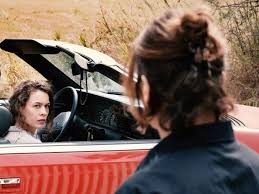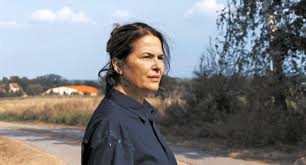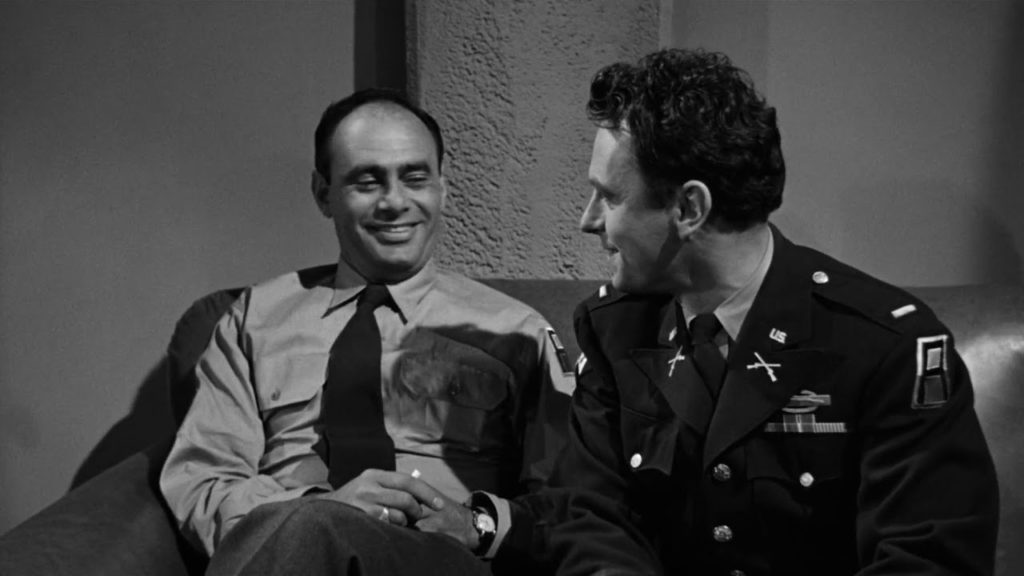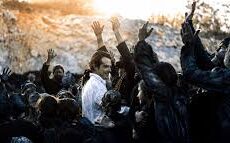
Photo caption: Pavel Talankan in MR. NOBODY AGAINST PUTIN. Courtesy of the SLO Film Fest.
Nothing has changed since Aeschylus observed that the first casualty of war is truth, as revealed in Mr. Nobody Against Putin, the blistering exposé of Putin’s outrageous domestic propaganda about his Ukraine War.
Pavel Talankan is an unassuming, goodhearted guy with a small-time job as the events coordinator at the school in a remote Russian industrial town. That also makes him the school videographer, so no no one notices that, as he films school assemblies, award ceremonies and performances, he is also capturing the blatant Big Lie propaganda. It’s a surreptitious documentary filmed in plain sight.
Pavel is an unlikely muckraker. He is a free-thinking nebbish who loves Russia and loves his hometown of Karabash in the Ural region, putrefied by a noxious copper plant and called “the most toxic place on earth”.
More than anything, Pavel cares about his students, and he is increasingly disgusted as Putin ramps up the propaganda. First, a cadaverous party hack, whose heroes are the most vile Commie hitmen in history, spreads empirically false information about Ukraine being the aggressor in the war. Then, horrifyingly, Wagner mercenaries are brought in as classroom guest speakers. Silently, Pavel continues to film, letting the propagandists defile themselves for history.
Pavel is a hero, albeit a non-violent one, who risked his life to gather this material. David Borenstein exquisitely formed Pavel’s footage into a searing exposé of Putin’s soul-crushing impact on Russia. The secret audio from the funeral of a former student killed in Ukraine is heart-rending. The film begins with video of Pavel’s midnight escape from Russia,
Mr. Nobody Against Putin has been Oscar-nominated as Best Documentary Feature. I saw it at the SLO Film Fest; it’s now available to stream from Amazon and AppleTV.
Photo caption: Amanda Seyfried in THE TESTAMENT OF ANN LEE. Courtesy of Searchlight Pictures.
Let’s get this out of the way at the outset – I don’t care for movie musicals, and, beforehand, I didn’t know that The Testament of Ann Lee was a musical. But I did not walk out on The Testament of Ann Lee because it is a musical – I walked out because it is a dreary, self-important musical.
This is a biopic of the woman who came to lead the Shaker religious sect in 18th century England, seen by followers as a female Christ, and founded the utopian Shaker settlement in America.
The talented and ever appealing Amanda Seyfried stars as Ann Lee, and this is the third feature for Mona Fastvold as a director. Fastvold co-wrote Brady Corbet’s Vox Lux and The Brutalist, and Corbet co-wrote The Testament of Ann Lee. with Fastvold. In trying to make a compelling portrait of spiritual zeal, the filmmakers had to address two challenges – the life of Ann Lee itself and the Shakers themselves – and they failed.
First, Ann Lee grew up in Manchester, England, in the mud-1700s, where even the families of artisans lived in what we would see as squalor. Already a religious non-conformist, Ann kept getting impregnated by her husband’s inconsiderate rutting, resultng in the birth of four babies, each of whom died before the age of one. Then, she was committed to an asylum. It’s no wonder that this experience would prompt Ann to lead her sect into celibacy. All this (sexual abuse, grief, depression, renouncement of sex) is not fun to watch.
Second, the Shakers were so named because they moved their bodies during worship to express ecstasy (“shaking”). These movements are depicted by the filmmkaers, well, oddly. The film opens with a group of women dressed like Pilgrims doing what looks like spastic Tai Chi. Later, it becomes clear that the Shaker’s movements are choreographed like Broadway numbers. The Shakers make up for their celibacy by rhythmically thrusting their arms instead of their hips. I am familiar with how spiritually euphoric Pentacostals act and even recently experienced Whirling Dervishes in Turkey. But Fastvold and Corbet’s Shaker “shaking” begins as offputtingly contrived before it lapses into the unintentionally funny.
The music, by Daniel Blumberg, who justifiably won an Oscar for The Brutalist’s score, is throbbing. Most of The Testament of Ann Lee was filmed in Hungary with mostly Hungarian technical crew. This is a technically well-crafted film, and the verisimilitude of the 18th century settings is excellent.
In a courageous and fully committed performance, Amanda Seyfried captures both Ann Lee’s suffering and her charismatic self-confidence. And Seyfried sings very well.
Nevertheless, unless you are convinced that you are Christ, stay away.
Photo caption: David Straithern and Jane Levy in A LITTLE PRAYER. Courtesy of Music Box Films.
In the exquisitely-acted family drama A Little Prayer, Bill (David Straithern) seems to be an unlikely candidate for a life crisis. He owns a successful Winston-Salem, North Carolina business, which he runs with his son David (Will Pullan). Bill is popular in the community, and his employees appreciate his fairness and generosity. He shares a spacious home and a longtime. comfortable marriage with his wife Venida (Celia Weston). David and his incredibly sweet wife Tammy (Jane Levy) live in a smaller house on their property, and both Bill and Venida adore Tammy.
But Bill is upset when he suspects that David may be having affair with one of their employees. Protective of Tammy, Bill dithers about what to do. As he tries to intervene, he finds that David’s extramarital fling might be the only tip of the iceberg.
Bill and Venida know what it’s like to disappointed by an adult child. Their daughter Patti (Anna Camp) is the hottest of hot messes, a nightmare of selfishness, entitlement, irresponsibility and self-created drama. In every respect, she is the worst possible role model for her daughter Hadley (Billie Roy), and Bill and Venida are sickened when they see Hadley acting out. I am not a violent person, but I wanted to reach through the screen to slap Patti.
It’s one thing to be disappointed by your child’s lack of achievement or romantic choice or even to suffer embarrassment from their legal trouble. But it’s entirely another level of horror to recognize profound character failings in your child. Could I have raised a sociopath, a victimizer? Why can’t I fix him?-
BIll has always known that Patti is a mess (and he has enabled her behavior). But, the deeper he probes into David’s life, the more shattered he becomes.
Bill is a Vietnam vet and enjoys the camaraderie of other old vets at the VFW hall. David is a veteran of the conflicts in the Middle East, and, although he is affable and fun-loving and seemingly functional, he may have unresolved issues from his service. Venida intuits that something is wrong in David and Tammy’s marriage, but Bill is gobsmacked to learn what it is.
David Straithern’s performance as Bill is one of his best. Bill is a decent, well-intentioned guy who is in control of his life, until he becomes absolutely bewildered by what is wrong and his own inability to fix it. I’ve loved Straithern’s work since his early John Sayles films, and he is now recognized as one of America’s most reliable screen actors.
Bill is the protagonist, but the story is centered on Tammy’s arc. Jane Levy (Zoey’s Extraordinary Playlist) is exceptional as Tammy, a seemingly perfect woman who masks her vulnerabilities. Levy has two scenes – one at a clinic and one after a museum visit with Bill, that are among the most emotionally powerful of the year.
The character played by Dascha Polanco (Daya in Orange Is the New Black) also has two extraordinary scenes with Bill, one where he is in control and one where he is powerless I always enjoy Celia West in a movie, and she’s also very good as Venida. This cast is one of the strongest ensembles in recent movies.
This is only the fourth feature film that writer-director Angus MacLachlan has directed since 2005, but one of them was the wonderful family dramedy Junebug. Junebug became an indie hit, and Amy Adams’ Oscar nominated performance launched her career.. A Little Prayer deserved to be a hit, too, but its release seemed to be delayed and it somehow got overlooked.
Junebug was also set in North Carolina. A Little Prayer was produced by a stalwart of North Carolina indie cinema, Ramin Bahrani, director of Goodbye Solo, At Any Price, 99 Homes, Fahrenheit 451.
A Little Prayer is one of the Best Movies of 2025 and can be streamed from Amazon, AppleTV and YouTube.
Photo caption: Lee Byung-hun in NO OTHER CHOICE. Courtesy of NEON.
In the brilliantly dark comedy No Other Choice, master filmmaker Park Chan-wook serves up social satire in delicious perversity. Man-su (Lee Byung-hun) and his family live a privileged life, financed by his job as a manager in a paper mill. But he loses his job, putting the big house, the tennis club, the cello lessons, and the all rest at risk. Man-su looks for another job – but there are other candidates. Man-su decides to eliminate the competition by murdering the other guys.
Remember that Man-su is a paper mill manager, not a skilled hit man, so his efforts to murder guys, dispose of their bodies and keep it all secret from the police and his family are very funny. His wife Miri (Son Yejin) is not exactly Lady Macbeth, but, when she catches a whiff of what is going on, she demonstrates some moral flexibility.
The recent great Korean satire Parasite was about the desperation of the disadvantaged in a society exploited by the rich. No Other Choice is about the desperation of the affluent to hang on to their material comforts and amenities. Man-su could, of course, choose to downsize his family’s lifestyle instead of becoming a serial killer.
No Other Choice works because, Park Chan-wook is fully committed to his pretty simple, but transgressive, premise and because he is a superb storyteller, just like in his stellar Decision to Leave and The Handmaiden. Of course, No Other Choice is also a pointed scritique of materialism and status-seeking, particularly in Korea, but also in the rest of the capitalist world.
No Other Choice is one of the Best Movies of 2025, and it opens widely this weekend.
John Prine in YOU GOT GOLD: A CELEBRATION OF JOHN PRINE. Courtesy of Abramarama.
The experience of watching You Got Gold is better than the movie itself. After all, it’s just a paint-by-the-numbers concert film – documenting a Nashville tribute concert with musical artists performing John Prine songs and telling stories about him. But the film, aptly subtitled A Celebration of John Prine, is elevated by Prine himself, his relentless playfulness and his concise, searing lyrics, so venerated by his peers, beloved by fans and acquaintances.
Prine’s song lyrics were poetry of the highest order, as in the unsurpassed fundamental truths and ultra-real humanity of Sam Stone, Souvenirs and Hello in There, Lyle Lovett recalls being stunned by the Prine lyric “naked as the eyes of a clown”. I remember being frozen by “There’s a hole in Daddy’s arm where the money goes.”
A great song can be performed in many genres. The deeply soulful War and Treaty bring a new dimension to Prine’s Knockin’ on your Screen Door. Rocker Bob Weir shreds on Great Rain.
Jason Isbell, Brandi Carlile and Dwight Yoakum all perform. Prine’s longtime friend and collaborator Bonnie Raitt tells of how she thought of them as Tom Sawyer and Becky-style playmates and performs the iconic Angel from Montgomery.
Lucinda Williams performs her own song about working with Prine, the hilarious but wistful Working On a Song (what could go wrong?).
John Prine was a great American humorist. Think Mark Twain and Will Rogers. One of his funniest songs, In Spite of Ourselves, is featured, and another, Illegal Smile, is referenced. (His funniest, Let’s Talk Dirty in Hawaiian, isn’t in the movie.)
This is ultimate Feel Good movie. If you know John Prine, You Got Gold is a Must See. If you don’t, you won’t regret watching it, either. Here’s a link to the trailer.
Photo caption: Bill Hayman and Udo Kier in MY NEIGHBOR ADOLF. Courtesy of Cohen Media Group.
In the wry fable My Neighbor Adolf, the chess master Polsky (David Hayman) has lost all his family in the Holocaust. Consumed by grief and bitterness, he lives the life of a misanthropic recluse in a remote South American countryside. Polsky is rocked when the long-vacant house next door becomes occupied by a mysterious German (the piercing-eyed Ugo Kier). Polsky becomes convinced that the new neighbor is Adolf Hitler himself. To convince skeptical authorities of his theory, Polsky must get past his terror and loathing to personally engage with the neighbor. A battle of wits between two strong-willed men ensues.
The 75-year-old Scottish actor Bill Hayman is excellent as Polsky, capturing both his vulnerability from residual trauma and the determination summoned to overcome it.
My Neighbor Adolf is the career finale for 81-year-old German actor Ugo Kier, who died in November. Kier proved that one can have a prolific career (275 IMDb credits) as a character actor in both art films and cult movies. He worked with directors like Werner Rainier Fassbinder, Werner Herzog, Wim Wenders and Lars Von Trier, and in Hollywood films like Johnny Mneumonic, My Own Private Idaho, Armageddon, Halloween and Ace Venture: Pet Detective. His visage, scarier as he aged, worked well in horror movies. and he did many, beginning with Jim Morrisey’s Andy Warhol’s Frankenstein and Blood for Dracula.
My Neighbor Adolf, the work of Russian-born Israeli filmmaker Leon Prudovsky, was my favorite film at the 2023 San Francisco Jewish Film Festival. It opens theatrically in the US this weekend.
Photo caption: Natalie Morales and Sonequa Martin-Green in MY DEAD FRIEND ZOE. Courtesy of Briarcliff Entertainment.
In the deeply affecting dramedy My Dead Friend Zoe, Merit (Sonequa Martin-Green) is a US Army veteran back from her deployment in Afghanistan. Merit is talented, disciplined and highly focused, but there’s something unresolved from her military service that is obstructing her transition to civilian life. We know that Merit has issues because she is often accompanied by her sassy BFF from the Army, Zoe (Natalie Morales), or rather by Zoe’s ghost, because Zoe is dead.
Zoe is high-spirited, playful and sarcastic, and usually a lot of fun. But Zoe detests sitting-in-a-circle support groups, so she isn’t encouraging Merit to complete a a mandatory program led by a psychologist specializing in combat PTSD (Morgan Freeman). Meanwhile, Merit’s military role model, her crusty Vietnam vet grandfather (Ed Harris), is becoming unable to live by himself at the family’s legacy lake house; Merit’s mom has tasked her to move him, against his will, into a safer setting.
We get the back story of Merit and Zoe’s deployment in flashback. We’re well into the movie before we learn how Zoe died, which I’m not going to spoil, because it’s central to the meaning of the film. I can say that the movie touches on PTSD, the veteran experience and the path to resilience.
Ed Harris, Natalie Morales and Sonequa Martin-Green in MY DEAD FRIEND ZOE. Courtesy of Briarcliff Entertainment.
My Dead Friend Zoe is an impressive first feature for writer-director Kyle Hausmann-Stokes, himself a decorated Army paratrooper who served in Iraq. The screenplay is brilliant, especially because the ingenious device of the very funny Zoe lightens what could have otherwise unwatchably bleak. Hausmann-Stokes wants us to appreciate a grim fact – what has killed more more members of the US military in the era of Middle Eastern wars than combat. He has succeeded in achieving a remarkably engaging movie with a satisfying ending.
Martin-Green carries the film with a very strong performance as Meit, and Morales is brightly charismatic as Zoe.
This might be the best film on the transition from wartime military service to civilian society since The Best Years of Our Lives., and it’s one of the Best Movies of 2025. My Dead Friend Zoe can be streamed from Amazon, AppleTV, YouTube and Fandango.
Photo caption: Seymour Hersh in COVER-UP. Courtesy of Netflix.
Cover-Up is a biodoc of the hard-charging investigative journalist Seymour Hersh, who uncovered the My Lai massacre and the Abu Ghraib abuses, and reported on the Nixon-Kissinger secret war in Cambodia and Watergate. These were important stories, and Hersh demonstrated remarkable resourcefulness and determination in his work.
He was a hyper-competitive practitioner of gotcha journalism, who himself was once gotten when duped by a salacious forgery
In Cover-Up, we hear about Hersh’s life and career, chiefly from Hersh himself, so we get a flavor of the man. I thought I was familiar with the My Lai massacre, but we hear about details that emerged after the initial sensation – details that I wish that I still didn’t know.
Today, we have a 24-hour news cycle, publication of gossip and fabrications, facts denied as fake news, media empires that are essentially propaganda, infotainment and so-called news obsession with celebrity. Seymour Hersh is an important figure in an era of journalism – the Woodward and Bernstein Era – that we have have moved past., IMO for the worst So, his story, while a notable episode in US political history during the Vietnam War, just isn’t that relevant today.
Cover-Up, which may interest some Baby Boomers, is streaming on Netflix.
Photo caption: Timothee Chalamet in MARTY SUPREME. Courtesy of A24.
In the superficially entertaining Marty Supreme, Timothee Chalamet plays Marty Mauser, a young 1950s New Yorker obsessed by an imagined future that everyone else finds most unlikely. Marty sees his path to fame and fortune as becoming a world ping pong champion, elevating the sport and monetizing his competitive success. This is not a delusion, because Marty is good enough to compete at the highest level, ping pong was a rising sport, and world champs can garner money from sponsorships and merchandising. All Marty has to do is to bend everyone else to his will – and, ay, there’s the rub.
(In the 1950s, ping pong was generally thought of as a game one played at summer camp, so no other character thinks that Marty’s dream is possible. But, the Marty Mauser character is based on a real guy, Marty Reisman.)
Narcissism and irascibility is a bad combination. Marty sees every human interaction in light of how it can advance his dream, and he’s always ready to embrace mendacity and disloyalty to hurdle an obstacle. Accordingly, he leaves a wake of burned bridges in his wake. The humor in Marty Supreme stems from his ridiculous entitlement and the outrageous lengths to which he will go.
Marty lives life at a frenetic pace, and director Josh Safdie, as he did in Uncut Gems, has the audience frantically keeping pace. It’s a two-and-a-half hour movie, but it feels substantially shorter.
Chalamet is very good at playing monomania, as he showed in A Complete Unknown, and he’s fun to watch here. Gwyneth Paltrow is excellent as a jaded former movie star. So is Odessa A’zion as Marty’s childhood friend, who at first seems like a victim, but turns out to equal Marty in moxie and resourcefulness.
I’ve read that Chalamet trained in ping pong for four years, and his ping pong skills are impressive. The ping pong scenes are mostly shown in long sot, with both players’ full bodies visible, so Chalamet is performing the sport without a double. It’s high level ping pong, and one scene where Marty and a partner are showing off with trick shots is especially cool. (BTW I know my ping pong, having once been a serious player, and even having played a match against someone from the US team’s 1971 ping pong diplomacy trip to China.)
Marty Supreme enjoys a very high Metacritic rating and some Oscar buzz. It is certainly well-crafted, but I didn’t like it that much. MILD SPOILER: I think the problem is, after watching Marty think of no one but himself and treat everyone else badly for two hours plus, I didn’t buy the final 90 seconds,in which Marty finally cares about another human.
Photo caption: Luisa Huertas in WE SHALL NOT BE MOVED. Courtesy of Varios Lobos Produccions.
Pierre Saint Martin’s brilliant debut feature We Shall Not Be Moved (No nos moverán) is about a lifelong obsession and an unexpected catharsis.
The salty, grumpy Socorro is an elderly Mexico City attorney with a decidedly downscale clientele. She lives with family members in an apartment stacked with decades of case files. Her life has been defined by the traumatic loss of her brother, killed in 1968 in the police repression of student demonstrations just before the 1968 Olympic Games known as the Tlatelolco massacre. Shortly after, she secured a photo of the soldier who killed her brother, but his identification eluded her.
For over five decades, Socorro has been consumed by the thirst for unfulfilled, and apparently impossible, vengeance. Her bitterness has resulted in deeply dysfunctional relationships with her roommates – her doddering sister and her floundering middle-aged son.
Just when it looks like Socorro’s health will end her quest for revenge, she is surprised by new information. Ever resourceful, she enlists a network of shady associates to launch a man hunt. It doesn’t turn out as she, or we, would expect.
Of course, an old lady is an unlikely assassin, especially one who can barely climb the stairs to her apartment, and most of her crew is just as decrepit, so there’s an underlying absurdity to her quest. There’s plenty of humor here, stemming from Socorro’s unrepentant irascibility and clever resourcefulness, and the foibles of the quirky folks in her life.
She may be a lawyer, but Socorro navigates an informal legal system and an informal economy, where every transaction seems to be off-the-books. We Shall Overcome is filled with the cynicism with which Mexicans regard their national institutions.
We Shall Overcome is an impressive first feature for director and co-writer Pierre Saint Martin. Despite the griminess of the settings, it’s a beautiful, sometimes magical-looking, black-and-white film. Saint Martin is also able to bring uncommon depth to the supporting characters, especially Socorro’s depressed and defeated son Jorge (Pedro Hernández), her zany gofer Sidarta (Jose Antonio Patiño), her dying old colleague Candiani (Juan Carlos Colombo), and her Argentine daughter-in-law Lucia (Agustino Quinci), who finds herself way too normal for this family.
We Shall Not Be Moved won four Ariels (the Mexican Oscar) for Best First Feature, Best Actress, Best Original Screenplay, and Best Breakthrough Performance, and is Mexico’s submission for the Best International Film Oscar. We Shall Not Be Moved is rolling out in American theaters, including San Francisco’s Roxie this week.