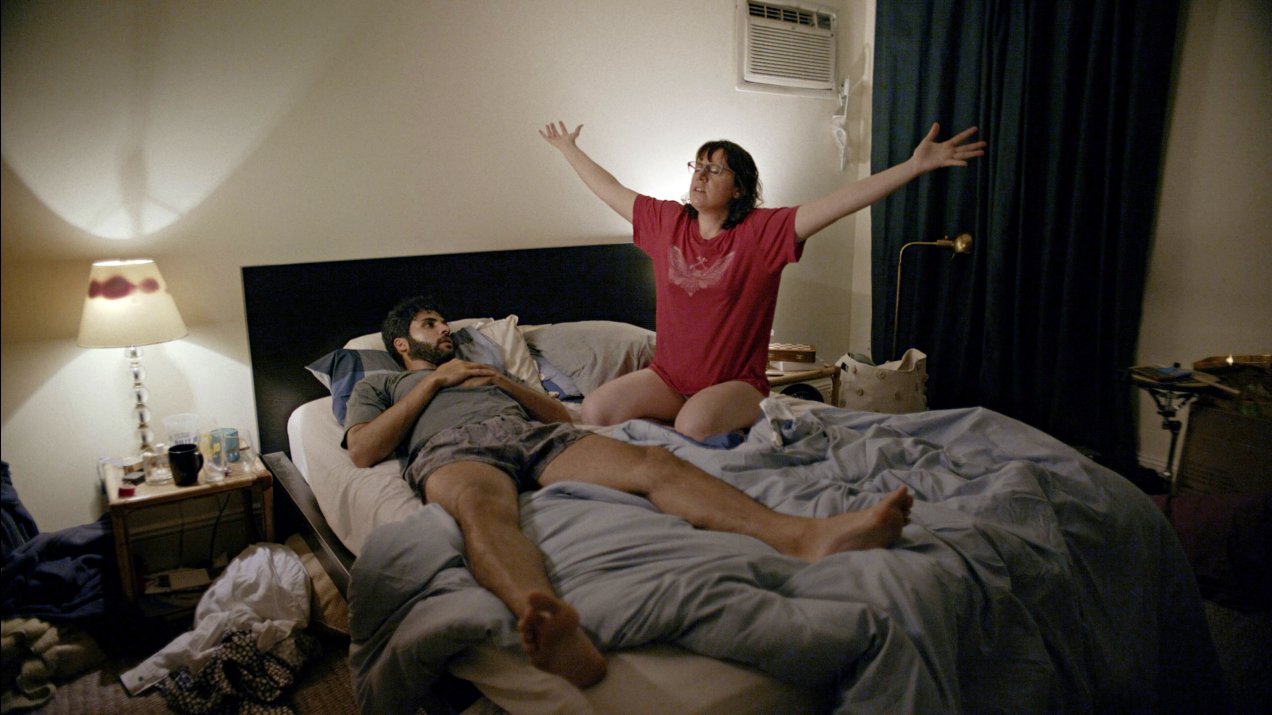
TONY: a brat unspoiled

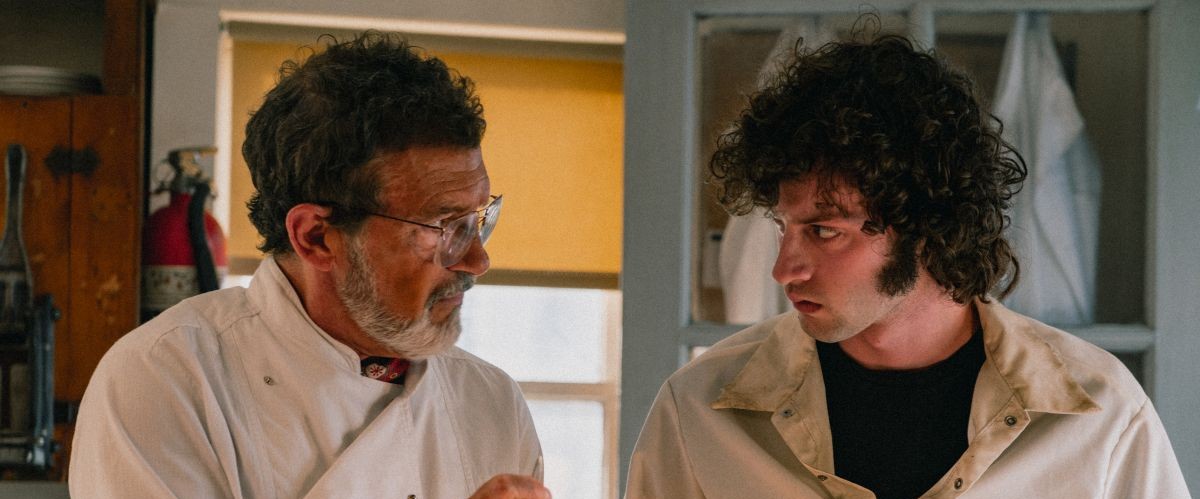
Photo caption: Antonio Banderas and Dominic Sesso in TONY: Courtesy of A24.

I was a spoiled, miserable, narcissistic, self-destructive and thoughtless young lout, badly in need of a good ass-kicking.”

So begins Tony, the origin story of celebrity chef/traveler/raconteur Anthony Bourdain – with Bourdain’s self-description of himself at age 19. Tony is more of a coming of age film than a biopic, focusing on this pivotal, transformative year in Bourdain’s life.

The young Anthony Bourdain (Dominic Sesso), lazy, entitled and supremely confident, is betting everything on being awarded a college writing fellowship that he can use to bankroll a fun year in NYC. Having no Plan B, he is devastated when he doesn’t win the fellowship. Even worse, he has already told everyone he knows that he had already won the prize, and, unable to face the embarrassment, covers it up by running away. Impulsively, he heads to the tip of Cape Cod in pursuit of a a girl who is summering there. Arriving at the onset of Provincetown’s tourist season, he soon finds himself with no girl, no money, no place to stay and no ticket for the return ferry.

The taciturn chef-owner (Antonio Banderas) of a modest restaurant allows him to sleep in a hammock on his back porch and to eat at the restaurant in return for working as the dishwasher. Bourdain becomes the lowest-ranking member of the kitchen team, a colorful assembly of experienced cooks. He thinks that he is too good for this setting, but his colleagues are uniformly unimpressed with him.

Young Bourdain, holding on to the writing fellowship as a false cover story, still tells everyone that he is a writer. Of course, he hasn’t written anything – not even a draft or an outline – or even concocted an original idea. He is, however, an earnest and often successful bullshitter – and he’s about to learn how far that will take him. He’s not a sociopathic liar, on the road to being a con man; he lies out of desperation, terrified that somebody will learn that at age 19, he hasn’t magically already become who he aspires to be. What he needs is a harsh reality check – and that’s what he gets from the restaurant kitchen – where pampering is not tolerated.

Of course, there is humor in watching a young punk getting his comeuppances, and much of Tony is very funny. Dominic Sesso (The Holdovers) is able to keep the audience rooting for the young Anthony Bourdain even while he is behaving badly. Banderas is solid as his boss and purveyor of tough love. Leo Woodall (Tuner, Nuremburg, The White Lotus) is excellent as kitchen crewmate Sal, a blue collar hedonist who has much more game than the teen Tony.

Note: Bourdain’s real life best friend, fellow celebrity chef Eric Ripert, appears in a cameo as the chair of the admissions committee for the Culinary Institute of America.

I remembered reading about Bourdain’s Provincetown experience in his own colorful memoir Kitchen Confidential, which launched his post-restaurateur career as a travel and food writer and television personality. The Bourdain biodoc Roadrunner: A Film About Anthony Bourdain was one of the best films of 2021, and also covers this period as it traces his entire life.

The director Matt Johnson and co-writers Todd Bartel and Lou Howe made wonderful choices in adapting the source material; instead of making a movie about Bourdain discovering a love of cooking, they focus on the character-building payoff of his Provincetown experience. Johnson also gets the tone just right, with just the right amount of humor, as he did in the corporate docudramedy BlackBerry in 2023. 

Tony’s  trailer (below) depicts a talented, immature narcissist who keeps self-sabotaging until he falls under the guidance of a crusty mentor.  Because that’s the plot of 1969’s fictional  Downhill Racer, with Robert Redford and Gene Hackman, I was going to skip Tony. But then I read Jeannette Catsoulis’ glowing review in the NYT, and I’m glad that The Wife and I got to see it. It’s a good watch.


OVER/UNDER: sweet and uncommonly authentic

Photo caption: Anastasia Veronica Lee and Emajean Bullock in OVER/UNDER. Courtesy of Bulldog Film Distribution.

In the sweet and uncommonly authentic coming of age film Over/Under, a deep friendship between two girls evolves over four years.

Their Southern California families vacation each year in a New England beach community, and nine-year-old Violet (Emajean Bullock) and Stella (Anastasia Veronica Lee) have become the fastest of friends. Over/Under reminds us of the innocent intensity of childhood friendship when kids feel compelled to spend every minute fully engaged with a best friend.

As the years pass, the beach setting remains idyllic, but their bodies and interests evolve. Disappointments, jealousies, betrayals and the appeal of boys threaten the friendships. Can their profound bond survive?

In her debut, director and co-writer Sophia Silver has made a film without a single false moment. Female viewers will recognize every moment of heartfelt exuberance or anguish.

Over/Under was nominated for a Grand Special Prize at the Deauville Film Festival (a French film fest devoted to American film).

This is a film that will resonate strongly with women and girls. Over/Under is now available to stream.

LA GRAZIA: it’s time to get past his malaise

Photo caption: Toni Servillo in LA GRAZIA. Courtesy of MUBI.

When we talk of “coming of age” movies, we usually mean those about kids or young adults experiencing life lessons for the first time. But, the more mature among us also face new realities as we age into new phases of our lives. That’s the case with Paolo Sorrentino’s lyrical La Grazia.

La Grazia is an insightful and empathetic portrait of a fictional president of Italy (Toni Servillo) in the final months of his term. He is a man of quiet and resolute competence, a jurist admired for guiding the country through six political crises. He is also staid and taciturn, a man of boring countenance (except for an his fondness of the most current pop music, including rap).

He is a lame duck and in a malaise from the loss of wife of fifty years. He’s just running out the clock. Fortunately, his daughter Dorotea (Anna Ferzeti), an impressive jurist in her own right, is nudging him through his daily duties. To her frustration, he is refusing to make his final three official decisions, about whether to sign euthanasia legislation and whether to grant two pardons.

He believes that his beloved wife had an affair forty years before, and now, instead of working, he’s stewing over who was her lover.

His lethargy contrasts with the vibrant, over-the-top baroque art covering every surface of the Quirinale Palazzo, the former papal palace now the headquarters of Italy’s President. The only sparks of life come from Anna’s prodding and from dinners with the art critic Coco, his friend from grade school and his wife’s bestie (played in a charismatic performance by Milvia Marigliano).

As doggedly as the president drags his feet, we know that he will need to find a catharsis and reset his life. As he figures things out, there is a remarkable scene involving, of all things, an astronaut shedding a zero gravity tear.

Toni Servillo is excellent here as a much more decent and much less flamboyant politician than the ones he played in Sorrentino’s Il Divo and Loro. La Grazia matches up well with his Youth, another contemplation of the end of a career. As usual, Sorrentino takes full advantage of the palace interiors and Roman exteriors; visually and otherwise, Sorrentino’s masterpiece remains The Great Beauty.

La Grazia is streaming on Amazon and AppleTV.

DICIANNOVE: coming of age – his way

Manfredi Marini (right) in Giovanni Tortorici’s DICIANNOVE. Courtesy of Oscilloscope Laboratories and Frameline.

The title of the coming-of-age film Diciannove is Italian for nIneteen, the age of Leonardo (Manfredi Marini), who is leaving his Palermo home for the first time to begin college in London. Ever restless, he is eager to embark on his life journey, but doesn’t know where to head, and, being nineteen, he won’t listen to anyone else. In mere days, Leonardo pivots from business courses in London to the study of Italian literature at a university in Siena. He discovers a passion for old Italian writers – just not the ones his professor assigns.

Nineteen is an age that most of us sample experiences, but Leonardo is an introvert, sometimes bratty, who refuses to socialize, and we wonder if he will ever forge relationships or act on his sexual urges. Diciannove is that highly original coming-of-age film in which what even Leonardo chooses NOT to do is interesting, and we can’t predict what could make his spirit soar at the end.

Diciannove is the debut feature for writer-director Giovanni Tortorici, a protege of Luca Guadagnino, who produced the film. Tortorici and cinematographer Massimiliano Kuveiller (who has also worked with Guadagnino) maintain visual interest by throwing everything at the screen – disco scenes with an operatic score, slow motion, animated dreams and every kind of fancy cut. Nighttime scenes in a cold and hard London give way to lovingly beautiful shots of tranquil Siena.

Diciannove is the singular and imaginative calling card of a new auteur; Tortorici may be a visual show-off, but he has an uncommon gift for creating a realistic, but compelling and unpredictable character.

I screened Diciannove in June for Frameline. It’s now releasing into US arthouse theaters, including Laemmle’s Monica Film Center and the Glendale.

BONJOUR TRISTESSE: not the life lesson she was expecting

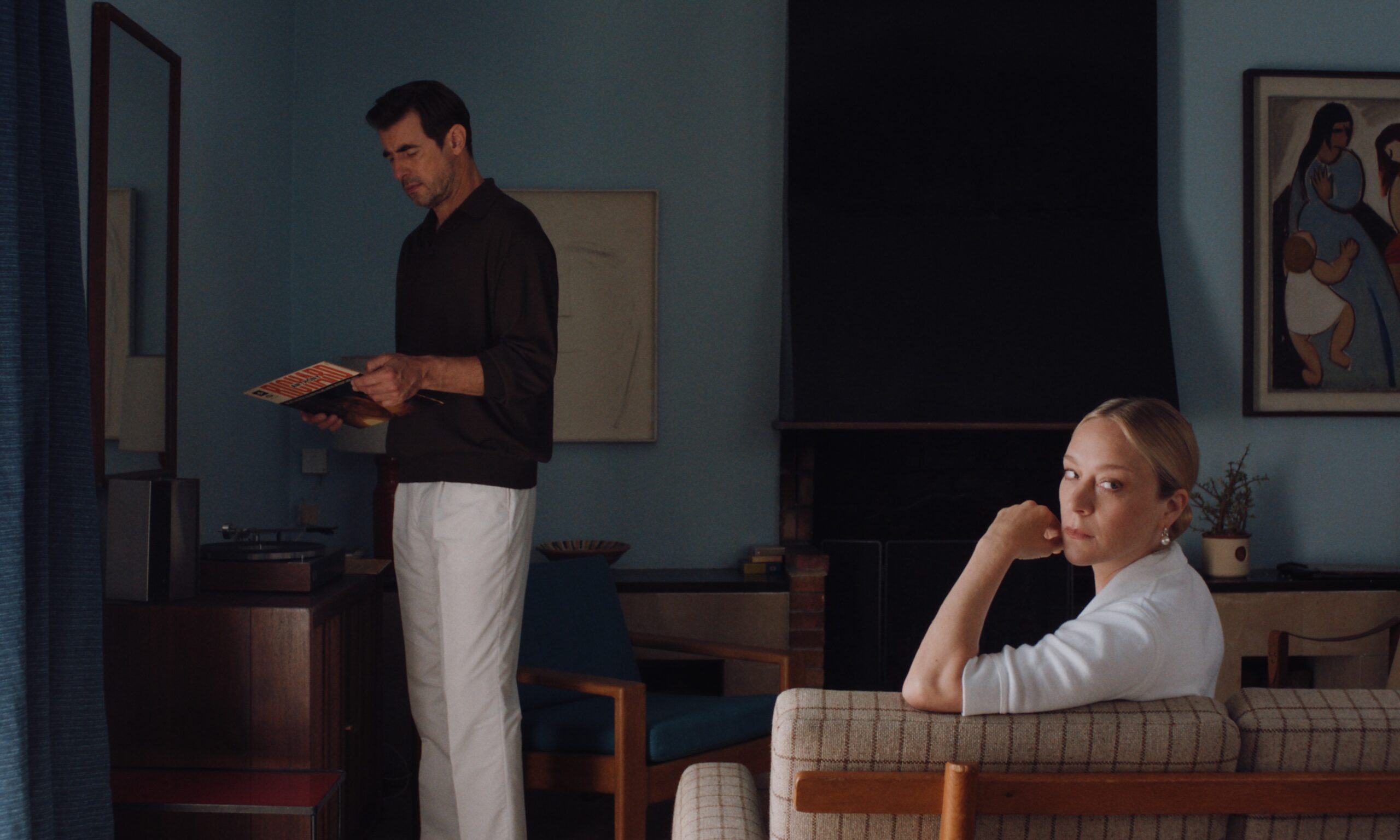
Photo caption: Claes Bang and Chloe Sevigny in in BONJOUR TRISTESSE. Courtesy of Greenwich Entertainment.

In the coming-of-age drama Bonjour Tristesse, Cécile (Lily McInerny) is on the cusp of adulthood and enjoying a languid summer holiday in a villa on the French Riviera (Bonjour Tristesse was shot in Cassis). She is accompanying her father Raymond (Claes Bang) and his girlfriend Elsa (Nailia Harzoune), who allow her to sneak off for make-out sessions on the beach with the young guy in the neighboring villa.

Cécile has a comfortable and playful relationship with Raymond, a charming lightweight. To his face, she describes him as often reckless and selfish, which he doesn’t dispute.  At one point, Raymond offer, “I don’t know why luck is so easily dismissed. I’ve always found it dependable.” Raymond’s attractive girlfriend Elsa is also fun-loving, with a healthy libido and unfounded self-confidence.

Cécile’s mother died when she was a young child. So, when Cécile’s mother’s best friend Anne (Chloe Sevigny) shows up at the villa for visit, Cécile wants to learn about her mom. What were her parents like back in the day? Anne has also forged impressive achievements as a designer and is reserved and guarded, with a serious demeanor. The adults that Cécile is used to, Raymond and Elsa, are shallow and hedonistic, so Anne is a fascinating contrast.

Claes Bang, Lily McInerny and Chloe Sevigny in in BONJOUR TRISTESSE. Courtesy of Greenwich Entertainment.

Just as Cécile is glomming on to Anne as a model, Anne does something which upends the household. Soon, Cécile is learning life lessons that she didn’t sign up for. This is a character-driven story, and Cécile is forming her own persona as Raymong and Anne reveal who they are, down deep.

Bonjour Tristesse is the directorial debut for Durga Chew-Bose, who adapted the Francois Sagan novel.

After premiering at Toronto, Bonjour Tristesse became a NYT Critic’s Pick on its theatrical run. Bonjour Tristesse releases digitally this Friday on Amazon, AppleTV, YouTube and Fandango.

EGGHEAD & TWINKIE: funny, sweet and genuine

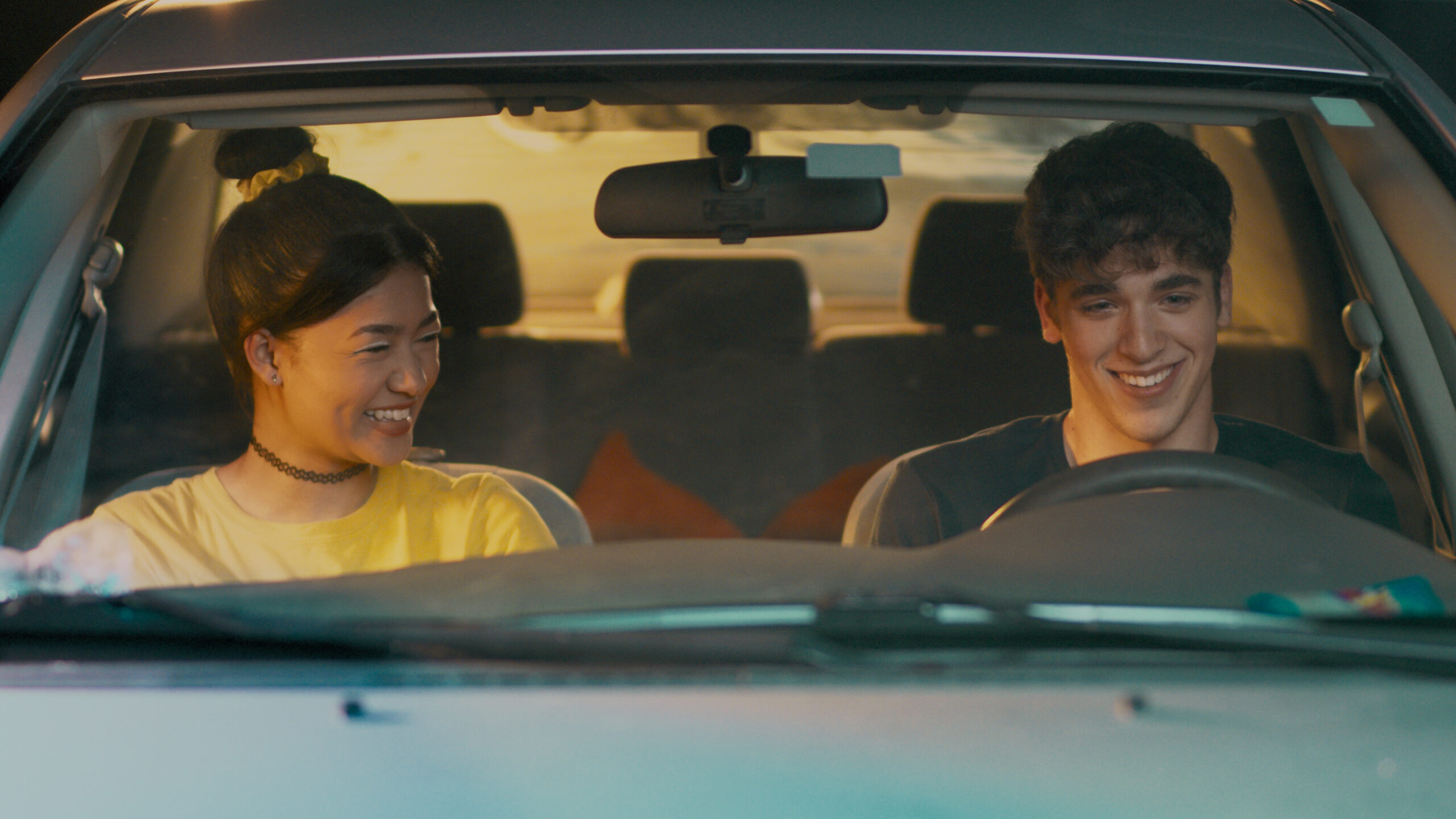
Photo caption: Sabrina Jie-A-Fa and Louis Tomeo in EGGHEAD & TWINKIE. Credit: Olivia Wilson, Courtesy of CanBeDone Films and Orange Cat Films.

In the funny, sweet and genuine coming of age film Egghead & Twinkie, Twinkie (Sabrina Jie-A-Fa) is finishing high school and trying to navigate her sexual awakening as aa lesbian – and it’s not easy. Her lifelong bestie is the neighbor boy Egghead (Louis Tomei), and he’s now sweet on her; (Egghead and Twinkie are their nicknames for each other), Twinkie impulsively commandeers her dad’s car and heads out on a cross country road trip to join her Internet object of desire (Tik Tok star Ayden Lee). Egghead is so loyal, smitten and cluelessly hopeful that he comes along.

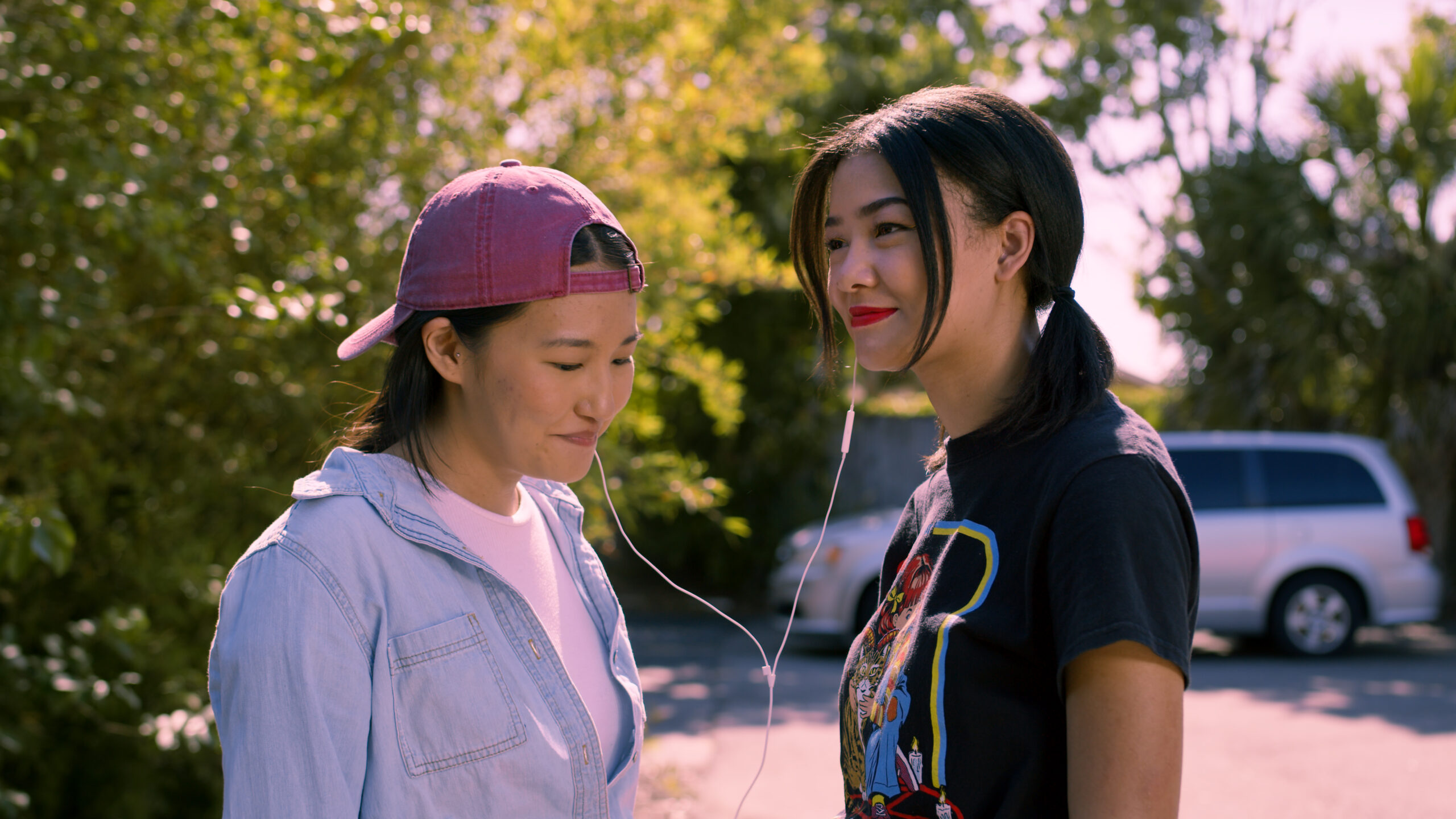
Along the way, they have their share of zany road trip experiences. Twinkie meets the girl (Asahi Hirano) who REALLY is perfect for her, but Twinkie is first destined to learn a cruel lesson about being infatuated with a player. It’s a hoot, and there’s not one false note. For all their kooky antics, the kids’ feelings are remarkably authentic.

The entire cast is very good. Sabrina Jie-A-Fa is a charming force of nature as Twinkie. She’s in every scene, and she’s a real talent.

Asahi Hirano and Sabrina Jie-A-Fa in EGGHEAD & TWINKIE. Credit: Olivia Wilson, Courtesy of CanBeDone Films and Orange Cat Films.

Egghead & Twinkie is the first feature for writer-director Sarah Kambe Holland, and it’s an impressive calling card. Egghead & Twinkie is perfectly paced, and Kambe Holland sprinkles in just enough animation to help leaven the angst with the whimsical. Kambe Holland says,

The kernel of an idea that turned into EGGHEAD & TWINKIE was
more of a question: Can I find humor in the coming out process? I
was nineteen years old at the time, and I had just come out to my
own parents a few months before. The stress of coming out was
fresh in my mind, but so was the hilarious awkwardness of it all. I
challenged myself to write a short film script about a teenage girl
who comes out to her parents, but I was adamant that it wouldn’t be
a drama. It would be a comedy, and the message would be one of
hope and friendship.

Of course, given Kambe Holland’s inspiration for the story, Twinkie just doesn’t HAPPEN to be gay or HAPPEN to be Asian-American, but the themes are universal, and Egghead & Twinkie is one of the best coming-of-age films of the decade.

I screened Egghead & Twinkie for its premiere at Cinequest.. After  a strong festival run, Egghead & Twinkie is available on VOD, including Amazon, AppleTV and YouTube, beginning today.

IN THE SUMMERS: they mature, he evolves

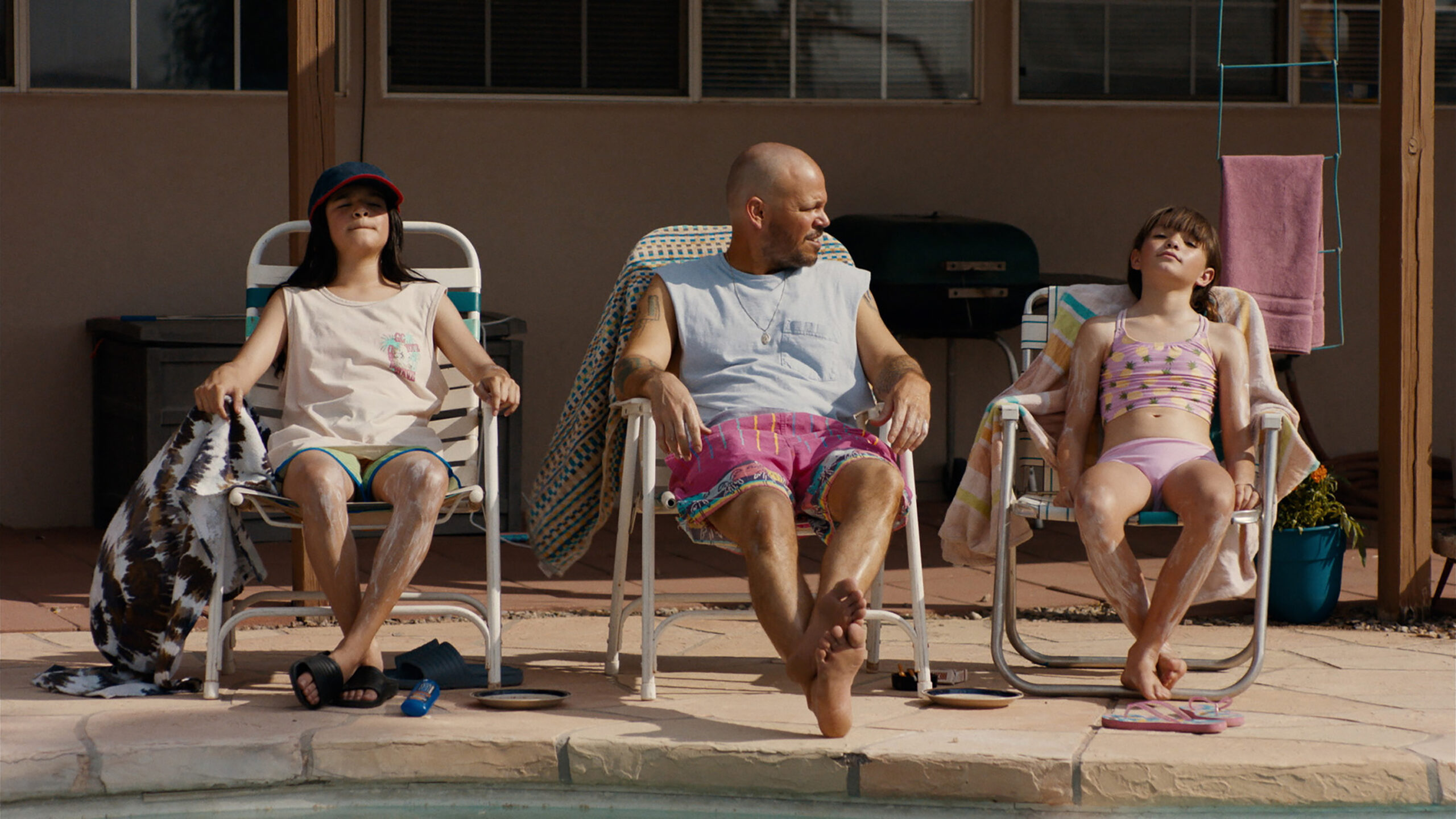
Photocaption: Rene Perez Joglar (center) in IN THE SUMMERS. Courtesy of NashFilm and Music Box Films.

In the remarkably authentic and evocative In the Summers, two sisters fly to Las Cruces, New Mexico, for annual summer visits with their divorced dad. The father, Vincente, played by Rene Perez Joglar (AKA the rapper Residente) is a spirited and talented underachiever who tries to show them a Disney Dad experience; the girls soak up the fun, but also absorb lessons about Vincente’s less reliable characteristics. Each summer, the girls return to Las Cruces with additional savvy and sponge up real world lessons from Vincente’s changing behavior.

The girls arrive expecting last year’s Vincente, but they get a new model, shaped by his changing circumstances and emotional needs, and reflecting how he sees himself. From year to year, Vincente bounces between unearned swagger to self-loathing distraction to an uneasy humility. It’s a compelling coming of age for the daughters.

Carmen (Emma Ramos), the bartender at the local pool hall, is the one consistent sounding board who can validate what the girls are experiencing with their dad.

Joglar’s performance, only his second acting role in a narrative feature and first lead, is remarkable. He is able to portray a character who is the same man at the core, but whose behavior each year is formed by the cumulative slings and arrows of his life.

The three sets of actors playing Violeta and Eva as they mature (Dreya Castillo and Luciana Eva Quinonez, Kimaya Thais and Allison Salinas, Sasha Calle and Lio Meliel) are excellent.  So is Emma Ramos (New Amsterdam) as Carmen.

Writer-director Alessandra Lacorazza Samudio is able to convey so much narrative without spoon-feeding the audience. She positions the audience in the point of view of the watchful daughters, as they they to assess what is going on with their own father. She also gets fine performances out of actors with little or no movie experience. In the Summers is a triumphant debut feature for Lacorazza and marks the emergence of very promising filmmaker,

In the Summers made my list of Best Movies of 2024 after being my favorite film at last month’s Nashville Film Festival, and it’s streaming now on Amazon, AppleTV, YouTube and Fandango.

THE FEELING THAT THE TIME FOR DOING SOMETHING HAS PASSED: is she going to be a loser?

Photo caption: Babak Tafti and Joanna Arnow in THE FEELING THAT THE TIME FOR DOING SOMETHING HAS PASSED. Courtesy of Magnolia Pictures.

You won’t see a more uniquely original film than the deadpan comedy The Feeling that the Time for Doing Something Has Passed. When we meet the protagonist Ann (played by writer-director Joanna Arnow), she’s in a situation of literal dissatisfaction. Although she is particularly vulnerable in this moment, dissatisfaction seems to be the theme of her life.

Ann is smart and witty, but no one in her life SEES her. She’s so invisible to others, that her workmates award her a one year-anniversary prize, when she’s been there for three years. Her boyfriend is remarkably self-absorbed, selfish and distracted. Her parents are blissfully too far on the other side of the generational divide to relate supportively; (there’s a rollicking scene where they break into Solidarity Forever at a vacation cabin).

Ann decides to stop settling, drops her boyfriend and embarks on meeting new guys with a dating app. But her indignities, at work and on the dating trail, continue with deadpan hilarity. Will she reach a point of self-discovery?

I’ve been burying the gob smack lead, happily perverted as it is. Ann and the men she dates are into BDSM, and Ann is a submissive. When we see someone whom we think has low self esteem as sexually submissive, we may gasp at what looks like exploitation. But, we’re wrong about Ann’s self-esteem – she won’t let herself be victimized. She may be suffering the slings and arrows of life, but she is not going to see herself as a loser.

Arnow’s performance is remarkably brave and adept on several levels. Most obviously, Arnow spends much of the movie naked, and her body more resembles those of her audience members than those of most big screen leading ladies. She’s also frequently engaging in submission sex play, and all that “yes, Master” sounds silly to those not into BDSM.

The Feeling that the Time for Doing Something Has Passed is the first narrative feature that Arnow has written and directed. I can’t wait to see what she comes up with next.

I understand that this is not a movie for everyone. Some will put off by the BDSM sex play and by a woman constantly in submissive positions. But, uniquely, this is a story told from tha woman’s perspective, and I think the payoff makes the film worth sticking through any discomfort.

The Feeling that the Time for Doing Something Has Passed is now tied for #27 on my list of Longest Movie Titles. Hopefully more significantly, it’s also on my Best Movies of 2024 – So Far.

This a droll masterpiece of transgressive originality. After a blink-and-you’ve-missed-it theatrical run earlier this year, The Feeling that the Time for Doing Something Has Passed is streaming on Amazon, AppleTV and Hulu.

DIDI: learning to get out of his own way

Photo caption: Izaac Wang in DÌDI. Courtesy of Focus Features/Talking Fish Pictures LLC © 2024 All Rights Reserved.

The coming of age dramedy Didi explores that moment of maximum awkwardness and intensity for boys – the summer before entering high school. Their universe is their peers, and their desperation to be accepted and to avoid embarrassment is overwhelming. At the same time, raging testosterone seems to be crowding out the ability to think.

Didi is set at that moment (2008?) when teenagers were migrating from Myspace to Facebook. Chris Wang (Izaak Wang) lives with his older sister, their mom and his dad’s elderly mother in the Silicon Valley suburb of Fremont; the dad is away on a tech job in Taiwan. The mom (Joan Chen) has her hands full running the household by herself, and her would-be career as a fine arts painter is just not happening.

There’s a lot of immaturity in our world, but little is as obnoxious as that of a 14-year-old boy. Chris plunges ahead brashly, with a social clumsiness that is remarkable even for a young teen male. .

He is fascinated by a girl, but his best friend accurately observes that “you have zero game“. Chris also identifies what he thinks is a short cut to popularity, as a skate board filmer, but without any of the requisite preparation. He doubles down on a series of postures. One of the funniest aspects of Didi is Chris’ gift for telling pathetically naked lies that will inevitably be exposed.

Not only do Chris’ poses fail to work, he self-isolates and self-humiliates. He is going to have to learn whether he can accept who he is and is not, whether his sister is his ally instead of his antagonist, and whether his mother has something to offer besides meal preparation.

Didi features another stunning performance by Joan Chen as a mom absolutely beaten down by household drudgery, her ungrateful kids, and relentless criticism from mother-in-law. Through most of the film, the character is an emotional pinata, but Chen finishes the story with moments of searing humanity.

Didi is the first narrative feature written and directed by documentarian Sean Wang, who was nominated for an Oscar last year for his short film Nai Ni and Wai Po. Wang brings us into a teen milieu with unsurpassed authenticity.

Note: As a Bay Area native, I was confused by the Wang family home being in Fremont, but Chris starting to attending Fremont High, which is twenty miles away in Sunnyvale; that’s a dumb-down for the non-Bay Area audience. Writer-director Sean Wang himself grew up Taiwanese-American in Fremont and attended Irvington High.

HOW TO HAVE SEX: raw and authentic

Photo caption: Mia McKenna-Bruce in HOW TO HAVE SEX. Courtesy of MUBI.

In the searingly realistic How to Have Sex, three British teen girls glamorize a holiday week of binge drinking, clubbing and casual sex, so they head for the beach town of Malia on the island of Crete. Malia’s hotel and bar scene caters to British teenagers, producing a kind of a Cabo San Lucas/Daytona Beach/South Padre Island spring break culture with a lot less restraint. In Britain, kids can move on from high school at age sixteen, so this is like American Spring Break with a heavy dose of sixteen- and seventeen-year-olds in the mix.

All three are gung ho on partying, but the lone virgin, Tara (Mia McKenna-Bruce), has the additional goal of her first sexual experience. Obviously, if a sixteen-year-old girl is determined to get as drunk as possible and lose her virginity in an unsupervised party frenzy with hundreds of drunk teenage boys, her quest can go painfully wrong in many easily imaginable ways. Hence, the joyous exuberance of the girls’ partying, is underpinned by the audience’s escalating sense of dread.

The three besties immediately self-intoxicate, meet some guys in their hotel and party essentially non-stop, cycling between poolside, beach and disco, stopping only to pass out. Rinse and repeat. How to Have Sex narrows its focus on Tara’s experience, which becomes more fraught, more emotionally isolated and devastating.

In her first feature, writer-Director Molly Manning Walker achieves remarkable verisimilitude in the weeklong party rampage, so much so that Mick LaSalle wrote, “The great strength and slight weakness of “How to Have Sex” is that it’s just like being there — except you might not want to be there.

Anchoring herself in authenticity, Manning Walker is comfortable with ambiguity, whether in the relationships between the girlfriends or their attitudes, behaviors and feelings. She has not made a message picture, a political screed or a cautionary tale, but her audiences certainly notices organized beach games that are premised on females as sex objects and circumstances that beg the question of what constitutes acceptable consent.

The performance of Mia McKenna-Bruce as Tara is astonishingly raw, nuanced, heartbreaking and hopeful. Other critics describe it as “star-making”, which will depend on her getting material this good in the future.

The actresses playing Tara’s friends, Lara Peake and Enva Lewis, are also very, very good.

(Manning Walker was the cinematographer for Scrapper, another debut coming of age film by a female British writer-director, Charlotte Regan).

How to Have Sex is an impressive directorial debut for Molly Manning Walker, who is not afraid to make her audience uncomfortable. This is a movie more to be admired than enjoyed. How to Have Sex is streaming on MUBI.