
THE BRIDE!: a funnier Bonnie and Clyde, with monsters

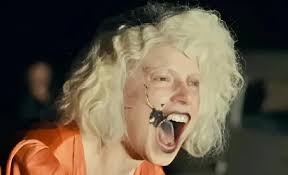
Photo caption: Jessie Buckley in THE BRIDE!. Courtesy of Warner Bros.

Director Maggie Gyllenhaal’s The Bride! is both a pedal-to-the-metal spectacle and an intellectual exercise, but not a great movie for the ages. But it is most certainly a showcase for the unique and awesome talents of Jessie Buckley.

The Bride! is set in the America of the early 1930s, that time of speakeasies, flappers, gangsters, hobos hopping trains and popular fascination with Talking Pictures. Having been re-animated 100 years before in Europe, the very sensitive Frankenstein’s monster (Christian Bale) longs for female companionship, and gets it when a Chicago mad scientist (Annette Bening) reanimates the corpse of a gangland escort (Jessie Buckley).

She doesn’t remember who she is or any specific experiences in her previous life. But, unlike the traditional Frankenstein’s monster, she immediately behaves like a fully formed woman, who is already acquainted with 1930s America, and speaks English with an impressive vocabulary. And she already knows how some men mistreat women, and, boy, is she pissed off.

The original male monster in The Bride! is named Frankenstein, unlike in Guillermo Del Toro’s and other Frankenstein movies, where the mad scientist is Viktor Frankenstein and the monster is “the Creature”.

The two take to each other, but Frankenstein has been comfortable living on the down low, and his bride has the ability and compulsion to ignite every social situation into an uproar and to escalate every commotion into a volcanic riot. They must flee Chicago and embark on a road trip to Manhattan, Niagara Falls and back to Chicago, leaving carnage in their wake.

Let’s talk about what The Bride! is NOT. It’s not anything like Guillermo Del Toro’s operatic Frankenstein epic. It’s not anything like the campy 1935 Bride of Frankenstein starring Elsa Lanchester. And, although there’s violence, it is not a gore fest like many contemporary horror movies.

The movie that The Bride! most resembles – and it’s intentional – is Bonnie and Clyde (and there’s at least one identical shot, where Buckley mirrors Faye Dunaway). There’s plenty of subversive humor in Bonnie and Clyde, but The Bride! is much more generally funny.
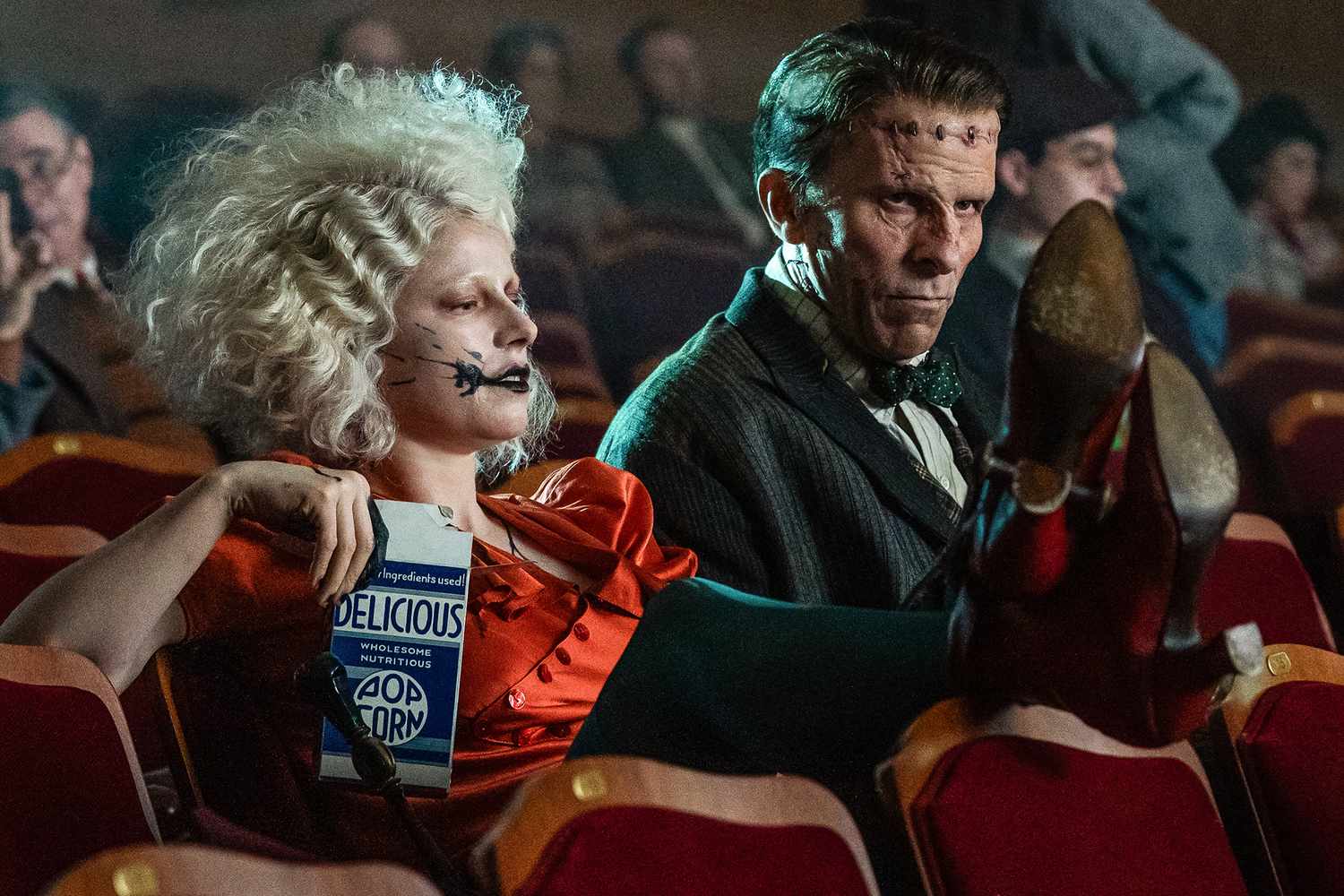
Jessie Buckley and Christian Bale in THE BRIDE!. Courtesy of Warner Bros.

Whether happy or angry, the Bride herself is absolutely explosive, and Jessie Buckley, with untethered physicality, makes her into a human detonator. Whether she enters a speakeasy or a cinema or a fancy hotel ballroom, there’s gonna be a riot very soon.

Christian Bale’s monster character is the most textured in The Bride! – in turns yearning, lovelorn, socially fearful, pathetic, disciplined, and joyous. Bale is really, really good in the role.

The Bride!’s cast is very rich; besides Bening, there’s Penelope Cruz, Peter Sarsgard and John Magaro. They’re all good, although all of the complexity is in Buckley’s and Bale’s roles. Jeannie Berlin, Oscar-nominated for 1973’s The Heartbreak Kid, is very good as the mad scientist’s grotesque assistant. I always sit up and take notice of Louis Cancelmi (Billions) when he shows up in a supporting role, and he’s just as good here as in The Eyes of Tammy Faye and Killers of the Flower Moon. The director’s brother, Jake Gyllenhaal, is very good as a song-and-dance movie star revered by Frankenstein.

The Bride’s volatility stems from her rage against misogyny, and that is the most persistent theme within The Bride!. I found myself more often thinking about the message and the cinematic references in The Bride! than being emotionally involved in it. Since Jessie Buckley is the most soulful actor in today’s cinema, I was expecting more soulfulness in the movie, and I think that’s a miss. Nevertheless, The Bride! is smart, funny and entertaining.
THE SHAPE OF WATER: an operatic romance (and it’s inter-species)

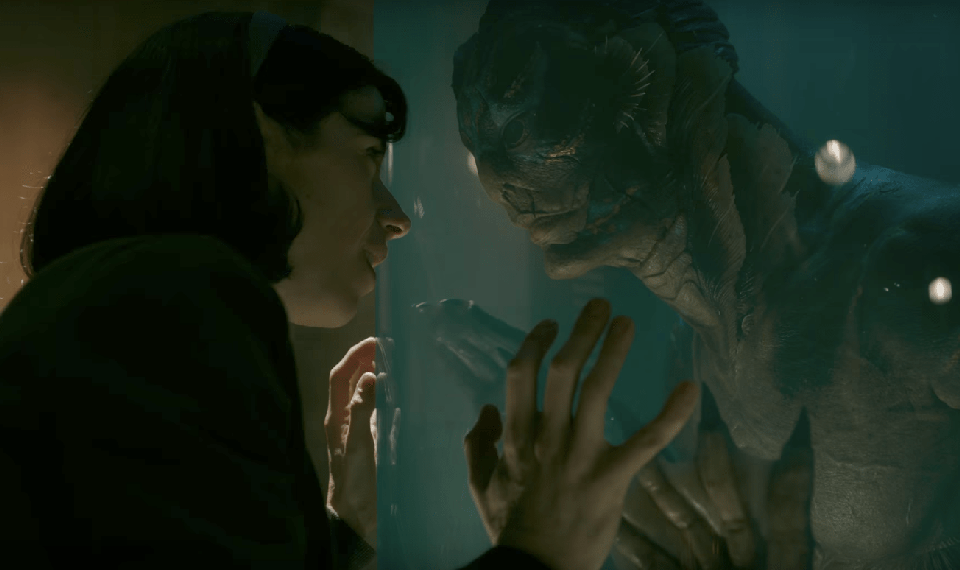
Sally Hawkins in THE SHAPE OF WATER

The Shape of Water is an epic romance from that most imaginative of filmmakers,  writer-director Guillermo del Toro.  The Shape of Water may become the most-remembered film of 2017.

The story is set in 1962 Baltimore. Elisa (Sally Hawkins) is a mute woman who lives in a dark apartment above an aging downtown movie palace.  She and her friend Zelda (Octavia Spencer) work as a janitors on the graveyard shift at a government research laboratory.  The Cold War adventurer Strickland (Michael Shannon), a tower of menace, has captured an amphibian creature from the Amazon and has brought him in chains to a tank at the laboratory.  The male creature, in the approximate form of a human, has dual breathing systems, so he can survive both under water and on the surface; it develops that he also has intelligence, feelings and even healing powers.

The scientist Hoffstetler (Michael Stuhlbarg) wants to study Amphibian Man to discover how his species could benefit humanity.  Strickland, on the other hand, wants to rush into killing and dissecting the creature.  Strickland is a sadist, who enjoys brutalizing Amphibian Man with his cattle prod.

Elisa is repulsed by Strickland’s torture, and she feel compassion for Amphibian Man.  She starts showing Amphibian Man some kindness.  As Amphibian Man becomes more trusting of Elisa, he feels gratitude for her kindness.  She cares about him, too, first with pity and then with the fondness of a pet owner.  As Amphibian Man’s intelligence and feelings become more apparent, the two become more equal, and their mutual fondness blossoms into passion.

But Strickland’s nefarious plans force Elisa and her supporters into a race against the clock to save Amphibian Man.  And so we’re off on a thriller, with a heist-like rescue and a chase, culminating in an ending of operatic scale.

Now this is a romance that transcends species.  I totally bought into this.  If you can’t, the movie is less moving and much, much more odd.  Romance is often consummated sexually, and this one is, too.

Sally Hawkins is not conventionally pretty, yet del Toro didn’t make Elisa a stereotypical spinsterish ugly ducking.  Elisa is vital, with a rich inner life, a wicked sense of humor and cultural interests, and who expresses herself sexually.  She may only be a night janitor with a disability, but that doesn’t define her.  Elisa’s defiant gaze at Strickland is one of the movie’s highlights.

Hawkins’ performance is a tour de force.  Shannon makes for a formidable villain, especially when he clenches his own gangrenous fingers.  Michael Stuhlbarg, Octavia Spencer and Nick Searcy (Art Mullen in Justified) are all excellent.

Richard Jenkins’s performance as Elisa’s neighbor Giles is very special.  This is a very vulnerable man, with his sexuality trapped in a closet, his growing sensitivity to his own aging and his career as a commercial artist becoming obsolete.  With his episodes of resolute denial spotted with instances of inner strength, both the character and the performance are very textured.  And Giles’ eccentric reactions to the story are very, very funny.

I highly recommend Guillermo del Toro’s interview on NPR’s Fresh Air , in which he discusses many of his choices in developing the story of The Shape of Water, including shaping the character of Elisa and the inspirations from The Creature from the Black Lagoon.  In the interview, del Toro explains that, if this movie were made in 1962, Strickland would have been the hero, the Cold Warrior protecting humans from the alien creature.  Instead of course, the heroes of The Shape of Water are a woman with a disability, a woman of color, a gay man and a commie spy and, of course, a monster.

None of the characters have any reason to envision that white male supremacy, oppression of gays or the Cold War would end, or even be tempered, in their lifetimes.  It’s a graphic time capsule, with the grand movie palace empty, pushing out a sword and sandal epic to compete in futility with the small screen offerings of Dobie Gillis, Mr. Ed and Bonanza.  It’s a world in which the coolest thing imaginable is a teal 1962 Cadillac De Ville.

Here’s where Guillermo del Toro’s imagination triumphs. This story could not be told as well in a novel, on stage or in any other artistic medium. It has to be a movie.

This is filmmaking at its most essential and most glorious. Del Toro, along with production designer Paul B, Austerberry and art director Nigel Churcher, create a set of vivid and discrete worlds, each with its own palette. There are Elisa’s and Giles’ dark apartments, the brooding institutional green of the laboratory and the bright mid-century modern domain of Strickland’s family.

This is a beautiful movie.  Between del Toro’s filmmaking genius and Hawkins’ performance, The Shape of Water is a Must See, one of the best movies of the year.