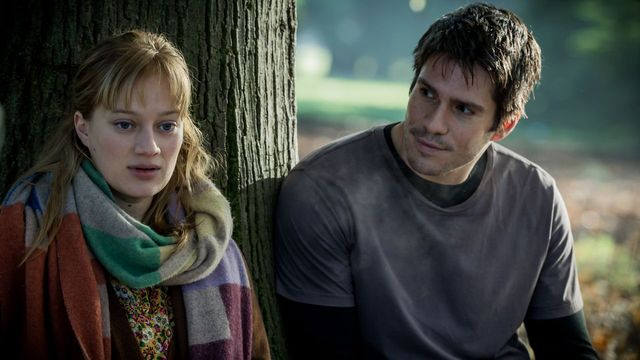
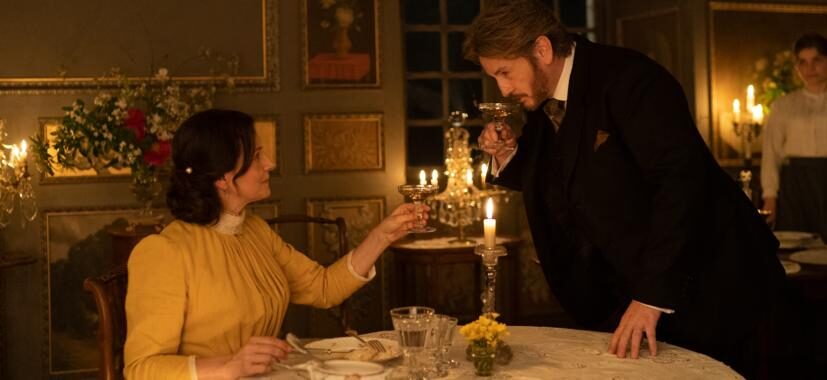
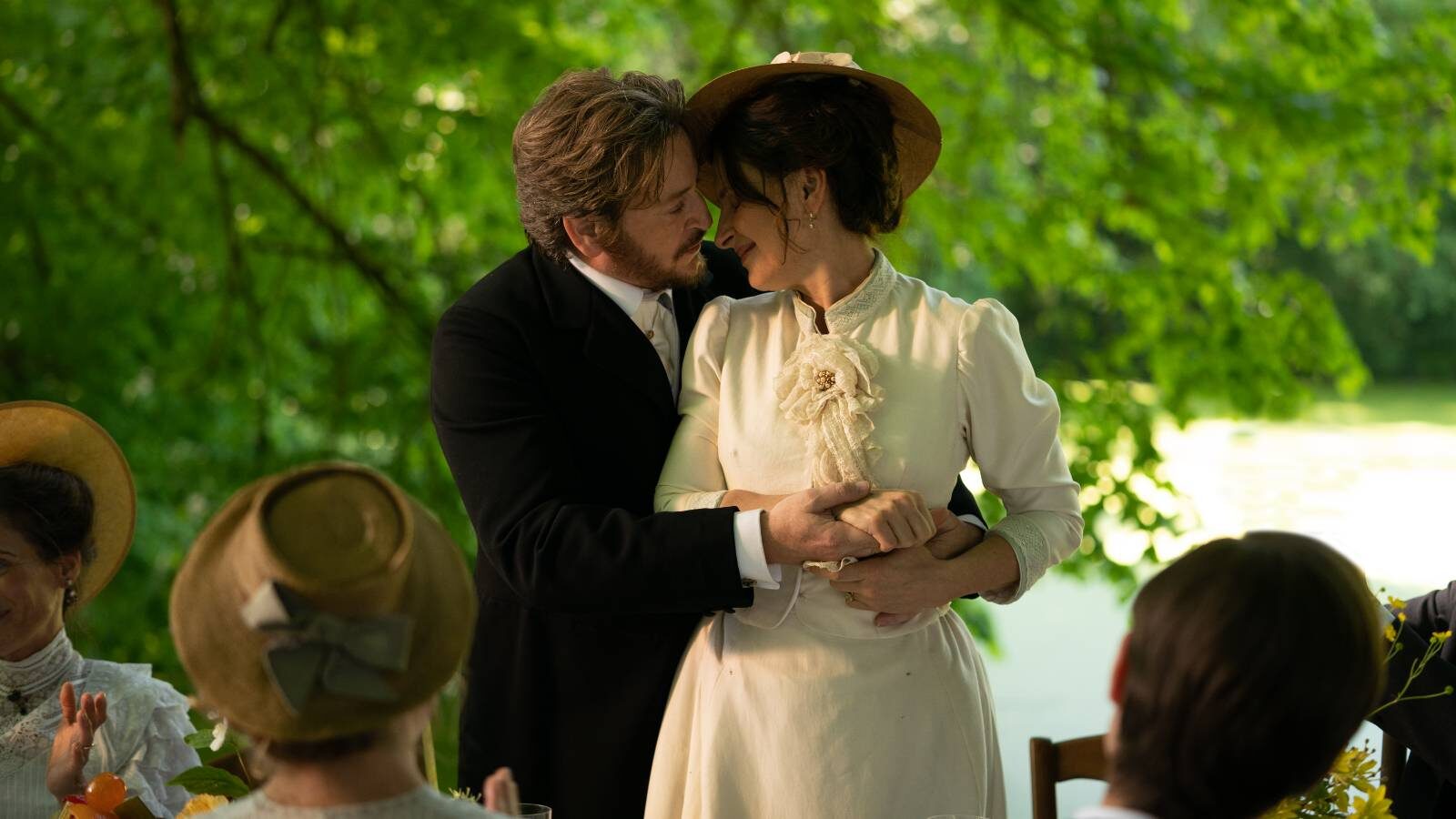
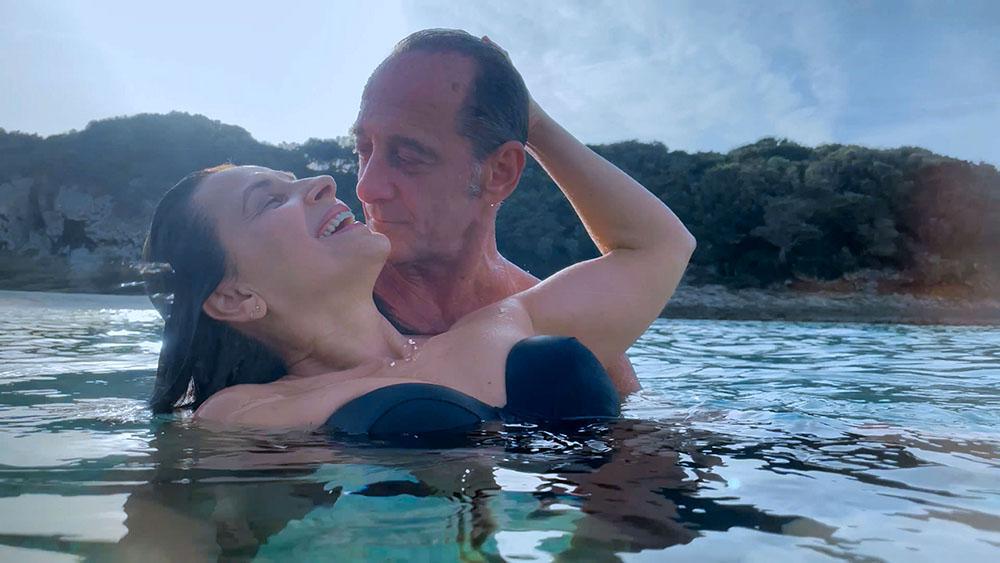
Photo caption: Nadia Tereszkiewicz and Francois Civil in TWO PIANOS. Courtesy of Kino Lorber.
In the well-crafted French melodrama Two Pianos, concert pianist Matthias (three-time César nominee Francois Civil) returns to his hometown of Lyon after a decade abroad. Matthias is already in a mid-career malaise, but things get more complicated when he re-encounters his formidable mentor Elena (Charlotte Rampling) and his best friend’s wife Claude (Nadia Tereszkiewicz). Matthias, who had dated Claude just before his self-exile, is further rocked when he sees that her ten-year-old son looks exactly like him. A well-crafted melodrama ensues, albeit one with unconventional turns.
Two Pianos is the latest from French director Arnaud Desplechin, who made the delightful My Golden Days, which I loved, and then Ismael’s Ghosts, which although it was generally favorable critical buzz, I loathed. Desplechin has received uneven notices for his recent narrative features. He co-wrote Two Pianos.
The plot of Two Pianos pivots on an unforeshadowed surprise which clears the way for a conventional ending, which Desplechin thankfully avoids. This plot point is so unabashedly convenient that some viewers have found it off-putting. I uneasily went with it and was relieved when Desplechin steered the story away from what would have been corny.
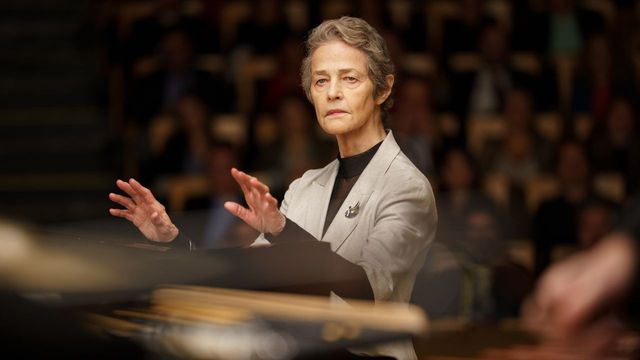
Charlotte Rampling in TWO PIANOS. Courtesy of Kino Lorber.
Civil has the challenge of playing a protagonist of uncertain will, who spends much of his screen time hand-wringing and naval gazing. The audience will see that, in contrast to Matthias’ dithering, all of the female characters know exactly what they want – the iron-willed Elena, Matthias’ unsentimental mother (Anne Kessler), Claude’s bestie Judith (Alba Gaia Bellugi) and, eventually, even the vulnerable and temperamental Claude.
Nadia Tereszkiewicz has a sexy magnetism and a feral unpredictability that serves her well in Two Pianos and in the underappreciated Only the Animals.
Charlotte Rampling is a treasure, and her performance as the exacting Elena is one of the pleasure of Two Pianos.
I especially appreciated that the story is set in Lyon, a city underrepresented in cinema. Lyon, after all, is the third largest city in France and the place where Parisian foodies go to experience the best of French cuisine. It’s a wonderful city.
I screened Two Pianos for the 2026 SFFILM festival. It opens in theaters this weekend.
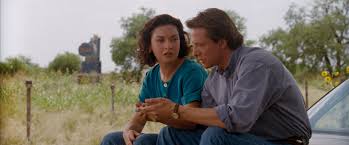
Photo caption: Chris Cooper and Elizabeth Pena in LONE STAR.
On April 9, Turner Classic Movies airs the 1996 John Sayles masterpiece Lone Star, a multi-generational story of mystery, corruption, racism, forbidden love and redemption. The ensemble cast is phenomenal: Chris Cooper, Elizabeth Pena, Matthew McConaughey, Kris Kristofferson, Miriam Colon, Joe Morton, Ron Canada, Frances McDormand, Clifton James, Stephen Mendillo, Tony Amendola. And the best part is the elegant storytelling of writer-director John Sayles.
The story is set in a small Texan town on the Mexican border. Sam Deeds (Chris Cooper) has returned to his hometown to serve as Sheriff. He hasn’t been in his hometown for many years because of his estrangement from his father, Buddy Deeds, the recently deceased previous Sheriff. The decidedly old school Buddy Deeds, who ran the county for decades, was respected and beloved – even legendary. After Sam introduces himself as Sheriff Deeds to an older local woman, she responds “Sheriff Deeds is dead, honey. You just Sheriff Junior.“
Sam’s daddy issues are mirrored by those of Delmore Payne (Joe Morton), a ramrod-striaght Colonel who has been assigned to command the nearby US Army base. Del resents growing up without his father Otis (Ron Canada), who owns a roadhouse outside the town proper, and Del is eager to unleash his bitterness upon Otis.
Inevitably, Sam finds his high school sweetheart Pilar (Elizabeth Pena) and the two rekindle a bond. Their relationship had been broken up by Sam’s dad Buddy and Pilar’s mom Mercedes, and Sam and Pilar have always thought it was on racial grounds.
Elizabeth Pena and Chris Cooper in LONE STAR.
Human remains are found in the desert, and they are identified as those of Buddy’s predecessor as Sheriff, the corrupt, racist and extremely fearsome Charlie Wade (Kris Kristofferson). Wade went inexplicably missing, and he was such a despicable bully, the relieved community didn’t seem to search for him very diligently.
The investigation of Charlie’s suspicious disappearance and death fall within Sam’s authority. Sam sees this as an opportunity to tarnish Buddy’s iconic status. Probing for some dirt to besmirch his father’s name, Sam asks Otis if Buddy ever took money for a favor, and gets back, “I don’t recall a prisoner ever died in your daddy’s custody. I don’t recall a man in this county – black, white, Mexican – who’d hesitate for a minute to call on Buddy Deeds to solve a problem. More than that, I wouldn’t care to say.”
Charlie disappeared before Sam and Pilar were born, but there are folks who were around at the time, Otis for one. Mercedes (Miriam Colon) is now a local business leader. The town’s good ol’ boy mayor Hollis (Clifton James) was, like Buddy, one of Charlie’s deputies. It turns out that what happened to Charlie is not so much a mystery as a long-suppressed secret.
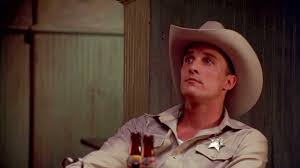
Kris Kristofferson in LONE STAR.
As Sam undertakes the present day investigation, we see flashbacks of the time when Charlie, as terrifying as a T-Rex, walked the earth, and we see the young Buddy (Matthew McConaughey), Hollis and Mercedes. Sayles unspools the story with live segues, in which a single camera shot shows the flashback action at a location and then shifts to the present at the same place. In Sayles hands, the technique is a seamless storytelling device, and never just a gimmick.
Along the way, Sam encounters a flood of memorable, fully fleshed out characters. especially a metal-detecting Army sergeant (Stephen Mendillo), a feisty Mexican old-timer (Tony Amendola) and Sam’s own ditzy ex-wife Bunny (Frances McDormand, in the same year as her Oscar-winning turn in Fargo).
As the story moves to its conclusion, there are two surprising revelations in the plot. And Sayles ends the film with one of the all-time best best closing lines.
Matthew McConaughey in LONE STAR.
Cooper and Pena lead a cast filled with exemplary performances. The villainous Charlie Wade is my favorite Kristofferson performance. McConaughey was essentially unknown, and Sayles said “I needed a guy who didn’t have any star weight but who had the presence to play off against Kristofferson.” That casting paid off with McConaughey playing a callow character, with just the hints of the charisma and authority that he would later grow into. Cooper, Colon and Morton all appeared in previous Sayles films.
John Sayles’ body of work is as impressive as that of any American indie film director – and more diverse: Passion Fish, Eight Men Out, Matewan, The Secret of Roan Inish and some of the most iconic Bruce Springsteen music videos. In Lone Star, racial relations on the Texas border are complicated and dynamic, just like those in urban New Jersey in that other Sayles ensemble piece City of Hope. He first became known for Return of the Secaucus 7, which was probably the model for The Big Chill and Thirtysomething.
Sayles was Oscar-nominated for the screenplays of both Lone Star and Passion Fish. The dialogue in Lone Star is exceptionally witty, and not just funny, but insightful thought-provoking. Sayles has also been a distinguished script doctor, responsible for many uncredited rewrites, such as Apollo 13. (He started out writing the screenplays for Roger Corman’s Piranha and another exploitation movie Alligator.)
Lone Star is John Sayles’ best movie and IMO the very best movie of 1996, along with Fargo and Secrets & Lies. If you miss it on TCM, you can stream it from Amazon, AppleTV, YouTube and Fandango.
On December 14, Turner Classic Movies airs the super hard-to-find German neo-noir romance Black Gravel. It’s not streaming, so this is your best chance.
In the German film noirBlack Gravel (Schwarzer Kies), Inge, the beautiful German wife of an American military base commander, runs into the shady hustler Robert, her former lover. He is one cynical dude and an asshole, but he doesn’t pretend to be anything else. Their reunion is bad for her, bad for him and bad for everyone.
The most common situation in film noir is a guy who falls for a dame (or a dame who falls for a guy) to his ruin. The sap is infatuated and thinks he’s in love. Here we have two characters and the question is whether they are really in love. Robert insists that he doesn’t love ANYONE, even as he is trying to rekindle the romance with Inge. Inge insists that it’s over. But is it over – for either of them? That’s what – in the end – Black Gravel is really all about – noir romance
In the last twenty minutes, the circumstances swivel. Rarely has a movie plot swung as rapidly between They’re gonna get caught – No, they’re gonna get away with it – No, They’re gonna get caught – No, they’re gonna get away with it – No, They’re gonna get caught – No, they’re gonna get away with it – No, They’re gonna get caught.
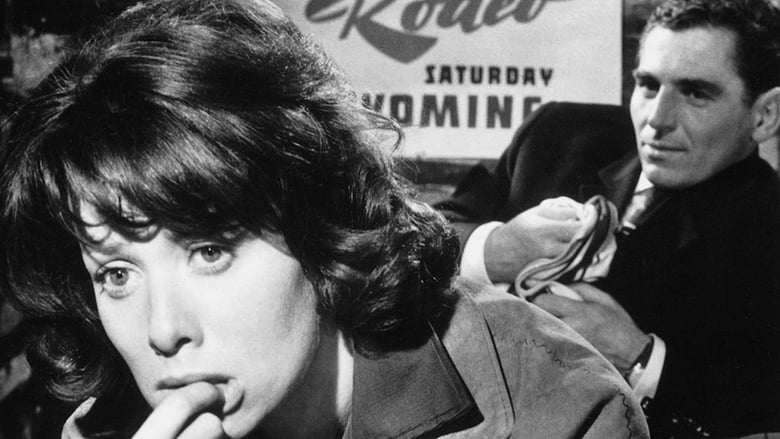
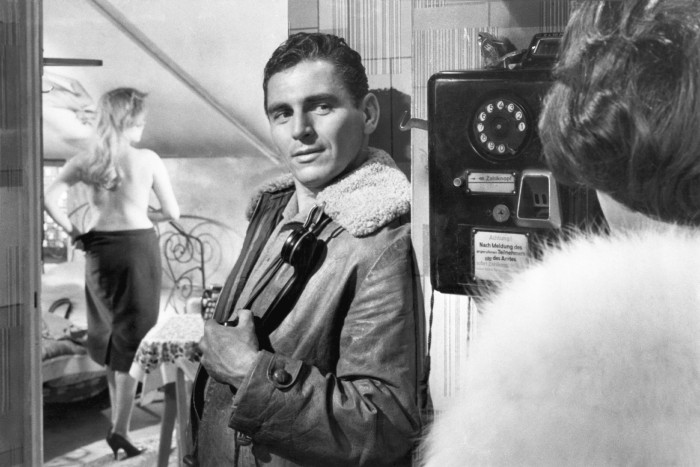
Ingmar Zeisberg and Helmut Wildt in BLACK GRAVEL
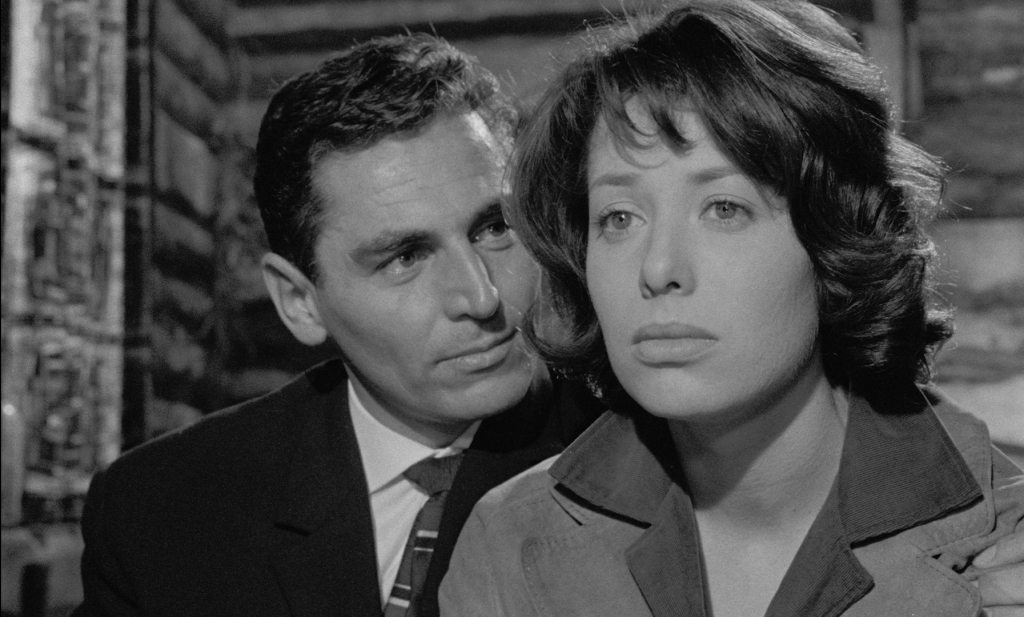
Robert is played by Helmut Wildt, a German actor I hadn’t seen before. He is charismatic and confident, with a breezy swagger that reminds me of Ben Gazzara. The deeply conflicted Inge is played ably by Ingmar Zeisberg.
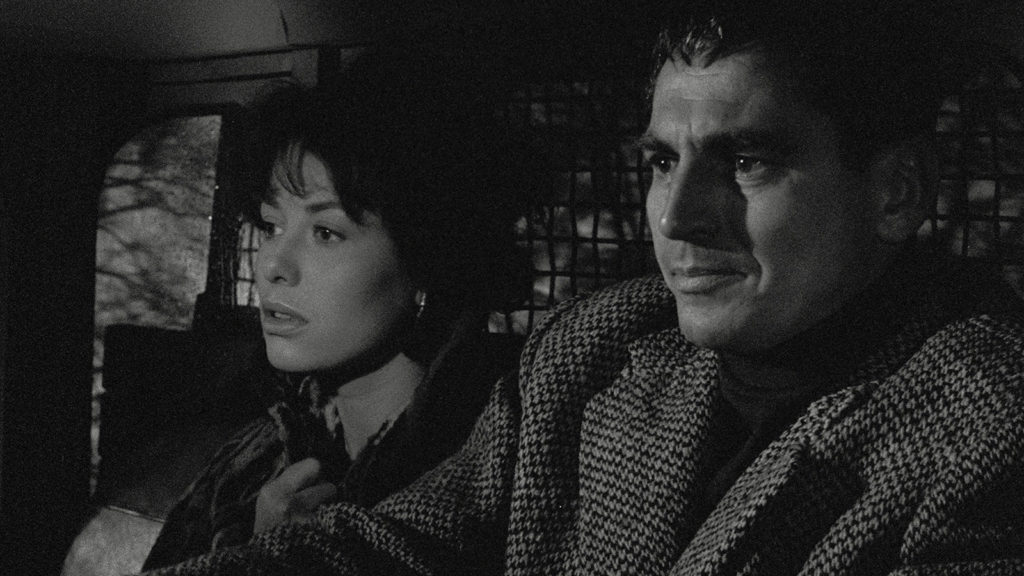
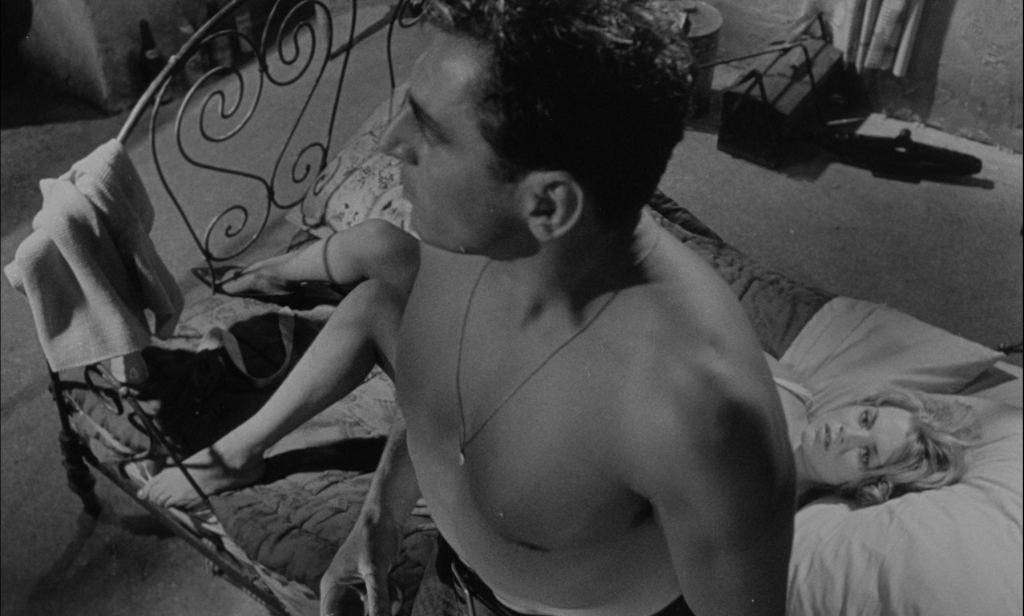
Anita Höfer, Helmut Wildt and Ingmar Zeisberg in BLACK GRAVEL
Black Gravel is set in a tiny German town corrupted by the presence of an US Air Force base, It’s the Phenix City of Germany, a sordid, trashy place. The character of Elli (Anita Höfer) is LITERALLY a slut.
Black Gravel is filled with tart observations of I Like Ike America, with its bland, conventional uniformity. The Germans are an amoral lot, reduced to leeching off the Americans. The Americans are clueless marks.
Helmut Wildt and Anita Höfer in BLACK GRAVEL
Note: A dog dies in the first minute of the film. I recommend that you don’t let this put you off this superb film; but, there it is, you’ve been warned.
The current version restores some bits that were cut from the film in 1961, supposedly as offensive to Jews. Those were probably the anti-semitic slurs uttered by unsympathetic characters; these slurs were not intended to debase Jews, but to illustrate the post-war continuation of antisemitism among Germans. (There’s some German racism in here, too). These are actually ANTI-antisemitic moments in the movie that were misunderstood at the time.
Unfortunately, it’s not streamable, but screenings can be booked from Kino Lorber, and it’s available for purchase in Blu-ray and DVD. I saw it at the 2020 Noir City.
Black Gravel was written and directed by Helmut Käutner. We don’t recognize this until late in the movie, but it turns out there’s no better noir romance than Black Gravel.
Photo caption: Juliette Binoche and Benoit Magimel in THE TASTE OF THINGS. Courtesy of IFC Films.
The French romantic drama The Taste of Things is the story of a man consumed by two passions – an obsession with gastronomy and a profound love for a woman. It’s also one of the mouthwatering movies in the history of cinema.
The man is Dodin (Benoit Magimel), a famous gourmand in 1884 France, a key moment in the history of the culinary arts, when the master French chef Escoffier was still in his 30s. The woman adored by Dodin is Eugenie (Juliette Binoche), not coincidentally his live-in cook.
The Taste of Things begins with a long scene (15+ minutes) as Eugenie leads a team in producing an elaborate garden to table meal, with every ingredient prepared old school, the long and hard way. Fish quenelles are formed by hand, shrimp shells are boiled into a stock, and the quenelles are pached in the shrimp stock. It takes hours for a rack of veal turned into an OMG marvel. It turns out that this is a multi-course feast prepared for Dodin and his chatty four buddies. The guys all fall SILENT when the consommé appears, and then, as the courses pile up, don’t say anything more that isn’t about the meal itself or the history of gastronomy.
The fruit of Eugenie’s labor, exquisitely photographed, are the height of food porn. One highlight is a spectacular vol-au-vent. When Eugenue shows up with a giant croissant-like thing (a giant bioche?) that she and the four buddies dig into with their hands, there were audible gasps from the audience at the screening.
There’s even a scene with a culinary Holy Grail, now illegal in the US, fabled ortolans devoured as per tradition, with the diners’ heads under their napkins. Of course gastronomy, as any human endeavor, can be taken to silly extremes, which is illustrated by a dinner for Dodin and his friends, hosted by a prince under the mistaken impression that more is always better.
Eugenie prepares masterpiece after masterpiece for Dodin until her health falters, giving him the opportunity to express his love by preparing and serving her an even more formidable dinner.
The Taste of Things is a film by writer-director Anh Hung Tran, who certainly knows his way around movie passion and movie foods (The Scent of Green Papaya).
Benoit Magimel and Juliette Binoche in THE TASTE OF THINGS. Courtesy of IFC Films.
It’s always a pleasure to watch the radiant Juliette Binoche, especially when she’s playing an endearing character like Eugenie, who keeps resisting Dodin’s offers of marriage even as she values his culinary partnership and welcomes him into her bed. Their relationship is perfectly summed up in the epilogue when Eugenie asks Dodin a question and receives his answer with bliss. She feels loved – and on her terms.
The Wife liked The Taste of Things less than I did, in part because she was less entertained by the long scenes of meal preparation, which captivated me. (I am The Movie Gourmet, after all.)
We both, however, thoroughly enjoyed the character of the culinary child prodigy Pauline (Bonnie Chagneau-Ravoire), especially her reaction to her first Baked Alaska and her growing into a peer of Dodin’s.
The Taste of Things was France’s submission to the Academy Awards. It’s going on my list of Best Foodie Movies. It’s now available to stream from Amazon and AppleTV..
Aylin Tezel and Chris Fulton in FALLING INTO PLACE. Courtesy of Cinequest.
The absorbing Scottish romantic drama Falling into Place begins on the Isle of Skye when two visiting London creatives meet outside a rowdy pub and flirt. Kira (Aylin Tezel), a theater set designer, is on holiday. Ian (Chris Fulton), a musician, has grown up on Skye and intends to shoehorn in an infrequent visit with his family. Kira is trying to get beyond a recent breakup, while Ian’s relationship is in its final throes.
When Kira hears that Ian has a girlfriend, she puts in the brakes, but she’s drawn enough to Ian that she accompanies him as he faces some family drama. Then, Kira and Ian return separately to London. The audience soon wants these two to get and stay together, but they’ll need to get past some trauma in Ian’s family, his current romantic entanglement, Kyra’s feelings for her ex, an attractive boss with his eyes on Kira and some bad timing.
Utterly devoid of the tropes in conventional movie romances, Falling into Place is profoundly authentic. This is the first feature for German-born writer/director Aylin Tezel (who also stars as Kira), and it’s a very strong and promising debut. As a director, she paces Falling into Place perfectly, keeping us eagerly engaged as the threads if Kira and Ian meet and part and meet again. She is especially adept directing the scenes in the Isle of Skye bar and the London art gallery opening, with lots of moving bodies and ambient sound. But it’s Tezel’s screenplay, without a single false note, that really soars.
I screened Falling Into Place for its US premiere at Cinequest.
Photo caption: Juliette Binoche and Benoit Magimel in THE TASTE OF THINGS. Courtesy of IFC Films.
The French romantic drama The Taste of Things is the story of a man consumed by two passions – an obsession with gastronomy and a profound love for a woman. It’s also one of the mouthwatering movies in the history of cinema.
The man is Dodin (Benoit Magimel), a famous gourmand in 1884 France, a key moment in the history of the culinary arts, when the master French chef Escoffier was still in his 30s. The woman adored by Dodin is Eugenie (Juliette Binoche), not coincidentally his live-in cook.
The Taste of Things begins with a long scene (15+ minutes) as Eugenie leads a team in producing an elaborate garden to table meal, with every ingredient prepared old school, the long and hard way. Fish quenelles are formed by hand, shrimp shells are boiled into a stock, and the quenelles are pached in the shrimp stock. It takes hours for a rack of veal turned into an OMG marvel. It turns out that this is a multi-course feast prepared for Dodin and his chatty four buddies. The guys all fall SILENT when the consommé appears, and then, as the courses pile up, don’t say anything more that isn’t about the meal itself or the history of gastronomy.
The fruit of Eugenie’s labor, exquisitely photographed, are the height of food porn. One highlight is a spectacular vol-au-vent. When Eugenue shows up with a giant croissant-like thing (a giant bioche?) that she and the four buddies dig into with their hands, there were audible gasps from the audience at the screening.
There’s even a scene with a culinary Holy Grail, now illegal in the US, fabled ortolans devoured as per tradition, with the diners’ heads under their napkins. Of course gastronomy, as any human endeavor, can be taken to silly extremes, which is illustrated by a dinner for Dodin and his friends, hosted by a prince under the mistaken impression that more is always better.
Eugenie prepares masterpiece after masterpiece for Dodin until her health falters, giving him the opportunity to express his love by preparing and serving her an even more formidable dinner.
The Taste of Things is a film by writer-director Anh Hung Tran, who certainly knows his way around movie passion and movie foods (The Scent of Green Papaya).
Benoit Magimel and Juliette Binoche in THE TASTE OF THINGS. Courtesy of IFC Films.
It’s always a pleasure to watch the radiant Juliette Binoche, especially when she’s playing an endearing character like Eugenie, who keeps resisting Dodin’s offers of marriage even as she values his culinary partnership and welcomes him into her bed. Their relationship is perfectly summed up in the epilogue when Eugenie asks Dodin a question and receives his answer with bliss. She feels loved – and on her terms.
The Wife liked The Taste of Things less than I did, in part because she was less entertained by the long scenes of meal preparation, which captivated me. (I am The Movie Gourmet, after all.)
We both, however, thoroughly enjoyed the character of the culinary child prodigy Pauline (Bonnie Chagneau-Ravoire), especially her reaction to her first Baked Alaska and her growing into a peer of Dodin’s.
The Taste of Things was France’s submission to the Academy Awards. It’s going on my list of Best Foodie Movies. It’s playing in a few arthouses now; I’ll let you know when it releases on VOD.
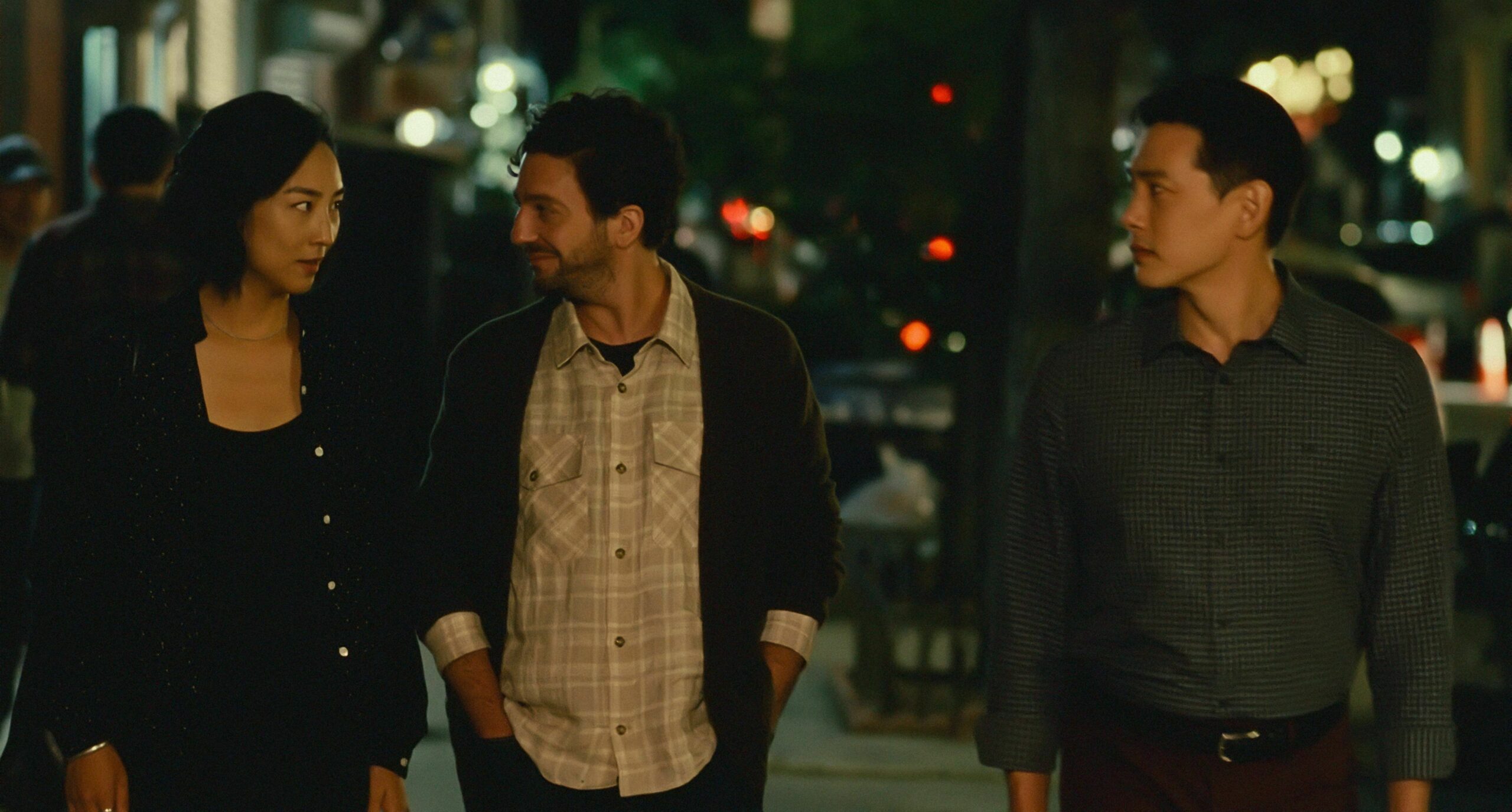
Photo caption: Greta Lee, John Magaro and Teo Yoo in PAST LIVES. Courtesy of A24
Past Lives is a profound romance, with one evolving relationship, and then a second, with the lives, loves and obsessions of three decent people swirling between two cultures over 24 years. The character-driven screenplay is a triumph for writer-director Celine Song in her first feature film.
The story of Past Lives begins 24 years ago in Korea, where a girl and a boy, 12-year-old classmates, are childhood best buddies. They have grown up as playmates, and are now each other’s first crush. The girl’s parents permanently relocate the family to Canada, and the two kids lose touch.
Twelve years later, the girl has grown into Nora (Greta Lee), a budding playwright in New York. The boy, Hae Sung (Teo Yoo) is an engineering student in Korea. Hae Sung tracks down Nora through social media, and the two have a reunion on Skype. The video calls became more frequent, and they kindle a tender and genuine adult relationship. They are becoming so close that it’s frustrating to not be geographically together, but they each have committed to career plans; she is beginning a writing fellowship in New York, and he’s about to go learn Mandarin in China. Nora recognizes that they are slipping into a love that is impractical and would require a major sacrifice by one of them – and she ends the calls.
Another twelve years pass, and Nora is still living in New York, but with her husband Arthur (John Magaro). Hae Sung is visiting New York and Nora arranges to meet him. When they finally meet again face-to-face, Nora learns what she may have suspected – the sole reason for Hae Sung’s visit is to see her. This meeting, awaited for 24 years, is clearly emotionally loaded for him; is it loaded for her as well?
Photo caption: Teo Yoo and Greta Lee in PAST LIVES. Courtesy of A24.
Now Nora has two men who want her, and she’s married to one of them. To describe Past Lives as a love triangle might be technically correct but would mislead you, because Past Lives is so specific, authentic and refreshing that it defies the conventions of the form. That we are so often surprised by Song’s movie is probably a telling comment on how we have been conditioned by insipid, shallow and inauthentic movie romances.
According to the conventions of Hollywood, Nora would run off with her soulmate – but which guy is that, exactly? It’s not quite the choice between Rick Blaine or Victor Laszlo, either. Each guy can give her something the other cannot. Each guy understand aspects of her that the other cannot. Nora describes Hae Sung to Arthur with “He’s so Korean“, and it’s unclear to what extent Nora see this as a good or bad thing.
There’s nary a false note in either of Nora and Hae Sung’s reunions, and the final dialogue is PERFECT.
Greta Lee in PAST LIVES. Courtesy of A24.
The performances do justice to the superb screenplay. Greta Lee plays Nora, who is the most central character (because she must choose between the others). Lee’s Nora is usually reserved and contained with others, sometimes even a cipher, but Lee is still able to convey Nora’s thinking and feeling.
Teo Yoo’s plays Hae Sung as an obsessive who ultimately evolves the most of any character. To Hae Sung, Nora is an object of fantasy for decades, and then he must see her as a person. There’s a scene at a carousel where Nora wants Hae Sung to speak to his feelings, and heartbreakingly, his cultural upbringing just won’t let him do it.
The most extraordinary performance is by John Magaro, an actor I had seen in The Big Short, The Many Saints of Newark and 18 1/2 without any appreciation that he was capable of work like this. Who wouldn’t be threatened when your partner’s first crush shows up to woo her? And when they are next to you, speaking with each other in a language you can’t understand? Arthur knows that he has played his hand already, and can only wait for the other cards to be revealed to see if he has won or lost. If he acts out, he would only hurt his chances. As he puts on a mask of stoicism and civility, Magaro’s Arthur is practically vibrating with anxiety.
In a clever prologue, Celine Song begins her movie with unseen patrons at a New York City bar trying to figure out the back story between the three people grouped across the room – an Asian man, an Asian woman and a white guy. Indeed, the movie is about who those three people are to each other. Like her character Nora, Song was born in Korea, immigrated to Canada with her parents, and lives in New York City with her American writer husband.
Song seems to be saying that love is more than one’s own feelings of attraction and connection; love also requires knowing who the other person truly is and is not, which demands setting aside one’s own perspective to listen and observe empathetically.
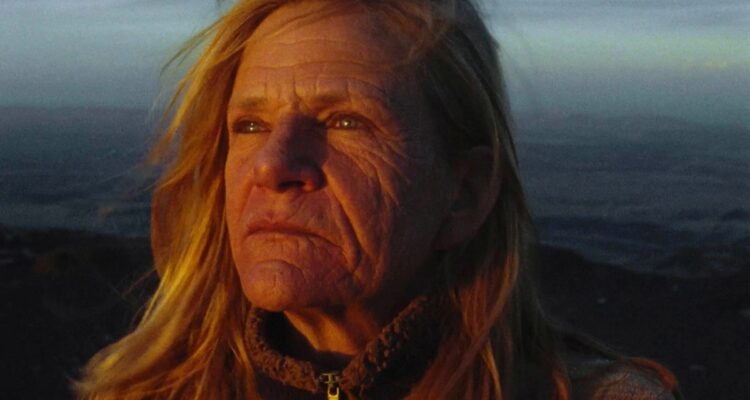
Photo caption: Dale Dickey in A LOVE SONG. Courtesy of San Luis Obispo Film Fest.
A Love Song is a welcome starring vehicle for the longtime character actress Dale Dickey, whose every good night and every bad night is etched into the lines on her face. Dickey plays Faye, whom we meet camping alone in her travel trailer in the remote high desert of Western Colorado.
After a decades-long marriage, Faye has been widowed for seven years, paralyzed by grief in the first two. Now she moves confidently around her solo campsite, displaying her serious outdoor skills and an impressive touch for fishing for crawdads.
It is revealed that Faye is waiting for someone. She has invited a high school friend, whom she hasn’t seen for over three decades, to re-connect. That friend is Lito (Wes Studi), who has also been widowed after a long marriage.
A Love Song wistfully explores loneliness and how grief can impact the ability to love again.
Dickey is on screen almost every moment, and she’s great. Dickey has a way of making even her supporting performances unforgettable. She broke through as the scary meth matriarch in Winter’s Bone, and played the flinty bank teller in Hell and High Water.
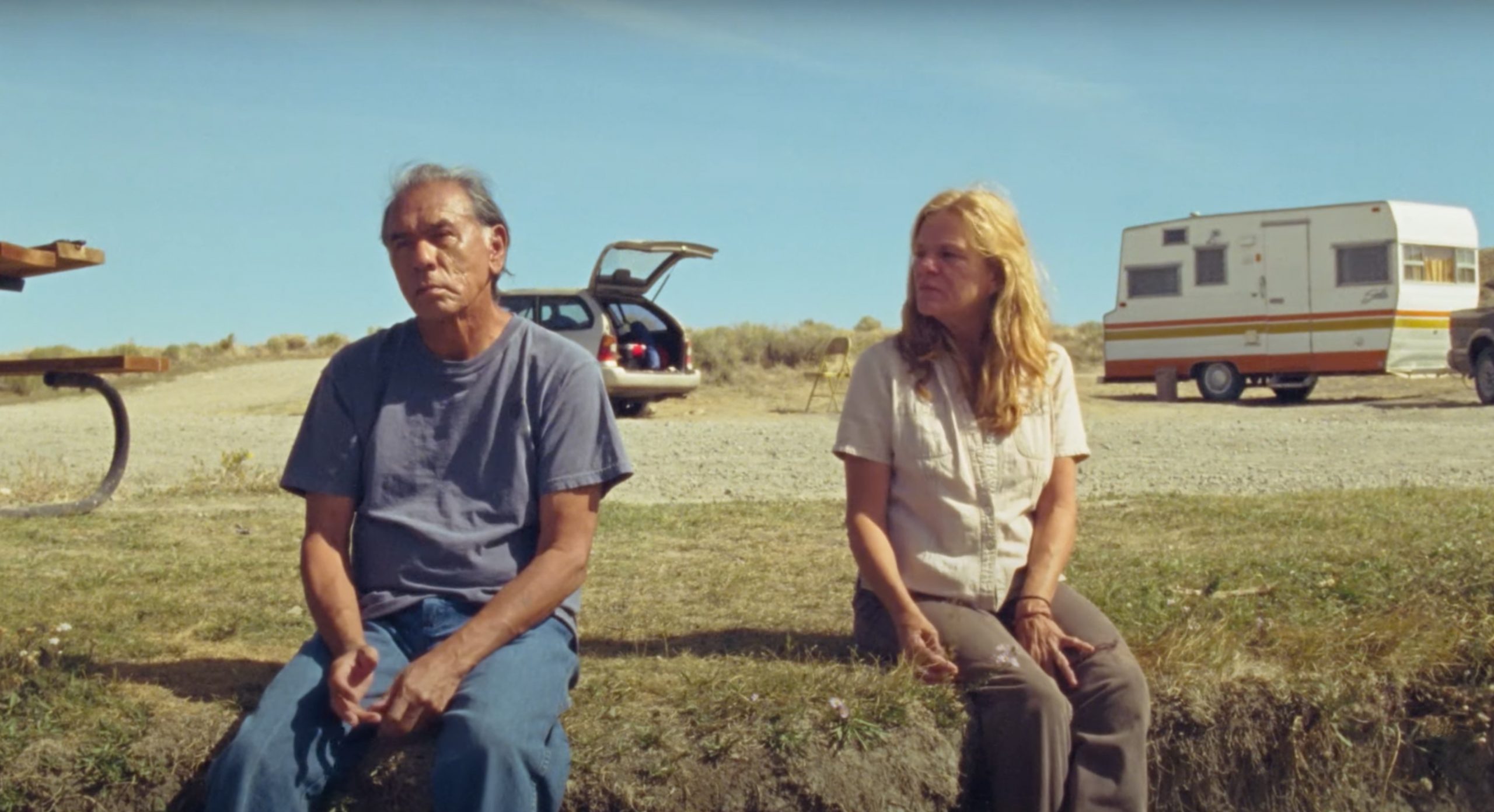
Wes Studi and Dale Dickey in A LOVE SONG. Courtesy of Bleecker Street.
Studi recently received a deserved lifetime Oscar. His performances as very scary Native American warriors in Dances with Wolves and The Last of the Mohicans sparked a very impressive body of film work.
Dickey and Studi have said that each had their very first on-screen kiss in A Love Song.
A Love Song is the first feature for writer-director Max Waterman-Silver, who uses his debut to show off his native Western Colorado. I found his direction inconsistent, but he delivered two perfect single-shot scenes, both of very long duration, one when Lito and Faye are sitting with guitars, the other when the two are standing outside Faye’s trailer.
Faye is occasionally visited by four Native American brothers with their little sister as their spokeswoman. Waterman-Silver’s sense of comic timing in these scenes is flawless.
Both The Wife and I were periodically distracted by holes or inconsistencies in the screenplay. At one point, the dog inexplicably vanishes (fortunately temporarily). And there’s no way that someone with Faye’s seasoning would hike up a mountain without water, especially when she can’t make it back down by nightfall.
I admire filmmakers who make their films short enough (82 minutes) so they can pace them slowly. The Wife, less patient with slow burns, still thought that it ran long.
The performances by Dickey and Studi are reason enough to watch this bittersweet, gentle, heartfelt and funny film. I saw A Love Song at the San Luis Obispo International Film Festival. It releases into theaters this weekend.
Photo caption: Juliette Binoche and Vincent Lindon in Claire Denis’ BOTH SIDES OF THE BLADE (FIRE). Courtesy of SFFILM.
With some of Frances’s top filmmakers on the job – Both Sides of the Blade is not your conventional love triangle.
Sara (the ever rapturous Juliette Binoche) has built a ten-year relationship with Jean (Vincent Lindon), that has survived his prison sentence. Sara had previously been with François (Grégoire Colin), but left him because she valued Jean’s reliability, loyalty and decency. When François shows up again in their lives, Sara is drawn to him again.
Both Sides of the Blade is the work of French auteur Claire Denis (35 Shots of Rum, Let the Sunshine In). With Denis, Binoche and Lindon layering in all the complexities of these characters, the result is unexpected.
I screened Both Sides of the Blade (also known as Fire) earlier this year for this year’s San Francisco International Film Festival (SFFILM). It opens in Bay Area theaters this week.
Photo caption: Dale Dickey in A LOVE SONG. Courtesy of San Luis Obispo Film Fest.
A Love Song is a welcome starring vehicle for the longtime character actress Dale Dickey, whose every good night and every bad night is etched into the lines on her face. Dickey plays Faye, whom we meet camping alone in her travel trailer in the remote high desert of Western Colorado.
After a decades-long marriage, Faye has been widowed for seven years, paralyzed by grief in the first two. Now she moves confidently around her solo campsite, displaying her serious outdoor skills and an impressive touch for fishing for crawdads.
It is revealed that Faye is waiting for someone. She has invited a high school friend, whom she hasn’t seen for over three decades, to re-connect. That friend is Lito (Wes Studi), who has also been widowed after a long marriage.
A Love Song wistfully explores loneliness and how grief can impact the ability to love again.
Dickey is on screen almost every moment, and she’s great. Dickey has a way of making even her supporting performances unforgettable. She broke through as the scary meth matriarch in Winter’s Bone, and played the flinty bank teller in Hell and High Water.
Studi recently received a deserved lifetime Oscar. His performances as very scary Native American warriors in Dances with Wolves and The Last of the Mohicans sparked a very impressive body of film work.
Dickey and Studi have said that each had their very first on-screen kiss in A Love Song.
A Love Song is the first feature for writer-director Max Waterman-Silver, who uses his debut to show off his native Western Colorado. I found his direction inconsistent, but he delivered two perfect single-shot scenes, both of very long duration, one when Lito and Faye are sitting with guitars, the other when the two are standing outside Faye’s trailer.
Faye is occasionally visited by four Native American brothers with their little sister as their spokeswoman. Waterman-Silver’s sense of comic timing in these scenes is flawless.
Both The Wife and I were periodically distracted by holes or inconsistencies in the screenplay. At one point, the dog inexplicably vanishes (fortunately temporarily). And there’s no way that someone with Faye’s seasoning would hike up a mountain without water, especially when she can’t make it back down by nightfall.
I admire filmmakers who make their films short enough (82 minutes) so they can pace them slowly. The Wife, less patient with slow burns, still thought that it ran long.
The performances by Dickey and Studi are reason enough to watch this bittersweet, gentle, heartfelt and funny film. I saw A Love Song at the San Luis Obispo International Film Festival. It has been picked up for distribution by Bleecker Street, which plans a July 29 theatrical release.