SIRAT: gripping, hypnotic and devastating

Photo caption: Bruno Nunez Arjuna  and Sergi Lopez in SIRAT. Courtesy of NEON.

In the harrowing, and finally shattering, Sirat, the middle-aged Spaniard Luis (Sergi Lopez) and his 11-year old son Esteban (Bruno Nunez Arjuna) are looking for Esteban’s older sister, a young adult who they haven’t heard from for five months. Following up on a tip, they are passing out leaflets with her picture at a gathering of European ravers deep in the Moroccan desert.

They don’t find anyone who has seen her, but they hear about another rave coming up to the south, near Mauritania. Civil war has erupted, and the army arrives to evacuate EU citizens out of the country. A small contingent of ravers bolts the convoy, heading for the rumored next rave to the South, and Luis and Esteban, uninvited, follow.

The five ravers, adorned with an assortment of tattoos, piercings, and missing limbs between them, are driving two Mad Max-style trucks that they sleep in. They are nomads, happy to endure rough conditions if they can get high and sway to electric dance music. They’re not thrilled to have Luis and Esteban along, but a bond develops as the seven face the same hardships together.

And hardships abound, as the little convoy grinds through the vast desert. The only people they see are multitudes of refugees fleeing, significantly, in the opposite direction. It’s an unforgiving environment, where if they run out of water, fuel or food, or lose a vehicle, there is no recourse.

They must transverse a narrow, mountain track perched on the side of a cliff. It’s terrifying.

Beginning midway through Sirat, director and co-writer Oliver Laxe rocks us with some stunningly sudden and emotionally devastating events. These are not like the jump scares in the horror genre. These are from among the most shocking occurrences that real people experience in real life.

Sergi Lopez in SIRAT. Courtesy of NEON.

When writing about Sirat, many critics use the words hypnotic and mesmerizing. The story is gripping, but it is embedded in stunning landscapes – the desert itself is becomes a character. During the journey, the soundtrack mirrors the throbbing electronic music from the rave in the opening opening. In terms of audience engagement, Sirat is a triumph for Oliver Laxe.

The performance by Sergi Lopez is epic. Lopez makes Luis’ vulnerability, caginess, dread, terror, numbing grief and fatalistic determination all credible and heartfelt.

The ravers are played by non-actors, but they are so authentic and believable, you can’t tell.

Tonin Janvier and Jade Oukid in SIRAT. Courtesy of NEON.

As Luis and Esteban drive deeper in the forbidding expanse, we wonder, Is the missing daughter/sister safe or in danger? Is she even alive? Does she want to be found? Is Luis risking himself and Esteban for nothing? In the first half of Sirat, we’re asking ourselves whether Luis and Esteban wilI find her. In the second half, those questions become meaningless.

Besides the elements that make Sirat a psychological thriller, there’s a lot here to think about. We see human empathy creating a bond. We see wisdom, most cruelly acquired. Ultimately, Laxe may be asking, what does it really mean to have nothing to lose?

There might also be a comment on adventure tourism. YouTube is full of folks who travel to other lands to experience physical challenges and risky thrills. As seasoned and well-supplied as are the ravers, they are Europeans, and they are from a society in which there are always first responders. Where they have ventured, there are no first responders.

Sirat’s title appears 32 minutes into the running time, a trend I’ve noticed in other recent films. I’m not sure whether I think this practice is pretentious. The title is the name of the mythical bridge between heaven and hell. I’m not sure that there is a heaven in this movie, or even whether any of the characters is seeking heaven. It’s more like everyone is navigating through purgatory unaware of their proximity to hell.

The road on the precarious cliff-side in the trailer frightened me off from seeing Sirat in a theater; I have a fear of heights that precludes me from driving these roads in rel life, and I fear even watching it on screen will trigger a panic attack. Once Sirat started streaming, I knew I could watch it while protected by the fast-forward button on my remote.

Sirat is set n the endless, parched deserts of Morocco, but it was filmed in both Morocco and the Aragon region of Spain. 

This is one of the most-acclaimed recent films. Sirat won the Palme d’or at Cannes and was nominated for the Best International Film Oscar. Many of the 47 awards it has won have been for sound and music.

That being said, this is not a movie for everyone. The audience has to be ready for excruciating heartache and profound bleakness. Despite the sun-baked visuals and the exciting set pieces, this is a very dark film.

Sirat is available to stream from Amazon, AppleTV, YouTube and Fandango and is included with Hulu.

HUMAN RESOURCES: Iago with a sick sense of humor

Pedro De Tavira (center) in HUMAN RESOURCES. Courtesy of Cinequest.

In the dark, dark Argentinian comedy Human Resources, Gabriel Lynch (Pedro De Tavira) is an alienated office worker, in an absurdly alienating workplace. Gabriel is a low-level supervisor on an anonymous lower floor of a corporate hive with too many layers of management and an oppressive, top-down culture. It’s also oversexed, with a carousel of Inappropriate office liaisons. And, we’ll soon see, is shockingly tolerant of what we would see as the most horrifying workplace violence.

Gabriel, an Iago with a sick sense of humor, begins a ruthless, unhinged campaign against those who offend him. Alienation leaks out in how her treats everyone. Mischievous, mean-spirited and completely unashamed, he’s very fun to watch. And, as venal as Gabriel is, he is matched, step-for-step, by Veronica from Finance (Juana Viale).

Around the 41-minute mark, Gabriel makes his grievance explicit (followed by a great drone shot)

“I’ve lived like the secret son of a king for a long time, waiting for a courtier to rescue me. Of course, nobody rescued me. Nobody rescues anybody.”

Human Resources is the creation of writer-director Jesús Magaña Vázquez. I’ve rarely seen a more cynical comedy.

Last year’s Cinequest hosted the US premiere of Human Resources, which I highlighted in my Best of Cinequest. Human Resources is now streaming on Hulu. There are many recent movies with a similar title; make sure you’re watching the 2023 Recursos Humanos directed by Magana and starring Pedro De Tavira.

I love the Spanish language trailer, even without English subtitles:

WE SHALL NOT BE MOVED: trauma, bitterness, catharsis

Photo caption: Luisa Huertas in WE SHALL NOT BE MOVED. Courtesy of Varios Lobos Produccions.

Pierre Saint Martin’s brilliant debut feature We Shall Not Be Moved (No nos moverán) is about a lifelong obsession and an unexpected catharsis.

The salty, grumpy Socorro is an elderly Mexico City attorney with a decidedly downscale clientele. She lives with family members in an apartment stacked with decades of case files. Her life has been defined by the traumatic loss of her brother, killed in 1968 in the police repression of student demonstrations just before the 1968 Olympic Games known as the Tlatelolco massacre. Shortly after, she secured a photo of the soldier who killed her brother, but his identification eluded her.

For over five decades, Socorro has been consumed by the thirst for unfulfilled, and apparently impossible, vengeance. Her bitterness has resulted in deeply dysfunctional relationships with her roommates – her doddering sister and her floundering middle-aged son.

Just when it looks like Socorro’s health will end her quest for revenge, she is surprised by new information. Ever resourceful, she enlists a network of shady associates to launch a man hunt. It doesn’t turn out as she, or we, would expect.

Of course, an old lady is an unlikely assassin, especially one who can barely climb the stairs to her apartment, and most of her crew is just as decrepit, so there’s an underlying absurdity to her quest. There’s plenty of humor here, stemming from Socorro’s unrepentant irascibility and clever resourcefulness, and the foibles of the quirky folks in her life.

She may be a lawyer, but Socorro navigates an informal legal system and an informal economy, where every transaction seems to be off-the-books. We Shall Overcome is filled with the cynicism with which Mexicans regard their national institutions.

We Shall Overcome is an impressive first feature for director and co-writer Pierre Saint Martin. Despite the griminess of the settings, it’s a beautiful, sometimes magical-looking, black-and-white film. Saint Martin is also able to bring uncommon depth to the supporting characters, especially Socorro’s depressed and defeated son Jorge (Pedro Hernández), her zany gofer Sidarta (Jose Antonio Patiño), her dying old colleague Candiani (Juan Carlos Colombo), and her Argentine daughter-in-law Lucia (Agustino Quinci), who finds herself way too normal for this family.

We Shall Not Be Moved won four Ariels (the Mexican Oscar) for Best First Feature, Best Actress, Best Original Screenplay, and Best Breakthrough Performance, and is Mexico’s submission for the Best International Film Oscar. We Shall Not Be Moved is rolling out in American theaters, including San Francisco’s Roxie this week.

THE FANTASTIC GOLEM AFFAIRS: absurd, raunchy and funny

Javier Botet and Bray Efe in THE FANTASTIC GOLEM AFFAIRS. Courtesy of Gluon Media.

The Spanish comedy The Fantastic Golem Affairs is unlike any other movie you’re likely to see this year, and the absurdity starts in the opening scene. After a night of partying, the pudgy slacker Juan (Bray Efe) and his best buddie David (David Menendez) are goofing around on the roof of Juan’s Madrid high-rise apartment building. David accidentally falls off and plunges to the roof of a car parked many stories below. That reveals that David is made of ceramic, as he shatters into hundreds of shards.

While still in a state of shock, Juan is annoyed by a shady car insurance agent, his late friend’s obnoxious and venal lover, apathetic cops and a woman with an outrageous computer dating profile. But he is obsessed by the mystery of a ceramic man, and keeps on the investigative trail until he stumbles on an unworldly conspiracy rooted in his own family. Along the way, a bizarre freak accident keeps recurring, killing people that he encounters during his investigation.

It’s been accurately written that there is magical realism in The Fantastic Golem Affairs, but it’s not the sweet, mystical kind in, say Like Water for ChocolateThe Fantastic Golem Affairs is bawdy and in-your-face.

The playfully, irreverent tone strongly reminds me of Pedro Almodovar’s early work (Women on the Verge of a Nervous Breakdown, Tie Me Up! Tie Me Down!, High Heels and Kika) and his VERY early work (Pepi, Luci, Born and Other Girlds Like Mom). Indeed, one of the characters observes, “This is like a Spanish movie from the 90s“. The Fantastic Golem Affairs is not as riotous as early Almodovar, but it adds that magical realism and much more absurdism.

Javier Botet in THE FANTASTIC GOLEM AFFAIRS. Courtesy of Gluon Media.

The Fantastic Golem Affairs is highly imaginative work of Spanish writer-directors Juan Gonzalez and Nando Martinez, who call themselves Burnin’ Percebes. They hit us with the absurdity of the shattering ceramic man right at the beginning, juxtaposed with the peppy music underneath the opening credits. The music combines with an often static camera, long shots, and colorfully retro sets that are unabashedly cheap. This is a zany, raunchy movie with some mild body horror.

[Gratuitous digression: I’m always proud to point out when I actually get a joke in Spanish. The directors’ pseudonym is Burnin’ Percebes, and percebes is Spanish for gooseneck barnacle, a hideously ugly (Google it) and delicious shellfish from Northern Spain. They are dangerous to harvest from oceanside cliffs, and are accordingly expensive – about ten times the price of a regular tapa. Of course, The Movie Gourmet himself has enjoyed percebes in San Sebastian.]

The Fantastic Golem Affairs is opening in theaters, including LA’s Alamo Drafthouse.

KILL THE JOCKEY: surrealism in the stables

Photo caption: Nahuel Perez Biscayart and Ursula Corbero in KILL THE JOCKEY. Courtesy of Music Box Pictures.

In the surreal Argentine comedy Kill the Jockey, Remo (Nahuel Perez Biscayart) is a once-champion jockey, who is zealously self-sabotaging his career; self-medicating with alcohol and even swiping the racehorses’ drugs and the booze left on a good luck altar, he has become utterly unreliable. Remo can only emerge from his narcosis to demonstrate his passion for his wife Abril (Ursula Corbero). Abril is also a jockey, and her racing career is on the upswing, although she will soon have to pause it to have their baby.

Both Remo and Abril ride for a mobster (Daniel Jimenez Cacho), who, against all available evidence, has concluded that Remo can still win a big race. As a result, Remo suffers a brain injury, which spurs catatonia and, eventually, a major change in his identity. Remo leaves the hospital without being discharged, and wanders the city in a walking stupor, unaware that both a frantic Abril and the mobster’s murderous goons are searching for him. At this point, Remo is not an ideal gunowner, but he gets a pistol, and the lives of Remo, Abril and the mobster take significant twists. Kill the Jockey morphs into a fable of identity.

Nahuel Perez Biscayart in KILL THE JOCKEY. Courtesy of Music Box Pictures.

Director and co-writer Luis Ortega tells this story with plenty of droll absurdism. Inexplicably, the mobster usually carries an infant, a mounted brass band suddenly appears, the possessions of a coat pocket include a live fish, and there’s ceiling-walking. Kill the Jockey has its share of LOL moments in the first half of the film.

Early in the film, Abril launches a celebratory dance, is soon joined by Remo, and the two move together as unhinged marionettes. It’s as if figures in a Dali painting broke into a sensuous dance. This is a spellbinding scene, the best one in Kill the Jockey and, possibly, in any movie this year so far.

Unfortunately, the second half of Kill the Jockey, with more Remo and less Abril, is not as compelling. Ortega keeps throwing in the entertainingly bizarre, but the film loses momentum as Remo transforms.

I first saw Nahuel Perez Biscayart as the star of the psychological Holocaust thriller Persian Lessons. He’s a good choice to play the tragicomic Remo, a broadly funny character that morphs into a heartfelt one. But the most interesting performance in Kill the Jockey is Ursula Corbero’s as Abril – brimming with charisma and vitality; Abril must navigate her life and Remo’s as Remo’s condition keeps changing dramatically.

Kill the Jockey is Argentina’s submission for the Best International Feature Film Oscar and has been nominated for significant awards, including the Goya (best Iberoamericano film) and the best film at Venice Film Festival. It releases into theaters this weekend, including the Laemmle NoHo in LA, the Roxie in San Francisco and the Smith Rafael Film Center in San Rafael.

THE WHISTLERS: walking a tightrope of treachery

Photo caption: Catrinel Marlon and Vlad Ivanov in THE WHISTLER. Courtesy of Magnolia Pictures.

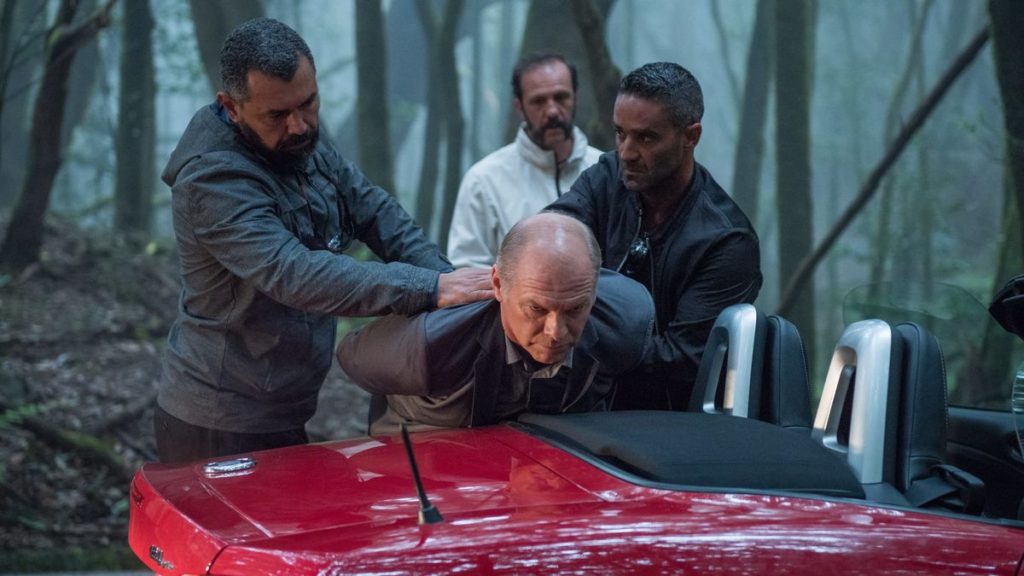
In the absorbing crime thriller The Whistlers, Cristi (Vlad Ivanov) is a shady Romanian cop who is lured into a dangerous plot by the rapturously sexy Gilda (Catrinel Marlon) and the promise of a fortune. A lethal Spanish mafia is planning a Perfect Crime to recover the loot stolen by Gilda and her Romanian partner, Zsolt. Only Zslot knows where the treasure is, and he’s been jailed by Cristi’s colleagues. To beat the omnipresent surveillance of Romanian state security, Cristi is sent to La Gomera, an island in the Spanish Canary Islands to learn a whistling language.

A whistling language? Indeed, residents of La Gomera can communicate by whistling in code. The language is called Silbo Gomera and it was already being used in ancient Roman times. The whistling can be heard for up to two miles, which allows the locals to communicate across the impassable ravines on the mountainous island.

The plan to spring Zsolt depends on Cristi learning Silbo Gomera and then implementing an intricate plan in which nothing can go wrong. Even if the plan goes right, Cristi and Gilda run the very real risk of being killed by the pitiless Spanish mafia or by the corrupt and unaccountable Romanian cops. Cristi and Gilda are walking a tightrope of treachery.

Vlad Ivanov in THE WHISTLERS. Courtesy of Magnolia Pictures.

The Whistlers is written and directed by Corneliu Porumboiu, who is a master of the deadpan. Two of his earlier films became art house hits in the US, 12:08 East of Bucharest and Police, Adjective. Both of those films explored fundamental corruption in Romanian society as a legacy of the communist era..

Cristi is played by Romanian actor Vlad Ivanov. Ivanov is best known for the Romanian masterpiece 4 Days, 3 Weeks and 2 Days, in which he played one of cinema’s most repellent characters – Mr. Bebe, the sexual harassing abortionist. American audiences have also seen Ivanov’s performances in Police, Adjective and Snowpiercer.

Ivanov excels in playing Everyman piñatas, which serves him well in The Whistlers. Ivanov delivered a tour de force in the 2019 Cinequest film Hier, as a man more and more consumed by puzzles, and increasingly perplexed, dogged, battered and exhausted.

For The Whistlers to work, Catrinel Marlon must make Gilda quick-thinking and gutsy, and she pulls it off. She is very good, as is Rodica Lazar as Cristi’s coldly ruthless boss Magda.

This is a Romanian film with dialogue in Romanian, English, Spanish and, of course, whistling. The Whistlers, a top notch crime thriller, can be streamed from Amazon, AppleTV, YouTube and Fandango – and it’s currently included with Max.

YOU ARE NOT ME: a nightmare at mom and dad’s

Photo caption: Roser Tapias in YOU ARE NOT ME. Courtesy of Music Box Films.

In the Spanish psychological horror film You Are Not Me, Aitana (Roser Tapias) and her Brazilian partner Gabi (Yapoena Silva), with their adopted infant, show up early for Christmas at the Catalan home of Aitana’s affluent parents (Pilar Almeria and Alfred Pico). And Aitana seems to step into a nightmare. Or is it?

The first thing that rocks Aitana is her parents’ reaction. They don’t seem happy to see Aitana after many years, nor to meet her partner or their own first grandchild. They’re especially displeased that Aitana’s family has arrived on the eve of a dinner party they’ve planned, a special party that is not the usual family holiday get-together.

Why are the parents acting so inappropriately? Are they homophobic? Are they racist (the baby is black)? Are they still pissed off at Aitana? Aitana is headstrong and often tactless, and we learn that there’s some baggage; years before, the parents were hosting Aitana’s wedding to their ideal son-in-law, when Aitana, realizing she was a lesbian, suddenly ran away, leaving everyone in the lurch.

Aitana is also upset by the condition of her wheelchair-bound younger brother, Saul (Jorge Motos), whose degenerative disease is apparently getting worse.

But, what really sends Aitana over the edge is that her parents are fawning over a Romanian woman Aitana’s age, Nadia (Anna Kurikka). They have awarded Aitana’s room to Nadia, along with their affection and even Aitana’s wedding dress. When Aitana discovers evidence of Nadia’s dishonesty and even behavior that threatens Saul, the parents refuse to listen.

A scene from in YOU ARE NOT ME. Courtesy of Music Box Films.

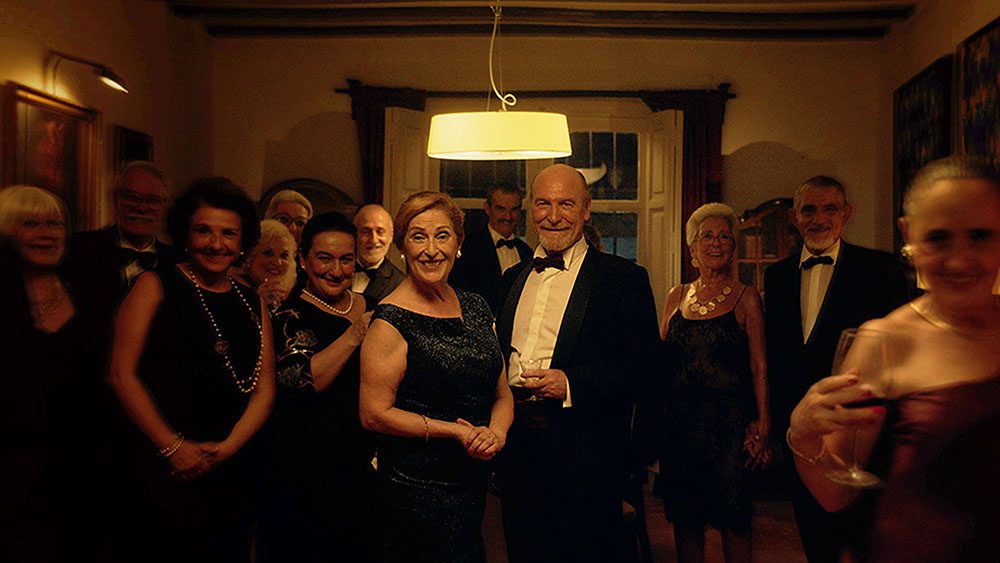
Finally, there’s the parents’ formal dinner party, hosting several couples their age. The parents are meeting many of the guests, from several European countries, for the first time. The guests are unusually convivial (and horny). Although the guests are outwardly very traditional, they make what is a decidedly a creepy assemblage. Everything is conventional, but Aitana and the audience feel that something must be amiss.

You Are Not Me was co-written and co-directed by Marisa Crespo and Moisés Romera in their second feature film. It’s a well-directed film that benefits from a clever story that keeps the audience off-balance. Are these things really happening, or is Aitana imagining or dreaming them, or even hallucinating? Is Aitana just easily offended or is she paranoid or even schizophrenic? Her well-balanced partner Gabi is rolling with the punches and unintentionally gaslighting Aitana. By making Aitana so prickly, having her jet-lagged and then drunk, Crespo and Romera keep us wondering. And just when we think that the ending is outrageously cheesy, Crespo and Romera creep us out again.

You Are Not Me is streaming on Amazon and Fandango.

THE SETTLERS: reckoning with the ugly past

Photo caption: Mark Stanley, Camilo Arancibilia and Benjamin Westfall in THE SETTLERS.  Courtesy of MUBI.

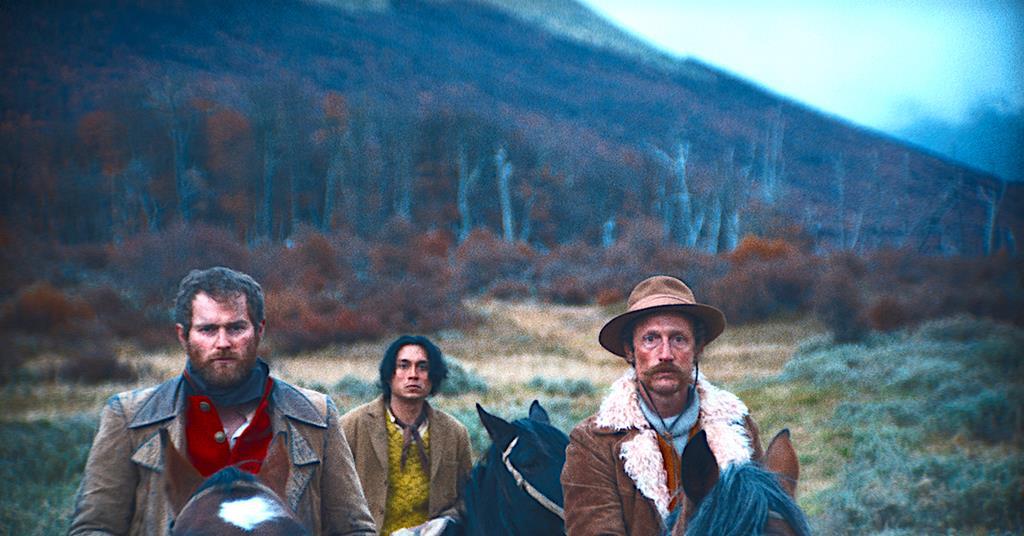
The grimly beautiful Chilean drama The Settlers takes us to Tierra del Fuego in 1901 where Spanish tycoon Jose Menendez (Alfredo Castro) is setting up a massive sheep ranch on 250,000 acres that spans across both Chile and Argentina. Menendez assigns his foreman, a ruthless Scot former soldier, Alexander MacLennan (Mark Stanley), to clear out the indigenous residents, who are inconveniently eating some of the sheep. Melendez makes it clear to MacLennan that he wants the indigenous people exterminated. Melendez and MacLennan are real historical figures, and these events are known as the Selk’nam Genocide.

MacLennan is assigned Bill (Benjamin Westfall), an American veteran of Indian conflicts. He also brings along the half-indigenous local man Segundo (Camilo Arancibilia). Neither MacLennan or Bill sees any humanity in the indigenous, and go about their work as if they were eradicating household pests. It’s pretty awful. There is some on-screen gore, but we experience most of the horror through the reaction of Segundo.

The Settlers jumps ahead almost a decade to explore the impact of the events on some of the key characters and their loved ones. There has to be a reckoning, after all, even if it can’t be fully satisfying.

Sobering as it is, The Settlers is remarkably fine cinema, and is an impressive debut feature for director Felipe Galvez Haberle. The matter-of-fact brutality is almost dwarfed by the stark, vast expanses of Patagonia. Some of the landscape shots by cinematographer Simone D’Arcangelo (The Tale of King Crab) are absolutely breathtaking. The unsettling story is enhanced by a soundtrack reminiscent, but not derivative of, Ennio Morricone’s spaghetti western scores.

First time actress Mishell Guana is very powerful as an indigenous woman. Sam Spruell colorfully brings alive a rogue British colonel (think Kurz in Apocalypse Now!).

The Settlers played in the Un Certain Regard program at Cannes, winning the FIPRESCI prize, and has won awards at a slew of other international film festivals. The Settlers is streaming on MUBI.

HUMAN RESOURCES: Iago with a sick sense of humor

Pedro De Tavira (center) in HUMAN RESOURCES. Courtesy of Cinequest.

In the dark, dark Argentinian comedy Human Resources, Gabriel Lynch (Pedro De Tavira) is an alienated office worker, in an absurdly alienating workplace. Gabriel is a low-level supervisor on an anonymous lower floor of a corporate hive with too many layers of management and an oppressive, top-down culture. It’s also oversexed, with a carousel of Inappropriate office liaisons. And, we’ll soon see, is shockingly tolerant of what we would see as the most horrifying workplace violence.

Gabriel, an Iago with a sick sense of humor, begins a ruthless, unhinged campaign against those who offend him. Alienation leaks out in how her treats everyone. Mischievous, mean-spirited and completely unashamed, he’s very fun to watch. And, as venal as Gabriel is, he is matched, step-for-step, by Veronica from Finance (Juana Viale).

Around the 41-minute mark, Gabriel makes his grievance explicit (followed by a great drone shot)

“I’ve lived like the secret son of a king for a long time, waiting for a courtier to rescue me. Of course, nobody rescued me. Nobody rescues anybody.”

Human Resources is the creation of writer-director Jesús Magaña Vázquez. I’ve rarely seen a more cynical comedy.

Cinequest hosts the US premiere of Human Resources, which I highlighted in my Best of Cinequest.

I love the Spanish language trailer, even without English subtitles:

QUIXOTE IN NEW YORK: an artistic master’s bucket list

Carrete in QUIXOTE IN NEW YORK. Courtesy of Cinequest.

The charming documentary Quixote in New York follows the 82-yer-old Spanish flamenco dance master El Carrete, who wants to cap his career by performing in a major NYC theater. It’s not that easy to mount a theater production, and he doesn’t have unlimited time to pull it off.

El Carrete himself is a hoot, funny AF and even makes rehearsals fun for everybody. Director Jorge Peña Martín has the good sense to give us a big dose of El Carrete. It’s a well-crafted film, especially the cinematography.

There’s a Can’t Miss seen where El Carrete watches a projection of Fred Astaire dance, and then dances himself in front of the screen, mirroring Astaire’s moves-flamenco-style.

This is an audience-pleaser. Cinequest hosts the US premiere of Quixote in New York.

Carrete in QUIXOTE IN NEW YORK. Courtesy of Cinequest.