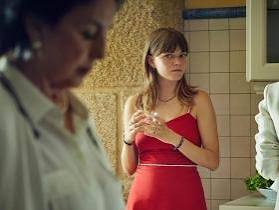
Photo caption: Lucia Garcia (center) in ROMERIA. Courtesy of Janus Films.
In the captivating drama Romeria, Marina (Llucia Garcia) has turned eighteen and travels from her home across Spain to Vigo on Galicia’s Atlantic coast. Marina’s biological parents died when she was very young, and she has been raised by an adoptive family in Catalonia. She doesn’t even remember her biological father, but she needs his death certificate to qualify for a college scholarship. So she heads to his hometown, both to pick up that document and to meet her father’s family for the first time.
She is welcomed by her father’s brothers and sisters, heartily by some and warily by others. Marina is carrying her mother’s diary, so she believes she understands the outline of her parents’ life together in Vigo, and she.’s eager to fill in the blanks. But the details that are related by – and slip out from – her uncles, aunts and cousins are surprising and sometimes unsettling. Not all of the dots are connecting.
In her third feature, director and co-writer Carla Simon has spun a helluva story. Marina and the audience work out the mystery of her heritage one step (or misstep) at a time, all the way to the satisfying, but poignant. resolution.
As Marina pieces together her parent’s reality, Romeria uses magical realism to veer into a flashback vignette. I’m generally not a fan of magical realism in movies, but I couldn’t think of a better way for Simon to portray the contrast between her mother’s actual experience and what her mother “recorded” in her diary.
Llucia Garcia, in her screen debut, perfectly captures Marina trying to keep her balance while being rocked by revelations of family secrets. Marina is reserved and ever correct, and maintains outward stoicism, but Garcia’s eyes let the audience inside as she processes surprise after surprise. The moment she quickly sizes up her grandfather is a tour de force.
Romeria is Spanish for pilgrimage, a fitting title for Marina’s journey in search of truth and love, especially since it ends near Santiago de Campostela, the terminus of the Camino de Santiago.
Spanish speakers will note that Marina speaks Catalan on the phone to her adoptive family and the readings from the mother’s diary are in Catalan. Marina speaks Spanish, of course, with everyone in Vigo.
The more I think about Romeria, the more I like it, and I’m looking forward to seeing more from both Simon and Garcia.
Photo caption: Bruno Nunez Arjuna and Sergi Lopez in SIRAT. Courtesy of NEON.
In the harrowing, and finally shattering, Sirat, the middle-aged Spaniard Luis (Sergi Lopez) and his 11-year old son Esteban (Bruno Nunez Arjuna) are looking for Esteban’s older sister, a young adult who they haven’t heard from for five months. Following up on a tip, they are passing out leaflets with her picture at a gathering of European ravers deep in the Moroccan desert.
They don’t find anyone who has seen her, but they hear about another rave coming up to the south, near Mauritania. Civil war has erupted, and the army arrives to evacuate EU citizens out of the country. A small contingent of ravers bolts the convoy, heading for the rumored next rave to the South, and Luis and Esteban, uninvited, follow.
The five ravers, adorned with an assortment of tattoos, piercings, and missing limbs between them, are driving two Mad Max-style trucks that they sleep in. They are nomads, happy to endure rough conditions if they can get high and sway to electric dance music. They’re not thrilled to have Luis and Esteban along, but a bond develops as the seven face the same hardships together.
And hardships abound, as the little convoy grinds through the vast desert. The only people they see are multitudes of refugees fleeing, significantly, in the opposite direction. It’s an unforgiving environment, where if they run out of water, fuel or food, or lose a vehicle, there is no recourse.
They must transverse a narrow, mountain track perched on the side of a cliff. It’s terrifying.
Beginning midway through Sirat, director and co-writer Oliver Laxe rocks us with some stunningly sudden and emotionally devastating events. These are not like the jump scares in the horror genre. These are from among the most shocking occurrences that real people experience in real life.
Sergi Lopez in SIRAT. Courtesy of NEON.
When writing about Sirat, many critics use the words hypnotic and mesmerizing. The story is gripping, but it is embedded in stunning landscapes – the desert itself is becomes a character. During the journey, the soundtrack mirrors the throbbing electronic music from the rave in the opening opening. In terms of audience engagement, Sirat is a triumph for Oliver Laxe.
The performance by Sergi Lopez is epic. Lopez makes Luis’ vulnerability, caginess, dread, terror, numbing grief and fatalistic determination all credible and heartfelt.
The ravers are played by non-actors, but they are so authentic and believable, you can’t tell.
Tonin Janvier and Jade Oukid in SIRAT. Courtesy of NEON.
As Luis and Esteban drive deeper in the forbidding expanse, we wonder, Is the missing daughter/sister safe or in danger? Is she even alive? Does she want to be found? Is Luis risking himself and Esteban for nothing? In the first half of Sirat, we’re asking ourselves whether Luis and Esteban wilI find her. In the second half, those questions become meaningless.
Besides the elements that make Sirat a psychological thriller, there’s a lot here to think about. We see human empathy creating a bond. We see wisdom, most cruelly acquired. Ultimately, Laxe may be asking, what does it really mean to have nothing to lose?
There might also be a comment on adventure tourism. YouTube is full of folks who travel to other lands to experience physical challenges and risky thrills. As seasoned and well-supplied as are the ravers, they are Europeans, and they are from a society in which there are always first responders. Where they have ventured, there are no first responders.
Sirat’s title appears 32 minutes into the running time, a trend I’ve noticed in other recent films. I’m not sure whether I think this practice is pretentious. The title is the name of the mythical bridge between heaven and hell. I’m not sure that there is a heaven in this movie, or even whether any of the characters is seeking heaven. It’s more like everyone is navigating through purgatory unaware of their proximity to hell.
The road on the precarious cliff-side in the trailer frightened me off from seeing Sirat in a theater; I have a fear of heights that precludes me from driving these roads in rel life, and I fear even watching it on screen will trigger a panic attack. Once Sirat started streaming, I knew I could watch it while protected by the fast-forward button on my remote.
Sirat is set n the endless, parched deserts of Morocco, but it was filmed in both Morocco and the Aragon region of Spain.
This is one of the most-acclaimed recent films. Sirat won the Palme d’or at Cannes and was nominated for the Best International Film Oscar. Many of the 47 awards it has won have been for sound and music.
That being said, this is not a movie for everyone. The audience has to be ready for excruciating heartache and profound bleakness. Despite the sun-baked visuals and the exciting set pieces, this is a very dark film.
Sirat is available to stream from Amazon, AppleTV, YouTube and Fandango and is included with Hulu.
Javier Botet and Bray Efe in THE FANTASTIC GOLEM AFFAIRS. Courtesy of Gluon Media.
The Spanish comedy The Fantastic Golem Affairs is unlike any other movie you’re likely to see this year, and the absurdity starts in the opening scene. After a night of partying, the pudgy slacker Juan (Bray Efe) and his best buddie David (David Menendez) are goofing around on the roof of Juan’s Madrid high-rise apartment building. David accidentally falls off and plunges to the roof of a car parked many stories below. That reveals that David is made of ceramic, as he shatters into hundreds of shards.
While still in a state of shock, Juan is annoyed by a shady car insurance agent, his late friend’s obnoxious and venal lover, apathetic cops and a woman with an outrageous computer dating profile. But he is obsessed by the mystery of a ceramic man, and keeps on the investigative trail until he stumbles on an unworldly conspiracy rooted in his own family. Along the way, a bizarre freak accident keeps recurring, killing people that he encounters during his investigation.
It’s been accurately written that there is magical realism in The Fantastic Golem Affairs, but it’s not the sweet, mystical kind in, say Like Water for Chocolate – The Fantastic Golem Affairs is bawdy and in-your-face.
The playfully, irreverent tone strongly reminds me of Pedro Almodovar’s early work (Women on the Verge of a Nervous Breakdown, Tie Me Up! Tie Me Down!, High Heels and Kika) and his VERY early work (Pepi, Luci, Born and Other Girlds Like Mom). Indeed, one of the characters observes, “This is like a Spanish movie from the 90s“. The Fantastic Golem Affairs is not as riotous as early Almodovar, but it adds that magical realism and much more absurdism.
Javier Botet in THE FANTASTIC GOLEM AFFAIRS. Courtesy of Gluon Media.
The Fantastic Golem Affairs is highly imaginative work of Spanish writer-directors Juan Gonzalez and Nando Martinez, who call themselves Burnin’ Percebes. They hit us with the absurdity of the shattering ceramic man right at the beginning, juxtaposed with the peppy music underneath the opening credits. The music combines with an often static camera, long shots, and colorfully retro sets that are unabashedly cheap. This is a zany, raunchy movie with some mild body horror.
[Gratuitous digression: I’m always proud to point out when I actually get a joke in Spanish. The directors’ pseudonym is Burnin’ Percebes, and percebes is Spanish for gooseneck barnacle, a hideously ugly (Google it) and delicious shellfish from Northern Spain. They are dangerous to harvest from oceanside cliffs, and are accordingly expensive – about ten times the price of a regular tapa. Of course, The Movie Gourmet himself has enjoyed percebes in San Sebastian.]
The Fantastic Golem Affairs is opening in theaters, including LA’s Alamo Drafthouse.
Photo caption: Roser Tapias in YOU ARE NOT ME. Courtesy of Music Box Films.
In the Spanish psychological horror film You Are Not Me, Aitana (Roser Tapias) and her Brazilian partner Gabi (Yapoena Silva), with their adopted infant, show up early for Christmas at the Catalan home of Aitana’s affluent parents (Pilar Almeria and Alfred Pico). And Aitana seems to step into a nightmare. Or is it?
The first thing that rocks Aitana is her parents’ reaction. They don’t seem happy to see Aitana after many years, nor to meet her partner or their own first grandchild. They’re especially displeased that Aitana’s family has arrived on the eve of a dinner party they’ve planned, a special party that is not the usual family holiday get-together.
Why are the parents acting so inappropriately? Are they homophobic? Are they racist (the baby is black)? Are they still pissed off at Aitana? Aitana is headstrong and often tactless, and we learn that there’s some baggage; years before, the parents were hosting Aitana’s wedding to their ideal son-in-law, when Aitana, realizing she was a lesbian, suddenly ran away, leaving everyone in the lurch.
Aitana is also upset by the condition of her wheelchair-bound younger brother, Saul (Jorge Motos), whose degenerative disease is apparently getting worse.
But, what really sends Aitana over the edge is that her parents are fawning over a Romanian woman Aitana’s age, Nadia (Anna Kurikka). They have awarded Aitana’s room to Nadia, along with their affection and even Aitana’s wedding dress. When Aitana discovers evidence of Nadia’s dishonesty and even behavior that threatens Saul, the parents refuse to listen.
A scene from in YOU ARE NOT ME. Courtesy of Music Box Films.
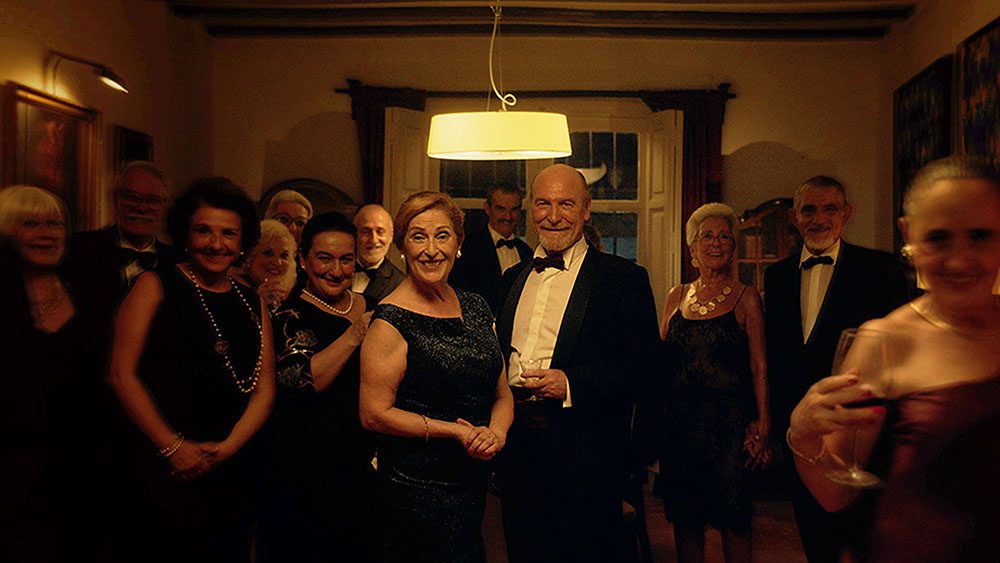
Finally, there’s the parents’ formal dinner party, hosting several couples their age. The parents are meeting many of the guests, from several European countries, for the first time. The guests are unusually convivial (and horny). Although the guests are outwardly very traditional, they make what is a decidedly a creepy assemblage. Everything is conventional, but Aitana and the audience feel that something must be amiss.
You Are Not Me was co-written and co-directed by Marisa Crespo and Moisés Romera in their second feature film. It’s a well-directed film that benefits from a clever story that keeps the audience off-balance. Are these things really happening, or is Aitana imagining or dreaming them, or even hallucinating? Is Aitana just easily offended or is she paranoid or even schizophrenic? Her well-balanced partner Gabi is rolling with the punches and unintentionally gaslighting Aitana. By making Aitana so prickly, having her jet-lagged and then drunk, Crespo and Romera keep us wondering. And just when we think that the ending is outrageously cheesy, Crespo and Romera creep us out again.
You Are Not Me is streaming on Amazon and Fandango.
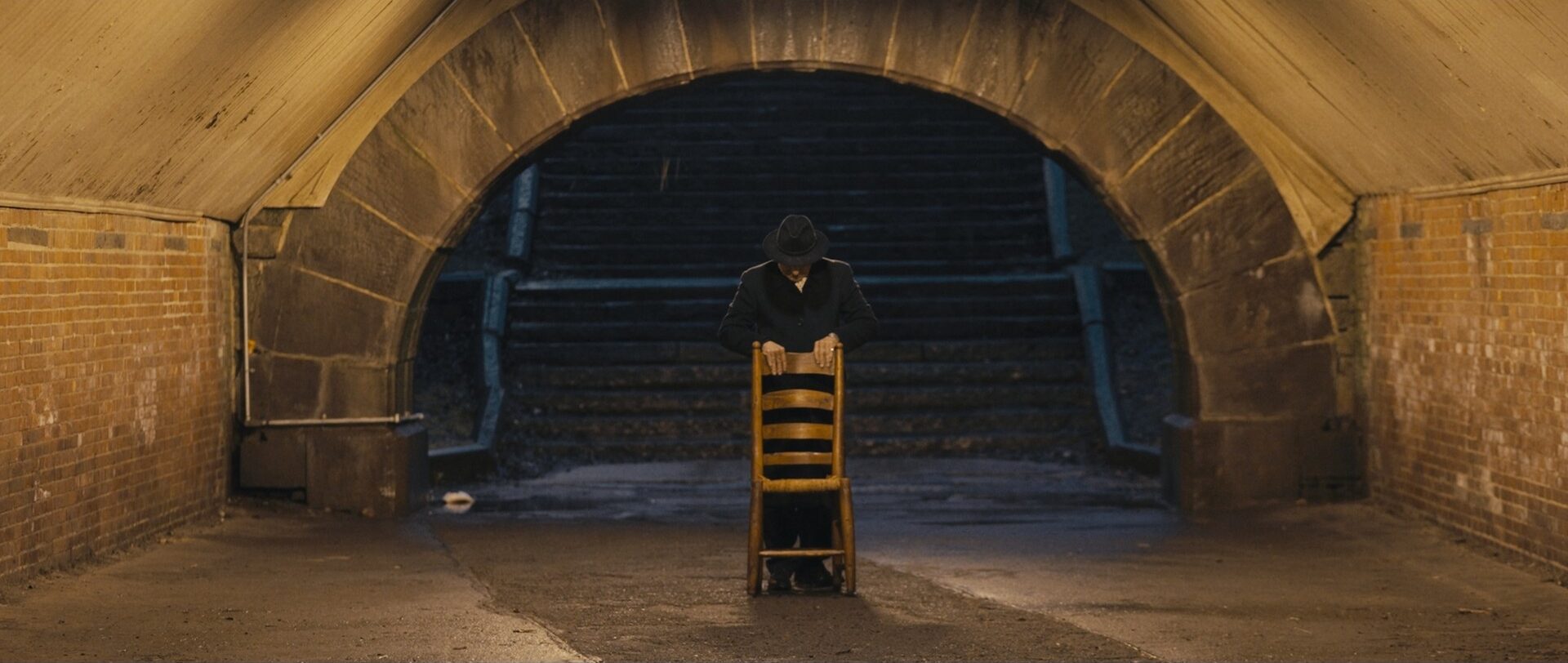
Carrete in QUIXOTE IN NEW YORK. Courtesy of Cinequest.
The charming documentary Quixote in New York follows the 82-yer-old Spanish flamenco dance master El Carrete, who wants to cap his career by performing in a major NYC theater. It’s not that easy to mount a theater production, and he doesn’t have unlimited time to pull it off.
El Carrete himself is a hoot, funny AF and even makes rehearsals fun for everybody. Director Jorge Peña Martín has the good sense to give us a big dose of El Carrete. It’s a well-crafted film, especially the cinematography.
There’s a Can’t Miss seen where El Carrete watches a projection of Fred Astaire dance, and then dances himself in front of the screen, mirroring Astaire’s moves-flamenco-style.
This is an audience-pleaser. Cinequest hosts the US premiere of Quixote in New York.
Carrete in QUIXOTE IN NEW YORK. Courtesy of Cinequest.
Photo caption: Laura Galán in PIGGY. Courtesy of Magnolia Pictures.
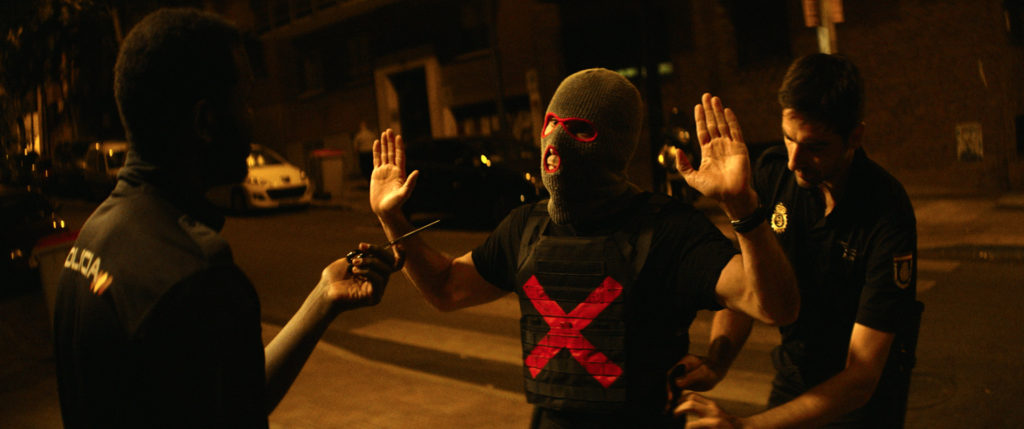
In the fresh and darkly hilarious Spanish horror movie Piggy, Sara (Laura Galán) is an overweight teenager cruelly teased by her peers. She works in her family’s butcher shop, which supplies her tormentors with a surfeit of unkind pork-related nicknames. Her affectionate but clueless dad and her brusque martinet of a mom aren’t much comfort.
One day, at the town swimming pool, mean girls sadistically traumatize her. Sara makes a shocking decision, and Piggy becomes a kind of Carrie meets Beauty and the Beast thrill ride as Sara is bounced along to the satisfying conclusion.
Piggy is the first feature for writer-director Carlota Pereda, a veteran television director. It’s based on her award-winning 2018 short with the same Spanish title, Cerdita, and also staring Galán. Galán gets all the teen angst and impulsiveness just right and, in a piñata-like role, is a helluva good sport.
Horror films turn on whether the protagonist can survive, and, often, on whether the victims deserve their demise; Pereda has a lot of fun with both.
I screened Piggy for the Nashville Film Festival, where it was one of my Under the Radar picks. Piggy opens this week at the Alamo Drafthouse and then rolls out nationally. This movie is a hoot.
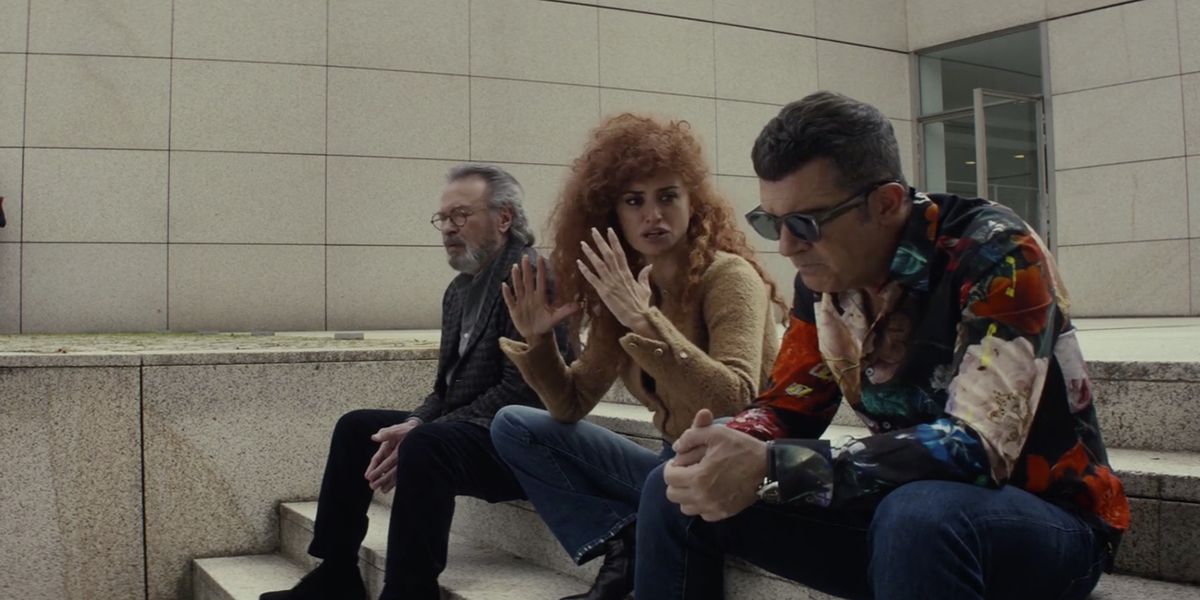
Photo caption: Oscar Martínez, Penélope Cruz and Antonio Banderas in OFFICIAL COMPETITION. Courtesy of IFC Films.
The smart and biting satire Official Competition uses the world of filmmaking (where better?) to send up professional jealousies. A billionaire wants to produce a great movie as his legacy, so he assembles a filmmaking Dream Team: the famed director Lola (Penélope Cruz), the global movie star Félix (Antonio Banderas) and the renowned sage actor Iván (Oscar Martínez). Their egos come along, too.
Ivan, a leading acting teacher who pioneers new and challenging theater, is the critical and academic world’s most esteemed actor. There’s a wonderful scene where Ivan and his wife (a children’s’ author) sit in their boho apartment listening to an avant garde audio performance.
Felix, in contrast, has become a world-wide celebrity by starring in what Martin Scorsese calls global audio-visual entertainment to distinguish these movies from cinema. Adored by millions of fans and used to having his whims and appetites satisfied by toadies, Felix is convinced that he has earned his reputation as a great actor. (And he shows up to every event with a different bimbo on his arm.)
The tycoon has purchased a Nobel Prize-winning novel (that he hasn’t read) to be adapted into a screenplay. It’s about a rivalry between brothers. (In one of Official Competition’s many delicious ironies, this source material is very pedestrian, several rungs below East of Eden, for example.)
Lola (Cruz wears a wig that is a mountain of reddish tangles) is a piece of work herself. She enjoys abusing her power as director and is devoid of personal boundaries.
Felix and Ivan are oil and water,and Lola, for artistic reasons (and more than a touch of sadism), provokes their latent rivalry, seeking to enhance what will be the tension in their on-screen rivalry. In nine days of rehearsals before the shoot, Lola plunges Ivan and Felix into a series of evermore ridiculous, intrusive and degrading acting exercises. She has them read lines under a huge, suspended rock, binds their bodies together in cling wrap, and overamplifies their kissing noises.
Lola’s caprices accomplish two things with Ivan and Felix. She turns their passive contempt for each other into open hatred. And she makes them hate her, too.
Each actor (and Lola, too) has a massive ego begging to be deflated, and the battles between them in Official Competition are very, very funny.
The ending of Official Competition is perfect – one of the cleverest and most satisfying that I’ve seen in a good long while.
The Argentines Mariano Cohn and Gastón Duprat co-directed Official Competition, which they co-wrote with Andrés Duprat. Official Competition is being described as an arch takedown of the movie industry, but the egos parodied here are present in many walks of life.
Cruz, Banderas and Oscar Martínez (the hilariously dark Wild Tales) each deliver dynamite performances. Irene Escolar is very good in a deadpan and essentially silent role as the billionaire’s daughter cast in the movie.
[Note: Prior to Official Competition, the Spanish stars Cruz and Banderas had only shared the screen for about two minutes in I’m So Excited; they did not work together in Pain and Glory, in which they both appeared in different segments.]
Official Competition, so far the wittiest film of 2022, is in theaters.
Photo caption: Milena Smith, Penélope Cruz and Aitana Sánchez-Gijón in PARALLEL MOTHERS. Photo courtesy of Sony Pictures Classics.
In Parallel Mothers, Pedro Almodóvar gives a lush melodrama, sandwiched between bookended dives into today’s unhealed wounds from the Spanish Civil War.
Two women meet in a Madrid maternity ward, each about to give birth to her first child. Neither is in a relationship and neither pregnancy was planned, although the circumstances differ strongly. Both are haunted – one by a family tragedy and the other by her parents’ dysfunction.
Janis (Penélope Cruz) is in confident middle age, a fashion photographer. She is worldly and independent, with a support system led by her bestie (Almodóvar veteran Rossy de Palma).
Ana (Milena Smit) is a teenager tossed from her throw-up-his-hands father in Granada to her self-absorbed actress mother in Madrid.
Janis and Ana bond with their babies and with each other. It’s difficult to write about their story because there’s a Big Reveal which I will not spoil.
The story of mothers and babies makes for a compelling 100-minute or so movie on its own. But the film begins and ends with segments in which a war crime from the Spanish Civil War touches characters. When Spain suddenly transitioned from the Franco dictatorship to a democracy, the nation addressed accountability for the Civil War’s atrocities differently than did, say, South Africa or North Ireland, and Parallel Mothers is Almodóvar’s comment on the continuing wounds.
And here’s my quandary: although the characters overlap, I just don’t see the unity that Almodovar intends between the mom/baby story and the Civil War legacy story. Sorry, Pedro – this just looks like two different (good) movies cobbled together to me.
Penélope Cruz in PARALLEL MOTHERS. Photo courtesy of Sony Pictures Classics.
Penélope Cruz is entering her fourth decade of Big Screen luminosity. She remains one of the most compelling presences in cinema.
Milena Smit as excellent as the troubled and immature Ana, who grows and changes more than any character in Parallel Mothers. It’s an impressive breakthrough performance, and Smit bears watching.
Penélope Cruz had already made the American art house faves Jamón Jamón and Belle Epoque before she joined the Almodóvar repertory, but it’s worth reflecting on the Spanish actresses, like Smit, that Almodóvar has introduced us to: Carmen Maura, Victoria Abril, Marisa Paredes, Cecilia Roth, Rosario Flores, Assumpta Serna and Chus Lampreave. (Plus Antonio Banderas and Javier Cámara, as well!)
Aitana Sánchez-Gijón is very good as Ana’s mom, who is initially is reflexibly insufferable, but whose role becomes more complicated as we learn about her.
Israel Elejalde is excellent as the one significant male character. It’s always great to see Rossy de Palma, who is unchallenged by her role as sympathetic sidekick. Julieta Serrano, another Almodóvar favorite also appears.
After beginning his career with two decades of subversively hilarious comedies, Almodóvar has made some of the most profound work in recent cinema. Parallel Mothers is well-crafted and engaging, but doesn’t rank with Almodóvar’s best: Talk to Her, Bad Education, Broken Embraces.
A very young Pedro Almodóvar’s 1980 Pepi, Luci, Bom and Other Girls Like Mom. This is early Almodovar – zany and ribald, even transgressive. The filmmaking craft is very rough (and very low budget), but Almodóvar’s signature energy and vibrant colors are already there. Fun rock music sets the tone from the get go in the title credits.
The humor is outrageous, embracing that of the very first American gross-out comedies (The Groove Tube and The Kentucky Fried Movie) and taking a step (or a few) farther:
A penis-measuring contest as a party game;
The question of whether a cop’s wife can become a punk band’s groupie;
Panties that turn farts into perfume;
Cops baited into a narc raid on a plastic marijuana plant;
Perhaps the dirtiest pop pseudopunk song ever: I love you because you’re dirty; Filthy slutty and servile.
The protagonist starts out as the party girl Pepi, but the story evolves to center around Luci, the wife of a brutish cop. As Luci is debased by more and more characters, becoming a human piñata, it is revealed that she is a masochist who actually is attracted to and pleasured by the meanest behavior. [SPOILER: There’s even a Golden Shower early in this story thread.]
Viewing through today’s lens, the movie violence against women no longer works as comedy, even though the character who is debased is a masochist and the rape that spurs the revenge theme is clearly intended to be broadly comic.
This is Almodóvar having fun being naughty. His most profound work was still two decades in the future: Talk to Her, Bad Education, Broken Embraces.
I watched Pepi, Luci, Bom and Other Girls Like Mom on TCM, and you can stream it from Amazon, AppleTV, Vudu and YouTube.
Victor Rivas (center) in CARVER. World premiere t Cinequest. Photo courtesy of Select Films.
In the neo-noirish Spanish thriller Carver, a guy named Ernesto takes on the alter ego of Carver in the wee hours. Carver strides through Ernesto’s gritty urban neighborhood in dressed in a ridiculous, homemade superhero costume. He has no super powers, but is driven to make things right, vigilante-style. A sexy, stoned woman of uncertain reliability engages his interest. Will she bring him down?
Ernesto (Victor Rivas) seems otherwise a normal, salt-of-the-earth guy . He lives a quotidian existence, monitoring a supermarket’s security cameras by day and presiding over his family’s evening meals. But when his wife and kids are ready for bed (and this is Spain, so it is LATE), he heads out on the streets, to his wife’s increasing displeasure.
Why? He’s not a wannabe hanging judge; he’s pretty merciful to the shoplifters that he catches at his day job. But he has this need to personally patrol the streets to keep kids and single women safe. It’s odd behavior, and he does so with an almost child-like naivete; we wonder what emotional trauma might have damaged him.
At first, as he fails to spot her manipultiveness Victor is no match for the femme fatale Alicia (Mar Del Corral) , who is channelling Brigid O’Shaughnessy. Then he begins to appreciate just how unhunged she may be.
This is the first feature for writer-director Evgeny Yablokov, and this character-driven thriller is an impressive calling card.
There are many film actors named Victor Rivas. The star of Carver is not one of the more famous one, but a mournful-faced stage actor in Madrid, who has played Kierkegaard.
Not everybody will be satisfied with the ending of Carver, but I thought it was perfect.
I screened Carver for its world premiere at Cinequest, and it made my Best of Cinequest 2021. You can stream it during the festival for only $3.99 at Cinequest’s online Cinejoy.