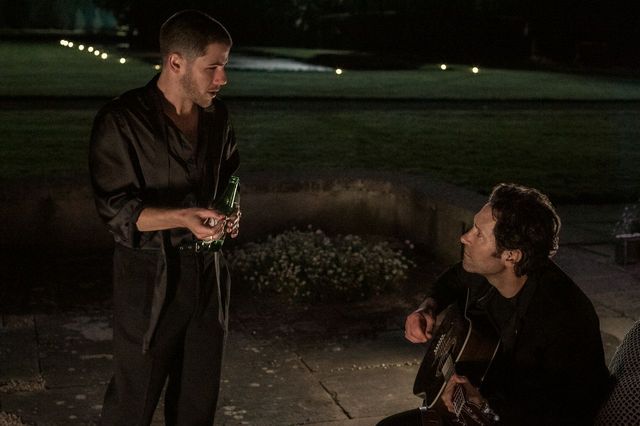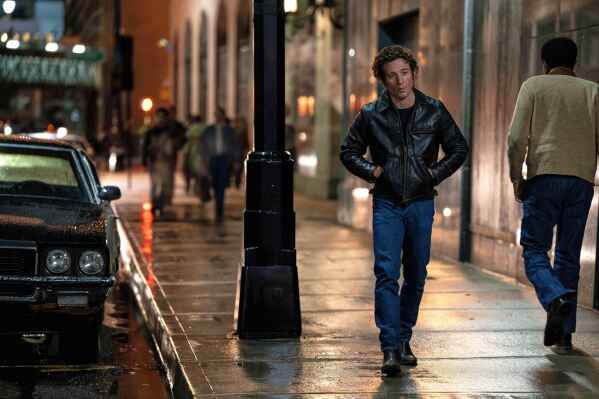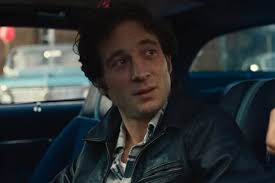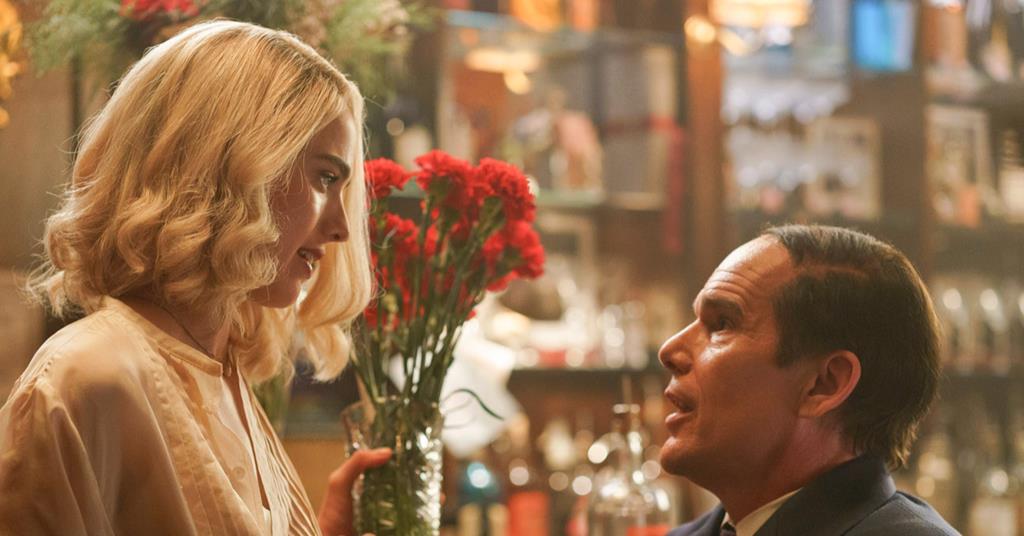
Photo caption: Nick Jonas and Paul Rudd in POWER BALLAD. Courtesy of Lionsgate
In the delightful Irish dramedy Power Ballad, the small-time wedding singer Rick (Paul Rudd) finds himself in an all-night jam with a no-longer-popular boy band star Danny (Nick Jonas). Weeks later, Danny revives his career with a monster hit. Did he steal the song from the Rick? And, if so, what can Rick do about it?
Power Ballad is the latest from John Carney, writer-director of Once, Sing Street and Flora and Son. Those three Feel Good movies all feature penniless Dubliners who discover themselves by harnessing their songwriting talents. Power Ballad includes those elements, but, here, Carney’s exploration of the creative process is more nuanced.
Sure, the core of the song is inspired by Rick’s most heartfelt reflections. But, Carney lets us see that it takes more than melody and lyrics to make a hit; Danny has the charisma and sense of performance that Rick doesn’t, along with the drive, discipline and appetite for grueling hard work that Rick can’t quite harness. And, having tasted the big-time success that Rick can only vaguely imagine, Danny is more desperate.
Carney avoids the potential cornball endings, and lands Power Ballad with an ingeniously satisfying resolution.
The original song in question, How to Write a Song (Without You), composed by Carney and his longtime collaborator Gary Clark, is very good and is plausible as a future jukebox classic. The performances of the real Billboard hits covered by Rick’s wedding band are very, very fun.
Paul Rudd, always so relatable, is very good as an American rocker who stepped off the fast track when he fell for an Irish girl on tour, and scrapes by modestly as a transplant in Dublin. He’s deeply in love with his wife and teenage daughter, who tolerate his very non-rock star Dad behaviors.
I was very impressed with Nick Jonas’ performance as Danny. Although he has 99 screen credits, they’ve almost all been Jonas Brothers videos, TV sitcoms and content in the Night at the Museum and Camp Rock franchises. Although he appeared in the shallow and clumsy (not Nick’s fault) 2019 version of Midway, he hasn’t played many complex adult characters. Although you might not think it a stretch for him to play a former boy bander, Jonas shows Danny to be surprisingly complicated, in the throes of his own identity crisis, an often weak man propelling himself forward with an ill-fitting, needy ambition.
I saw Power Ballad at the closing night of the SLO Film Fest, where it was very well-received. It also played at the SFFILM Festival. It opens in theaters this weekend, and it’s an audience-pleaser.
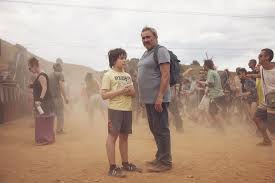
Photo caption: Bruno Nunez Arjuna and Sergi Lopez in SIRAT. Courtesy of NEON.
In the harrowing, and finally shattering, Sirat, the middle-aged Spaniard Luis (Sergi Lopez) and his 11-year old son Esteban (Bruno Nunez Arjuna) are looking for Esteban’s older sister, a young adult who they haven’t heard from for five months. Following up on a tip, they are passing out leaflets with her picture at a gathering of European ravers deep in the Moroccan desert.
They don’t find anyone who has seen her, but they hear about another rave coming up to the south, near Mauritania. Civil war has erupted, and the army arrives to evacuate EU citizens out of the country. A small contingent of ravers bolts the convoy, heading for the rumored next rave to the South, and Luis and Esteban, uninvited, follow.
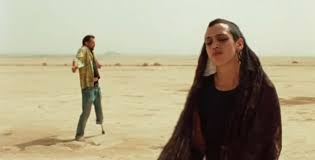
The five ravers, adorned with an assortment of tattoos, piercings, and missing limbs between them, are driving two Mad Max-style trucks that they sleep in. They are nomads, happy to endure rough conditions if they can get high and sway to electric dance music. They’re not thrilled to have Luis and Esteban along, but a bond develops as the seven face the same hardships together.
And hardships abound, as the little convoy grinds through the vast desert. The only people they see are multitudes of refugees fleeing, significantly, in the opposite direction. It’s an unforgiving environment, where if they run out of water, fuel or food, or lose a vehicle, there is no recourse.
They must transverse a narrow, mountain track perched on the side of a cliff. It’s terrifying.
Beginning midway through Sirat, director and co-writer Oliver Laxe rocks us with some stunningly sudden and emotionally devastating events. These are not like the jump scares in the horror genre. These are from among the most shocking occurrences that real people experience in real life.
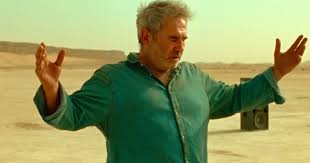
Sergi Lopez in SIRAT. Courtesy of NEON.
When writing about Sirat, many critics use the words hypnotic and mesmerizing. The story is gripping, but it is embedded in stunning landscapes – the desert itself is becomes a character. During the journey, the soundtrack mirrors the throbbing electronic music from the rave in the opening opening. In terms of audience engagement, Sirat is a triumph for Oliver Laxe.
The performance by Sergi Lopez is epic. Lopez makes Luis’ vulnerability, caginess, dread, terror, numbing grief and fatalistic determination all credible and heartfelt.
The ravers are played by non-actors, but they are so authentic and believable, you can’t tell.
Tonin Janvier and Jade Oukid in SIRAT. Courtesy of NEON.
As Luis and Esteban drive deeper in the forbidding expanse, we wonder, Is the missing daughter/sister safe or in danger? Is she even alive? Does she want to be found? Is Luis risking himself and Esteban for nothing? In the first half of Sirat, we’re asking ourselves whether Luis and Esteban wilI find her. In the second half, those questions become meaningless.
Besides the elements that make Sirat a psychological thriller, there’s a lot here to think about. We see human empathy creating a bond. We see wisdom, most cruelly acquired. Ultimately, Laxe may be asking, what does it really mean to have nothing to lose?
There might also be a comment on adventure tourism. YouTube is full of folks who travel to other lands to experience physical challenges and risky thrills. As seasoned and well-supplied as are the ravers, they are Europeans, and they are from a society in which there are always first responders. Where they have ventured, there are no first responders.
Sirat’s title appears 32 minutes into the running time, a trend I’ve noticed in other recent films. I’m not sure whether I think this practice is pretentious. The title is the name of the mythical bridge between heaven and hell. I’m not sure that there is a heaven in this movie, or even whether any of the characters is seeking heaven. It’s more like everyone is navigating through purgatory unaware of their proximity to hell.
The road on the precarious cliff-side in the trailer frightened me off from seeing Sirat in a theater; I have a fear of heights that precludes me from driving these roads in rel life, and I fear even watching it on screen will trigger a panic attack. Once Sirat started streaming, I knew I could watch it while protected by the fast-forward button on my remote.
Sirat is set n the endless, parched deserts of Morocco, but it was filmed in both Morocco and the Aragon region of Spain.
This is one of the most-acclaimed recent films. Sirat won the Palme d’or at Cannes and was nominated for the Best International Film Oscar. Many of the 47 awards it has won have been for sound and music.
That being said, this is not a movie for everyone. The audience has to be ready for excruciating heartache and profound bleakness. Despite the sun-baked visuals and the exciting set pieces, this is a very dark film.
Sirat is available to stream from Amazon, AppleTV, YouTube and Fandango and is included with Hulu.
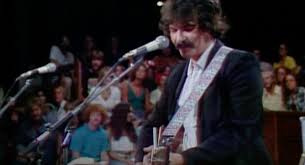
John Prine in YOU GOT GOLD: A CELEBRATION OF JOHN PRINE. Courtesy of Abramarama.
The experience of watching You Got Gold is better than the movie itself. After all, it’s just a paint-by-the-numbers concert film – documenting a Nashville tribute concert with musical artists performing John Prine songs and telling stories about him. But the film, aptly subtitled A Celebration of John Prine, is elevated by Prine himself, his relentless playfulness and his concise, searing lyrics, so venerated by his peers, beloved by fans and acquaintances.
Prine’s song lyrics were poetry of the highest order, as in the unsurpassed fundamental truths and ultra-real humanity of Sam Stone, Souvenirs and Hello in There, Lyle Lovett recalls being stunned by the Prine lyric “naked as the eyes of a clown”. I remember being frozen by “There’s a hole in Daddy’s arm where the money goes.”
A great song can be performed in many genres. The deeply soulful War and Treaty bring a new dimension to Prine’s Knockin’ on your Screen Door. Rocker Bob Weir shreds on Great Rain.
Jason Isbell, Brandi Carlile and Dwight Yoakum all perform. Prine’s longtime friend and collaborator Bonnie Raitt tells of how she thought of them as Tom Sawyer and Becky-style playmates and performs the iconic Angel from Montgomery.
Lucinda Williams performs her own song about working with Prine, the hilarious but wistful Working On a Song (what could go wrong?).
John Prine was a great American humorist. Think Mark Twain and Will Rogers. One of his funniest songs, In Spite of Ourselves, is featured, and another, Illegal Smile, is referenced. (His funniest, Let’s Talk Dirty in Hawaiian, isn’t in the movie.)
This is ultimate Feel Good movie. If you know John Prine, You Got Gold is a Must See. If you don’t, you won’t regret watching it, either. Here’s a link to the trailer.
Photo caption: Jeremy Allen White in DELIVER ME FROM NOWHERE. Courtesy of 20th Century Studios.
As the Bruce Springsteen docudrama Deliver Me from Nowhere opens, Springsteen (Jeremy Allen White) is belting out the massive hit Hungry Heart to cap off his The River tour in 1981. Afterwards, his manager/producer/confidante Jon Landau (Jeremy Strong) finds him sitting alone in the bowels of the arena, exhausted and depleted. Too nice a guy to blow off chatting with local radio personalities, Springsteen rallies, but Landau can see that he’s fried.
Landau sets up Springsteen at a rented house in the countryside of Colts Neck, New Jersey. It’s an obscure enough location, so he can rest in privacy, but still only a 25-minute drive to Bruce’s old stomping grounds in Asbury Park. Bruce sits around, decompressing in the darkened house, pondering something other than his future. While their record company is eager for another exuberant, rockin’ Springsteen album and tour, Landau does his best to insulate Springsteen from the pressure.
Bruce experiences a few lighthearted moments, sitting in with the house band at The Stone Pony and having a dalliance with a single mom (a fictional character played by the Australian actress Odessa Young). The Terence Malick movie Badlands sparks his interest and he starts researching the teen killing spree that the film was based on. But mostly, he’s brooding.
Jeremy Allen White in DELIVER ME FROM NOWHERE. Courtesy of 20th Century Studios.
In flashback, Deliver Me from Evil depicts the childhood that Bruce is reflecting on, dominated by his haunted and sometimes brutish father Doug (Stephen Graham). Doug had his demons, and now Bruce’s own demons are blocking his creative work. Bruce Springsteen is depressed, and that’s what Deliver Me from Evil is really about. In publicity for the film, Springsteen is oft crediting Landau for steering him to professional help and advocating for the destigmatization of mental health treatment.
The scenes with Doug Springsteen both with the young Bruce and the adult Bruce – are the core of Deliver Me from Evil.
The plot centers on Springsteen’s dark contemplations leading to his writing his darkest material yet, the songs that make up his Nebraska album. He records the material by himself, at home and on a cassette recorder, intending to record them in a studio with the E Street Band. The unconventional artistic choices that followed and the battle with his own record company, with Landau’s unwavering support, make up the rest of the story.
(In the same period, Springsteen also wrote Born in the U.S.A., Glory Days and I’m on Fire, which were later successful in arrangements with the full E Street Band on the Born in the U.S.A. album which followed Nebraska.)
Deliver Me from Evil depends on an actor’s success in a ballsy challenge – playing a person that all of us have watched closely for decades. Fortunately, Jeremy Allen White can match Bruce Springsteen in charisma and intensity, and that allows White to inhabit the character of Springsteen without resorting to impersonation.
Stephen Graham in DELIVER ME FROM NOWHERE. Courtesy of 20th Century Studios.
Stephen Graham delivers another indelible performance as Doug, capturing the core disappointment and bitterness that leak out in rage and confusion. After early-career roles in Gangs of New York and Band of Brothers, the stocky Englishman has emerged as one of our great character actors, perhaps best in British crime mini-series like Little Boy Blue, Line of Duty, and Adolescence. He also appears in Hollywood movies like Rocketman and the Pirates of the Caribbean franchise (he plays Scrum), and the 2012 refresh of Tinker Tailor Soldier Spy. Along the way, he has become a one-man cottage industry playing fabled American gangsters – Baby Face Nelson in Public Enemies, Al Capone in Boardwalk Empire, and Tony Provenzano in The Irishman. I just love this guy’s work.
Gaby Hoffman is excellent as Springsteen’s mom.
Deliver Me from Nowhere’s director Scott Cooper (Crazy Heart) and Warren Zanes wrote the screenplay, adapting Zanes’ book about the writing and recording of Nebraska. Deliver Me from Nowhere was made with the participation and support of Springsteen and Landau; that provides lots insight to the screenplay, although Landau’s character is a bit saintly, for my taste. However, the portrayal of Springsteen is unsparing.
The E Street Band isn’t on screen much, but I didn’t completely swallow the depiction of certain band members. But that’s just a quibble about a film otherwise brimming with authenticity.
Deliver Me from Nowhere, as smart and genuine as it is, is irresistiblyentertaining.
Photo caption: Ethan Hawke in BLUE MOON. Courtesy of Sony Pictures Classics.
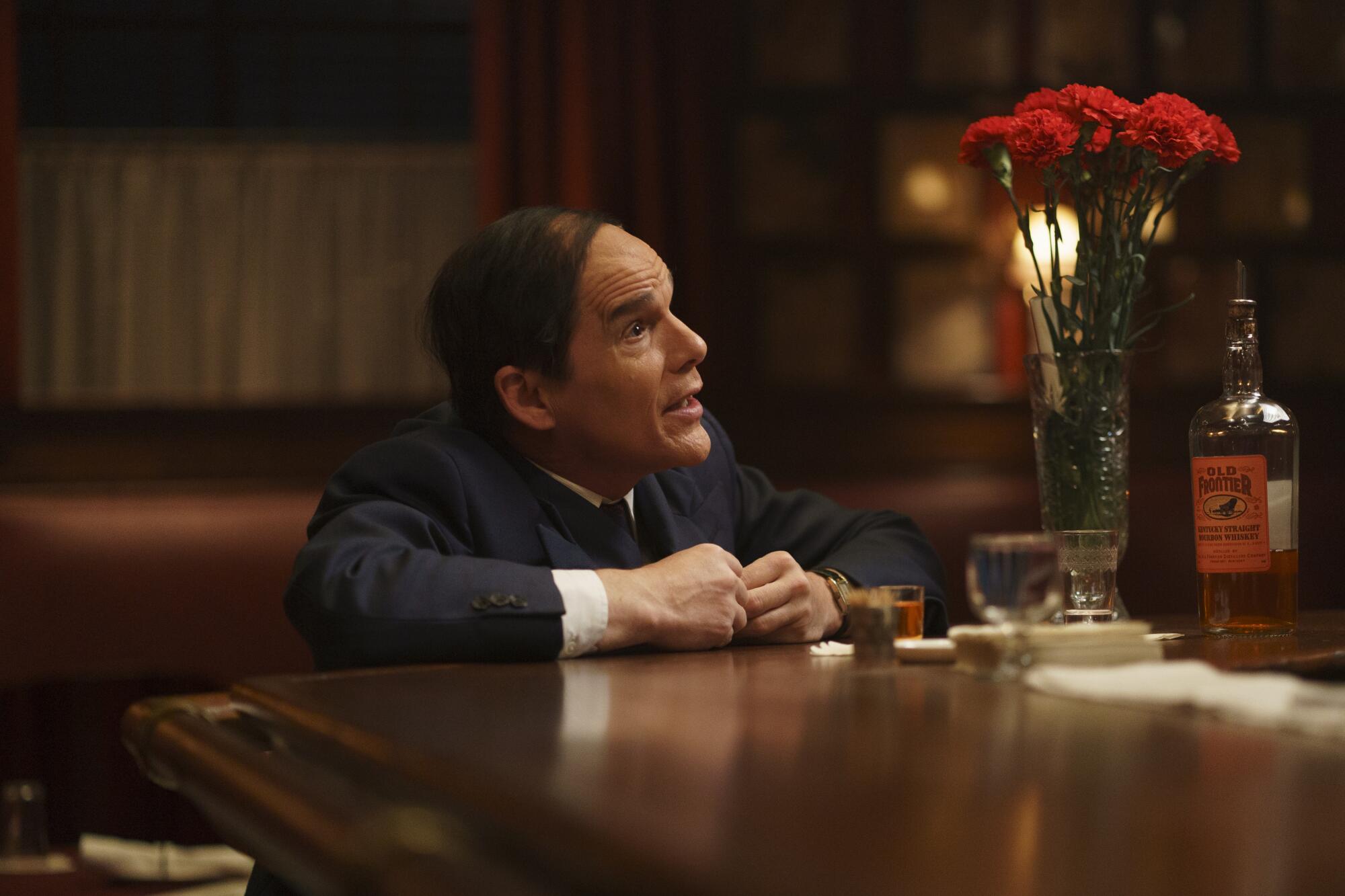
The protagonist of Richard Linklater’s Blue Moon is lyricist Lorenz Hart (Ethan Hawke), who Linklater immediately shows us dying of alcoholism, before taking us to a night eight months earlier. Hart, having left the opening night production of Oklahoma!, has entered a familiar haven, the bar at Sardi’s, where he is ready, as always, to hold forth. His longtime partner Richard Rodgers has dumped him for a new collaborator, Oscar Hammerstein, and Hart has immediately recognized that the new duo’s debut musical would dwarf the success of the Rodgers and Hart work. It’s hard to feel good about yourself when you are dumped by your partner of 24 years, who then soars to new heights with a different collaborator.
Beginning in 1919 (when Hart was 24 and Rodgers only 17), the two created 28 stage musicals (including Babes in Arms and Pal Joey and more than 500 songs for Broadway and Hollywood, many of which have become American standards, like Manhattan, The Lady Is a Tramp, My Funny Valentine, and, of course, Blue Moon.
Seeing that body of work eclipsed in one night has Hart reeling. But, now, in 1943, Hart was 48 and Rodgers 41. Hart’s alcoholism has made him unreliable, so Rodger has moved on. Hart’s gift at wordplay is as brilliant as ever, but his confidence is crushed – and he is desperate to work again, and, in his wildest dreams, with Rodgers.
Hart’s career desperation is matched by his romantic desperation – from a doomed fixation with the comely Yale coed, Elizabeth (Margaret Qualley). Elizabeth is self-confident and ambitious, towers over the shrimpish Hart and can match wits with him . Hart is a successful celebrity, but not rich or conventionally attractive, and being an over-the-hill drunken gay man, neither the audience or other characters in Blue Moon see Hart’s pursuit of Elizabeth as anything but a pathetic fantasy.
Margaret Qualley and Ethan Hawke in BLUE MOON. Courtesy of Sony Pictures Classics.
Hart presides over all conversation in the bar, and proves himself a most witty raconteur. Hart, usually unintentionally, reveals himself in banter with Sardi’s affable bartender (an excellent Bobby Cannavale).
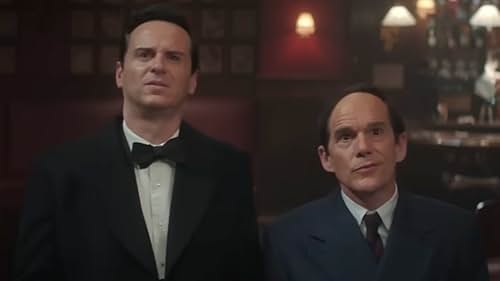
Finally, Richard Rodgers (Andrew Scott) leads in his entourage from Oklahoma! for the opening night party, and Hart explodes into the full wheedle. Moment by moment, we learn more about Rodger’s complicated experience with Hart. It’s clear that Rodgers is genuinely grateful for Hart’s contribution to his life and is also relieved not to no longer be a secondary victim of Hart’s drinking. Rodgers still is affectionate and nostalgic with Hart, but wary about reliving Hart’s worst behavior. When Hart offers a celebratory glass of champagne, Rodgers recoils and barks, “I won’t drink with you!”, registering the pain that Hart’s drinking has inflicted on him over many years.
Why isn’t Blue Moon, a portrait of a man’s crash-and-burn, unwatchably sad?
Foremost, even when Hart is being sad, he’s very, very funny.
Hawke’s performance is deliciously vivid.
We stay engaged in sussing out the complicated relationship between Hart and Rodgers.
We delight in the stellar cast and in Richard Linklater’s storytelling genius.
Hawke is one of our very most interesting actors, and his turn as Hart is exceptional, plumbing all of Hart’s desperation, self-loathing and vulnerability. Of course, Hawke, who is 5′ 10″, can play a dreamy romantic lead, so there’s some movie magic – and a bad comb over – employed to help us see him as a 5 foot gnome. Others have described Hawke’s performance here as career-topping, but it’s hard for me to see this performance, as good as it is, as even better than those in Before Sunrise, Before the Devil Knows You’re Dead, and First Reformed, for example.
Andrew Scott and Ethan Hawke in BLUE MOON. Courtesy of Sony Pictures Classics.
Lorenz Hart is a flashy role, but Andrew Scott (Tom Ripley in the recent television episodic Ripley) is quietly mesmerizing as Rodgers, who struggles to contain the embarrassment, wariness, revulsion, pity and love that Hart triggers. Scott won the supporting actor Silver Bear at the Berlinale for this performance.
Qualley just seems to brighten every movie that she’s in – shall we call it the Joan Blondell quality?
One of the most interesting encounters in Blue Moon is between Hart and another bar patron, the writer E.B. White (Patrick Kennedy). The two know and admire each other’s work, although they are conversing for the first time. White can keep up with Hart intellectually, and also has the emotional intelligence to see, without comment, what’s going on with Hart. It’s a remarkably subtle performance by Kennedy.
The entire movie takes place in Sardi’s, except for two or three minutes at and near the beginning. Over 80% of the story takes place in Sardi’s bar. But Blue Moon never looks as inexpensive as it must be. No filmmaker has delivered more fine movies on low budgets than Linklater; I couldn’t find a Linklater movie budgeted at more than a frugal $35 million (School of Rock). Nevertheless, Linklater has created the three most thoughtful romances in cinema (the Before Sunrise series) and the milennium’s best film (Boyhood), along with launching an entire generation of actors in Dazed and Confused.
Here, Linklater turns one night into a vivid portrait of a man’s life and times, and Blue Moon is both funny and profound.
Bix Biederbecke in BIX BIEDERBECKE: AIN’T NONE OF THEM PLAY LIKE HIM YET
The thorough documentary Bix Biederbecke: Ain’t None of Them Play Like Him Yet rediscovers a lost jazz legend. Bix Biederbecke was a cornet prodigy and an age peer of Louis Armstrong. His love for and obsession with music was undermined by alcoholism, and he drank himself to death at age 28 in 1931.
Biederbecke was an innovator and soulful performer. One of his bandmates compares the thrill of listening to Bix to hearing a woman say, Yes.
This superbly-sourced documentary was released in 1981 release, and includes interviews filmed in 1978-1980 with fellow musicians and band-mates, including his friend, Hoagy Carmichael. Bix’s sister also appears. There are also recordings of Bix’s performances.
Bix Biederbecke: Ain’t None of Them Play Like Him Yet has made my list of Longest Movie Titles.
This is a bit of a Lost Film, having been very, very hard to find on streaming platforms over the last few years. Bix Biederbecke: Ain’t None of Them Play Like Him Yet can now be streamed on Amazon.
Photo caption: Janis Ian in JANIS IAN: BREAKING SILENCE. Courtesy of Greenwich Entertainment.
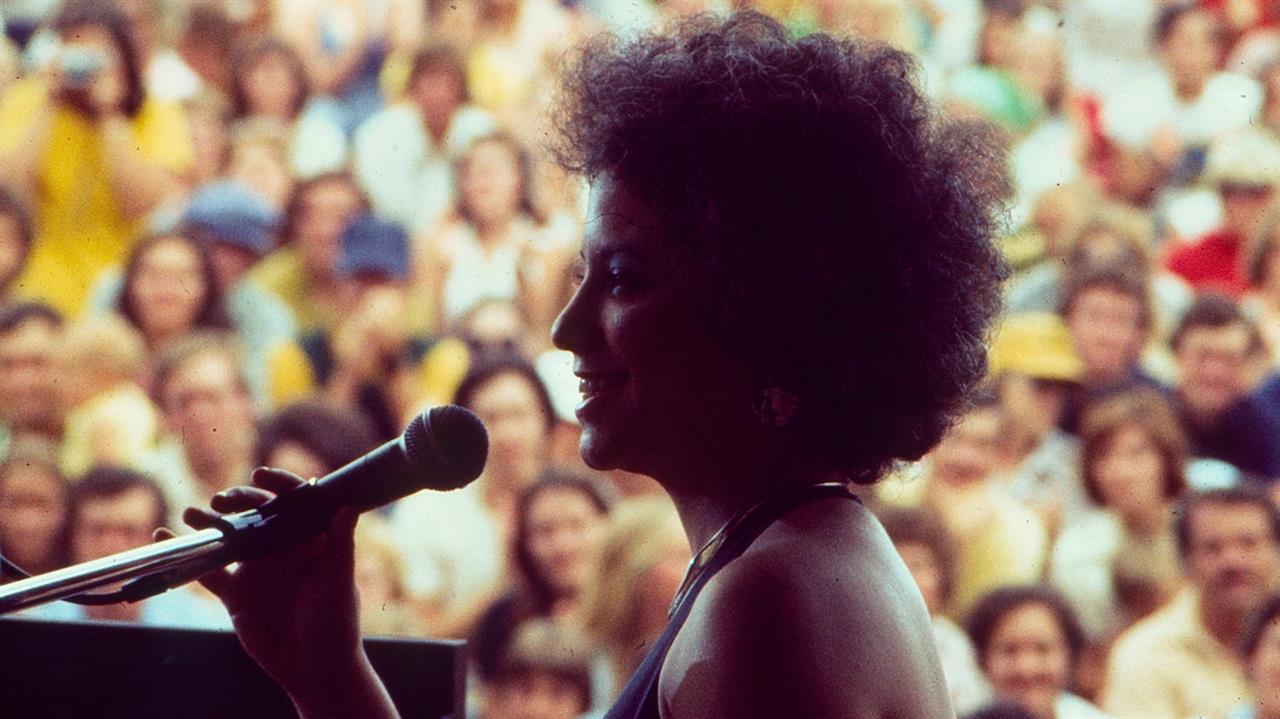
In Janis Ian, Breaking Silence, the biodoc of the earnest pop-folk singer-songwriter, a teen prodigy steps onto the roller coaster of the music industry at a tender age and experiences the highest highs and the lowest lows. And, it turns out that there’s more to Janis Ian than Society’s Child and At Seventeen.
The word prodigy is overused, but accurately describes Ian, who was doing professional-level song-writing at age 14. Her dad answers a booking request on the home phone with with, “You know she’s only 15, right?“
We’re not surprised that Ian experiences the shock of instant national stardom, the vicissitudes of record companies, the proverbial crooked business managers, (but not as MANY drugs as in most music biodocs). But it’s insightful to hear from Ian herself about how all this seemed and felt as it happened. Ian recounts her relationships while touring, with both men and women, and the impact of being outed involuntarily.
When Ian is unexpectedly confronted by someone who broke her heart years before, she blurts out the perfect last laugh.
Janis Ian: Breaking Silence was made with Janis Ian’s cooperation, and takes a very sympathetic point of view; that’s okay because Ian herself is clear-eyed, self-deprecating and maintains a solid, often wry, perspective on her experience. Janis Ian herself testifies, along with others close to her (including old pals Arlo Guthrie and Joan Baez).
This is the third feature for director Varda Bar-Kar, who is aided by excellent editing from Ryan Larkin in his first feature.
I originally reviewed Janis Ian: Breaking Silence for its brief thetricl release earlier this year. It’s now playing on PBS American Masters; you can find American Masters on your PBS channel or watch the film on the American Masters website.
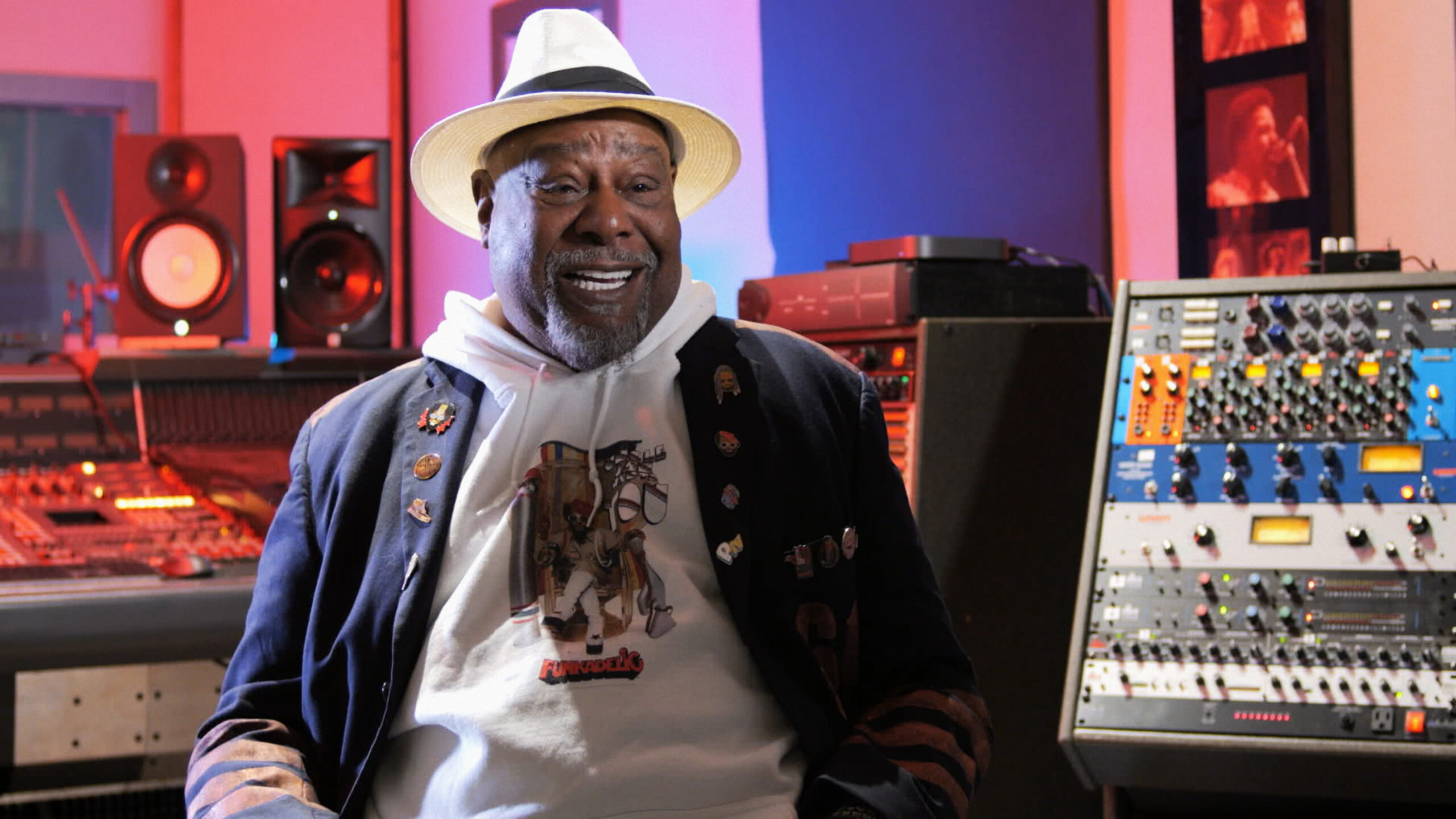
Photo caption: George Clinton in WE WANT THE FUNK. Courtesy of Firelight Films.
The delightful We Want the Funk is as far from an eat-your-broccoli documentary a you can get. Directors/producers Stanley Nelson and Nicole London explain the musical essence, history, and socio-political context of Funk without taking any of the fun out of it. Because the very raison d’être of Funk is to make you want to move your body, this is an especially enjoyable watching experience.
We see the evolution of Funk, beginning with James Brown, Sly and the Family Stone and Parliament/Funkadelic. We Want the Funk traces influence from the Black church and Funk’s legacy impacts on Afrobeat and Hip-hop.
We hear from musicians, like the always playful George Clinton, and scholars, including my favorite musicologist and cultural historian, Questlove. We Want the Funk drills deep to explain James Brown’s weaponization of the one-beat and Sly and the Family Stone bassist Larry Graham’s innovative slap. And how elements of Funk were absorbed by Brits like Elton John, who was stunned when Bennie and the Jets topped the US R&B charts.
We Want the Funk emphasizes the moment when Black music mirrored Black attitudes and sensibilities, as the Civil Rights Era morphed into Black Power. There was a political subtext to Dance to the Music. Motown acts had made sure that their appearance and behavior appealed to mainstream (i.e., White) audiences. Adopting a newly Afro-confident starting point, Funk music didn’t care how Whites reacted (although Whites, being humans, have embraced it, too).
Thank You Falettinme Be Mice Elf Agin. PBS begins airing We Want the Funk April 8 on Independent Lens. It will become available on the PBS app and PBS YouTube beginning April 9th.
Photo caption: Janis Ian in JANIS IAN: BREAKING SILENCE. Courtesy of Greenwich Entertainment.
In Janis Ian, Breaking Silence, the biodoc of the earnest pop-folk singer-songwriter, a teen prodigy steps onto the roller coaster of the music industry at a tender age and experiences the highest highs and the lowest lows. And, it turns out that there’s more to Janis Ian than Society’s Child and At Seventeen.
The word prodigy is overused, but accurately describes Ian, who was doing professional-level song-writing at age 14. Her dad answers a booking request on the home phone with with, “You know she’s only 15, right?“
We’re not surprised that Ian experiences the shock of instant national stardom, the vicissitudes of record companies, the proverbial crooked business managers, (but not as MANY drugs as in most music biodocs). But it’s insightful to hear from Ian herself about how all this seemed and felt as it happened. Ian recounts her relationships while touring, with both men and women, and the impact of being outed involuntarily.
When Ian is unexpectedly confronted by someone who broke her heart years before, she blurts out the perfect last laugh.
Janis Ian: Breaking Silence was made with Janis Ian’s cooperation, and takes a very sympathetic point of view; that’s okay because Ian herself is clear-eyed, self-deprecating and maintains a solid, often wry, perspective on her experience. Janis Ian herself testifies, along with others close to her (including old pals Arlo Guthrie and Joan Baez).
This is the third feature for director Varda Bar-Kar, who is aided by excellent editing from Ryan Larkin in his first feature.
The theatrical release of Janis Ian: Breaking Silence is rolling out, including California cinemas: Laemmle NoHo, Laemmle Monica, SBIFF Film Center, SBIFF Riviera, Smith Rafael Film Center, Rialto Cinemas Elmwood and Rialto Cinemas Sebastopol.
Timothée Chalamet in A COMPLETE UNKNOWN. Courtesy of Searchlight Pictures.
A Complete Unknown, James Mangold’s brilliant biopic of Bob Dylan, is a film about genius. If you need to understand why Dylan is the only songwriter to win the Nobel Prize for Literature, here is why. It’s a fascinating story, and Mangold’s telling of it is insightful and entertaining.
The story begins with 19-year-old Bob Dylan showing up in New York City. No one knows who he is (a complete unknown), because he hasn’t done anything, but he wants to meet his hero, the now hospitalized folksinger Woody Guthrie. Dylan can’t pretend to be anything but another homeless musician wannabe, but legendary folksinger Pete Seeger (Edward Norton) takes Dylan under his wing. Starting with open mic nights, Dylan starts playing around the Greenwich Village folk scene.
Dylan meets Sylvie Russo (Elle Fanning) a student activist Dylan whom appreciates because she is pretty, smart, opinionated and has an apartment. Sylvie is a barely fictionalized Suze Rutolo, Dylan’s girlfriend of the period, who appears on the cover of his The Freewheelin’ Bob Dylan album.
Dylan meets another woman his age, Joan Baez (Monica Barbaro), who is already a big deal. Baez had played the Newport Folk Festival at age eighteen and had already recorded three albums. Bob is excited by Baez’s stardom, and Joan admires Bob’s still undiscovered song writing. Without falling in love exactly, they begin an affair. Bob takes advantage of Joan’s connections and credibility (and apartment); he lets her cover Don’t Think Twice, It’s All Right before he released his own version. You get the impression that Joan could have fallen in love with Bob if he would treat her with decency and affection, but Bob is only in love with himself.
Seeger, Baez and others in Greenwich Village’s music world soon recognize the extraordinary, generational genus of Dylan’s songwriting. He finally gets to record his own material in 1963 with The Freewheelin’ Bob Dylan; it was an auspicious and transformative collection of original songs from a 22-year-old: Blowin’ in the Wind, Masters of War, A Hard Rain’s Gonna Fall and Don’t Think Twice, It’s All Right.
In what I found to be the most thrilling moment in A Complete Unknown, Dylan debuts The Times They Are a-Changin‘ to a live audience, and all the listeners, including Seeger and Baez, are captivated, by each new groundbreaking verse. Come mothers and fathers…Throughout the land…And don’t criticize…What you can’t understand…Your sons and your daughters…Are beyond your command. The song – and this scene in A Complete Unknown – completely capture the zeitgeist of the time.
Dylan becomes a huge star and cultural icon – a symbol of a generation. And he immediately is alienated by the accompanying trappings of celebrity.
Dylan also evolves musically from his roots in acoustic folk music. His mentors in the Folk Music movement have a tough time with that, and it all explodes at the 1965 Newport Folk Festival when Dylan defiantly shows up with an electric rock band, the climax of A Complete Unknown.
The folk purists, like Pete Seeger and the musicologist Alan Lomax, saw folk music as politically significant and rock and roll music as politically inconsequential – history soon proved them very wrong about this. The old folkies had also suffered for their movement by being victimized in the McCarthy Era, earning some of their self-righteousness. What the old folkies could not comprehend – and would find abhorrent if they did – is that Bob Dylan was bigger than the genre of Folk Music itself.
Elle Fanning and Timothee Chalamet in A COMPLETE UNKNOWN. Courtesy of Searchlight Pictures.
So, just who IS Bob Dylan? We expect any biopic to reveal, but Mangold has targeted one of our culture’s most notorious enigmas. Mangold and Chalamet give us a Dylan perhaps less complicated than his image. Here, Dylan is ambitious and absolutely committed to his art. He will not prioritize any relationship or behavioral norm above his songwriting or his career.
He wants the recognition, fame and money that comes from having an audience and fans but, in person, he doesn’t want to experience the fandom or even respect the audience. In pursuit of his own vision, Dylan is not afraid to disappoint (or enrage) anyone else, nor does he feel constrained by loyalty. (Although, if consistent with his vision, he can be kind to his hero Woody Guthrie.)
There’s more than a touch of narcissism there, too. A Complete Unknown depicts Dylan between the ages of 19 to 24, when he was only as mature as most of us were at that age; after all, one can be important while still very immature. He can be a brat, but he isn’t a bad person; he just isn’t capable of a reciprocal relationship. Sylvie Russo and Joan Baez both come to understand that, whoever he really is, he’s not interested in giving them what they want.
The older generation of folksingers certainly don’t GET Dylan, His manager Albert Grossman (Dan Fogler) doesn’t get him, but is fiercely devoted, anyway. In A Complete Unknown, the only people who get Bob are Bobby Neuwirth (Will Harrison), the singer-songwriter who became his road manager, and another icon, Johnny Cash (Boyd Harrison).
As far as I can tell, A Complete Unknown is remarkable for its historical accuracy. There are a few tiny factual quibbles (Dylan actually changed his name from Zimmerman just AFTER he arrived in New York), but none of them are important or detract from the essential truth.
A Complete Unknown is also a time capsule of the early 1960s, and will be especially evocative for Baby Boomers like me, right down to the institutional green paint on Woody Guthrie’s hospital walls. LBJ hadn’t yet escalated the Viet Nam War, so peaceniks were campaigning against the threat of nuclear annihilation and white college kids were flocking to the Civil Rights Movement. Mangold perfectly captures the instant terror and helplessness that Americans felt during The Cuban Missile Crisis – and the suddenness of relief when it was over.
If you know the story, there are lots of delicious tidbits. For example, in the recording session for Like a Rolling Stone, Al Kooper (Charlie Tahan of Ozark), whose services were not needed on guitar, switches instruments so he can get paid for the session and invents the 1960s’ most iconic organ riff.
Monica Barbaro and Timothee Chalamet in A COMPLETE UNKNOWN. Courtesy of Searchlight Pictures.
Chalamet, whom I’ve always seen as a little kittenish, finally gets to be a little dangerous and is appropriately prickly as Bob Dylan. Chalamet portrays Dylan’s aching and yearning for artistic achievement, which allows us to root for a guy who often behaves badly.
Barbaro’s Joan Baez is especially vivid, especially as she sizes up Dylan’s talent and assesses his behavior. Bob, you’re kind of an asshole.
Scoot McNairy’s performance as Woody Guthrie is especially haunting. Guthrie had been suffering from the then little understood Huntington’s disease; because of the disabling neurological effects and the behavioral symptoms, he spent his final years confined in psychiatric hospitals.
Big Bill Morganfield’s performance as a fictional blues artist named Jesse Moffette, who clearly stands in for Muddy Waters, is especially charismatic. Morganfield happens to be the son of Muddy Waters.
Chalamet, Norton, Barbaro and Boyd Harrison do their own singing in A Complete Unknown, which has been much ballyhooed, but I don’t find that important to a successful biopic. Their singing in character is all very good, and I was impressed by how perfectly Barbaro nails Baez’s unique voice. Norton, BTW, plays his own banjo, which is also impressive.
The editing by Andrew Buckland and Scott Morris is exceptional – none of the shots or scenes linger even a half-second too long. This is a two hour, twenty minute film that never lags.
A Complete Unknown is the best biopic, showbiz or otherwise, since Walk the Line (also a James Mangold film) and it’s one of the Best Movies of 2024.