In the rapturously filmed period drama Dance of the 41, Mexican politician Ignacio de la Torre (Alfonso Herrera), a political Icarus if there ever were one, marries President Porfirio Diaz’s daughter Amada (Mabel Cadena). It’s the turn of the 20th Century, and de la Torre starts scheming with breathtaking recklessness.
The risk comes from the fact that de la Torre is in a secret club of gay aristocrats, closeted in plain sight in the most macho and homophobic mainstream culture. He has married Amada so she can be his beard, but his new bride, unaware of her new hubbie’s secret, was expecting her own sexual awakening. Instead, he spurns her for a torrid love affair with Evaristo (Emiliano Zurita).
De la Torre had married the boss’ daughter in a bid for advancement, expecting her to submit to being his pawn. But, hurt at not being desired, she calls on her dad’s capacity as an enforcer. It all culminates in a formal queer bacchanal that turns heartbreaking.
Dance of the 41 is a fictionalized (but very plausible) telling of a historical event, the salacious scandal called the “Dance of the Forty-One” or the “Ball of the Forty-One”.
I found the century-old story of Mexican LGBTQ history and the forbidden love between the men to be less interesting than the story between the husband and the young bride he had wildly underestimated. He is trapped because he’s gay and ambitious, but he is also a dick who is relying on male privilege to dismiss a young woman’s needs and aspirations and to cynically use her.
Director David Pablos and cinematographer Carolina Costa have created a visually extravagant film that makes use of its architecturally stunning locations. Much of Dance of the 41 takes place in gorgeously lit – candlelight.
I screened Dance of the 41 for the 2021 SFFILM. It is now streaming on Netflix.
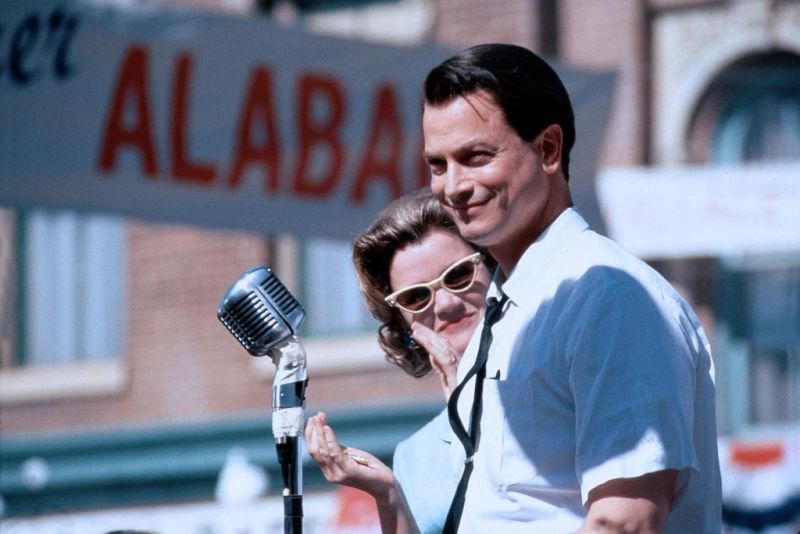
On January 12, Turner Classic Movies brings us George Wallace, with its brilliant performance by Gary Sinise. Sinise captures the character of the driven, morally flexible Alabama Governor, whose political opportunism took him to personify the defense of racial segregation in America. His wild personal journey included presidential campaigns, becoming paralyzed by an assassination attempt, and mellowing in a redemption-seeking epilogue.
Originally a 1997 TV miniseries, this three-hour work was based on the fine Marshall Frady biography and was directed by the legendary John Frankenheimer (The Manchurian Candidate, Seven Days in May).
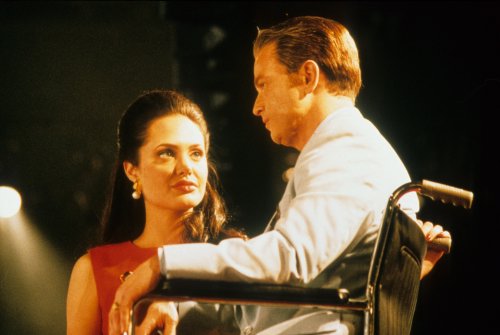
Mare Winningham plays Wallace’s first wife Lurleen, who succeeded him as Alabama’s Governor, and Angelina Joie plays his second wife Cornelia. Sinise, Winningham and Frankenheimer all won Primetime Emmys.
George Wallace is not available to stream and is rarely broadcast, so set your DVR.
Photo caption: Jude Hill in BELFAST. Courtesy of Focus Features.
In Belfast, Kenneth Branagh’s superb coming of age story, we see Northern Ireland’s Troubles through the eyes of eight-year-old Buddy (Jude Hill). His dad (Jamie Dornan) works for two weeks at a time in Britain, so his mom (Caitriona Balfe) is raising Buddy and his older brother by herself most of the time. The family is under severe financial pressure. They are a nominally Protestant family living in a working class Belfast neighborhood, integrated with Catholics.
The movie’s opening is set on August 15, 1969, the day the Troubles intrude on Buddy’s neighborhood. Branagh perfectly captures the moment – the very second – that external events upend Buddy’s life. Overnight, his block has barbed wire at one end and a barricade at the other. Catholics are pressured to move out in a measure of ethnic cleansing.
Things get real, and the dad has the chance to move the family to Britain. There are factors that make uprooting the family a complicated decision. The audience is thinking, get the HELL out of THERE. After all, the family doesn’t know what we know – that the Troubles will persist for 29 more years.
This is autobiographical, the story of Kenneth Branagh’s own family. They escaped the Troubles by moving to from Belfast to Britain in 1970 when Branagh was Buddy’s age.
Although this story is about a specific child, telling it from the child’s point of view makes it universal. Children need security, but adult grievances, however valid, are prioritized over the security of children. The sectarians may think that they are targeting Catholics or Protestants, but the impact of their violence is to destroy safety, civility and predictability for all.
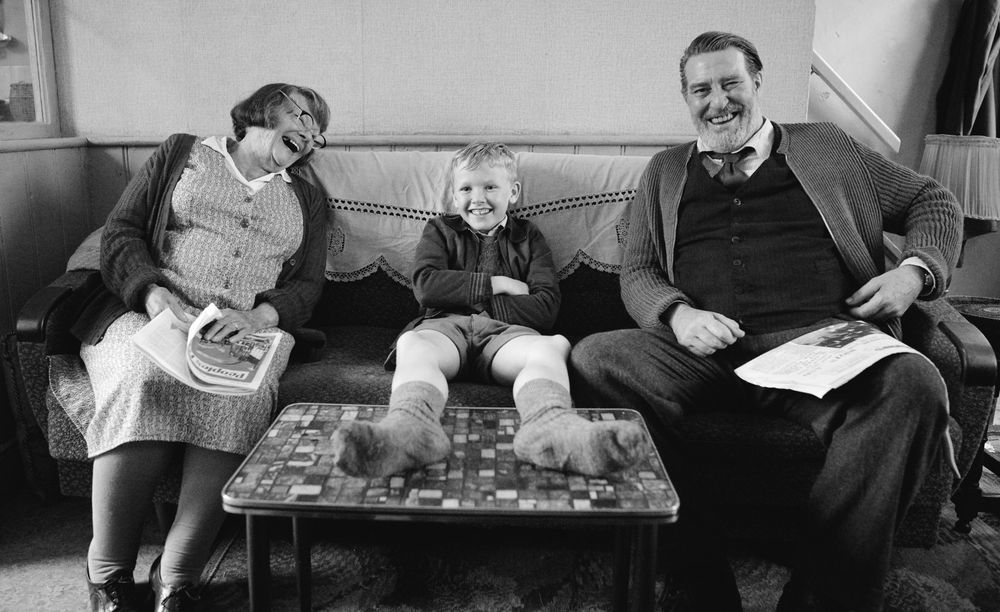
Judi Dench, Jude Hill and Ciarán Hinds in BELFAST. Courtesy of Focus Features.
The performances are impeccable, especially those by Judi Dench and Ciarán Hinds as Buddy’s grandparents. (The grandfather has the best line in the film.)
And where did Branagh find this kid actor Jude Hill? He is completely believable in every scene – and he might just be the most adorable child on the planet.
Belfast is a family drama, but the family is Irish, so there’s plenty of humor.
Branagh has shot Belfast in a glorious black-and-white which amplifies both the historical period and the grittiness of the setting. The use of Belfast’s own Van Morrison on the soundtrack is perfect.
Belfast is justifiably one of the Oscar favorites. If you have heartstrings, they are gonna get pulled.
An American Story: Norman Mineta and His Legacy traces the life and times of Norman Mineta, who amassed a startling number of “firsts” and other distinctions in America history:
The first Asian-American mayor of a major U.S. city.
The first Japanese American member of Congress elected from the 48 Continental states.
A Cabinet Secretary in both Democratic and Republican Administrations.
The nation’s longest-serving Transportation Secretary.
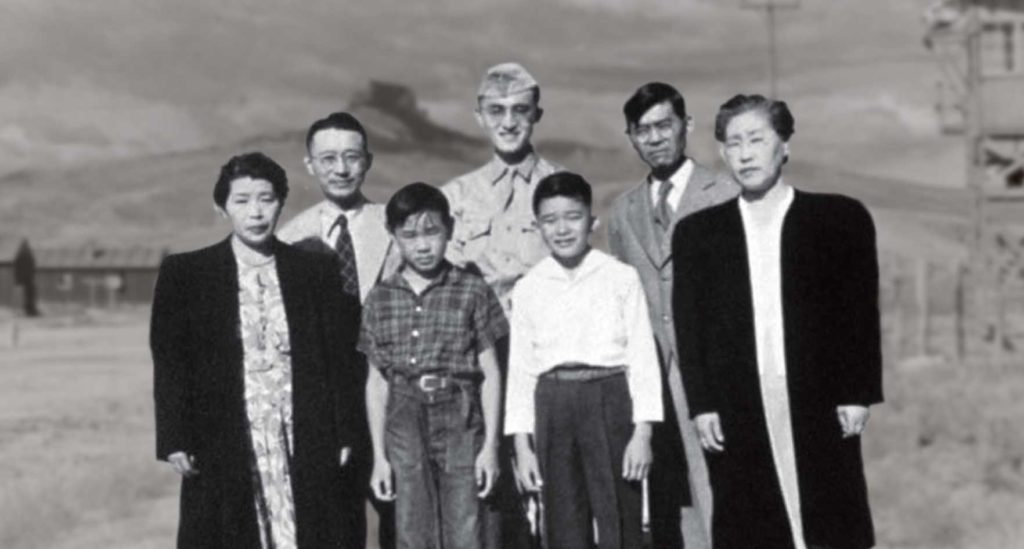
The achievements were even more remarkable given that, as a child, Mineta was imprisoned by his own US government in a WW II internment camp. And given that his political base had, during his career, an Asian-American population of far less than ten percent.
This didn’t happen by accident. Norm Mineta is a driven man. At the same time, his ambition and will is tempered by his buoyancy and ebullience.
Documentarians Dianne Fukumi (director and co-producer) and Debra Nakatomi (co-producer) embed the story of Japanese-Americans, from immigration through internment, and on to reparations.
AN AMERICAN STORY: NORMAN MINETA AND HIS LEGACY
The defining event for Mineta’s Nissei generation was the WW II internment of 120,000 Americans by their own government. The central thread in the Mineta story is that the injustice of Mineta’s internment informed George W. Bush’s resistance to treating American Muslims that same way in the aftermath of the 9/11 attacks.
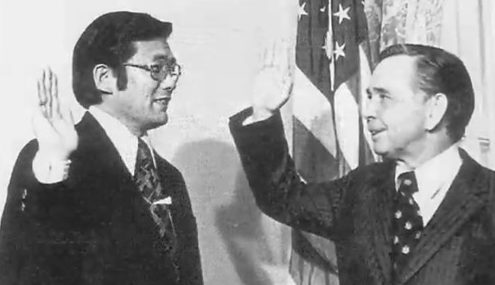
Mineta being sworn into the US House of Representatives by House Speaker Carl Albert in AN AMERICAN STORY: NORMAN MINETA AND HIS LEGACY
The film’s most delightful moment may be the octogenarian Mineta sunnily taking his luggage through security at Norman Y. Mineta San Jose International Airport.
[Full disclosure: I have known Norm since I served in his 1974 primary campaign and interned for him on Capitol Hill in the mid 70s. I saw An American Story: Norman Mineta and His Legacy at an October 2018 special screening with Norm Mineta, Fukumi and Nakatomi in San Jose.]
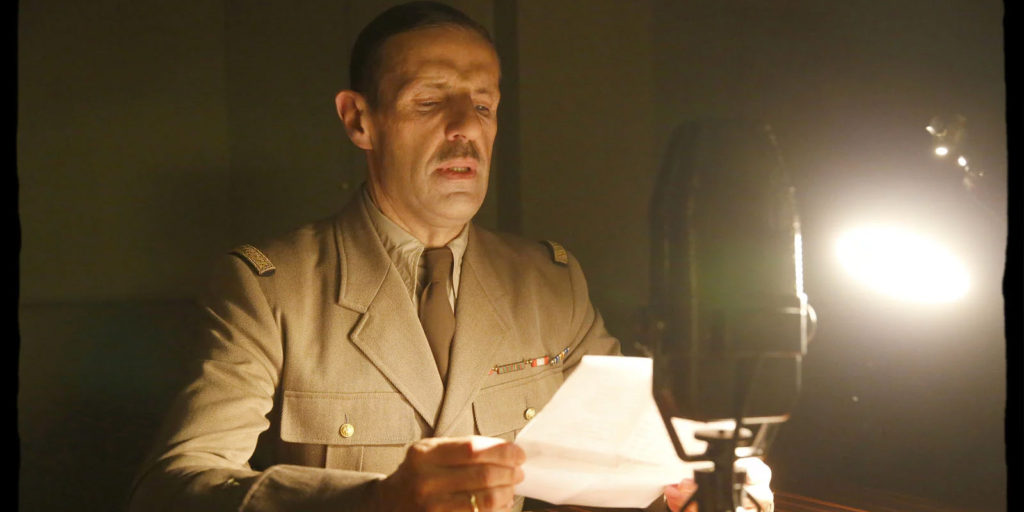
Photo caption: Lambert Wilson in DE GAULLE. Courtesy of Samuel Goldwyn Films.
De Gaulle takes us to a pivotal moment in French WW II history that is no longer well-understood by most Americans. The French Army has collapsed in the face of German invasion, and the fall of Paris is both inevitable and imminent. The French government is considering asking Hitler for an armistice, seeking to end the slaughter and to repatriate its 2 million POWs.
Charles de Gaulle (Lambert Wilson) is also losing his battle to convince the government not to surrender, but to keep fighting the Nazis from outside France itself, based in France’s colonial possessions. In this moment of catastrophe, de Gaulle is virtually alone in imagining that Great Britain, joined by America’s industrial might, could someday liberate France. It doesn’t help that, for the authoritarian and anti-Semitic French military establishment, Hitler isn’t so abhorrent.
Writer-director Gabriel Le Bomin has focused De Gaulle on only two weeks of WW II history – between June 5 and June 19, 1940. Every minute counts – and the clock is ticking.
It’s a similar approach as in Darkest Hour, where all of the story takes place in May, 1940, as Churchill is facing England’s moment of existential peril. In fact, the Darkest Hour (Amazon, AppleTV, Vudu, YouTube and HBO Max) would complete an excellent double feature with De Gaulle.
The tension is enhanced with a parallel thread – the political crisis has isolated de Gaulle in London while his family, completely out of communication, is scrambling to escape the Nazis in France.
Aloof, shy and an egomaniac, de Gaulle was easily dislikeable. Le Bomin has humanized him by including his most relatable attributes – his relationship with his wife and kids, especially his daughter with Down’s Syndrome.
Le Bomin and Wilson had to meet high expectations on the portrayal of an icon. After all, De Gaulle’s appearance, speech and mannerisms are as familiar to a French audience as those of Elvis Presley, Richard Nixon, Jacqueline Kennedy and Muhammad Ali are to an American one.
I wouldn’t have immediately thought of Lambert Wilson for the role. Wilson, known for the Matrix franchise, is handsome and physically graceful. But, for starters, Wilson is tall enough, at 6-2, to play de Gaulle, just under 6-5. Prosthetics and makeup completed the physical transformation. Wilson’s acting craft took him the rest of the way – capturing de Gaulle’s stiffness and the physical awkwardness that some very tall people have.
I streamed De Gaulle on Virtual Cinema at Laemmle.
THE BOYS IN RED HATS. Photo courtesy of Shark Dog Films.
Remember the resulting frenzy when the Kentucky prep school boy at the Lincoln Memorial smirked at the indigenous tribal elder? Documentarian Jonathan Schroder is an alum of that very prep school – Covington Catholic or “CovCath”. In The Boys in Red Hats, his point of view shifts as he peels back the onion on what really happened. It comes down to insights into media, social media and, especially, White privilege.
Like most of us, Schroder was initially outraged at the boys; as more facts emerged, he became sympathetic to what seemed like mistreatment of the boys in social media. Don’t give up on this movie as a whitewash – as the story gets more complicated and Schroder becomes more reflective, his needle sways back and forth until the final payoff.
This was a Rorschach event at the Lincoln Memorial. One thing is for sure, these privileged kids and their chaperones, confronted by a crazy hate group (Black Hebrew Israelites), were unequipped to deal with a momentary convergence of disorder and diversity.
To put my own cards on the table, I am not disposed to sympathize with rich kids who were comfortable in being shipped to an anti-choice rally, wearing MAGA hats. In The Boys in Red Hats, the journalist Anne Branigan’s perspective most resonated with me.
Schroder gives plenty of rope to a professional conservative talking head, two CovCath dads and the school’s alumni director, none of whom display a modicum of sensitivity or empathy to those less rich, less white or less male than they.
Schroder sees the significance when one of his CovCath buddies says, “I like my bubble”.
I screened The Boys in Red Hats for its world premiere at Cinequest, and it made my Best of Cinequest 2021. The Boys in Red Hats releases in theaters and streaming on Virtual Cinema on July 16.
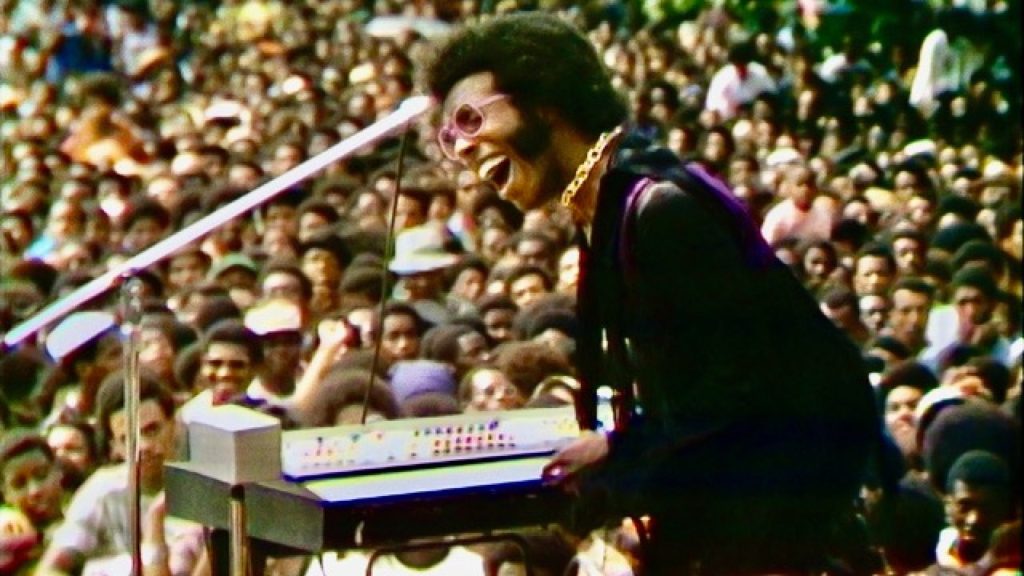
Sly Stone in SUMMER OF SOUL (…OR, WHEN THE REVOLUTION COULD NOT BE TELEVISED)
In Summer of Soul (…Or, When the Revolution Could Not Be Televised), Questlove recovers the never-before-seen film of the Harlem Cultural Festival over six weekends in 1969. The promoters had tried to market the footage as “the Black Woodstock”, but had no takers at the time (for the obvious reason).
This is a superb concert film, but that’s not all it is. 1969 was an important historical and cultural moment – especially for American Blacks, and Questlove supplies the context. A 2021 audience cannot miss the parallels between 1969’s Black Is Beautiful and Black Power and today’s Black Lives/Black Voices.
Ahmir “Questlove” Thompson is widely-known as drummer of The Roots and bandleader for The Tonight Show with Jimmy Fallon. Creative and versatile, he is Emmy-nominated and Grammy-winning, he is going to win an Oscar for this, his directorial debut for a feature film. Summer of Soul proves that Questlove is such a gifted storyteller that I hope he takes on narrative fictional filmmaking, too.
The music in Summer of Soul is fantastic:
Sly and the Family Stone shattered expectations with their garb, racially integrated band and female musicians on trumpet and keyboards. Their psychedelic funk and super-charged ebullience blew away the audience. (BTW Vallejo native Sly Stone is now age 78.)
Stevie Wonder was only 19, 3 years before Superstition, and already taking his remarkable creativity and musicianship down new roads.
Gladys Knight and the Pips – watch the Pips and appreciate how those guys really worked it.
BB King at the height of his popular breakthrough, singing Why I Sing the Blues.
The Fifth Dimension were best sellers among the white mainstream – and here they were finally accepted by a Black audience. Billy Davis Jr. and Miriam McCoo get to relive the experience on camera in one of Summer of Soul’s most touching moments.
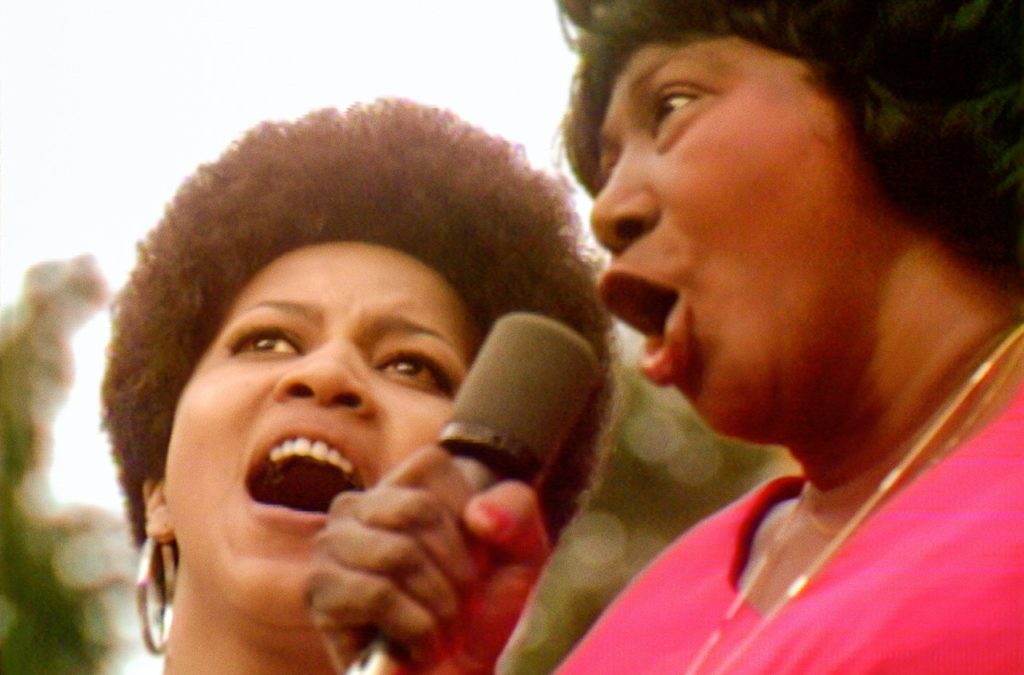
The musical high point is a rendition of Precious Lord, Take My Hand by Mahalia Jackson and Mavis Staples. Mahalia was then 58 and a legend, and this was her signature song. Mavis was already a showbiz veteran at 30 and at the top of her game. The Reverend Jesse Jackson introduces the song with a heartbreaking account of Martin Luther King asking for this, his favorite hymn, seconds before his murder. Mahalia was not feeling well, and asked Mavis to kick off the song. Mavis’ first verse is volcanic, then Mahalia takes over and the two finish together in an explosion of emotions. Epic.
Mavis Staples and Mahalia Jackson in SUMMER OF SOUL (…OR, WHEN THE REVOLUTION COULD NOT BE TELEVISED)
Something else happened that summer – the manifestation of JFK’s pledge to land a man on the Moon and return him safely to Earth. Questlove uses file footage of person-on-the-street interviews to contrast the reactions of Blacks and Whites. It’s a Rorschach test of privilege and alienation.
Gladys Knight recounts “it wasn’t just about the music”. BB King performed here just weeks after the release of The Thrill Is Gone, and he must have included Thrill in his set, but I’m sure that Questlove instead chose Why I’m Singing the Blues to focus on that song’s larger subtext for Black Americans.
And the need to show the militant commitment to self-determination must be why Questlove features so much of Nina Simone at her rawest. If she had ever worried about being too harsh, Simone was well past that point in 1969.
On a lighter note, ironic sombrero-wearing must have been a thing in Harlem that summer – check out the crowd shots (and drink a shot for every sombrero.)
Summer of Soul etc. etc. has also earned the #13 ranking on my list of Longest Movie Titles.
How good is Summer of Soul, which swept the Grand Jury Prize and the Audience Award at Sundance? It’s hard to imagine it not winning the Oscar for Best Documentary Feature, and I’m guessing it will be that rare doc nominated for Best Picture. FWIW I’m putting it on my list of Best Movies of 2021 – So Far.
Summer of Soul (…Or, When the Revolution Could Not Be Televised) is in theaters and streaming on Hulu. It’s worth watching for the music and worth it for the history, too; for the combination, it’s a Must See.
THE BOYS IN RED HATS. Photo courtesy of Shark Dog Films.
Remember the resulting frenzy when the Kentucky prep school boy at the Lincoln Memorial smirked at the indigenous tribal elder? Documentarian Jonathan Schroder is an alum of that very prep school – Covington Catholic or “CovCath”. In The Boys in Red Hats, his point of view shifts as he peels back the onion on what really happened. It comes down to insights into media, social media and, especially, White privilege.
Like most of us, Schroder was initially outraged at the boys; as more facts emerged, he became sympathetic to what seemed like mistreatment of the boys in social media. Don’t give up on this movie as a whitewash – as the story gets more complicated and Schroder becomes more reflective, his needle sways back and forth until the final payoff.
This was a Rorschach event at the Lincoln Memorial. One thing is for sure, these privileged kids and their chaperones, confronted by a crazy hate group (Black Hebrew Israelites), were unequipped to deal with a momentary convergence of disorder and diversity.
To put my own cards on the table, I am not disposed to sympathize with rich kids who were comfortable in being shipped to an anti-choice rally, wearing MAGA hats. In The Boys in Red Hats, the journalist Anne Branigan’s perspective most resonated with me.
Schroder gives plenty of rope to a professional conservative talking head, two CovCath dads and the school’s alumni director, none of whom display a modicum of sensitivity or empathy to those less rich, less white or less male than they.
Schroder sees the significance when one of his CovCath buddies says, “I like my bubble”. I screened The Boys in Red Hats for its world premiere at Cinequest, and it made my Best of Cinequest 2021.
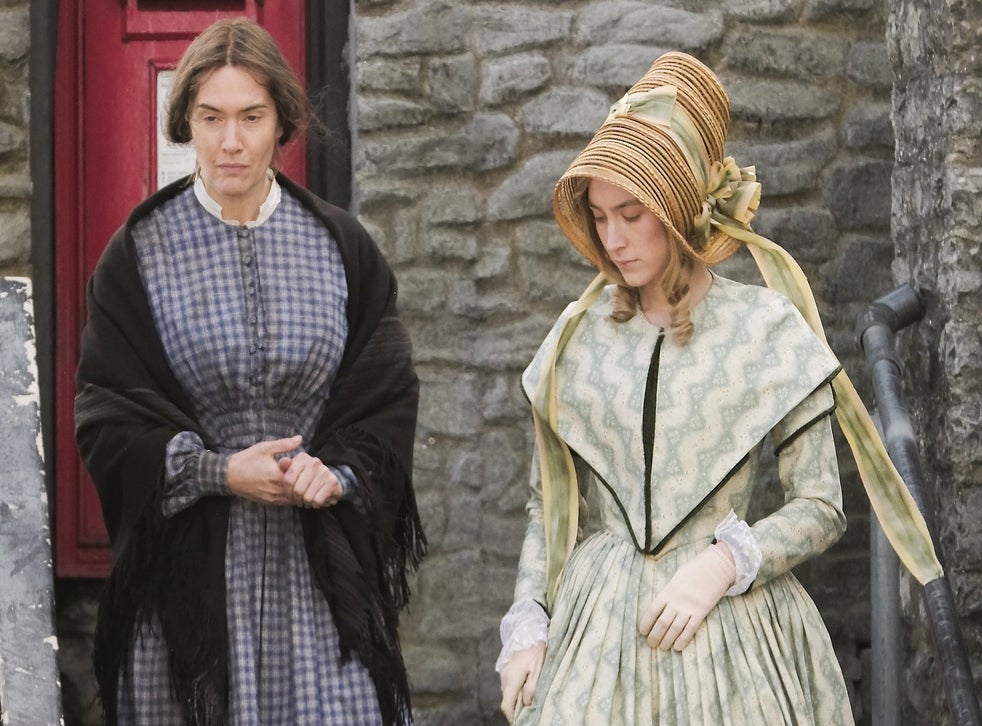
The fine acting of Kate Winslet and Saoirse Ronan can’t save Ammonite, a slog of a period romance.
Winslet plays a 19th century paleontologist isolated in the inhospitable climate of an English coastal village. Ronan plays a young wife whose clueless husband has diagnosed as melancholy, although her biggest issue seems to be him; he thinks that leaving her with Winslet’s loner in the brisk ocean breeze might be therapeutic.
The general arc of the story is predictable – these two underestimated women will come to appreciate each other’s gifts and will fall in love, a forbidden love in this time and place. Of course, it takes a long time to break down the anti-social barriers that the Winslet character has constructed to protect herself emotionally. In the mean time, there’s only so much smoldering that the audience can stand to consume.
The problem here is the directing and editing – the pace needed to be picked up. There’s not enough of a payoff to this story to reward a slow, slow, slow burn. The Wife and I just couldn’t hang in there with it. We stopped caring.
The Winslet character is so solitary – and so terse when she’s not alone – dialogue in Ammonite is scant. And the sound design is intentionally rigged to emphasize this – and it’s a problem. All of the non-dialogue sounds are louder than usual. Now, this works near the crashing surf; we all know that voices are drowned out by waves crashing on rocks. But every footstep and creaking hinge a makes a pronounced, even jarring, sound. Once you figure out what’s going on, it’s very distracting.
The sound design, because it is so innovative, has prompted some Oscar buzz. But it’s innovative-bad, not innovative-good.
Ammonite is available to stream; I watched it on Amazon.
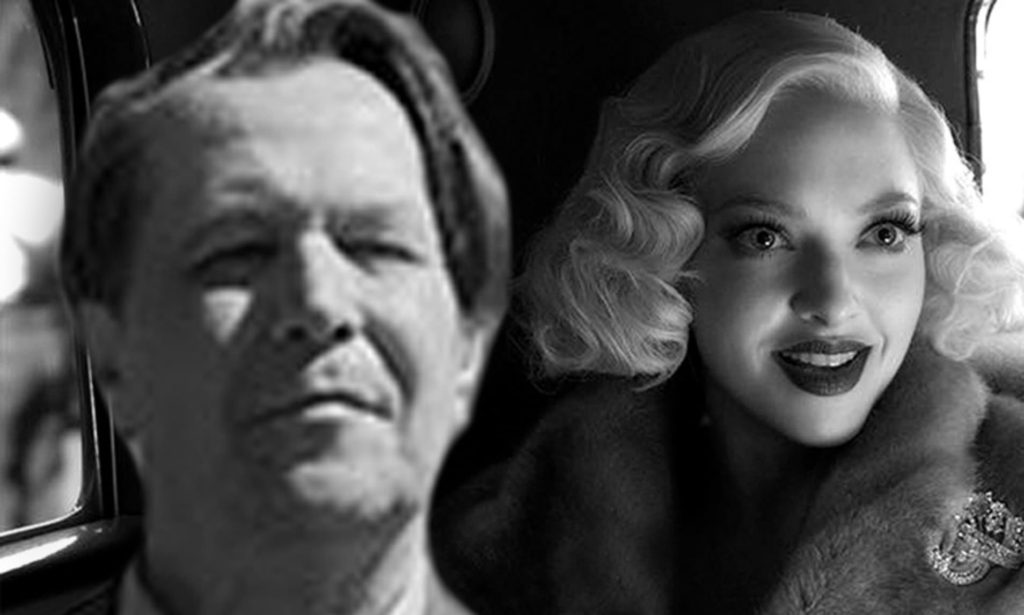
David Fincher’s Mankis a black-and-white beauty of a film, a portrait of troubled talent in Classic Hollywood.
Mank is a character study of Herman J. Mankiewicz (Gary Oldman) as he pens his Oscar-winning screenplay for Citizen Kane. Mankiewicz was an Algonquin Round Table wit whose misfortune was that he despised the one thing that he excelled at. He was a master writer and fixer of Hollywood movie scripts, but he would rather have been in Manhattan trading bon mots with his peers in the intelligentsia. He particularly the industrial, ultra-commercial and course movie studio bosses and despised their politics.
It didn’t help that Mankiewicz was a raging alcoholic and compulsive gambler (although not a womanizer). He was so hard to handle that Orson Welles essentially imprisoned him at a remote California desert ranch to write Citizen Kane.
Mankiewicz had one unsurpassed idea for a script – the story of media mogul (and frustrated politician) William Randolph Hearst. Mankiewicz had been a frequent guest of Hearst and his companion Marion Davies at Hearst Castle. The problem is that telling this story would piss off the owner of the world’s biggest publicity machine and horrify the movie studio heads who employed screenwriters. And, most poignantly, it would betray Mankiewicz’s kind friend Marion Davies.
Mankiewicz had served as the court jester at Hearst Castle, and the term comes up repeatedly in Mank, most importantly in a cutting remark by Herman’s little brother Joseph Mankiewicz.
The Wife stayed with Mank and finished it, but she advised me that Mank is much more appealing to cinephiles who already know the “inside baseball” of the old movie studio system and the making of Citizen Kane. Indeed, when the likes of Louis B. Mayer, Ben Hecht, Joseph Mankiewicz, Irving Thalberg and John Houseman popped up, it instantly resonated with me.
The entire cast is excellent, but Amanda Seyfried is beyond great as Marion Davies. Charles Dance (coming off his Lord Mountbatten in The Crown) is perfect as William Randolph Hearst. Muckraker-turned-socialist-gubernatorial-candidate Upton Sinclair is played by…(wait for it)…Bill Nye the Science Guy.
David Fincher is one of our greatest directors (Se7en, Fight Club, Zodiac, The Social Network, Gone Girl). Fincher’s father Jack Fincher wrote the screnplay for Mank (and clearly shared Herman Mankiewicz’ acid view of the Hollywood hierarchy), so this is clearly a labor of love for David Fincher.
As a tribute to both Citizen Kane and the Golden Age of Hollywood, Mank is just gorgeous, as beautiful a black-and-white film as any directed by John Ford or shot by Sidney Toler, Nicholas Musuraca or John Alton. Mank’s cinematographer is Erik Messerschmidt (TV’s Mindhunter).
Mank is going on my list of Best Movies of 2020 – So Far. I see Oscar nominations coming for Fincher, Messerschmidt and Seyfried. Mank is streaming on Netflix.