PRESSURE: a study in high-stakes decision-making

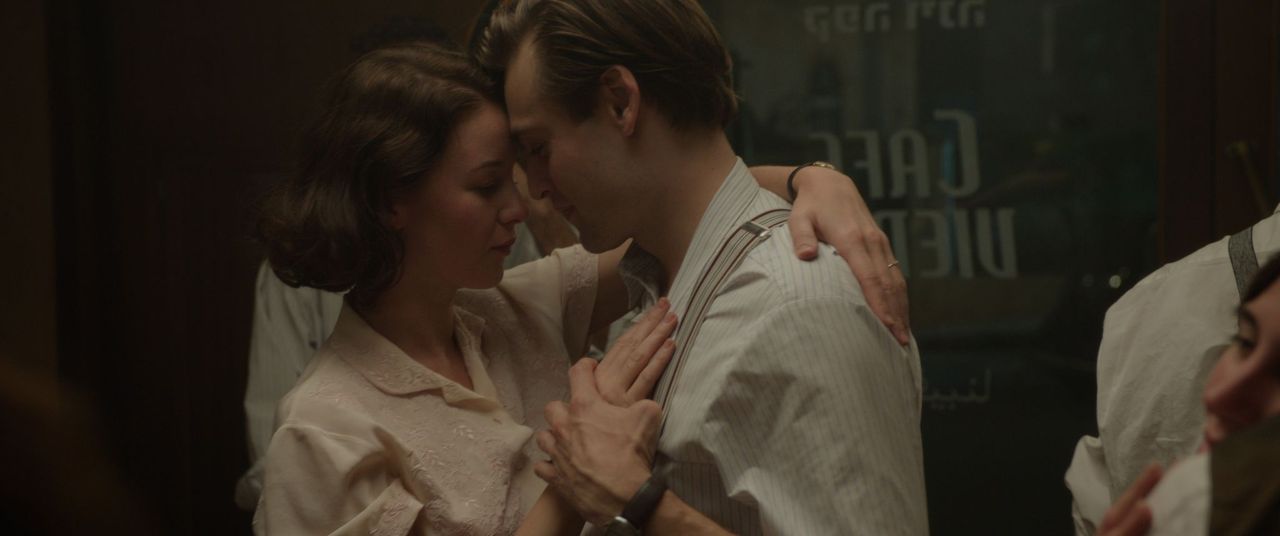
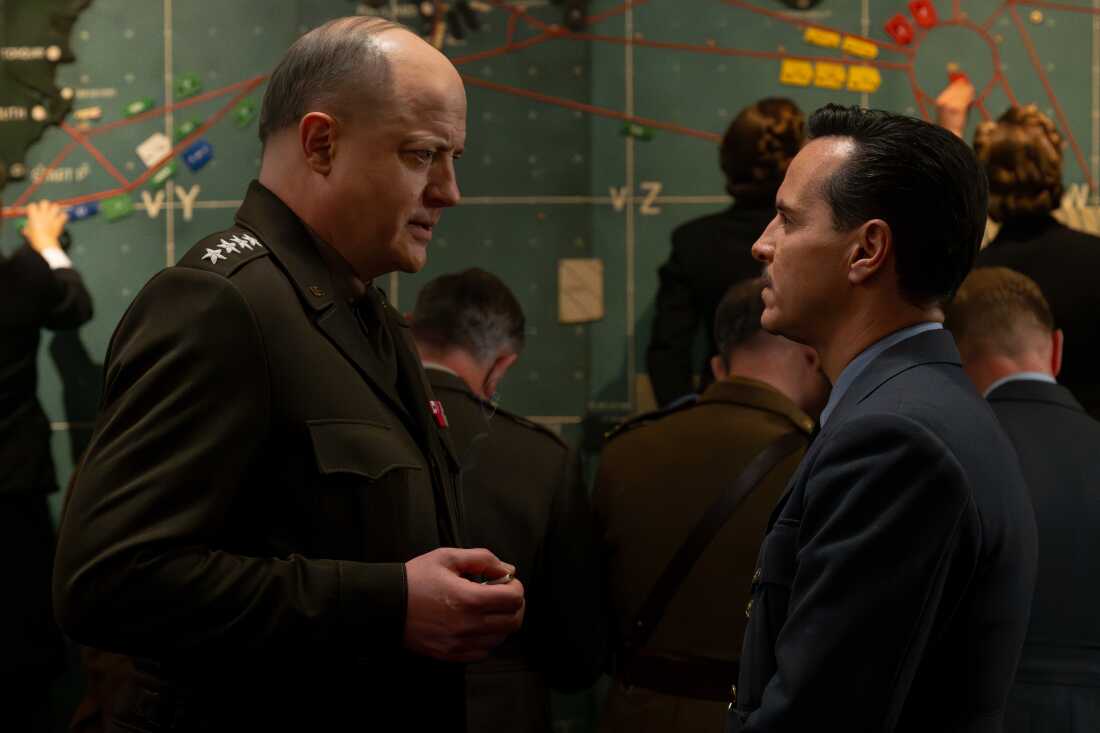
Photo caption: Brendan Fraser and Andrew Scott in PRESSURE. Credit: Alex Bailey/Focus Features/STUDIOCANAL © 2026 All Rights Reserved. Courtesy of Focus Features.

The superb historical drama Pressure is a study in high-stakes decision-making. Few human endeavors had higher stakes than the Allied invasion of Europe, upon which hinged millions of lives, the liberation of formerly free nations, and the defeat of the fascist and racist Nazi regime (whose worst crimes were yet to be publicized). And, after all the planning and investment in resources, the success of that invasion came down to secrecy and a weather report, made by human beings.

History’s most massive amphibious invasion would be logistically difficult and cost many lives, no matter how well things went. But it would certainly generate horrendous casualties and possibly even fail, if the Allies lost the element of surprise. The allies had gone to extraordinary lengths to mislead the Germans about the location of the D-Day landings. This spiderweb of secrecy, deception and misdirection couldn’t be maintained forever, and the clock was ticking.

While the Allies needed to launch D-Day as soon as possible, they also needed to wait for the right conditions. The landing required high tides and low-enough waves for landing craft, a moon-lit night for the airborne forces, along with good visibility and a high ceiling for air support. Missing the window for the moon and tides, would mean a two-week delay – with the threat of the secrecy unraveling.
Brandon Fraser in PRESSURE. Courtesy of Focus Features.

One man held the responsibility for the critical decision of when to deploy – General Dwight D, Eisenhower (Brendan Fraser). Eisenhower’s decision would pivot on the weather forecast by the British meteorologist British Captain James Stagg (Andrew Scott). Pressure is the harrowing moment-by-moment story of the crushing weight of this decision.

This is a true story, and Pressure is remarkably historically accurate. Some details are streamlined, but the truth of what happened is maintained. I fact-checked the two elements in the story that I wasn’t familiar with, and they turned out to be factual. As is the case with the best history, the historical events are humanized.

Director Anthony Maras co-wrote the screenplay with David Haig, based on Haig’s play. In his second feature, director Maras distills a complex story and maintains a blistering pace – only one-hour-and-forty minutes.

Brendan Fraser accurately captures the cauldron that Ike operates in, always burdened by the most immense responsibility, while being sniped at and undermined by rivals. Fraser’s Ike maintains control – and the appearance of control – while constantly second- and third-guessing himself.
Andrew Scott in PRESSURE. Courtesy of Focus Features.

Likewise, Andrew Scott is excellent as the apparently humorless Stagg, who kept his eye on the science despite overwhelming pressure to come ip with a more desirable answer. There were no weather satellites in 1944, and Stagg had to get a handle on the future volatile weather by manually tracking real-time reports from various weather stations in the North Atlantic. Scientists like Stagg don;t give final reports with 100% certainty, and Eisenhower had to act decisively despite that. (I had the experience of helping to make important public health decisions during the COVID pandemic; political and military leaders are comfortable making decisions based on, say, 75% certainty, while doctors and scientists often refuse to be definitive unless they have 100% proof.)

Despite overwhelming pressure to do otherwise, Stagg had the balls to stand firm with his scientifically-informed forecast, no matter how unpopular. (I related to Stagg, having, many times in my own real-life career, told very powerful people what they did not want to hear, even in the presence of pandering sycophants.)

Kerry Condon is excellent as Kay Summersby, Ike’s driver and personal assistant, and essentially his work wife. Condon just keeps showing up in movies with yet another distinctive performance (Three Billboards Outside Ebbing, Missouri, Ray Donovan, Better Call Saul, The Banshees of Inisherin, Train Dreams). This time she brings a historical character to life, and, once again, she’s one of the best elements of a movie.

Similarly, Damian Lewis nails the supreme confidence and insufferable narcissism of Field Marshal Bernard “Monty” Montgomery. Montgomery was incapable of being a team player, and his arrogance and disloyalty is depicted here.

I saw Pressure with The Wife, who is generally not a fan of war movies, and she was absorbed in impressed by the film. Pressure is now in theaters.
TIME LIMIT: second-guessing the impossible

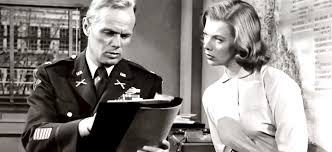
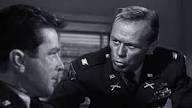
Photo caption: Richard Basehart and Richard Widmark in TIME LIMIT.

In the absorbing Korean War Era drama Time Limit, Major Harry Cargill (Richard Basehart) is charged with the capital offense of treason for, as the senior American officer in a North Korean POW camp, collaborating with the enemy. Colonel William Edwards (Richard Widmark) has the responsibility for investigating the case and then recommending a court martial. Since Cargill himself steadfastly admits the charges, all the surviving POWs share the same testimony and recordings of Cargill’s propaganda broadcasts exist, there doesn’t seem to any doubt that Cargill is headed for a trial for his life.

But some details seem fishy to Edwards, and he keeps probing for exculpatory evidence, despite resistance from Cargill himself, seemingly bent on martyring himself. There’s plenty of dramatic tension in this situation anyway, but the son of Edwards’ base commander, General Connors (Carl Benton Reid) died in the POW camp, and the general is fixated on swift justice..

Time Limit is a thinker, posing the philosophical question, when there are no good choices, does one choose most humane option, or follow the oath one has taken and go by the book? It takes Edwards a long time to drill into the truth, which poses its own question of moral and legal accountability (which may not be the same thing).

Time Limit has the look and feel of a play, which it is. Henry Denker adapted the screenplay from the play he co-wrote with Ralph Berkey. Time Limit is directed by Oscar-winning actor Karl Malden. It is his only feature film as a director (apart from filling in for 30 days on the Gary Cooper western The Hanging Tree).

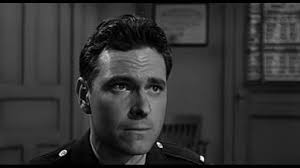
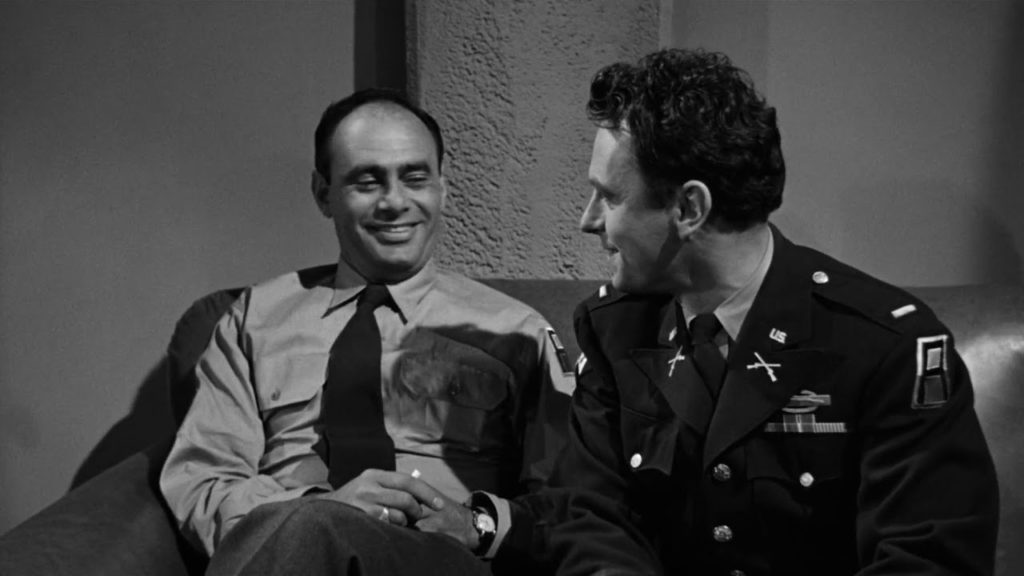
Martin Balsam and Rip Torn in TIME LIMIT

Widmark is very good as the brooding, high-principled and stubborn Edwards; so is Basehart as the traumatized Cargill. There are plenty of memorable performances in Time Limit:

  • Rip Torn is superb as a POW camp survivor, who initially masks his own trauma with a convincing confidence.
  • Martin Balsam as the seasoned non-com with a cynical, clear-eyed view of how things work in the military. He is also comfortable in the devious audacity that comes from being one of the sergeants who really run things in the Army, no matter what the officers think.
  • Dolores Michaels plays Corporal Jean Evans, Edwards’ perky office manager. It will not escape modern viewers that Cpl. Evans is always the smartest person in the room, although it’s clear that she will always stay as an admin because she is a woman. Her insights are explained by her being the daughter of a lawyer.
  • June Lockhart plays Cargill’s bewildered wife.
Richard Widmark and Dolores Michaels in TIME LIMIT.

Fresh off the experience of the Korean War, the topic of brainwashing was very topical in 1957. So was the situation of POWs, in an America where a huge majority of the adult males were WW II vets. Other movies of the period addressed this premise:

  • The Rack (1956):  A returning US army captain (Paul Newman) is court-martialed for collaborating with the enemy while a POW.  He was tortured, and The Rack explores what can be realistically expected of a prisoner under duress.  It’s a pretty good movie, and Wendell Corey and Walter Pidgeon co-star. The Rack occasionally plays on TCM and can be streamed on Amazon, AppleTV, YouTube and Fandango.
  • Act of Violence (1949): In the extremity of a Nazi prisoner of war camp, Frank (Van Heflin) was faced by a situation with no good choices; he knows (correctly) that few in 1949 America will be able to see his action in that context. I’ve tagged Act of Violence as “the single most underrated film noir“. Act of Violence regularly plays on Turner Class Movies and can be streamed on Watch TCM. 
  • Not to mention, of course, Stalag 17 (collaboration POW camps) and The Manchurian Candidate (North Korean brainwashing).

I watched it on TCM, where is occasionally plays, but you can find Time Limit on Amazon and AppleTV.

Rip Torn in TIME LIMIT

MY DEAD FRIEND ZOE: getting to resilience

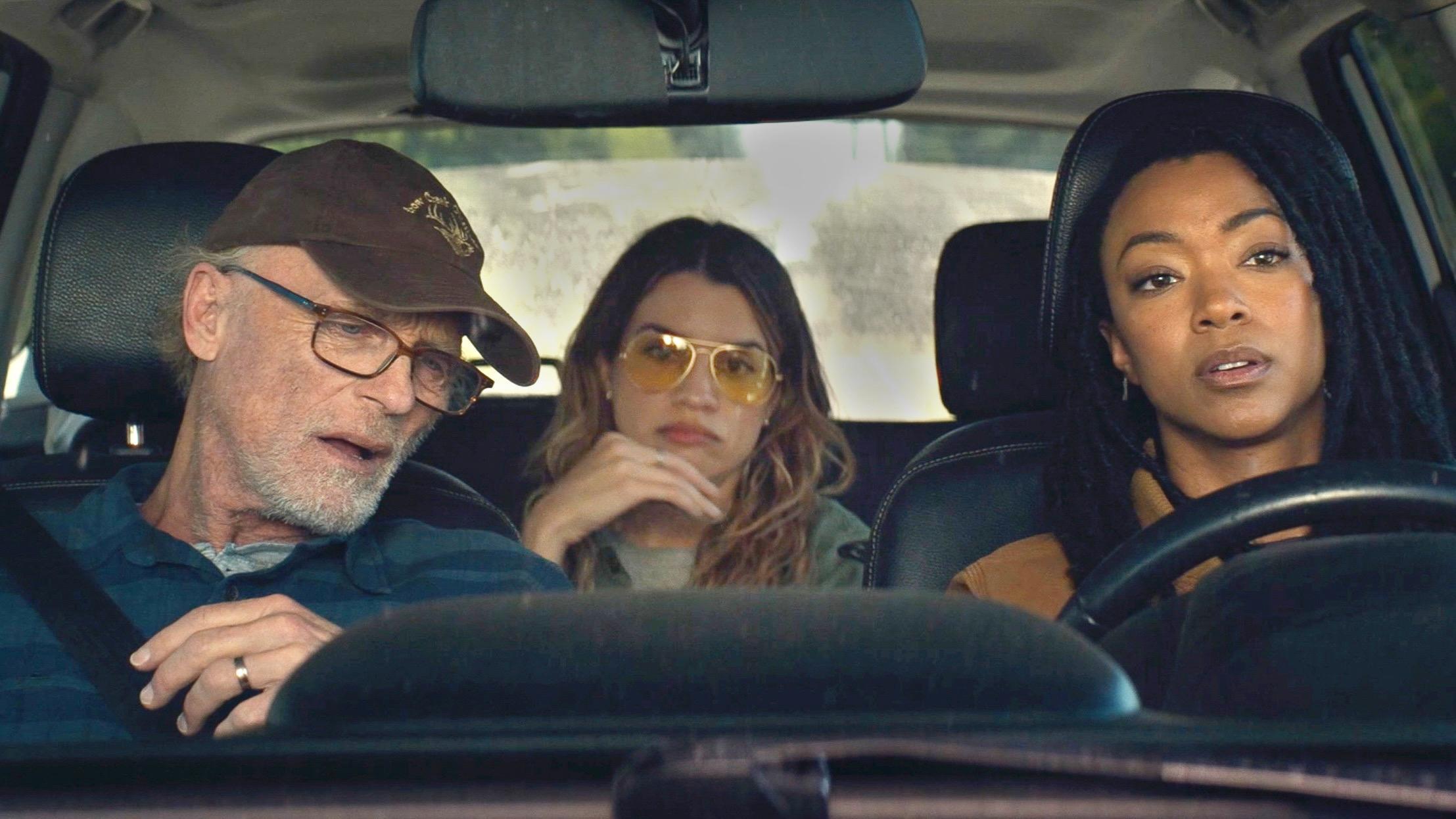
Photo caption: Natalie Morales and Sonequa Martin-Green in MY DEAD FRIEND ZOE. Courtesy of Briarcliff Entertainment.

In the deeply affecting dramedy My Dead Friend Zoe, Merit (Sonequa Martin-Green) is a US Army veteran back from her deployment in Afghanistan. Merit is talented, disciplined and highly focused, but there’s something unresolved from her military service that is obstructing her transition to civilian life. We know that Merit has issues because she is often accompanied by her sassy BFF from the Army, Zoe (Natalie Morales), or rather by Zoe’s ghost, because Zoe is dead.

Zoe is high-spirited, playful and sarcastic, and usually a lot of fun. But Zoe detests sitting-in-a-circle support groups, so she isn’t encouraging Merit to complete a a mandatory program led by a psychologist specializing in combat PTSD (Morgan Freeman). Meanwhile, Merit’s military role model, her crusty Vietnam vet grandfather (Ed Harris), is becoming unable to live by himself at the family’s legacy lake house; Merit’s mom has tasked her to move him, against his will, into a safer setting.

We get the back story of Merit and Zoe’s deployment in flashback. We’re well into the movie before we learn how Zoe died, which I’m not going to spoil, because it’s central to the meaning of the film. I can say that the movie touches on PTSD, the veteran experience and the path to resilience.

Ed Harris, Natalie Morales and Sonequa Martin-Green in MY DEAD FRIEND ZOE. Courtesy of Briarcliff Entertainment.

My Dead Friend Zoe is an impressive first feature for writer-director Kyle Hausmann-Stokes, himself a decorated Army paratrooper who served in Iraq. The screenplay is brilliant, especially because the ingenious device of the very funny Zoe lightens what could have otherwise unwatchably bleak. Hausmann-Stokes wants us to appreciate a grim fact – what has killed more more members of the US military in the era of Middle Eastern wars than combat. He has succeeded in achieving a remarkably engaging movie with a satisfying ending.

Martin-Green carries the film with a very strong performance as Meit, and Morales is brightly charismatic as Zoe.

This might be the best film on the transition from wartime military service to civilian society since The Best Years of Our Lives., and it’s one of the Best Movies of 2025. My Dead Friend Zoe can be streamed from Amazon, AppleTV, YouTube and Fandango.

NUREMBERG: matching wits with a master manipulator

Photo caption: Russell Crowe (left) and Rami Malek (right) in NUREMBERG. Courtesy of Sony Pictures Classics.

The psychodrama Nuremberg pits the Nazi war criminal Hermann Goering (Russell Crowe) against the American psychiatrist Douglas Kelley (Rami Malek) in a high stakes battle of wits. It’s the end of WW II, the full extent of the Holocaust is just being revealed and the Allies are ready to hold the world’s first war crimes trial.

With the suicides of Hitler and Himmler, Goering is undeniably the highest ranking and highest profile surviving Nazi leader. He and other top Nazis are in a military prison run by the US Army, where Dr. Kelley is assigned. The Army’s interest in the defendants’ mental heath was not primarily humanitarian – it was in preventing their suicides so they could be executed by hanging.

Kelley’s intellectual curiosity, though, is alive with the opportunity that any behavioral scientist would envy – probing the psyches of the men with the worst ever human behavior; these are the men who thought the unthinkable and acted to realize it. (And, more prosaically, he hopes to garner material for a profitable book.)

The lead American prosecutor is US Supreme Court Justice Robert Jackson (Michael Shannon), who has to make up the jurisdiction and rules, even the charges, for the trial as he goes along. Nuremberg reminds us that the trial was about more than criminal justice; perhaps even more importantly, the trial was a vehicle to show the world, especially the German people, the extent of the Nazi regime’s crimes against humanity, a term coined by Jackson for the trial. Accordingly, the Allied prosecutors made and showed films documenting the extermination camps. These images were not yet widely viewed at the time, and Malek shows Kelley’s revulsion at seeing the atrocities for the first time.

Nuremberg also reminds us that trying Nazi leaders would come at some considerable risk – the possibility that some of the defendants could make themselves sympathetic or martyrs, or, worst of all, even get off scot-free.

Kelley immediately tags Goering as a narcissist, a diagnosis which Goering himself does not dispute. Goering is uncommonly crafty and sly, tempering his his characteristic arrogance with a jovial charm that even threatens to seduce Kelley. Indeed, climbing to the top of a pyramid of back-stabbers was no mean feat, and Goering’s skills at political infighting and social climbing are formidable. Similarly, he possesses a gift to read the room and accordingly flatter and insinuate. Goering even has the hubris to believe that he will be able to manipulate his way out of a conviction.

With some hubris of his own, Jackson is eager to win a match of wits with Goering, planning to break him on the stand. Kelley, who has seen Goering’s charm and intellect up close, thinks that Jackson is likely to lose a frontal assault and perceives that Goering’s vulnerability lies elsewhere.

The Allied officials, including Kelley initially, intuit that any person who committed such monstrous acts must be some unique kind of monster. In 1946, the concept of the banality of evil was still fifteen years away from being coined by Hannah Arendt at the 1961 trial of Adolph Eichmann. Kelley meets all of the Nuremberg defendants, who Nuremberg accurately depicts as the motley group they were – this one a hoodlum, that one a psychotic crank. Rudolf Hess is depicted as befuddled (or ACTING befuddled as he faked amnesia for the second time). Of course, the Nazis were bullies, and bullies are always less fearsome when they are held to account.

The people who committed the most horrific acts in human history are surprisingly, even disappointingly, ordinary. For every deranged megalomaniac who comes to power, there are plenty of opportunistic thugs who go along for the ride.

Similarly, Kelley finds that Goering is such a greedy, attention-seeking asshole, that he was happy to play along with exploiting racial hatred, even to the point of genocide, just to become richer, more famous and more powerful.

In an impressive performance, Russell Crowe captures Goering’s narcissistic entitlement, magnetic charm, manipulative sociopathy and seemingly unshakable self-confidence.

Kelley starts out with his own hubris, confident that he holds all the cards vis-a-vis Goering, who is not himself a trained psychiatrist and is, after all, locked in a prison cell. Malek is able to portray Kelley’s sense of himself as far more fragile than one would expect, with the potential to become a tragic figure.

John Slattery is very good as a straight-ahead Army prison commander, as is Colin Hanks as an unapologetically venal rival shrink.

In scenes intended to reveal Kelley’s own humanity and manipulations, the character of Goering’s wife Emmy (Lotte Verbeek) is written with too much sympathy for my taste. In real life, Emmy Goering was a real piece of work, who vied with Joseph Goebbel’s wife to outdo Hitler’s mistress Eva Braun as the most prominent figure in the Nazi Reich and who was an enthusiastic looter of Jewish-owned fine art.

The 2023 The Zone of Interest was a masterpiece on the banality of evil. On this subject, I also recommend Blind Spot: Hitler’s Secretary and, for the Indonesian version of banality of evil, the wonderful documentary Act of Killing. For sheer gall that supassed even Goering’s, there’s another documentary, Speer Goes to Hollywood, in which we hear recordings of Albert Speer pitching a Hollywood movie to rehabilitate his image.

Even casual students of history know that Goering didn’t escape conviction, but Nuremberg, in the tradition of fine courtroom dramas, is able to keep the audience hooked on how Goering, Kelley and Jackson will perform at the trial, and whether Goering will destroy anyone else. Nuremberg open in theaters this Friday.

LAST DAYS IN VIETNAM: folly, desperation, heroism

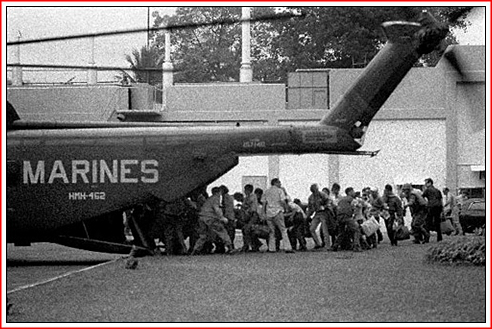
LAST DAYS IN VIETNAM

History is a compendium of individual human stories, oft caught up in a world event. That’s what drives the riveting documentary Last Days in Vietnam, which chronicles the desperate attempts of many South Vietnamese to escape before the Communist takeover in 1975. Over 140,000 got out in the initial exodus, including 77,000 through the means depicted in this film – mostly compressed into just two panicked days.

As if there weren’t enough American folly in Vietnam, the first evacuation plan didn’t include any non-Americans, even including the Vietnamese dependents of Americans. Then there were evacuation plans that were never implemented because of the blockheadedness of the US Ambassador.  In the final week, young American military and intelligence officers took matters into their own hand, and began a sub rosa evacuation – ignoring the chain of command, breaking immigration laws and risking career-killing charges of insubordination.

Last Days in Vietnam is directed by Rory Kennedy (daughter of RFK), who recently made Ethel, the affecting bio-doc of her mother. Kennedy does a good job of setting the historical stage for those who didn’t live through the era, and then letting the witnesses tell their compelling personal stories.

The talking heads include:

  • the six-year-old who jumped out of a helicopter and then watched his mother drop his baby sister on to a ship’s deck;
  • the US Navy vet who plays the taped diary that he sent home to his wife after the fateful day;
  • the CIA analyst who unsuccessfully tried to convince the deluded US Ambassador that the end was at hand;
  • the college student who managed to get over a wall inside the embassy, but found that his freedom was not guaranteed;
  • Ford Administration officials Henry Kissinger and Ron Nessen, who relate the White House view of the events.

One heroic young American officer managed with ingenuity and chutzpah to get out hundreds of Vietnamese.  In the film’s most poignant moment, it falls to him to tell the final American lie to the 400 Vietnamese remaining in the US embassy, for whom there were no more helicopters.

I saw the movie in San Jose with an audience that was about half Vietnamese-American, some of the age to have lived through this period.  San Jose’s 100,000 Vietnamese population is largest of any city outside Vietnam, and many Vietnamese-Americans still memorialize the subject of this film as Black April.  The exit from the theater was somber.

Last Days in Vietnam is a PBS American Experience film, and there are many clips, images and audio on their site; the entire film can be streamed from YouTube.

SHOSHANA: two lovers amid a deepening conflict

Photo caption: Irina Starshenbaum and Douglas Booth in SHOSHANA. Courtesy of Greenwich Entertainment.

The thriller Shoshana is a historical drama set in pre-Israel Palestine that revolves around a love story between two people on different sides. The Jewish journalist Shoshana Borochov (Irina Starshenbaum) is a committed Zionist and a supporter of the paramilitary group Haganah. Thomas Wilkin (Douglas Booth) is the Assistant Superintendent of Criminal Investigation for the British authorities.

All of the significant characters in Shoshana were real people, and the story takes place from 1933 to 1944. We don’t see many movies set in this time and place. The Ottoman Empire had ruled Palestine for 400 years, until the Ottomans were expelled by the British in WW I. The British then took over governing Palestine, with its majority Arab population and small Jewish community, under an international agreement – the British Mandate – and with a policy that there should be a Jewish homeland in Palestine. The Arab residents have been living with a few Jews, but are horrified by the specter of mass Jewish immigration, and they revolt. Tit for tat murders begin between Arabs and Jews, which the British try to suppress. Soon there are rival Jewish paramilitary organizations, each with a different take on how to deal with the British, with the Arabs and with each other. When the British sharply limit Jewish immigration and frustrate the efforts to form a Jewish-majority state, the Jews react with anger against the British.

It becomes a lethal gam of three-dimensional chess. Shoshana does a pretty good job in helping the audience track who is who – and who wants to kill who. Shoshana was directed by the veteran Michael Winterbottom (Welcome to Sarajevo, Jude, The Claim, A Mighty Heart and The Trip movies).

Thomas Wilkin and Shoshana Borochov forge an 11-year relationship in an environment that becomes more stressful every year. But Thomas is unwilling to stop being a British policeman, and Shoshana is unwilling to put aside her Zionist beliefs. They love each other, but not enough for either to abandon deeply-held values or their personal identities.

What could doom their relationship is not just arguing politics at the dinner table, but something more ominous – there are plenty of players who want each of them dead. The situation is explosive – often literally. And neither can hide in a Tel Aviv still small enough that everybody knows each other.

The British are trying to cope with what we now know as asymmetrical warfare. A British officer sneeringly asks a Zionist terrorist why he is blowing up women and children, and gets the reply “Because we don’t have the resources that you do“. Ironically, the British in Shoshana are themselves employing mass reprisals, extrajudicial executions and torture that would clearly be considered war crimes today.

Of course, British colonial rule was known for arrogant, racist, and culturally tone-deaf twits, and they are represented by Shoshana‘s villain, police official Geoffrey Morton (the fine actor Harry Melling).

Arabs and their cause may not be depicted in depth in Shoshana, but are shown as victims of both Jewish terrorism and British atrocities.

The historical events constitute the origin stories for both the nation of Israel and the Israeli-Palestinian conflict. The British throw up their hands and fal to provide for Palestinian self-determination within the borders of Palestine. The Jewish organizations in Shoshana later evolved into the two major Israeli political parties of the past 75 years, and the Haganah morphed into the Israeli Defense Forces. Israel has since become a military power and now faces its own asymmetrical warfare.

Given the impact of this history upon the current day, we might have expected more films about this period. After all, there are a zillion films about the Holocaust and a lot set in post-1948 Israel. In 1960, Otto Preminger made the blockbuster film Exodus from the 1958 Leon Uris novel which was the biggest best seller in US since Gone With the WindExodus was set in the period between 1946 and 1948. (My parents saw Exodus at a drive-in with me as a small boy in the back seat.) No less than the pioneering Zionist leader and Israeli prime minister David Ben-Gurion said of the novel, “as a piece of propaganda, it’s the greatest thing ever written about Israel“.

Shoshana is far more clear-eyed and nuanced than ExodusShoshana reflects a historical setting that was complicated, and tells the story of lovers’ inner conflicts amid a dynamic and perilous external conflict. Shoshana, which I reviewed earlier this year for the San Francisco Jewish Film Festival, is now streaming on Amazon, AppleTV, YouTube and Fandango.

SHOSHANA: two lovers amid a deepening conflict

Photo caption: Irina Starshenbaum and Douglas Booth in SHOSHANA. Courtesy of Greenwich Entertainment.

The thriller Shoshana is a historical drama set in pre-Israel Palestine that revolves around a love story between two people on different sides. The Jewish journalist Shoshana Borochov (Irina Starshenbaum) is a committed Zionist and a supporter of the paramilitary group Haganah. Thomas Wilkin (Douglas Booth) is the Assistant Superintendent of Criminal Investigation for the British authorities.

All of the significant characters in Shoshana were real people, and the story takes place from 1933 to 1944. We don’t see many movies set in this time and place. The Ottoman Empire had ruled Palestine for 400 years, until the Ottomans were expelled by the British in WW I. The British then took over governing Palestine, with its majority Arab population and small Jewish community, under an international agreement – the British Mandate – and with a policy that there should be a Jewish homeland in Palestine. The Arab residents have been living with a few Jews, but are horrified by the specter of mass Jewish immigration, and they revolt. Tit for tat murders begin between Arabs and Jews, which the British try to suppress. Soon there are rival Jewish paramilitary organizations, each with a different take on how to deal with the British, with the Arabs and with each other. When the British sharply limit Jewish immigration and frustrate the efforts to form a Jewish-majority state, the Jews react with anger against the British.

It becomes a lethal gam of three-dimensional chess. Shoshana does a pretty good job in helping the audience track who is who – and who wants to kill who. Shoshana was directed by the veteran Michael Winterbottom (Welcome to Sarajevo, Jude, The Claim, A Mighty Heart and The Trip movies).

Thomas Wilkin and Shoshana Borochov forge an 11-year relationship in an environment that becomes more stressful every year. But Thomas is unwilling to stop being a British policeman, and Shoshana is unwilling to put aside her Zionist beliefs. They love each other, but not enough for either to abandon deeply-held values or their personal identities.

What could doom their relationship is not just arguing politics at the dinner table, but something more ominous – there are plenty of players who want each of them dead. The situation is explosive – often literally. And neither can hide in a Tel Aviv still small enough that everybody knows each other.

The British are trying to cope with what we now know as asymmetrical warfare. A British officer sneeringly asks a Zionist terrorist why he is blowing up women and children, and gets the reply “Because we don’t have the resources that you do“. Ironically, the British in Shoshana are themselves employing mass reprisals, extrajudicial executions and torture that would clearly be considered war crimes today.

Of course, British colonial rule was known for arrogant, racist, and culturally tone-deaf twits, and they are represented by Shoshana‘s villain, police official Geoffrey Morton (the fine actor Harry Melling).

Arabs and their cause may not be depicted in depth in Shoshana, but are shown as victims of both Jewish terrorism and British atrocities.

The historical events constitute the origin stories for both the nation of Israel and the Israeli-Palestinian conflict. The British throw up their hands and fal to provide for Palestinian self-determination within the borders of Palestine. The Jewish organizations in Shoshana later evolved into the two major Israeli political parties of the past 75 years, and the Haganah morphed into the Israeli Defense Forces. Israel has since become a military power and now faces its own asymmetrical warfare.

Given the impact of this history upon the current day, we might have expected more films about this period. After all, there are a zillion films about the Holocaust and a lot set in post-1948 Israel. In 1960, Otto Preminger made the blockbuster film Exodus from the 1958 Leon Uris novel which was the biggest best seller in US since Gone With the Wind. Exodus was set in the period between 1946 and 1948. (My parents saw Exodus at a drive-in with me as a small boy in the back seat.) No less than the pioneering Zionist leader and Israeli prime minister David Ben-Gurion said of the novel, “as a piece of propaganda, it’s the greatest thing ever written about Israel“.

Shoshana is far more clear-eyed and nuanced than Exodus. Shoshana reflects a historical setting that was complicated, and tells the story of lovers’ inner conflicts amid a dynamic and perilous external conflict. Shoshana releases into theaters this weekend.

BLITZ: one brave, resourceful kid amid the horrors

Photo caption: Saiorse Ronan and Elliott Heffernan in BLITZ. Courtesy of AppleTV.

In the WW II drama Blitz, Rita (Saiorse Ronan) is a single mom who, like all Londoners, must endure The Blitz, the 8-month German terror bombing of civilian London. Over a million English city-dwellers were evacuated to the countryside, and half of them were children. Rita’s own nine-year-old son George (Elliott Heffernan) is set to be sent to safety while she remains at her job in a munitions factory.

This plan angers George, and he bolts, running amok through London. His adventures, and Rita’s terrified search for him when she finds him missing, make up the core of Blitz. It is a child-in-peril story, but not one where the adult protagonist rescues the child. Rita may be played by a big movie star, but this is George’s story and a portrait of his determination and resourcefulness.

George is multi-racial, which is hard to be in 1940 England, where he looks different that just about everyone else. As he runs a gauntlet of racist attitudes, it’s a huge relief whenever George encounters someone with even minimal kindness.

Elliott Heffernan in BLITZ. Courtesy of AppleTV.

Writer-director Steve McQueen’s biggest achievement in Blitz is to tell this story so compellingly from the child’s point of view. Sometimes George isn’t scared when he should be, and sometimes he is overwhelmed by a situation any adult could handle. McQueen certainly found the right actor to play George in Heffernan, who captures George’s vulnerabilities as well as his underlying reservoir of tenacity.

McQueen also pulls off a well-paced thriller and makes the audience feel the historical context. We’ve all seen depictions of The Blitz with the air raid sirens, blackout wardens and plucky Brits sheltering in the Underground and emerging to see the rubble, carnage and fire. But not like this. McQueen’s Blitz is vivid, uncomfortable and terrifying.

There is a spectacular scene at a ritzy hotel’s nightclub, complete with a Cab Calloway-like band and an extra-long tracking shot through the kitchen, an homage to Martin Scorsese’s famous Copacabana shot in Goodfellas. I understand that McQueen would argue that this scene sets up a brief moment later in the film, but it really isn’t necessary and McQueen is just showing off his skills (and AppleTV’s budget). It’s fun, though.

What McQueen fails to deliver, though, is multi-dimensional characters (with the exception of George). Pretty much every non-George character is just one thing – officious, bigoted, evil or saintly.

The is, however, more than a glimmer of texture in a performance by one of my favorite actors, Stephen Graham, who often plays a troubled cop or a criminal psycho in British crime shows like Line of Duty and Little Boy Blue. Graham has a small role as a depraved gang leader, and he makes the character despicable and unhinged and scary and damaged. Graham has worked in US films, too, as an Italian-American mobster in Martin Scorsese’s The Irishman, Scrum in the Pirates of the Caribbean franchise, Al Capone in Boardwalk Empire and Baby Face Nelson in Michael Mann’s Public Enemies.

Blitz is a fine adventure yarn, evocative history and a visually impressive film. Blitz is now streaming on AppleTV.

CIVIL WAR: a most cautionary message

Photo caption: Kirsten Dunst in CIVIL WAR. Courtesy of A24.

Alex Garland’s unsettling thriller Civil War is a different movie than anyone expects.

An America in the near future is embroiled in a civil war, but it’s NOT sectarian violence along the Red State/Blue State axis that divides America today. Writer-director Garland never explicitly explains the cause of the war, but he leaves enough clues, especially when a blowhard, propagandist President (Nick Offerman) refers to his “third term”, which he must have seized unconstitutionally. A band of journalists are dispassionate about what the two sides are fighting about, but forecast that the President is about to be deposed like despots Nicolae Ceausescu and Muammar Ghaddafi.

We see the civil war through the eyes of the journalists, led by two veterans from Reuters, war photographer Lee (Kirsten Dunst) and her writing partner Joel (Wagner Moura). They are joined by an old school New York Times political reporter, Sammy (Stephen McKinley Henderson) and a young free-lance photographer, Jessie (Cailee Spaenee of Priscilla), who idolizes Lee and is covering her very first conflict.

The four are on a quest for a journalistic holy grail, to secure what they will believe will be the very last interview with the President. They drive to DC from New York on a circuitous route, navigating through battle-torn upstate New York, western Pennsylvania, West Virginia and Virginia. Essentially, the plot of Civil War is their harrowing road trip through the war zone, moving from vignette to vignette, which range from terrifying to surreal.

Civil War‘s substantial impact comes from the depiction of the familiar in an unfamiliar setting. We are used to seeing the atrocities of insurgency wars, both in news reports and fictional stories. Accordingly, we may be inured to the horror of a mass grave of executed civilians – if it is in, say, Serbia or Sudan. The same is true of an encounter with a fighter with an assault weapon-bearing fighter who can kill you on a whim. Indeed, Civil War has much the same feel as movies like The Killing Fields, Salvador or Hotel Rwanda.

The shocking difference is these horrors are taking place in the old U S of A. (There’s a brief, jarring shot of a red, white and blue flag with only two stars.) At one point, Lee says that she has been sending home photos of other people’s civil conflicts as a warning to Americans – avoid this at all costs. Civil War is a message picture, and this is the message. Lee is used to witnessing nightmarish things and compartmentalizing them so she can go about her job amid the horrors. But seeing them in her home nation brings her anguish, which she is less and less able to contain.

The most surreal scene is when the journalists drive into a hamlet where life goes on as if there is no civil war, and an apathetic store clerk will only observe “from what we see on TV, it’s all for the best.”

Kirsten Dunst’s performance as Lee carries Civil War; she’s our moral center, a bad ass whose soul is crushed before our eyes.

Stephen McKinley Henderson, as usual, projects warmth, canniness and lived experience; he’s really a treasure. Cailee Spaenee is 26, but looks much younger (young enough to play a 14-year-old in Priscilla); unlike in Priscilla, her character in Civil War has a lot of agency, and she’s very good. Jesse Plemons (Dunst’s real life husband) is brilliant in a cameo as the random judge-and-jury soldier with an assault weapon.

Like many who had seen the trailer, I was expecting a much different movie – one I really didn’t want to experience. When I found that it was the creation of Alex Garland and had gotten some rave reviews, I decided to see it. But I put it off until I could go to the theater with my buddy Keith, who shares many of my sensibilities, for support.

As it turned out, Keith didn’t like Civil War, primarily because the source of the conflict is not explicitly explained, and the idea of a California-Texas alliance is so absurd. And, as a photographer himself, he was distracted by Jessie shooting with a film camera that she never reloads. Those criticisms, while reasonable, weren’t a problem for me.

This is only Garland’s fifth feature as a director, but he directed Ex Machina, my pick as the top film of 2014. Before that, Garland wrote 28 Days Later, which I would rate as the best and most thoughtful zombie movie of all time.

We’re used to rooting for one side or the other in a war movie, but Civil War is not about why a war is fought, it’s about the experience of civil war itself, and why it should be unthinkable.

NAPOLEON: but didn’t they name a complex after this guy?

Photo caption: Joaquin Phoenix in NAPOLEON. Courtesy of AppleTV.

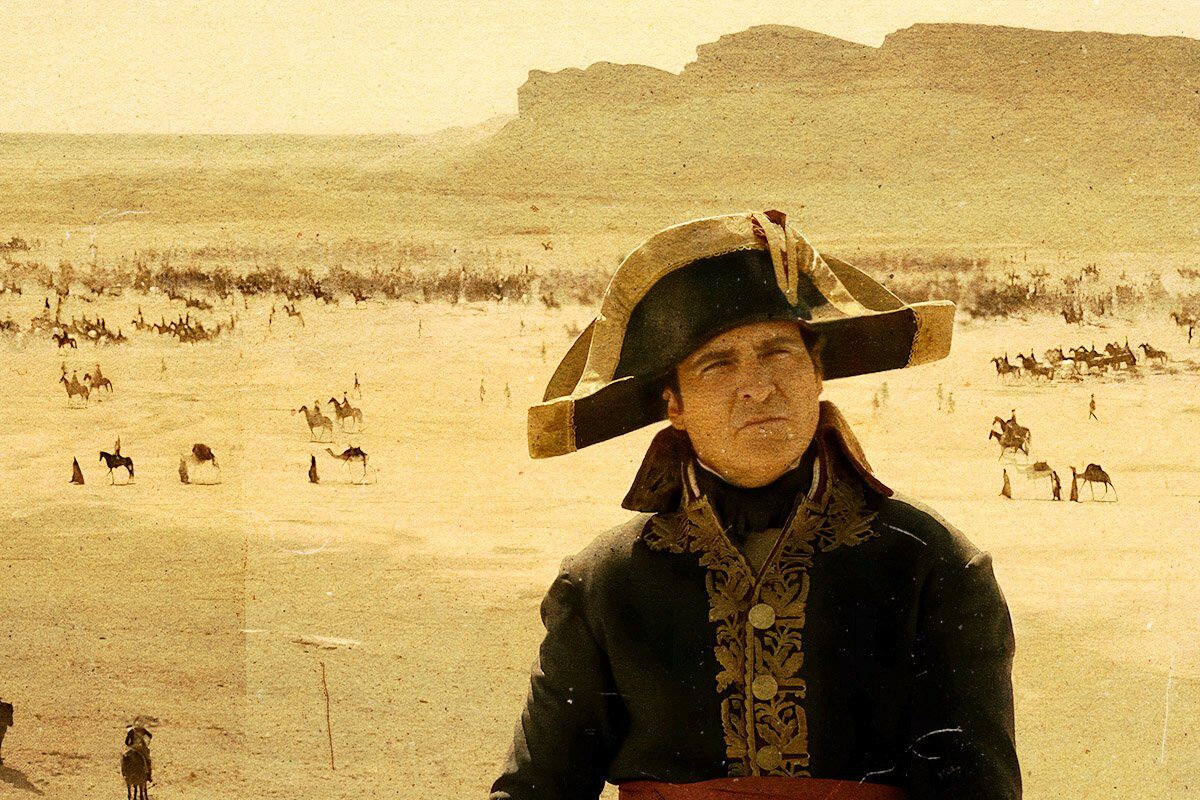
Of all living filmmakers, Ridley Scott would seem the most well-equipped to pull off a boundless EPIC, but his Napoleon, other than three spectacular battle scenes and a little sex, is boring, underwhelming and a little confounding. As The Wife said exiting the theater, it’s a slog, and she wasn’t referring to the winter retreat from Moscow.

For better or worse, Napoleon covers Napoleon Bonaparte’s entire public career – from his emergence in 1793 at age 24 to the beginning of his final captivity on St. Helena in 1815 at the age of 46. It’s kinda like a college survey course in the Napoleonic Era. Napoleon’s historical accuracy is solid, and, for a Hollywood movie, remarkably unusual.

Even with a running time of 2 hours and 38 minutes, there’s a lot of ground to cover. He did fight 61 battles, and it took the SEVENTH Coalition of opposing nations to defeat him. So, we get the briefest of glimpses of Napoleon’s mother, his second wife and other major figures in his life and times.

Here’s what is great about Napoleon – three extraordinarily spectacular battle scenes, depicting the Siege of Toulon, and the famous Battles of Austerlitz and Waterloo. They are amazing to watch, and the first two help us to understand Napoleon’s military genius (and the third, Wellington’s military genius). A segment of Austerlitz where Napoleon orders cannon fire to break the ice under enemy forces is one of greatest and most unforgettable battle scenes in cinema history.

Napoleon also does a pretty fair job with the the relationship between Napoleon (Joaquin Phoenix) and his first wife Josephine (Vanessa Kirby). It was a very uncomplicated one: he was utterly captivated by and devoted to her, and she just wasn’t that IN to him. Josephine was a survivor and an adventuress, who navigated through her misogynistic environment with a gift for canny manipulation. He finds that even making her an empress isn’t enough to quell her promiscuity. Phoenix and Kirby do a good job with this part of the story.

But, oddly for a biopic, Napoleon fails to help us understand Napoleon. Sure, he’s ambitious from the start, but why? And why does he need to keep conquering, at the risk of overreaching and losing everything? After all, didn’t they name a complex after this guy?

Joaquin Phoenix was so vivid as Johnny Cash in Walk the Line, as Commodus in Gladiator, and as Freddie in The Master; he was so original and authentic in Her and C’mon C’mon. But, in Napoleon, his performance doesn’t unwrap the package of Napoleon’s psyche. I can’t say it’s Phoenix’a fault, but the collaboration between Phoenix, Scott and screenwriter David Scarpa doesn’t pay off.

Scott does point out in an end title that 3 million lost their lives during the Napoleonic Wars, which raises the question, to what end? This guy with an insatiable appetite for power and conquest was starting wars with some twits who had been born into underserved monarchy.

Here’s a random digression from the movie Napoleon. Was Napoleon’s military prowess overrated? This is ironic, because Napoleon rose on his merits. But the forces he was defeating were led by royalty and aristocrats, who were given command of armies, not by their own training and demonstrated skills, but by the accident of birth. Alexander I of Russia, for example, started out as an immature, headstrong nitwit and aged into a fullblown nutcase. Maybe Napoleon was analogous to MLB Hall of Famers who never had to face black ballplayers. Hmmm.

Napoleon is now in theaters, and will stream on AppleTV on a date TBD.