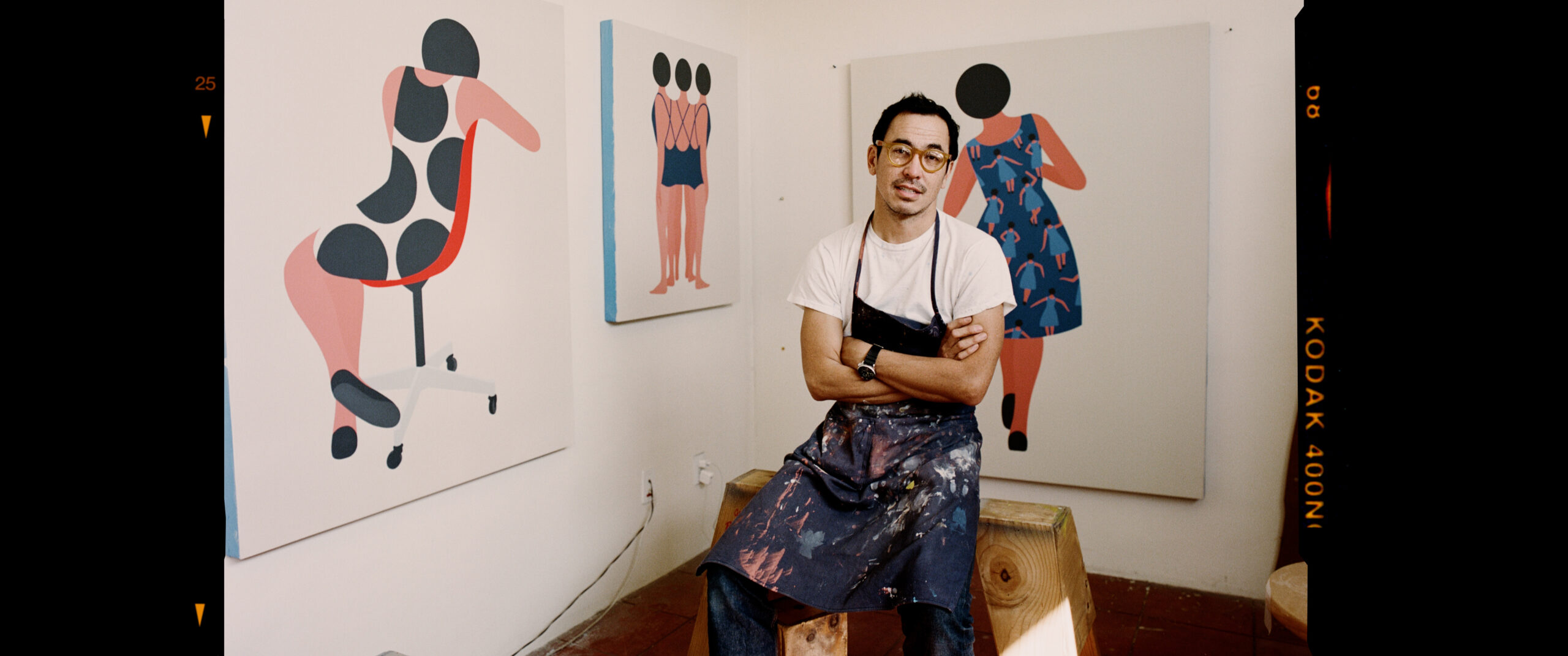
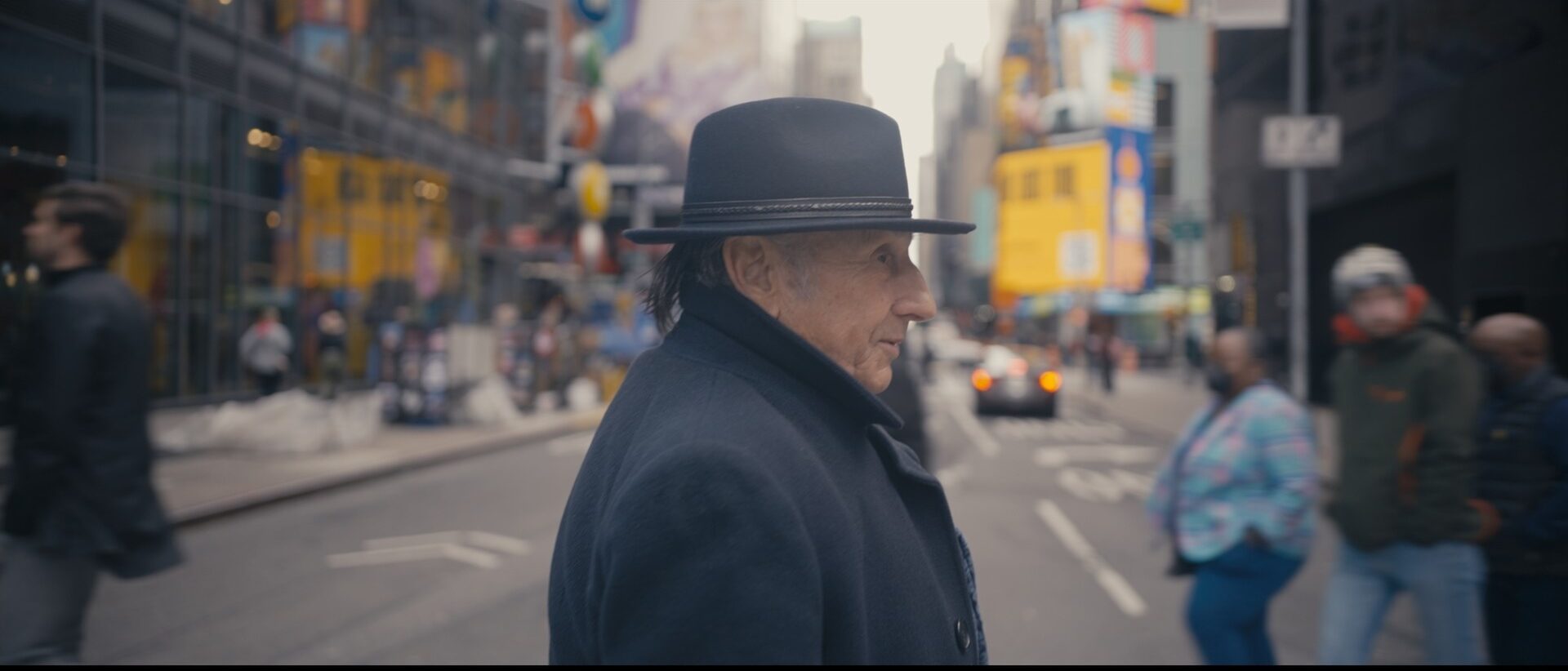
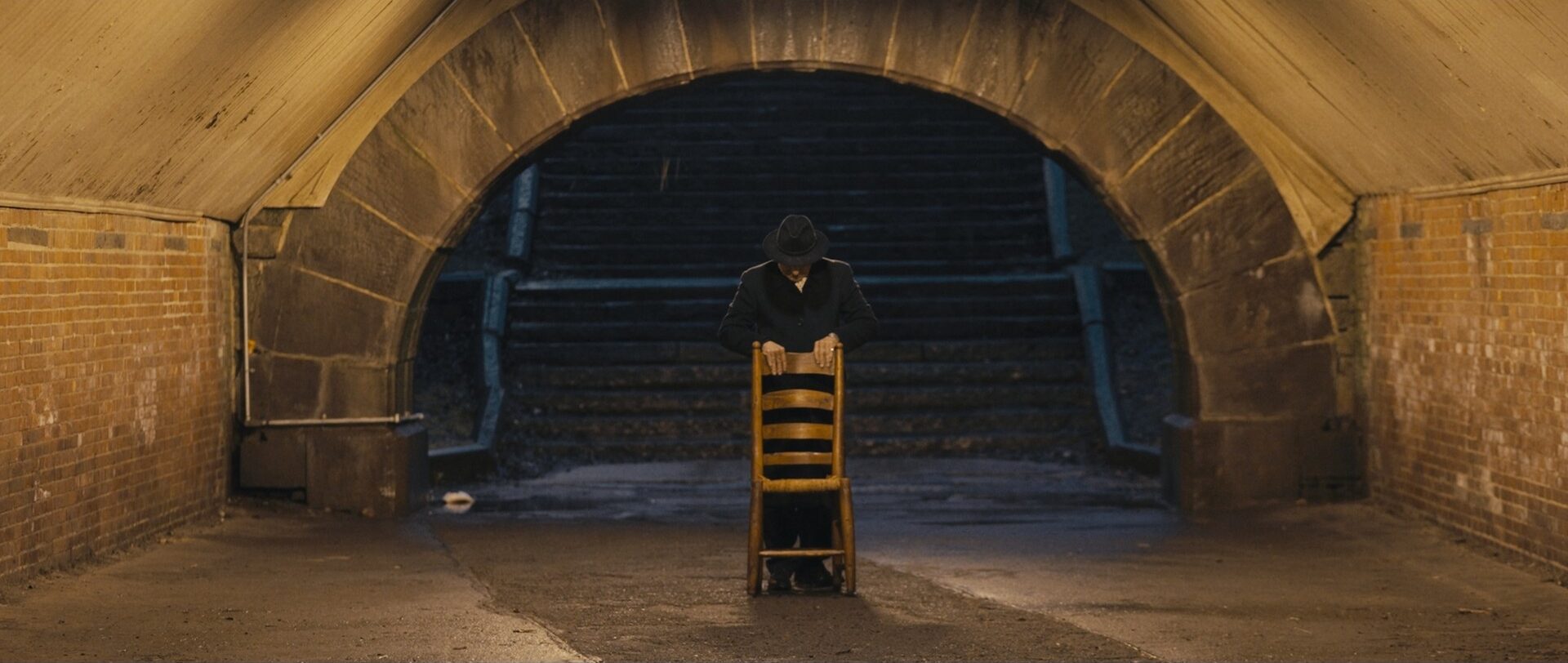
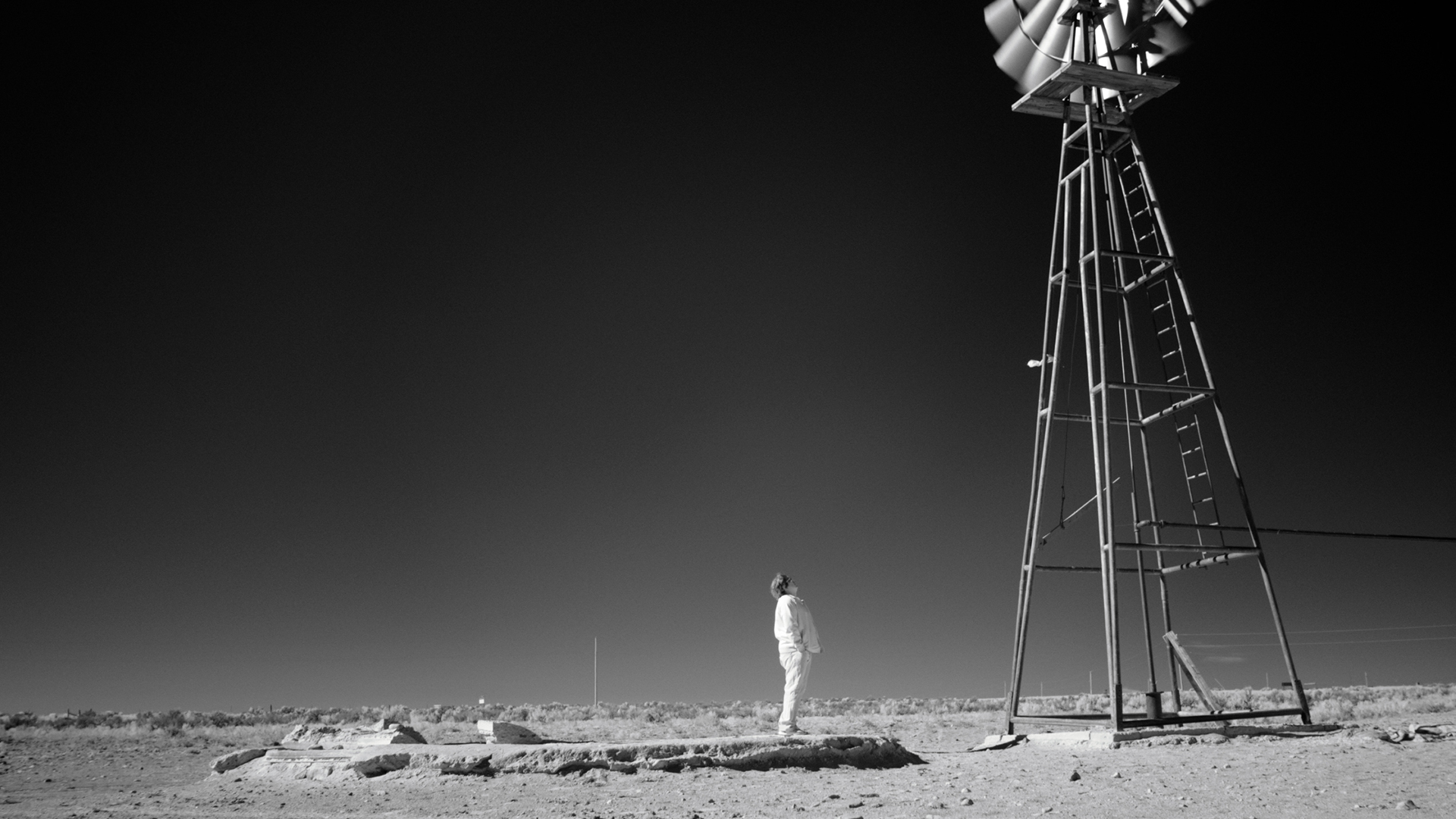
Photo caption: Geoff McFetridge in GEOFF MCFETRIDGE: DRAWING A LIFE. Credit: Andrew Paynter; courtesy of Gravitas Ventures.
The thoughtful documentary Geoff McFetridge: Drawing a Life examines a great artist who is decidedly not tortured. No ear-slicing, overdoses or bratty rampages here, just a guy whose disciplined lifestyle and commitment to his family subvert the stereotypes of an artist fueled by torment.
Where’s the interest in a movie about someone who creates without turbulence? This is a guy who is unusually fierce with both his artistic and family lives. He refuses to compromise his art; his attitude is, take it or leave it (although, as a good Canadian, he is polite about it). Just as tenaciously, he safeguards his family time.
At one point in Drawing a Life, McFetridge makes it explicit. He sees it as too easy to make everything else – good behavior, responsibilities – subservient to art. The achievement is to do great art while maintaining life balance.
You may not know McFetridge’s name, but you’ll recognize his art. McFetridge has exhibited in major cities around the world, collaborated with filmmakers like Spike Jonz and Sofia Coppola, and designed for brands like Apple, Hermes, Vans and Patagonia.
Director and co-writer Dan Covert has filled Drawing a Life with McFetridge’s art, and viewing the film is to be immersed in the art. The editing, by Covert and co-writer Eric Auli, is magnificent. Geoff McFetridge: Drawing a Life won the 2023 Audience Award for Documentary Feature at SXSW.
Geoff McFetridge: Drawing a Life opens in NYC theaters tomorrow, in LA next week and digitally on July 2.
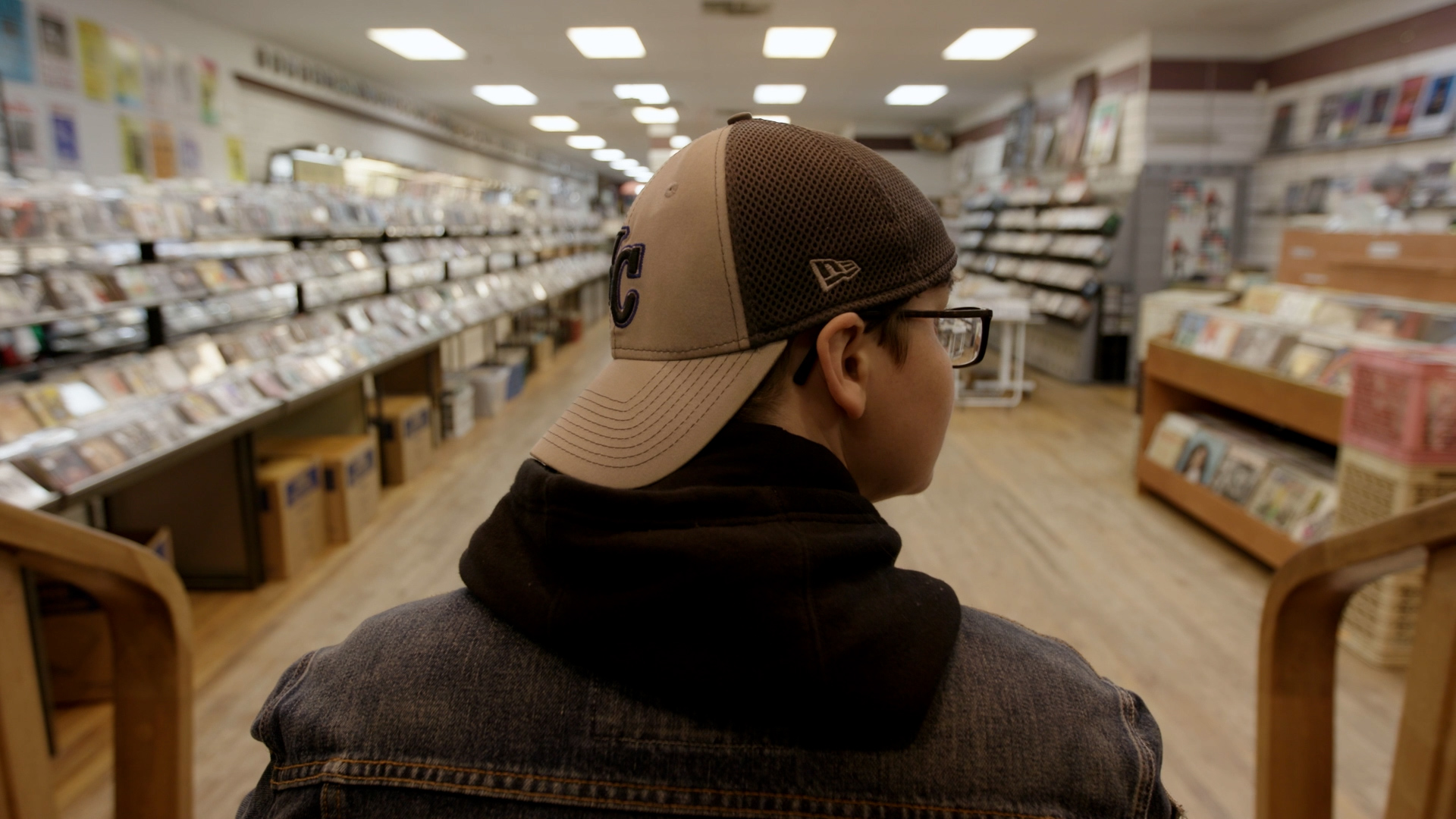
In the irresistible documentary Chasing Chasing Amy, filmmaker Sav Rodgers tells his own highly personal story of finding sanctuary in a romantic comedy, a movie that ultimately spurs a both a filmmaking career and his transition to trans man. Rodgers weaves in parallel tracks, the origin story of the 1997 movie Chasing Amy, and thoughtful discussion of how that film, after 25 years of cultural evolution, has aged. Chasing Chasing Amy seamlessly braids together the fictional love story in Chasing Amy with the stories of real life relationships, including his own.
Chasing Chasing Amy‘s writer-director Savannah Rodgers, grew up a bullied lesbian in small town Kansas, and found lesbian representation in an old DVD of Chasing Amy, which became a lifesaver. When Kevin Smith himself heard Rodgers’ TED Talk, he connected with Rodgers and supported her (and then his) filmmaking career. All this is contained in Chasing Chasing Amy along with some revelations.
The novelty of Chasing Amy is a straight man and a lesbian as inseparable soulmates, and we learn that Kevin Smith modeled this after his real life friends, his producer Scott Mosier and the screenwriter Guinevere Turner. Turner had written the lesbian coming of age film Go Fish, which was on the festival circuit along with Smith and Mosier’s Clerks; Turner later wrote the screenplays for American Psycho and The Notorious Bettie Page.
But the core of Chasing Amy’s narrative is a love affair sabotaged by the guy’s insecurities, mirroring Smith’s own less-than-two-year relationship with Joey Lauren Adams, who plays Alyssa, the main female character.
Rodgers meets Smith himself, who becomes a mentor, and we get current on-camera interviews with Smith, Adams and other principals. There’s a shoulder-to-shoulder joint interview with Smith and Adams, followed by a sobering solo interview with Adams. Along the way, Rodgers matures from a gushing fan girl to a grownup who recognizes the personal flaws that complicate other people’s relationships. Smith comes off well here, and if Rodgers seems too adoring of Smith in most of the film, just wait until her final interview with Joey Lauren Adams.
Chasing Amy was director Kevin Smith’s 1997 masterpiece, with a groundbreaking lesbian/bi-sexual leading lady; but, after 25 years of cultural evolution, some elements now seem stale and even embarrassing. The leading male character is Holden, played by Ben Affleck. His buddy and wingman is Banky, played by Jason Lee, and Banky (to Lee’s off camera discomfort) is unspeakably vulgar and homophobic, a whirlpool of toxic masculinity. But of course, Banky is there to highlight Holden’s comparative evolved tolerance and openness. As an exasperated Kevin Smith says, ‘Banky id the idiot“. But, were Smith to make the same movie today, he would certainly still make Banky offensive, but so much over-the-top offensive.
Some viewers saw in Chasing Amy a toxic male fantasy of a “the right” straight male being able to “convert” a lesbian to heterosexuality. But Alyssa is a bisexual character, as is explicitly depicted in the movie when her lesbian friends react to her fling with Holden. She’s just a bisexual who is more than he is emotionally able to handle.
The story of Sav Rodgers winds from Kansas and the TedTalk, through her long relationship and now marriage, and final, the transitioning into a he/him trans man. Rodgers grows from a naïf into a grown ass man, albeit one that is still earnest, sweet and wears his emotions on his sleeve.
That Rodgers tells such a highly personal story along with the origin story of Chasing Amy and subsequent film and cultural criticism is impressive and ever watchable. I screened Chasing Chasing Amy for the San Luis Obispo International Film Festival where it led my Best of the SLO Film Fest. I’ll let you know when it’s available to stream.
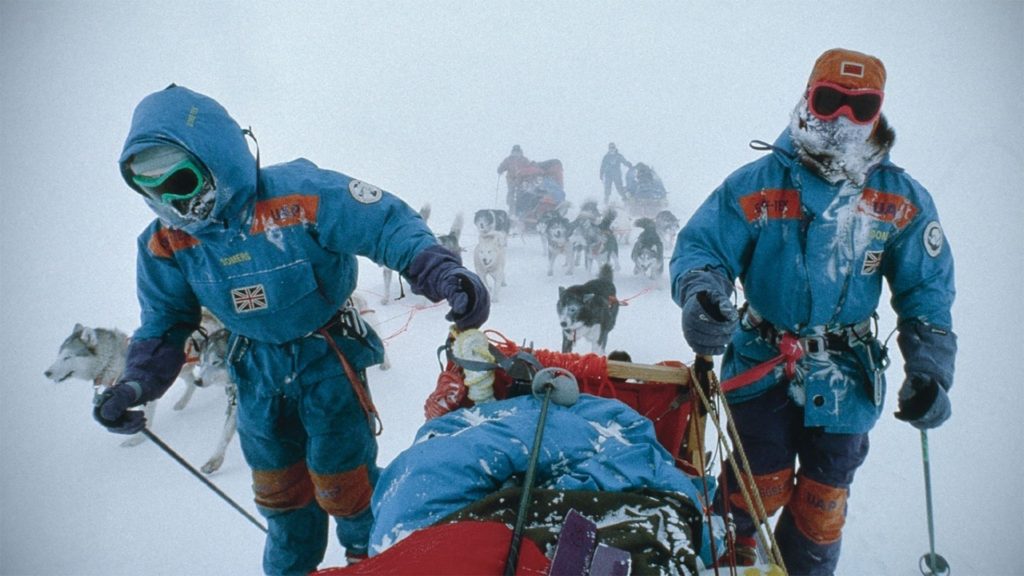
Tasha Van Zandt’s AFTER ANTARCTICA. Photo courtesy of SFFILM.
The fine documentary After Antarctica follows ecological adventurer Will Steger on two polar expeditions – different poles and twenty-five years apart.
In 1989-90, Steger led the first non-mechanized expedition to cross continent of Antarctica (the LONG way – from one coast to the other). This was a grueling and risky endeavor. The international team needed to avoid terrifying crevasses; (check out the beginning of the trailer below.) The volatility of the weather was brutal. Steger noted, “Antarctica doesn’t want us here, and is making every effort to remind us”.
The team faced a crisis of supplies and exhaustion just 16 miles from the end of their 3700 mile journey. They knew that the earlier Antarctic explorer Robert F. Scott had died only 12 miles from a supply cache. Steger’s leadership, informed by zen discipline and sheer force of will, brought them through.
The Steger team’s achievement will not be matched – due to climate change, the 4000 square mile Larsen ice shelf that they traversed is no longer there.
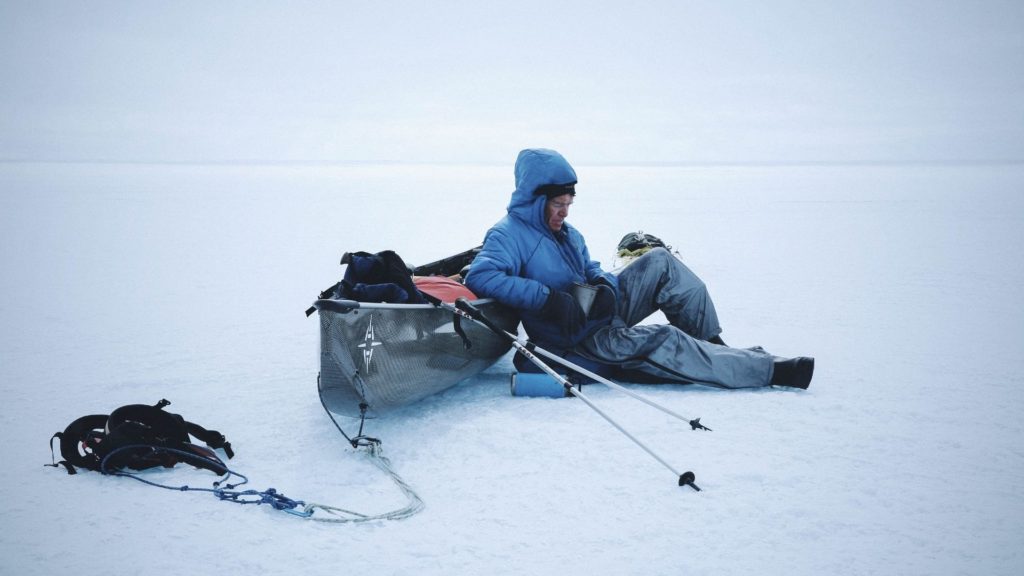
Tasha Van Zandt’s AFTER ANTARCTICA. Photo courtesy of SFFILM.
A quarter of a century later, After Antarctica follows a 75-year-old Steger as he undertakes a solo expedition above the Arctic Circle – contemplating the effects of climate change and and his own mortality. In contrast with the global celebrity of the Antarctic expedition, the Arctic march is solitary.
Will Steger, who has survived both a lethal mountain climbing accident and cancer, has lived a life on the extreme. He is self-focused, crusty and open, without defensiveness, about own personal flaws.
The two polar journeys, the examination of climate change and Steger’s own life are told through the voice of Will Steger himself.
After Antarctica is the first feature for director Tasha Van Zandt. We see never-before-seen file footage of the Antarctic expedition. The Arctic cinematography by Van Zandt and DP Sebastian Zeck is extraordinary. Van Zandt has said that the icy ground and the grey sky of the Arctic hindered depth perception, making the piloting of drones for aerial photography especially difficult.
I screened After Antarctica for the 2021 San Francisco International Film Festival (SFFILM), where it won a jury award. It’s finally available to stream on Amazon, AppleTV and YouTube.
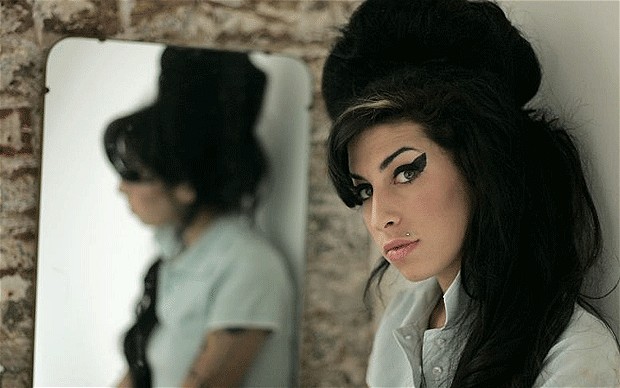
Photo caption: Amy Winehouse in AMY. Courtesy of A24.
An Amy Winehouse movie (Back to Black) is coming out this weekend, but I’m not aware of any reason to go see it, when you can watch a great Amy Winehouse movie, an Oscar winner, at home. Amy, documentarian Asif Kapadia’s innovative biopic of the singer-songwriter, is heart-felt, engaging and features lots of the real Amy Winehouse.
In a brilliant directorial choice, Amy opens with a call phone video of a birthday party. It’s a typically rowdy bunch of 14 year-old girls, and, when they sing “Happy Birthday”, the song is taken over and finished spectacularly by one of the girls, who turns out to be the young Amy Winehouse. It shows us a regular girl in a moment of unaffected joy and friendship, but a girl with monstrous talent.
In fact ALL we see in Amy is footage of Amy. Her family and friends were devoted to home movies and cell phone video, resulting in a massive trove of candid video of Amy Winehouse and an especially rich palette for Kapadia.
We have a ringside seat for Amy’s artistic rise and her demise, fueled by bulimia and substance addiction. In a tragically startling sequence, her eyes signal the moment when her abuse of alcohol and pot gave way to crack and heroin.
We also see when she becomes the object of tabloid obsession. It’s hard enough for an addict to get clean, but it’s nigh impossible while being when harassed by the merciless paparazzi.
Amy makes us think about using a celebrity’s disease as a source of amusement – mocking the behaviorally unhealthy for our sport. Some people act like jerks because they are jerks – others because they are sick. Winehouse was cruelly painted as a brat, but she was really suffering through a spiral of despair.
The Amy Winehouse story is a tragic one, but Amy is very watchable because Amy herself was very funny and sharply witty. As maddening as it was for those who shared her journey, it was also fun, from all reports. Everyone who watches Amy will like Amy, making her fate all the more tragic.
Amy, which won the Oscar for Best Documentary Feature can be streamed from Amazon, AppleTV, YouTube and is included in Max and Hulu subscriptions.
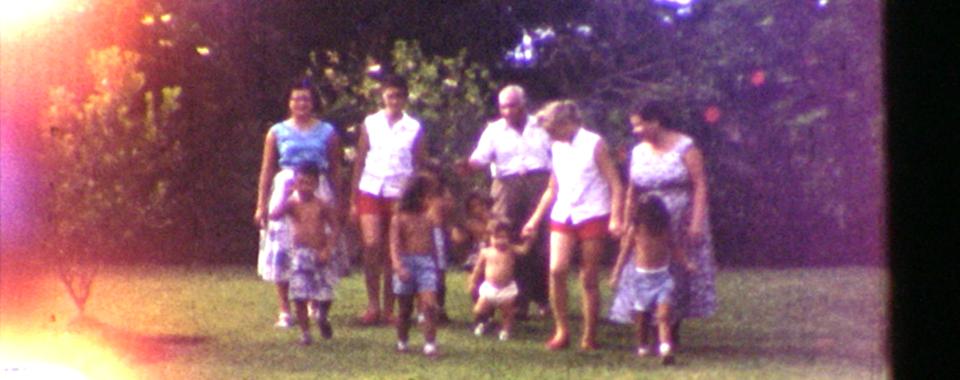
Photo caption: A scene from Tracey Arcabasso Smith’s RELATIVE. Courtesy of Gravitas.
Relative is filmmaker Tracey Arcabasso Smith’s reflective exploration of intergenerational sexual abuse in her own family. As Smith lovingly, but insistently, interviews her family members, she uncovers an epidemic of abuse in generation after generation. Relative becomes ever more powerful as Smith refuses to sensationalize, but stays centered on the strength and humanity of the women on camera. Finally, Relative takes us to how the cycle of abuse can be broken.
This is a brilliantly edited film (by Jeremy Stulberg, Ian Olds and Natasha Livia Motola) – first person testimonies are inter-cut with the home movies of a lively family – a family we now understand was stained with corrosive secrets.
Relative is the first feature for director Arcabasso Smith. (BTW the unadorned word Relative is a great title for this story.)
I screened Relative for the 2022 Nashville Film Festival. It’s now available to stream on Amazon (included with prime), AppleTV, Vudu and YouTube.
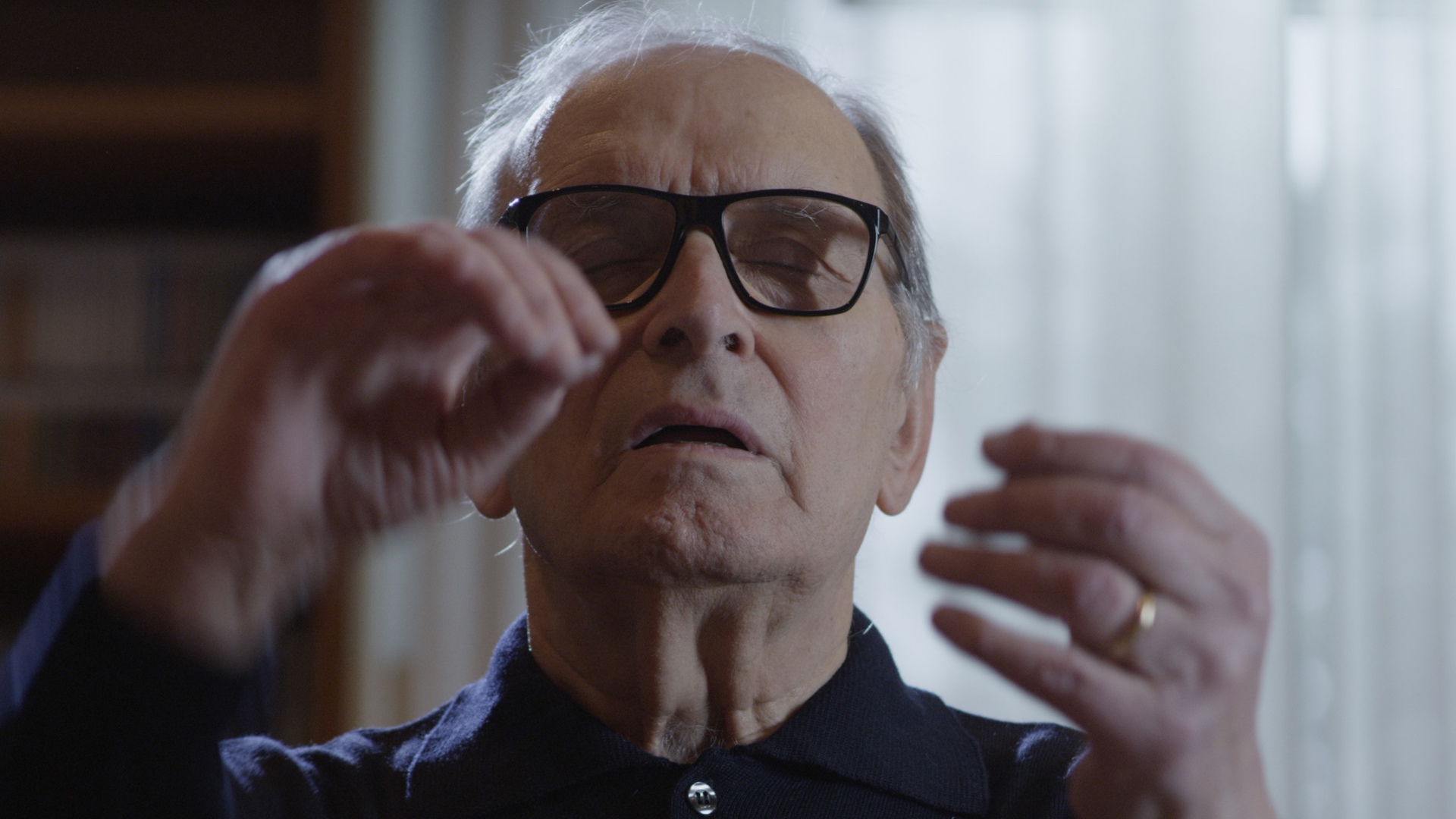
Photo caption: Ennio Morricone in ENNIO. Courtesy of Music Box Films.
Ennio Morricone is one of the greatest composers of movie music and certainly the most original, and the thorough and well-sourced documentary Ennio traces his life and body of work. We hear from Morricone himself and plenty of talking heads – many film directors, composers and musicians, from Clint Eastwood to Bruce Springsteen.
Morricone is the first artist I’ve heard of who aspired to become a doctor, but was forced by his father to play trumpet. During WW II in Italy, the Morricone family business was a small town brass band that entertained occupying German, then American troops, which the young Ennio found humiliating. Nevertheless, he followed his talent into a music conservatory, and evolved into composing.
Circumstances brought him a gig writing movie music and led to his groundbreaking scores for Sergio Leone’s spaghetti westerns A Fistful of Dollars, For a Few Dollars More and The Good, the Bad and the Ugly. Beginning with the whistle in A Fistful of Dollars, this now iconic music is described in Ennio as “cultural shock” “operatic” and a “whole new language”. We learn how Morricone built his score for The Good, the Bad and the Ugly around his interpretation of a coyote howl. Great stuff.
Ennio’s other highlights include:
His work with Joan Baez for Sacco & Vanzetti in 1971.
His 9/11 symphony.
How he was snubbed by the Oscars for The Mission and The Untouchables before wining for The Hateful Eight.
Ennio takes two hours and 36 minutes to comprehensively survey Morricone’s entire career, and I would have preferred a shorter film more focused on the highlights. There is an unnecessarily long exit ramp of accolades at the end.
BTW I recommend listening to Morricone himself conduct an orchestra’s performance of his music from The Mission; search YouTube for “morricone conducts the mission”
Ennio is now available to stream on Amazon, AppleTV and YouTube.
Photo caption. Isa and Veronica Garcia-Hayes in MATTER OF MIND: MY PARKINSON. Courtesy of PBS Independent Lens.
The surprisingly uplifting documentary Matter of Mind: My Parkinson’s shines a light on Parkinson’s disease, and what we need to know about it. An estimated one million Americans are living with Parkinson’s, and the key to Matter of Mind’s success is in introducing us to three of them – a Brooklyn optician, a San Francisco fitness trainer and an Alaskan cartoonist – and their families. On April 8, Matter of Mind: My Parkinson’s becomes available on PBS’ Independent Lens and the PBS App..
Parkinson’s is incurable and degenerative, and attacks motor abilities. Matter of Mind does not sugar coat the symptoms, ranging from from tremors, falling and speech impairment to dementia and depression. Nevertheless, there are now medicines and surgeries ((including deep brain stimulation)) that can impact the symptoms.
We watch the three subjects and their families, all engaging and relatable, explore the medical treatments, with their risks and tradeoffs, and adapt to getting the most out of their lives, even with Parkinson’s. Matter of Mind emphasizes the impacts on family members and the importance of family in supporting each sufferer’s response.
The 54-minute format of Independent Lens fits this subject matter exceptionally well – long enough to explain the science without becoming an eat-your-broccoli slog.
This is the second in a series of three documentaries on neurodegenerative diseases from co-writers and co-directors Anna Moot-Levin and Laura Green; the others are on ALS and Alzheimer’s. I’m usually not keen on disease movies, but Matter of Mind: My Parkinson’s is so good, and Parkinson’s so prevalent and inadequately understood, that this is essential viewing.
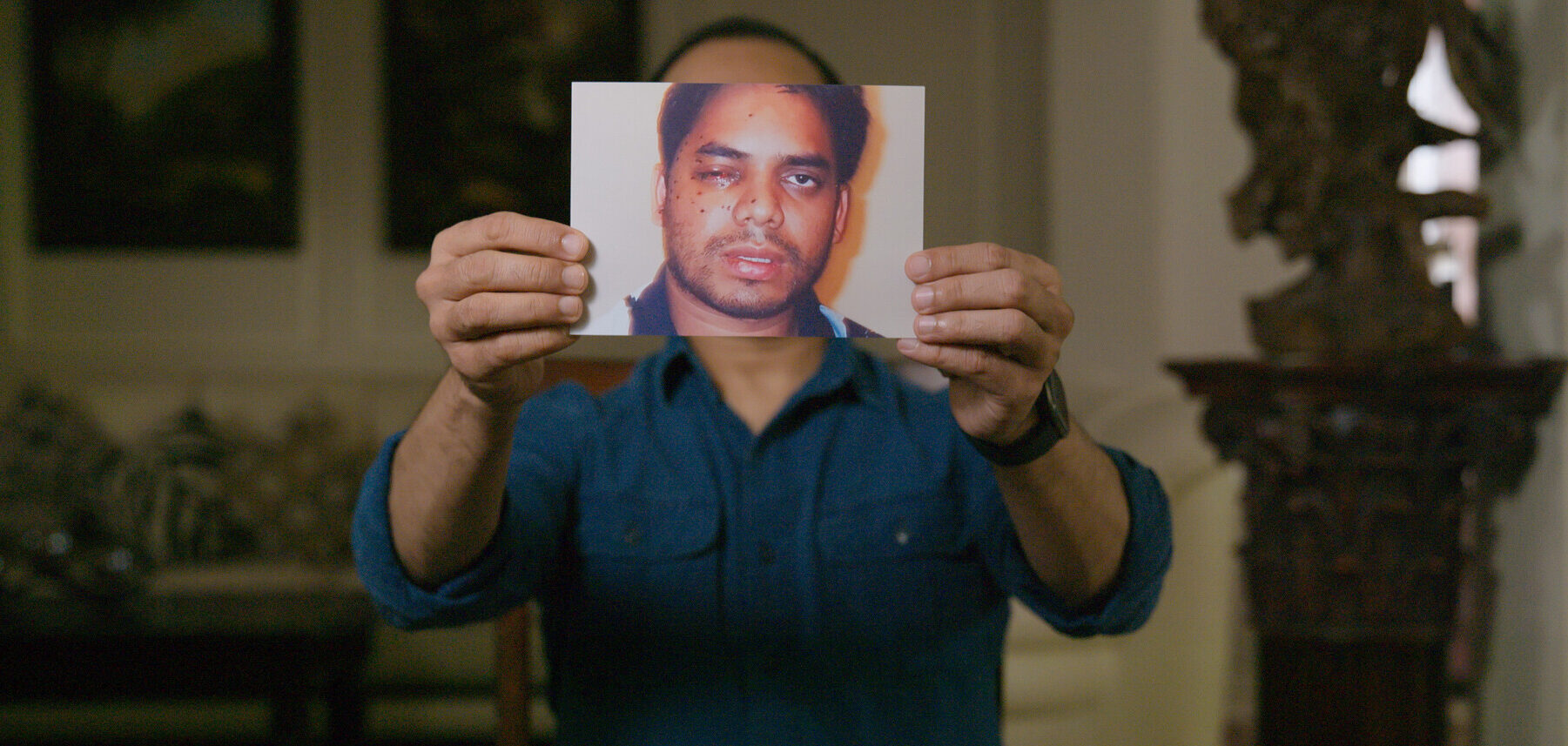
Rais Bhuiyan in PAIN AND PEACE. Courtesy of Cinequest.
The extraordinary and emotionally powerful documentary Pain and Peace begins with the story of Rais Bhuiyan. In the wake of the 9/11 attacks, an attacker who was looking to kill Muslims, any Muslims, shot two convenience store clerks to death and then entered the workplace of Bangladeshi immigrant Bhuiyan and shot him in the face with a shotgun; Bhuiyan somehow survived and then, perhaps even more remarkably, began a campaign of forgiveness for his perpetrator. What follows is an exploration of forgiveness as a necessary prerequisite to reconciliation and ending the cycle of demonizing other people.
Bhuiyan interviews other survivors of hate crimes, many of the highest profile, like the Georgia church shooting, the Buffalo supermarket shooting, the Orlando nightclub shooting, and more. It’s riveting when they retell their experiences and talk about forgiving their attackers.
Bhuiyan, as a hate crime survivor himself, brings major credibility as an interviewer and is superb as the narrator/guide of the film.
Pain and Peace also introduces us to some perpetrators of hate crimes, and that brings some surprises, too.
Pain and Peace is the first feature for director Mark Feijó.
I screened Pain and Peace for its world premiere at Cinequest. I highlighted it as one of two Must See films in my Best of Cinequest. It’s not very often that I see a movie as potentially life-changing, but this one is.
Carrete in QUIXOTE IN NEW YORK. Courtesy of Cinequest.
The charming documentary Quixote in New York follows the 82-yer-old Spanish flamenco dance master El Carrete, who wants to cap his career by performing in a major NYC theater. It’s not that easy to mount a theater production, and he doesn’t have unlimited time to pull it off.
El Carrete himself is a hoot, funny AF and even makes rehearsals fun for everybody. Director Jorge Peña Martín has the good sense to give us a big dose of El Carrete. It’s a well-crafted film, especially the cinematography.
There’s a Can’t Miss seen where El Carrete watches a projection of Fred Astaire dance, and then dances himself in front of the screen, mirroring Astaire’s moves-flamenco-style.
This is an audience-pleaser. Cinequest hosts the US premiere of Quixote in New York.
Carrete in QUIXOTE IN NEW YORK. Courtesy of Cinequest.
The environmental justice documentary Demon Mineral explores the impact of uranium mining on the Navajo people. In her first feature, director and co-writer Hadley Austin uses indigenous voices to tell the story, including her co-writer, environmental scientist Dr. Tommy Rock. It’s the testimony of Navajo people themselves that traces the history of uranium mining, subsequent health problems and the science connecting the dots. Some of the first-person narratives are heart-breaking.
This real life story takes place in one of the most iconic locations in American cinema – Arizona’s Monument Valley. (The Navajo themselves have complicated feelings about the legacy of John Ford Westerns made in their homeland.) Cinematographer Yoni Goldstein’s black-and-white photography soars, bringing out the majesty of the harsh landscape and imparting a gravitas to the story.
There’s even a cameo by hard right Congressman Paul Gosar, who is so stupid that he doesn’t comprehend just how stupid he is.
Demon Mineral has enjoyed a robust film festival run and won the Audience Award for Documentary Feature at the 2024 Slamdance.