CALL ME BY YOUR NAME: first love in a luscious Italian summer

Timothée Chalamet and Armie Hammer in CALL ME BY YOUR NAME

Call Me by Your Name is an extraordinarily beautiful story of sexual awakening set in a luscious Italian summer.  The film is gorgeous and magnificently well-acted, but flawed.

Each year, the family of 16-year-old Elio (Timothée Chalamet) spends the summer in a villa in Northern Italy.  Elio’s father is an American professor of ancient Greek and Roman culture, and each summer he invites a different grad student to live in their villa and work on scholarly pursuits.  In this summer of 1981, that lucky grad student is the 26-year-old Oliver (Armie Hammer).  Elio is attracted to Oliver, who is a closeted gay man. Oliver is attracted to Elio, but initially resists Elio’s overtures.  What follows between the two of them is an enthralling and authentic exploration of first love.

Timothée Chalamet is really perfect as Elio, a musical prodigy who is beating off the girls with a stick.  Even really handsome and talented 17-year-olds have some awkwardness, especially while they’re trying too hard to be cool.  Chamalet captures that perfectly, along with the obsessive longing of a first romance.  (Chalamet is also in Lady Bird, where he plays the dreamy kid who plays in a band, the object of Lady Bird’s desire.)  Armie Hammer is also superb as the more worldly Oliver, whose external confidence masks inner conflicts.

Timothée Chalamet in CALL ME BY YOUR NAME

The story of the two main characters would have made a perfect film, but famed screenwriter James Ivory adds some distracting implausibility with the other characters.  First, there are Elio’s impossibly cool and understanding parents (Michael Stuhlbarg and Amira Casar) who practically push their teen son into the arms of an older man; nobody has parents like that, especially TWO of them.  (And, yes, I did understand the dad’s motivation, made almost explicit in his final monologue).  Second, Elio hurts the feelings of a girl (in a way that almost every male has hurt some girl).  Later, she forgives him and it’s all made to be okay.  This is just too convenient for Elio, and I didn’t buy it.

And then there’s one of my own movie pet peeves.  I generally despise musical interludes in movies, when the dialogue is suspended and a song is played over a montage of imagery.  This usually indicates a lack of imagination in the story-telling.  A movie gets negative bonus points from me when the music is an insipid pop ballad.  In Call Me by Your Name, there are two such Euro-pop interludes.

On the other hand, the depiction of the Italian countryside, with its rustling breezes, orchards heavy with fruit, ancient buildings and  is pure travel porn.  I think that The Wife would have walked out of Call Me by Your Name – not because she wouldn’t have liked it – but to make reservations for a return to Tuscany.  Director Luca Guadagnino (A Bigger Splash, I Am Love) has a gift for making his native Italy unbearably attractive on the screen.  Between the work of Guadagnino and Paolo Sorrentino (The Great Beauty), Italy has been well-celebrated in recent films.

Call Me By Your Name is a very good movie, and the core story of Elio and Oliver is great cinema.

THE SHAPE OF WATER: an operatic romance (and it’s inter-species)

Sally Hawkins in THE SHAPE OF WATER

The Shape of Water is an epic romance from that most imaginative of filmmakers,  writer-director Guillermo del Toro.  The Shape of Water may become the most-remembered film of 2017.

The story is set in 1962 Baltimore. Elisa (Sally Hawkins) is a mute woman who lives in a dark apartment above an aging downtown movie palace.  She and her friend Zelda (Octavia Spencer) work as a janitors on the graveyard shift at a government research laboratory.  The Cold War adventurer Strickland (Michael Shannon), a tower of menace, has captured an amphibian creature from the Amazon and has brought him in chains to a tank at the laboratory.  The male creature, in the approximate form of a human, has dual breathing systems, so he can survive both under water and on the surface; it develops that he also has intelligence, feelings and even healing powers.

The scientist Hoffstetler (Michael Stuhlbarg) wants to study Amphibian Man to discover how his species could benefit humanity.  Strickland, on the other hand, wants to rush into killing and dissecting the creature.  Strickland is a sadist, who enjoys brutalizing Amphibian Man with his cattle prod.

Elisa is repulsed by Strickland’s torture, and she feel compassion for Amphibian Man.  She starts showing Amphibian Man some kindness.  As Amphibian Man becomes more trusting of Elisa, he feels gratitude for her kindness.  She cares about him, too, first with pity and then with the fondness of a pet owner.  As Amphibian Man’s intelligence and feelings become more apparent, the two become more equal, and their mutual fondness blossoms into passion.

But Strickland’s nefarious plans force Elisa and her supporters into a race against the clock to save Amphibian Man.  And so we’re off on a thriller, with a heist-like rescue and a chase, culminating in an ending of operatic scale.

Now this is a romance that transcends species.  I totally bought into this.  If you can’t, the movie is less moving and much, much more odd.  Romance is often consummated sexually, and this one is, too.

Sally Hawkins is not conventionally pretty, yet del Toro didn’t make Elisa a stereotypical spinsterish ugly ducking.  Elisa is vital, with a rich inner life, a wicked sense of humor and cultural interests, and who expresses herself sexually.  She may only be a night janitor with a disability, but that doesn’t define her.  Elisa’s defiant gaze at Strickland is one of the movie’s highlights.

Hawkins’ performance is a tour de force.  Shannon makes for a formidable villain, especially when he clenches his own gangrenous fingers.  Michael Stuhlbarg, Octavia Spencer and Nick Searcy (Art Mullen in Justified) are all excellent.

Richard Jenkins’s performance as Elisa’s neighbor Giles is very special.  This is a very vulnerable man, with his sexuality trapped in a closet, his growing sensitivity to his own aging and his career as a commercial artist becoming obsolete.  With his episodes of resolute denial spotted with instances of inner strength, both the character and the performance are very textured.  And Giles’ eccentric reactions to the story are very, very funny.

I highly recommend Guillermo del Toro’s interview on NPR’s Fresh Air , in which he discusses many of his choices in developing the story of The Shape of Water, including shaping the character of Elisa and the inspirations from The Creature from the Black Lagoon.  In the interview, del Toro explains that, if this movie were made in 1962, Strickland would have been the hero, the Cold Warrior protecting humans from the alien creature.  Instead of course, the heroes of The Shape of Water are a woman with a disability, a woman of color, a gay man and a commie spy and, of course, a monster.

None of the characters have any reason to envision that white male supremacy, oppression of gays or the Cold War would end, or even be tempered, in their lifetimes.  It’s a graphic time capsule, with the grand movie palace empty, pushing out a sword and sandal epic to compete in futility with the small screen offerings of Dobie Gillis, Mr. Ed and Bonanza.  It’s a world in which the coolest thing imaginable is a teal 1962 Cadillac De Ville.

Here’s where Guillermo del Toro’s imagination triumphs. This story could not be told as well in a novel, on stage or in any other artistic medium. It has to be a movie.

This is filmmaking at its most essential and most glorious. Del Toro, along with production designer Paul B, Austerberry and art director Nigel Churcher, create a set of vivid and discrete worlds, each with its own palette. There are Elisa’s and Giles’ dark apartments, the brooding institutional green of the laboratory and the bright mid-century modern domain of Strickland’s family.

This is a beautiful movie.  Between del Toro’s filmmaking genius and Hawkins’ performance, The Shape of Water is a Must See, one of the best movies of the year.

THE DISASTER ARTIST: deluded incompetence makes for successful comedy

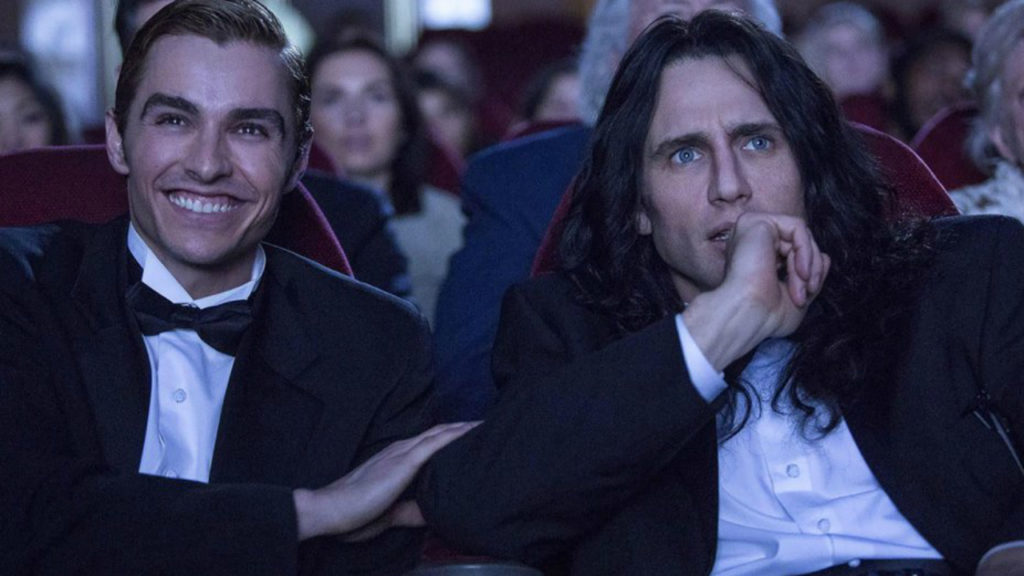
Dave Franco and James Franco in THE DISASTER ARTIST


Really bad movies can be so unintentionally funny that they are fun to watch and mock. Such is the case with The Room, which has risen to number 2 in my Bad Movie FestivalThe Room was a vanity project that was written and directed by its star, Tommy Wiseau, with his ravaged face, stringy hair and undeterminable accent. To fully appreciate Tommy Wiseau’s performance, search YouTube for “you’re tearing me apart Lisa!” – or watch The Disaster Artist, James Franco’s hilarious docucomedy about the making of The Room.

The primary element in The Disaster Artist (and the primary appeal of The Room) is that Wiseau is absolutely confident in his own talent, despite no validation from any one else.

Wiseau himself is a mystery. No one knows where he was born, how old he is or how he amassed enough of a fortune to blow six million dollars on making The Room.  He is so psychologically non-functional, he couldn’t have made millions on his own.  His accent betrays an origin someplace between Belgrade and St. Petersburg, even though he ridiculously claims the accent is from New Orleans.

Anyone who has watched The Room will marvel at James Franco’s brilliance in capturing all of Wiseu’s awkward and offbeat mannerisms.  It’s a remarkable, All In comedic performance and the core of the film.

The Disaster Artist is based on the book by Greg Sestero, Wiseu’s friend/muse/roommate, on the making of the movie.  Sistero is played by Dave Franco (and Sistero’s girlfriend Amber is played by Dave Franco’s real-life wife, Alison Brie).  The entire cast, which includes Seth Rogen and Jacki Weaver is excellent.

This is a very successful comedy.  The Disaster Artist is one of the funniest movies of the year.

Note:  The end of The Disaster Artist features a split screen for the very worst scenes of The Room side-by-side with the re-enactments by the cast of The Disaster Artist.  And make sure you wait through ALL the end credits for an encounter between the real Tommy Wiseau and James Franco in character as Wiseau.

Note #2:  Yes, I have turned to The Wife and bellowed, “you’re tearing me apart, Lisa!”

COCO: the splendor of authenticity

COCO

Pixar movies are known for their exquisite animation.  Pixar movies soar when they have excellent stories (the Toy Story trilogy).  Coco, Pixar’s moving and authentic dive into Mexican culture, soars.

Set in Mexico during Dia de los Muertos, the boy Miguel longs to become a musician, an avocation his family forbids because a musician ancestor once abandoned the family.  He tries to follow his passion, but becomes trapped in the world of the dead.  He must get the blessing of a dead family member to return to the living.  Just when we think we know the score, there is an unexpected plot twist.

The colors of the Mexican town in daytime perfectly capture the look and feel of Mexico.  But the scenes in nighttime and in the world of the dead, explode on the screen, and it’s hard to decide which is the most spectacular.  There’s an overhead shot of the town cemetery on the night of Dia de los Muertos, with the glow of candles from every grave.  The worlds of the living and of the dead are separated by a bridge of flowers made out of marigold petals.  And then there’s Pepita, a giant winged panther in the world of the dead.

The exploration into Mexican culture is authentic because it is so firmly anchored to the Mexican sense of family.   There are no stereotypes here, and all of the characters look far more Mexican than do many faces on Spanish-language television.  There are many inside chuckles, such as the character of Ernesto de la Cruz perfectly capturing the Mexican singing movie star of black and white films.  There is, of course, the focus on the Mexican version of Dia de los Muertos with its ofrendas and criaturas. 

COCO
Courtesy of ©2017 Disney•Pixar. All Rights Reserved.

The three main adult characters are superbly voiced by Gael Garcia Bernal, Benjamin Bratt and Alanna Ubach.  We also hear the voices of Edward James Olmos, Cheech Marin and Luis Valdez.  The only decidedly non-Latino voice talent is John Ratzenberger, who has still voiced a character in every Pixar film.

Emotionally moving, culturally authentic and visually stunning, Coco is splendid in every way.  Coco is the best Pixar film in years and one of the best movies of the year.

DARKEST HOUR: certainty in a moment of uncertainty

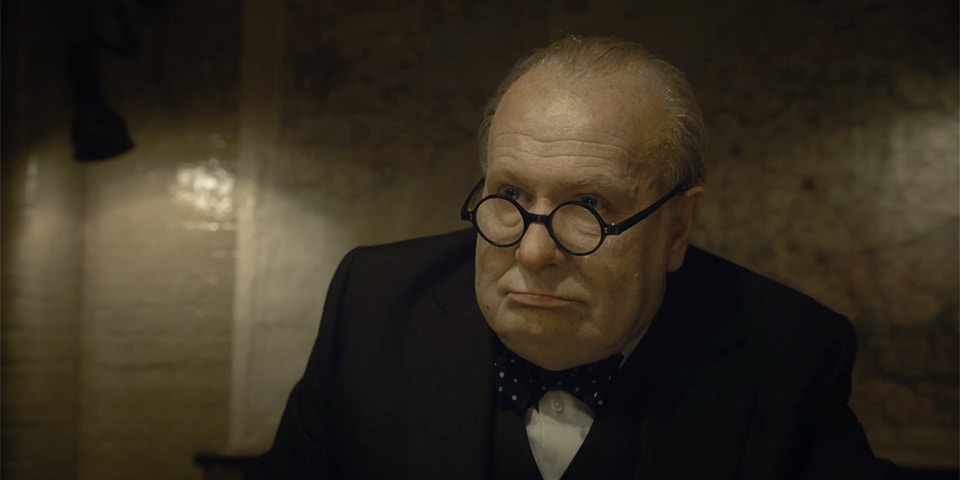
Gary Oldman in DARKEST HOUR

A less-remembered moment in human history makes for a great story in Joe Wright’s Darkest Hour, which takes place entirely in May 1940, the period after the German blitzkrieg through the Low Countries on the way to Paris and just before the Dunkirk evacuation.

It’s not always easy today to remember that there was a time when it appeared that Hitler would win WW II. In May 1940, the Nazi empire had swallowed essentially all of Central and Western Europe except for France, which was teetering on the verge of imminent surrender. The entire British Army was trapped, surrounded on a French beach across the Channel.

The UK was both damaged and entirely isolated. Stalin had split Poland with Hitler, and it was over a year before Hitler’s invasion of the USSR. It was also 19 months before Pearl Harbor brought the US into the war.  With no hope of external help, Winston Churchill even publicly contemplated the war being carried on by the Commonwealth nations after the German conquest and occupation of the island of Britain.

in Darkest Hours, Winston Churchill (Gary Oldman in a superb, Oscar-worthy performance) has just become Prime Minister. At the time, Churchill was a 66-year-old who had peaked at forty.  He had been a superstar daredevil in his twenties who squandered his celebrity in a career dotted by Bad Gambles, where he had repeatedly gone All In and lost all of his chips. By 1940 he was well-known for engineering a horrific military disaster at Gallipoli in WW I and for a series of political party changes. Not the confidence-inspiring figure we think of today.

So in this situation, what to do? One option was to embark on what one could rationally conclude would be a suicidal course of waging aggressive war and risking obliteration. Another option would be to negotiate the most favorable surrender with Nazi Germany.  No good choices here.

If Churchill begins trash talking the Germans just before their invasion, is that delusional or intellectually dishonest? Or a moment of inspired leadership?

Churchill’s selection as Prime Minister was forced on the former Prime Minister Neville Chamberlain and his top foreign affairs expert Lord Halifax, and the two were understandably concerned that Churchill might be leading the nation to its (literal) ruin. They lay a trap, but great politicians like Lincoln and Churchill do not let themselves be trapped.

The core of Darkest Hour is Churchill probing for a solution while under the most oppressive stress and pressure. In Darkest Hour, his outsized personality and eccentricities sprinkle the story with humor. Churchill, well-known for consuming a bottle of champagne with both lunch and dinner and working, slugging down brandy and whisky,  late into the night, is shown having breakfast eggs with champagne and whisky. When the King, at lunch, asks him, “How do you manage drinking during the day?”, Winston replies, “Practice”.

Oldman is as good as any of the fine actors who have played Churchill.  Kristin Scott-Thomas is especially excellent (no surprise here) as Churchill’s wife of then 32 years, Clementine.  Lily James (Lady Rose in Downton Abbey) is appealing as the fictional secretary through whose eyes the audience sees the private Churchill. Ben Mendelsohn is very good as King George VI, who has watched Churchill’s career to date askance. Stephen Dillane is particularly good as Lord Halifax,

There is one especially touching, but wholly phony scene with a “poll” in the Underground, but, other than that, Darkest Hour is very solid history.

Joe Wright is a fine director, and, here, has selected a moment in history that has sparked an exceptionally good movie. I saw Darkest Hours with a multiplex audience, which erupted into a smattering of applause at the end.

NOVITIATE: seeker finds grim slog

Melissa Leo in NOVITIATE

In Novitiate, a young girl (Margaret Qualley) from a broken family finds comfort and stability in the Catholic Church  As a teen, she plunges into a spiritual quest and commits herself to becoming a nun.  As Sister Cathleen, she is looking for Love and Sacrifice, but she gets too much sacrifice and discipline from the abbess Reverend Mother (Melissa Leo).

Novitiate is set in 1962, and the order is severe, requiring silence and Grand Silence.  Unfortunately for the young wannabe nuns, the drill sergeant in this nun boot camp is a sadist.  Under the guise of discipline, there is self-flagellation, self-starving, walking on knees along the stone floors, and, worst of all, the “Chapter of Faults” group sessions of emotional abuse.  The Reverend Mother is a bully, so profoundly mean, so devout to the discipline and so devoid of love.

All of this is taking place as Vatican II seeks to update the Church, a movement that the Reverend Mother resists in every way she can.  She is afraid of losing both the routine she finds meaningful and her position of authority.

Sister Cathleen is on a romantic quest, where the romance is with a theoretical object, an ideal.

Because of Margaret Qualley’s performance in the lead role, we believe Sister Cathleen’s resolute commitment to her quest and the extremes to which it leads.  Melissa Leo has gotten Oscar buzz for her performance, and she is good in a role less textured than she has pulled off in Frozen River or Treme.  The best acting comes from Dianna Negron (Glee), as the promising #2 nun who leaves the convent, and from Julianne Nicholson as Sister Cathleen’s mother, who can’t understand how her daughter has come to this.

The story is one of unrelenting grimness and the film viewing experience becomes tedious.  Novitiate is by no means a bad movie, it’s just a long slog through Eat Your Broccoli territory.

Novitiate is the debut feature of writer-director Margaret Betts, who shows promise as a director of actors and as a visual director.  The film’s shortcoming is the story.

[SPOILER:  The Wife aptly pointed out that the girl-on-girl sexual action is entirely unnecessary in the scene where Sister Cathleen yearns for physical and emotional comfort.  There had already been a same-sex encounter between minor characters at the nunnery, and this scene, which is about the need for comfort as a relief from the all-consuming severity, didn’t need to go there.  There’s also an utterly gratuitous glimpse of Qualley’s nipples that is only prurient.  This is disappointing for a woman director, but, reading recent revelations from Salma Hayek and others, you never know if this wasn’t Betts’ idea at all.]

BOMBSHELL: THE HEDY LAMARR STORY: the world’s most beautiful woman and her secrets

BOMBSHELL: THE HEDY LAMARR STORY

Bombshell: The Hedy Lamarr Story is the riveting biopic of a glamorous movie star who invented and patented the precursor to wireless technology; that’s amazing enough, but Bombshell delves deeply into how Lamarr’s stunning face, her Jewish heritage, and mid-century gender roles shaped her career, marriages and parenting. Top notch.

In the last few years, one totally unexpected aspect of Lamarr’s life has become more well-known.  She was a tinkerer/inventor who co-invented a radio guidance system for submarine torpedos, which she donated to the US military.  The US Navy used this technology in WW II.   Modern blue tooth technology stems directly from her innovation.  Today her patent would be worth billions.

Bombshell adds layer upon layer to this tale of beauty and brains, as it traces Lamarr’s remarkable life.   Hedy Lamarr had no control over being born a woman, being born to Jewish parents and being born to be a beauty.  These three accidents of birth set the parameters of her journey – granting her access to some professional opportunities and stunting others, even threatening her life.

She burst into celebrity – and notoriety – at age 19, as the star of the film Ecstasy.   Not only was Hedy the first actress filmed in full frontal nudity, she was the first screen actress to portray female orgasms.  She was soon the young trophy wife of an Austrian industrialist, a formidable and fearsome supplier of munitions to Hitler.  Hedy’s life seemed headed along the Bimbo Track, but she realized that her husband was powerful enough to keep her trapped in the marriage, but not powerful enough to protect her from the Nazis.  At this point, she orchestrated an international escape that is the stuff of thrillers.

At age 24, often nominated as the most beautiful woman in the world, she launched a Hollywood career.  Professional ups and downs, marriages and affairs and children followed, along with her work in technology.

Her beauty was often a blessing and sometimes a curse, but always affected her trajectory.  Someone that beautiful is just different – the rest of us can’t help our reactions to her. But how many times can you be a trophy wife?

She was a person who survived troubling times, which left scars on her.  How Hedy handled her Jewishness, how she raised her kids and how she was treated by the military are unsettling.  Documentarian Alexandra Dean, Bombshell’s writer-director brings us witnesses, including Hedy’s children, to deliver an inside peek at a real life that would not be believable as a work of fiction.

I saw Bombshell: The Hedy Lamarr Story this summer at the San Francisco Jewish Film Festival (SJFF).  It’s coming to theaters this week.

Stream of the Week: LOUDER THAN BOMBS – an intricately constructed family drama

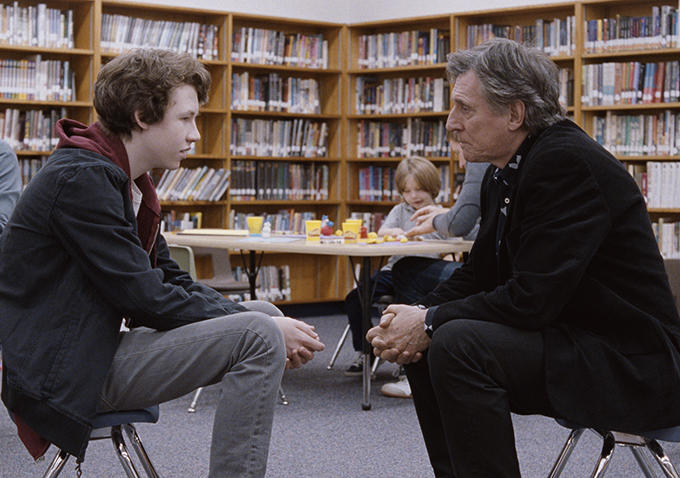
Devin Druid in LOUDER THAN BOMBS

Norwegian writer-director Joachim Trier’s new film Thelma is rolling out, so it’s a good time to check in with his recent – and overlooked – American movie Louder Than Bombs.  All of Trier’s work (with his writing partner Eskil Vogt) focuses on the psychological, and Louder Than Bombs is an intricately constructed family drama.

Gabriel Byrne plays the father of two sons – a man whose vital wife (Isabelle Huppert) has died suddenly in middle age.  His young adult son (Jesse Eisenberg) is superficially achieving, but it turns out, has some real issues.  But the younger teen son (Devin Druid) is clearly troubled; the dad is trying, but he just can’t get ANY traction with younger son.

The unstable younger son is about to find out that his mother committed suicide, and Louder Than Bombs is a ticking clock, as we wait to see what happens when younger son finds out.   The audience has an ever-present fear that tragedy is going to erupt.

Isabelle Huppert and Gabriel Byrne in LOUDER THAN BOMBS

In flashback, Huppert’s character is strong and Sphinx-like, ever dominating the three men she left behind.  The rest of the cast is also excellent: Byrne, Eisenberg, Amy Ryan, Rachel Brosnahan, and David Strathairn.  Young Devin Druid is a revelation as the younger son.

Devin Druid and Gabriel Byrne in LOUDER THAN BOMBS

In Louder Than Bombs  Trier employs flashbacks, dream sequences, and even the same scene replayed from a different point of view a la Rashomon.

Joachim Trier previously made Reprise, a wonderful film about sanity and the creative process in which two young novelists send in their manuscripts at the beginning of the film, just before one suffers a psychotic breakdown. Reprise was #4 on my list of Best Movies of 2008. w Trier’s next film was the well-crafted and utterly authentic Oslo August 31, which I didn’t like as much as most critics.  Trier’s newest film, Thelma, opens this fall.

The critical response to Louder Than Bombs has been mixed from middling to rhapsodic.  Right after seeing it, I wasn’t sure that I’d recommend it, but the film stayed with me for several days.  Eventually, I realized that this is an excellent film to see and then mull over.

Louder Than Bombs is now available to stream from Amazon, iTunes, Vudu, YouTube, Google Play.

WESTERN: alienated man goes native

Meinhard Neumann in WESTERN

In the evocative and thought-provoking German drama Western, a crew of German hardhats sets up a construction camp on a remote Bulgarian mountainside to build a water power plant.  They aren’t cultural tourists and certainly not diplomats, and they see the nearby Bulgarian village as a distraction from, even an impediment to, their project.  Of the Germans, only Meinhard (Meinhard Neumann) seeks out contact with the Bulgarians.

Writer-director Valeska Grisebach lets the audience connect the dots about what’s going on. The Germans and the Bulgarians have encounters at the camp, at the riverside swimming hole and in the village.  As one would expect from any modern German filmmaker, Grisebach shines a harsh light on the German sense of superiority and entitlement.  One German even says, “They know we’re back. 70 years later, but we’re back.”  But the characters have dimension.  The blustery project boss Vincent (Reinhardt Wetrek) is an asshole, but even he has his own personal and job problems.

Of the Germans, only Meinhard makes Bulgarian friends.  Meinhard is a loner among his co-workers, yet he seems to be searching for something among the Bulgarians and their alien language and culture.  Meinhard is well-traveled and looks like he Has Lived a Life.  He’s not a misfit (he’s very functional), but he hasn’t found where he DOES fit.

What has caused Meinhard’s alienation?  That’s not clear, but it doesn’t need to be.  Hell, Jack Nicholson just shows up alienated in every movie from Five Easy Pieces through The Passenger, and that works out just fine.

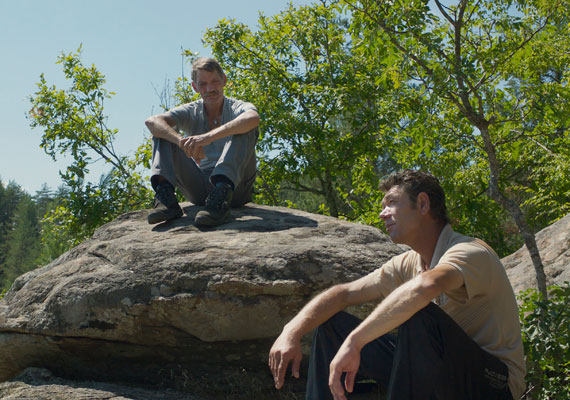
Meinhard has no ties.  Asked if he is homesick, he queries, “what is homesick?” He thrives in the simpler culture, and this solitary man finds himself becoming social.  He develops a deep trusting friendship with a local leader, Adrian (Syuleyman Alilov Letifov).

We have the advantage of subtitles, so we know what is being said in German and in Bulgarian. The characters are not understanding about 90% of what is spoken in the other language.  The friendship between Meinhard and Adrian transcends language. The highlight of Western is a beautiful dialogue in which the two don’t understand all (or even most) of each other’s words.

Meinhard goes native.  Will it work out for him?  The Germans and the Bulgarians learn that they are competing for the same scarce resource.  The Germans are always on the verge of provoking a riot.  The insular Bulgarians are wary of strangers.

Western is not a brisk movie, but Grisebach paces it just about perfectly.  This character-driven story is a sequence of revelations, and we need Grisebach to take her time. Grisebach uses the handheld camera effectively to plunge us right into the experience of the characters, who are often trying to discover something about the other guys.

Meinhard Neumann and Syuleyman Alilov Letifov in WESTERN

So that’s what is on the screen. I was astounded to learn that Grisebach used no professional actors in Western.  She reportedly auditioned 600 working folks to get her cast.  She snagged two sublime natural talents in Meinhard Neumann and Syuleyman Alilov Letifov. Not only that, but Grisebach did not use a script.

Quoted by Stefan Dobroiu in Cineuropa, Grisebach said, “I wanted to get closer to the solitary, inflated, often melancholic male characters of the western.”  Grisebach may not have intended it, but she nailed the Going Native subgenre of Westerns, where a first world man becomes immersed into a native culture, which he ultimately embraces.  Examples include A Man Called Horse and Dances with Wolves.

I saw Western in October at Camera Cinema Club. It played the Cannes and Toronto film festivals in 2017. Western has a US distributor (The Cinema Guild), and a US theatrical release is planned for 2018.  Western is a strong film and should satisfy art house audiences.

THREE BILLBOARDS OUTSIDE EBBING, MISSOURI: raw emotion and dark hilarity

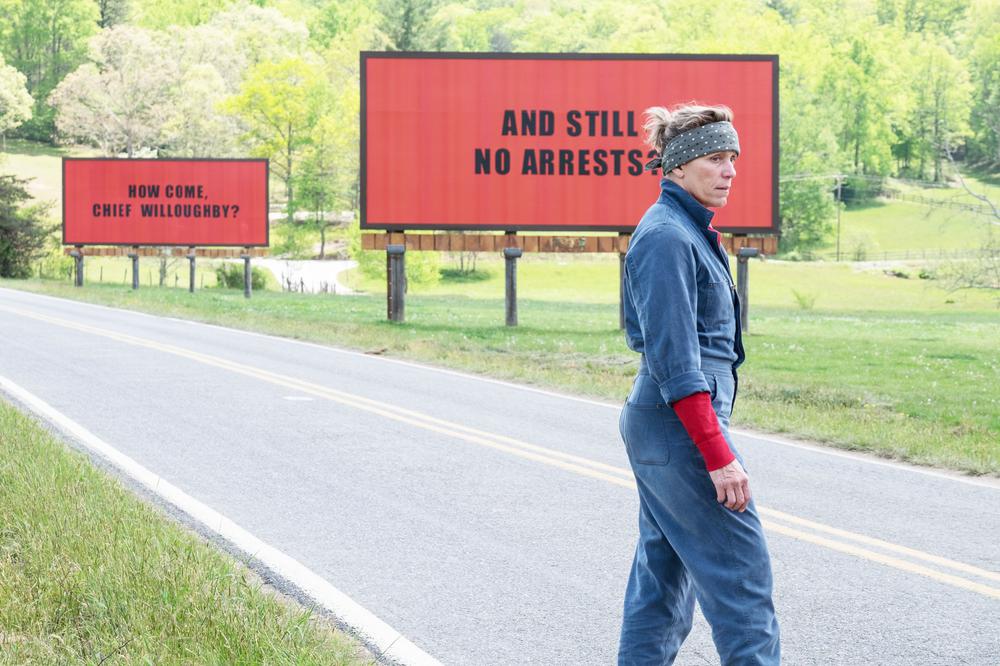
Frances McDormand in THREE BILLBOARDS OUTSIDE EBBING, MISSOURI

In Three Billboards Outside Ebbing, Missouri, a powerful combination of raw emotions and dark hilarity, Frances McDormand plays Mildred, a small town woman consumed by the unsolved murder of her daughter.  Mildred doesn’t have the power to solve the murder herself, but she has the power to make everyone else uncomfortable until she finds justice and closure.  She buys billboards that personalize the stalled murder investigation, laying the blame on the popular town sheriff (Woody Harrelson).  She intends to rile people up, and, boy, does she succeed.

There are consequences, both intended and unintended.  In addition to the murder mystery, there are two new whodunits related to the billboards and some violent outbursts by two of the characters.  There’s a heartbreaking letter, and two more utterly unexpected letters.

The murder of one’s child is shattering enough, but Mildred also piles guilt on herself.  The murder has enraged the entire family, including Mildred’s son (Lucas Hedges of Manchester By the Sea) and her ex-husband (John Hawkes).  All three express their rage in different ways.  This is a showcase role for McDormand.

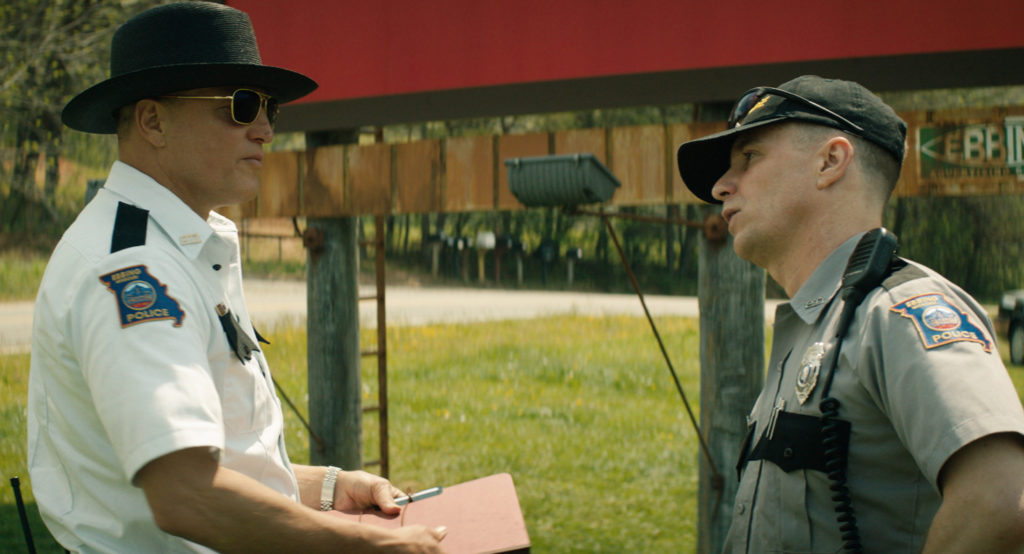
Woody Harrelson and Sam Rockwell in THREE BILLBOARDS OUTSIDE EBBING, MISSOURI

This might be Woody Harrelson’s best performance.  His sheriff is an island of common sense, decency and levelheadedness in a turbulent sea of upset and idiocy.  The character of the sheriff is a remarkably fine father and husband in ways that are fun and interesting to watch.   The sheriff is facing his own mortality, and his feelings are hurt unjustly, but we only see glimpses of the pain in Harrelson’s eyes.  This is a performance that would have been in the wheelhouse for Jimmy Stewart, Henry Fonda and Gregory Peck, and Harrelson nails it.

Sam Rockwell plays Dixon, one of the sheriff’s deputies.  Dixon is an unfortunate muddle of bad instincts, no impulse control, stupidity, racism and rage.   Then he gets an unexpected opportunity for redemption…

Sandy Martin also sparkles as Dixon’s Momma.  It’s a very small part, but Martin practically steals the movie  with her white trash Svengali. Martin’s 128 screen credits include roles in Transparent, Big Love and as Grandma in Napoleon Dynamite (she’s the one who says Knock it off, Napoleon! Just make yourself a dang quesa-dilluh).

Samara Weaving is really perfect as the inappropriately-young-girlfriend-on-the-rebound of Mildred’s ex.  Weaving is drop dead beautiful with a remarkable sense of comic timing and a mastery of deadpan.  Fully invested in her character’s goodhearteredness and  airheadedness, she reminds me of Margot Robbie and Elizabeth Banks as a comic actor.

Peter Dinklage plays a character that provides comic relief and one important plot point, and he brings an unexpected and profound feeling to the part.

Here’s one thing that is uncommonly great about Three Billboards:  the story would have worked with characters of far less dimension, but the roles written by Martin McDonagh and performed by the cast elevates Three Billboards.  Mildred could have been only a shrew, the sheriff could have been only a cardboard foil and Dixon could have been only a buffoon.  Instead McDormand, Rockwell and Rochwell add layers of complexity to their characters, and Hawkes, Martin, Weaver and Dinklage each contribute more to the mix.

Three Billboards is brilliantly written by director Martin McDonagh.  McDonagh’s 2008 In Bruges was either the funniest hit man movie ever or the darkest and most violent buddy comedy ever.  Three Billboards shares the same dark/funny flavor.   Three Billboards also has a really fine soundtrack with a couple of spaghetti western-inspired cues.

The emotion in Three Billboards is genuine and deeply felt.  There are some especially grim moments, peppered with lots of laughs.   As I ponder this film, I keep coming back to the characters, the performances and the surprises in the story. Three Billboards in Ebbing, Missouri was an audience favorite on the festival circuit and is a Must See in theaters now.