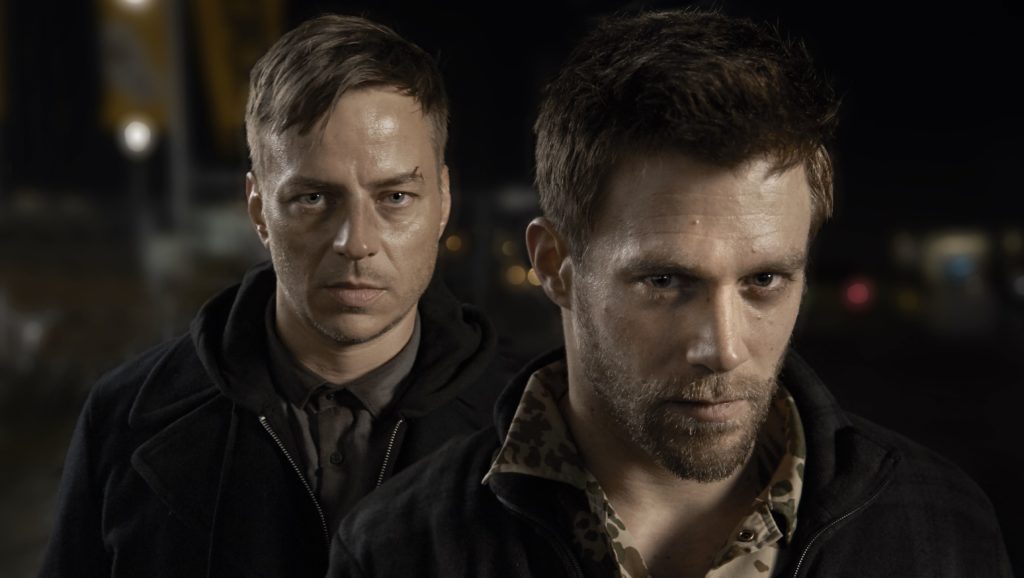
In the intense German thriller Berlin Falling, Frank (Ken Duken) is a troubled vet hoping to reunite at Christmas with his estranged wife and kid. But he picks up the hitchhiker Andreas (Tom Wlaschiha of Game of Thrones), who turns out to be any contemporary European’s worst nightmare (exactly what kind of nightmare is revealed at the end). Andreas subdues Frank with a highly personalized threat and forces him him to engage in a horrific terrorist attack, complete with its own chilling Isis video. It looks like there is no way out for Frank, and Berlin Falling ticks on like a time bomb to its uncompromising and violent conclusion.
With its comments on terrorism, immigration and xenophobia, Berlin Falling covers much of the same ground as this year’s German Oscar submission, In the Fade, but with a huge plot twist. It’s the writing-directing feature debut for actor Ken Duken, who plays Frank. It all works as a nail-biter, but it’s a bit exhausting. I saw Berlin Falling at Cinequest.
Skull, an absolutely bizarre film, is intended to be Indonesia’s first sci-fi film. Opening with a beautiful drone shot, Skull lurches forward with bits of mystery, romance, chases and shootouts until its “science unleashes the end of the world” finish.
The discovery of a giant skull threatens the underpinnings of many scientific theories and results in an international secret research project and a coverup by the Indonesian government. Ani ( Eka Nusa Pertiwi), a young woman at the research project is about to become a victim of the coverup when her killer-to-be is whacked by Yos (played by writer-director Yusran Fuadi), and the two escape on a motorcycle roadtrip through the Indonesian hinterlands, ending up with Yos’ mentor in a watchtower high above the jungle.
The frenetic pacing screeches to an abrupt halt while the three banter in front of a static camera for maybe ten minutes – it’s not at all a bad scene, just jarringly different than the pace of the rest of the film. The mentor gets in a couple sniffs of Ani’s hand, then rest of the assassins arrive and there’s a shootout. Afterwards, there’s a visit to a philosopher who might have the key to the mystery.
Along the way, we have a SWAT team wearing skull masks, an exercise in mass voting by text (but is it hacked?) and a character exclaiming, “Dried Shit!”. This paranoid thriller finally concludes with a Pandora’s box ending with odd, but very effective special effects. Skull is also notable for its vivid colors and terrible translation in the English subtitles.
I saw Skull at a Cinequest screening with the cast and crew. Yusran Fuadi made the film in 128 days of shooting over more than three years on 40 different locations in Java. Each time he could save up $180 from his paycheck as a lecturer, he would gather the crew and shoot some more of the movie. He said his major direction to leading lady Eka Nusa Pertiwi was a plea not to get pregnant in the next three years.
WHAT THEY HAD Blythe Danner and Hilary Swank star as Ruth and Bridget Keller in WHAT THEY HAD, a Bleecker Street release. Photo courtesy of Bleecker Street
In the family drama What They Had, two siblings (Hilary Swank and Michael Shannon) face their mom (Blythe Danner) sinking into Alzheimer’s, and their father (Robert Forster) refusing to take action. To heighten the pressure, the out-of-town daughter wants to give the old folks more slack than does the local son. He’s been dealing with this situation up close, and he’s fed up. The dad is used to always being in charge, and he doesn’t cope well with needing help.
Despite the subject, What They Had is not a depressing movie, mostly because of the sunniness of Danner’s character. This is a character-driven story that benefits from this stellar cast. This is the first feature for writer/director Elizabeth Chomko, and she delivers an authentic and well-crafted story.
I saw What They Had at Cinequest. An October 18, 2018 release is planned. Here’s a clip.
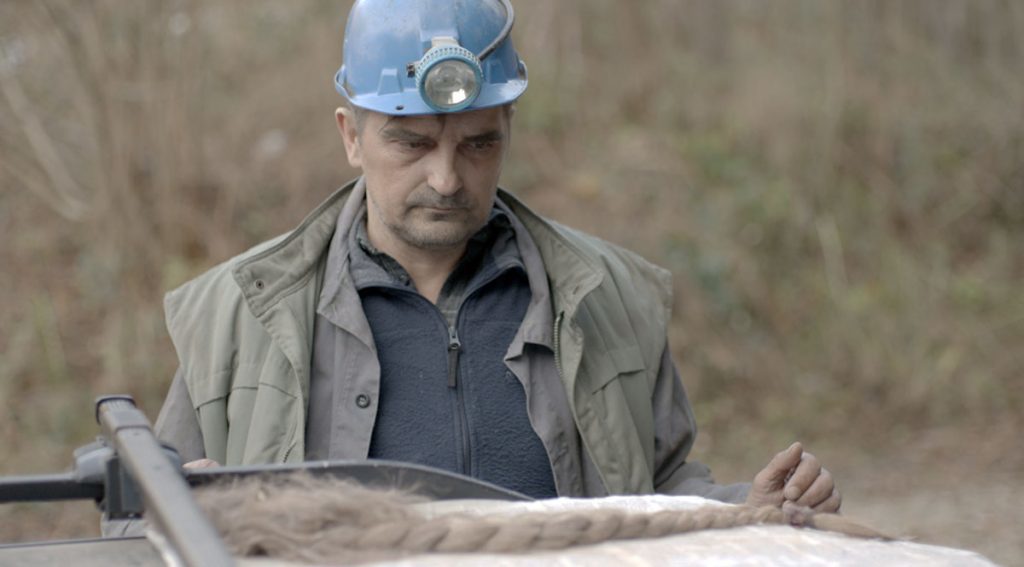
In the gripping Slovene drama The Miner (Rudar), the experienced miner Alija (Leon Lucev) is tasked with checking out an abandoned mine before it is permanently sealed. No one wants anything found in the old shaft, let alone anything controversial. But Alijah is a man burdened by a great sense of duty. As a Bosnian immigrant, he has also been seared by the Bosnian genocide.
The movie starts out as a mystery and urns into a psychological thriller. Indeed, [MINOR SPOILER] the mine that has been closed since 1945 is revealed to contain a mass grave. Embued with the Bosnian resolve to “find them all”, Alijah is not about to cooperate in the coverup that his employer and the Slovenian government desire. Alijah is a man of few words, but he is eloquent when he relates the family story to his adult daughter. The Miner is based on a true story.
The writer-director is Hannah Antonina Wojcik Slak, and The Miner is her third feature.
I saw The Miner at Cinequest. Cinequest’s international film scout Charlie Cockey specializes in Eastern European cinema and brought this gem to the festival. Slak won Best Director and Lucev won Best Actor at the Slovene Film Festival, and The Miner was Slovenia’s submission to the Oscars.
The excellent Czech historical drama Barefoot is from director Jan Sverák, who won an Oscar for Kolya. It’s the coming of age story of a small boy named Eda and is set during World War II. The local puppets collaborating with the Nazis make it impossible for Eda’s father to stay in the city, so he moves his family to his rural home village.
In the countryside, Eda develops a gang of buddies and meets his mysterious uncle Wolf. In the city, Eda’s father had been courageous – even risking his life – to undermine the Nazis; but, in the village, the father is completely submissive to his own father and the rural extended family.
The war is in the background, occasionally protruding into the forefront. The Germans are on their heels and a Russian victory is inevitable, but the Germans are still in control and dangerous.
We follow the story through the boy’s lens, and there’s an effective balance of humor and drama. Whether in wartime or peacetime, a boy must grow and learn life lessons and form his character.
I saw Barefoot at Cinequest, where Director of Programming Mike Rabehl secured the rare black-and-white director’s cut. The black-and-white is splendid, and there’s a sleigh ride scene that is magical.
Barefoot, which is way better than the Oscar winner Kolya, is another gem from Cinequest’s international film scout Charlie Cockey. It doesn’t yet have distribution in the US, but I’ll let you know when it’s available to US audiences.
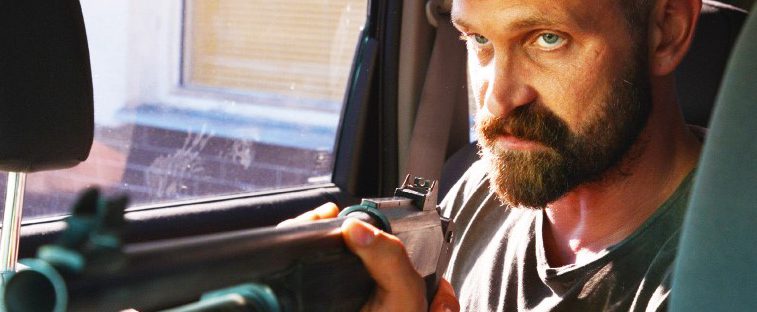
In the neo-noir Slovak thriller The Line (Ciara), Adam’s (Tomas Mastalir) life is about to be changed by history. The Schengen agreement, which opens the borders between the European nations, is about to be implemented. That’s a problem for Adam, who leads a crew of smugglers who sneak Ukrainian cigarettes through Slovakia to Austria and other European markets. First, there’s no longer going to be any market for smuggling anything out of Slovakia. Second, the border between Slovakia and the Ukraine is going to be hardened, so he’s no longer going to be able to source anything from the Ukraine. What was going to be his last big job goes awry, leaving him in hopeless hock to a ruthless Ukrainian gangster. So he’s going to have to take a chance on a very dangerous job.
We see Adam’s crew equipping vehicles with hidden compartments and making bribes at the border. One crew member sends off a load of bootleg cigarettes with “Cancer is headed to Austria”.
Adam is one tough mother, a guy who is exceptionally tough even by the standards of movie crime bosses. But he’s under increasing pressure, and that same pressure is incentivizing people he relies on to go sideways on him. At its heart, The Line is a film about betrayal.
It turns out that Adam runs a business started by his mother (Emília Vásáryová), who is herself the most formidable and lethal granny since Livia Soprano or Lillian Gish in The Night of the Hunter. There’s a great scene near the end where Adam and mom experience a shared memory of what happened to his father.
Adam’s wife (Zuzana Fialová) knows him very well. She also knows when to hold her cards and when to fold them.
The Line keeps getting darker – and then even darker – until a major veer at the end. It’s an effective character-driven thriller.
The Line was directed by Peter Bebjak, who acted in the best foreign film at the 2017 Cinequest, The Teacher. The Line was Slovenia’s submission to this year’s Oscars.
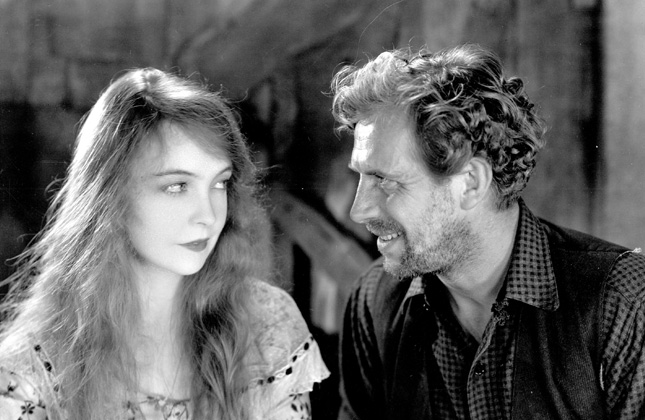
The Wind is usually named as Lillian Gish’s top silent film performance. Gish plays a young pioneer woman who is stranded in a vast sparsely populated Western desert. She marries one of her several suitors and takes up housekeeping in an isolated cabin, with only the perpetually howling wind for company. She has to “wash” her dishes in sand. Unsurprisingly, she can’t take it and is driven to desperate measures.
Fortunately, I got the chance to see The Wind at Cinequest on the big screen of a period movie palace, the California Theatre, accompanied by world-renowned Dennis James on the Mighty Wurlitzer organ.
Dennis James traveled with Lillian Gish as accompanist when she would present movies. For The Wind he added two colleagues on wind machines. Before the film, James read a florid movie mag account of a visit to the set of The Wind in the Mojave. I recommend Sal Pizarro’s excellent profile of Dennis James in the Mercury News.
James’ organ accompaniment and the large audience made all the difference. I had watched The Wind by myself on tv and started using the fast forward on the remote. But there’s lots of humor embedded in The Wind which is activated by the laughing of audience members.
It’s easy to appreciate how Gish rose to stardom. Her slight, delicate frame is offset by her spirited charisma. She’s great when three men propose to her on the same evening and she’s not feelin’ it. Gish, Dennis James’ Wurlitzer and the California Theatre made for a wonderful cinema experience.
Donald Sutherland and Helen Mirren in THE LEISURE SEEKER, Photo courtesy of Sony Pictures Classics.
In The Leisure Seeker, a strong-willed suburban retiree (Helen Mirren) finds her longtime husband (Donald Sutherland) sinking into Alzheimer’s. Having been a teacher who has found the greatest joy in his recall of literature, the impact of the memory disease will be very specific. Facing a health issue of her own, she decides to take him on a road trip all the way down the Eastern Seaboard to Ernest Hemingway’s house in Key West. Off they go in their trusty Winnebago and adventures ensue.
There’s plenty of humor here, and this is not a particularly heartbreaking Alzheimer’s movie. Mirren and Sutherland are both just so good in their roles. Sutherland’s hubby is good-natured as long as he can pilot his 20-foot RV and get a decent hamburger without having to learn a restaurant server’s first name; he slips into a literary revelry at the slightest provocation. Mirren is the social navigator, now faced with corralling somebody who now dips into another reality.
It’s the first American film for the accomplished Italian director Paolo Virzi (Like Crazy). Unfortunately, there’s just something about the iconic American road trip and, perhaps, America itself that Virzi just doesn’t get, and The Leisure Seeker never quite ascends to greatness.
I was amused more than thrilled or moved by The Leisure Seeker. Yet the performances of Helen Mirren and Donald Sutherland can justify catching the movie.
Marguerite Moreau and Hus Miller in YOU CAN’T SAY NO
In the indie romantic comedy You Can’t Say Know, Alex (Marguerite Moreau) and Hank (Hus Miller) are at the end of a 14-year-old marriage. Their relationship has never been communication-rich, things have gotten stale and a Hank affair has brought down the curtain. Just before they sign the divorce papers, they send the kids off to camp and take individual road trips. Coincidentally, they meet up on the road, and they play a game, taking turns to order the other to do something that he/she cannot refuse. Comic situations, raw emotions and redemption ensue.
Moreau is especially good as the wife who needs to express her anger but still believes that she will be happiest choosing an improved marriage over divorce. Alex is trying to find her path, and she’s definitely not a doormat. Moreau brings spunk and likeable charm to the role.
Peter Fonda is wonderful as Hank’s eccentric winemaking dad Buck. Hamish Linklater is sometimes hilarious as Buck’s wacky protegé. Ingrid Vollset brings spirit and sympathy as the free-spirited vagabond Allison.
Hus Miller wrote the screenplay in his feature debut as a writer. Unfortunately, You Can’t Say No doesn’t harvest its comic potential. The scenes are often a few counts too long, and the direction and editing tend to be clunky.
You Can’t Say No had its world premiere at Cinequest.
Bombshell: The Hedy Lamarr Storyis the riveting biopic of a glamorous movie star who invented and patented the precursor to wireless technology; that’s amazing enough, but Bombshell delves deeply into how Lamarr’s stunning face, her Jewish heritage, and mid-century gender roles shaped her career, marriages and parenting. Top notch.
In the last few years, one totally unexpected aspect of Lamarr’s life has become more well-known. She was a tinkerer/inventor who co-invented a radio guidance system for submarine torpedos, which she donated to the US military. The US Navy used this technology in WW II. Modern blue tooth technology stems directly from her innovation. Today her patent would be worth billions.
Bombshell adds layer upon layer to this tale of beauty and brains, as it traces Lamarr’s remarkable life. Hedy Lamarr had no control over being born a woman, being born to Jewish parents and being born to be a beauty. These three accidents of birth set the parameters of her journey – granting her access to some professional opportunities and stunting others, even threatening her life.
She burst into celebrity – and notoriety – at age 19, as the star of the film Ecstasy. Not only was Hedy the first actress filmed in full frontal nudity, she was the first screen actress to portray female orgasms. She was soon the young trophy wife of an Austrian industrialist, a formidable and fearsome supplier of munitions to Hitler. Hedy’s life seemed headed along the Bimbo Track, but she realized that her husband was powerful enough to keep her trapped in the marriage, but not powerful enough to protect her from the Nazis. At this point, she orchestrated an international escape that is the stuff of thrillers.
At age 24, often nominated as the most beautiful woman in the world, she launched a Hollywood career. Professional ups and downs, marriages and affairs and children followed, along with her work in technology.
Her beauty was often a blessing and sometimes a curse, but always affected her trajectory. Someone that beautiful is just different – the rest of us can’t help our reactions to her. But how many times can you be a trophy wife?
She was a person who survived troubling times, which left scars on her. How Hedy handled her Jewishness, how she raised her kids and how she was treated by the military are unsettling. Documentarian Alexandra Dean, Bombshell’s writer-director brings us witnesses, including Hedy’s children, to deliver an inside peek at a real life that would not be believable as a work of fiction.
I saw Bombshell: The Hedy Lamarr Story this summer at the 2017 San Francisco Jewish Film Festival (SJFF). It’s coming to Bay Area theaters this weekend.