Stream of the Week: LOUDER THAN BOMBS – an intricately constructed family drama

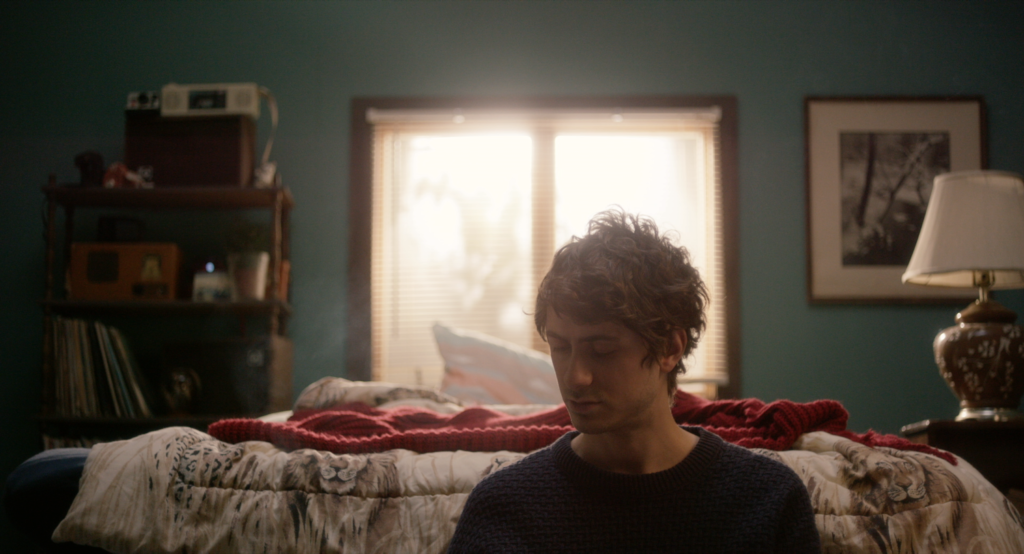
Devin Druid in LOUDER THAN BOMBS

Norwegian writer-director Joachim Trier’s new film Thelma is rolling out, so it’s a good time to check in with his recent – and overlooked – American movie Louder Than Bombs.  All of Trier’s work (with his writing partner Eskil Vogt) focuses on the psychological, and Louder Than Bombs is an intricately constructed family drama.

Gabriel Byrne plays the father of two sons – a man whose vital wife (Isabelle Huppert) has died suddenly in middle age.  His young adult son (Jesse Eisenberg) is superficially achieving, but it turns out, has some real issues.  But the younger teen son (Devin Druid) is clearly troubled; the dad is trying, but he just can’t get ANY traction with younger son.

The unstable younger son is about to find out that his mother committed suicide, and Louder Than Bombs is a ticking clock, as we wait to see what happens when younger son finds out.   The audience has an ever-present fear that tragedy is going to erupt.

Isabelle Huppert and Gabriel Byrne in LOUDER THAN BOMBS

In flashback, Huppert’s character is strong and Sphinx-like, ever dominating the three men she left behind.  The rest of the cast is also excellent: Byrne, Eisenberg, Amy Ryan, Rachel Brosnahan, and David Strathairn.  Young Devin Druid is a revelation as the younger son.

Devin Druid and Gabriel Byrne in LOUDER THAN BOMBS

In Louder Than Bombs  Trier employs flashbacks, dream sequences, and even the same scene replayed from a different point of view a la Rashomon.

Joachim Trier previously made Reprise, a wonderful film about sanity and the creative process in which two young novelists send in their manuscripts at the beginning of the film, just before one suffers a psychotic breakdown. Reprise was #4 on my list of Best Movies of 2008. w Trier’s next film was the well-crafted and utterly authentic Oslo August 31, which I didn’t like as much as most critics.  Trier’s newest film, Thelma, opens this fall.

The critical response to Louder Than Bombs has been mixed from middling to rhapsodic.  Right after seeing it, I wasn’t sure that I’d recommend it, but the film stayed with me for several days.  Eventually, I realized that this is an excellent film to see and then mull over.

Louder Than Bombs is now available to stream from Amazon, iTunes, Vudu, YouTube, Google Play.

WESTERN: alienated man goes native

Meinhard Neumann in WESTERN

In the evocative and thought-provoking German drama Western, a crew of German hardhats sets up a construction camp on a remote Bulgarian mountainside to build a water power plant.  They aren’t cultural tourists and certainly not diplomats, and they see the nearby Bulgarian village as a distraction from, even an impediment to, their project.  Of the Germans, only Meinhard (Meinhard Neumann) seeks out contact with the Bulgarians.

Writer-director Valeska Grisebach lets the audience connect the dots about what’s going on. The Germans and the Bulgarians have encounters at the camp, at the riverside swimming hole and in the village.  As one would expect from any modern German filmmaker, Grisebach shines a harsh light on the German sense of superiority and entitlement.  One German even says, “They know we’re back. 70 years later, but we’re back.”  But the characters have dimension.  The blustery project boss Vincent (Reinhardt Wetrek) is an asshole, but even he has his own personal and job problems.

Of the Germans, only Meinhard makes Bulgarian friends.  Meinhard is a loner among his co-workers, yet he seems to be searching for something among the Bulgarians and their alien language and culture.  Meinhard is well-traveled and looks like he Has Lived a Life.  He’s not a misfit (he’s very functional), but he hasn’t found where he DOES fit.

What has caused Meinhard’s alienation?  That’s not clear, but it doesn’t need to be.  Hell, Jack Nicholson just shows up alienated in every movie from Five Easy Pieces through The Passenger, and that works out just fine.

Meinhard has no ties.  Asked if he is homesick, he queries, “what is homesick?” He thrives in the simpler culture, and this solitary man finds himself becoming social.  He develops a deep trusting friendship with a local leader, Adrian (Syuleyman Alilov Letifov).

We have the advantage of subtitles, so we know what is being said in German and in Bulgarian. The characters are not understanding about 90% of what is spoken in the other language.  The friendship between Meinhard and Adrian transcends language. The highlight of Western is a beautiful dialogue in which the two don’t understand all (or even most) of each other’s words.

Meinhard goes native.  Will it work out for him?  The Germans and the Bulgarians learn that they are competing for the same scarce resource.  The Germans are always on the verge of provoking a riot.  The insular Bulgarians are wary of strangers.

Western is not a brisk movie, but Grisebach paces it just about perfectly.  This character-driven story is a sequence of revelations, and we need Grisebach to take her time. Grisebach uses the handheld camera effectively to plunge us right into the experience of the characters, who are often trying to discover something about the other guys.

Meinhard Neumann and Syuleyman Alilov Letifov in WESTERN

So that’s what is on the screen. I was astounded to learn that Grisebach used no professional actors in Western.  She reportedly auditioned 600 working folks to get her cast.  She snagged two sublime natural talents in Meinhard Neumann and Syuleyman Alilov Letifov. Not only that, but Grisebach did not use a script.

Quoted by Stefan Dobroiu in Cineuropa, Grisebach said, “I wanted to get closer to the solitary, inflated, often melancholic male characters of the western.”  Grisebach may not have intended it, but she nailed the Going Native subgenre of Westerns, where a first world man becomes immersed into a native culture, which he ultimately embraces.  Examples include A Man Called Horse and Dances with Wolves.

I saw Western in October at Camera Cinema Club. It played the Cannes and Toronto film festivals in 2017. Western has a US distributor (The Cinema Guild), and a US theatrical release is planned for 2018.  Western is a strong film and should satisfy art house audiences.

THREE BILLBOARDS OUTSIDE EBBING, MISSOURI: raw emotion and dark hilarity

Frances McDormand in THREE BILLBOARDS OUTSIDE EBBING, MISSOURI

In Three Billboards Outside Ebbing, Missouri, a powerful combination of raw emotions and dark hilarity, Frances McDormand plays Mildred, a small town woman consumed by the unsolved murder of her daughter.  Mildred doesn’t have the power to solve the murder herself, but she has the power to make everyone else uncomfortable until she finds justice and closure.  She buys billboards that personalize the stalled murder investigation, laying the blame on the popular town sheriff (Woody Harrelson).  She intends to rile people up, and, boy, does she succeed.

There are consequences, both intended and unintended.  In addition to the murder mystery, there are two new whodunits related to the billboards and some violent outbursts by two of the characters.  There’s a heartbreaking letter, and two more utterly unexpected letters.

The murder of one’s child is shattering enough, but Mildred also piles guilt on herself.  The murder has enraged the entire family, including Mildred’s son (Lucas Hedges of Manchester By the Sea) and her ex-husband (John Hawkes).  All three express their rage in different ways.  This is a showcase role for McDormand.

Woody Harrelson and Sam Rockwell in THREE BILLBOARDS OUTSIDE EBBING, MISSOURI

This might be Woody Harrelson’s best performance.  His sheriff is an island of common sense, decency and levelheadedness in a turbulent sea of upset and idiocy.  The character of the sheriff is a remarkably fine father and husband in ways that are fun and interesting to watch.   The sheriff is facing his own mortality, and his feelings are hurt unjustly, but we only see glimpses of the pain in Harrelson’s eyes.  This is a performance that would have been in the wheelhouse for Jimmy Stewart, Henry Fonda and Gregory Peck, and Harrelson nails it.

Sam Rockwell plays Dixon, one of the sheriff’s deputies.  Dixon is an unfortunate muddle of bad instincts, no impulse control, stupidity, racism and rage.   Then he gets an unexpected opportunity for redemption…

Sandy Martin also sparkles as Dixon’s Momma.  It’s a very small part, but Martin practically steals the movie  with her white trash Svengali. Martin’s 128 screen credits include roles in Transparent, Big Love and as Grandma in Napoleon Dynamite (she’s the one who says Knock it off, Napoleon! Just make yourself a dang quesa-dilluh).

Samara Weaving is really perfect as the inappropriately-young-girlfriend-on-the-rebound of Mildred’s ex.  Weaving is drop dead beautiful with a remarkable sense of comic timing and a mastery of deadpan.  Fully invested in her character’s goodhearteredness and  airheadedness, she reminds me of Margot Robbie and Elizabeth Banks as a comic actor.

Peter Dinklage plays a character that provides comic relief and one important plot point, and he brings an unexpected and profound feeling to the part.

Here’s one thing that is uncommonly great about Three Billboards:  the story would have worked with characters of far less dimension, but the roles written by Martin McDonagh and performed by the cast elevates Three Billboards.  Mildred could have been only a shrew, the sheriff could have been only a cardboard foil and Dixon could have been only a buffoon.  Instead McDormand, Rockwell and Rochwell add layers of complexity to their characters, and Hawkes, Martin, Weaver and Dinklage each contribute more to the mix.

Three Billboards is brilliantly written by director Martin McDonagh.  McDonagh’s 2008 In Bruges was either the funniest hit man movie ever or the darkest and most violent buddy comedy ever.  Three Billboards shares the same dark/funny flavor.   Three Billboards also has a really fine soundtrack with a couple of spaghetti western-inspired cues.

The emotion in Three Billboards is genuine and deeply felt.  There are some especially grim moments, peppered with lots of laughs.   As I ponder this film, I keep coming back to the characters, the performances and the surprises in the story. Three Billboards in Ebbing, Missouri was an audience favorite on the festival circuit and is a Must See in theaters now.

LADY BIRD: genuine and entirely fresh

Saoirse Ronan and Laurie Metcalf in LADY BIRD

In Greta Gerwig’s triumphant debut as a writer-director, Lady Bird, Saoirse Ronan plays Christine, a Sacramento teen in her final year of high school. I’ve seen lots of good coming of age movies and lots of high school movies, but rarely one as fresh and original as Lady Bird. Gerwig is an insightful observer of human behavior, and she gets every moment of Christine’s journey, with all of her aspirations and impulses, exactly right.

Movies rarely explore the mother-daughter relationship, but this is the biggest thread in Lady Bird.  Christine and her mother (Laurie Metcalf) deeply need each other but just can’t get out of each other’s way, perpetually on each other’s very last nerve. Christine insists on being called “Lady Bird”, rejecting even the name her mother gave her.  From the very first scene to the last, Lady Bird probes how this most complex relationship evolves.

A girl’s relationship with her father is also pretty central, and the great writer Tracy Letts’ understated performance as the dad is extraordinary.  Letts can play a despicable character so well (Andrew Lockhart in Homeland), I hardly recognized him as Christine’s weakened but profoundly decent father.  The dad is a man whose career defeats have cost him his authority in the family and he is suffering silently from depression.  Yet he remains clear-eyed about the most important things in his children’s lives and is able to step up when he has to.  It’s not a showy role, but Letts is almost unbearably authentic.

There isn’t a bad performance in Lady Bird.  Ronan soars, of course.  The actors playing her high school peers nail their roles, too, especially Beanie Feldstein as her bestie.

Lady Bird’s soundtrack evokes the era especially well. Thanks to Sheila O’Malley for sharing Gerwig’s letter to Justin Timberlake, asking to license Cry Me a River. It’s a gem.

Visually, Gerwig is clearly fond of her hometown, and fills her film with local landmarks. It’s not my favorite California city (and I’ve worked in the Capitol), but Sacramento has never looked more appealing than in Lady Bird.  I did really love the shots of the deco Tower Bridge and the Tower Theater sign.

I don’t care for Gerwig’s performances as an actress, and, in writing about them, I have not been kind. As a director, she is very promising, eliciting such honest and singular performances from her actors and making so many perfect filmmaking choices.  As a writer, she’s already top-notch.  Write another movie, Greta.

THE MEYEROWITZ STORIES (NEW AND SELECTED): who cares and why?

Grace Van Patten, Ben Stiller and Adam Sandler in THE MEYEROWITZ STORIES (NEW AND SELECTED)

The Meyerowitz Stories (New and Selected), writer-director Noah Baumbach’s latest family comedy, is entirely character-driven (usually a very good thing). We really don’t see anything on screen that isn’t intended to reveal something about a character – a man’s lack of confidence, his father’s vanity, his daughter’s surprising well-groundedness. The story (not really a plot) moves from set piece to set piece, beginning with a funny (and futile) search for a Manhattan parking space, each depicting the family quirks and tensions.

The Meyerowitz Stories (New and Selected) is star studded (Adam Sandler, Ben Stiller, Dustin Hoffman, Grace Van Patten, Emma Thompson, Judd Hirsch, a cameo by Sigourney Weaver) and very well-acted. The problem is that, once I was introduced to these characters, I really wasn’t interested in what would happen to them next. I only lasted 42 minutes before reaching for the remote.

Baumbach has become somewhat of a brand name for naval-gazing (The Squid and the Whale, Margot at the Wedding, Greenberg, Mistress America), and his work has tended toward the Woody Allen neurotic New Yorker genre, only with less depth and FAR less comedy.

You can stream The Meyerowitz Stories (New and Selected) on Netflix Instant, but I can’t imagine why you would want to.

LBJ: a Cliff Notes portrait of LBJ, traced through three relationships

Woody Harrelson in LBJ

Woody Harrelson captures the essence of Lyndon B. Johnson in Rob Reiner’s LBJ.  The best thing about this movie is the main character – probably the most complex and self-contradictory in American history.

LBJ was amazingly talented, aspirational, mean, charming, vulgar and surprisingly needy. LBJ was so masterful and tough and powerful, yet extremely thin-skinned for a politician.  His eternal grasping seems rooted in personal desperation.  LBJ had the need to dominate others and get everything he wants all of the time, and still needed to be loved (which is impossible when you are running over everyone else).

With all of his personal flaws, no American Presidents (except maybe Lincoln and FDR) have been able to roll up a record of legislative accomplishments in two short years to match the Civil Rights Act of 1964, the Voting Rights Act of 1965, Medicare, Medicaid, and Head Start.  Yes, this was a guy who was able to end legal racial segregation and systemic repression of voting rights and to bring medical security to the elderly and the poor.  (And then be capable of an equally huge policy mistake – the escalation of the Vietnam War.)

How do you tell the story of a larger-than-life character in only 90 minutes?  LBJ focuses on an eight-year period of LBJ’s career.  We first see him in 1956 as Senate Majority Leader, at his most energetic, masterful and powerful.  We then see him in his period of frustration and weakness as Vice-President.  The JFK assassination makes him President, and the film concludes after the enactment of Civil Rights Act in June 1964.

LBJ shows us the many sides of LBJ by tracing three of his personal relationships:

  • Georgia Senator Richard Russell (Richard Jenkins), the leader of Southern segregationists and one of LBJ’s most important mentors.  LBJ rose to power with Russell’s guidance and loyalty, but LBJ, to find his own place in history, needed to destroy everything Russell stood for.
  • Lady Bird Johnson (a superb Jennifer Jason Leigh), the only person who could handle the vulnerable, needy, whiny, disconsolate LBJ.
  • LBJ’s nemesis Robert F. Kennedy (Michael Stahl-David). Because RFK was a martyr, the public tends to forget about his nasty and “ruthless” side, which did exist.  LBJ and RFK took an instant dislike to each other in the early 1950s, a situation which built into a profound and fundamental mutual hatred.
  • Bill Pullman plays Senator Ralph Yarborough, a very minor character in history, but one who serves here as a composite for liberal politicians and for those bullied by LBJ.

The highlights of LBJ are found in that fateful week in November 1963.  At Dallas’ Love Field, it’s clear that JFK’s star power has eclipsed the weakened and resentful LBJ even in Texas.  Then we see LBJ just after the assassination, taking command and plunging into action, taking command and knowing exactly what to do when everyone else was paralyzed by shock.

The history in LBJ is very sound.  I’ve read and re-read the over three thousand pages of Robert Caro’s four-volume biography of Johnson.  Much of LBJ’s dialogue is word-for-word historically correct; I’ve even heard the real LBJ himself utter these words on phone calls that he taped himself.

Woody Harrelson is excellent, capturing both the human tornado and the vulnerable sides of LBJ.  The fine actors Randy Quaid, Rip Torn, Michael Gambon, James Cromwell, Liev Schreiber and Tom Wilkinson have all had their cracks at playing LBJ on the screen.  Woody is significantly better than all of those guys, but I still prefer Bryan Cranston’s LBJ in All the Way.

Yes, it’s a Cliff Notes version, but LBJ, with its top rate performances by Woody Harrelson and Jennifer Jason Leigh, is a fine historical introduction and pretty entertaining, too.

Jennifer Jason Leigh and Woody Harrelson in LBJ

MURDER ON THE ORIENT EXPRESS: moderately entertaining lark

Kenneth Branagh in MURDER ON THE ORIENT EXPRESS

Although I love mysteries, I have never warmed to Agatha Christie’s fictional detective Hercule Poirot.  In this year’s remake of Murder on the Orient Express, Kenneth Branagh actually made Poirot marginally appealing to me.  Branagh, who also directed, brings to the role a more explicit OCD diagnosis and a mustache that has its own architecture.

It’s the same plot as in the 1970s version – as the increasingly more improbable coincidences pile up, it becomes clear that they may not be coincidences at all.  And this year’s Murder on the Orient Express is also star-studded, with fine performances from Michelle Pfeiffer, Willem Dafoe, Judy Dench, Olivia Colman, Penelope Cruz, Derek Jacobi and Johnny Depp, who can pull off a pencil thin mustache better than anyone in the last 60 years.

Murder on the Orient Express begins with a spectacular overhead shot of the Wailing Wall and concludes with an amusing Last Supper tableau (see M*A*S*H*).  It’s moderately entertaining, at its best when it acknowledges that it’s just a lark.

Michele Pfeiffer in MURDER ON THE ORIENT EXPRESS

DVD/Stream of the Week: SMOKE SIGNALS – Native American roadtrip to laughs and a long-buried secret

Evan Adams and Adam Beach in SMOKE SIGNALS

The smart and bitingly funny dramedy Smoke Signals is a film about Native Americans written and directed by Native Americans.  Evans Adams plays Thomas Builds-the-Fire, an Indian nerd, a character type almost certainly unique in cinema.  Adam Beach plays his oft-surly friend Victor.  The two had contrasting relationships with Victor’s father, who has recently died.  Thomas and Victor embark on a road trip to unearth a family secret.

Smoke Signals was written with an acerbic wit and is often downright uproarious. The laugh lines are as funny as in any screwball comedy: Sometimes it’s a good day to die, and sometimes it’s a good day to have breakfast. One of the high points is a rendition of the original song John Wayne’s Teeth.

As Thomas and Victor banter, we get to glimpse inside both Indian Country and mainstream culture from the Indian point of view. Smoke Signals unflinchingly takes on alcoholism and other issues within the Native American community, as well as resentment of how Native Americans are treated by the dominant American culture.

Adam Beach and Evan Adams in SMOKE SIGNALS

Smoke Signals’s screenplay was written by Sherman Alexie, based on his own novel. Alexie set the core of the story on the Coeur d’Alene Reservation on which he grew up. It was directed in 1997 by then 28-year-old Chris Eyre. Eyre, a Cheyenne-Arapaho, has since directed the Native American-themed Skins and Edge of America, along with episode of Friday Night Lights and American Experience.

Adams is hysterically funny as Thomas, and Beach is a capable straight man. Smoke Signals also features the fine Native Canadian actor and actress Gary Farmer and Tantoo Cardinal and the Native American actress Irene Bedard. Michele St. John and Elaine Miles are very funny as Victor and Thomas’ reservation friends Velma and Lucy.

The film won the Audience Award and the Filmmakers Trophy at the 1998 Sundance Film Festival. Smoke Signals is available on DVD from Netflix and to stream from Amazon, iTunes, Vudu, YouTube and Google Play.

Paul Manafort ripped from the headlines in GET ME ROGER STONE

Roger Stone in GET ME ROGER STONE
So this week’s biggest news has been the indictment of former Trump campaign chief Paul Manafort.  The indictment comes out of special prosecutor Robert Mueller’s probe of the Russian hacking of last year’s presidential campaign.   Earlier this year, Netflix released the documentary Get Me Roger Stone, and IMDb bills Paul Manafort third in the “cast”, right behind Roger Stone and Donald Trump.

Get Me Roger Stone is an insightful look at the career of political consultant/provocateur Roger Stone, one of the most outrageous characters on the American political scene.  What’s especially relevant today is that Roger Stone and Paul Manafort together invented a new model of lobbying – where the political consultants who help get a candidate elected to high office, then sell their influence over said elected official.

Even without the Manafort angle, Get Me Roger Stone is an entertaining watch, although you might find Roger Stone himself too loathsome to watch.  Stone will do anything – no matter how duplicitous – to win a political campaign.  He will do anything to bring public attention (i.e., notoriety) upon himself.   And he is utterly unapologetic about both.   Stone is the political world’s version of a pro wrestling villain.

Roger Stone is the unmatched master of high jacking a news cycle with a preposterous smear.  The man has a tattoo of Richard Nixon’s face on his back, which tells you a whole lot about him.

Get Me Roger Stone also chronicles Stone’s decades-long quest to get Trump to run for president, and then Stone’s role as an unofficial/official/unofficial Trump strategist.  The documentary also touches on a Roger Stone sex scandal.

Anyway, it’s ripped from the headlines, and you can stream it from Netflix Instant.

MARK FELT: THE MAN WHO BROUGHT DOWN THE WHITE HOUSE: American history’s greatest mystery with the excitement sucked out

Liam Neeson in MARK FELT: THE MAN WHO BROUGHT DOWN THE WHITE HOUSE

In the sagging docudrama Mark Felt: The Man Who Brought Down the White House, Liam Neeson plays the title character – the man at the center of modern American history’s most compelling mystery. The Washington Post source known as Deep Throat was responsible for keeping the Watergate scandal alive until it dethroned Richard Nixon from the presidency. Deep Throat’s identity remained secret for thirty years. It turned out to be Mark Felt, the number two official at the FBI.

Think about it – this was one of the most compelling people in America for thirty years. Deep Throat was clearly one of a handful of men so well-positioned at the center of government power that we would know him, but no one could finger him. The intrigue was brilliantly captured in All the President’s Men, in which Hal Holbrook played Deep Throat.

In Mark Felt: The Man Who Brought Down the White House, Neeson plays Felt as a stolid, principled and crafty bureaucratic survivor. Somehow the character just isn’t that personally interesting. The story attempts to flesh him out with a troubled wife (Diane Lane, always superb, even in this thankless role) and a runaway hippie daughter.

As we watch Mark Felt, it gradually becomes apparent that this is a one-note character in a one-note movie. The leaden, pseudo-dramatic soundtrack doesn’t help. Mark Felt also fumbles the chance to get some spark out of Watergate icons John Dean, John Erlichman and John Mitchell. The real-life mystery is so much more interesting than this movie. The movie may be irresistible to Watergate buffs like me, but probably should be resisted.

Mark Felt was directed by Peter Landesman, who recently made the near-masterpiece Parkland. Parkland explores the JFK assassination from the viewpoints of the secondary participants. Mark Felt, however, is not a work of directorial mastery.

Marton Csokas is excellent as weak-willed and overmatched FBI Director L. Patrick Gray.  Nixon handpicked Gray to be his stooge only to leave Gray, as henchman John Erlichman indelibly described, to “twist slowly, slowly in the wind”.

In Loving, Csokas, with pitiless, piercing eyes, was remarkably effective as the Virginia sheriff dead set on enforcing Virginia’s racist statute in the most personally intrusive way. Too often, actors seem to be impersonating Rod Steiger in In the Heat of the Night when they play racist Southern sheriffs, but Csokas brought originality to that performance.  Here Csokas is able to portray a man of ability and ambition, but not spine.

The great but personally turbulent actor Tom Sizemore showcases his talent once again in the film’s most showy role, a bitter and cynic relic of the FBI’s most sordid skullduggery.  Sizemore brings a magnetic cocktail of menace and humor to the role. Besides Diane Lane, the always welcome Bruce Greenwood and Eddie Marsan show up in minor roles.

Perhaps needless to say, Mark Felt: The Man Who Brought Down the White House has made my list of Longest Movie Title.