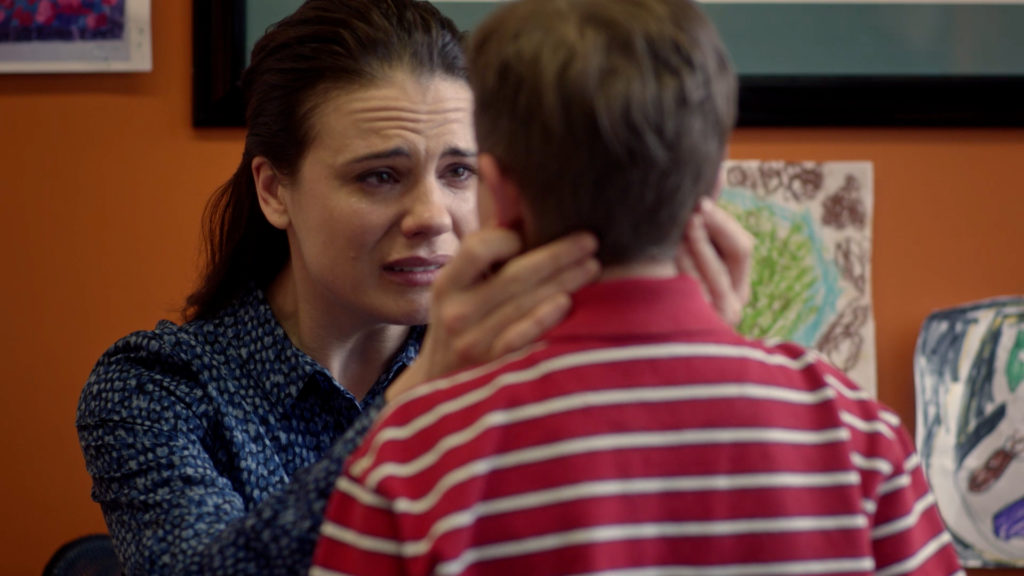
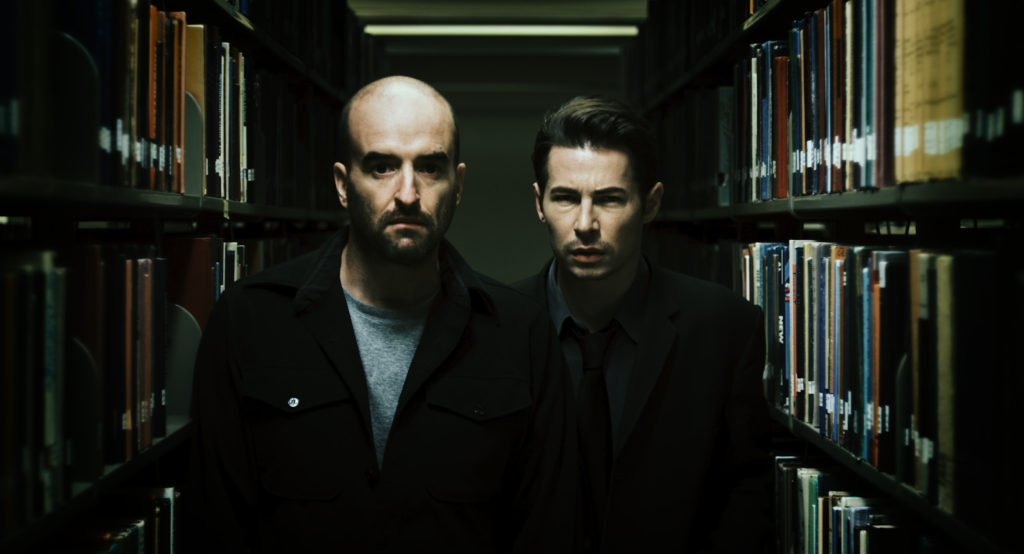
Exploring the challenges of co-parenting with an addict, the realistic Canadian drama Luba is topped off with a ticking time bomb finish. Luba (Nicole Maroon) is a struggling single mom whose estranged husband Donnie (Vladimir Jon Cubrt of Hannibal and Designated Survivor) is a crackhead. Donnie really loves his son, and Luba tries to let her son create some memories with his dad.
Unfortunately, Donnie is helpless to his addiction At his best, he is manipulative, sponging Luba’s last few discretionary dollars. At his worst, he is dangerously irresponsible. Then Donnie decompensates and goes lethally out of control.
In a futile attempt to make ends meet, Luba lives a hamster wheel experience, bouncing between multiple crappy waitress jobs and childcare that she can’t afford. Her only emotional and babysitting support comes from other busy moms and from Donnie’s sympathetic mother. Co-star Vladimir Jon Cubrt wrote Luba and completely captures the essence of Luba’s life – she’s trapped without any moment of relief or enrichment for herself.
Luba doesn’t have unrealistic expectations. She just wants to pay the rent on time, have some adult male companionship, and, being Canadian, play an occasional pickup game of ice hockey. Cubrt’s screenplay vividly brings alive another fundamental truth – the grinding impact of living with an addict’s roller coaster of self-sabotage. Luba’s attempts at moments of normality keep getting hijacked by Donnie’s selfishness. Repeatedly, respite suddenly turns into panic. This is Cubrt’s first screenplay, but he has written three original stage productions for the theater company he founded in Toronto.
Luba is the first feature for director Caley Wilson. This an authentic and relatable drama with an ending that works as a thriller. Cinequest hosts Luba’s world premiere.
Lawrence Kao and Lauren K. Montgomery in I HATE YOU
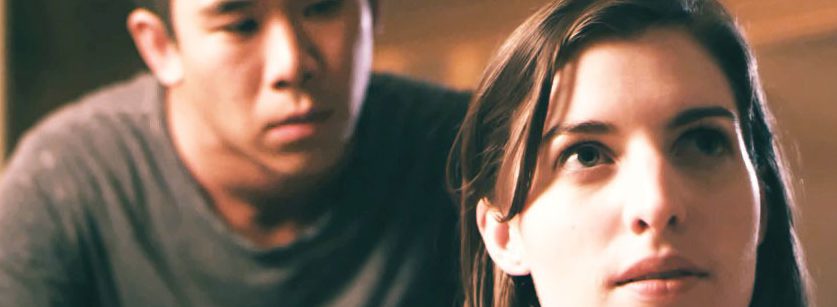
In the indie romantic comedy I Hate You, two very different twenty-somethings meet cute. Kelly (Lauren K. Montgomery) has plunged from one relationship to another and is particularly angry that the terms of her lease force her to stay in an apartment with her ex and his horny new girlfriend. Chi (Lawrence Kao) is an obsessive gamer who still lives with his mom.
Chi is not Kelly’s type but, then again, her type is a jerk. He is, however, way less experienced than she is. You’ve probably already guessed that they will get together, so that’s not really a spoiler. But she’s a workaholic, and when she’s off her laptop, she wants to analyze their relationship. Chi just wants a domestic life without much drama.
While following the usual arc of a romantic comedy, I Hate You mostly avoids dipping into rom-com clichés, and the ending is not predictable. I Hate You was written by Brad Kageno and Pyung Kim and is Kageno’s debut as a feature director.
This is an amiable and entertaining film. Cinequest hosts the US premiere of I Hate You.
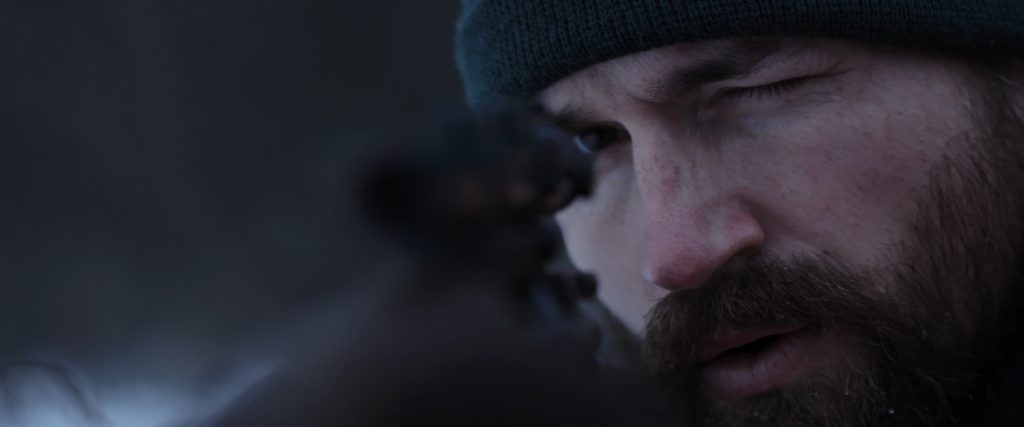
In the slow burn thriller Hunting Lands, Frank (Marshall Cook) is living a solitary life as a subsistence hunter in a forest cabin, a long pickup drive outside his northern Michigan hometown. Frank is a guy with serious wilderness skills, loading his own ammo and field dressing the large mammals that he fells with a single shot. He witnesses a serious crime in the woods and is immediately driven to make things right – but not in the way we expect.
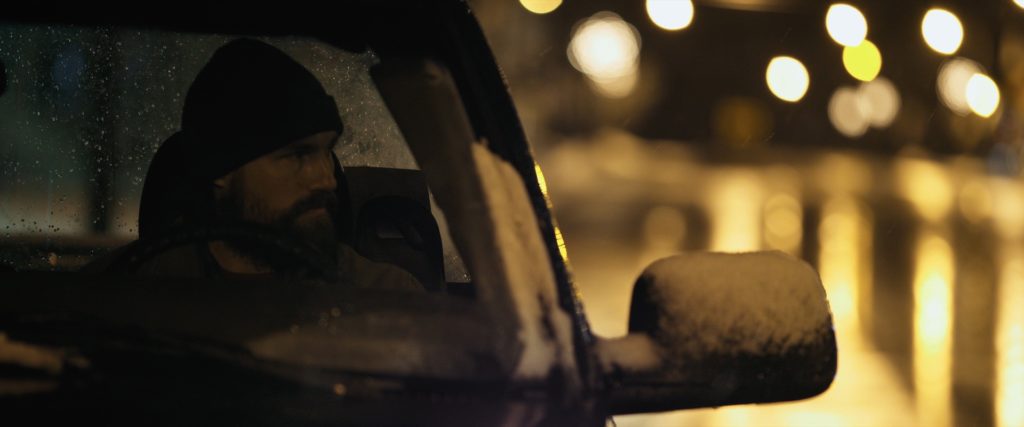
Frank has nobody to talk to, and we see him silently triage the situation and begin a hunt for the perpetrator. Silent observation comes naturally to a hunter, and we see him wordlessly patrolling the small towns in his pickup, as he tracks down his human prey. We see what Frank sees, and one of the most pivotal characters is only seen in long shot until the last 15 minutes or so.
HUNTING LANDSHUNTING LANDS
Hunting Lands is the first feature from writer-director Zack Wilcox, a story-teller who is thankfully willing to let the audience connect the dots. Because Hunting Lands is only 83 minutes long, Wilcox can take his time watching Frank watch others. Even as Frank is still and quiet, the audience is gripped by what he is going to do next.
An original character, Frank seems unusually self-aware for a hermit. When he finally gets in a conversation, he turns out to be an articulate guy who understands and can explain why he has become a recluse.
Wilcox follows Billie Wilder’s screenwriting advice – “don’t hang around”; the ending is not even one second too long. And Wilcox knows that a little ambiguity about what happens afterwards can pack a punch.
Cinequest will host the word premiere of Hunting Lands.
Tommie-Amber Pirie and Aaron Abrams in THE GO-GETTERS
The bawdy lowbrow comedy The Go-Getters centers on the antics of two almost lovable losers who go to absurd lengths to avoid making an honest dollar. We meet Owen (Aaron Abrams) when, sleeping in an alley, he is awakened by being pissed on. Soon Lacie (Tommie-Amber Pirie) enters the movie, lying in a fetal position on a restroom floor, vomiting on Owen’s shoes.
The two are denizens of a dive bar owned by Owen’s brother. Owen is a hop-head whose gift is stealing his brother’s merchandise. Lacie is a pill-popping hooker whose pimp operates out of a booth in the bar; the pimp says that his Blockbuster card is worth more than Lacie’s, uh, charms. Lacie’s five-dollar hand job is so inept that one john fakes a male orgasm to get it over with.
These two are utterly base, venal and addiction-driven, which drives a comedy one might describe as a light look at substance abuse. Hitting bottom, of course, is entirely individual. These two have long since zoomed below what most of us would consider the bottom. There’s really seems to be no limit to how low they’ll go.
The humor comes from their continual scheming to get something for nothing – or nothing except increasing loss of dignity. The Go-Getters works as an absurdist exploration of an addict’s unceasing need to place his or her need above the interests of anyone else. This comes across most effectively in a very funny scene where a taxi driver forces them to pay their fare, and each’s sense of depraved self-interest is revealed.
The Go-Getters‘ world premiere will be at Cinequest.
The taut Argentine thriller Amateur reminds us of Psycho, but with more grisly killing and sexual perversity. A new hire at a television station is combing through some old tapes and discovers a sex tape (hence the title). He becomes obsessed with the woman in the tape and later meets her in real life. As in Psycho, a serial killer suddenly takes over the story, and Amateur plunges into tales of blackmail, kidnapping and a sordid back story of sexual exploitation. Trying to solve the first murder, the police stumble along as the bodies pile up.
The original sex tape is only the first layer of voyeurism in Amateur. More and more characters video record and view the actions of others.
Jazmín Stuart is very good as a woman that the audience is likely to underestimate at the beginning of the film There is a moment in Amateur when she has just had a consensual sexual encounter but her eyes start to signal that something is terribly wrong; it’s unforgettable.
Alejandro Awada is perfectly cast as a guy who seems formidable at first; we keep learning that he has more and more assets, including his trophy wife. His easy-going affect of geniality and confident charm is an effective juxtaposition to the monster he is revealed to be. Awada delivered another excellent supporting performance in the overlooked neo-noir The Aura.
The veteran producer Sebastian Perillo makes his writing and directing debuts with Amateur. The US premiere of Amateur is at Cinequest.
7 Splinters in Timehas to be the trippiest film in this year’s Cinequest. The detective Darius (Edoardo Ballerini – Corky Caporale in The Sopranos) is seriously confused. He can’t remember large chunks of his past. And then he’s confronted by an exact look-alike in a most unlikely place. Soon, even more doppelgängers arrive in the story. Darius is trying to figure out what’s going on- and so is the audience.
We go from place to place and, possibly, from time to time. And Darius and/or his lookalikes keep showing up. It’s as if one’s life were depixelated, digitally compressed and then defectively reassembled. Artifacts from other periods of time – Polaroid camera, rotary phone, microfiche viewer – are clues that time travel may be involved here.
Story threads are braided together, some more vividly nightmarish than others. There’s plenty of eye candy and sometimes there’s the feeling of Fellini on Dexedrine. If you like your movies linear and unambiguous, you will likely be impatient until the explanation in the last 20 minutes. But it’s fun to settle in and try to figure out what is going on.
7 Splinters is the feature film debut for writer-director Gabriel Judet-Weinshel. To depict Darius’ different realities (what he calls the “fractured psyche”), Judet-Weinshel used 8mm, 16mm, 35mm film and analog still film, along with the full range of digital, from low-resolution 30-frame video to the large format digital Red Camera. The effect is very cool.
Greg Bennick is excellent as the hyperkinetic mystery figure Luka. Lynn Cohen is a howl as the salty curmudgeon Babs, Darius’ elderly neighbor. Both are effective counterpoints to Ballerini’s chilly and stony Darius.
The beloved character actor Austin Pendleton plays The Librarian, a much more pivotal character than initially apparent. Pendleton has a zillion screen credits, including Frederick Larrabee in What’s Up, Doc? and Gurgle in Finding Nemo. I think I heard his character say, “You are the lizard warrior”. It’s that kind of movie.
Cinequest hosts the world premiere of 7 Splinters in Time. The film is listed under its alternative title of Omphalos, so you can find its screenings here in the Cinequest program.
Greg Bennick and Edoardo Ballerini in 7 SPLINTERS IN TIME
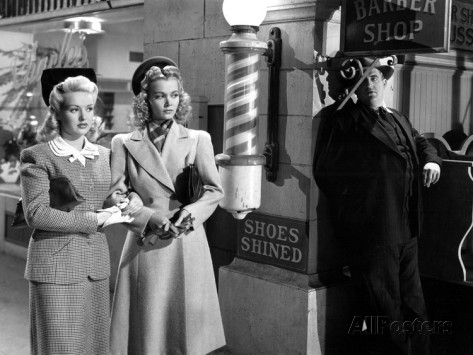
Betty Grable, Carol Landis and Laird Cregar in I WAKE UP SCREAMING
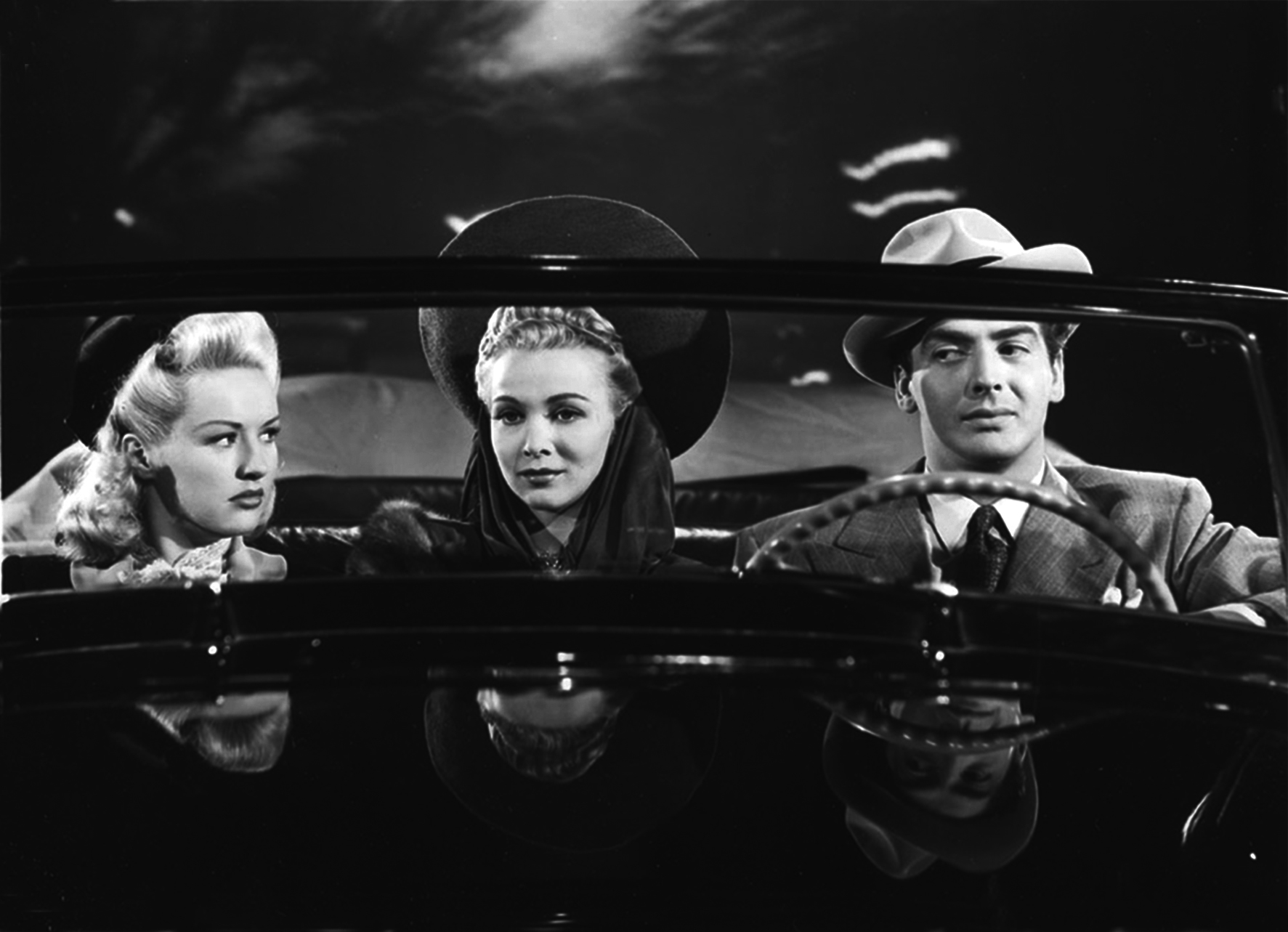
As a tribute to the Noir City festival of film noir in San Francisco, my DVD of the Week was just featured at Noir City. In I Wake Up Screaming, the promoter Frankie (Victor Mature) discovers the hardscrabble beauty Vicky (Carole Landis), and seeks to turn her into a star. She gets her Hollywood contract, but leaves Frankie behind with a pile of nightclub tabs and furrier bills. Vicky turns up murdered, and the cops, led by the menacing Cornwell (Laird Cregar) try to pin the crime on Frankie. Frankie and Vicky’s sister Jill (Betty Grable in a rare dramatic role) try to find the Real Killer. They discover that Frankie isn’t just a convenient suspect, he is being framed – and the stakes get higher as they race the cops to solve the crime.
As befits a noir, we see gritty diners, top end nightclubs, the police interrogation room and an all-night theater. When the light goes on in the den of a stalker, set up as a shrine to his victim, it’s a jaw-dropping moment. I Wake Up Screaming is on my list of Overlooked Noir.
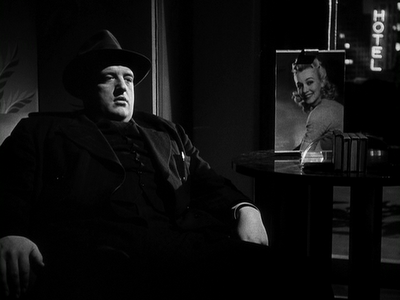
This is Laird Cregar’s movie. Cregar’s hulking and insolent Cornwell dominates every scene that he’s in, and several times he makes us literally jump. Cregar understood how to use his size and looks to intimidate. Cornwell is almost buoyant as he explains to Frankie how he intends to ruin Frankie’s life. But when Cornwell doesn’t know that he’s being watched, he drops his chin and lapses into an open-mouthed stare at Landis. This is a very early and groundbreaking portrayal of a stalker. There are early hints to his unhealthy obsession, but nothing prepares the audience for the revelation of just how unhealthy it turns out to be.
Cregar was an immense acting talent. A closeted gay man and overweight, he was uncomfortable in his own skin. Sadly, aspiring to become a leading man, he died suddenly from damage caused by a quackish, extreme diet. (At the time, no one could foresee Raymond Burr’s path – playing film noir heavies and later becoming a huge star on TV.)
Betty Grable, Carol Landis and Victor Mature in I WAKE UP SCREAMING
In her brief career, Carole Landis was usually cast based on her impressive, top-heavy figure. Here, she brings some nuance to the role of Vicky, for whom there is more going on than apparent. She’s far more than the Eliza Doolittle that Frankie thinks she is. It’s later revealed that she can get what she wants from a slew of men and that she can make a canny and ruthless business deal. She cheerfully cuts Frankie out of his Return On Investment with an “it’s just business” attitude. Landis was only 23 years old when she made I Wake Up Screaming. After four stormy marriages, she committed suicide at age 29 – right after boyfriend Rex Harrison refused to leave his wife for her.
The hunky Mature went on to spend an entire decade shirt-free in sword-and-sandal movies. Of course, Grable would soon become the favorite pin-up girl for the US military in WW II. The most unintentionally funny part of I Wake Up Screaming is when the two decide to top off a date with a late-night swim at a NYC indoor pool. It is easy to visualize the studio brass ordering the poor screenwriters to somehow get Grable and Mature into their swimsuits.
Before getting stuck in beefcake roles like Samson, Horemheb the Egyptian and Demetrius the Gladiator, Mature proved himself to be a pretty fair noir hero, especially in 1947’s Kiss of Death. He’s good here. So is Grable, without any singing or dancing (although she did have a song in a deleted scene on the DVD). Film noir favorite Elisha Cook, Jr. has a role that seems small but juicy, until it becomes pivotal.
Scholars place 1940’s Stranger on the Third Floor as the very first film noir. Released in 1941, I Wake Up Screaming is a very early noir, along with The Maltese Falcon, Johnny Eager, Suspicion, High Sierra and The Shanghai Gesture. Director H. Bruce Humberstone and cinematographer Edward Cronjager did not become giants of noir, or even notable noir artists, but their lighting was impressive. Cregar often lurks in the shadows, and when he doesn’t, we usually see his shadow, often dwarfing another character. Cregar also gets the horizontal shadows of Venetian blinds across his face. At least three times, characters turn on the light to find that another character has slipped into their apartment – yikes!
The exposition in I Wake Up Screaming is pretty muck by-the-numbers. The primary appeals of the film is the proto-noir style, the matter-of-fact sexiness of Landis, the easy-to-root-for pair of Grable and Mature, and the amazing performance of Laird Cregar. Incongruously, the song Somewhere Over the Rainbow keeps showing up in this dark and oft creepy movie. I don’t understand how or why, but it is an effective choice.
I Wake Up Screaming plays occasionally on Turner Classic Movies. The DVD is available with a Netflix subscription, or you can buy it from Amazon. I Wake Up Screaming was featured at the Noir City 2018.
A scene from THE FINAL YEAR, a Magnolia Pictures release. Photo courtesy of Magnolia Pictures.
In the documentary The Final Year, we get to peek inside the last year of the Obama foreign policy. Director Greg Barker’s cameras go behind the scenes to follow Secretary of State John Kerry, UN Ambassador Samantha Power and Deputy National Security Advisor Ben Rhodes as they travel the globe to keep the peace and mitigate conflict.
We see a lot of movies about the military and the intelligence services, so it’s a rare and welcome treat to watch diplomacy in action.
The Final Year primarily depicts and references the Obama Administration’s signature accomplishments – the Iran nuclear deal, avoiding catastrophe in North Korea, the Paris climate accords – along with the challenges of Syria.
We tend to see these folks as talking heads on television, so it’s humanizing to see them in candid moments. However, this is hardly a warts-and-all expose, and sometimes the tone even reaches reverent or fawning. Rhodes even gets the chance to evade responsibility for a basic political mistake – letting a reporter exploit his words.
It’s impossible to watch The Final Year in early 2018 without comparing these folks with the current administration. Whatever their imperfections, Kerry, Power and Rhodes are serious, competent people trying to implement a coherent foreign policy in our national interest and, in the process, earning the respect of other nations. The juxtaposition with the clown show of the current Administration is alarming and profoundly sad.
[SPOILER: In the final shot before the closing credits, the very-soon-to-be-former President Obama says, “Are we done here? Okay, see you later.” and turns down a White House corridor with his security detail for perhaps the last time. It’s heartbreakingly wistful.]
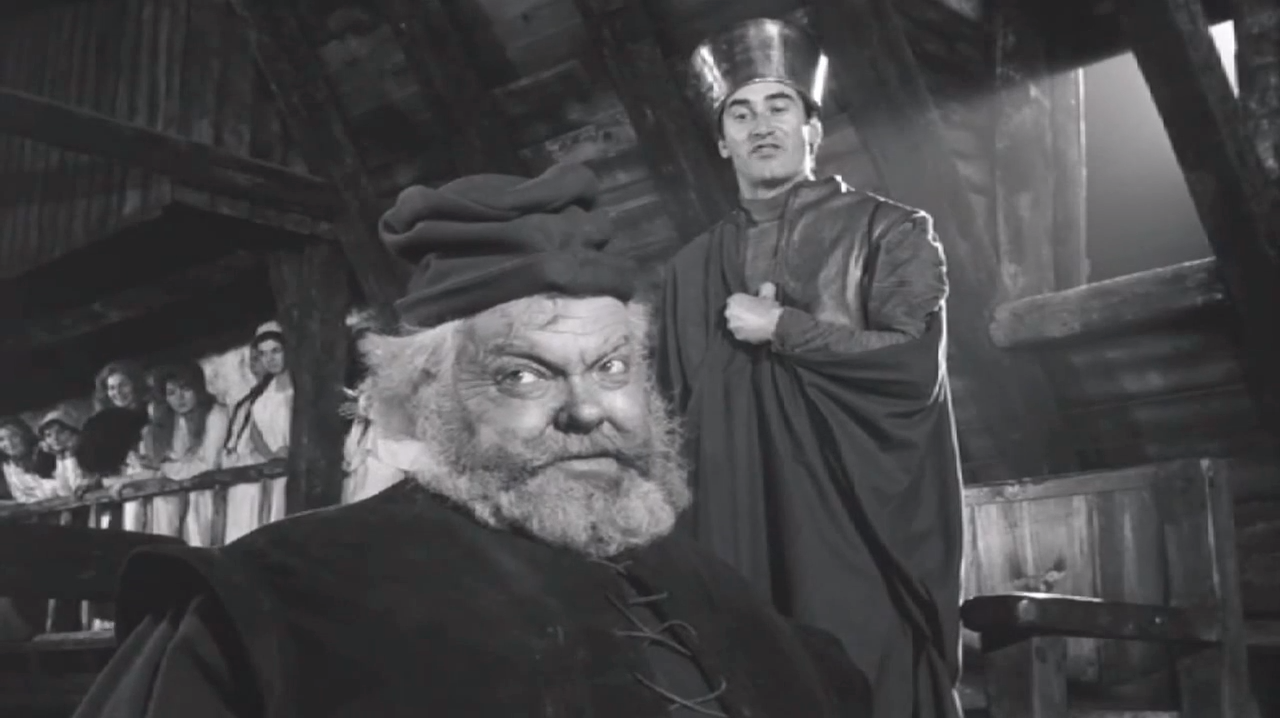
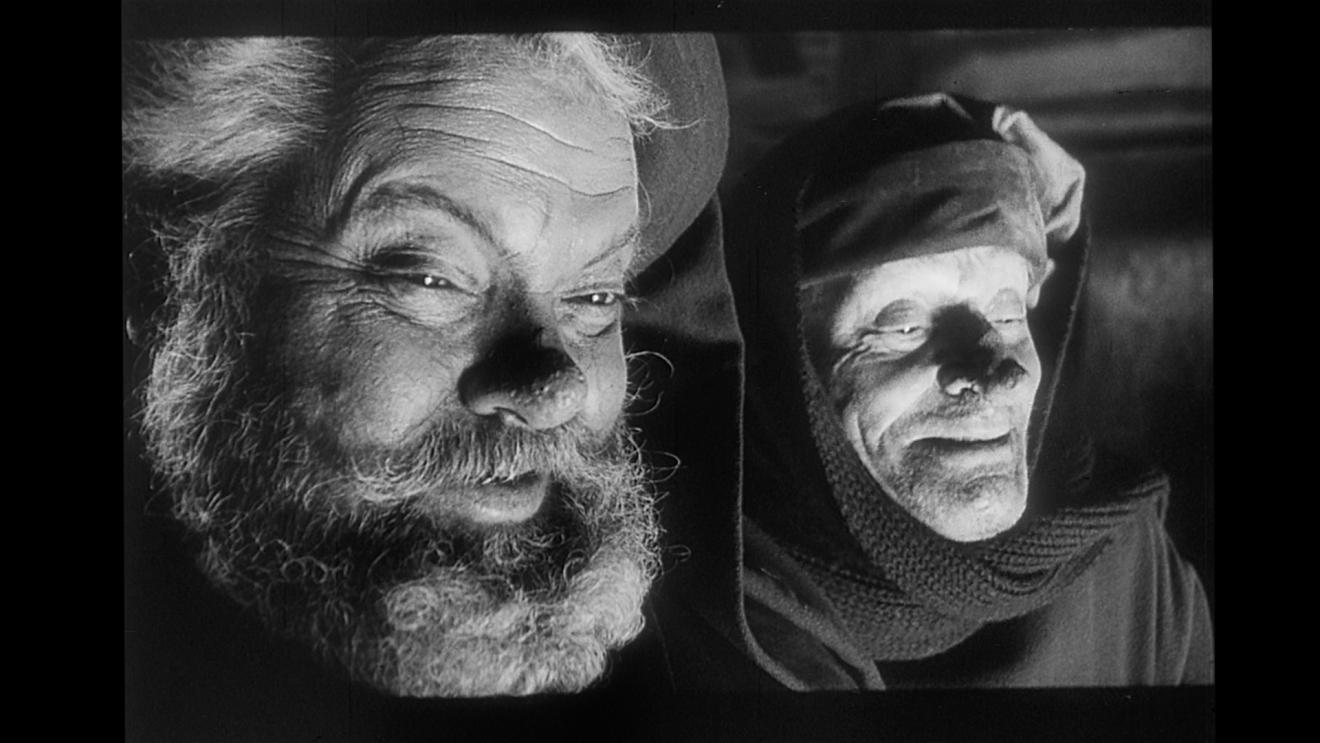
Orson Welles and Keith Baxter in CHIMES AT MIDNIGHT
The great auteur Orson Welles loved Shakespeare and made three Shakespearean movies, of which Chimes at Midnight is the masterpiece. Welles’ genius was in braiding together parts of Henry IV Parts 1 and 2, some Richard III, Henry V and The Merry Wives of Windsor into a cohesive story of what he called “betrayal of friendship”. You can watch Chimes at Midnight Wednesday on Turner Classic Movies.
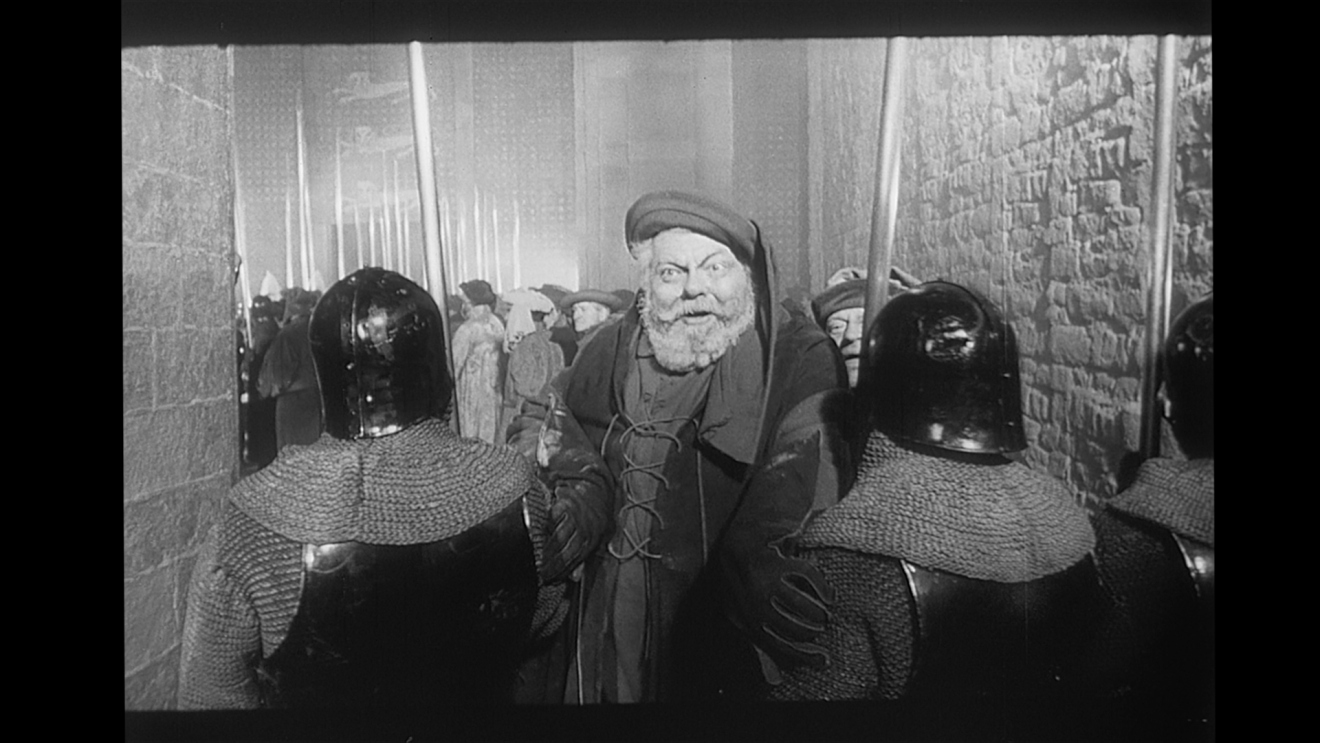
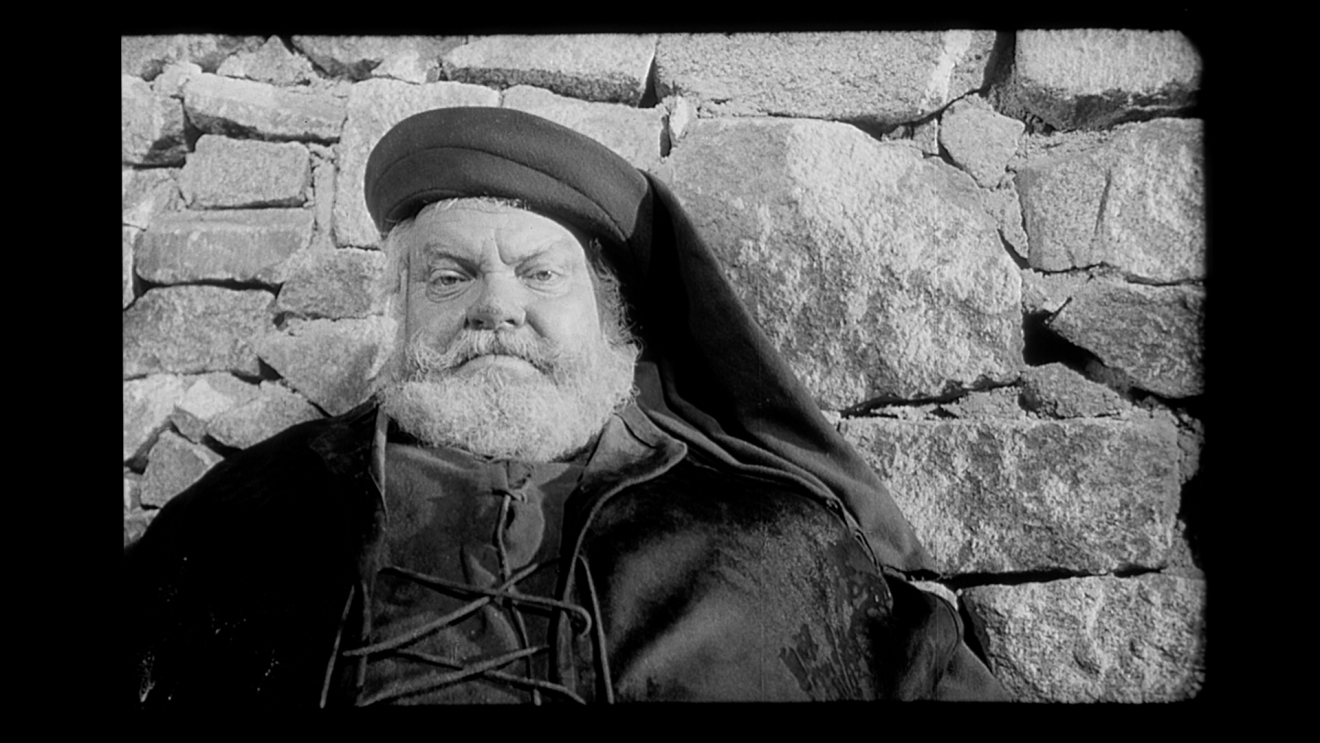
Welles himself vividly plays the recurring Shakespearean character of Sir John Falstaff.
Falstaff is a rogue knight, a shameless braggart and robustly debauched.
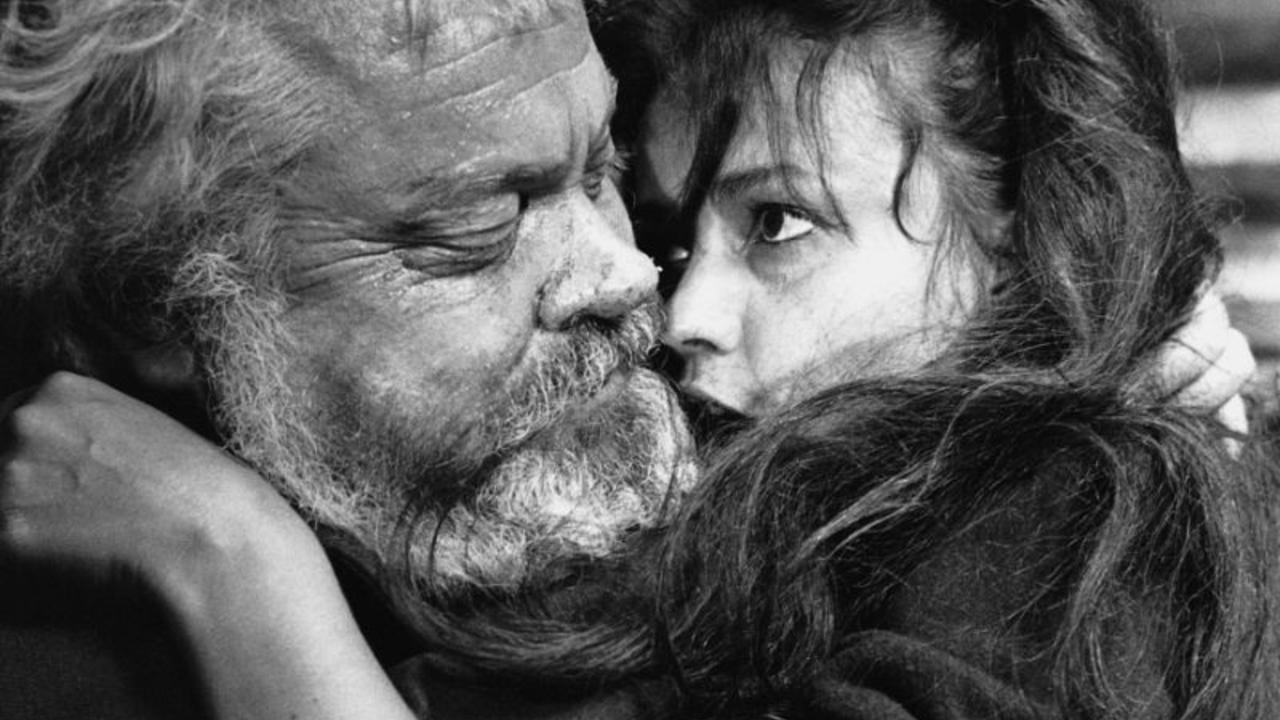
The young Prince Hal (Keith Baxter), the future King Henry V, is sowing his wild oats, and he is in the market for a dissolute companion. To the disgust of Hal’s severe father, King Henry IV (John Gielgud), Hal and Falstaff are carousing buddies, their fast friendship forged in taverns with plentiful spirits and women of easy virtue. (Falstaff’s wench is played by Jeanne Moreau.)
Orson Welles and Jeanne Moreau in CHIMES AT MIDNIGHT
There’s plenty of palace intrigue interwoven with the comic pranks and partying by the rascal Hal and his favorite scoundrel Falstaff. Falstaff even does mocking impressions of Henry IV.
CHIMES AT MIDNIGHT
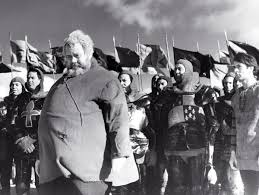
Chimes at Midnight features an amazing 12-minute battle scene beginning at the 55 minute mark. Somehow Welles was able to afford 150 extras and was able to use them and his camera to create a battle scene as effective as the ones in Braveheart and Kenneth Branagh’s Henry V. Welles doesn’t pull any punches in depicting the brutality of medieval warfare. The initial horse charge is followed by the chaos of hacking and clubbing. The combatants become a roiling cauldron of lethal mayhem. In all the fog of war, it’s still easy to follow Falstaff in his size XXXL armor. Welles’ Falstaff believes that honor is merely ornamental and not worth sacrificing one’s life for. No hero, Falstaff.
CHIMES AT MIDNIGHT
Finally, Henry IV dies and Prince Hal will ascend the throne. Falstaff thinks he’s won the lottery, but a king can’t afford sloppy bad habits. Hal rejects vanity, of which Falstaff is the signal emblem. Hal rebuffs Falstaff with Presume not that I am the thing I was and banishes him. Falstaff is stunned – but then proud of his mentee. Defeated in the end, Welles’ eyes show us his pride and simultaneous disappointment. This high point of Chimes at Midnight is also probably Welles’ best moment as an actor.
The broad, raucous comedy in Chimes at Midnight shows us what it must have like to see Shakespeare’s words performed in the rowdy Globe Theater. Shot in Spain with authentic medieval settings, Chimes at Midnight looks very good for a low, low-budget film. It is narrated by Ralph Richardson.
Chimes at Midnight was extremely hard to find until very recently, except for a bootleg on YouTube and a 2015 DVD released in the UK. It’s still not available to rent on DVD. Fortunately, Chimes at Midnight has become available to stream on Amazon, iTunes, Vudu, YouTube, Google Play and FilmStruck. And, of course, it plays occasionally on Turner Classic Movies where it will be featured on January 17.
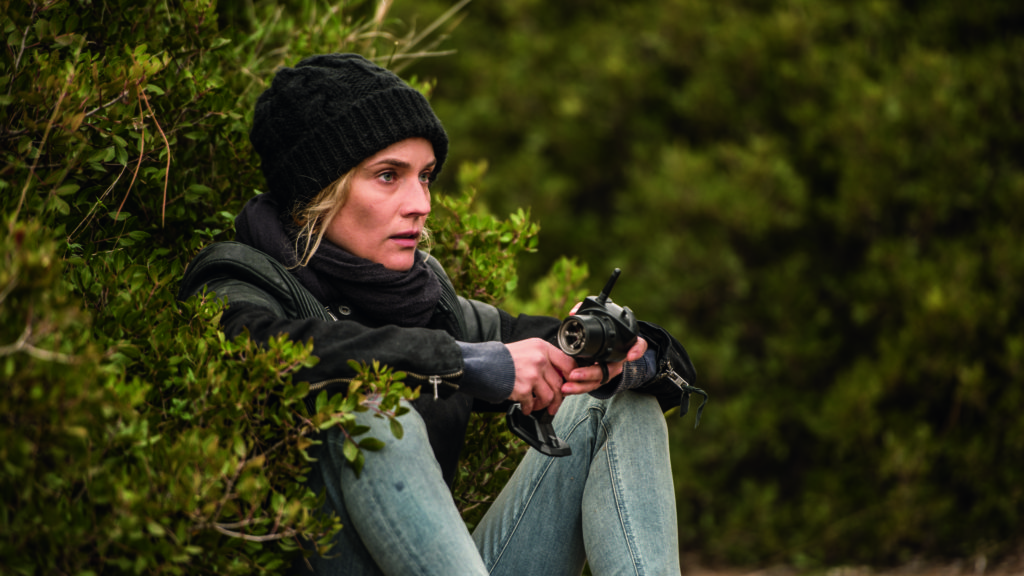
Diane Kruger in IN THE FADE, a Magnolia Pictures release. Photo courtesy of Magnolia Pictures.
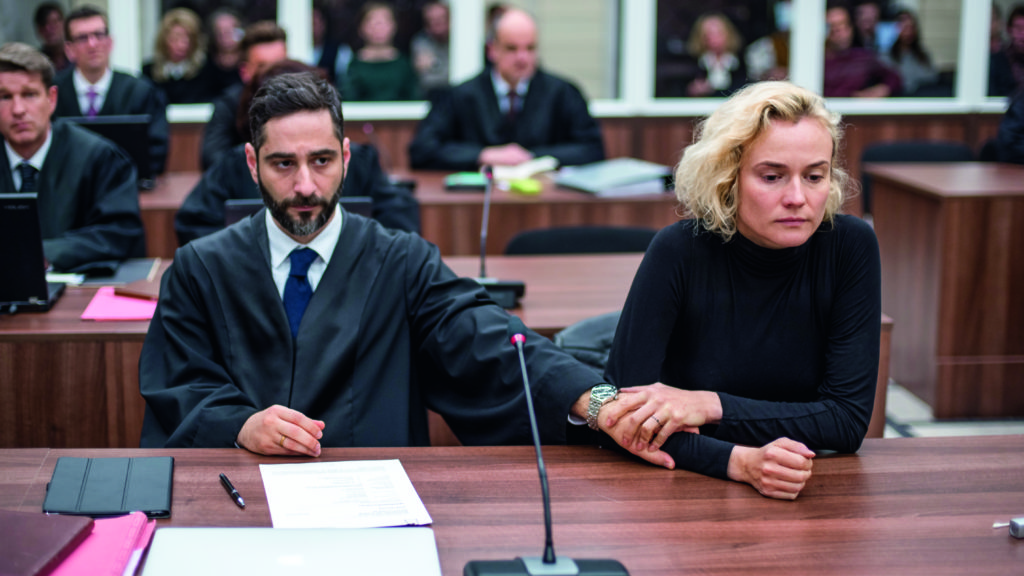
Diane Kruger gives a brilliant performance in the searing and emotionally devastating German thriller In the Fade. Kruger plays a German woman whose husband and child are murdered. Her life essentially disintegrates, as a whodunit carries on mostly beyond her. Katja is not exactly the German Betty Crocker. She’s tatted up and has married a Turkish Kurdish man who is a reformed drug dealer. But her grief is universal, and so is her impulse for revenge. Her husband’s attorney Danilo (Denis Moschitto) leads her on a quest for justice. But she must decide whether to take justice into her own hands. And how. And at what cost. The final scene in In the Fade is unforgettable.
German writer-director Fatih Akin, like Katja’s husband, is the son of Turkish immigrants. In In the Fade’s taut one hour, 46 minutes, he has crafted a pulsating page-turner. It can’t be easy to keep the pace of a movie from grinding down when the protagonist is plunging into a puddle of grief, but Akin pulls it off. The horror of the murder is not shown on-screen, but Akin funds a way to make it even more horrible than if we had watched it happen. Akin has made a successful thriller here, not a “message movie”, but he also effectively addresses the topical issues of immigration, racism and terrorism.
Diane Kruger in IN THE FADE, a Magnolia Pictures release. Photo courtesy of Magnolia Pictures.
Diane Kruger won Best Actress at last year’s Cannes film festival for this performance. She creates a fundamentally vibrant Katja, who must react to a horrific loss, and then to a series of indignities capped by brutal gut-punch from her mother-in-law. This is a profoundly authentic depiction of grief. When any chance for resolution is jerked away from Katja by a shocking injustice, Kruger takes Katja into steely resolve.
Kruger is an impressively versatile actress. She’s equally good as an American detective with Asberger’s in the absorbing American miniseries The Bridge and as a whim-driven queen in the French costume drama Farewell, My Queen.
Denis Moschitto and Diane Kruger in IN THE FADE, a Magnolia Pictures release. Photo courtesy of Magnolia Pictures.
In the Fadeis filled with excellent performances. Besides Moschitto, I’ll point out
Johannes Krisch as cinema’s most despicable defense attorney, loathsome down to the prefunctory danke with which he ends each argument.
Hening Peker as the earnest-to-a-fault police investigator, doing everything rationally and by the book, but not in a way comfortable for our sympathetic victim, Katja.
Ulrich Tukur as a character who has found serenity in doing the right thing, difficult as it may have been.
In the Fade won a Golden Globe for Best Foreign language Picture last Sunday and
opens this weekend in San Francisco.