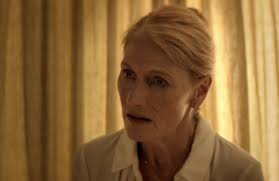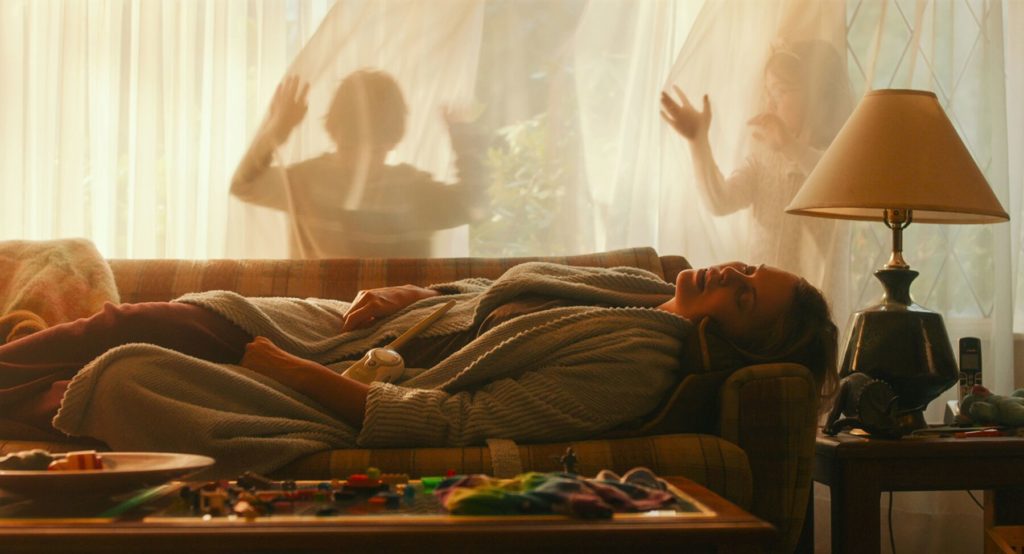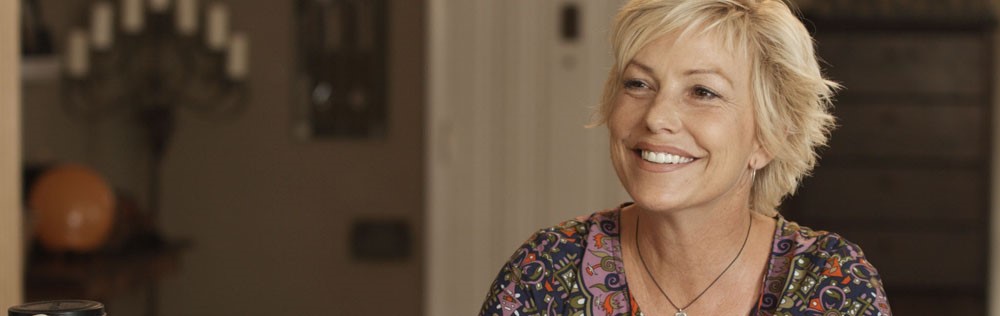
The talented actress Rusty Schwimmer plays Gabby, that rebellious oldest daughter whose bad choices have left her, at age 49, in a puddle of low self-esteem and underachievement. Having caught her loser boyfriend cheating, she’s now back living with her hypercritical mom and working out of the bedroom as a phone sex operator. She connects with an unusually empathetic and reflective customer, and decides to travel across the country to try to meet him.
Schwimmer does as much as possible with the material, and there’s a very appealing performance by Timothy Omundson as her favorite mystery caller. There’s also a moment at a taco truck, the funniest and only original moment in Wild Honey, when the Gabby and her sister (Stephnie Weir) two sisters slide into a gibberish language from their childhood. But there’s not much else we haven’t seen before in Wild Honey, a clunky, predictable and disappointing film.
Wild Honey premiered at the Austin Film Festival and plays Cinequest 2018.
The proto-feminist war movie Voevoda is set in the Bulgarian resistance against the Ottoman Empire. This epic tells the historical life of Roumena, a Bulgarian woman who led insurgent ambushes and nighttime kidnapping raids against the occupying Turks. In Eastern Europe, the word voevoda generally means warlord; in the 19th Century Bulgarian context it means leader of a guerilla band.
19th Century Bulgaria is not the first place we would expect to find a woman warrior, and that’s what’s singular about Voevoda. Motivated by Ottoman atrocities, she leads the local men into violent rebellion and most of them accept her leadership.
Bulgaria under Ottoman repression was a harsh time and place. This is the first time that I’ve seen the Turkish torture of being hung upside by the feet and having the entire village marched by to spit on your exposed buttocks. Roumena was one tough cookie, however, and that’s exemplified in one fairly alarming standing childbirth scene.
Writer-director Zornitsa Sophia is a seasoned director. She stars here as Roumena in her first screen acting credit, and is believable as the strong-willed and hardened leader. Sophia’s real 12-year-old daughter plays the young Roumena in flashbacks. Valen Yordanov turns in a fine performance as Stoyan, Roumena’s longtime lover and stalwart.
Voevoda is a well-crafted epic film and succeeds in creating the veneer of historical authenticity. Cinequest hosts Voevoda’s US premiere.
In the appealing Canadian transgender dramedy Venus, Sid (Debargo Sanyal) is at a personal crossroads. Single after things didn’t work out with his closeted boyfriend Daniel (Pierre-Yves Cardinal), Sid has just begun to dress like a woman in public and to take hormones for his transition. Then, he is shocked to learn that he has a 14-year-old son Ralph (Jamie Myers). The boy thinks that having a transgender dad with Indian heritage is very cool and, unbeknownst to his mom, starts spending more and more time with Sid. Sid has to deal with this, along with the reactions of his more traditional Indian parents and a chance meeting with Daniel.
In her first narrative feature, writer-director Eisha Marjara has crafted a funny, touching and genuine story. Venus is successful largely because of Debargo Sanyal’s performance. Eschewing flamboyance, Sanyal’s Sid is a man driven to keep his dignity in the most inescapably awkward situations. It helps that Sanyal is a master of the comic take; Sid’s reactions to his mother’s and Ralph’s intrusiveness are very funny.
Cinequest hosts the US premiere of Venus, and I expect it to become one of the most popular indies at the festival.
Luke Shirock in TOMMY BATTLES THE SILVER SEA DRAGON
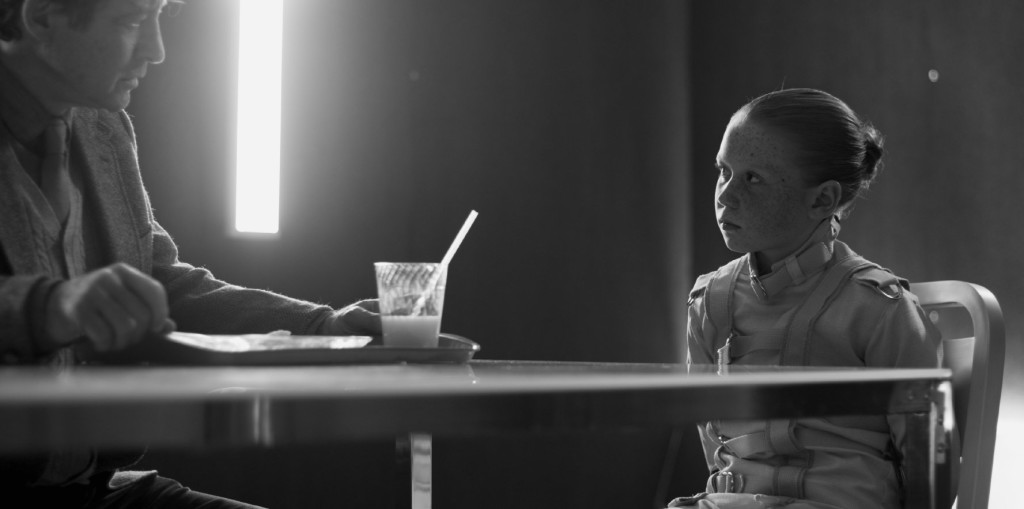
Tommy Battles the Silver Sea Dragon has to be the bravest and most artistically ambitious movie premiering at Cinequest. In his debut feature as director, writer, composer and star Luke Shirock has imagined a guy put on trial by his own subconscious. Tommy (Shirock) has feeling of unresolved guilt about his mother’s death that have troubled his life and impacted the relationship with his girlfriend Carolyn (Celine Held).
The trial is a nightmare, surreal and Kafkaesque. We see Tommy’s life in flashbacks, and learn just how accurate his own view of his life may or may not be.
And here’s what makes Tommy Battles the Silver Sea Dragon so singular. It’s a musical – all set to Shirock-composed music. This could have been titled Inner Torment: The Musical.
Held is very good as Carolyn, and David Andrew MacDonald is compelling as The Prosecutor.
Reportedly, Tommy Battles the Silver Sea Dragon was made on a $500,000 budget, which is difficult to imagine given the rich look of the film and some of the special effects and the shots on the water. Certainly, Luke Shirock is an artist swinging for the fences. Cinequest hosts the world premiere of Tommy Battles the Silver Sea Dragon. Here’s a link to the trailer.
Isabelle Chester and Sam Sonenshine in THREESOMETHING
In the cheeky and original comedy Threesomething, Charlie (Sam Sonenshine) and his buddy Isaac (James Morosini) invite Charlies’ friend Zoe (Isabelle Chester) to engage in a three-way sexual encounter. That pitch alone is one of the funniest three-minute, fifteen-second, openings to a film I’ve seen in years. But then Threesomething finds the ridiculous moments in both the sex itself and in the all-consuming passion of new infatuation. After a crisp 72 minutes, Threesomething‘s ending is very fresh and non-formulaic, posing just enough ambiguity about the characters’ futures.
Co-writers Morosini and Sonenshine have identified the comic possibilities within the notion that a threesome is more or less symmetrical. Let me explain it this way. What if your idea of a threesome is three participants, but it evolves into two participants and a spectator?
Lust and love are such ripe sources of comedy because we humans are most ridiculous when we are the most absorbed and single-minded – and that is definitively the case while having sex. And everyone’s sexual fantasies and fetishes – even if shared with one’s sexual partner – are laughable or creepy to someone else. Threesomething reaps the laughs from these situations without being sit-commy.
This is the Are you good? generation. Threesomething’s commentary on the compulsive over-checking in and over-supportiveness is all very sharply witty. And over-sharing is the core of Charlie’s relationship with his mother (Dru Mouser, who steals all of her scenes).
Sonenshine is just about perfect in his reactions during the threesome. He is fantastically gifted at playing both awkward discomfort and contained frustration.
Chester’s performance has several highlights, beginning with Zoe’s takes on the initial proposition and a particularly ill-timed outburst of weeping (inspired). As the story concludes, watch Chester’s face as Zoe considers and reconsiders how comfortable she really is in her choice of partner(s).
Threesomething is Morosini’s directorial debut and the first feature screenplay for both Morodini and Sonenshine. Comedy is hard to write, especially comedy as smart and original as this. Cinequest will host Threesomething’s world premiere.
What does it really mean to be a “fearless” or “uncompromising” artist? That’s the question explored by the documentary Mr. Fish: Cartooning from the Deep End. Mr. Fish is an extremely talented political cartoonist, filled with rage against social injustice. A gentle soul in person, especially with his delightful daughters, Mr. Fish’s profound anger is expressed in his brilliant work.
a Mr Fish cartoon in MR FISH: CARTOONING FROM THE DEEP END
Mr. Fish’s art is always intentionally provocative. And oft hilarious. And sometimes pornographic. And even heartbreaking, with two characters gazing at a portrait of John Lennon:
Uh oh- I think we’re fucked
Why?
Because give peace a chance seems nostalgic.
One would think that anyone as talented as Mr. Fish could afford to economically survive, if not to flourish, in modern America. But three things are holding Mr. Fish back from financial success. One is the declining market for newspaper-purchased cartoons as newspapers themselves melt out of existence. The second is that Mr. Fish’s principles don’t allow him to fine-tune his art to be more accessible to a commercial audience. Finally, Mr. Fish is oblivious to any opportunities to make money created through new media. He does toy with a television pilot and gets a part-time day job in commercial art, but he really isn’t comfortable with the word “paycheck”.
Asked about not having an audience, Mr. Fish calls it “heroic”. His wife brings home the bacon. She is totally in tune with his art (although she could do with fewer erect penises in it). But, weary of shouldering all the financial responsibility, she observes that not making money is all fine and good as long as you don’t expect to spend any.
The consequences of being admired by peers for living his principles but being not able to pay the family’s bills have been explored in Trumbo, among other recent narrative films. This is the real deal.
a Mr Fish cartoon in MR FISH: CARTOONING FROM THE DEEP END
Mr. Fish: Cartooning from the Deep End is the first feature for director Pablo Bryant, a veteran documentary cinematographer. Bryant knows a genius when he sees one and fills the film with Mr. Fish’s art; the effect is intoxicating. Stick around to the very end of the closing credits or you’ll miss some of Mr. Fish’s best.
In the Spanish dramedy Marisa in the Woods, Marisa (Patricia Jordá) is at a personal and career crossroads. She’s burnt out from her job with a touring theater troupe and takes a needed break. Unfortunately, she doesn’t get any support from her network of friends and colleagues, all of whom are needier than she is. Her bestie is literally hysterical, over-dramatizing everything in her life until it leads to a tragedy. Finally, Marisa finds some empathy after reconnecting with a teacher from her past, who has changed gender.
Marisa in the Woods is an acid commentary on first-world problems and the complaints of the self-absorbed. As Marisa bounces from one dissatisfied friend to another, we are treated to a tour of Madrid locations, all the way to the magical realism at the ending.
This is a very witty film, obviously influenced by early Pedro Almodóvar (not a bad thing), but without Almodóvar’s frenetic energy. Marisa in the Woods is the first feature for writer-director Antonio Morales. Its US premiere will be at Cinequest.
Exploring the challenges of co-parenting with an addict, the realistic Canadian drama Luba is topped off with a ticking time bomb finish. Luba (Nicole Maroon) is a struggling single mom whose estranged husband Donnie (Vladimir Jon Cubrt of Hannibal and Designated Survivor) is a crackhead. Donnie really loves his son, and Luba tries to let her son create some memories with his dad.
Unfortunately, Donnie is helpless to his addiction At his best, he is manipulative, sponging Luba’s last few discretionary dollars. At his worst, he is dangerously irresponsible. Then Donnie decompensates and goes lethally out of control.
In a futile attempt to make ends meet, Luba lives a hamster wheel experience, bouncing between multiple crappy waitress jobs and childcare that she can’t afford. Her only emotional and babysitting support comes from other busy moms and from Donnie’s sympathetic mother. Co-star Vladimir Jon Cubrt wrote Luba and completely captures the essence of Luba’s life – she’s trapped without any moment of relief or enrichment for herself.
Luba doesn’t have unrealistic expectations. She just wants to pay the rent on time, have some adult male companionship, and, being Canadian, play an occasional pickup game of ice hockey. Cubrt’s screenplay vividly brings alive another fundamental truth – the grinding impact of living with an addict’s roller coaster of self-sabotage. Luba’s attempts at moments of normality keep getting hijacked by Donnie’s selfishness. Repeatedly, respite suddenly turns into panic. This is Cubrt’s first screenplay, but he has written three original stage productions for the theater company he founded in Toronto.
Luba is the first feature for director Caley Wilson. This an authentic and relatable drama with an ending that works as a thriller. Cinequest hosts Luba’s world premiere.
Lawrence Kao and Lauren K. Montgomery in I HATE YOU
In the indie romantic comedy I Hate You, two very different twenty-somethings meet cute. Kelly (Lauren K. Montgomery) has plunged from one relationship to another and is particularly angry that the terms of her lease force her to stay in an apartment with her ex and his horny new girlfriend. Chi (Lawrence Kao) is an obsessive gamer who still lives with his mom.
Chi is not Kelly’s type but, then again, her type is a jerk. He is, however, way less experienced than she is. You’ve probably already guessed that they will get together, so that’s not really a spoiler. But she’s a workaholic, and when she’s off her laptop, she wants to analyze their relationship. Chi just wants a domestic life without much drama.
While following the usual arc of a romantic comedy, I Hate You mostly avoids dipping into rom-com clichés, and the ending is not predictable. I Hate You was written by Brad Kageno and Pyung Kim and is Kageno’s debut as a feature director.
This is an amiable and entertaining film. Cinequest hosts the US premiere of I Hate You.
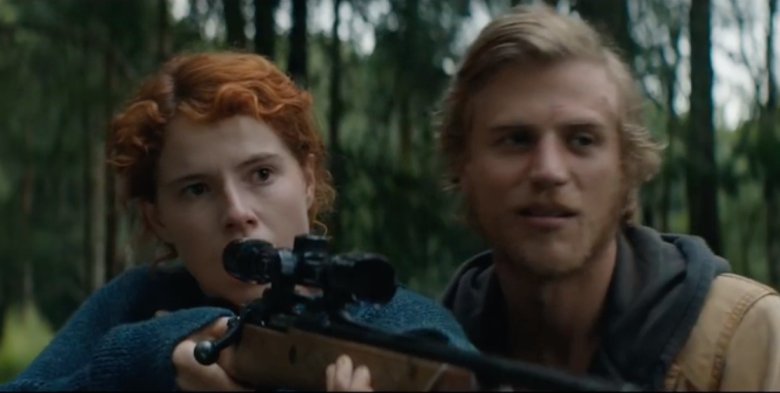
In the slow burn thriller Hunting Lands, Frank (Marshall Cook) is living a solitary life as a subsistence hunter in a forest cabin, a long pickup drive outside his northern Michigan hometown. Frank is a guy with serious wilderness skills, loading his own ammo and field dressing the large mammals that he fells with a single shot. He witnesses a serious crime in the woods and is immediately driven to make things right – but not in the way we expect.
Frank has nobody to talk to, and we see him silently triage the situation and begin a hunt for the perpetrator. Silent observation comes naturally to a hunter, and we see him wordlessly patrolling the small towns in his pickup, as he tracks down his human prey. We see what Frank sees, and one of the most pivotal characters is only seen in long shot until the last 15 minutes or so.
HUNTING LANDSHUNTING LANDS
Hunting Lands is the first feature from writer-director Zack Wilcox, a story-teller who is thankfully willing to let the audience connect the dots. Because Hunting Lands is only 83 minutes long, Wilcox can take his time watching Frank watch others. Even as Frank is still and quiet, the audience is gripped by what he is going to do next.
An original character, Frank seems unusually self-aware for a hermit. When he finally gets in a conversation, he turns out to be an articulate guy who understands and can explain why he has become a recluse.
Wilcox follows Billie Wilder’s screenwriting advice – “don’t hang around”; the ending is not even one second too long. And Wilcox knows that a little ambiguity about what happens afterwards can pack a punch.
Cinequest will host the word premiere of Hunting Lands.