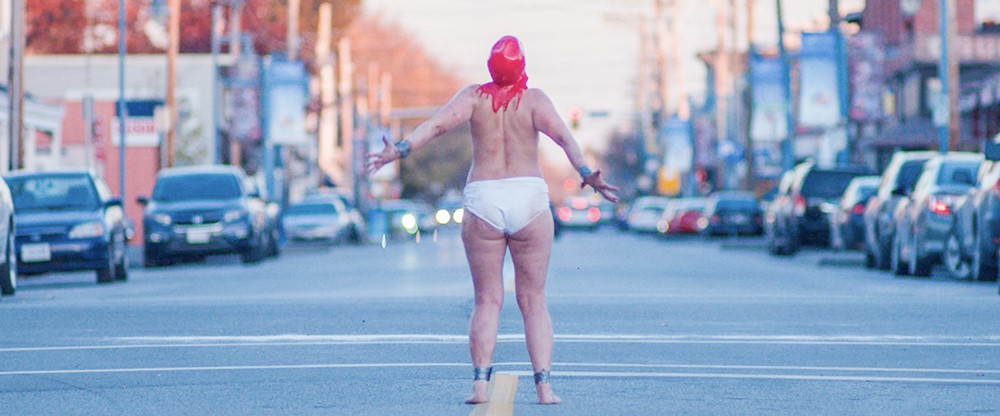
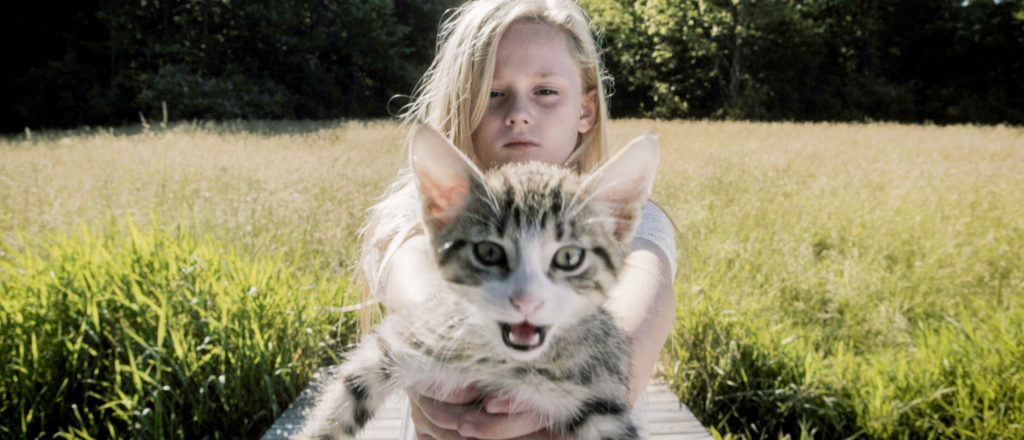
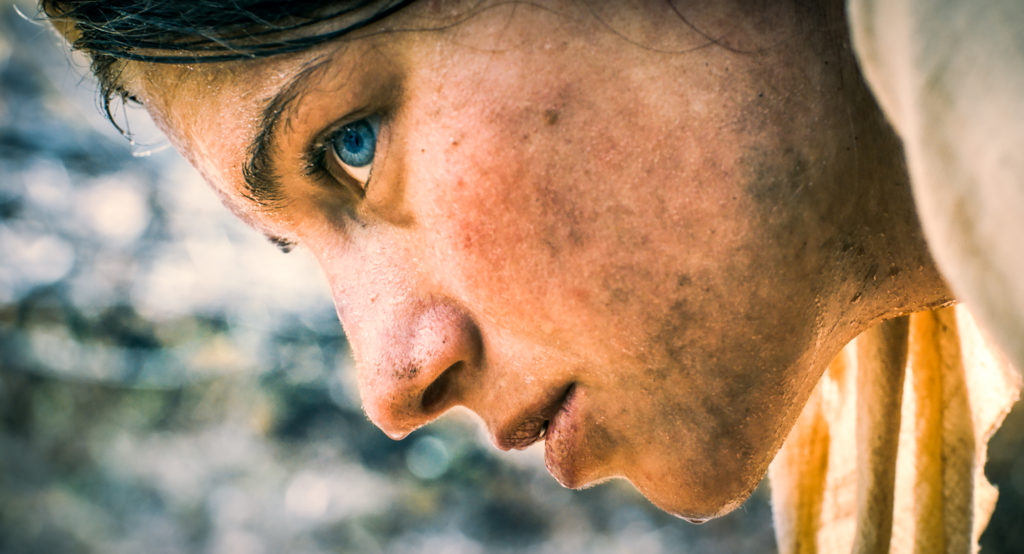
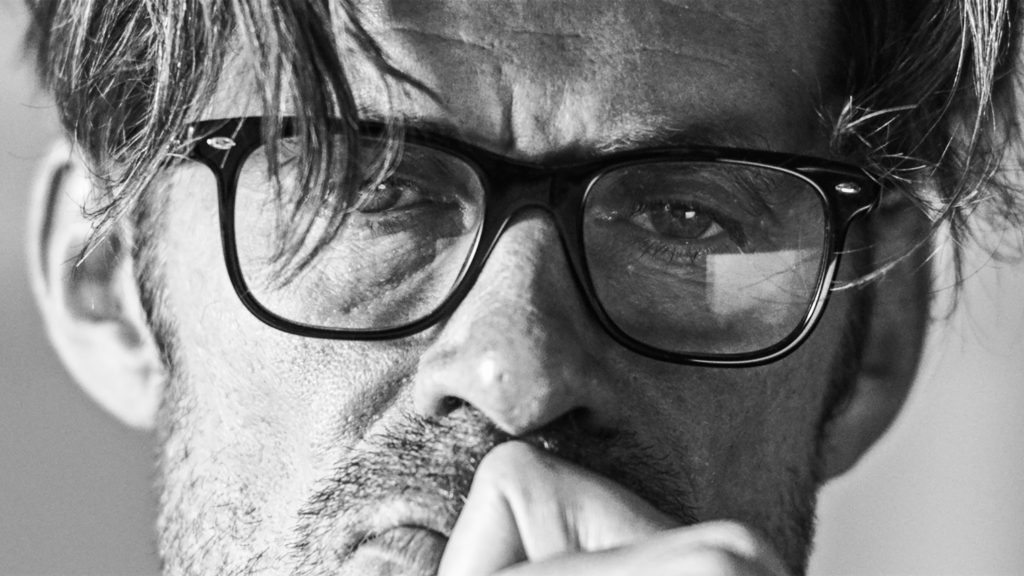
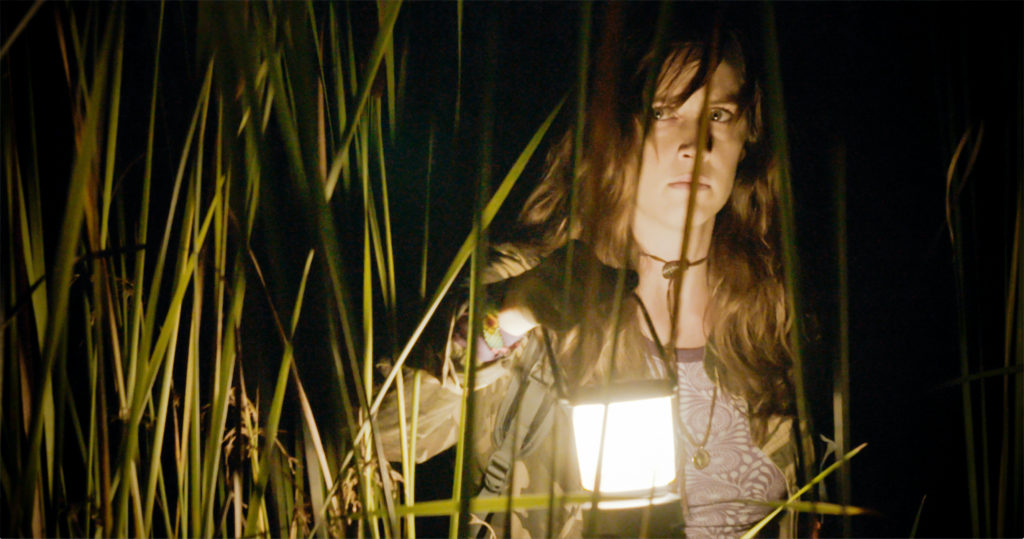
This is a two-second shot in THUNDERBIRD which has nothing much to do with the plot. Photo courtesy of Cinequest.
In the unremarkable Canadian mystery Thunderbird, a city detective visits a backwoods hamlet to unspool a mystery involving damaged young adults from a local tragic family. Thunderbird has the feel of a typical TV whodunit procedural with a trippy supernatural angle slapped on.
If you’ve ever watched a TV or movie drama, you will have already heard every line of dialogue in Thunderbird.
There’s also an insufferable dose of noble indigenous spiritualism.
I thought I was watching an especially insipid ending, but then was surprised with the real ending, even more insipid.
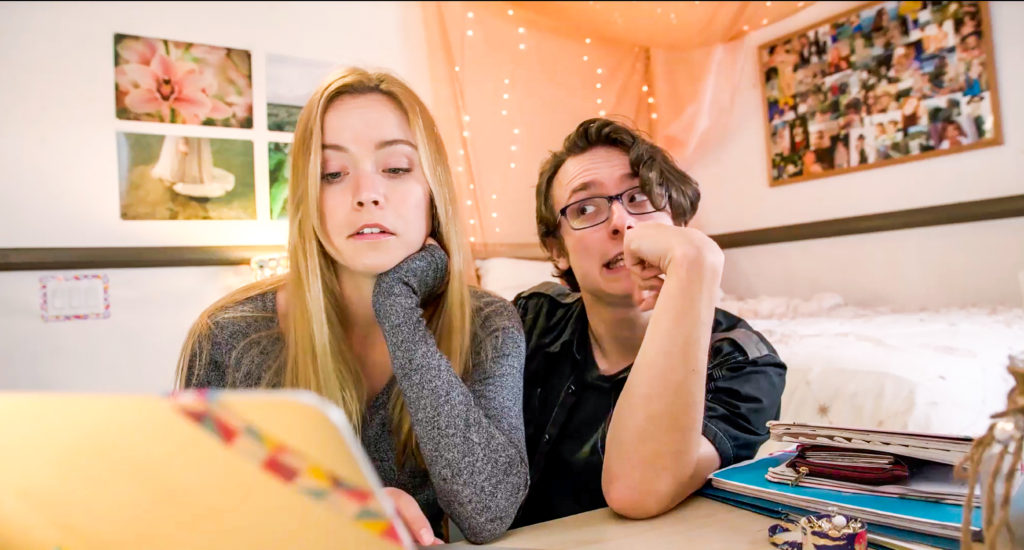
TWELVE DAYS OF CHRISTMAS. Photo courtesy of Cinequest.
In the comedy Twelve Days of Christmas, high school friends reunite when they’re home for their first college Christmas break. They all get down to some serious partying, but two of them must deal with a serious issue.
These characters act like they are refugees from some mythical colleges that are devoid of booze and drugs. The partying is so purposeful, it brought to my mind the Joe Ely song Everybody Got Hammered. The one blow-out party is very impressive, especially compared to my own first-college-break experience: Round Table pizza, cans of beers and a bottle of rum.
The core of the story is the angst of unrequited love; one character has obviously been in love with his best friend, who hasn’t noticed his yearning for her. And that’s the weakness of Twelve Days of Christmas. Although this guy is fun, witty, loyal and dependable, she knows that he is kinda weak-willed, so it’s evident that she could never see him has a partner.
Most of the cast is very good, although I never got away from being distracted by all the actors seeming at least 4-5 years older than the 19-year-old characters.
Director Michael Boyle and editor Carter Feuerhelm have enough faith in their audience and skill to drop in some split-second gags, all the more effective without lingering on them.
Cinequest hosted the world premiere of Twelve Days of Christmas.
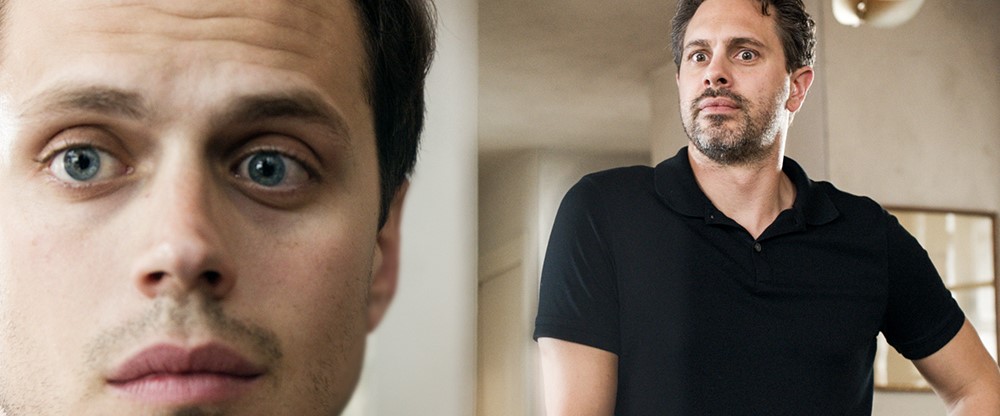
Jake Robinson and Thomas Sadoski in THE MIMIC. Photo courtesy of Cinequest.
In the offbeat and cerebral comedy The Mimic, a widowed screenwriter (Thomas Sadoski) becomes obsessed with his own sociopathic character – and the a person JUST LIKE the character (Jake Robinson) materializes in his life. The two embark on a surreal battle of wits.
Is the new acquaintance a real person, or is he the character in the screenplay? Is the sociopathic character miming the writer? Or is the writer exploring his own sociopathy?
The Mimic is an intellectual exercise, with more knowing chuckles than knee-slappers. Ultimately, it is more clever than it is engaging or entertaining.
The Mimic is basically a two-hander, but it’s rich in cameos. There’s a priceless turn by Gina Gershon as a cougar bar fly. M. Emmet Walsh, Marilu Henner and Jessica Walter show up, too, along with the always-welcome Austin Pendleton (whom I’ve enjoyed since his Francis Larabee in What’s Up, Doc?).
Audrey Grace Marshall in Niav Conty’s SMALL TIME, premiering at Cinequest. Photo courtesy of Cinequest.
Filmmaker Niav Cinty explores rural America’s opioid crisis through its impact on one little girl in Small Time. Emma (Audrey Grace Marshall) is growing up among damaged and ill-prepared adults who are modeling the worst possible lessons about drug use, parental responsiblity, handling firearms, choice of language and taking things that belong to someone else. This is an opioid-ravaged world in which the one character who actually saves two lives is the local abusive drug dealer. Emma sees things that no child should see.
Emma is spirited, smart and has a child’s pureness of heart. Amidst the adult chaos, she’s baking cookies and thinking about the tooth fairy. But we have to ask, what is the shelf life of innocence? When will her environment take its toll?
Nobody is comfortable watching a child in bad situations, so why isn’t Small Time unwatchable? Writer-director Conty has mastered the tone by making Emma such a spirited, hopefully indomitable protagonist. And Conty embeds just enough humor in scenes with the local lunkheads playing the board game Risk and Emma turning the doctrinal tables on a priest, forcing him to resort to bluster.
The child actress Audrey Grace Marshall is very good. Conty shot Small Time over three years as Audrey ranged from seven to ten. Small Time was filmed on location in north central Pennsylvania.
Willow is a triptych by Oscar-nominated master Macedonian filmmaker Milcho Manchevski that plumbs the heartaches and joys of having children. Willow contains the stories of three mothers and the heartache of childlessness, the heartbreak of losing a child and the emotional roller coaster of parenting. In Willow, a mother’s love can bring devastating grief and triumphant joy.
There’s a scene in the final vignette with a mother and son in a car that is one of the most amazing scenes I’ve ever seen.
There’s also a woman who is drawn to a man when she watches him act with profound decency – even though he doesn’t know anyone else is watching him. That launches a deeply beautiful love story.
Just about every parent has had a child vanish at the turn of one’s head, and plunges into panic, desperation and terror until the child is found. There is more than one of these scenes in Willow, and they are uncomfortable.
As a World Cinema bonus, we are introduced to the Macedonian phrase, “wash the bananas”.
Manchevski’s Before the Rain was nominated for the Best Foreign Language Oscar in 1994. Most recently, he directed my choice as the best film of the 2017 Cinequest, Bikini Moon.
Cinequest hosts the North American premiere of Willow.
In the Finnish dark comedy Void, a noted author is struggling in his fifth year of a writer’s block. For better or worse, his wife’s career as a film actress is blooming. As he crumbles under deadline pressure and self-loathing despair, it’s less and less likely that he will hold on to his wife. To reset himself, he tries a sailing adventure and then a visit to a remote hunting cabin to visit a much less-talented author. There, a very unusual circumstance may relaunch his career…and it’s the very opposite of creativity.
Void is filled with the dryest Scandinavian humor. The artistic malaise in Void covers the territory of 8 1/2 and The Shining, but not as compellingly. Void does deliver an inventive lifesaver for the writer to grasp, along with an arch Finnish observation of Hollywood.
Void is mostly photographed in black-and-white. There are four cinematographers credited, and the black-and-white cinematography is stunning.
Cinequest hosts the North American Premiere of Void.
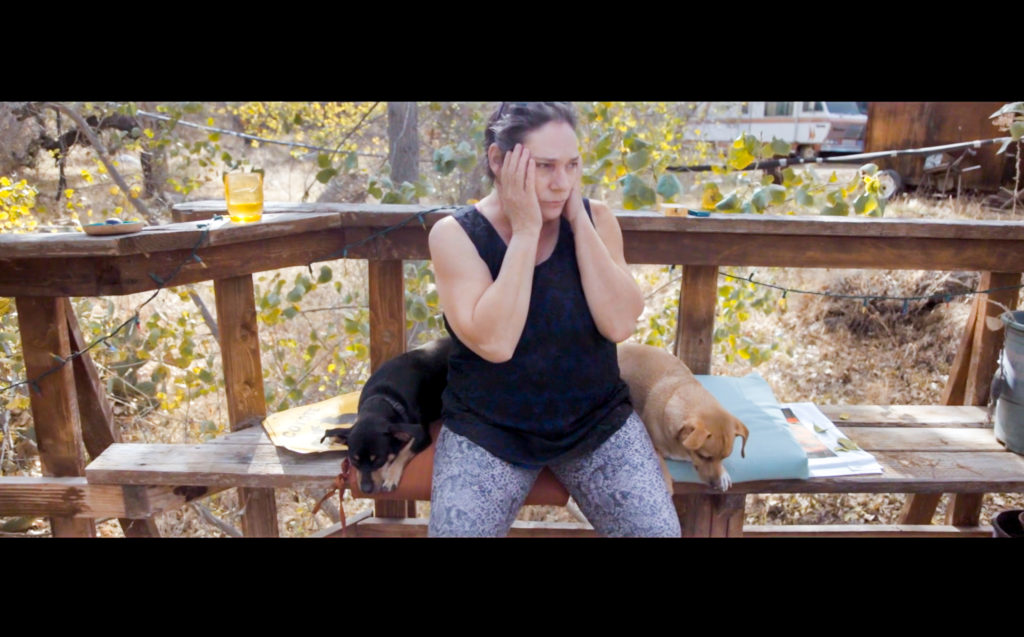
Kate Woods in THE QUICKSILVER CHRONICLES. Photo courtesy of Cinequest.
The documentary The Quicksilver Chronicles introduces us to the 60ish brother and sister Kemp and Kate Woods, who live a bohemian existence in a ghost town that they have to themselves. In other times, Kemp and Kate might have been labeled eccentrics or Free Thinkers.
Kate is raucously voluble. She is never without a cigarette, espouses her love of Mexican ballads and has an opinion on everything. Her friend, photographer Tom Chargin, has been taking pictures of Kate for decades.
Most of Kemp and Kate’s lives seem to involve dogs and cigarettes. The Quicksilver Chronicles is only 75 minutes long, which gives the filmmakers the freedom to pace the film slowly – that allows us to settle in and let these characters and their lifestyle wash over us. Just when you think we’re just watching these two putter around in the boonies, a major life event DOES happen.
They are living in Idria, California, population 2. This is the site of the long-defunct New Idria Mine, once America’s second biggest mercury mine (after San Jose’s New Almaden Quicksilver mine), In the California Gold Rush, mercury was used to extract gold from ore. There’s a mountainful of naturally occurring mercury at Idria, and the disturbances from the mining have made this a Superfund site.
As the crow flies, Idria is remarkably close to Silicon Valley. But, to get there, you first have to drive the 45 minutes to Hollister and then ANOTHER 2 hours past the tiny crossroads of Paicines, Panoche and Mercey Hot Spings.
Documentarians Ben Guez and Aleksandra Kulak shot The Quicksilver Chronicles over four years of visits to New Idria.
Cinequest hosts the US premiere of The Quicksilver Chronicles, my favorite documentary at this year’s festival.
The documentaryTheremin Magicexplores that most weirdly unworldly of musical instruments, the Theremin. Documentarian Cressandra Thibodeaux took advantage of a global Theremin festival (who knew?) to film the world’s top five Theremin players.
The five are a diverse lot, and their mastery of the instrument is astonishing. Because the instrument is played by waving one’s fingers in the air next to it, the performances are visually somewhere between conducting an orchestra and dancing ballet. At the very end there’s a scene with an entire classroom full of Theremin players.
If you are interested in music and haven’t dived deeply into the Theremin, this is all interesting. Cinequest hosts the world premiere of Theremin Magic.
Megan Hensley in Charlie Griak’s NINA OF THE WOODS, premiering at Cinequest. Photo courtesy of Cinequest.
The supernatural thriller Nina of the Woods follows a cynical reality TV crew into a forest; the struggling actress Nina (Megan Hensley) has signed on to the gig, and the shoot happens to take place where Nina grew up. This is one of those lurid shows about the supposed supernatural – sensationalizing phenomena from aliens to Sasquatch; these guys are used to creating the ILLUSION of the supernatural, not FINDING the supernatural. Everyone gets a surprise.
The show’s on-screen host Jeremy (Daniel Bielinski) is the biggest asshole, but this is mostly a jaded bunch. As the crew sneers at the working class locals, they get some truth from Eric the camera guy (Ricardo Vázquez),
These are the people who actually watch your show. Average people. This is who you do it for…. “Reality”. This is reality. Not what we do. No one would want to watch the real thing anyway. It’s too much and too boring all at the same time. Who would care?
A local backwoods guide (Shawn Patrick Boyd) is hired; he is a very serious guy who respects the menace of this particular forest. Nina, having been raised by a father with a spiritual sense of the forest, can also sense something off kilter.
Now something happens that is unexplainable on the time/space matrix. Weird shit happens, and the party happens upon more than they bargained for.
Director and co-writer Charlie Griak unsettles us without employing gore or monsters. Nothing is as unsettling as when our reality is challenged.
In 2015, Cinequest hosted the world premiere of Griak’s debut feature (The Center), a remarkably good drama about recruitment for a Scientology-like cult. Hensley played Annika in The Center.
Griak inserts file footage of old Northwest lumberjacks at work with some very cool Foley.
Cinequest hosts the world premiere of Nina of the Woods.
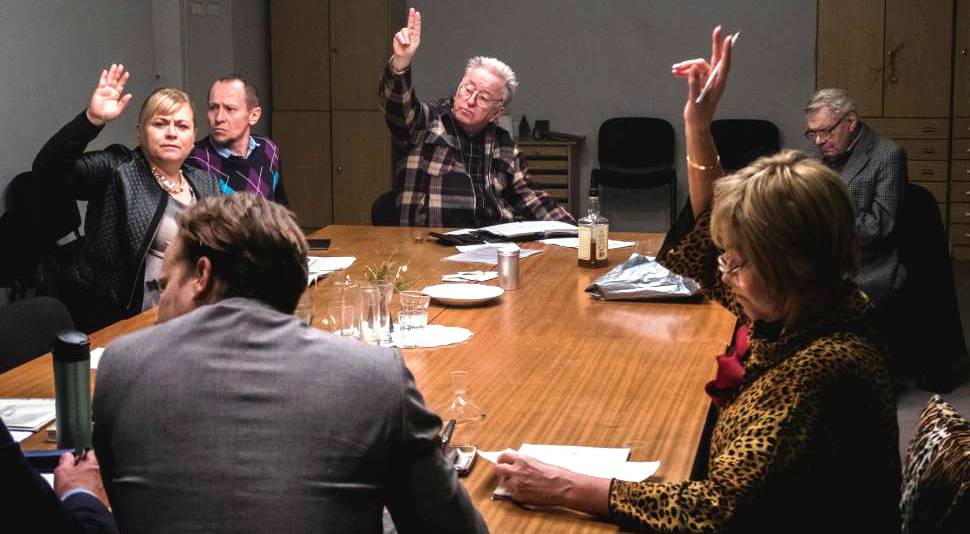
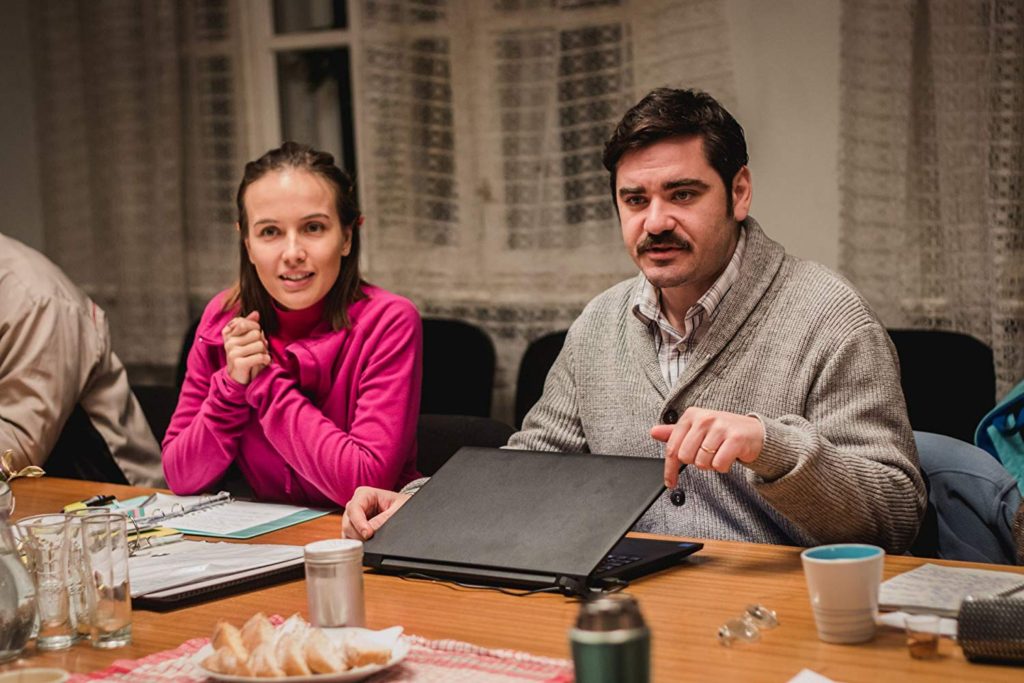
The very dark Czech comedy Owners sharply observes the foibles of the human personality. It’s the regular business meeting of the apartment owners association – but their deliberations about building improvements are anything but mundane, and things quickly get personal.
It’s a rich cast of characters, including:
the insufferable auditor who finds every nit and insists on picking it;
the couple that are self-selected officers, but are too disorganized to ever make a meeting on time; (this time their excuse is that the babysitter was late – yet they come in with their kids!) ; and
two slickster smoothies who are back in the Czech Republic after having made their way in the swashbuckling world of American finance.
It’s all a vortex of past neighborly grievances and self-interest. From the outset, one owner offers his services (I have a little company“) for everything from locksmithing to boiler repair – but his game is only the most naked. Everyone, it turns out, has an agenda. But most hold their cards close to their vests in this poker game of a negotiation.
It all results in multiple epic meltdowns.
OWNERS
It’s unexpected that this comes to mind from an Eastern European film, but Owners’ jaundiced view of human nature matches that of America’s greatest author – Mark Twain. As if Twain were time-traveled to the modern Czech Republic. One of the owner sagely avers that a “conflict of Pinterest” exists.
One element of human nature seems to be that it is easier to accept and trust the unfamiliar than it is the same folks you’ve been squabbling with for years.
Owners also comments on the post-Communist Czech Republic, with the gripes of the old commie holdovers and the onslaught of the new American-style capitalists. The old system didn’t work for everybody, and neither does the new one.
Owners is adapted from a play, and kinda like a funny 12 Angry Men, has a claustrophobic feeling from its containment in the conference room.
Owners has been recognized at this year’s best Czech film. Cinequest hosts the North American premiere of Owners. Make sure that you stay through the closing credits.