3 DAY WEEKEND: an ingeniously constructed thrill ride

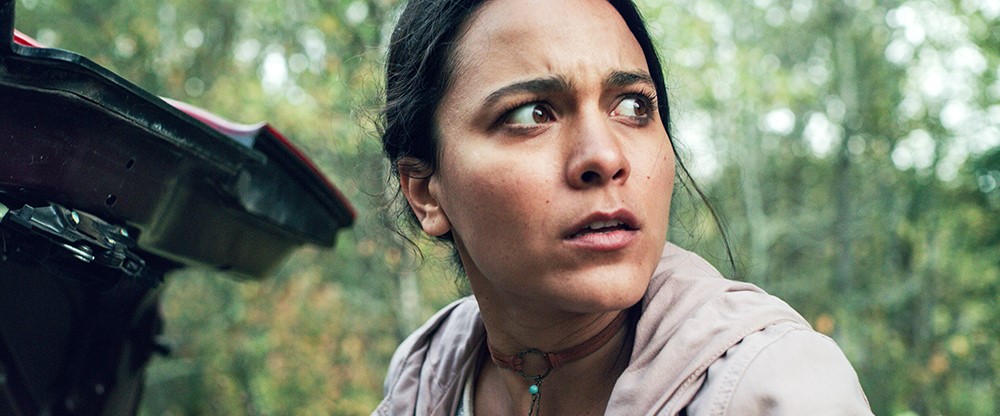
Maja Stojan in 3 DAY WEEKEND. Photo courtesy of Cinequest.

The inventively constructed thriller 3 Day Weekend is a storytelling triumph for writer-director Wyatt McDill and a taut 80 minutes of gripping entertainment.

3 Day Weekend begins with a lovelorn Millennial doofus, Ben, on a solo camping trip. Despite a noticeable lack of outdoor skills, Ben pitches his tent in the woods near a remote lake; but other people arrive, and everything that Ben witnesses tells him that he has blundered into a kidnapping in progress, and, possibly, a murder. But all is not as it seems…

We follow what Ben sees for 29 minutes, and then the point of view shifts to that of a second character. The added vantage point provides the audience with more puzzle pieces, and we start understanding that the story is going in another direction. Then a third character, and, finally a fourth, add layers to complete the story.

McDill even takes us from one crime subgenre to another – is this a peril-and-rescue film, a heist movie, a tragic neo-noir or a perfect crime flick?

And McDill tells his story with hardly any dialogue – and essentially none in the first half of the movie, unless you count grunts. The actors – Maya Stojan, Morgan Krantz, Nathan Phillips and Scott MacDonald – ably tell the story without many lines.

This isn’t exactly like Rashomon, where each character’s perspective shapes the facts differently. In 3 Day Weekend, the facts are all the same; it’s just that some characters come to the story knowing things that others don’t, and some characters experience events that others miss.

There’s plenty of humor slyly embedded in this tale, chiefly in the foibles of the male characters. Plus there are two tattoos that the audience will not be expecting.

McDill also cleverly uses the time-stamped notifications and texts from smart phones to set and reset the timeline of the story threads.

This is an ingenuously-constructed story. Cinequest hosts the world premiere of 3 Day Weekend.

WHAT SHE SAID: THE ART OF PAULINE KAEL – the drive for relevance

Pauline Kael in WHAT SHE SAID: THE ART OF PAULINE KAEL

What She Said: The Art of Pauline Kael is the remarkably thorough and insightful biodoc of the iconic film critic Pauline Kael and her drive for relevance.

Documentarian Rob Garver has sourced What She Said is well-sourced with the memories of Kael’s colleagues, rivals and intimates. Garver’s portrait of Kael helps us understand her refusal to conform to social norms as she basically invented the role of a female film critic and what today we might call a national influencer on cinema.

Of course, one of Kael’s defining characteristics was her all-consuming love of movies, a trait shared by many in this film’s target audience. Fittingly, Garver keeps things lively by illustrating Kael’s story with clips from the movies she loved and hated. Garver’s artistry in composing this mosaic of evocative movie moments sets What She Said apart from the standard talking head biodocs.

Kael was astonishingly confident in her taste (which was not as snooty as many film writers). For the record, I think Kael was right to love Mean Streets, Band of Outsiders, Bonnie and Clyde, and, of course, The Godfather. It meant something to American film culture that she championed those films. She was, however, wrong to love Last Tango in Paris. She was also right to hate Limelight, Hiroshima Mon Amour and The Sound of Music. But Kael was just being a contrarian and off-base to hate Lawrence of Arabia and Shoah.

Kael was by necessity an intrepid self-promoter and filled with shameless contradictions. She famously dismissed the auteur theory but sponsored the bodies of work of auteurs Scorsese, Peckinpah, Coppola and Altman. She loved – even lived – to discover and support new talent.

Most of the people we like and admire possess at least some bit of selflessness and empathy. Kael’s daughter Gina James says that Kael turned her lack of self awareness into triumph,. This observation, of course, cuts both ways.

I saw What She Said: The Art of Pauline Kael at the 2019 San Francisco Jewish Film Festival. It’s now playing in theaters in San Francisco and Berkeley.

Stream of the Week: CITY OF HOPE – life is complicated, so are American cities

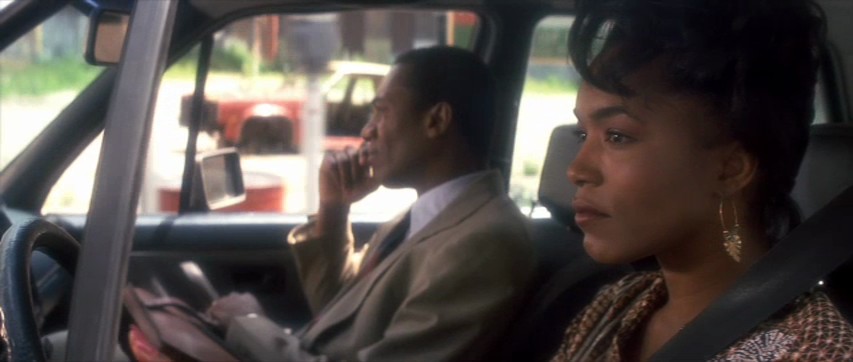
Joe Morton and Angela Bassett in CITY OF HOPE

John Sayles’ City of Hope, almost thirty years old, is still searingly relevant on race in America and is still one of the most incisive films on American politics.  Life is complicated, so is America and so are politics.  Most political films are NOT complicated, but Sayles respects the audience enough to give us a realistic story in a realistic community setting.

City of Hope features over twenty characters braided together in interlocking story threads.  It’s set in an Eastern US City very much like Newark, New Jersey.  An Italian-American business and political establishment is still clinging to the levers of power, as an emerging black and brown majority pushes for inclusion.  There is racial tension and everyday political corruption – and people must get on with their lives. 

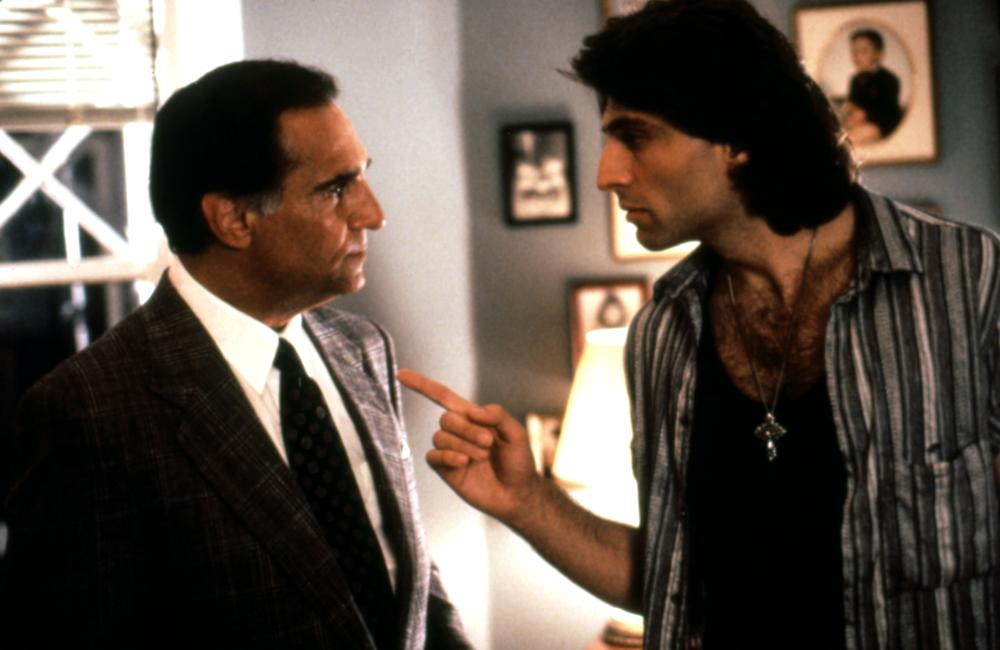
Tony Lobianco and Vincent Spano in CITY OF HOPE

A self-made contractor (Tony Lo Bianco) is trying to finish a big project but the driving forces of race and politics intervene, just as his troubled and immature son (Vincent Spano) is flaming out.  An African-American professor-turned elected official (Joe Morton) is trying to keep his integrity, maintain credibility with the black community and be effective – which is hard to do at the same time.  And that really just kicks things off.

City of Hope has an extraordinary cast that includes many stars early in their careers:  Angela Bassett, Chris Cooper, Gina Gershon, Frankie Faison, Miriam Colon.  Kevin Tighe is absolutely brilliant as a police union official whose every personal interaction is designed to increase his political leverage (this is a guy that I’ve met many times on my day job).  Tom Wright is compelling as Malik, a distrustful activist.  The great David Strathairn, who has appeared in six of Sayles’ films, is unforgettable as Asteroid, a schizophrenic street dweller.

Sayles and Sayles’ life partner Maggi Renzi, who has produced all his films, carved out juicy – and the least sympathetic roles – for themselves. In a hilarious turn, Renzi plays a Greek Chorus in the form of an Italian homemaker (They don’t LISTEN!).  Sayles himself plays Carl, a treacherous and reptilian scumbag of a local crime lord.

City of Hope was released in 1991, right on the heels of 1989’s Do the Right Thing – both remain as insightful on America’s race issues as they were thirty years ago.   City of Hope is said to have influenced The WireCity of Hope may be streamed from iTunes, Vudu, YouTube and Google Play.

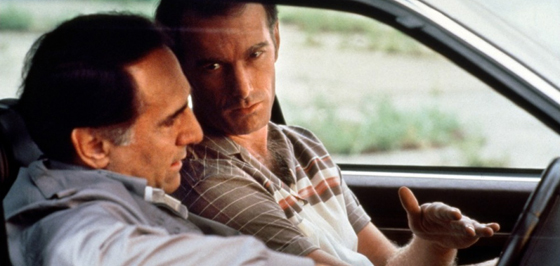
Tony Lobianco and John Sayles in CITY OF HOPE

Stream of the Week: COLMA: THE MUSICAL – a refreshing hoot

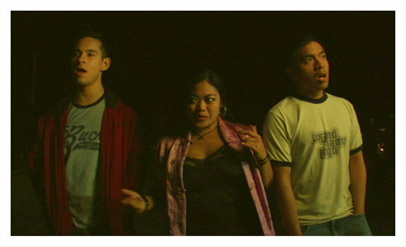
COLMA: THE MUSICAL

Here’s a heartfelt and funny cinematic dive into the Bay Area’s Filipino community – and it’s a movie musical!  Colma: The Musical is a coming of age story following three Filipino-American kids graduating from high school. 

The characters burst into 13 original songs written by director H.P. Mendoza – and they’re great songs.  As one of the kids, the charismatic L.A. Renigen absolutely soars.

The film was shot on location in Colma, California, the town more known in the Bay Area as the home of San Francisco’s cemeteries.  But almost 2,000 living, breathing folks reside there, and they have their stories, too.

H.P. Mendoza is a Bay Area treasure, having written and directed the genre-bending art film I Am a Ghost and the dark indie comedy on domestic violence Bitter Melon.

Colma: The Musical is refreshing on many levels – and it’s a hoot.  I recommend the delightful Colma: The Musical for anyone, especially Bay Area residents; you can stream it from Vudu, YouTube and Google Play.

1917: why all the fuss?

George MacKay in 1917

The WW I thriller 1917 is a only a solid movie, despite groundbreaking technical achievements. The story is simple – two British soldiers must race across nine miles of enemy territory to prevent a doomed attack. One of them has been cynically selected because his brother would be one of the soldiers to walk into the German deathtrap. Will they survive a series of perils and make it in time?

There are moments which are essentially the equivalents of video games or amusement park rides, especially a tunnel cave-in, a crashing biplane and an unexpectedly roaring river. Now, a viewer knows that there is NO MOVIE HERE AT ALL if at least one of these guys doesn’t reach the objective, or at least come heartbreakingly close; that knowledge removes some of the tension from the dangerous situations in the first three-quarters of the film.

The screenplay, co-written by director Sam Mendes, is very lame; unbelievably, it has been nominated for an Oscar. One of the leads regards his tranquil surroundings with “I don’t like this place,” which is movie foreshadowing as obvious as “It’s quiet…too quiet.” I don’t consider it a spoiler to let you know something bad happens in “I don’t like this place“,

On to the technical achievements. Mendes has constructed the film as if it were one, continuous shot. This is NOT a gimmick; the continuity and the illusion of a single shot is all in service to the story by reinforcing the POV of our protagonists. It is brilliantly photographed by cinematographer Roger Deakins.

Deakins is a lead pipe cinch to win a deserved Cinematography Oscar. He won in 2018 for Blade Runner 2049 and has 12 other Oscar nominations. 1917 is in amazing achievement for Deakins.

At one point, a protagonist is creeping through a decimated town that is filled with enemy snipers. Every so often, a flare lights up the ruins as if it were daylight, and our soldier has to sprint toward darkness, essentially racing the flares. It’s a remarkable visual, and I never seen anything like it before.

There are scenes where we follow the soldiers down miles of trenches – a remarkable job of production design. Mendes also seems to have gotten all of the period details right.

George MacKay is excellent as one of the protagonists, Corporal Scofield. As a character, Scofield spends the movie in fear, determination or both simultaneously, so MacKay doesn’t need to use much range, but he is compelling. MacKay has the kind of face that is well-suited for a character haunted by dread and tragedy.

The always-charismatic Benedict Cumberbatch makes the most out of his two minutes on screen. as does Andrew Scott.

I admired the movie wizardry of 1917, but I wasn’t thrilled or moved by it. 1917 won a Golden Globe and has garnered a zillion Oscar nominations. I see 1917 as this year’s Avatar, a technical marvel that no one will be talking about in five years.

HONEYLAND: bees good, neighbors bad

HONEYLAND

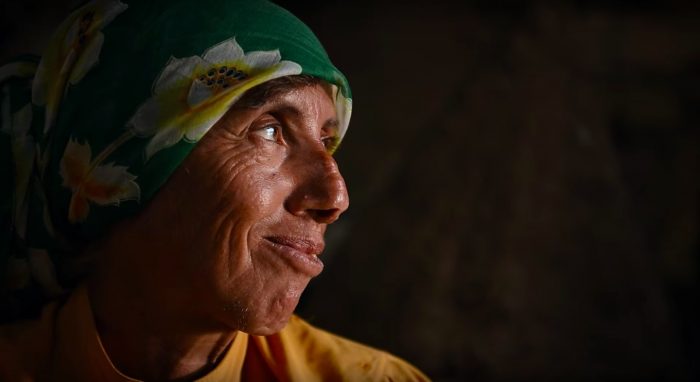
The documentary Honeyland is about a fiftyish Macedonian woman named Hatidze, who lives in an otherwise abandoned mountain village. She cares for her mother, who is blind and bedridden, and she clambers over rocky mountains to collect honeycombs and bees; she sells the honey in a nearby city for a living.

Suddenly, a thoroughly disorganized family moves in next door, sprawling litter and rowdy kids across the previously serene landscape. The father, Hussein, thinks that he will strike it rich raising cattle and bees; the fact that it’s not that easy utterly escapes him. Hussein is foolish, makes the lazy choice at every opportunity and blames the resultant misadventures on others.

Despite Hatidze’s best efforts, her mother’s health declines and Hussein’s self-made disasters continue. That’s all that happens in Honeyland. As my longtime readers will know, I’m more patient with the slowly paced, indie cinéma vérité than the next guy; but but I lost interest in Honeyland. The only reason I watched Honeyland to the end was because The Wife wanted to see if something more interesting was going to happen.

In fact, the only reason that I’m writing about this film at all is that it has somehow been Oscar-nominated for both the Best International Film and the Best Documentary, which I find baffling.

Reportedly, the filmmakers lived in tent in the remote village and filmed Honeyland over four years.

Hatidze is sweet, decent and fully aligned with popular values of sustainability. She has a sense of humor and some measure of snaggle-toothed charm. The film is only one hour 26 minutes, but it seems longer. I streamed Honeyland, but I don’t know why you should.

Stream of the week: CARLITO’S WAY – Pacino illuminates another gangster epic

Al Pacino (right) in CARLITO’S WAY

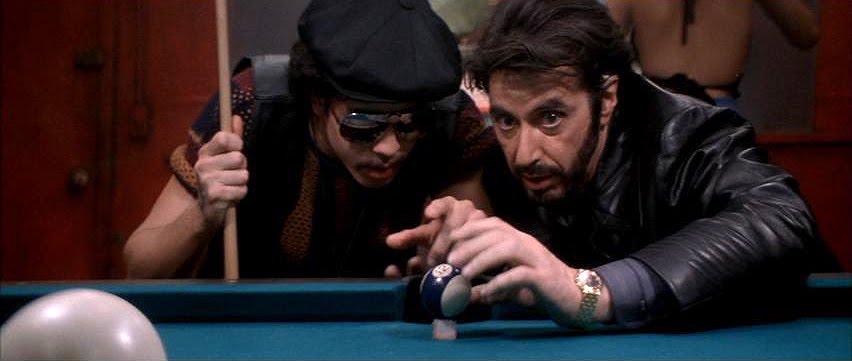
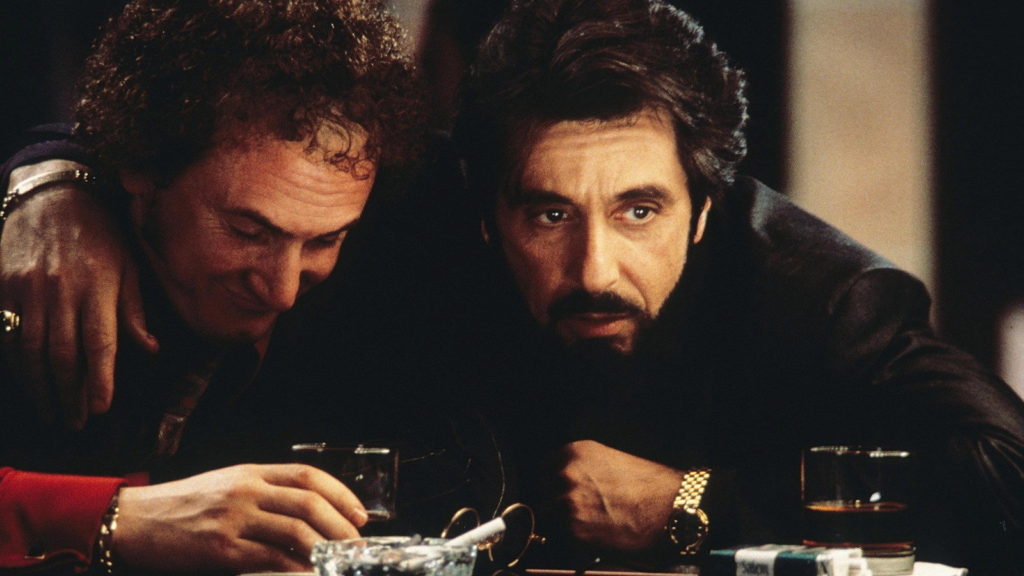
Brian De Palma’s 1993 neo-noir Carlito’s Way is one of the great crime films.  If you like The Godfather, you’ll like the similarly operatic Carlito’s Way. Al Pacino is brilliant, and we so sympathize with this anti-hero that we’re hoping he will avoid the heartbreakingly noir ending.

Pacino stars as Carlito Brigante, a successful Puerto Rican drug dealer just released back to New York City from prison.  He’s looking to invest in a nightclub and develop a legitimate nest egg so he can retire to the tropics with his girlfriend.  But the crime world he comes from isn’t going to make that easy. This isn’t the bombastic Pacino – his Carlito is ever-watchful and shrewd, like his Michael Corleone in The Godfather films.

Carlito’s Way’s high points are three unforgettable set pieces: a drug deal rendezvous where Carlito senses something is amiss, a nightclub confrontation with an aspiring gangster, and an extraordinary chase scene through Grand Central Station. In the chase, Carlito must escape two skilled and determined Mafia hit men, one of whom is profoundly obese.

Carlito’s Way features top rate supporting performances from Luis Guzman, Sean Penn, Penelope Ann Miller and Viggo Mortensen, along with John Leguizamo’s breakthrough.  Penn’s coke-fueled shady lawyer is the juiciest role, but don’t overlook Jorge Porcel as Sasso; this Argentine comic actor was near the end of his 54-movie and 32 -television series career, and he is perfect as Sasso.

The two hours and 24 minutes never drags.  Carlito’s Way plays frequently on premium television channels and is available on DVD and Blue-Ray from Netflix. Carlito’s Way can also be streamed from Amazon, iTunes, Vudu, YouTube and Google Play.

Sean Penn and Al Pacino in CARLITO’S WAY. Credit:The Kobal/Universal. Collection
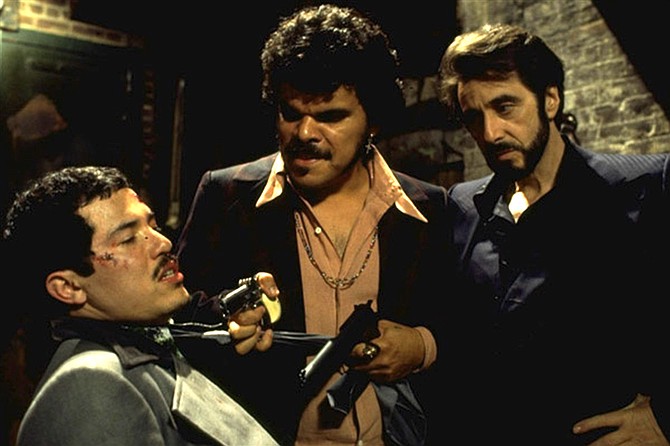
John Leguizamo, Luis Guzman and Al Pacino in CARLITO’S WAY.

UNCUT GEMS: neo-noir in a pressure cooker

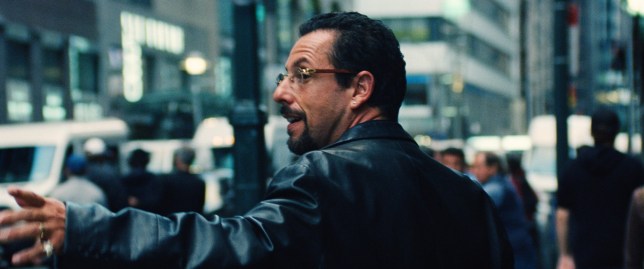
Adam Sandler in UNCUT GEMS

Adam Sandler and filmmaking brothers Benny and Josh Safdie serve up neo-noir in a pressure cooker in the relentlessly tense Uncut Gems.

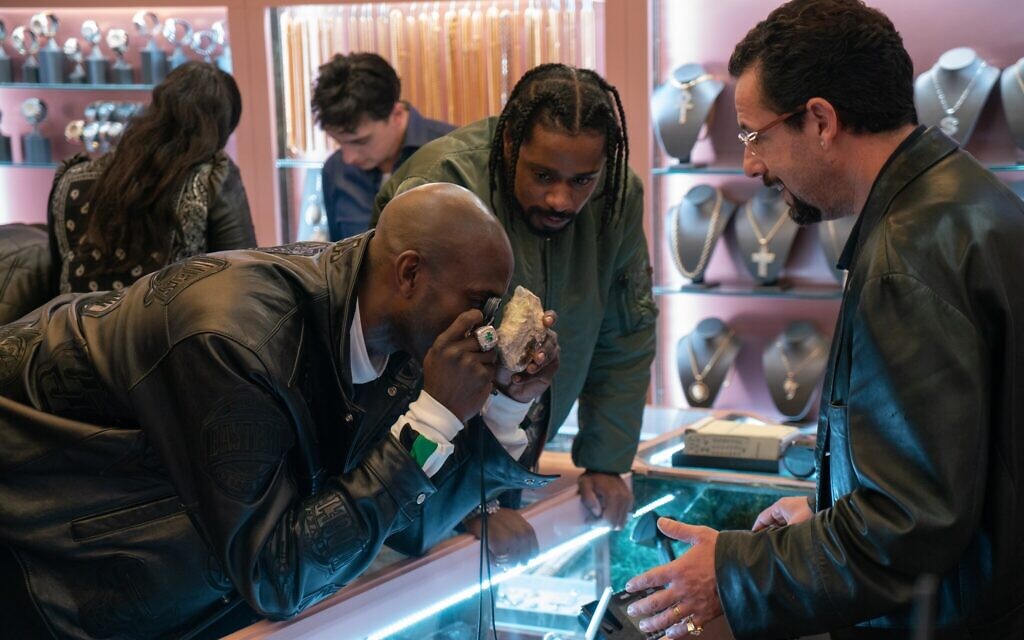
Howard (Adam Sandler) is a Jewish jewelry dealer in New York City’s Diamond District, who makes his big bucks catering to NBA stars brought in by his associate (LaKeith Stanfield). He’s also a gambling addict. One of the consequences of gambling addiction is losing more than you can afford and owing money that you don’t have to very nasty people.

Kevin Garnett, LaKeith Stanfield and Adam Sandler in UNCUT GEMS

Howard has a lot – a wife and kids in a luxurious suburban house, a young mistress in a Manhattan apartment, a thriving business. But he’s always on the verge of losing it all because it’s not enough; his life is driven by the compulsion to make five figure exotic sports bets.

That means that he is constantly robbing Peter to pay Paul, shifting money, jewelry, schemes and bullshit around like a spinning plate act on The Ed Sullivan Show. Throughout Uncut Gems, the chaos elevates, as Howard bets on being bailed out by the Big Sale and the Big Bet. There’s a massive Ethiopian opal (a MacGuffin like the Maltese Falcon), a spine chilling auction and an even more gripping sports bet.

It’s clear that the inevitable will catch up with Howard – we just don’t know where it will fall on the continuum between having all of the bones in his hand broken and wearing cement shoes in the East River. Or whether his spiking blood pressure will send him out with a stroke or heart attack. Come to think of it, this probably isn’t the best movie choice for a cardiologist.

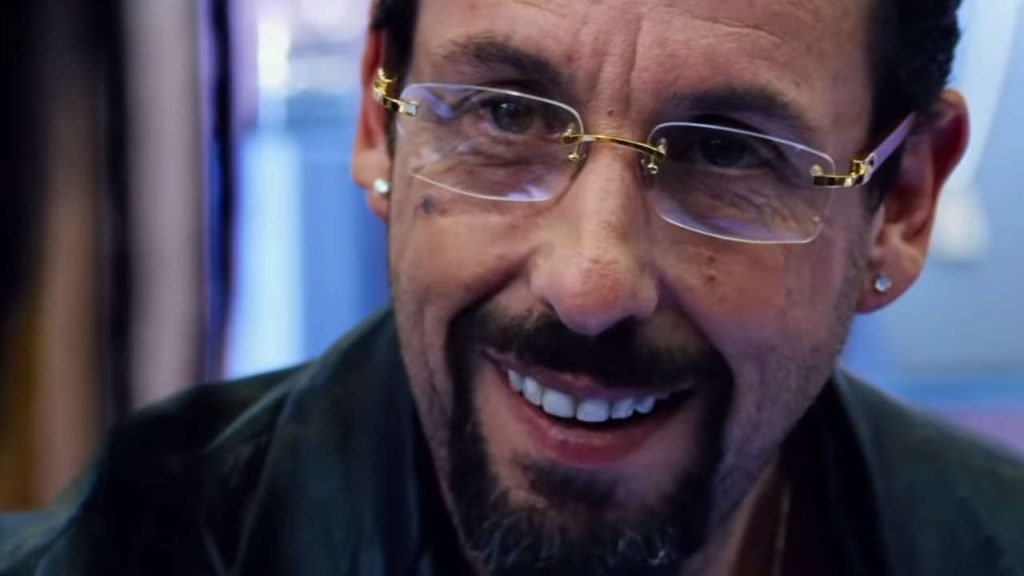
Adam Sandler in UNCUT GEMS

Here’s the challenge that the Safdies faced in writing this character and that Sandler faced in playing him. How do you make him just appealing enough to keep us engaged with his situation? This is a guy who, were we in the same family or community, we would dread his every approach (Here comes trouble).

This is an extraordinary, awards-worthy performance by Sandler; he inhabits a perpetually frenetic guy, fueled by his compulsions and by the resultant desperation.

Idina Menzel is superb as the wife who knows Howard best and assesses him the most accurately (and cruelly). Stanfield is very good, as are Julia Fox as the girlfriend and Eric Bogosian as a frustrated creditor. Former NBA star Kevin Garnett plays NBA star Kevin Garnett and holds his own with the professional actors.

The 2 hours and 15 minutes of Uncut Gems flies by (and you feel like you’ve been running the whole time). This is one of the Best Movies of 2019.

THE TWO POPES: surprising complexity

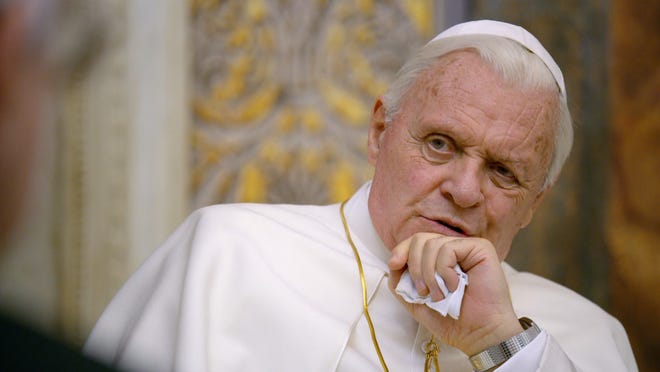
Anthony Hopkins in THE TWO POPES

Refusing to play it safe, director Francisco Meirelles elevates The Two Popes from would have been a satisfying acting showcase into a thought-provoker. The Two Popes is based on the transition of the papacy from the reactionary German Ratzinger (Pope Benedict XVI) to the tolerant, social justice advocate Argentine Bergoglio (Pope Francis).

Of course, we expect great performances from two of our greatest screen actors, Anthony Hopkins (as Ratzinger) and Jonathan Pryce (Bergoglio). These guys are great, especially Hopkins, who has the task of making us see the humanity in a cold, humorless, doctrinaire character.

The story is a natural odd couple match-up set in a moment of historical drama, and, with Pryce and Hopkins, that would be enough for most filmmakers. But Meirelles takes it up a notch with an unexpected second flashback to Bergoglio’s career as a Jesuit leader during the brutal Argentine coup in the 1970’s. I didn’t se this coming, and it illuminates Bergoglio’s experience, more complicated than initially apparent. Credit the construction and the added complexity to Meirelles (City of God) screenwriter Anthony McCarten (Darkest Hour The Theory of Everything).

BTW The Two Popes is shot in the Vatican, including the Sistine Chapel, and the papal summer getaway, Castel Gandolfo. Way cool.

The Two Popes is streaming on Netflix.

MIDNIGHT FAMILY: an all-night race for pesos

Luke Lorentzen’s MIDNIGHT FAMILY. Cuurtesy of SFFILM

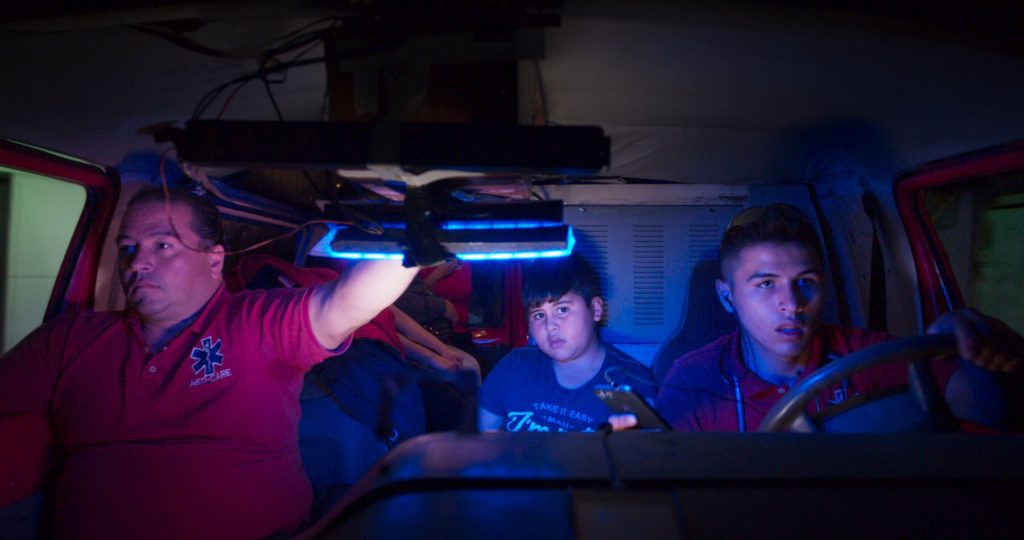
In his gripping documentary Midnight Family, filmmaker Luke Lorentzen takes us on ridealongs with an all-night ambulance crew in Mexico City. It’s even wilder than you may expect.

Midnight Family is set in an absurd situation with life-and-death stakes. We learn right away that there are only 45 government-operated ambulances in Mexico City, a metropolis of 9 million. The rest of the ambulances are private and mostly independents.

Competition is cut throat. The private ambulances listen to police scanners and then TRY TO OUTRACE each other to the scene. One of these independent ambulances is the Ochoa family’s business.

Fernando Ochoa is the head of the family, and he collects the ambulance fee from hospitals and patients. His 17-year-old son Juan is the voluble front man and driver, who careens them through the Mexico City streets at alarming speed. The Ochoa’s colleague, the even-tempered medic Manuel, rides in the back. The youngest Ochoa son, pudgy, Ruffles-devouring 10-year-old Josue, rides along as a gopher. BTW there are no seat belts in the back.

The private ambulances operate in a shady world of semi-formal licensing, so they can always be shut down arbitrarily by the cops. Indeed, we even see the Ochoas arrested while trying to take a patient to the hospital. It’s common for the police to extract bribes from the vulnerable ambulance crews.

There is an incentive to steer patients to the private hospitals that will pay the ambulance crews, so their business is, by its nature, often a hustle; there are some instances of ethical ambiguity. Aiming to depict a “wide spectrum”, Lorentzen balances life-saving heroics with the more sketchy moments. Getting payment out of a grieving family when the loved one dies on the way to the hospital is, well, awkward.

Here is the Ochoa’s business model. Ideally, they get paid about $250 to deliver a patient to a private hospital. They deduct the cost of gasoline, medical supplies and police bribes, and then split what’s left four ways. If a patient can’t or won’t pay, if the vehicle breaks down, or if the cops shut them down – the Ochoas are out of luck.

Luke Lorentzen’s MIDNIGHT FAMILY. Cuurtesy of SFFILM

Fernando is silent but expressive. Carrying an alarming belly, he stoically juggles an assortment pills to treat his chronic illness. The loquacious Juan is a born front man, and basically provides play-by-play commentary throughout the film in real time. We see him downloading the previous night’s drama over the phone to his girlfrend Jessica and, by loud speaker, directing other Mexico City drivers out of his way.

Fernando and Juan sleep on the floor of a downscale apartment, and they never know if they’ll make enough money for tomorrow’s gasoline. It’s an incredibly stressful existence. How resilient can they be? Is there any limit to the stress they can absorb? As Lorentzen himself says, this is “a world where no one is getting what they need”.

I saw Midnight Family at the 2019 San Francisco International Film Festival (SFFILM), which included an in-person Q&A with Lorenzen. Lorentzen spent 80-90 nights with the crew. About 70% of the film comes from the last three nights that he rode with the Ochoas.

Midnight Family joins a mini-genre of rogue ambulance cinema. The very dark Argentine narrative Carancho stars the great Ricardo Darin as a LITERALLY ambulance-chasing lawyer. In the Hungarian dark comedy Heavenly Shift (I saw it at the 2014 Cinequest), an outlaw ambulance crew gets kickbacks from a shady funeral director if the patient dies en route to the hospital.

Midnight Family is just concluding a run at the Roxie in San Francisco. I’ll let you know when it’s streamable. Midnight Family is one of the nest documentaries of the year, and on my Best Movies of 2019.