NUREMBERG: matching wits with a master manipulator

Photo caption: Russell Crowe (left) and Rami Malek (right) in NUREMBERG. Courtesy of Sony Pictures Classics.

The psychodrama Nuremberg pits the Nazi war criminal Hermann Goering (Russell Crowe) against the American psychiatrist Douglas Kelley (Rami Malek) in a high stakes battle of wits. It’s the end of WW II, the full extent of the Holocaust is just being revealed and the Allies are ready to hold the world’s first war crimes trial.

With the suicides of Hitler and Himmler, Goering is undeniably the highest ranking and highest profile surviving Nazi leader. He and other top Nazis are in a military prison run by the US Army, where Dr. Kelley is assigned. The Army’s interest in the defendants’ mental heath was not primarily humanitarian – it was in preventing their suicides so they could be executed by hanging.

Kelley’s intellectual curiosity, though, is alive with the opportunity that any behavioral scientist would envy – probing the psyches of the men with the worst ever human behavior; these are the men who thought the unthinkable and acted to realize it. (And, more prosaically, he hopes to garner material for a profitable book.)

The lead American prosecutor is US Supreme Court Justice Robert Jackson (Michael Shannon), who has to make up the jurisdiction and rules, even the charges, for the trial as he goes along. Nuremberg reminds us that the trial was about more than criminal justice; perhaps even more importantly, the trial was a vehicle to show the world, especially the German people, the extent of the Nazi regime’s crimes against humanity, a term coined by Jackson for the trial. Accordingly, the Allied prosecutors made and showed films documenting the extermination camps. These images were not yet widely viewed at the time, and Malek shows Kelley’s revulsion at seeing the atrocities for the first time.

Nuremberg also reminds us that trying Nazi leaders would come at some considerable risk – the possibility that some of the defendants could make themselves sympathetic or martyrs, or, worst of all, even get off scot-free.

Kelley immediately tags Goering as a narcissist, a diagnosis which Goering himself does not dispute. Goering is uncommonly crafty and sly, tempering his his characteristic arrogance with a jovial charm that even threatens to seduce Kelley. Indeed, climbing to the top of a pyramid of back-stabbers was no mean feat, and Goering’s skills at political infighting and social climbing are formidable. Similarly, he possesses a gift to read the room and accordingly flatter and insinuate. Goering even has the hubris to believe that he will be able to manipulate his way out of a conviction.

With some hubris of his own, Jackson is eager to win a match of wits with Goering, planning to break him on the stand. Kelley, who has seen Goering’s charm and intellect up close, thinks that Jackson is likely to lose a frontal assault and perceives that Goering’s vulnerability lies elsewhere.

The Allied officials, including Kelley initially, intuit that any person who committed such monstrous acts must be some unique kind of monster. In 1946, the concept of the banality of evil was still fifteen years away from being coined by Hannah Arendt at the 1961 trial of Adolph Eichmann. Kelley meets all of the Nuremberg defendants, who Nuremberg accurately depicts as the motley group they were – this one a hoodlum, that one a psychotic crank. Rudolf Hess is depicted as befuddled (or ACTING befuddled as he faked amnesia for the second time). Of course, the Nazis were bullies, and bullies are always less fearsome when they are held to account.

The people who committed the most horrific acts in human history are surprisingly, even disappointingly, ordinary. For every deranged megalomaniac who comes to power, there are plenty of opportunistic thugs who go along for the ride.

Similarly, Kelley finds that Goering is such a greedy, attention-seeking asshole, that he was happy to play along with exploiting racial hatred, even to the point of genocide, just to become richer, more famous and more powerful.

In an impressive performance, Russell Crowe captures Goering’s narcissistic entitlement, magnetic charm, manipulative sociopathy and seemingly unshakable self-confidence.

Kelley starts out with his own hubris, confident that he holds all the cards vis-a-vis Goering, who is not himself a trained psychiatrist and is, after all, locked in a prison cell. Malek is able to portray Kelley’s sense of himself as far more fragile than one would expect, with the potential to become a tragic figure.

John Slattery is very good as a straight-ahead Army prison commander, as is Colin Hanks as an unapologetically venal rival shrink.

In scenes intended to reveal Kelley’s own humanity and manipulations, the character of Goering’s wife Emmy (Lotte Verbeek) is written with too much sympathy for my taste. In real life, Emmy Goering was a real piece of work, who vied with Joseph Goebbel’s wife to outdo Hitler’s mistress Eva Braun as the most prominent figure in the Nazi Reich and who was an enthusiastic looter of Jewish-owned fine art.

The 2023 The Zone of Interest was a masterpiece on the banality of evil. On this subject, I also recommend Blind Spot: Hitler’s Secretary and, for the Indonesian version of banality of evil, the wonderful documentary Act of Killing. For sheer gall that supassed even Goering’s, there’s another documentary, Speer Goes to Hollywood, in which we hear recordings of Albert Speer pitching a Hollywood movie to rehabilitate his image.

Even casual students of history know that Goering didn’t escape conviction, but Nuremberg, in the tradition of fine courtroom dramas, is able to keep the audience hooked on how Goering, Kelley and Jackson will perform at the trial, and whether Goering will destroy anyone else. Nuremberg open in theaters this Friday.

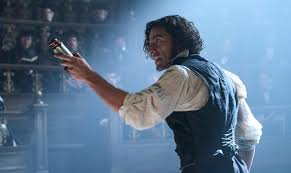
FRANKENSTEIN: who is the real monster here?

Photo caption: Oscar Isaac in FRANKENSTEIN. Courtesy of Netflix.

If, like me, your idea of Frankenstein is Boris Karloff’s monster staggering around, you’re going to be blown away by Guillermo del Toro’s Frankenstein, a sweeping, operatic tragedy and a triumph of filmmaking. Instead of remaking the 1931 film, del Toro based his film on the 1818 Mary Shelley novel, Frankenstein; or, the Modern Prometheus, and made an epic movie about morality.

In Frankenstein, we learn about Victor Frankenstein’s back story, beginning with traumas in his childhood that form his obsession to overcome the inevitability of human death. The adult Victor (Oscar Isaac) is a scientific genius whose secret work is sponsored by a shady zillionaire (Cristoph Walz). Victor patches together body parts of war casualties, assembling them into a Creature (Jacob Elordi) that he uses electricity to re-animate. Critically, Victor only cares that his experiment has succeeded, and doesn’t recognize any humanity in his Creature, who does, after all, possess a human brain. And things get out of hand.

The Creature is big and scary-looking, but it turns out that his mind is capable of learning, and he comes to move with sinewy grace.

Victor is visited by his brother’s fiance Elizabeth (Mia Goth), a young woman with her own scientific aspirations. More than just a naive do-gooder, Elizabeth’s intellectual curiosity and proto-feminist self confidence allow her to assess the Creature’s humanness and become the moral center of Frankenstein.

Oscar Isaac in FRANKENSTEIN. Courtesy of Netflix.

We sympathize with Victor as a survivor of childhood trauma, we admire his scientific genius and, given that he is played by the very handsome Oscar Isaac, we don’t expect Victor to be the bad guy. Victor seeks to become humankind’s greatest champion, but his arrogance and his callousness and cruelty toward the Creature define him otherwise. As characters in Frankenstein explicitly ask, who is the real monster here?

It is also, of course, a story about man’s overreaching, a central theme of literature and drama since the ancient Greeks, with their Icarus myth and their hubris-filled heroes. Not to mention the Bible (Pride goeth before destruction, and an haughty spirit before a fall). Even my beloved film noir genre is usually about someone doing something they shouldn’t, motivated by some combination of greed and lust. Audacity is required to harvest the biggest rewards (e.g., the Apollo manned flights to the moon), but audacious risks may also bring catastrophe (e.g., both Napoleon’s and Hitler’s invasions of Russia).

We humans are not very good at anticipating consequences.  After all, could conquering death somehow be a bad thing? As we now see with AI – it’s impressive that you CAN do it, but SHOULD you do it?

At two-and-a-half hours, Frankenstein is over twice the length of the 1931 version – and for a good reason. Del Toro structures Frankenstein as tales told from three points of view – that of the sea captain who comes across Victor in the Arctic, that of Victor and that of the Creature himself. The first two acts are good storytelling, but Frankenstein’s third act is thrilling and emotionally powerful.

Given del Toro’s skill in bringing fantasies to life (Pan’s Labyrinth, The Shape of Water), we expect a visually unforgettable movie, and that’s what we get. Frankenstein is a spectacular testament to the imaginations and technical skills of del Toro and his collaborators – cinematographer Dan Lausten, production designer Tamara Deverell, costume designer Kate Hawley, composer Alexander Desplat and the hair and makeup team. I foresee Oscar nominations for all of them, and Hawley HAS to win for the stunning colors of Elizabeth’s dresses.

Oscar Isaac is very good as Victor, a man complicated by his best and worst traits. So are Charles Dance as Victor’s cold and cruel father and Lars Mikkelsen as the ship captain. (Dance has acted in thirty-five feature films and television series, including (Mank, Game of Thrones and The Crown, while IN HIS SEVENTIES.)

Jacob Elordi in FRANKENSTEIN. Courtesy of Netflix.

The most revelatory performance is, surprisingly that of Jacob Elordi (Saltburn, Priscilla, Oh Canada) as the Creature, who keeps evolving in his capacity to reason and to feel. Buried under pounds of makeup, Elordi is able to clearly express all of the Creature’s feelings through his eyes and the movement of his body.

Like many of you, I don’t enjoy gore and generally avoid the horror movie genre. Here, there’s only two or three minutes of body horror, as Victor surgically chops up corpses and reassembles them as his creation. You can hold your fingers over your eyes or fast forward if necessary. Just don’t miss this movie. There’s no fright or camp here – the tone is romantic and operatic.

Frankenstein is one of the Best Movies of 2025 – So Far. Frankenstein releases on Netflix this Friday. I saw Frankenstein at my local multiplex in an auditorium equipped with Dolby’s ATMOS sound. Most of you will be watching it at home on Netflix. I recommend honoring the filmmaking here by turning off the lights in the room, and watching it, UNINTERRUPTED, on your biggest screen with the sound cranked up.

POWWOW HIGHWAY: a groundbreaking Indigenous road trip

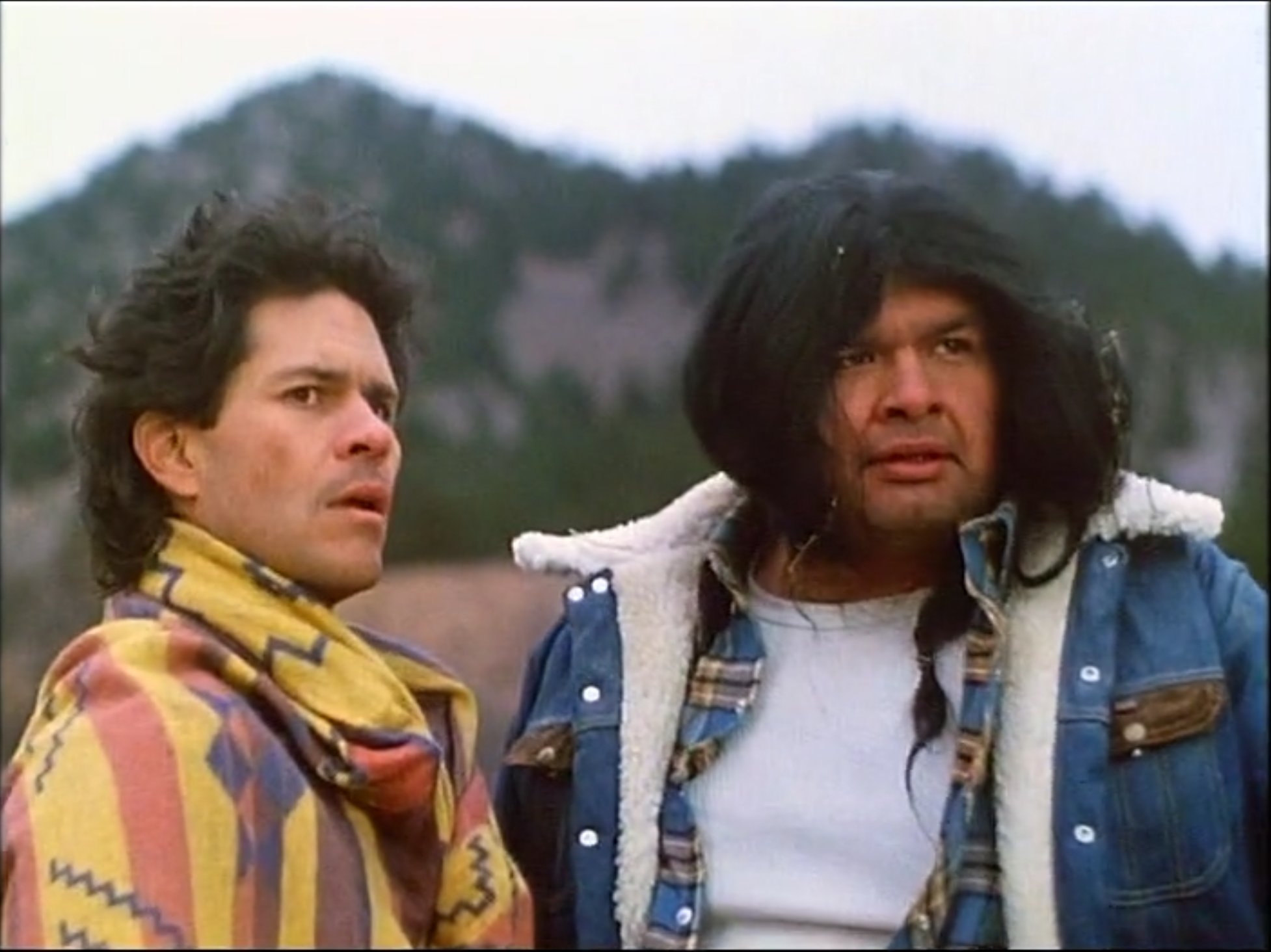
Photo caption: A Martinez and Gary Farmer in POWWOW HIGHWAY.

Powwow Highway is a groundbreaking indie from 1988. It’s very hard to find, but it’s airing November 4 on Turner Classic Movies. Powwow Highway is a droll, offbeat road trip comedy, significant for being one of the first movies with a contemporary Indigenous lens.

Buddy (A Martinez) is an activist on the Northern Cheyenne Reservation in Montana, leading opposition to a strip-mining project. To get him out of their way, the big money interests conspire to have his sister Bonnie (Joanelle Romero) framed and arrested in New Mexico. Buddy is desperate to go to her relief, but has no transportation. His childhood acquaintance Philbert (Gary Farmer), having dreamed of a mystical pony, has purchased a decrepit 1964 Buick that he unironically names Protector. Although it is dubious whether Protector can get them off the reservation, let alone all the way to Santa Fe, they begin their quest, and adventures and misadventures follow.

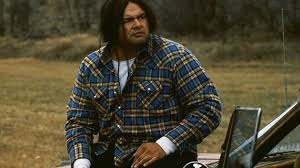
Gary Farmer in POWWOW HIGHWAY.

Much of the humor stems from the Odd Couple on the road trip. Buddy is political and Philbert is spiritual. Buddy is in a hurry, and Philbert doesn’t recognize the concept of hurrying. Gary Farmer has become one of my favorite character actors, and his performance here is indelible.

The renowned Indigenous actors Wes Studi (Dances with Wolves, The Last of the Mohicans, Heat and 2020 honorary Academy Award) and Graham Greene (The Green Mile, Wind River and Oscar-nominated for Dances with Wolves) also appear in supporting roles.

Powwow Highway also takes us inside daily life on the impoverished reservation with striking verisimilitude. Powwow Highway was produced by George Harrison (yes, THAT George Harrison), directed by South African Jonathan Wacks from David Seals’ 1979 novel.

Powwow Highway won the Sundance Film Festival Filmmaker’s Trophy, was nominated for four Independent Spirit Awards, and has been selected for inclusion in the Library of Congress Film Registry.

Powwow Highway can be streamed on the Criterion Channel, but is otherwise unavailable. Make sure you DVR this week’s TCM broadcast.

If you like Powwow Highway, you’ll also appreciate another early indie with an Indigenous lens, Smoke Signals from 1998. It’s another wry road trip comedy, starring Adam Beach, Evan Adams and Irene Bedard, with another turn from Gary Farmer. Smoke Signals is available to stream from Amazon, Apple, YouTube and Fandango.

Gary Farmer in POWWOW HIGHWAY.

DELIVER ME FROM NOWHERE: a genius works out his issues

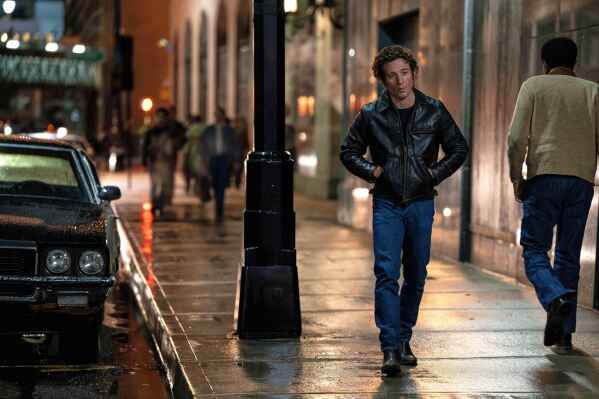
Photo caption: Jeremy Allen White in DELIVER ME FROM NOWHERE. Courtesy of 20th Century Studios.

As the Bruce Springsteen docudrama Deliver Me from Nowhere opens, Springsteen (Jeremy Allen White) is belting out the massive hit Hungry Heart to cap off his The River tour in 1981. Afterwards, his manager/producer/confidante Jon Landau (Jeremy Strong) finds him sitting alone in the bowels of the arena, exhausted and depleted. Too nice a guy to blow off chatting with local radio personalities, Springsteen rallies, but Landau can see that he’s fried.

Landau sets up Springsteen at a rented house in the countryside of Colts Neck, New Jersey. It’s an obscure enough location, so he can rest in privacy, but still only a 25-minute drive to Bruce’s old stomping grounds in Asbury Park. Bruce sits around, decompressing in the darkened house, pondering something other than his future. While their record company is eager for another exuberant, rockin’ Springsteen album and tour, Landau does his best to insulate Springsteen from the pressure.

Bruce experiences a few lighthearted moments, sitting in with the house band at The Stone Pony and having a dalliance with a single mom (a fictional character played by the Australian actress Odessa Young). The Terence Malick movie Badlands sparks his interest and he starts researching the teen killing spree that the film was based on. But mostly, he’s brooding.

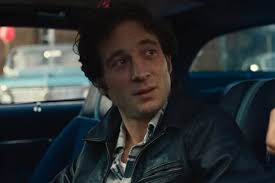
Jeremy Allen White in DELIVER ME FROM NOWHERE. Courtesy of 20th Century Studios.

In flashback, Deliver Me from Evil depicts the childhood that Bruce is reflecting on, dominated by his haunted and sometimes brutish father Doug (Stephen Graham). Doug had his demons, and now Bruce’s own demons are blocking his creative work. Bruce Springsteen is depressed, and that’s what Deliver Me from Evil is really about. In publicity for the film, Springsteen is oft crediting Landau for steering him to professional help and advocating for the destigmatization of mental health treatment.

The scenes with Doug Springsteen both with the young Bruce and the adult Bruce – are the core of Deliver Me from Evil.

The plot centers on Springsteen’s dark contemplations leading to his writing his darkest material yet, the songs that make up his Nebraska album. He records the material by himself, at home and on a cassette recorder, intending to record them in a studio with the E Street Band. The unconventional artistic choices that followed and the battle with his own record company, with Landau’s unwavering support, make up the rest of the story.

(In the same period, Springsteen also wrote Born in the U.S.A., Glory Days and I’m on Fire, which were later successful in arrangements with the full E Street Band on the Born in the U.S.A. album which followed Nebraska.)

Deliver Me from Evil depends on an actor’s success in a ballsy challenge – playing a person that all of us have watched closely for decades. Fortunately, Jeremy Allen White can match Bruce Springsteen in charisma and intensity, and that allows White to inhabit the character of Springsteen without resorting to impersonation.

Stephen Graham in DELIVER ME FROM NOWHERE. Courtesy of 20th Century Studios.

Stephen Graham delivers another indelible performance as Doug, capturing the core disappointment and bitterness that leak out in rage and confusion. After early-career roles in Gangs of New York and Band of Brothers, the stocky Englishman has emerged as one of our great character actors, perhaps best in British crime mini-series like Little Boy Blue, Line of Duty, and Adolescence. He also appears in Hollywood movies like Rocketman and the Pirates of the Caribbean franchise (he plays Scrum), and the 2012 refresh of Tinker Tailor Soldier Spy. Along the way, he has become a one-man cottage industry playing fabled American gangsters – Baby Face Nelson in Public Enemies, Al Capone in Boardwalk Empire, and Tony Provenzano in The Irishman. I just love this guy’s work.

Gaby Hoffman is excellent as Springsteen’s mom.

Deliver Me from Nowhere’s director Scott Cooper (Crazy Heart) and Warren Zanes wrote the screenplay, adapting Zanes’ book about the writing and recording of Nebraska. Deliver Me from Nowhere was made with the participation and support of Springsteen and Landau; that provides lots insight to the screenplay, although Landau’s character is a bit saintly, for my taste. However, the portrayal of Springsteen is unsparing.

The E Street Band isn’t on screen much, but I didn’t completely swallow the depiction of certain band members. But that’s just a quibble about a film otherwise brimming with authenticity.

Deliver Me from Nowhere, as smart and genuine as it is, is irresistibly entertaining.

BLUE MOON: wit and vulnerability

Photo caption: Ethan Hawke in BLUE MOON. Courtesy of Sony Pictures Classics.

The protagonist of Richard Linklater’s Blue Moon is lyricist Lorenz Hart (Ethan Hawke), who Linklater immediately shows us dying of alcoholism, before taking us to a night eight months earlier. Hart, having left the opening night production of Oklahoma!, has entered a familiar haven, the bar at Sardi’s, where he is ready, as always, to hold forth. His longtime partner Richard Rodgers has dumped him for a new collaborator, Oscar Hammerstein, and Hart has immediately recognized that the new duo’s debut musical would dwarf the success of the Rodgers and Hart work. It’s hard to feel good about yourself when you are dumped by your partner of 24 years, who then soars to new heights with a different collaborator.

Beginning in 1919 (when Hart was 24 and Rodgers only 17), the two created 28 stage musicals (including Babes in Arms and Pal Joey and more than 500 songs for Broadway and Hollywood, many of which have become American standards, like Manhattan, The Lady Is a Tramp, My Funny Valentine, and, of course, Blue Moon.

Seeing that body of work eclipsed in one night has Hart reeling. But, now, in 1943, Hart was 48 and Rodgers 41. Hart’s alcoholism has made him unreliable, so Rodger has moved on. Hart’s gift at wordplay is as brilliant as ever, but his confidence is crushed – and he is desperate to work again, and, in his wildest dreams, with Rodgers.

Hart’s career desperation is matched by his romantic desperation – from a doomed fixation with the comely Yale coed, Elizabeth (Margaret Qualley). Elizabeth is self-confident and ambitious, towers over the shrimpish Hart and can match wits with him . Hart is a successful celebrity, but not rich or conventionally attractive, and being an over-the-hill drunken gay man, neither the audience or other characters in Blue Moon see Hart’s pursuit of Elizabeth as anything but a pathetic fantasy.

Margaret Qualley and Ethan Hawke in BLUE MOON. Courtesy of Sony Pictures Classics.

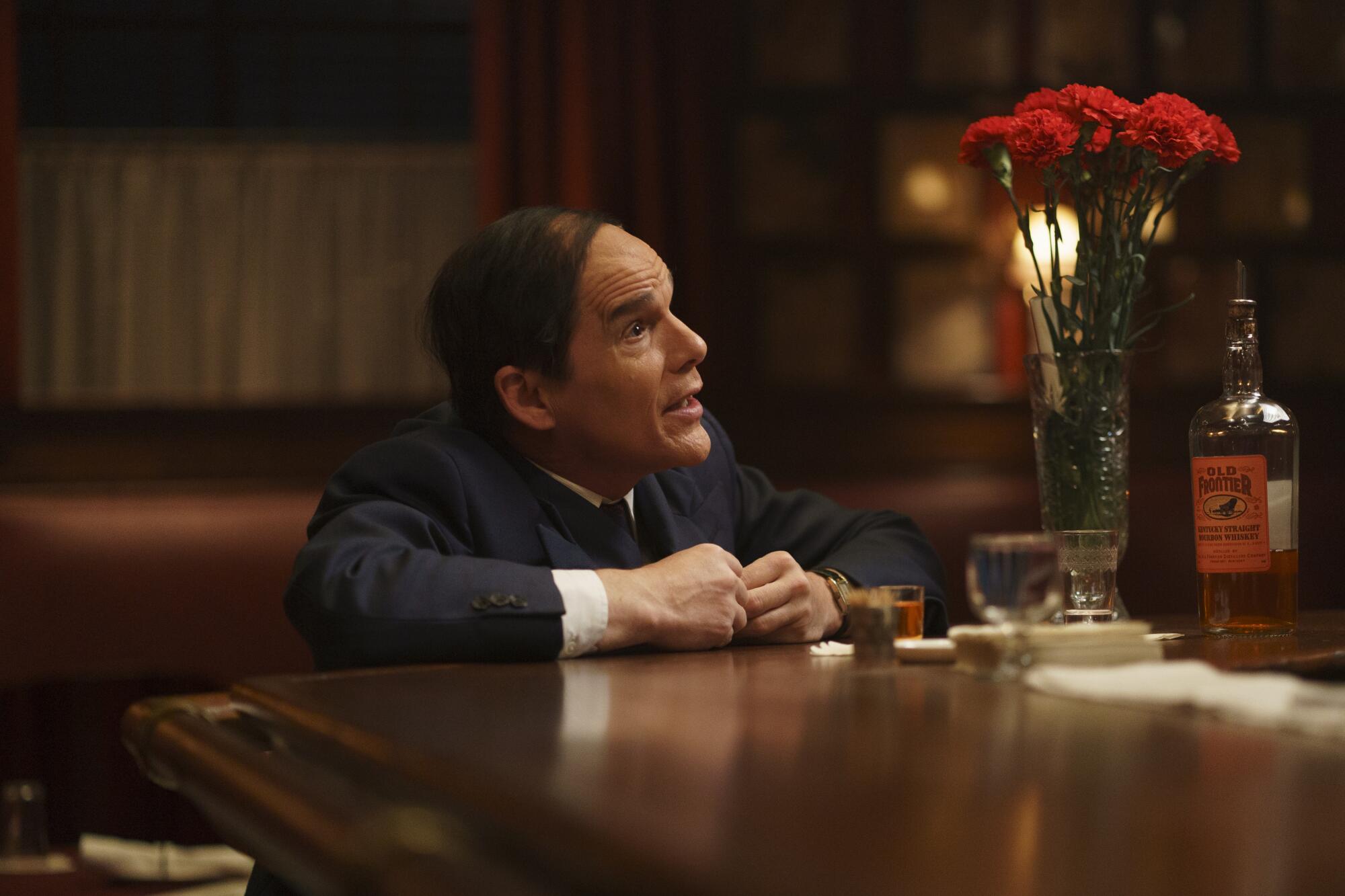
Hart presides over all conversation in the bar, and proves himself a most witty raconteur. Hart, usually unintentionally, reveals himself in banter with Sardi’s affable bartender (an excellent Bobby Cannavale).

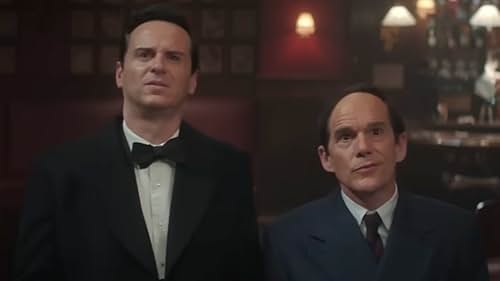
Finally, Richard Rodgers (Andrew Scott) leads in his entourage from Oklahoma! for the opening night party, and Hart explodes into the full wheedle. Moment by moment, we learn more about Rodger’s complicated experience with Hart. It’s clear that Rodgers is genuinely grateful for Hart’s contribution to his life and is also relieved not to no longer be a secondary victim of Hart’s drinking. Rodgers still is affectionate and nostalgic with Hart, but wary about reliving Hart’s worst behavior. When Hart offers a celebratory glass of champagne, Rodgers recoils and barks, “I won’t drink with you!”, registering the pain that Hart’s drinking has inflicted on him over many years.

Why isn’t Blue Moon, a portrait of a man’s crash-and-burn, unwatchably sad?

  • Foremost, even when Hart is being sad, he’s very, very funny.
  • Hawke’s performance is deliciously vivid.
  • We stay engaged in sussing out the complicated relationship between Hart and Rodgers.
  • We delight in the stellar cast and in Richard Linklater’s storytelling genius.

Hawke is one of our very most interesting actors, and his turn as Hart is exceptional, plumbing all of Hart’s desperation, self-loathing and vulnerability. Of course, Hawke, who is 5′ 10″, can play a dreamy romantic lead, so there’s some movie magic – and a bad comb over – employed to help us see him as a 5 foot gnome. Others have described Hawke’s performance here as career-topping, but it’s hard for me to see this performance, as good as it is, as even better than those in Before Sunrise, Before the Devil Knows You’re Dead, and First Reformed, for example.

Andrew Scott and Ethan Hawke in BLUE MOON. Courtesy of Sony Pictures Classics.

Lorenz Hart is a flashy role, but Andrew Scott (Tom Ripley in the recent television episodic Ripley) is quietly mesmerizing as Rodgers, who struggles to contain the embarrassment, wariness, revulsion, pity and love that Hart triggers. Scott won the supporting actor Silver Bear at the Berlinale for this performance.

Qualley just seems to brighten every movie that she’s in – shall we call it the Joan Blondell quality?

One of the most interesting encounters in Blue Moon is between Hart and another bar patron, the writer E.B. White (Patrick Kennedy). The two know and admire each other’s work, although they are conversing for the first time. White can keep up with Hart intellectually, and also has the emotional intelligence to see, without comment, what’s going on with Hart. It’s a remarkably subtle performance by Kennedy.

The entire movie takes place in Sardi’s, except for two or three minutes at and near the beginning. Over 80% of the story takes place in Sardi’s bar. But Blue Moon never looks as inexpensive as it must be. No filmmaker has delivered more fine movies on low budgets than Linklater; I couldn’t find a Linklater movie budgeted at more than a frugal $35 million (School of Rock). Nevertheless, Linklater has created the three most thoughtful romances in cinema (the Before Sunrise series) and the milennium’s best film (Boyhood), along with launching an entire generation of actors in Dazed and Confused.

Here, Linklater turns one night into a vivid portrait of a man’s life and times, and Blue Moon is both funny and profound.

ROADS OF FIRE: an edge-of-your-seat documentary

Photo caption: ROADS OF FIRE. Courtesy of New Mountain Films

The edge-of-your-seat doc Roads of Fire explores undocumented immigration into the US by cross-cutting together three stories –

  • an Ecuadorian asylum-seeker prepares for her deportation hearing,
  • a small NGO faces the tsunami of migrants being dumped by the Texas Governor into NYC, and and
  • a group of Venezuelans try to get from Columbia to Panama on the first leg of their journey. 

The inside story of the Venezuelans is an incredible insider’s view – down to their orientation by their smugglers.  We hear the Ecuadorian woman’s description of the same harrowing route as we follow the Venezuelans.  Wow.

Many of the shots involve zipping through the jungle on motorbikes, hiding from authorities and interfacing with human traffickers. With its oft-breathtaking derring-do, Roads of Fire is a significant achievement for filmmaker Nathaniel Lezra. Every year, I screen a bunch of immigration-centered documentaries, and hardly ever do I see one with this much punch.

Super-topical, well-crafted and very compelling, Roads of Fire opens Friday at the Laemmle’s Monica Film Center and next week at the Glendale and the Claremont 5.

THE TINGLER: Halloween fright from the 50s

Vincent Price in THE TINGLER

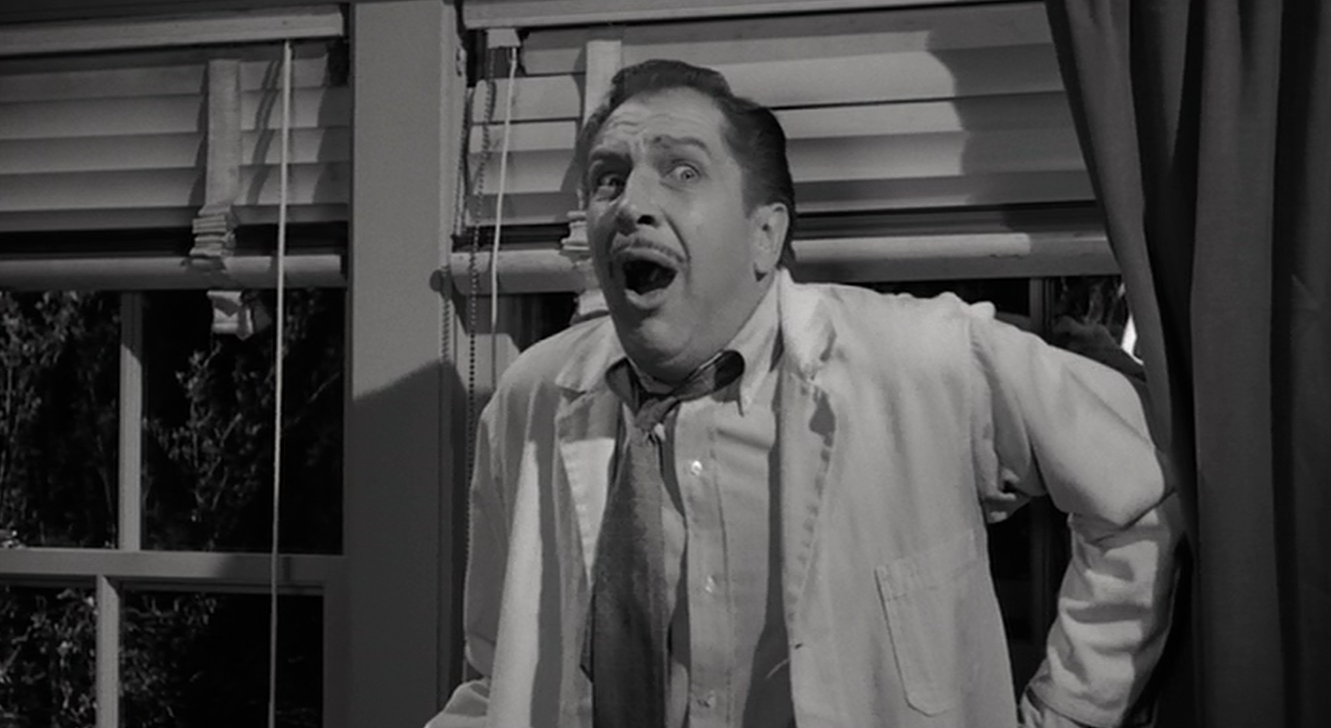
On late Friday night, Turner Classic Movies is bringing us a campy Vincent Price horror classic from 1959, The Tingler.  It has a scary premise – a parasite embedding itself in people’s spine and feeding on them –  unaware until they feel a tingle AND THEN IT MAY BE TOO LATE!  When finally revealed, the grown parasite is VERY scary-looking.  Conveniently, the infested can weaken the parasite by screaming.  Horror schlockmeister William Castle reportedly installed buzzers in the backs of some theater seats, so some audience members would get an actual tingle in the spine at the scariest moments.  In the trailer below, Castle preps his audiences to scream if they feel a tingle.  It’s a cult classic.

A HOUSE OF DYNAMITE: a master filmmaker reminds us of the terrifyingly plausible

Photo caption: Rebecca Ferguson in A HOUSE OF DYNAMITE. Courtesy of Netflix.

In Kathryn Bigelow’s thoughtful nail-biter A House of Dynamite, a ballistic missile armed with a nuclear warhead is on its way to annihilate an American city. American military and national security officials have only minutes to act. That’s a terrifying scenario, and Bigelow knows that portraying it in exacting, realistic detail is very, very scary. She also forces the audience to undertake an intellectual exercise, thinking through What would I do?

All of us Americans – and all the Russian people – understand that if Russia were to launch a nuclear strike on the US, that the US would then automatically retaliate and destroy the military and economic capacity of Russia, along with most of its residents.  And vice-versa.  In that case, all the decision-makers know the procedures to implement, already carefully thought out in advance.

But what happens if we don’t know WHO has fired a nuclear warhead at us?  That very central ambiguity would make decisions very much NOT automatic.

Most of us know that the US President is shadowed by a military officer carrying a briefcase (“the football”) that contains the codes authorizing nuclear warfare.  Some of us know that select officials would be evacuated to nuke-proof bunkers. And that, in the event our top 36 leaders are wiped out at once, there’s a 37th person designated to take command. Here, Bigelow takes us inside to show us what all this would actually look like.

Most of the national security chain of command is highly trained to dal with the situations that the rest of see only as vague contingencies.  These folks know exactly what their responsibilities are and what to do.  Of course, they are human, and they recognize the consequences of the actions that they are trained to take and the impacts those situations will have on their loved ones.  I’m talking here about the National Security staff in the situation room, the top military commanders, the folks tasked with launching defensive missiles from their silos and that young guy carrying “the football”,  

But the President and Defense Secretary (try for a moment to forget the current occupants of those offices), press aides and others in the government probably don’t have that background, and must deal with a broadband of topics. With just an orientation briefing when they took office, they would essentially be thinking all this through for the first time, like the rest of us.

Bigelow also reminds us that a crisis may occur when we’re on vacation, running late to work, at some forgettable photo op, or when our spouse is taking the feverish kid to the doctor.  Civil War re-enactments have their value, but juxtaposed with an impending nuclear holocaust… Time waits for no one, as they say.

Idris Elba in A HOUSE OF DYNAMITE. Courtesy of Netflix.

Idris Elba and Jared Harris are superb as the President and Defense Secretary, plunged into a crisis they would never, never have chosen to address.  As the national security and military pros, Rebecca Ferguson, Jason Clarke, Tracey Letts and Anthony Ramos are similarly excellent.

We see so many national security thrillers with ridiculously implausible plots (The Diplomat and Hostage are recent examples) that it’s both welcome and bracing to see a screenplay so realistic. Bigelow gets everything right, down to how female decision-makers in DC wear comfy shoes to the office and change into dress shoes after passing though the metal detector.

I love movies that tell their stories in real time. Here, the key part of the story is only seven minutes long, so Bigelow tells it again and again from the perspective of different characters.

Along with being the first woman to win the Best Director Oscar, Kathryn Bigelow (K-19: The Widowmaker, The Hurt Locker, Zero Dark Thirty) may be our greatest national security filmmaker ever.  A House of Dynamite is thoughtful, chilling and one of the Best Movies of 2025 – So Far.

A House of Dynamite is in theaters and begins streaming on Netflix this Friday. The immersive experience of a movie theater was great for A House of Dynamite; if you’re streaming it at home on Netflix at home, turn off the lights in the room, crank up the volume on the TV and silence the notifications on your phone.

PEACOCK: a chameleon, lost

Photo caption: Albrecht Schuch in PEACOCK. Courtesy of Oscilloscope Laboratories.

In the droll and absurd comedy Peacock, Matthias (Albrecht Schuch of All Quiet on the Western Front) works in a most unusual companion service; he gets paid for jobs like masquerading as a client’s fictional partner. Matthias has so perfected being a chameleon that he has lost all sense of himself. This disquiets his wife and colleagues, and, when the vengeful ex-husband of a client terrorizes him, Mattias’ world starts to unravel.

Albrecht Schuch in PEACOCK. Courtesy of Oscilloscope Laboratories.

If you like Ruben Ostland’s work (Force Majeure, The Square, Triangle of Sadness), you’ll like Peacock. In fact, there’s a scene in Peacock that borrows A LOT from the chimp impersonator scene in The Square.

Austrian director Bernhard Wenger won a prize at Venice, where Peacock was also nominated for Best Film in the Critic’s Week.

I screened Peacock for NashFilm. It’s being shown at six Laemmle theaters in LA this Wednesday.

URCHIN: no redemption here

Photo caption: Frank Dillane in URCHIN. Courtesy of 1-2 Special.

In Urchin, the first film written and directed by actor Harris Dickinson, Mike (Frank Dillane) is a homeless British addict who gets jailed for a strong-arm robbery. Released on paroled with eight months of sobriety, Mike gets placed into a free apartment and a job with a very understanding boss, and he starts to forge healthy friendship with workmates.

The problem is that Mike thinks that society owes him. I’m not trying to get all Twelve-Steppy, but nobody is going to recover from addiction without accountability and gratitude, which Mike does not. Sure enough, Mike is frustrated by a normal minor responsibility and … Urchin is basically an exercise of waiting for Mike to blow it.

Critics have been falling over themselves in praising Dickinson’s film and Dillane’s performance. Indeed, Dillane is extraordinarily convincing in his portrayal of a street addict; unfortunately, he doesn’t succeed in getting us to care about Mike.

With the exception of a couple unnecessary and distracting moments of magical realism, Dickinson directs very ably. A la Mike Leigh (very high praise), he brings us right into the gritty world of panhandling, street drug sales, the police station booking room and menial workplaces. (Mike Leigh never needed magical realism and could keep us engaged in a bleak story.)

But Dickinson is a better director than a writer. The audience never develops a stake in Mike’s predictable demise, which leaves Urchin as an Eat Your Broccoli movie.