A scene from Teppo Airaksinen’s film SUPERCOOL, which played at SFFILM. Photo courtesy of SFFILM.
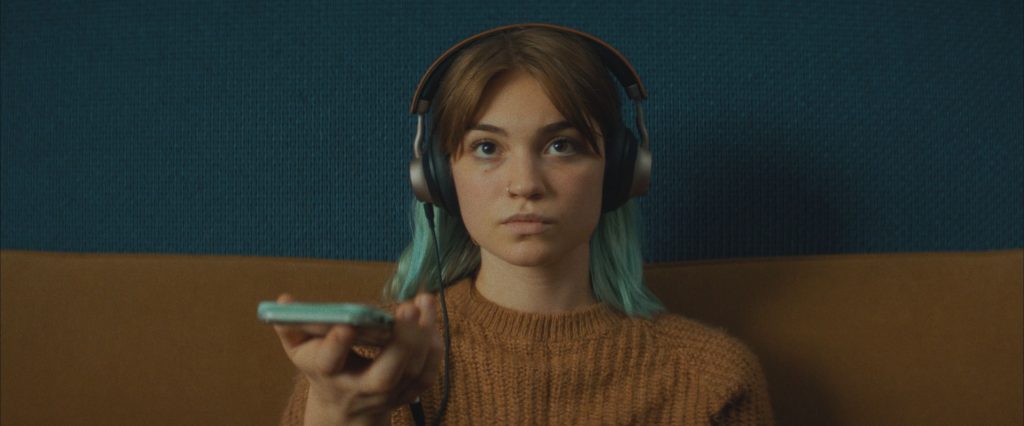
Supercool has the familiar arc of a teen comedy – until it doesn’t. We get the high school cafeteria lunch period, the adolescent social awkwardness, the bullies and the parents-away teen house party. And then there are some unexpected sparkles.
Our protagonists, Neil (Jake Short) and Gilbert (Miles J. Harvey) have a commonplace obsession for teen boys: they aspire to get SOME sexual experience with another person. And Neil worships a girl whom he is afraid to even talk to,
There’s a funny scene (glimpsed in the trailer below) where the guys fantasize a situation where girls would be attracted to them, unaware that Neil’s parents are hearing every word.
The guys also have two misadventures that put them in hilariously uncomfortable sexual situations.
Neil has a helluva imagination and creates graphic novels that picture how he hopes to eventually woo his beloved. Fortunately, he is sweet on a girl who turns out to have an awesome sense of humor.
I must note that Supercool does contain the best-ever movie use of the (only?) Haddaway song What Is Love.
I screened Supercool for its world premiere at SFFILM in April 2021. Supercool can now be streamed from Amazon, Vudu, YouTube and redbox.
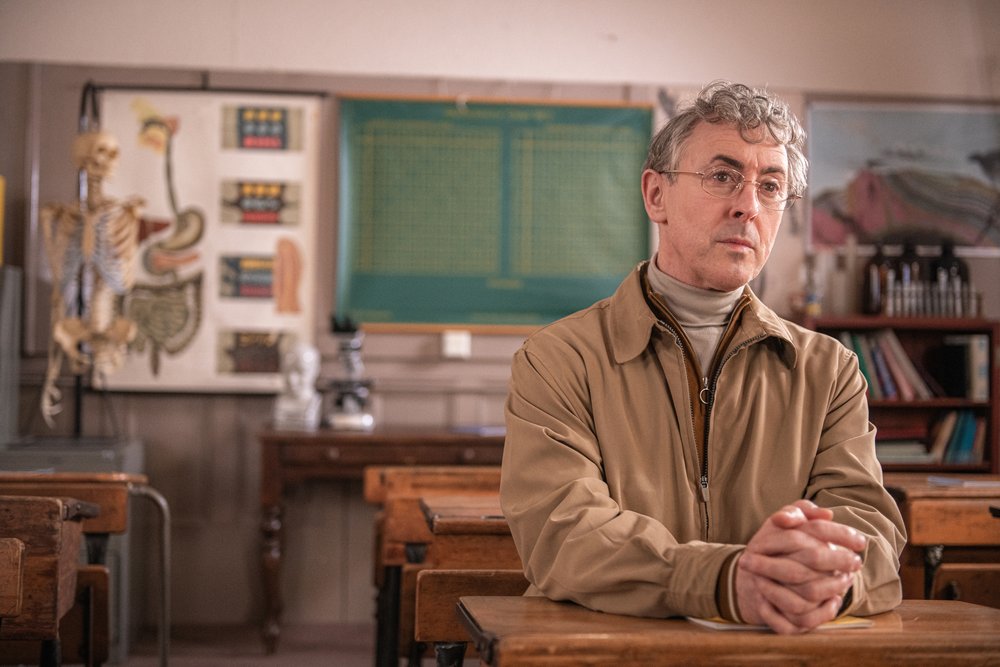
Alan Cumming in MY OLD SCHOOL, a Magnolia Pictures release. Photo courtesy of Magnolia Pictures.
The absorbing documentary My Old School is about a guy who fooled his Scottish high school classmates and, notably, the school authorities, into believing that he was not who he really was. The impersonation was extreme, audacious and more than a little creepy, and resulted in a scandal well-known in the British Isles.
Writer-director Jono McLeod was one of those classmates, and he has been able to garner more than a handful of the kids and teachers who were eyewitnesses. And he secured over five hours of audio from the impersonator himself, which are brilliantly lip-synced by actor Alan Cummings (kind of the opposite of voiced by).
MY OLD SCHOOL, a Magnolia Pictures release. Photo courtesy of Magnolia Pictures.
If that weren’t creative enough, McLeod uses animation to illustrate key moments in the story. And, surprisingly, there comes a video clip of a high school performance of the musical South Pacific, a performance that would be excruciatingly mundane – except for what the audience knows.
In telling My Old School, McLeod reveals the deception itself right away and then gradually unspools a series of more shockers, about how the ruse was executed, with whose help and the motivation. It’s quite the story.
My Old School opens in theaters this weekend, including at the Opera Plaza in San Francisco.
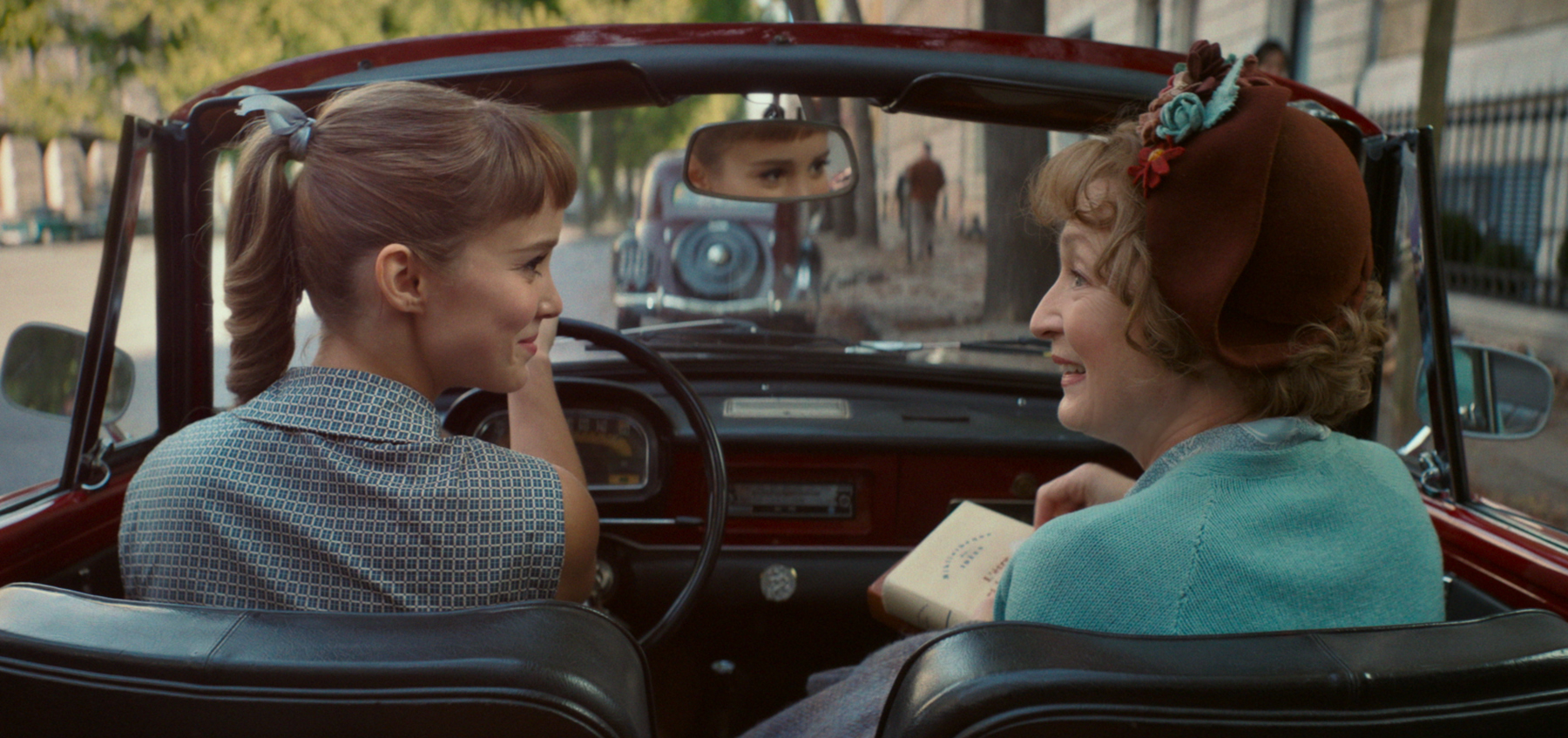
In the goodhearted Mrs. Harris Goes to Paris, Lesley Manville plays the titular character, a war widow who cleans houses in 1957 London. Although there is nothing in her hardscrabble circumstance that seems to justify her bubbly hopefulness, we in the audience know that everything is going to work out. This is an unabashed Feel Good movie.
Mrs. Harris Goes to Paris is an unchallenging, fluffy film and doesn’t pretend to be anything else. It is well-crafted and well-acted, especially by Manville.
Lesley Manville has amassed a distinguished body of work in Mike Leigh films alone: Secrets & Lies, Topsy-Turvy, High Hopes, All or Nothing, Vera Drake, and, most brilliantly, in Another Year. She was Oscar-nominated for Phantom Thread.
The great Isabelle Huppert plays the sourpuss role that Lesley Manville often plays in Mike Leigh films. I’m always glad to see Isabelle Huppert and Nathalie Baye, even in the one-dimensional roles they’ve gotten in the past two years.
The one singular segment of Mrs. Harris Goes to Paris is a depiction of the opening for the 1957 Dior collection. I have little (maybe no) interest in fashion, but I was riveted.
I wasn’t planning to see this movie, but The Wife really felt like sitting in a movie theater, which I always encourage. Although I had predicted the the ending within 30 minutes, it wasn’t a painful experience.
Nothing wrong with a dose of sentimentality once in a while. Mrs. Harris Goes to Paris is in theaters.
Photo caption: THE FAITHFUL: THE KING, THE POPE, THE PRINCESS. Courtesy of Annie Berman.
In the documentary The Faithful: The King The Pope The Princess, filmmaker Annie Berman follows the people who are devoted to iconic celebrities, both dead (Elvis Presley and Princess Diana) and alive (the Pope du jour). I don’t mean “fans”, I mean “devoted”, as in those who make annual pilgrimages and who decorate shrines.
At first, Berman wryly observes the endless variety of cheesy Elvis souvenirs, and the possibly cheesier panoply of Pope souvenirs. She archly interviews a Papal spokesman about the Vatican’s commercial licensing of the Pope’s image. We see what are purported to be Pope lollipops, but when they are unwrapped, the Pope’s image turns out to be on a paper cover, so no tongues actually commit the sacrilege of licking the papal face.
But Berman – herself returning yearly to Graceland and Elvis’ Tupelo birthplace, a London Princess Di shrine and the Vatican – focuses on the faithful. She lets them talk about their obsessions, and how someone they never met “touched their lives”. Berman is remarkably nonjudgmental with these people and their sincere devotion and chooses not to mock them.
THE FAITHFUL: THE KING, THE POPE, THE PRINCESS. Courtesy of Annie Berman.
Finally, Berman has to ask herself whether she herself is too obsessed with this project on obsession.
Berman’s narration takes us on a journey that sometimes amusing, sometimes appalling, but fundamentally meditative.
SPEER GOES TO HOLLYWOOD. Courtesy of Vanessa Lapa.
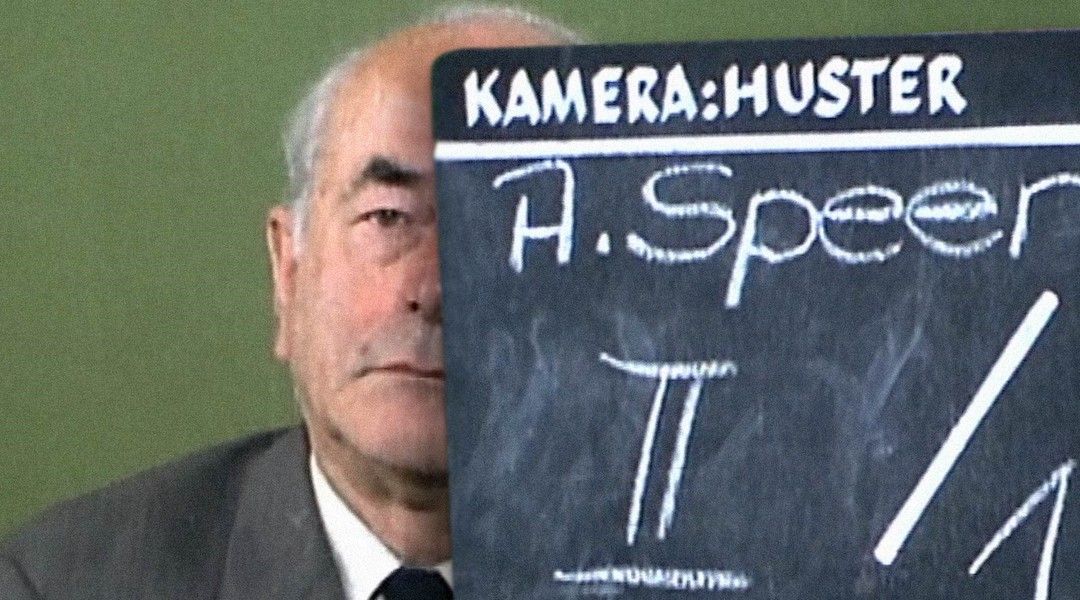
In her absorbing documentary Speer Goes to Hollywood, filmmaker Vanessa Lapa takes us inside a Nazi war criminal’s brazen attempt to rehabilitate his image into “the Good Nazi”. Previously unheard private audio recordings of Albert Speer himself reveal him to be one of history’s most audacious spin doctors.
Speer, the highest ranking Nazi to escape execution at the Nuremberg Trials, was the master of the Nazis’ wartime production efforts. A trained architect, any ability Speer had to design structures was surpassed by his genius in logistics. In Speer Goes to Hollywood, Speer displays an ever greater gift for dissembling.
After being released from prison in the mid 1960’s, Speer published a bestselling (and self-serving) memoir, Inside the Third Reich, to perpetuate what is known as The Speer Myth. Speer would have us believe that the worst crimes in history occurred – right under his nose and to his benefit – without any participation on his part. Speer’s defense was essentially, “Hey, it was the OTHER Nazis“.
(Note: not even a liar as bald-faced as Speer denied that the Holocaust happened.)
To supply the German war machine, Speer exploited the nearly limitless pool of those conquered, persecuted and to be exterminated by the Nazis. Powering his production with forced labor, Speer enslaved 12.5 million victims and worked many of them to death, all to perpetrate a war of aggression.
In the tapes, we hear Speer collaborating with Andrew Birkin, a Stanley Kubrick protege, on the script for a film to further Speer’s version of history. In the face of damning evidence, Speer never wavered in his deflections, dodges and denials. Speer Goes to Hollywood reveals Albert Speer to stay on message with unmatched relentlessness, discipline and audacity.
Andrew Birkin was trying to cash in on the popularity of Inside the Thrd Reich. The tapes show Birkin to be stunningly enabling in the attempted whitewash. Once Birkin slips and blames a kerfuffle on “the Jewish machine”.
Another Birkin mentor, Carol Reed is the truth teller. Reed, the director of The Third Man, gives Birkin a reality check – this IS a whitewash, pure and simple.
A prime example of the banality of evil, Speer doesn’t seem to be a fanatic hater, but an amoral grasper/climber, willing to swallow even genocide as an acceptable price for getting ahead. He does display an ingrained antisemitism, once tossing off “Of course, we resented the Jews“, as if, who wouldn’t?
Here’s a tantalizing nugget from Speer Goes to Hollywood. We hear Speer claim to have written the top Nuremberg prosecutor, American Robert Jackson, to claim important knowledge of Germany’s neurological warfare research, using it as leverage to avoid being turned over to the Soviets. Speer hints at an implied quid pro quo, but given Speer’s credibility, who knows if any of it is true.
The ever-watchable Speer Going to Hollywood chronicles unashamedness on a mass scale.
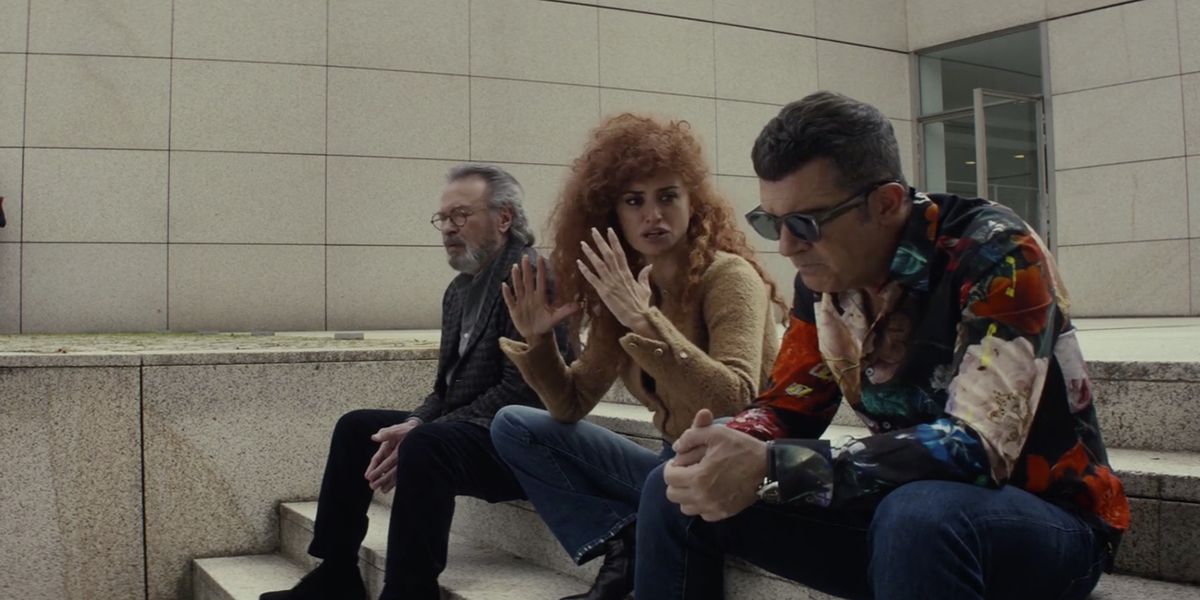
Photo caption: Oscar Martínez, Penélope Cruz and Antonio Banderas in OFFICIAL COMPETITION. Courtesy of IFC Films.
The smart and biting satire Official Competition uses the world of filmmaking (where better?) to send up professional jealousies. A billionaire wants to produce a great movie as his legacy, so he assembles a filmmaking Dream Team: the famed director Lola (Penélope Cruz), the global movie star Félix (Antonio Banderas) and the renowned sage actor Iván (Oscar Martínez). Their egos come along, too.
Ivan, a leading acting teacher who pioneers new and challenging theater, is the critical and academic world’s most esteemed actor. There’s a wonderful scene where Ivan and his wife (a children’s’ author) sit in their boho apartment listening to an avant garde audio performance.
Felix, in contrast, has become a world-wide celebrity by starring in what Martin Scorsese calls global audio-visual entertainment to distinguish these movies from cinema. Adored by millions of fans and used to having his whims and appetites satisfied by toadies, Felix is convinced that he has earned his reputation as a great actor. (And he shows up to every event with a different bimbo on his arm.)
The tycoon has purchased a Nobel Prize-winning novel (that he hasn’t read) to be adapted into a screenplay. It’s about a rivalry between brothers. (In one of Official Competition’s many delicious ironies, this source material is very pedestrian, several rungs below East of Eden, for example.)
Lola (Cruz wears a wig that is a mountain of reddish tangles) is a piece of work herself. She enjoys abusing her power as director and is devoid of personal boundaries.
Felix and Ivan are oil and water,and Lola, for artistic reasons (and more than a touch of sadism), provokes their latent rivalry, seeking to enhance what will be the tension in their on-screen rivalry. In nine days of rehearsals before the shoot, Lola plunges Ivan and Felix into a series of evermore ridiculous, intrusive and degrading acting exercises. She has them read lines under a huge, suspended rock, binds their bodies together in cling wrap, and overamplifies their kissing noises.
Lola’s caprices accomplish two things with Ivan and Felix. She turns their passive contempt for each other into open hatred. And she makes them hate her, too.
Each actor (and Lola, too) has a massive ego begging to be deflated, and the battles between them in Official Competition are very, very funny.
The ending of Official Competition is perfect – one of the cleverest and most satisfying that I’ve seen in a good long while.
The Argentines Mariano Cohn and Gastón Duprat co-directed Official Competition, which they co-wrote with Andrés Duprat. Official Competition is being described as an arch takedown of the movie industry, but the egos parodied here are present in many walks of life.
Cruz, Banderas and Oscar Martínez (the hilariously dark Wild Tales) each deliver dynamite performances. Irene Escolar is very good in a deadpan and essentially silent role as the billionaire’s daughter cast in the movie.
[Note: Prior to Official Competition, the Spanish stars Cruz and Banderas had only shared the screen for about two minutes in I’m So Excited; they did not work together in Pain and Glory, in which they both appeared in different segments.]
Official Competition, so far the wittiest film of 2022, is in theaters.
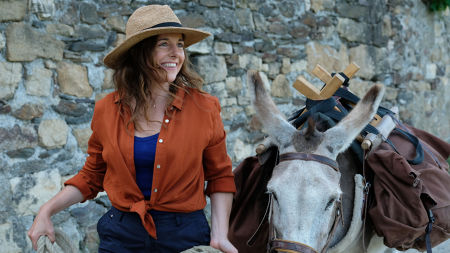
In the intriguingly titled French comedy My Donkey, My Lover & I, Antoinette (Laure Calamy) is a vivacious and goofy schoolteacher in a French provincial town. She’s single, but she’s head over heels into a fling with a married man. She’s excited that’s he’s taking her away to a resort at the upcoming school holiday, but – at the very last minute – he instead submits to a mountain hiking trip with his family.
Antoinette’s distraught and angry disappointment soon transforms into determination and lunacy – she decides to go to the same network of mountain trails, rent a donkey and encounter him in the mountains.
Here’s what I didn’t know before I stumbled on this film at the Mill Valley Film Festival. In 1879, a lovelorn Robert Louis Stevenson, with only a donkey companion, took a solitary hike in Southern France and penned his travel memoir Travels with a Donkey in the Cévennes. It’s common for today’s French to spend a week of their vacations re-creating Stevenson’s experience. It’s a thing, and it’s spawned a cottage industry of donkey rentals and mountain hostels.
Antoinette can be an over-sharer, and when she blurts her mission to another hiker, it goes viral, and soon everyone else in the mountains knows. Having prepared for a lie-by-the-pool vacation, she is ill-equipped, especially in the footwear department, to trudge over mountains,. And, of course, she gets the very most uncooperative donkey. How is she going to find her lover – and, if she does, what is she going to do with him?
Laure Calamy is a brilliant comic actress (and one of the highlights of last summer’s Sibyl). She knows that the key to comedy is for an actor to be absolutely committed (with no hint of winking at the audience) to an absurd course of action. This is why Buster Keaton, Lucille Ball and Gene Wilder were performance geniuses. And it is why Will Ferrell isn’t as funny as Bill Hader or Kristen Wiig.
In My Lover, My Donkey & I, Calamy is all in on Antoinette, a woman who can be both alarmingly unself-conscious and cringingly self-conscious, and both pathetic and empowered. Antoinette endures indignity after indignity, but Calamy’s radiance shines through.
The premise of this film seems utterly unbelievable, but the story is based on actual events which are well-known in France, hence the French title Antoinette dans les Cévennes.
My Lover, My Donkey & I may not be Annie Hall or even There’s Something About Mary, but there are worse ways to spend 97 minutes than with the delightful Laure Calamy. It’s opening July 22, including in the Bay Area at the Opera Plaza and the Rafael.
Photo caption: Juliette Binoche and Vincent Lindon in Claire Denis’ BOTH SIDES OF THE BLADE (FIRE). Courtesy of SFFILM.
With some of Frances’s top filmmakers on the job – Both Sides of the Blade is not your conventional love triangle.
Sara (the ever rapturous Juliette Binoche) has built a ten-year relationship with Jean (Vincent Lindon), that has survived his prison sentence. Sara had previously been with François (Grégoire Colin), but left him because she valued Jean’s reliability, loyalty and decency. When François shows up again in their lives, Sara is drawn to him again.
Both Sides of the Blade is the work of French auteur Claire Denis (35 Shots of Rum, Let the Sunshine In). With Denis, Binoche and Lindon layering in all the complexities of these characters, the result is unexpected.
I screened Both Sides of the Blade (also known as Fire) earlier this year for this year’s San Francisco International Film Festival (SFFILM). It opens in Bay Area theaters this week.
Photo caption: Colie Moline and Hollyn Patterson in BITTERBRUSH. Courtesy of Magnolia Pictures.
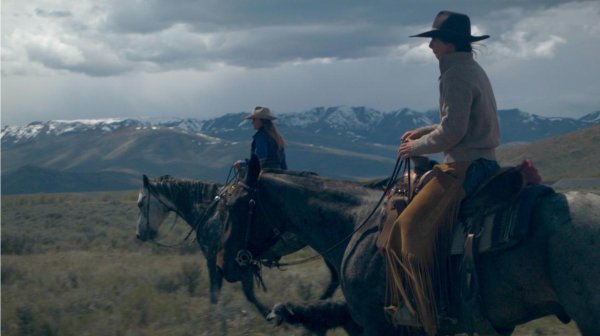
In the cinéma vérité documentary Bitterbrush, Hollyn and Colie, two women in their early twenties do their jobs. Because they are range riders, their job is to move into a spartan cabin high in the remote mountains of eastern Idaho and collect cattle pasturing in the heights. Over several months, the two of them, on horseback and aided by a few trained dogs, find and herd 500-600 head of cattle.
This is LITERALLY not their first rodeo, and we quickly see that Hollyn and Colie are already seasoned, skilled and resourceful. These are two very young women alone on an isolated mountain and responsible for hundreds of valuable animals – and they face no situation that confounds them. We also see that range riding is hard, hard work. And it’s even harder in a snow storm.
As do any co-workers, Hollyn and Colie shoot the breeze. Their hopes and dreams and future plans are vague, along the lines of “If I won the lottery“, until one development forces more focus.
For those of us not in the cattle industry, the cattle-herding ability of the dogs is a revelation.
Technically, this is a workplace documentary. All the gals do on camera is go about their daily work, but the novelty of that work and the rapturous setting make the leisurely pace of Bitterbrush surprisingly riveting. This is director Emelie Mahdavian’s second feature, and it’s damn good.
The location, in high Rocky Mountain valleys, is stunning. Cinematographers Derek Howard and Alejandro Mejia take full advantage.
Sensibility alert: this film is about the livestock industry, and horses and cows are not treated as suburban pets.
Bitterbrush is streaming on Amazon, AppleTV, Vudu and redbox.
Colie Moline and Hollyn Patterson in BITTERBRUSH. Courtesy of Magnolia Pictures.
Photo caption: Sylvie Mix in POSER. Photo courtesy of Oscilloscope Films.
Poser, a deeply psychological portrait of an artistic wannabe among real artists, was the Must See at the 2021 Nashville Film Festival and it’s in theaters now (albeit hard to find). It is worth seeking out.
Lennon (Sylvie Mix) reveres the underground music scene of Columbus, Ohio’s Old North (which she compares to the cultural achievements of Renaissance Florence). Her entrée is a podcast, which allows her to meet a panoply of local artists, including Bobbi Kitten, the charismatic front woman of the real life band Damn the Witch Siren. At first, we chuckle and cringe at Lennon, until it becomes apparent that a much darker personal plagiarism is afoot and Poser evolves into a thriller.
Poser is the first narrative feature for directors Ori Segev and Noah Dixon (Dixon wrote the screenplay), Mix, Kitten and damn near the entire cast and crew, and it’s packed with original music. Segev and Dixon are Columbus filmmakers who work in music, and they wanted to set a story in that music scene with their favorite bands; they could have done that with a banal premise, but instead their story is super original
There is so much in here about identity and the creative process, lots of original music and some cultural tourism, too. A shot of the recording of train sounds is indelibly chilling.
The podcast lets Lennon invite herself into the world she worships. When Lennon is invited up on a rooftop by two actual artists, she can barely contain her excitement. We find Lennon amusing until she practices aping an artist in front of her mirror, and we sense something much darker is afoot. Stealing the creative work of someone else is plagiarism – but what is stealing someone else’s identity?
It’s easy to mock self-invention, but every achiever begins with the ambition to be something he/she is not yet. (And it doesn’t escape me that no one but me decided that I would become a movie blogger.)
Sylvie Mix and Bobbi Kitten in POSER. Photo courtesy of Oscilloscope Films.
Be prepared to be creeped out by Mix’s performance and to be dazzled by Bobbi Kitten’s magnetism. This is the first feature film for Sylvie Mix, and she is able to turn the role of a passive, unaccomplished, initially silly character into something powerful.
Poser is the first screen credit for the exuberantly confident Bobbi Kitten, who commands our attention whenever she is onscreen. Damn the Witch Siren is the premiere electronic act in Columbus, Ohio, and five of her songs are on the soundtrack.
Z Wolf in POSER. Photo courtesy of Oscilloscope Films.
Kitten’s colleague Z Wolf is also a presence in Poser. Z Wolf always wears a full wolf mask on his head, sipping a fountain drink through a straw with great practicality.
The audience gets to visit the Old North, Columbus Ohio’s local arts neighborhood. There’s a very funny montage where we hear from real artists and aspiring artists. It reminded me of a code that The Wife and our niece Sarah devised when strolling through an art show – BA for Bad Art, NA for Not Art and KA for Kid Art. One very stoned guy marvels over the secret of the doubled-over potato chip.
Poser is rolling out in theaters and is playing Landmark’s Opera Plaza beginning July 8. My favorite film at last year’s Nashville Film Festival, Poser is one of the Best Movies of 2022 – So Far.