Photo caption: Jacob Elordi in FRANKENSTEIN. Courtesy of Netflix.
This week on The Movie Gourmet, new reviews of Jennifer Lawrence ablaze in Die My Love, the Netflix miniseries Death By Lightning and the artsy period allegory Harvest, to go with recent reviews of Frankenstein, A House of Dynamite, Deliver Me from Nowhere, Nuremberg and Blue Moon. The Palm d’Or winner at this year’s Cannes Film Festival, It Was Just an Accident, opens more widely today, so expect my review in the coming week; I’ve heard and read good things.
I will not be seeing Now You See Me Now You Don’t because the film’s trailer exposes the screenplay as stupefyingly lazy. Why would you have Woody Harrelson, born in 1961, putting down a kid born in the 2000s for using the word bummer, which came into wide use in the Hippie 1960s?
I also want to warn you off of The Summer Book, which you may see algorithm-recommended on your streaming platform and which I discussed in October.
REMEMBRANCE
Actor Tatsuya Nakadai starred in Akira Kurosawa’s two great color epics Ran and Kagemusha, and played the foil to Toshiro Mifune’s hero in Yojimbo.
CURRENT MOVIES
Frankenstein: who is the real monster? In theaters and on Netflix.
A House of Dynamite: a master filmmaker reminds us of the terrifyingly plausible. Netflix.
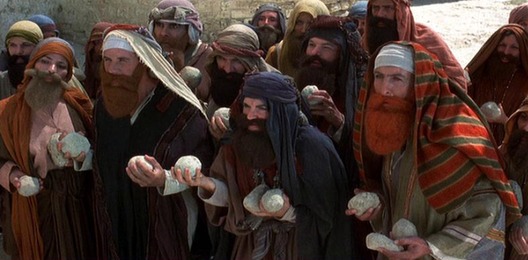
On November 15, Turner Classic Movies airs one of the great satires, Monty Python’s Life of Brian, which brilliantly skewers Biblical epics, left-wing militants and political correctness, the origin story of Christianity, religion and human nature, generally. Life of Brian also makes my lists of Worst Teeth in the Movies and Least Convincing Movie Hair.
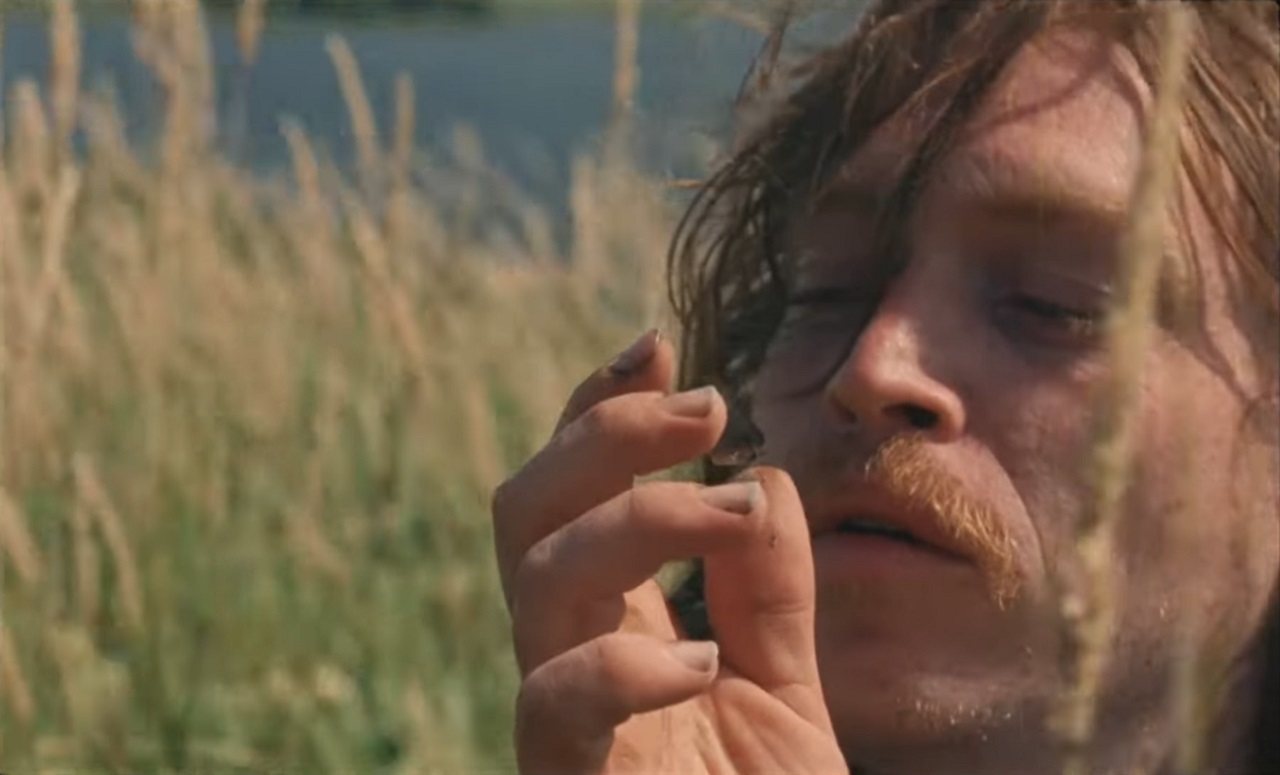
Photo caption: Caleb Landry Jones in HARVEST. Courtesy of MUBI.
The artsy allegory Harvest is a period piece, and it takes a while to figure out just what period of European peasant history we’re in. The look of Harvest immediately reminded me of The Return of Martin Guerre, set in 16th century France. But Harvest’s story takes place in Scotland between 1750 and 1860, in the Highland Clearances; in this period, landowners switched to more profitable, less labor-intensive agriculture, thereby depopulating huge swaths of Scotland.
The central character is Walter (Caleb Landry Jones), who is, unusually, a peasant by choice. He had been manservant to a landowner, but fell in love with a rural woman and moved to her village. Walter is more cosmopolitan than his neighbors; although he isn’t familiar with maps, he quickly grasps the concept.
Walter’s former boss and current landlord is Master Kent (Harry Melling), a gentle soul adrift as he mourns his late wife. Kent is not just a kind landlord, he is laughably lenient as he overlooks bad behavior by his peasants.
But as Kent’s wife estate is settled, he is replaced by the ruthless, smirking relative Jordan (Frank Dillane of Urchin), who can’t wait to get rid of all these inconvenient peasants so more sheep can graze. There is, of course, nothing the peasants can do about it.
So, Harvest seems to be an allegory about the inhumanity of unbridled capitalism. That shouldn’t take two hours and 19 minutes to tell, but that’s how long Harvest drags on.
I was eagerly anticipating Harvest because of my admiration for its Greek director, Athina Rachel Tsangari. Her Chevalierwas one of my Best Movies of 2016. (In 2011, Tsangari brought her hilariously offbeat Attenberg to SFFILM.) Harvest is Tsangari’s first English-language feature, and she used a different co-writer this time, which did not help with the resultant film.
If you must stream it, Harvest is available on AppleTV.
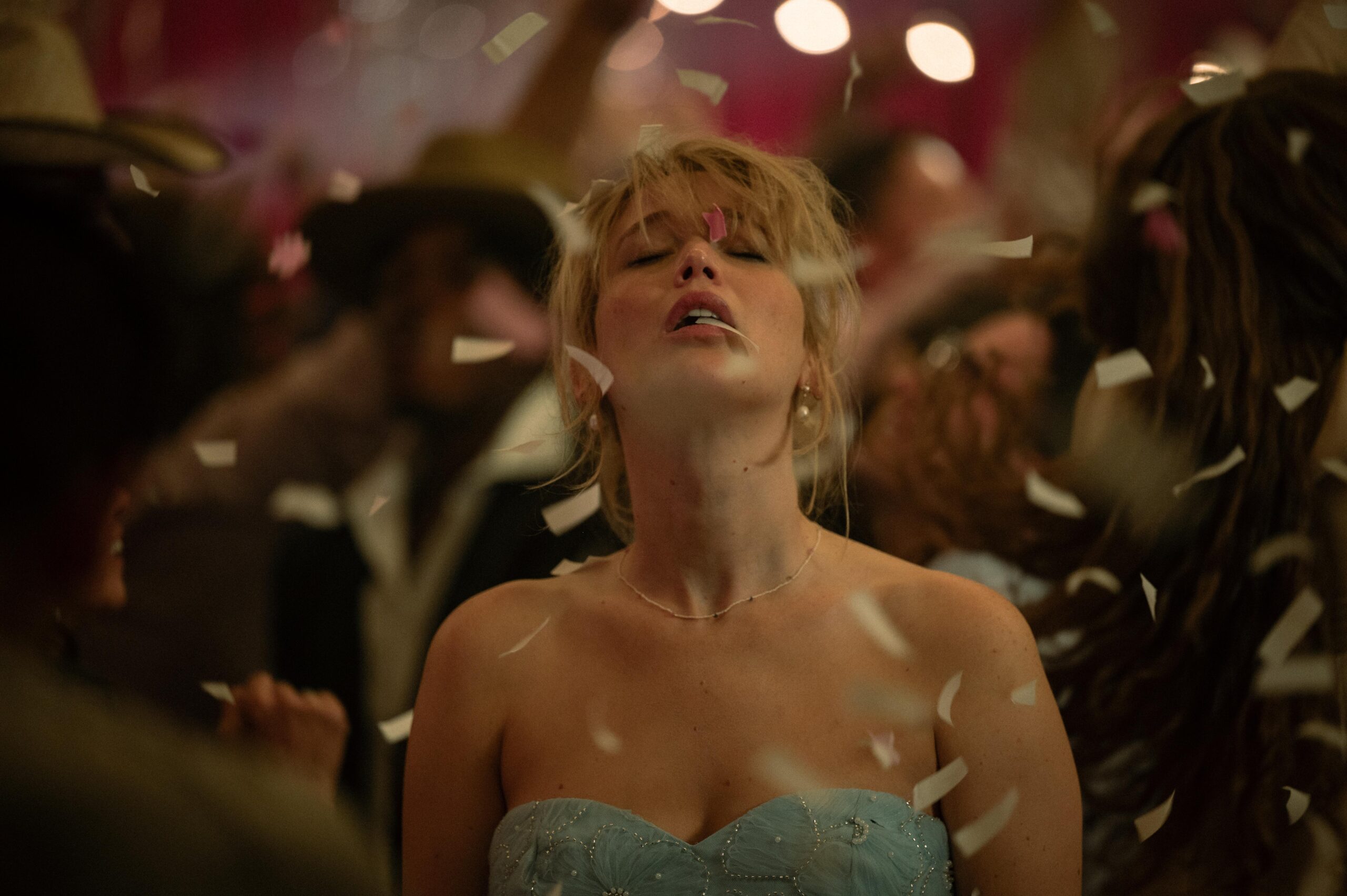
Photo caption: Jennifer Lawrence in DIE MY LOVE. Courtesy of MUBI.
In perhaps the year’s best onscreen performance, Jennifer Lawrence delivers an astonishing portrait of a young woman’s mental breakdown in Die My Love. Lawrence plays Grace, a writer who marries Jackson (Robert Pattison), whose job requires him to be on the road for days at a time. They move into Jackson’s inheritance, a ramshackle house in Montana outside the town Jackson’s mom Pam (Sissy Spacek) lives in. And they have a baby.
Grace is playful and imaginative, and she adores her baby. But she’s isolated at home with no relief from the grind of the baby care. She has lost her interest in writing. She becomes tired, irritable and down in the dumps. Jackson is selfish, clueless about Grace’s changing needs, and has a knack for doing exactly the wrong thing, like bringing home the most annoying pet dog on the planet.
Grace’s mother-in-law Pam, who likes Grace, sees that she is struggling and tries to help. But Grace slides into depression with ever more alarming symptoms and decompensates. Finally, Grace’s behavior shocks Jackson, who starts doing everything he can think of to help, but he is ill-equipped, and it’s too little, too late.
Many actors would love to portray an explosive meltdown, and Lawrence makes you lean back in your theater seats when Grace goes off. But Jennifer Lawrence’s genius is most apparent in the moments that she is just BEING in her condition and in the moments that she is trying to hold it together for others. As Grace’s psyche evolves, this is a performance of astonishing texture and nuance.
Robert Pattinson and Jennifer Lawrence in DIE MY LOVE. Courtesy of MUBI.
Pattinson is excellent as Jackson, who the audience initially sees as a shit, but who becomes very sympathetic as he struggles to help Grace get right, before her illness destroys him, too. Sissy Spacek, is perfectly cast as Pam, who has her own struggles with grief and aging, but brings her good heart, intuition and common sense to become the audience’s surrogate.
What’s going on with Grace? I think The Wife was correct is suggesting that Grace came with an underlying bi-polar disorder which was exacerbated by the postpartum depression. Early in the movie, we see Grace as playful, but maybe that playfulness is a bit frenzied. Of course, it’s fun for Jackson then, but she’s destined to become way more than he can handle. Late in the movie, we see flashbacks from their wedding, and the signs are there.
Die My Love was directed and co-written by Lynne Ramsey, who seems to specialize in madness (We Need to Talk About Kevin, You Were Never Here). Ramsey keeps us off-balance by keeping us unsure about whether what is onscreen is Grace’s real experience or a dream, delusion, or hallucination. Both a black horse and the LaKeith Stanfield character appear to Grace multiple times, but perhaps only once each in reality. It’s just not always clear. After the movie, The Wife and I actually had different views about which of the ending scenes really happened or were imagined. This is smart, artsy filmmaking, which works to keep us guessing.
So, should you see Die My Love? It’s an epic acting performance in a well-made Feel Bad movie, so there you are. Die My Love is now in theaters.
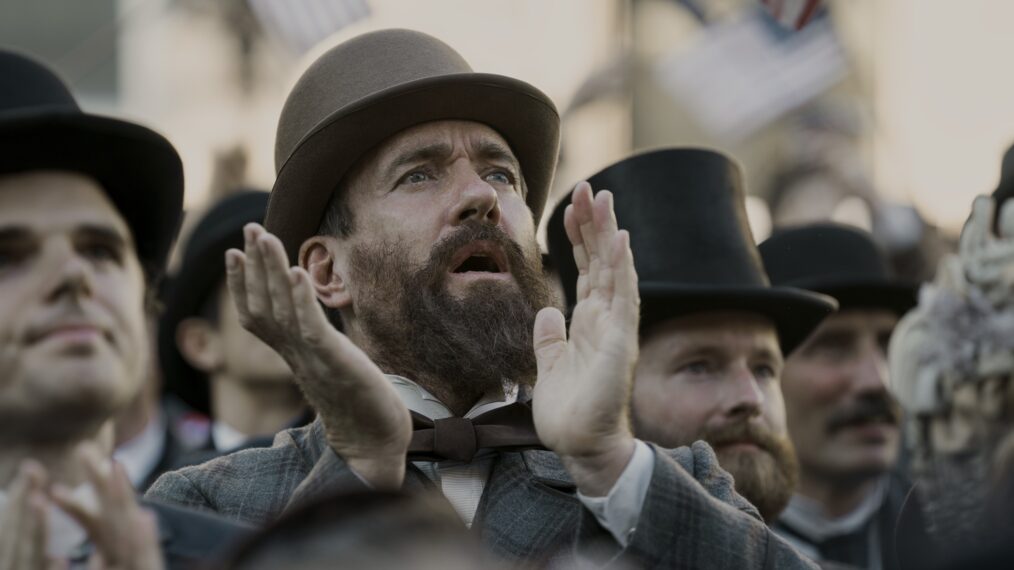
Photo caption: Matthew McFadyen in DEATH BY LIGHTNING. Courtesy of Netflix.
In the four-part Netflix miniseries Death By Lightning, Mike Makowsky (Emmy winner for Bad Education) creates a cracking good story out of an exceedingly obscure segment of our history. In a boring history class, this would be a period in which one President (James Garfield) served only six months and the other (Chester Arthur) was never elected President in his own right, with the big political debate being about patronage versus civil service. But there was also political intrigue, corruption, double crosses, a down-to-the-wire election, madness and murder – and Makowsky makes the story pop.
I’ll be commenting on the series itself, and then the history, and finally a personal perspective from my own life in politics. First, Death By Lightning itself. It’s 1880, and the Republican Party, desperate to keep control of the White House, faces a three-way race between the political heavyweights of the time; none of the three can muster a majority, and, after 33 ballots, the delegates settle on a compromise choice who wasn’t even running – James Garfield (Michael Shannon). And, they choose a guy with a completely conflicting political profile, Chester Arthur (Nick Offerman) as Garfield’s running mate; Arthur hadn’t been running, either. Now the fractured party has to reunite behind the unexpected standard-bearers, refill the empty party coffers and navigate though the minefields of controversy.
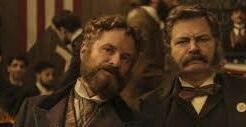
Most of us have heard of Garfield and Arthur because they were Presidents, but the most powerful and visible leaders of the age were James Blaine and Roscoe Conkling – political giants and personal rivals with a visceral hatred for each other. Death By Lightning accurately shows how Garfield and Arthur try to make their way within the overall battle between Blaine (Bradly Whitford) and Conkling (Shea Whigham). It helps that Conkling was an outrageous, venal, womanizing character with a unique haircut that Whigham gets to flaunt. Whigham’s colorful portrayal of Conkling is reason enough to watch Death By Lightning.
The other best reason to watch Death By Lightning is the performance of Matthew McFadyen as the series’ real main character, Charles Guiteau. Guiteau was a highly functioning schizophrenic narcissist who saw himself as deserving of high office and deluded himself into thinking that he had great value as a political advisor. Guiteau, in his grasping for status, also showed himself to be a cunning fraudster and an audacious compulsive liar. Guiteau’s frustration was that everyone he met saw through his harebrained scheming, crank ideas and pathetic pretensions. As insignificant as was Guiteau, he managed to significantly impact history as a presidential assassin. In Death By Lightning, as Garfield, Arthur, Blaine and Conkling engage in real political competition, Guiteau flits around as a crazy pest – and as a ticking bomb.
The acting in Death By Lightning is superb. Shea Whigham, one of my favorite character actors, and Offerman get the flashiest roles, because Conkling and Arthur were such scallywags. Shannon has both gravitas and reserved magnetism as Garfield. Other standouts include Paula Malcomson as Guiteau’s fictional enabling sister, Betty Gilpin as Lucretia “Crete” Garfield and Dominic Applewhite as a young, idealistic party activist.
But the soaring, award-worthy performance is Matthew McFadyen’s star turn as Guiteau. McFadyen (Tom Wambsgans in Succession) is able to show how Guiteau could opportunistically turn on a dime as he reached for the influence he thought he was due, and how Guiteau just couldn’t keep it together when his lies were exposed. Ever watchable, McFadyen’s Guiteau never fails to entertain.
Incidentally, Death By Lightning was shot in Hungary on Hungarian sets with a Hungarian technical crew, but everything passes for America in 1880-81.
Shea Whigham and Nick Offerman in DEATH BY LIGHTNING. Courtesy of Netflix.
The history (contains some spoilers)
Death By Lightning is fictionalized, but accurately captures the politics of the day and the overall arc of the Garfield/Arthur/Conkling/Blaine/Guiteau story.
Even major American political figures, like Presidents and presidential candidates, had no real security at the time. People of the period must have thought of the Lincoln assassination as an awful, unthinkable one off. A regular person could approach and get up close to any politician or elected official, including inside the White House up to the door of the president’s office; (the Oval Office hadn’t been built yet.)
Unlike today, when all the regular government employment is civil service, essentially all federal jobs were appointed politically. So, if you wanted to be a small town postmaster or a clerk in the Interior Department or consul to Naples, you needed to ask the President (or somebody else who could ask him) for the job. Indeed, that meant that the President of the US himself was always swarmed with job seekers.
Guiteau definitely had historical encounters with Blaine. I couldn’t find documentation of Guiteau meeting Garfield, Arthur or Lucretia Garfield, but those encounters depicted in Death By Lightning are all plausible, especially for someone as devious and persistent as Guiteau, who was always on alert to ambush famous people.
Other things that Death By Lightning gets right historically:
Arthur did feel compelled to reverse himself and enact Garfield’s program, which he had initially opposed.
Crete Garfield was indeed a key White House advisor of her husband’s. It’s not depicted in Death By Lightning, but the Garfields’ marriage became close after a very rocky first few years, as you can read on Crete Garfield’s Wikipedia page.
Guiteau really did join (and get kicked out of) a “free love” sect, the Oneida Community. The creeped-out women, who were having sex with the other men in the sect, did nickname him “Charley Gitout”.
All the details of Guiteau’s capture, trial and execution, including his expectation that President Arthur would pardon him in gratitude, his attempts to monetize his notoriety and the song he composed for the gallows, were EXACTLY as they happened in real life.
Roscoe Conkling really was that arrogant and flamboyant and really did sport that haircut with the curly locks on his forehead.
But this IS a fictionalized account:
Death By Lightning portrays Garfield as some sort of citizen farmer who was reluctantly involved in politics. In 1880, Garfield had been in Congress for 17 years and had risen to become the Chairman of the Appropriations Committee and then the Republican Floor Leader in the House. He was a professional politician and a national figure. This was a guy who had been elected to the State Legislature in his 20s, was able to recruit his own Civil War regiment at age 30, serve with distinction and rise to Major General rank by 34.
In Death By Lightning, Guiteau has a good-hearted, gullible sister Franny who enables his misadventures. In real life, Guiteau had no sister, but had a father who didn’t cause Charles’ mental illness, but who used corporal punishment and toyed with the Oneida Community himself, which certainly didn’t help.
Roscoe Conkling really did blunder his career away by resigning from the Senate, but I couldn’t find any source attributing his defeat to the combined efforts of his wife and his mistress.
It’s also not depicted in Death By Lightning, but Garfield, who was both a classics scholar and ambidextrous, would astound folks by writing in Greek with one hand and Latin with the other SIMULTANEOUSLY. Best Presidential party trick ever.
The politics (contains some more spoilers)
I really enjoyed Death By Lightning, and, as a history buff, especially as a student of American political history, I am admittedly a sucker for historical movies. But I also have spent four decades as a political professional, so I frequently DISLIKE movies about politics that I find naive, simplistic or implausible. So, please pay attention when I heap praise on Death By Lightning for capturing how people in politics really behave – especially those at the margins of politics.
Politics draws a lot of hard-working, ambitious people who are motivated by idealism, duty, hunger power, need for attention, and all kinds of reasons. But American democracy is, by definition a public process, and the high visibility attracts lots of mentally unstable people, too. Every politician – from school board member to presidential candidate – has been surprised by some unbalanced person with a crank fixation or worse. It;s the worst in California, where the Brown Act allows anyone to address any local government body on any topic, resulting in psychotics ranting nonsense at their captive audience of elected officials.
Of course, politicians WANT to be visible at public events. In what’s called the grip and grin, it’s traditional for candidates and their surrogates to get their photos snapped (and now we’re in the Selfie Age) with anybody, even those unknown to them. One anonymous guy who got his picture taken with First Lady Roslyn Carter turned out to be serial killer John Wayne Gacy.
While often a person immediately presents as crazy, sometimes you get a ways into the conversation before it happens. What I really love about Death By Lightning are the scenes with both Blaine and Lucretia, where Guiteau eventually makes the one overreaching remark that causes them to instantly recognize, oh, this guy is a crank.
What people didn’t understand in 1880 was that Guiteau hadn’t opposed Garfield, as John Wilkes Booth did with Abraham Lincoln. Guiteau was a huge Garfield fan, who was disappointed when Garfield’s team found Guiteau too crazy for them to hire. (It was also crazy for Chapman to shoot Reagan in an attempt to impress Jody Foster.) I have spent my life in politics, and I can verify that there are a lot of Guiteaus out there.
Makowsky even takes shot at a contemporary politician; he has Garfield proclaim, “No matter how long America stands, there will still be Roscoe Conklings.”
I also highlighted this week’s TCM broadcast of Powwow Highway. If you missed it, you can find it on the Criterion Channel. Or, for another early indie with an Indigenous lens, you can watch Smoke Signals from 1998 on Amazon, Apple, YouTube and Fandango.
I also want to warn you off of The Summer Book, which you may see algorithm-recommended on your streaming platform and which I discussed in October.
REMEMBRANCE
Three-time Oscar nominee Diane Ladd is known for Chinatown, Alice Doesn’t Live Here Anymore, Ghosts of Mississippi (she was a Mississippi native) and Primary Colors. She worked with her real life daughter Laura Dern in five movies, and in Rambling Rose, they became the first mom and daughter to be nominated for Oscars for the same movie. Early in her career, she appeared in Roger Corman’s biker exploitation film, The Wild Angels.
CURRENT MOVIES
Frankenstein: who is the real monster? In theaters and on Netflix.
A House of Dynamite: a master filmmaker reminds us of the terrifyingly plausible. Netflix.
To Kill a Wolf: mysteries revealed. Amazon, AppleTV, Fandango.
ON TV
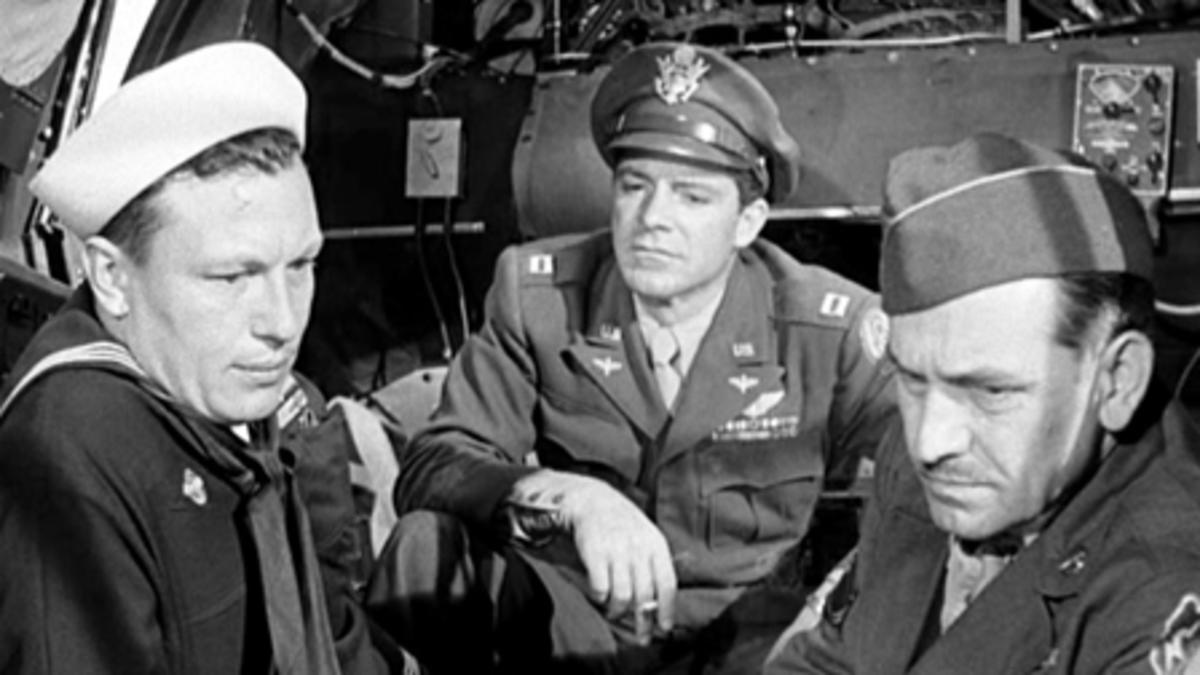
Harold Russell, Dana Andrews and Frederic March in THE BEST YEARS OF OUR LIVES
We all need to feel better about America, even if we have to go back to 1946 to justify it with Turner Classic Movies’ November 11 broadcast of The Best Years of Our Lives. One of the greatest movies of all time, The Best Years of Our Lives, is an exceptionally well-crafted, contemporary snapshot of post WW II American society adapting to the challenges of peacetime. It won seven Oscars. And it’s still a great and moving film. When Frederic March, immediately back from overseas, sneaks back into his apartment where Myrna Loy is washing the dishes, I dare you not to shed tears at her reaction.
The exceptional American Experience biodoc Kissinger brings a balanced perspective to one of the most visible and important figures in 20th Century US history, Henry Kissinger. It neither canonizes or vilifies Kissinger, but presents a clear-eyed, unsparing look at his career. That’s important, because Kissinger’s genius at public relations may have exceeded his formidable diplomatic skills and distorted his image during his lifetime.
Kissinger is solid, well-sourced history. We hear directly from several former Kissinger staff members with an intimate, inside view of Kissinger the man and his work, We also hear from Kissinger’s son, who adds insightful personal stories about his father. And, of course, we hear and see archival footage of Kissinger himself, although perhaps never candidly. Kissinger is told in two parts over three hours.
Kissinger emerged into American public consciousness seemingly fully-formed in his mid-forties, a Harvard brainiac with a heavy German accent. Kissinger brings us his German childhood, family emigration to the US and the WW II and college experiences that molded him.
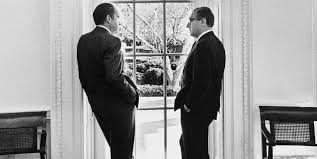
Naturally, Kissinger details the two great foreign affairs triumphs of Kissinger’s partnership with President Richard Nixon. First, there was the historic opening of relations with China, a hitherto mysterious and sinister closed society, The story of Nixon’s original idea, of the ping pong diplomacy and Kissinger’s secret trips is still exciting.
Second, once Nixon and Kissinger had established a relationship with China, they had outflanked the Soviet Union. That resulted in detente with the USSR and the SALT negotiations leading to the Anti-Ballistic Missile Treaty, the first limitation of the proliferation of nuclear arms.
These were real, groundbreaking achivements that sprang from Kissinger’s brilliance, but also his sense of realpolitik. He was all about superpower positioning, which he prioritized above other considerations. Along the way, Kissinger found tradeoffs acceptable that had undeniably momentous consequences.
In the decade from 1965 though 1975, American society was torn apart by the Vietnam War. Taking responsibility for the war in 1969, Nixon and Kissinger based their policy on “peace with honor”, which meant they wanted to avoid the unpleasant optics of Vietnam falling to the Communists. But, from 1968, at the latest, it was always apparent that the Republic of Vietnam would fall to North Vietnam as soon as the US abandoned their South Vietnamese allies. Wanting to avoid the PR consequences of South Vietnam’s ignominious collapse, Nixon and Kissinger extended the war for another six years. That six-year extension of the cost 38,094 American and countless Vietnamese lives, all to achieve exactly the same outcome as a withdrawal in January 1969.
Kissinger references, but does not emphasize something even worse – that Kissinger and Nixon encouraged the Vietnamese Communists NOT to settle with the US in 1968, but to hold out for a better deal with Nixon.
Kissinger does document, in the greatest detail I’ve seen, the Kissinger-Nixon secret war in Cambodia, and their paranoid and unconstitutional concealment of it. And it covers Kissinger’s role in the overthrow of Chile’s leftist, but democratically elected government, leading to decades of human rights violations by the repressive Pinochet regime. Kissinger also presents voices from Cambodia and Chile, pointing out how, over fifty years later, the two nations remain traumatized by Kissinger policy.
And then there’s Watergate. Kissinger shows how the Nixon Administration’s secret wiretapping of Americans was started b.y Kissinger, wiretapping his own staff suspected of leaks to the press. Of course, the paranoid and vindictive Nixon took it from there. Ironically, this led to Nixon’s downfall, while Kissinger remained at the heart of US foreign policy in the successor administration. Of course, Kissinger was always Teflon to Nixon’s Velcro.
While in government, Kissinger’s public image was shaped by his sickening manipulation of the press, who made him popular celebrity. The public thought of Nixon’s War in Vietnam and Nixon’s bombing of Cambodia, while ,lauding Kissinger for diplomatic wins with China and the USSR. It culminated with Kissinger actually winning a Nobel Peace Prize for ending a war that he had extended for six years. The guy with whim Kissinger negotiated, Le Duc Tho, turned down his Nobel, rightfully noting that the war was still going on, albeit with Americans having left.
So, Kissinger lays out the history and lets us connect the dots and assesses the legacy of Kissinger’s pragmatism and opportunism. We are able to talk with the Chinese government today, although the relationship is wary at best. We were able to avoid a nuclear showdown with the USSR up to the disintegration of the Iron Curtain in 1991, although Russia remains our most volatile foreign enemy. But at what cost?
If your goal is to project American influence around the world, it’s a fair question to ask, just what does America stand for? If you think that America stands for democratic values, why destroy a democratically elected government? If you think that America stands for freedom of thought and expression, why persecute Americans for their advocacy?
Photo caption: Russell Crowe (left) and Rami Malek (right) in NUREMBERG. Courtesy of Sony Pictures Classics.
The psychodrama Nuremberg pits the Nazi war criminal Hermann Goering (Russell Crowe) against the American psychiatrist Douglas Kelley (Rami Malek) in a high stakes battle of wits. It’s the end of WW II, the full extent of the Holocaust is just being revealed and the Allies are ready to hold the world’s first war crimes trial.
With the suicides of Hitler and Himmler, Goering is undeniably the highest ranking and highest profile surviving Nazi leader. He and other top Nazis are in a military prison run by the US Army, where Dr. Kelley is assigned. The Army’s interest in the defendants’ mental heath was not primarily humanitarian – it was in preventing their suicides so they could be executed by hanging.
Kelley’s intellectual curiosity, though, is alive with the opportunity that any behavioral scientist would envy – probing the psyches of the men with the worst ever human behavior; these are the men who thought the unthinkable and acted to realize it. (And, more prosaically, he hopes to garner material for a profitable book.)
The lead American prosecutor is US Supreme Court Justice Robert Jackson (Michael Shannon), who has to make up the jurisdiction and rules, even the charges, for the trial as he goes along. Nuremberg reminds us that the trial was about more than criminal justice; perhaps even more importantly, the trial was a vehicle to show the world, especially the German people, the extent of the Nazi regime’s crimes against humanity, a term coined by Jackson for the trial. Accordingly, the Allied prosecutors made and showed films documenting the extermination camps. These images were not yet widely viewed at the time, and Malek shows Kelley’s revulsion at seeing the atrocities for the first time.
Nuremberg also reminds us that trying Nazi leaders would come at some considerable risk – the possibility that some of the defendants could make themselves sympathetic or martyrs, or, worst of all, even get off scot-free.
Kelley immediately tags Goering as a narcissist, a diagnosis which Goering himself does not dispute. Goering is uncommonly crafty and sly, tempering his his characteristic arrogance with a jovial charm that even threatens to seduce Kelley. Indeed, climbing to the top of a pyramid of back-stabbers was no mean feat, and Goering’s skills at political infighting and social climbing are formidable. Similarly, he possesses a gift to read the room and accordingly flatter and insinuate. Goering even has the hubris to believe that he will be able to manipulate his way out of a conviction.
With some hubris of his own, Jackson is eager to win a match of wits with Goering, planning to break him on the stand. Kelley, who has seen Goering’s charm and intellect up close, thinks that Jackson is likely to lose a frontal assault and perceives that Goering’s vulnerability lies elsewhere.
The Allied officials, including Kelley initially, intuit that any person who committed such monstrous acts must be some unique kind of monster. In 1946, the concept of the banality of evil was still fifteen years away from being coined by Hannah Arendt at the 1961 trial of Adolph Eichmann. Kelley meets all of the Nuremberg defendants, who Nuremberg accurately depicts as the motley group they were – this one a hoodlum, that one a psychotic crank. Rudolf Hess is depicted as befuddled (or ACTING befuddled as he faked amnesia for the second time). Of course, the Nazis were bullies, and bullies are always less fearsome when they are held to account.
The people who committed the most horrific acts in human history are surprisingly, even disappointingly, ordinary. For every deranged megalomaniac who comes to power, there are plenty of opportunistic thugs who go along for the ride.
Similarly, Kelley finds that Goering is such a greedy, attention-seeking asshole, that he was happy to play along with exploiting racial hatred, even to the point of genocide, just to become richer, more famous and more powerful.
In an impressive performance, Russell Crowe captures Goering’s narcissistic entitlement, magnetic charm, manipulative sociopathy and seemingly unshakable self-confidence.
Kelley starts out with his own hubris, confident that he holds all the cards vis-a-vis Goering, who is not himself a trained psychiatrist and is, after all, locked in a prison cell. Malek is able to portray Kelley’s sense of himself as far more fragile than one would expect, with the potential to become a tragic figure.
John Slattery is very good as a straight-ahead Army prison commander, as is Colin Hanks as an unapologetically venal rival shrink.
In scenes intended to reveal Kelley’s own humanity and manipulations, the character of Goering’s wife Emmy (Lotte Verbeek) is written with too much sympathy for my taste. In real life, Emmy Goering was a real piece of work, who vied with Joseph Goebbel’s wife to outdo Hitler’s mistress Eva Braun as the most prominent figure in the Nazi Reich and who was an enthusiastic looter of Jewish-owned fine art.
The 2023 The Zone of Interest was a masterpiece on the banality of evil. On this subject, I also recommend Blind Spot: Hitler’s Secretary and, for the Indonesian version of banality of evil, the wonderful documentary Act of Killing. For sheer gall that supassed even Goering’s, there’s another documentary, Speer Goes to Hollywood, in which we hear recordings of Albert Speer pitching a Hollywood movie to rehabilitate his image.
Even casual students of history know that Goering didn’t escape conviction, but Nuremberg, in the tradition of fine courtroom dramas, is able to keep the audience hooked on how Goering, Kelley and Jackson will perform at the trial, and whether Goering will destroy anyone else. Nuremberg open in theaters this Friday.
Photo caption: Oscar Isaac in FRANKENSTEIN. Courtesy of Netflix.
If, like me, your idea of Frankenstein is Boris Karloff’s monster staggering around, you’re going to be blown away by Guillermo del Toro’s Frankenstein, a sweeping, operatic tragedy and a triumph of filmmaking. Instead of remaking the 1931 film, del Toro based his film on the 1818 Mary Shelley novel, Frankenstein; or, the Modern Prometheus, and made an epic movie about morality.
In Frankenstein, we learn about Victor Frankenstein’s back story, beginning with traumas in his childhood that form his obsession to overcome the inevitability of human death. The adult Victor (Oscar Isaac) is a scientific genius whose secret work is sponsored by a shady zillionaire (Cristoph Walz). Victor patches together body parts of war casualties, assembling them into a Creature (Jacob Elordi) that he uses electricity to re-animate. Critically, Victor only cares that his experiment has succeeded, and doesn’t recognize any humanity in his Creature, who does, after all, possess a human brain. And things get out of hand.
The Creature is big and scary-looking, but it turns out that his mind is capable of learning, and he comes to move with sinewy grace.
Victor is visited by his brother’s fiance Elizabeth (Mia Goth), a young woman with her own scientific aspirations. More than just a naive do-gooder, Elizabeth’s intellectual curiosity and proto-feminist self confidence allow her to assess the Creature’s humanness and become the moral center of Frankenstein.
Oscar Isaac in FRANKENSTEIN. Courtesy of Netflix.
We sympathize with Victor as a survivor of childhood trauma, we admire his scientific genius and, given that he is played by the very handsome Oscar Isaac, we don’t expect Victor to be the bad guy. Victor seeks to become humankind’s greatest champion, but his arrogance and his callousness and cruelty toward the Creature define him otherwise. As characters in Frankenstein explicitly ask, who is the real monster here?
It is also, of course, a story about man’s overreaching, a central theme of literature and drama since the ancient Greeks, with their Icarus myth and their hubris-filled heroes. Not to mention the Bible (Pride goeth before destruction, and an haughty spirit before a fall). Even my beloved film noir genre is usually about someone doing something they shouldn’t, motivated by some combination of greed and lust. Audacity is required to harvest the biggest rewards (e.g., the Apollo manned flights to the moon), but audacious risks may also bring catastrophe (e.g., both Napoleon’s and Hitler’s invasions of Russia).
We humans are not very good at anticipating consequences. After all, could conquering death somehow be a bad thing? As we now see with AI – it’s impressive that you CAN do it, but SHOULD you do it?
At two-and-a-half hours, Frankenstein is over twice the length of the 1931 version – and for a good reason. Del Toro structures Frankenstein as tales told from three points of view – that of the sea captain who comes across Victor in the Arctic, that of Victor and that of the Creature himself. The first two acts are good storytelling, but Frankenstein’s third act is thrilling and emotionally powerful.
Given del Toro’s skill in bringing fantasies to life (Pan’s Labyrinth, The Shape of Water), we expect a visually unforgettable movie, and that’s what we get. Frankenstein is a spectacular testament to the imaginations and technical skills of del Toro and his collaborators – cinematographer Dan Lausten, production designer Tamara Deverell, costume designer Kate Hawley, composer Alexander Desplat and the hair and makeup team. I foresee Oscar nominations for all of them, and Hawley HAS to win for the stunning colors of Elizabeth’s dresses.
Oscar Isaac is very good as Victor, a man complicated by his best and worst traits. So are Charles Dance as Victor’s cold and cruel father and Lars Mikkelsen as the ship captain. (Dance has acted in thirty-five feature films and television series, including (Mank, Game of Thrones and The Crown, while IN HIS SEVENTIES.)
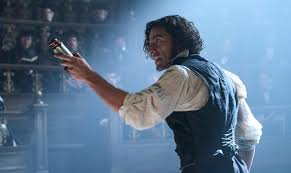
Jacob Elordi in FRANKENSTEIN. Courtesy of Netflix.
The most revelatory performance is, surprisingly that of Jacob Elordi (Saltburn, Priscilla, Oh Canada) as the Creature, who keeps evolving in his capacity to reason and to feel. Buried under pounds of makeup, Elordi is able to clearly express all of the Creature’s feelings through his eyes and the movement of his body.
Like many of you, I don’t enjoy gore and generally avoid the horror movie genre. Here, there’s only two or three minutes of body horror, as Victor surgically chops up corpses and reassembles them as his creation. You can hold your fingers over your eyes or fast forward if necessary. Just don’t miss this movie. There’s no fright or camp here – the tone is romantic and operatic.
Frankenstein is one of the Best Movies of 2025 – So Far. Frankenstein releases on Netflix this Friday. I saw Frankenstein at my local multiplex in an auditorium equipped with Dolby’s ATMOS sound. Most of you will be watching it at home on Netflix. I recommend honoring the filmmaking here by turning off the lights in the room, and watching it, UNINTERRUPTED, on your biggest screen with the sound cranked up.
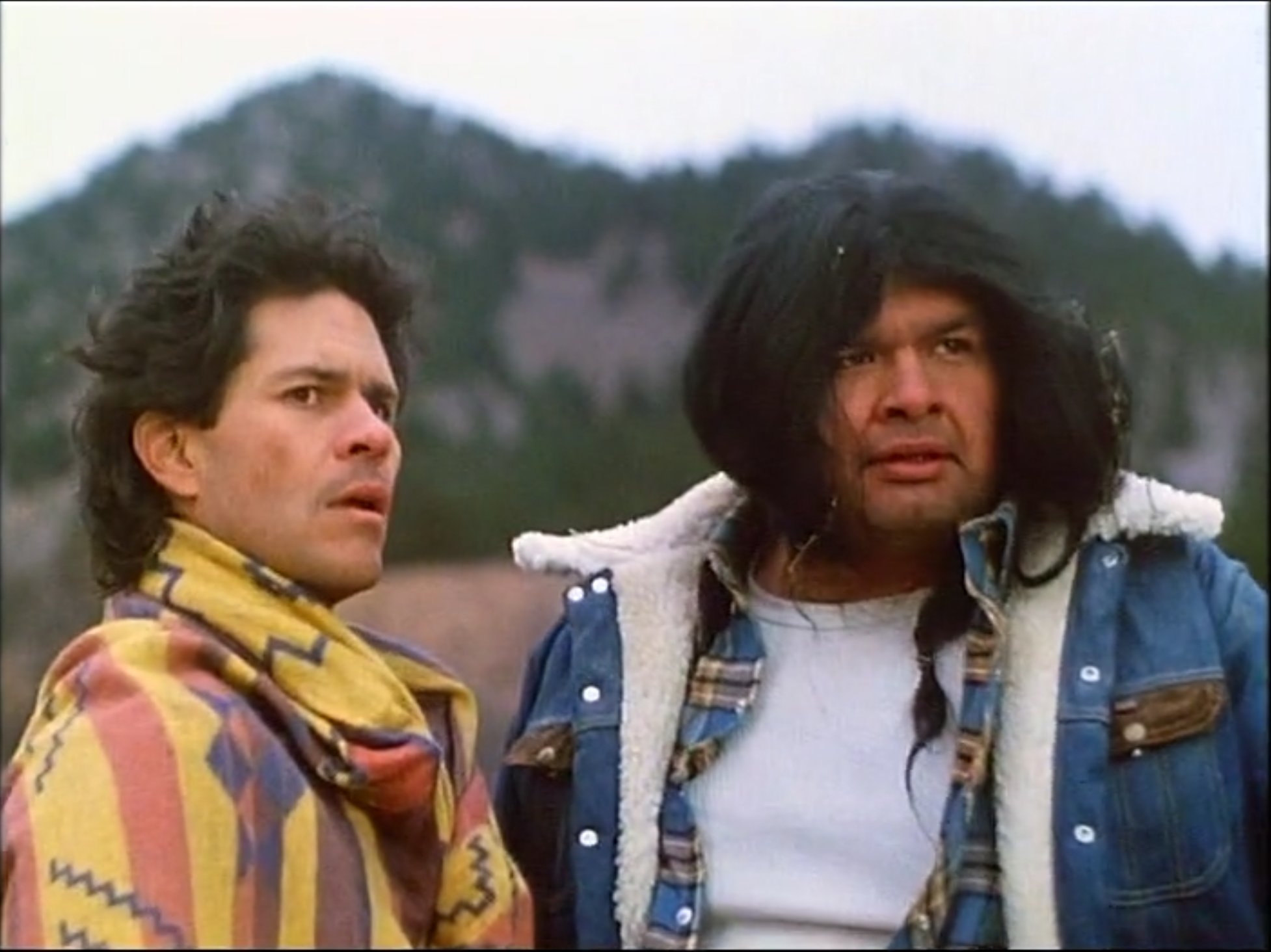
Photo caption: A Martinez and Gary Farmer in POWWOW HIGHWAY.
Powwow Highway is a groundbreaking indie from 1988. It’s very hard to find, but it’s airing November 4 on Turner Classic Movies. Powwow Highway is a droll, offbeat road trip comedy, significant for being one of the first movies with a contemporary Indigenous lens.
Buddy (A Martinez) is an activist on the Northern Cheyenne Reservation in Montana, leading opposition to a strip-mining project. To get him out of their way, the big money interests conspire to have his sister Bonnie (Joanelle Romero) framed and arrested in New Mexico. Buddy is desperate to go to her relief, but has no transportation. His childhood acquaintance Philbert (Gary Farmer), having dreamed of a mystical pony, has purchased a decrepit 1964 Buick that he unironically names Protector. Although it is dubious whether Protector can get them off the reservation, let alone all the way to Santa Fe, they begin their quest, and adventures and misadventures follow.
Gary Farmer in POWWOW HIGHWAY.
Much of the humor stems from the Odd Couple on the road trip. Buddy is political and Philbert is spiritual. Buddy is in a hurry, and Philbert doesn’t recognize the concept of hurrying. Gary Farmer has become one of my favorite character actors, and his performance here is indelible.
The renowned Indigenous actors Wes Studi (Dances with Wolves, The Last of the Mohicans, Heat and 2020 honorary Academy Award) and Graham Greene (The Green Mile, Wind River and Oscar-nominated for Dances with Wolves) also appear in supporting roles.
Powwow Highway also takes us inside daily life on the impoverished reservation with striking verisimilitude. Powwow Highway was produced by George Harrison (yes, THAT George Harrison), directed by South African Jonathan Wacks from David Seals’ 1979 novel.
Powwow Highway won the Sundance Film Festival Filmmaker’s Trophy, was nominated for four Independent Spirit Awards, and has been selected for inclusion in the Library of Congress Film Registry.
Powwow Highway can be streamed on the Criterion Channel, but is otherwise unavailable. Make sure you DVR this week’s TCM broadcast.
If you like Powwow Highway, you’ll also appreciate another early indie with an Indigenous lens, Smoke Signals from 1998. It’s another wry road trip comedy, starring Adam Beach, Evan Adams and Irene Bedard, with another turn from Gary Farmer. Smoke Signals is available to stream from Amazon, Apple, YouTube and Fandango.
Photo caption: Idris Elba in A HOUSE OF DYNAMITE. Courtesy of Netflix.
This week on The Movie Gourmet – two marvelously entertaining movies about depressives and am edge-of-your-seat movie about real people risking their lives for there families. To wit, I have new reviews of Richard Linklater’s Blue Moon with Ethan Hawke, the docudrama about Bruce Springsteen, Deliver Me from Nowhere, and the immigration thriller Roads of Fire.
I also want to warn you off of The Summer Book, which you may see algorithm-recommended on your streaming platform. An elementary school-age girl and her father, struggling with the death of her mother, spend the summer at her grandmother’s home on a tiny Finnish island. The grandmother (Glenn Close) always knows the right thing to do or say as the girl heals and comes of age. This is an adaptation of the 1972 novel by Finnish-Swedish author Tove Jansson, which is reputedly a great read. Unfortunately, its literary merit isn’t translated to the screen. Close’s fine performance can’t save this slog. I checked the time after nothing had happened in the first 31 minutes, and decided to keep watching in case it turned out to be the most boring film I had ever seen. That most boring film ever remains Le Quattro Volte, but The Summer Book is a contender.
CURRENT MOVIES
A House of Dynamite: a master filmmaker reminds us of the terrifyingly plausible. Netflix.
To Kill a Wolf: mysteries revealed. Amazon, AppleTV, Fandango.
ON TV
Robert Redford in DOWNHILL RACER
On November 2, Turner Classic Movies pay tribute to the late Robert Redford’s acting career by airing eight of his films: Downhill Racer, Barefoot in the Park, The Candidate, Jeremiah Johnson, All the President’s Men, The Sting, Butch Cassidy and the Sundance Kid, and The Way We Were. With the exception of Barefoot in the Park, which I find dated, these are all excellent movies that stand up well today. The Candidate, Jeremiah Johnson and All the President’s Men are three of my personal favorite films.
Of course, Redford was important for being more than a fine actor. His very first effort at directing, Ordinary People, won the Best Picture Oscar. Redford’s biggest contribution was his developing the Sundance Institute and the Sundance Film Festival as incubators for other people’s independent filmmaking; that leveraged his own stardom to accelerate the careers of Steven Soderbergh, Quentin Tarantino, James Wan, Darren Aronofsky, Nicole Holofcener, David O. Russell, Ryan Coogler, Robert Rodriguez, Chloé Zhao and Ava DuVernay.
To celebrate his acting, I am recommending one of Redford’s earliest and less well-known roles, Downhill Racer. Redford plays Chappellet, a talented, competitive skier with a chip on his shoulder. He becomes a rookie on the US national ski team, where he remains a social outsider. To unleash his promise, his sensitive but no nonsense coach Claire (Gene Hackman) must penetrate the issues that make Chappellet a hitherto uncoachable diva. Redford and Hackman deliver fine performances This was the first feature film for then-television director Michael Ritchie, who followed Downhill Racer with Prime Cut, The Candidate, Bad News Bears and Semi-Tough.