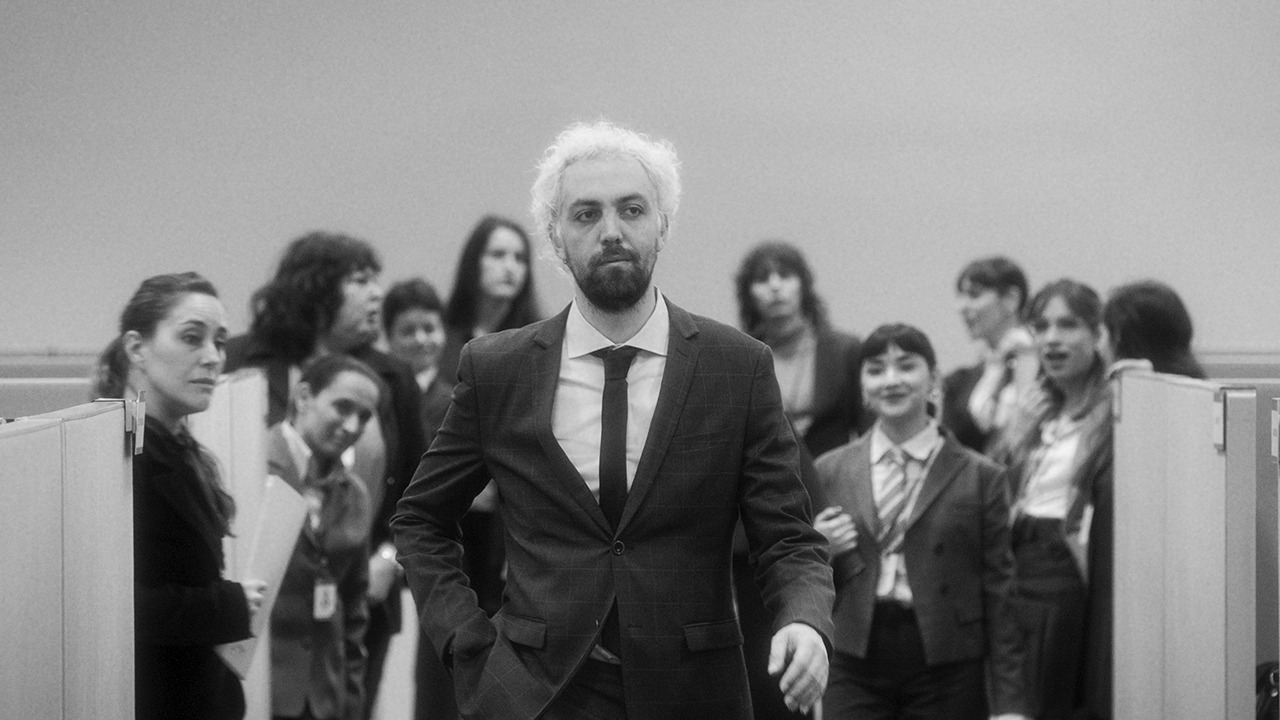
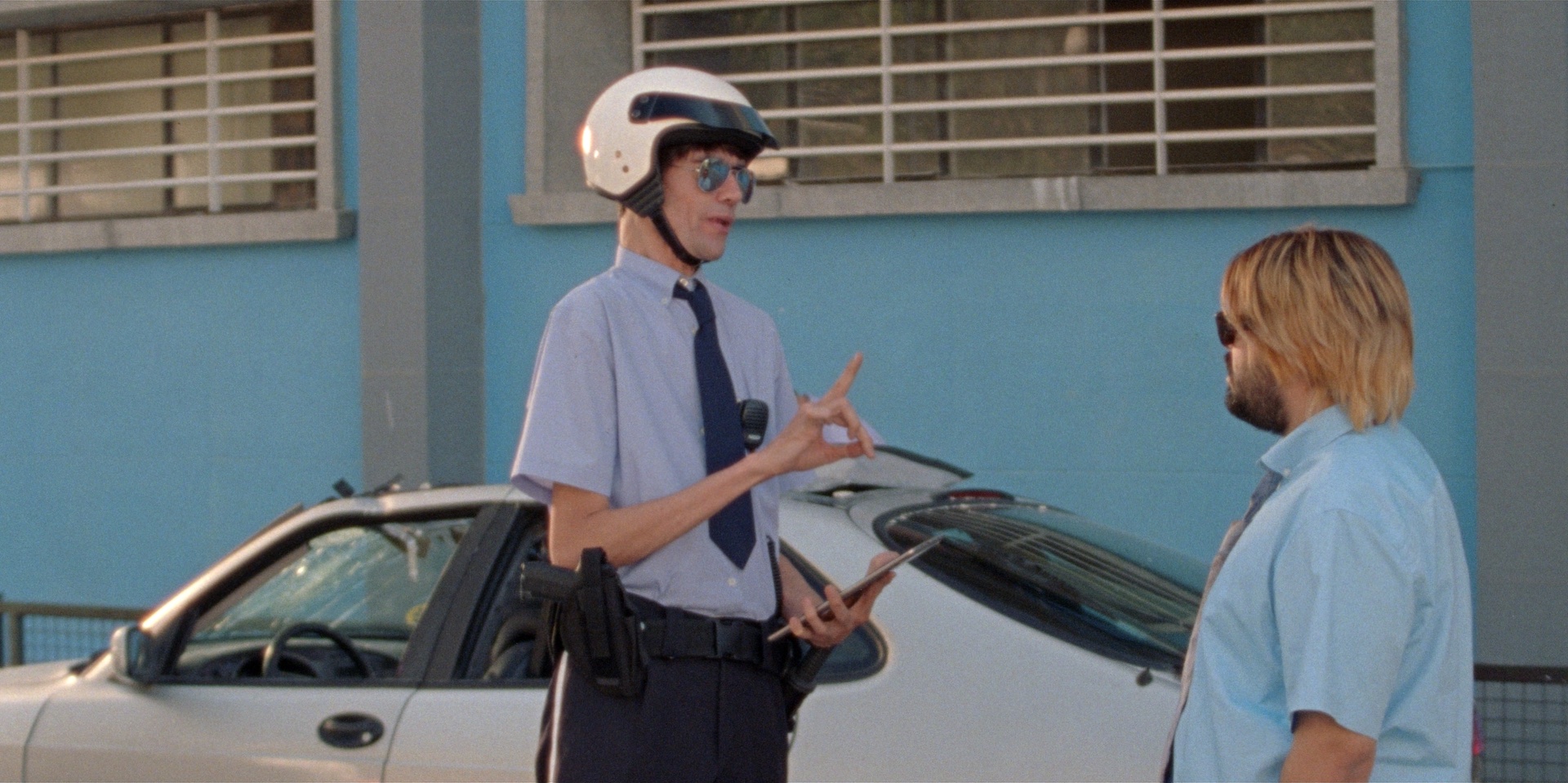
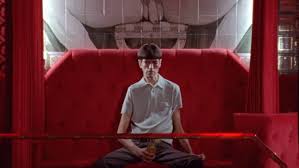
Pedro De Tavira (center) in HUMAN RESOURCES. Courtesy of Cinequest.
In the dark, dark Argentinian comedy Human Resources, Gabriel Lynch (Pedro De Tavira) is an alienated office worker, in an absurdly alienating workplace. Gabriel is a low-level supervisor on an anonymous lower floor of a corporate hive with too many layers of management and an oppressive, top-down culture. It’s also oversexed, with a carousel of Inappropriate office liaisons. And, we’ll soon see, is shockingly tolerant of what we would see as the most horrifying workplace violence.
Gabriel, an Iago with a sick sense of humor, begins a ruthless, unhinged campaign against those who offend him. Alienation leaks out in how her treats everyone. Mischievous, mean-spirited and completely unashamed, he’s very fun to watch. And, as venal as Gabriel is, he is matched, step-for-step, by Veronica from Finance (Juana Viale).
Around the 41-minute mark, Gabriel makes his grievance explicit (followed by a great drone shot)
“I’ve lived like the secret son of a king for a long time, waiting for a courtier to rescue me. Of course, nobody rescued me. Nobody rescues anybody.”
Human Resources is the creation of writer-director Jesús Magaña Vázquez. I’ve rarely seen a more cynical comedy.
Last year’s Cinequest hosted the US premiere of Human Resources, which I highlighted in my Best of Cinequest.Human Resources is now streaming on Hulu. There are many recent movies with a similar title; make sure you’re watching the 2023 Recursos Humanos directed by Magana and starring Pedro De Tavira.
I love the Spanish language trailer, even without English subtitles:
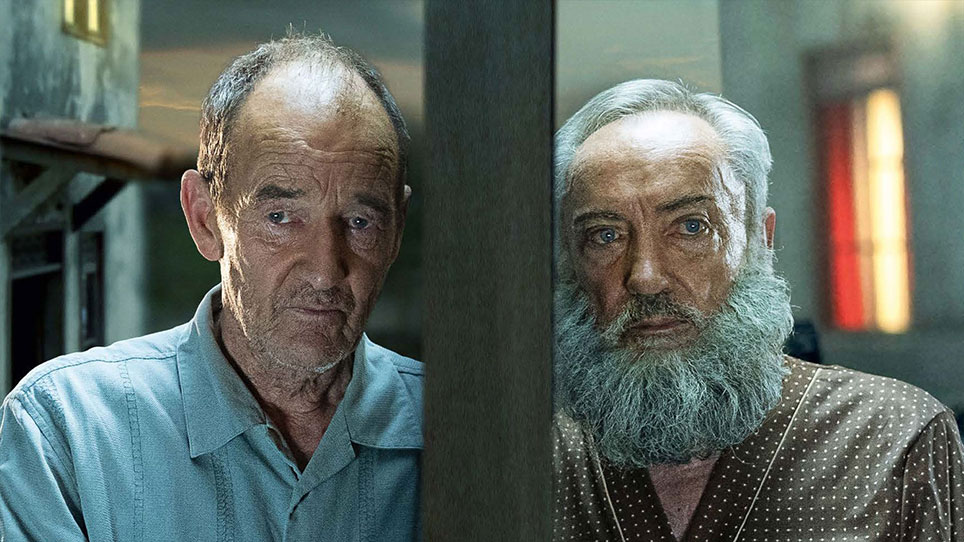
Photo caption: Bill Hayman and Udo Kier in MY NEIGHBOR ADOLF. Courtesy of Cohen Media Group.
In the wry fable My Neighbor Adolf, the chess master Polsky (David Hayman) has lost all his family in the Holocaust. Consumed by grief and bitterness, he lives the life of a misanthropic recluse in a remote South American countryside. Polsky is rocked when the long-vacant house next door becomes occupied by a mysterious German (the piercing-eyed Ugo Kier). Polsky becomes convinced that the new neighbor is Adolf Hitler himself. To convince skeptical authorities of his theory, Polsky must get past his terror and loathing to personally engage with the neighbor. A battle of wits between two strong-willed men ensues.
The 75-year-old Scottish actor Bill Hayman is excellent as Polsky, capturing both his vulnerability from residual trauma and the determination summoned to overcome it.
My Neighbor Adolf is the career finale for 81-year-old German actor Ugo Kier, who died in November. Kier proved that one can have a prolific career (275 IMDb credits) as a character actor in both art films and cult movies. He worked with directors like Werner Rainier Fassbinder, Werner Herzog, Wim Wenders and Lars Von Trier, and in Hollywood films like Johnny Mneumonic, My Own Private Idaho, Armageddon, Halloween and Ace Venture: Pet Detective. His visage, scarier as he aged, worked well in horror movies. and he did many, beginning with Jim Morrisey’s Andy Warhol’s Frankenstein and Blood for Dracula.
My Neighbor Adolf, the work of Russian-born Israeli filmmaker Leon Prudovsky, was my favorite film at the 2023 San Francisco Jewish Film Festival. It opens theatrically in the US this weekend.
Photo caption: Josh O’Connor in THE MASTERMIND. Courtesy of MUBI.
In Kelly Reichardt’s dark comedy The Mastermind, a slacker steals valuable paintings from a museum in suburban New England in 1970. But The Mastermind is less of a heist film than a character study of a man with little character.
James Blaine Mooney (Josh O’Connor) is James to his wife and parents and J.B. to his friends. His guiding value is selfishness. With a degree in the arts, he is an occasional cabinet-maker who lets his hardworking wife (Alana Haim) support his family with a real job, while he sponges off his mom (Hope Davis). Instead of working, J.B. spends his time fantasizing how to make money without working. He lands on a scheme to rob the local art museum and fence the paintings.
He is smart enough to get the paintings out of the museum and hide the loot. But then his own character flaws begin to betray him. Having watched many crime movies, we all know that any criminal conspiracy is only as strong as its weakest link. But J.B. has employed three untrustworthy low lifes as crime partners. Of course, J.B. is too unreliable himself to recognize reliability in anyone else. And then The Mastermind follows J.B. as he tries to avoid the consequences of his choices – and his flight becomes a consequence in and of itself.
What makes this a comedy? The running joke is that J.B. never makes the responsible, prudent choice throughout the movie, always taking what he sees as the easy path, regardless of morality or loyalty.
Usually, a movie audience roots for the heist to be successful. Here, we don’t sympathize with the museum, which doesn’t value its collection enough to invest in even the most basic security. But we don’t care about J.B. either, because he is a shit who only needs the money so he doesn’t have to get a job. We do care about other people in J.B.s life, and he ruins the lives of his wife and family, puts at risk his dear friends and his own sons, fleeces his mother, and surely humiliates his father.
Josh O’Connor is very good as a man who never misses a chance to think only of himself. I would recommend another film with a heist element, La Chimera, where O’Connor plays a more complex character.
Fine actors all, Davis, Haim, Bill Camp, Gaby Hoffman and John Magaro are perfect in supporting roles. Hoffman is especially strong as an old friend who recognizes how dangerous J.B.’s affable charm really is. Davis has an inspired moment when she breaks a corn cob in half – and then quickly assesses which half has moire kernels,
Writer-director Reichardt is an acclaimed indie filmmaker who usually makes languorous, observational movies and gets excellent performances out of actors like Michele Williams, Lily Gladstone and Jared Harris. Her Wendy and Lucy is a masterpiece. There is more humor (the quiet, sly kind) and much, much more plot in The Mastermind than in Reichardt’s other works. I keep waiting for Reichardt to make another Wendy and Lucy, which is probably as unfair as waiting for Orson Welles to make another Citizen Kane.
Reichardt, who was only six years old in 1970, completely nails the verisimilitude of the time and place.
The very best thing about The Mastermind is the original music by Rob Mazurek, usually a solitary jazzy cornet or drums. The Mastermind is Mazurek’s first feature film score, but his Wikipedia page details an impressive and varied career as a musical artist.
Bottom line: The Mastermind is an exceptionally well-made film about a guy who we wouldn’t like to know in real life, but who ultimately gets his just desserts.
Photo caption: Liz Larsen and Michael Strassner in THE BALTIMORONS. Courtesy of IFC.
Here’s the perfect film for the family to watch on Thanksgiving Weekend (after the littlest kids have gone to bed). In the goodhearted and witty comedy The Baltimorons, a cracked tooth sends a guy to an emergency dentist and launches them into a nighttime adventure through Baltimore that could result in romance. It’s a funny movie about second chances.
Each of them faces a very problematic invitations. Cliff (Michael Strassner) has been sober for a few months, but he hasn’t found work. His lack of resources and his failed suicide attempt have left him in an unhealthy power imbalance with his girlfriend. He’s got to choose between his promised appearance at the girlfriend’s family holiday gathering and the chance to perform again at a pop-up comedy show organized by his buddies. Problem is, he is terrified that he can’t be funny without drinking.
The dentist Didi (Liz Larsen), in contrast, has a strong business and owns a nice home. But she’s personally reeling from her divorce, which has left her lonely and gashed a hole in her confidence. Didi is suffering the humiliation of a courtesy invite to the Christmas party hosted by her ex-husband and his new wife. So, we have two talented people in moment pf vulnerability and recovery. An impounded car sends them out together, and comic situations ensue.
What happens is funny, but The Baltimorons succeeds because of its humanity – we really care about Cliff and Didi.
Cliff and Didi would make an unlikely romantic pairing. He’s already in a serious relationship, after all. She is significantly older, and more well-educated. She’s highly functional, and he’s a floundering goof.
The Baltimorons reflects the sharp comic sensibility of writer-director Jay Duplass. With his brother Mark, Duplass wrote and directed Baghead, Cyrus and Jeff Who Lives at Home, and has since been busy directing/producing in television and acting (Transparent, Lynn Shelton’s Outside In). This is the first feature he has directed since 2012. At its world premiere, The Baltimorons won the Best Narrative Feature award at SXSW.
I saw The Baltimorons at its third public screening, at the SLO Film Fest with Jay Duplass in attendance. It won the SLO Film Fest’s Best of Fest. It’s now available to stream from Amazon, AppleTV, YouTube and Fandango.
Photo caption: Albrecht Schuch in PEACOCK. Courtesy of Oscilloscope Laboratories.
In the droll and absurd comedy Peacock, Matthias (Albrecht Schuch of All Quiet on the Western Front) works in a most unusual companion service; he gets paid for jobs like masquerading as a client’s fictional partner. Matthias has so perfected being a chameleon that he has lost all sense of himself. This disquiets his wife and colleagues, and, when the vengeful ex-husband of a client terrorizes him, Mattias’ world starts to unravel.
Albrecht Schuch in PEACOCK. Courtesy of Oscilloscope Laboratories.
If you like Ruben Ostland’s work (Force Majeure, The Square, Triangle of Sadness), you’ll like Peacock. In fact, there’s a scene in Peacock that borrows A LOT from the chimp impersonator scene in The Square.
Austrian director Bernhard Wenger won a prize at Venice, where Peacock was also nominated for Best Film in the Critic’s Week.
I screened Peacock for NashFilm. It’s being shown at six Laemmle theaters in LA this Wednesday.
Javier Botet and Bray Efe in THE FANTASTIC GOLEM AFFAIRS. Courtesy of Gluon Media.
The Spanish comedy The Fantastic Golem Affairs is unlike any other movie you’re likely to see this year, and the absurdity starts in the opening scene. After a night of partying, the pudgy slacker Juan (Bray Efe) and his best buddie David (David Menendez) are goofing around on the roof of Juan’s Madrid high-rise apartment building. David accidentally falls off and plunges to the roof of a car parked many stories below. That reveals that David is made of ceramic, as he shatters into hundreds of shards.
While still in a state of shock, Juan is annoyed by a shady car insurance agent, his late friend’s obnoxious and venal lover, apathetic cops and a woman with an outrageous computer dating profile. But he is obsessed by the mystery of a ceramic man, and keeps on the investigative trail until he stumbles on an unworldly conspiracy rooted in his own family. Along the way, a bizarre freak accident keeps recurring, killing people that he encounters during his investigation.
It’s been accurately written that there is magical realism in The Fantastic Golem Affairs, but it’s not the sweet, mystical kind in, say Like Water for Chocolate – The Fantastic Golem Affairs is bawdy and in-your-face.
The playfully, irreverent tone strongly reminds me of Pedro Almodovar’s early work (Women on the Verge of a Nervous Breakdown, Tie Me Up! Tie Me Down!, High Heels and Kika) and his VERY early work (Pepi, Luci, Born and Other Girlds Like Mom). Indeed, one of the characters observes, “This is like a Spanish movie from the 90s“. The Fantastic Golem Affairs is not as riotous as early Almodovar, but it adds that magical realism and much more absurdism.
Javier Botet in THE FANTASTIC GOLEM AFFAIRS. Courtesy of Gluon Media.
The Fantastic Golem Affairs is highly imaginative work of Spanish writer-directors Juan Gonzalez and Nando Martinez, who call themselves Burnin’ Percebes. They hit us with the absurdity of the shattering ceramic man right at the beginning, juxtaposed with the peppy music underneath the opening credits. The music combines with an often static camera, long shots, and colorfully retro sets that are unabashedly cheap. This is a zany, raunchy movie with some mild body horror.
[Gratuitous digression: I’m always proud to point out when I actually get a joke in Spanish. The directors’ pseudonym is Burnin’ Percebes, and percebes is Spanish for gooseneck barnacle, a hideously ugly (Google it) and delicious shellfish from Northern Spain. They are dangerous to harvest from oceanside cliffs, and are accordingly expensive – about ten times the price of a regular tapa. Of course, The Movie Gourmet himself has enjoyed percebes in San Sebastian.]
The Fantastic Golem Affairs is opening in theaters, including LA’s Alamo Drafthouse.
Photo caption: Margaret Qualley in HONEY DON’T. Courtesy of Focus Features.
In Ethan Coen’s dark comedy Honey Don’t, the potential clients of private eye Honey O’Donahue (Margaret Qualley) keep getting killed, and she suspects that the deaths are connected to a sexually predatory sham preacher (Chris Evans). She’s a whip-smart lipstick lesbian, and she sizzles with the local cop MG (Aubrey Plaza). Honey and the phony pastor have lots of robust sex, none of it with each other. We think we know who the big villain is going to be, but there’s a big surprise twist.
There’s a lot of sassy dialogue, and there are some LOL lines like “no, but I saw Palmdale” that could have become iconic if this were a better movie. It’s kinda funny, dotted with a few inspired moments, but, on the whole, a disposable movie.
Director Ethan Coen co-wrote Honey Don’t with longtime Coen Brothers editor Tricia Cooke, who also co-wrote his Drive Away Dolls. In a twist on the detective genre, the oversexed, badass characters are women – Honey, MG and a mysterious, motor scooter-riding drug importer (Lera Abova). The two main male characters are Evan’s predatory minister, a doofus who thinks he’s a mastermind, and a smarmy cop (Charlie Day), who knows that he’s a doofus and is blissfully content with being one. That being said, Honey Don’t is all about the carnage-laden comic violence that men tend to enjoy, and I doubt that the female-centric angle is enough to draw women into the audience.
Qualley and Evans are both very good, and I will watch anything that features Aubrey Plaza. There are excellent comic performances by Josh Pafchek, as an impressively dim thug, and Kale Browne, as an old man whose identity isn’t revealed right away.
One of the most distinctive and fun stars of the film is its setting – emphatically downscale Bakersfield. I’m not convinced that there is a nice part of Bakersfield, but, if there is, we sure don’t see it here. Californians will also enjoy the references to Lancaster and Palmdale.
Honey Don’t is a mildly enjoyable 87 minutes, but not a Must See.
Photo caption: Logan Lerman as Isaac and Molly Gordon as Iris in OH, HI!. Courtesy of Sony Pictures Classics.
The dark romantic comedy Oh, Hi! begins with Iris (Molly Gordon of Booksmart, Theater Camp, The Bear) and Isaac (Logan Lerman of The Perks of Being a Wallflower) heading off to a countryside vacation rental for their first romantic getaway. All is lustful fun until they discover that each has a different perception of what their relationship is and where it is headed. What could have been a merely awkward or hurtful moment precipitates an extreme reaction, and escalates into an absurdly funny situation.
Oh, Hi! is the sophomore feature for writer-director Sophie Brooks. Commitment-averse guys and overthinking gals are common fodder for rom com humor, but Brooks is sharply observant about relationships tending to evolve at different speeds for the participants. Although she has created a broadly funny, over-the-top situation, much of the comedy is character-driven. Brooks has mined the first act and later flashbacks with clever hints about each character’s level of commitment to the relationship and their emotional stability. It’s a smart screenplay.
The success of Oh, Hi! depends on Molly Gordon’s fine performance as a woman whose increasingly unhinged and transgressive behavior is vulnerability-based. Logan Lerman is very good as a guy thinking his way through through a surreal experience with complete helplessness.
Polly Draper (Thirtysomething) is very funny as Iris’ mother, dispensing supportive yet unhelpful advice. Josh Reynolds is hilarious as an uxorious goof who has become entangled in a No Win state of affairs.
I screened Oh, Hi!, which premiered at this year’s Sundance, for the San Francisco Jewish Film Festival. It releases in theaters this weekend.
Photo caption: Nahuel Perez Biscayart and Ursula Corbero in KILL THE JOCKEY. Courtesy of Music Box Pictures.
In the surreal Argentine comedy Kill the Jockey, Remo (Nahuel Perez Biscayart) is a once-champion jockey, who is zealously self-sabotaging his career; self-medicating with alcohol and even swiping the racehorses’ drugs and the booze left on a good luck altar, he has become utterly unreliable. Remo can only emerge from his narcosis to demonstrate his passion for his wife Abril (Ursula Corbero). Abril is also a jockey, and her racing career is on the upswing, although she will soon have to pause it to have their baby.
Both Remo and Abril ride for a mobster (Daniel Jimenez Cacho), who, against all available evidence, has concluded that Remo can still win a big race. As a result, Remo suffers a brain injury, which spurs catatonia and, eventually, a major change in his identity. Remo leaves the hospital without being discharged, and wanders the city in a walking stupor, unaware that both a frantic Abril and the mobster’s murderous goons are searching for him. At this point, Remo is not an ideal gunowner, but he gets a pistol, and the lives of Remo, Abril and the mobster take significant twists. Kill the Jockey morphs into a fable of identity.
Nahuel Perez Biscayart in KILL THE JOCKEY. Courtesy of Music Box Pictures.
Director and co-writer Luis Ortega tells this story with plenty of droll absurdism. Inexplicably, the mobster usually carries an infant, a mounted brass band suddenly appears, the possessions of a coat pocket include a live fish, and there’s ceiling-walking. Kill the Jockey has its share of LOL moments in the first half of the film.
Early in the film, Abril launches a celebratory dance, is soon joined by Remo, and the two move together as unhinged marionettes. It’s as if figures in a Dali painting broke into a sensuous dance. This is a spellbinding scene, the best one in Kill the Jockey and, possibly, in any movie this year so far.
Unfortunately, the second half of Kill the Jockey, with more Remo and less Abril, is not as compelling. Ortega keeps throwing in the entertainingly bizarre, but the film loses momentum as Remo transforms.
I first saw Nahuel Perez Biscayart as the star of the psychological Holocaust thriller Persian Lessons. He’s a good choice to play the tragicomic Remo, a broadly funny character that morphs into a heartfelt one. But the most interesting performance in Kill the Jockey is Ursula Corbero’s as Abril – brimming with charisma and vitality; Abril must navigate her life and Remo’s as Remo’s condition keeps changing dramatically.
Kill the Jockey is Argentina’s submission for the Best International Feature Film Oscar and has been nominated for significant awards, including the Goya (best Iberoamericano film) and the best film at Venice Film Festival. It releases into theaters this weekend, including the Laemmle NoHo in LA, the Roxie in San Francisco and the Smith Rafael Film Center in San Rafael.
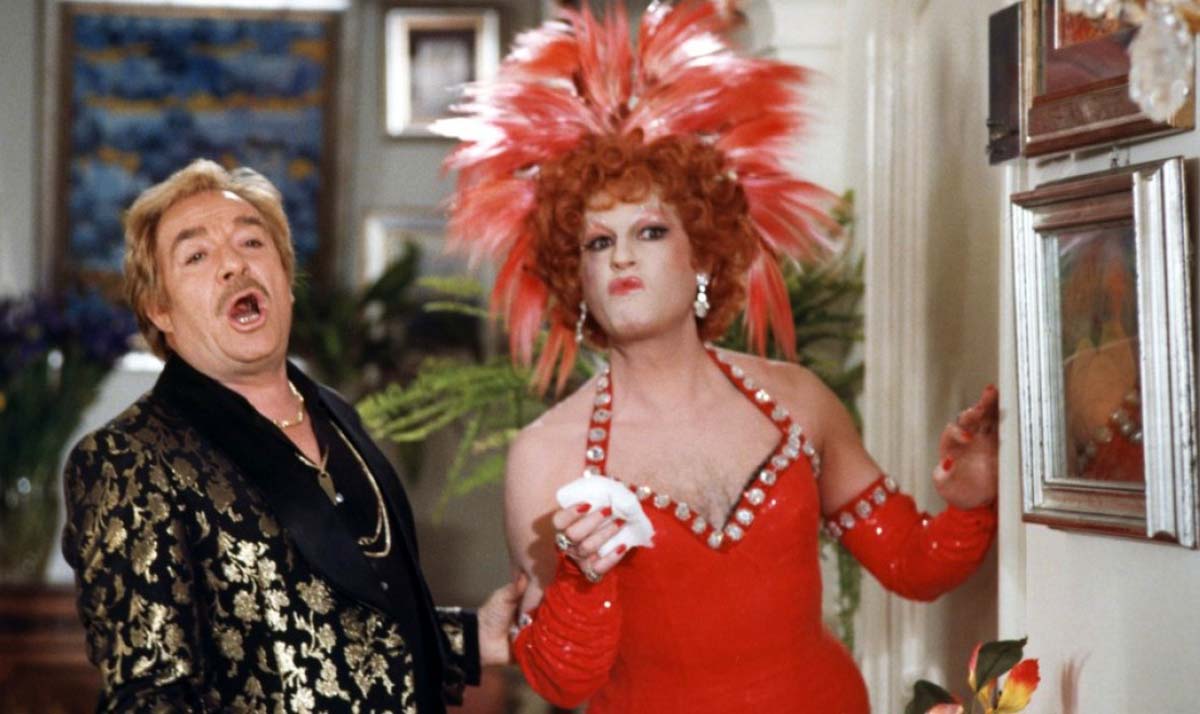
Ugo Tognazzi and Michel Serrault in LA CAGE AUX FOLLES
On June 13, Turner Classic Movies will present the groundbreaking French comedy La Cage Aux Folles – a daring film in 1978, when few were thinking publicly about same-sex marriage. A gay guy runs a nightclub on the Riviera, and his partner is the star drag queen. The nightclub owner’s beloved son wants him to meet the parents of his intended. But the bride-to-be’s father is a conservative politician who practices the most severe and judgmental version of Roman Catholicism, so father and son decide to conceal aspects of dad’s lifestyle. Madcap comedy ensues, and La Cage proves that broad farce can be heartfelt. Michel Serrault is unforgettable as Albin/Zaza – one of the all-time great comic performances. (La Cage was tepidly remade in 1996 as The Birdcage with Robin Williams, but you want to see the French original.)
I’m currently watching my way through the program of this year’s Frameline LGBTQ film fest, which I just previewed. I don’t think you can overestimate the cultural impact of La Cage Aux Folles, which charmed straight audiences into relating to sympathetic portrayals of LGBTQ people.