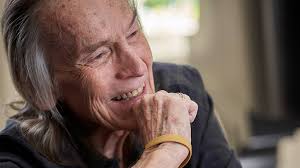
Gordon Lightfoot in GORDON LIGHTFOOT: IF YOU COULD READ MY MIND
Gordon Lightfoot: If You Could Read My Mindis a surprisingly interesting documentary about a now genial singer-songwriter that I hadn’t thought of for decades.
The biodoc emphasizes Lightfoot’s talent as a songwriter and his importance to Canadian music scene. Just when it starts getting too reverential, the more lively tidbits from his career and personal life start rolling out.
Notably, the inspiration for the lyrics of Sundown is revealed:
I can see her lyin’ back in her satin dress
In a room where ya do what ya don’t confess
Sundown you better take care
If I find you been creepin’ ’round my back stairs
Amazingly, The Wreck of the Edmund Fitzgerald was recorded not only on the first TAKE, but the on first time Lightfoot’s band had ever PLAYED the song.
Gordon Lightfoot in GORDON LIGHTFOOT: IF YOU COULD READ MY MIND
Physically unrecognizable from his hey day, the 81-year-old version of Lightfoot is pretty likeable. He is modest and irreverent about his own work (I hate that fuckin’ song). He is also grateful for his blessings, sober, open and regretful about the mistakes in his personal life.
Heck, I enjoyed spending an hour-and-a-half with the guy. Gordon Lightfoot: If You Could Read My Mind is available on Virtual Cinema; I watched it at the Laemmle.
In the fresh and perceptive coming of age filmAn Easy Girl, it’s summertime in Cannes, and local working class girl Naima (Mina Farid) has just turned 16, with an internship lined up in a hotel kitchen. But first, her 22-year-old Parisian cousin Sofia (Zahia Dehar) comes for a week’s visit. Sofia catches the eyes of two much older guys, Andres (Nuno Lopes) and Philippe (Benoît Magimel), and the girls are invited to party on Andres’ massive yacht.
Sofia lives her life for “adventure and sensation”, and works her stunning looks so she can rely on the kindness of strangers. She doesn’t even carry cash, putting everything on the tabs of male admirers.
Naima is no shrinking violet and no prude, but she has NO IDEA about the extravagance and carnality of Eurotrash hedonism. The audience may cringe at the plopping of Naima’s comparative innocence onto a zillionaire’s party yacht with her enthusiastically decadent cousin. We’re expecting that Naima may be victimized, corrupted, or have a sexual awakening,
But here’s what is so fresh about An Easy Girl – thanks to the female director and co-writer Rebecca Zlotowski, the UNEXPECTED happens. Naima learns more about life and human behavior than she did at school or would in her internship.
As Jeanette Catsoulis points out in the NYT review, the French title can mean “An Easy Girl” or “A Simple Girl”.
Sofia, fully committed to the most shallow of lifestyles, is decidedly not the ideal role model. But she turns out to be a canny observer of people and passes along some invaluable tips about how to handle social situations.
Most unexpected, however, is what Naima learns from Philippe. At first, he seems to only be Andres’ diffident wing man. But Philippe has reflected on his own life, and his lessons to Naima about her own self-worth are indelible.
Benoît Magimel in THE EASY GIRL
It’s a superb performance by Benoît Magimel (The Piano Teacher, The Flower of Evil). Flashy roles get the awards buzz, but Magimel’s understated interpretation of the still-waters-run-deep Philippe is masterful.
Because the story is all from Naima’s point of view, Mina Farid is on-screen in every scene, and she’s exceptional. Nuno Lopes (the one good thing about the epic snorefest Lines of Wellington) is fine as Andres.
Zahia Dehar is perfectly cast for Sofia, perhaps shockingly so. In real life, Dehar is famous in France for parlaying her national notoriety as a teen prostitute to the rich and famous into her own fashion line. Her lips and figure are like a caricature of Brigitte Bardot’s.
This is a remarkably genuine and non-exploitative coming of age story. An Easy Girl is a NYT Critic’s Pick and it is streaming on Netflix.
Itsaso Arana in THE AUGUST VIRGIN. Photo courtesy of Outsider Pictures.
In the lovely and genuine The August Virgin, 33 year-old Eva (Itsaso Arana) is between relationships, not defined by any career success, and her biological clock is ticking. She knows it’s time for a reset. In August, Eva borrows an acquaintance’s apartment in another Madrid neighborhood and sets off on a series of strolls, in search of possibilities as yet unknown.
Many madrileños escape the city’s oppressive heat for the month of August. But Madrid is still filled with street festivals and tourists. Eva meanders around town, encountering old friends and making new ones. As Eva notes, in Madrid’s August, expectations are relaxed.
Eva is purposeful about shaking things up, but she has no plan other than to be open to the possibilities. That openness, with its fluidity and randomness, leads her to her moment of reinvention.
Eva is played by the film’s co-writer, Itsaso Arana. What’s so singular about Arana’s performance is that her Eva, as dissatisfied as she is with her current situation, is always comfortable in her own skin. She’s never desperate or needy (except when trying to negotiate a reluctant door lock) and always confident enough to engage with a stranger. At one point, the Spanish pop star Soleá sings, “I’ve still got time. I’m still here.”
THE AUGUST VIRGIN. Photo courtesy of Outsider Pictures.
The August Virgin’s other co-writer is director Jonás Trueba, and this is his sixth feature. I recently watched his next most recent film The Reconquest (La Reconquista) on Netflix, and it’s another intensely personal and genuine story, about two 30-year-olds reconnecting 15 years after a teen crush. Jonás Trueba is the son of Oscar-winning director Fernando Trueba (Belle Epoque, Chico & Rita).
Several critics have seen Trueba’s work as an homage to French New Wave filmmaker Éric Rohmer, but I found The August Virgin, with Eva’s serial conversations (real, probing conversations), reminded me of the more accessible work of Richard Linklater.
Madrid itself is on display here, with its searing daytime sun, and the liveliness of the streets, tapas bars and after-hours clubs when the sun goes down.
Trueba and Arana allow Eva her process, and she samples one experience after another, seemingly with the faith that one of them will lead her to where she wants to be. This is not a film for the impatient, but I found its two hours enchanting.
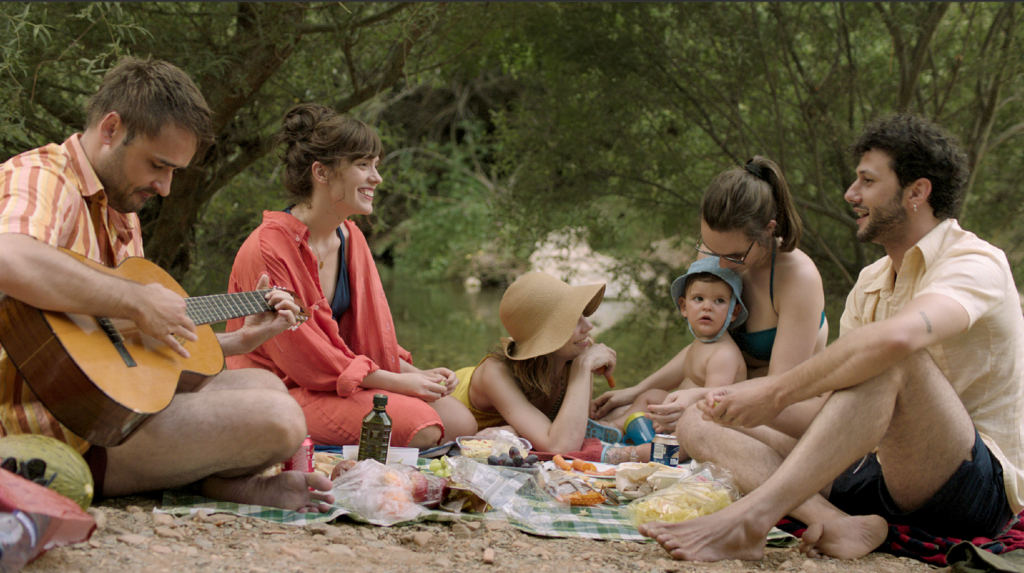
The August Virgin is on my list of Best Movies of 2020 – So Far and will be available to stream beginning Friday, August 21 on Virtual Cinemas, like San Rafael’s Rafael or Laemmle’s in LA.
The first surprise in the short documentary The Speed Cubers is that there are people – very young people – who can routinely solve a Rubik’s Cube in less than eight seconds. Then we’re not surprised that they have world records and world championship competitions.
But then we learn that an AUTISTIC teenager has been dominating the competition. And we learn the story of his parents’ love and persistence. And then the story of his relationship with the former champion he unseated. It all combines into a quick cinematic stir fry of profound decency and friendship.
Director Sue Kim distilled the world of speed cubers, the compelling personal stories of the two protagonists and their relationship into a tight forty minutes.
The amiable documentary The Booksellers slips us into the obscure world of antiquarian book collectors and dealers. It’s a passion that few of us share, but, for the few, a passion it is indeed.
The subject here (old books) is LITERALLY dry. The sparks of interest come from the people who treasure and covet them. These folks are mostly, but not all, old white men. The introduction of a younger female dealer, fiery and committed, brings some welcome energy.
The conflict in this story is with the times – with the trajectory of books themselves driving the future of book collecting.
The Booksellers can be streamed from Amazon, Apple TV, YouTube and Google Play.
An agreeable star playing a disagreeable character, Gemma Arterton elevates the melodrama Summerland. Arterton plays a writer self-isolating in an English country village. Self-absorbed, crusty and even mean, she finds herself being assigned to care for a young boy evacuated from the London Blitz.
Why is she like this? We learn that she has been damaged, first by the childhood loss of her father, and then by the loss of her great love. It turns out that everyone in Summerland is damaged by loss – after all, there is a devastating war going on. And, the English are not disposed to letting out their feelings.
Summerland is about addressing the needs of one child. The war has made his parents unavailable, his guardian is reluctant and poorly-equipped, and the emotional capacity of his community is not apparent.
There are two surprises in the plot, and the biggest one is unpredictable; both are contrived – you can either suspend disbelief or not. I was watching with two women who couldn’t get past the unsympathetic behavior of the writer to embrace the story.
Once again, Gemma Arterton proves that she is versatile and can carry a movie on her own. Her work has ranged across genres to the Bond Girl in Quantum of Solace. In the light comedy Tamara Drewe, the main joke is that the main character suddenly transforms into someone who looks as stunning as, well, Gemma Arterton. In Gemma Bovery, Arteron and the French comic actor Fabrice Luchini deliver a smart, contemporary take on Madame Bovary.
The supporting cast is excellent: Gugu Mbatha-Raw (Belle and lots of TV), Penelope Wilton (Downton Abbey), Tom Courtenay (Oscar-nominated decades apart for The Dresser and Doctor Zhivago) and Sian Phillips (Livia in I, Claudius back in 1976).
This is the first feature for writer-director Jessica Swale, She did an excellent job directing the child actors – Lucas Bond and Dixie Egerickx (now starring in The Secret Garden) – to fine performances.
Summerland is essentially a melodrama that finally arrives at a heartwarming conclusion; as such, it’s moderately satisfying. Summerland is available from all the major streaming services
The infectious We Got the Beat by the Go-Go’s is fun itself, distilled into a song. The documentary The Go-Go’s tells the story of the all-female band.
There is a familiar arc to every documentary about a rock band. Scrappy and hungry musicians perform the music they love in obscurity, before being suddenly thrust into worldwide fame and more cash than they could have imagined. Then the bubble is burst by some combination of drug abuse, internal jealousy, creative differences, personality conflicts and fights over money. Usually the survivors look back with pride in the music, nostalgia about the good times and regrets that they didn’t handle it all with more maturity.
The Go-Go’s fits in that framework, to be sure, but it’s about women. The Go-Go’s have been the only all-female band to write their own music and play their own instruments ever to have a number one Billboard record. They achieved that in 1982, and it hasn’t been duplicated since.
All five Go-Go’s thankfully have survived and each shares her experiences in The Go-Go’s. They are an open, engaging and likeable lot.
There’s a tidbit about the gentlemanly class shown by The Police. And we learn why none of the Go-Go’s is proud of their appearance on Saturday Night Live.
This is a modest film about a singular moment in popular music. The Go-Go’s is available on Showtime.
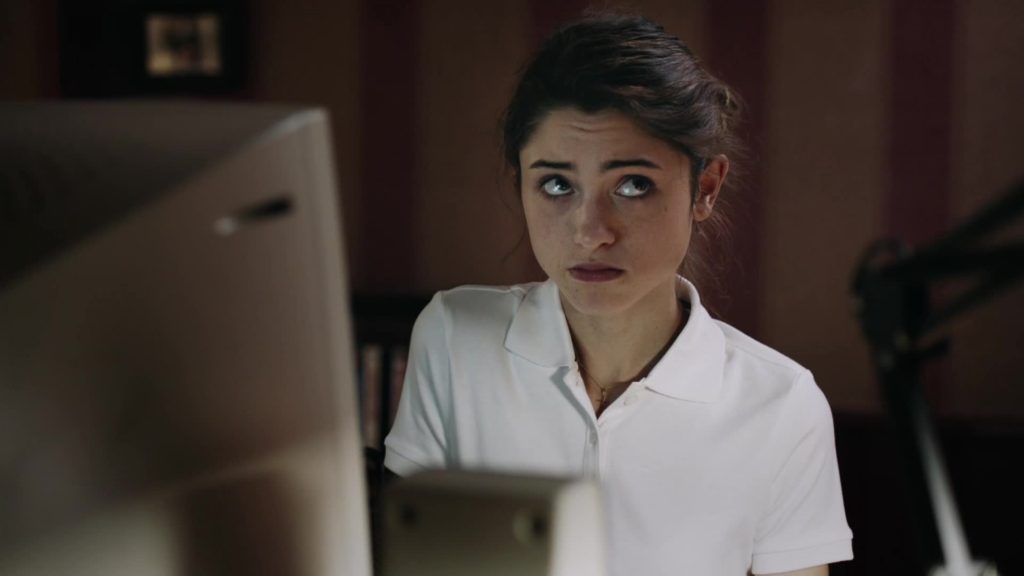
Drawn from the experience of writer/director Karen Maine’s own youth, the sweet coming of age comedy Yes, God, Yes, aims pointed jabs at religious hypocrisy. Bobbing in a sea of peer pressure, Catholic high schooler Alice (Natalia Dyer) heads off with the popular kids to a four-day retreat.
The retreat center is buried in the woods, and the retreat itself has some cultish aspects, with overly smiley/huggy teen youth leaders squeezing out highly personal confessions Authority-with-a-capital-A is present in the form of the high school’s stern young priest. The entire program is designed to make kids feel guilty about their normal, healthy feelings and to scare them from doing what everyone does naturally.
Amusing throughout, this is not a broad comedy, and there aren’t many guffaws. Instead, it’s a piercing satire based on arch observation of human behavior. The moment where Alice is able to leverage an adult’s hypocrisy against him is very satisfying,
The ironic title, of course, is something someone cries while literally coming a age.
Susan Blackwell is a low-profile character actor who just shows up and steals movies, as she did in last year’s Auggie. In Yes, God, Yes, she’s the character Gina, who owns a lesbian bar and rides a motorcycle, and it’s another great performance.
The Wife was raised Catholic, and she enjoyed this film. Yes, God, Yes is available to stream on Virtual Cinema and will be available from the usual VOD platforms after July 2
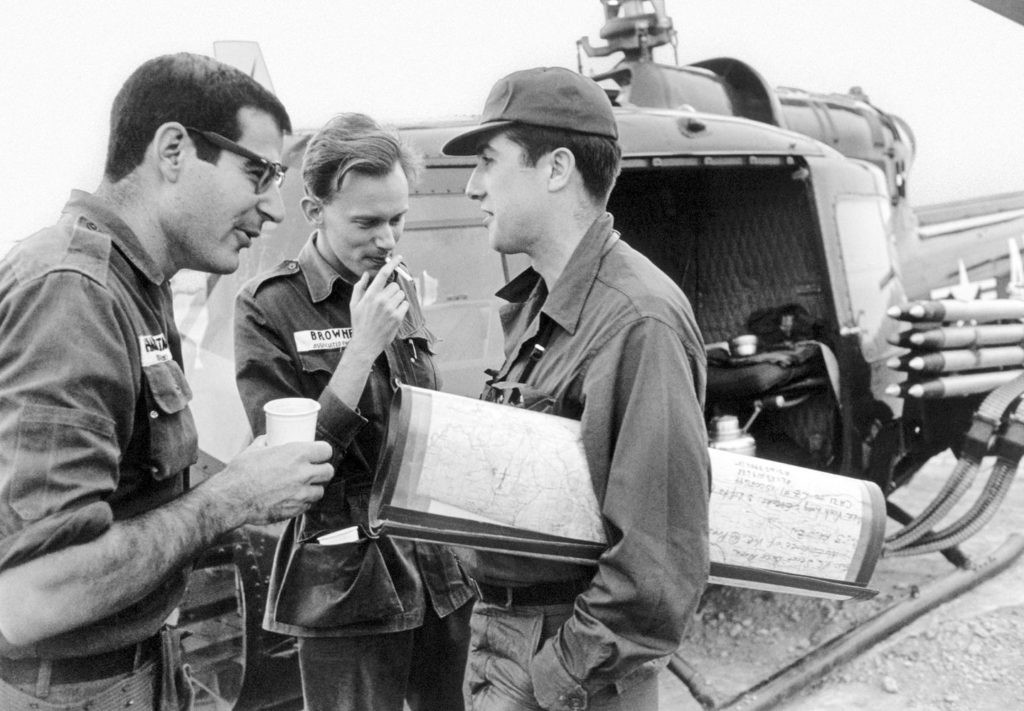
David Halberstam (left) and Malcolm Browne (center) in DATELINE-SAIGON
Dateline-Saigon documents the efforts of five journalists to cover the Vietnam War in the face of a US government which did not want the facts to be told. The five were Malcolm Browne, Neil Sheehan, Horst Faas, David Halberstam and Peter Arnett, who amassed a bucket of Pulitzers between them.
What they found in Vietnam was that American policy was not working, because (among many factors) the Diem regime was alienating most of its own population, the South Vietnamese Army was less motivated to fight than the Viet Cong, and that Americans were more directly involved in combat than had been acknowledged. And the US government didn’t want any of this reported.
As Dateline-Saigon says, “When these patriotic journalists arrive in Vietnam, they had no idea they would become the enemy“, meaning the truth-wielding enemy of the US government propaganda. The reporters describe the government efforts to obscure, mislead, spin, hide and controvert the facts as a “vast lying machine” and the “Truth Suppressors”.
Quang Lien and Malcolm Browne (center) in DATELINE-SAIGON (AP Photo)
All television news viewers (especially a ten-year-old The Movie Gourmet) were shocked by the 1963 Buddhist monk’s self-immolation to protest the Diem regime in 1963. No one was more shocked than Browne, who was covering the Buddhist march, and, to his surprise and horror, had this unfold a few steps in front of him.
Sheehan is famous for uncovering the Pentagon Papers. Beginning with The Best and the Brightest, Halberstam banged out bestseller after bestseller on 20th century American history. Arnett went to cover dozens of conflicts interview Osama Bin-Laden and was a major media face of the Iraq War.
This is a Must See for students of journalism and of the Vietnam War Era of American History. You can stream Dateline-Saigon on iTunes.
Walter Mercado in MUCHO MUCHO AMOR: THE LEGEND OF WALTER MERCADO
Just about every Spanish speaker knows who Walter Mercado is – and almost no non-Spanish speaker has heard of him. To describe him as a TV astrologer is profoundly inadequate.
Decades ago, I was flipping through TV channels and happened upon Walter’s astrology show and found him mesmerizing. He was so UNUSUAL, that, late at night, I just couldn’t change the station. The documentaryMucho Mucho Amor: The Legend of Walter Mercado will explain the phenomenon better than I can describe it.
For one thing, 99% of the show’s production value must have been in costume cost. Walter just stood in front of the camera and recited horoscopes, but he was always clad in capes that Liberace and Elvis would have considered WAY over the top. And Walter, for all the machismo in traditional Latino culture, was what we call today non-binary; Walter emanated a singular combination of androgyny and asexuality.
In Mucho Mucho Amor: The Legend of Walter Mercado, we get to meet the elderly Mercado, and find out about his life before and after his 25-year reign as the Spanish language TV ratings king. And why he suddenly disappeared from television.
While often jaw-droppingly flamboyant, Walter possessed a serene gentleness and warm-hearted demeanor that makes this documentary a Feel Good experience. Mucho Mucho Amor: The Legend of Walter Mercado is streaming on Netflix.