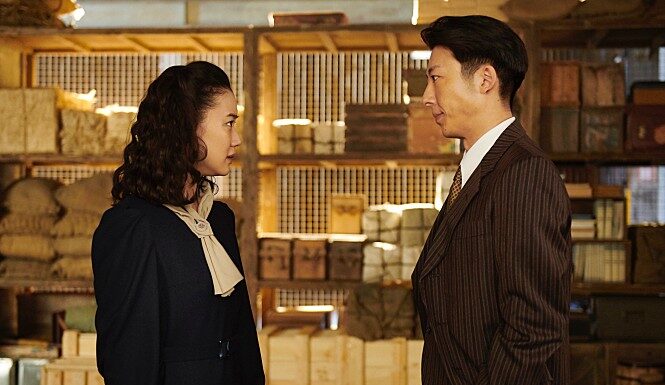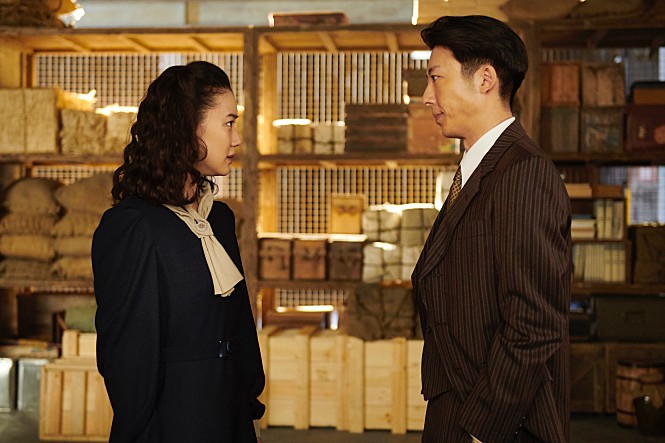
MEMORIZU: a cinematic essay on memories

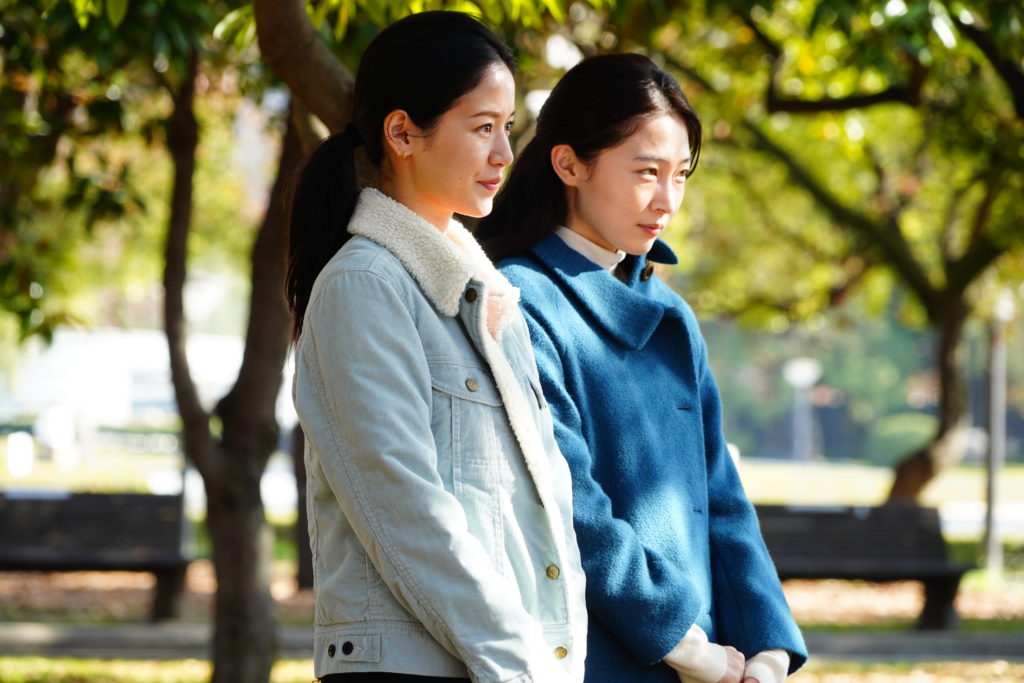
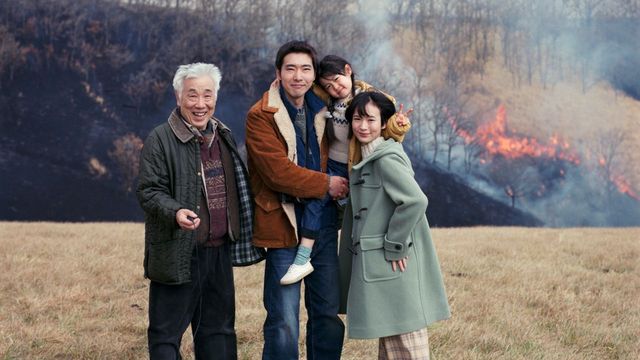
Photo caption: Issei Ogata, Tasuku Emoto, Shiki Inoue and Moeka Hoshi in MEMORIZU. Courtesy of Tribeca.

The mesmerizing Memorizu begins with Yuta (Tasuku Emoto) traveling hours away to a rural town on Japan’s southernmost major island. He’s planning to spend two months caring for his elderly father-in-law, incapacitated by a broken leg. The widowed father-in-law, Makoto (Issei Ogata), is grouchy and maddeningly particular, but Yuta dutifully carries on, looking forward to video calls from his wife Yuki (Moeka Hoshi) and their young daughter Hana (Shiki Inoue). This area is unfamiliar to Yuta, but he soon settles into a routine – walking the dog, eating his lunch on a bench with a view of a farm horse, and minding Makoto’s portrait photography shop.

Memorizu is the impressively confident debut feature by writer-director Miiku Sakanishi, who shows us that even the littlest moments add up to define a life. As these moments are documented by images – snapshots, photographic portraits, videos – Sakanishi forms Memorizu into a cinematic essay on memory. The editing by veteran editor Shinichi Fushima is impeccable, and Sakanishi’s pacing keeps us engrossed even with little movie action.

Many images, like selfies and even class photos, seem disposable, but they evoke memories that are re-experienced forever. Yuta himself begins taking photos on his daily rounds. It seems that his corporate job gives Yuta the flexibility to get away, while Yuki has to stay to care for Hana and for her job as a tour guide/translator for Chinese tourists; the video calls between them become increasingly important..

Eventually, we see more emotionally charged images: a flashback video from Yuta at the time of Hana’s birth, Makoto’s portrait of his best friend; and, most affecting, a recorded voicemail. Memorizu is authentically heartfelt without sinking into sentimentality.

Memorizu introduces us to Sakanishi as a gifted new auteur. I screened Memorizu for its world premiere at Tribeca, where it won the Best New Narrative Director Award.
EXIT 8: nightmare on a loop

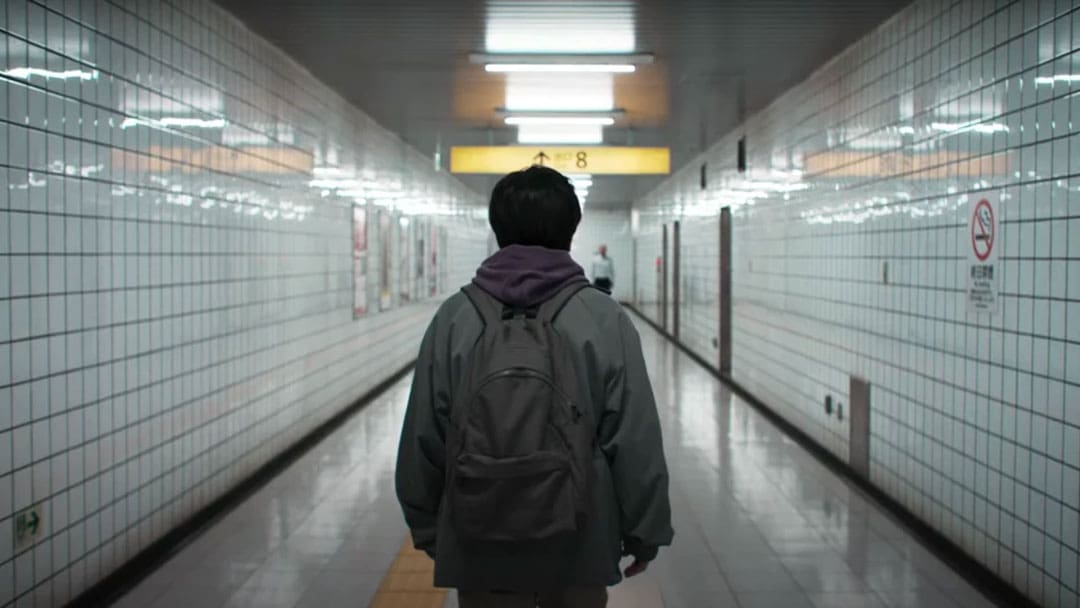
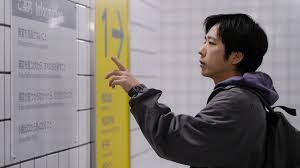
Photo caption: Kazunari Ninomiya in EXIT 8. Courtesy of NEON.

In the Japanese psychological thriller Exit 8, a workaday Everyman (Kazunari Ninomiya) is unenthusiastically heading to his temp job on Tokyo’s subway. But when he exits the train, he can’t find the way out of the station. As he walks past the gleaming white-tiled walls, he follows the signage toward Exit 8, which never emerges. He’s caught in a nightmarish loop, and he gets increasingly desperate. Will the guy, named “Lost Man”, be trapped forever?

This is a movie about endless repetition, so how does director and co-writer Genki Kawamura keep us engaged for an hour-and-thirty-five minutes? First, Lost Man encounters other solitary, and seemingly random characters in the station corridors The most vivid is the rigidly-postured, pony-tailed Walking Man (Yamato Kochi) – who is he, and why isn’t he panicking about being lost, too? Later, there’s a boy, a high school girl and the apparition of someone the Lost Man knows. To make the Lost Man’s escape even more frantic, he learns he has to deal with a life-changing development outside the subway system.

Although it’s not obvious, Exit 8 is based on a labyrinth game, and there’s a subway information placard with the instructions to keep going as long as there are no anomalies, but to turn back if an anomaly is spotted. Kawamura gets us to follow Lost Man as he essentially plays the game by trying to spot the anomalies

Kazunari Ninomiya in EXIT 8. Courtesy of NEON.

Finally, Kawamura deploys some horror movie techniques. There are jump scares and disturbing images and sounds. While I was watching Exit 8, The Wife was in a different room, but she still got scared by the soundtrack. There is no gory body horror.

96% of the story is in a maze comprised of the same three or four corridors of a subway station, filmed on a set. The rest was shot in three actual Tokyo subway stations.

This is a film unlike any we’ve seen, and it’s pretty entertaining. Exit 8 is streaming on Amazon, AppleTV, YouTube and Fandango.

Coming up on TV – the bracing neo-noir PALE FLOWER

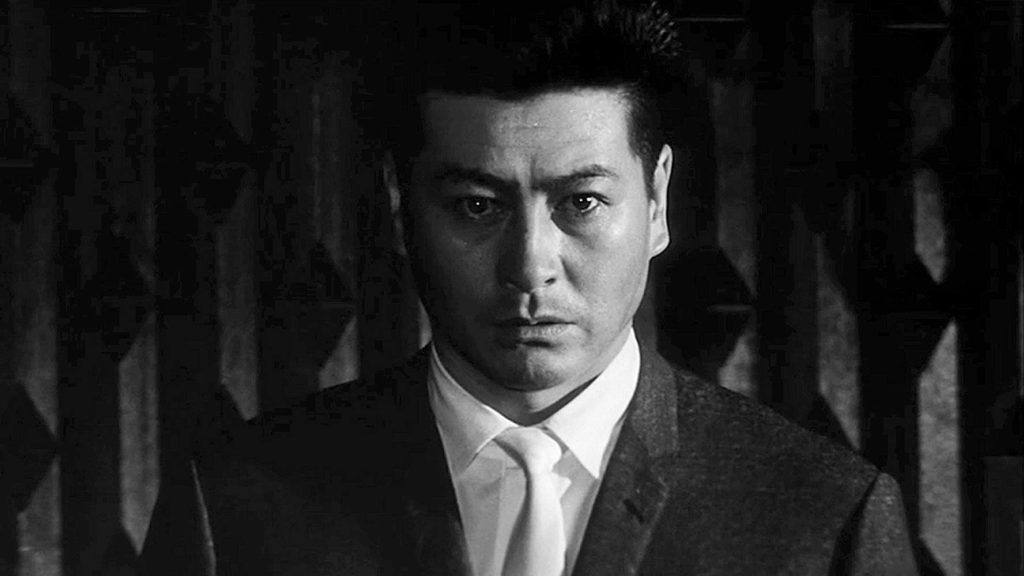
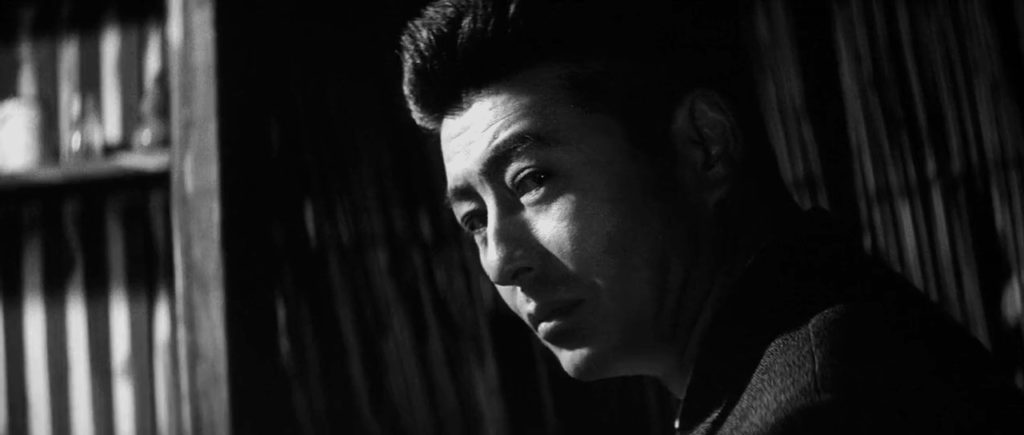
Ryô Ikebe in PALE FLOWER

Coming up this Saturday and Sunday on Turner Classic Movies’ Noir Alley with Eddie Muller, the Japanese neo-noir Pale Flower is a slow burn that erupts into thrilling set pieces. This is pioneering neo-noir. Pale Flower is writer-director Masahiro Shinoda’s masterpiece; its look and feel is as different from classic noir as are Elevator to the Gallows and Blast of Silence.

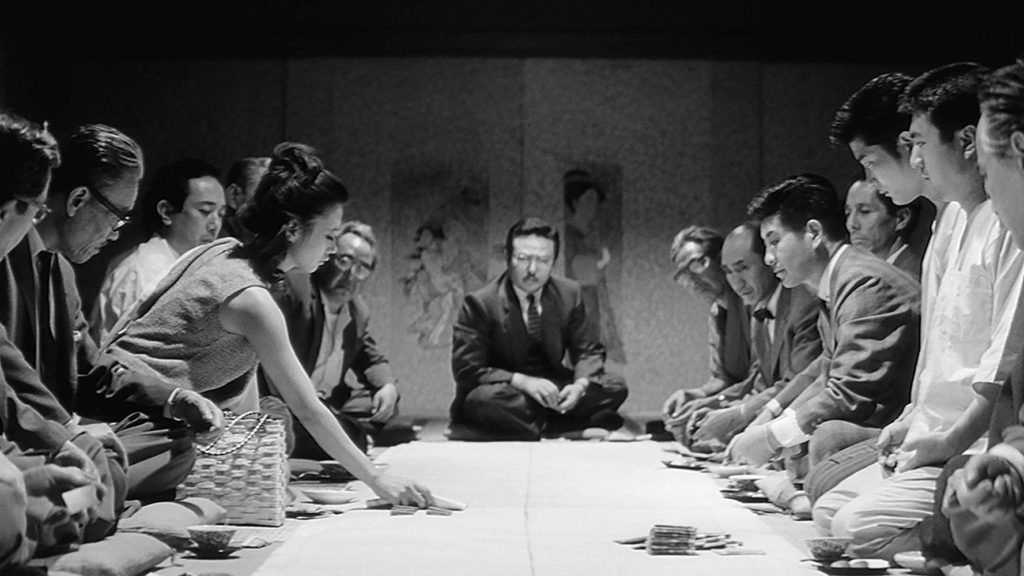
Maraki (Ryô Ikebe) is a fortyish Yazuka hit man, just released from loyally serving a prison term. He went away for offing a gangland rival, but now the two gangs have become allies. Out gambling with fellow Yakuza, he encounters the much younger woman Saeko (Mariko Kaga). The stoic and completely self-contained Maraki becomes fascinated by – and then obsessed with – Saeko, who lives her life seeking thrill after thrill.

PALE FLOWER

Maraki and Saeko meet gambling on the Japanese card game of hanafuda (flower cards). She is the only woman at a table surrounded by male gangsters. Shinoda makes the tension of card games resemble that of walking into a hostile bar or waiting an Old West quick draw gunfight. The card games are silent but for the ritual betting and the players clicking their cards. The film’s title refers to both hanafuda and Saeko.

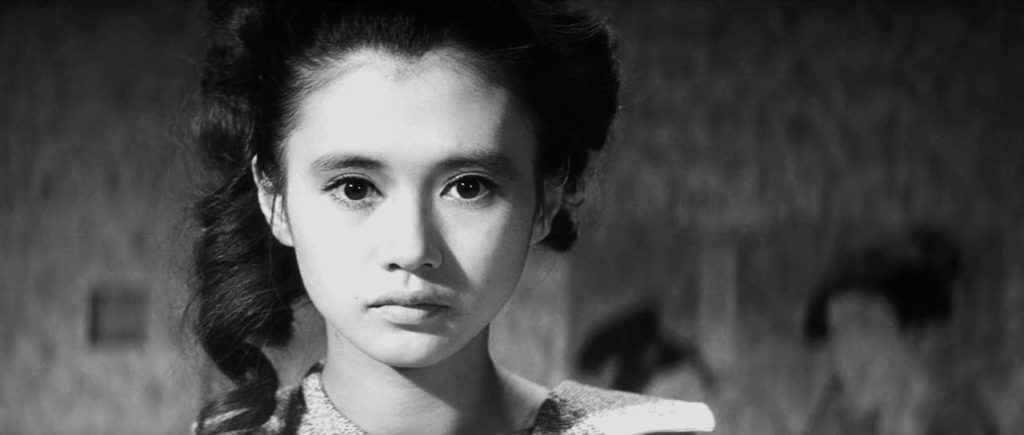
Mariko Kaga in PALE FLOWER

Just who is this mystery woman? Muraki is snagged, but he is too cool to search out her background. His obsession is more complicated than sexual passion alone, although there is a sexual element (watch whether he acts on it when he can). The mystery makes Saeko (the then 20-year-old Mariko Kaga in only her fourth movie) all the more captivating.

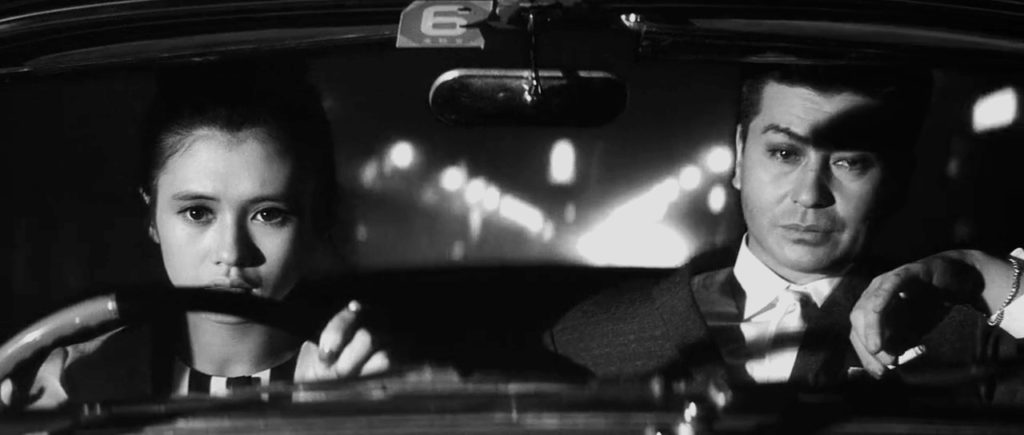
In another gripping set piece, Saeko races her sports car through Tokyo’s tunnels and overpasses at 2:30 AM. In the passenger seat, Muraki is transfixed by her recklessness. He’s not thrilled by the careening wild ride, he’s thrilled by Saeko’s compulsion to seek the thrill.

Mariko Kaga and Ryô Ikebe in PALE FLOWER

The ultimate thrill might be to accompany a hit man on the job. The climactic three-minute scene is a mob hit in a church, set to an aria, Henry Purcell’s Dido’s Lament. It is operatic – and remarkably similar to Francis Ford Coppola’s later montage in The Godfather where Michael Corleone’s assassins kills all his enemies while he is standing in church at the christening of his sister’s baby. Muarki’s murder-for-hire is up-close-and-personal.

When Maraki and Saeko are on-screen, Pale Flower is dramatically and stylistic Stylistic – the card games, the car race, the final killing, In contrast, we see the mundane plotting of the Yazuka bosses (but not their crimes) as they kibbitz at the horse races. Their underlings go bowling.

Does it all matter? is a central theme in film noirPale Flower’s powerful final prison scene is the the ultimate neo-noir ending.

Pale Flower is included in Roger Ebert’s Great MoviesPale Flower is challenging to find; it can be streamed with a subscription to Criterion Collection or kanopy, and it plays occasionally on TCM, including on June 21-22.

Ryô Ikebe in PALE FLOWER

EVIL DOES NOT EXIST: not so mesmerizing

Photo caption: Hitoshi Omika in EVIL DOES NOT EXIST: Courtesy of Janus Films.

I was delighted when Evil Does Not Exist finally trickled on to VOD recently. I had been eager to se it because of my admiration for it’s writer-director Ryusuke Hamaguchi, whose last movie, Drive My Car, made #1 on my Best Movies of 2021. Evil Does Not Exist had also won the Silver Lion at the Venice Film Festival. Unfortunately, I didn’t like it.

This parable is set in a tiny village nestled in remote mountains (shot near Nagano, Japan), with its surrounding forest still wild and relatively untouched. Takumi (Hitoshi Omika) is the village jack-of-all-trades, and he is attuned to the natural cycles of life in the forest. A hospitality corporation has bought land outside the village and hopes to attract tourists to a newly developed glamping camp.

Takahashi (Ryûji Kosaka) is the PR guy dispatched to sell the project to the locals and preempt any political resistance from them. When Takumi raises concerns at a community meeting, Takahashi smoothly tries to deflect them. However, Takahashi privately recognizes that Takumi is right – the project’s lack of adequate septic capacity will imperil the village’s drinking water. Takahashi is the most interesting character in the fil, as he takes risks to push back internally against the company line.

In a devastating ending, Takumi, who has been stewing about the water issue, reacts to an urgent situation by taking an action that was hard for me to understand.

Evil Does Not Exist has been described as mesmerizing, and that’s how I found the extended introduction to be, but but too many scenes are way too long, especially the community meeting. I’m more patient and receptive to slow burns than most movie viewers, but, IMO, this story needed to be told more economically. Then, the ending lost me.

Now, I’m an outlier here. Besides its slew of prestigious festival awards, Evil Does Not Exist has an 83 rating on Metacritic, including raves by some of my favorite critics.

Evil Does Not Exist is streaming on Amazon, AppleTV and Criterion.

TOKYO COWBOY: he came, he saw, he changed

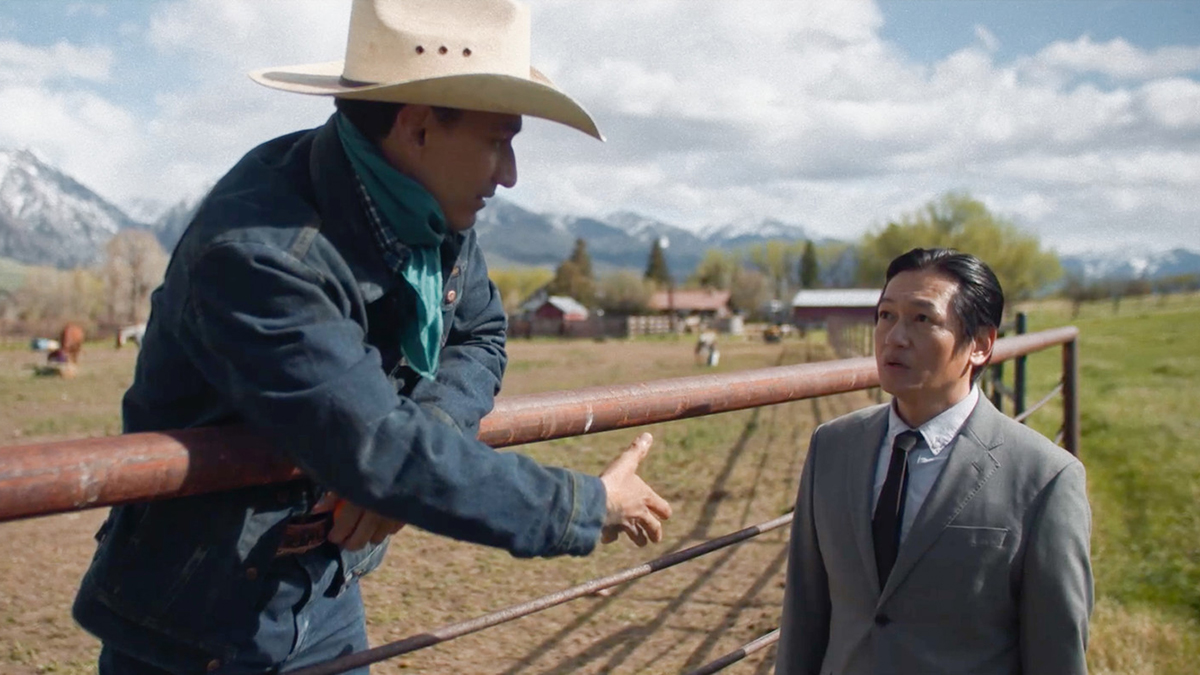
Photo caption: Goya Robles and Arata Iura in TOKYO COWBOY. Courtesy of Salaryman.

The charming dramedy Tokyo Cowboy centers on a Japanese corporate turnaround artist, Hideki (Arata Iura). Confident that he has the secret sauce to recharge any stagnant brand, he’s got a slick pitch deck (with a snapshot from his own childhood), and he’s engaged to the corporate vice-president he reports to. His company is about to liquidate a money-hemorrhaging cattle ranch in Montana, when he parachutes in for a quick fix. His Japanese beef consultant goes hilariously native, and Hideki, a smart guy, immediately sees that his idea for a quick fix was mistaken. Now unsettled and off the grid in an alien culture, Hideki recalibrates his values and his life goals.

Arata Iura’s performance is exceptional, especially since the character of Hideki is a restrained man from a very reserved culture, a cypher who is dramatically changing internally. Ayako Fujitani is very good a Hideki’s fiancé/boss Keiko. Robin Weigert (Calamity Jane in Deadwood) is excellent as the ranch manager. Jun Kunimura (222 IMDb credits) is hilarious as Hideki’s cattle expert.

Arata Iura and Ayako Fujitani in TOKYO COWBOY. Courtesy of Salaryman.

It’s the first narrative feature for director Marc Marriott, who, with cinematographer Oscar Ignacio Jiménez, creates a Big Sky setting that could reset any of us in need of self-discovery. Some directors would have ruined this story by making the fish-out-water comedy too broad or the self-discovery too self-important, but Marriott strikes the perfect tone. The screenplay was co-written by Ayako Fujitani (who plays Keiko)) and Dave Boyle.

I screened Tokyo Cowboy for the SLO Film Fest, where it won the jury award for Best Narrative Feature. Tokyo Cowboy opens on September 28 at the Lark in Larkspur and on October 25 at the Palm in San Luis Obispo.

PERFECT DAYS: intentional contentment

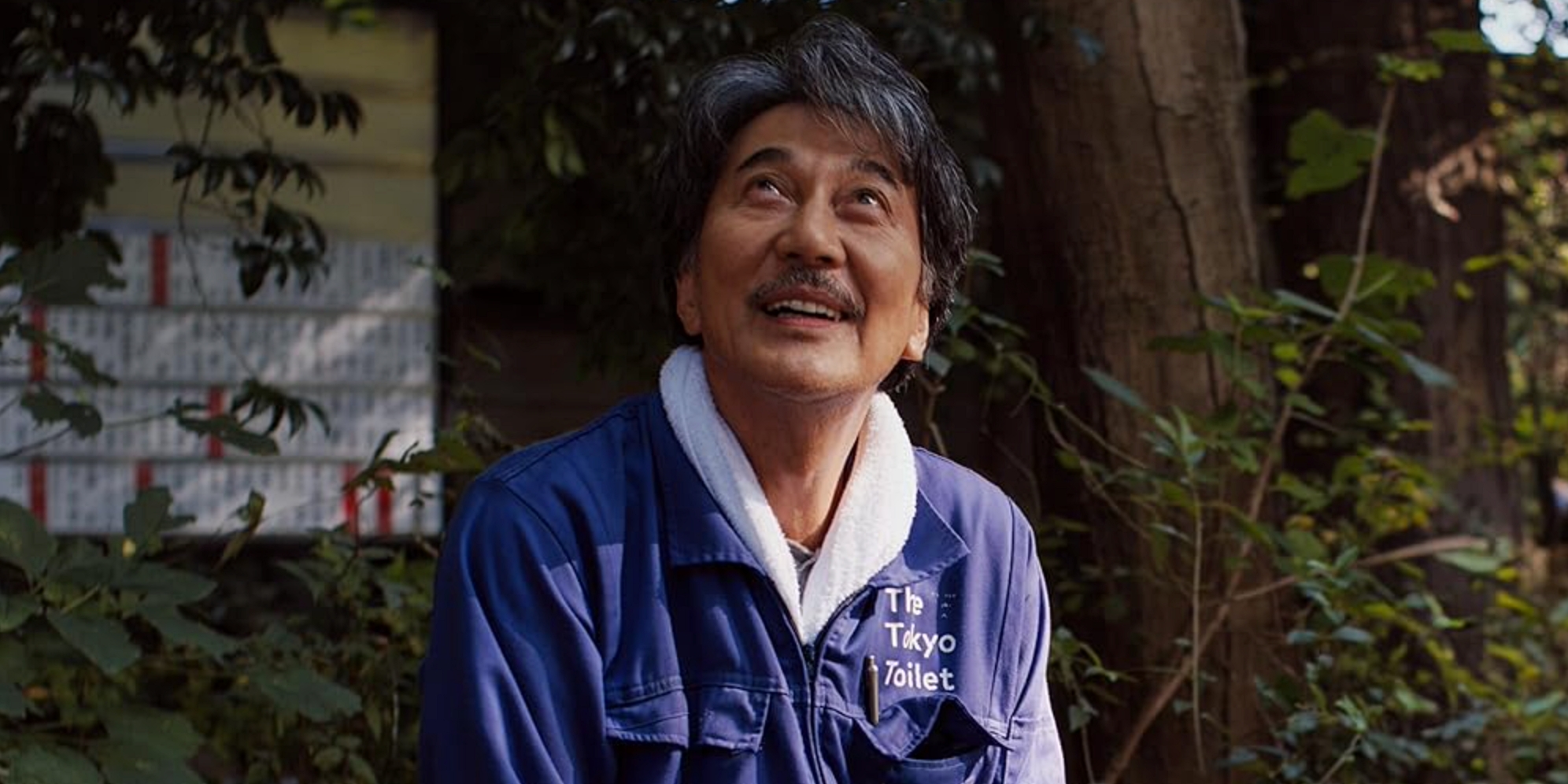
Koji Yakusho in PERFECT DAYS. Courtesy of NEON.

Wim Wenders’ quietly mesmerizing Perfect Days is an ode to those who can identify the beauty in everyday life. Sixtyish Hirayama (Koji Yakusho) works cleaning public toilets in Tokyo’s urban parks. He lives a simple, even spartan existence, within the parameters of a firm routine. Others might be ground down by a life of drudgery, but Hirayama is a happy man.

Hirayama finds beauty in the parks, his massive collection of audiocassettes of 70s and 80s rock, dramatic cityscapes, his friendship with a restaurant owner, a little gardening and reading William Faulkner and Patricia Highsmith. Hirayama isn’t a blissed-out simpleton – he is deliberate in seeking and garnering pleasure from bits of beauty. It’s as if he frames his job, not as cleaning toilets all day, but as working in Tokyo’s most serene urban oases. Hirayama lives within a complete absence of envy and has long since discarded any need for striving. Hirayama lives a life of intentional contentment.

He is kind, but not a naive pushover. His younger work partner is a slacker who is shallow, impulsive and lazy; Hirayama disapproves of his lack of work ethic, but doesn’t let it ruin his own day. Hirayama doesn’t seek social interaction, but is available to emotionally support his runaway niece and a cancer-ridden acquaintance.

There are characters who do not get Hirayama’s ethos, like his estranged sister. The annoying younger co-worker is not affected by Hirayama’s cassette of Patti Smith’s Redondo Beach, and doesn’t notice that the woman he is dating is entranced; we know that it’s going to be his loss.

Hirayama catches the eye of a young working woman as each lunches on a sandwich on a park bench; she looks back, not understanding how he can find a sandwich in a tranquil setting to be so rapturous.

Wim Wenders first directed a movie in 1967 and became an acclaimed international auteur, his masterpiece being Paris, Texas. Now at 78, Wenders still has something to say, and it’s about contentment and beauty.

Perfect Days is not for everyone – some may be bored by the repetition in Hirayama’s routine – getting up, commuting, cleaning toilets, dropping in a public bath before bed, rinse and repeat.

Koji Yakusho won the best actor award at Cannes for this performance. You may remember him starring in the arthouse hits Tampopo (1985) and Shall We Dance? (1996), in Alejandro Inarritu’s international ensemble in Babel (2008), as the lead assassin in 2010’s 13 Assassins and as the oddball confessed murderer in Hiroyuki Koreeda’s 2018 The Third Murder.

This is a beautiful little film, sweet, without being cloying or sentimental. Perfect Days can be streamed on Amazon, AppleTV, YouTube, Fandango and Hulu (included).

WIFE OF A SPY: espionage non-thriller

Photo caption: Yû Aoi and Issey Takahashi in WIFE OF A SPY. Courtesy of Kino Lorber.

In the espionage non-thriller Wife of a Spy, the prosperous Yusaku (Issey Takahashi) runs a business in international commerce. That is increasingly uncomfortable in 1940 Japan, where the militaristic government is whipping up xenophobia and bullying those Japanese who interact with foreigners.

Yusaku is a smooth cosmopolitan who won’t be intimidated. He keeps on the road, even to dangerous hotspots like Manchuria. That’s not okay with his loving, apparently frivolous wife Santoko (Yû Aoi), who, frustrated by his absences, is getting increasingly suspicious about what he’s really up to.

She finally stumbles upon his secret – he and his nephew Fumio (Ryôta Bandô) are outraged by the war crimes of the military government and are engaged in a secret plot to undermine it. Santoko, who was been a mere adornment, becomes herself embroiled.

Regrettably, Wife of a Spy is more of a snoozer than a thriller. It just takes director Kiyoshi Kurosawa (no relation to Akira) too long to get through the first and second acts.

Worse, I found the sudden dramatic lurches in the performances by Yû Aoi and Ryôta Bandô very off-putting. I don’t think I missed something cultural because I’ve watched a lot of Japanese cinema, and haven’t seen anything like this before. It’s like the director of a high school play says, “Now throw yourself on the floor!” Yû Aoi is a popular and lauded actress who has five nominations and two wins in the Japanese equivalent of the Oscars. I’m blaming Kurosawa.

I’m also mostly alone in my opinion. Wife of a Spy enjoys a high score of 79 on Metacritic and was a New York Times Critic’s Pick. Wife of a Spy’s advocates may be seduced by the film’s undeniable beauty. The cinematography by Tatsunosuke Sasaki, production design by Norifumi Ataka and the costumes by Haruki Koketsu are exquisite.

Here’s a novel aspect to Wife of a Spy. The hero is a traitor to his nation. Yusaku loves Japan, hates the Japanese government, and believes Japan will be better off the sooner that Japan loses the war. So, he is trying to hasten the defeat of his own nation’s military, which is the definition of traitorous. I haven’t heard that this was hugely controversial in today’s Japan.

Wife of a Spy is streaming on Amazon, AppleTV, Vudu, YouTube and KinoNow and is included on MHz.

DRIVE MY CAR: sublime and powerful

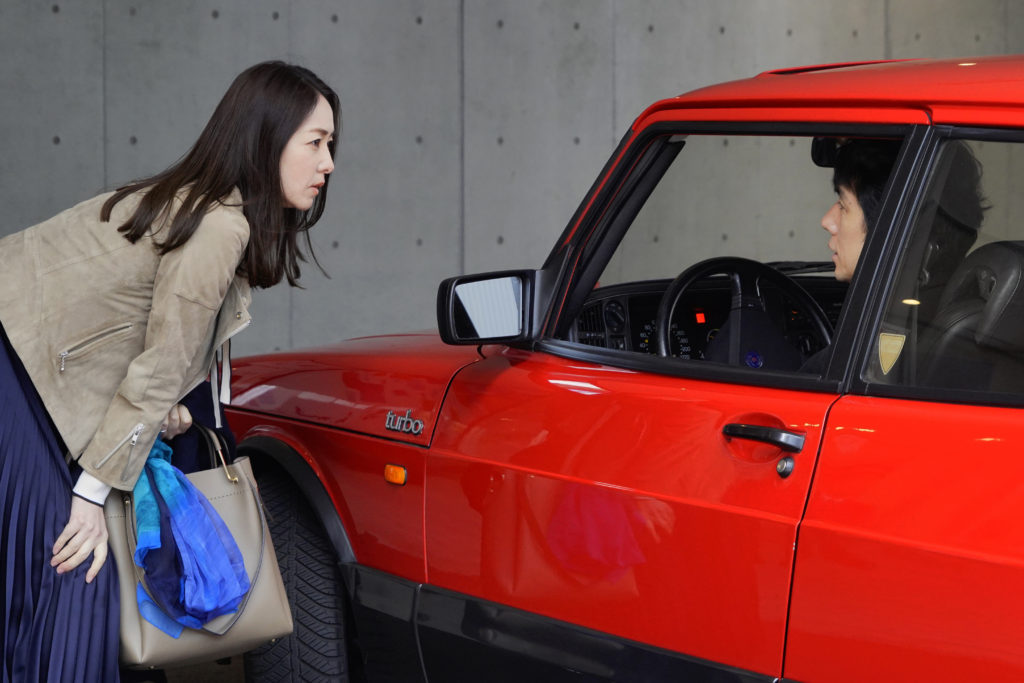
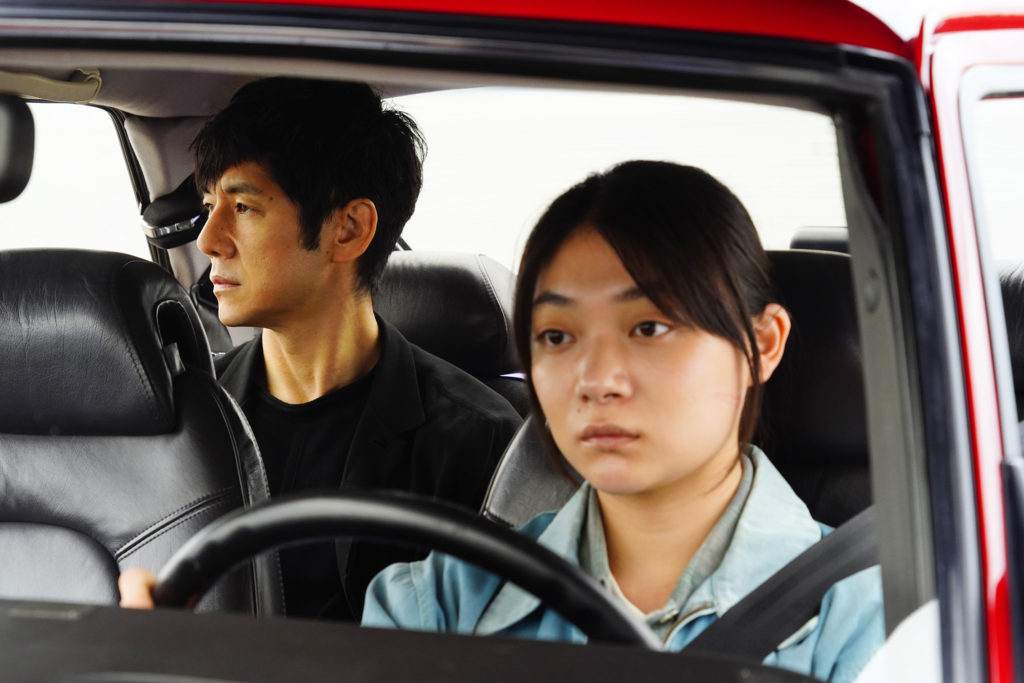
Photo caption: Reika Kirishima and Hidetoshi Nishijima in DRIVE MY CAR. Courtesy of The Match Factory.

Drive My Car is director and co-writer Ryûsuke Hamaguchi’s engrossing masterpiece about dealing with loss – and it’s the best movie of 2021. Layered with character-driven stories that could each justify their own movie, this is a mesmerizing film that builds into an exhilarating catharsis.

Drive My Car opens with an entrancing story about a teenage girl, told by a woman to her sexual partner. It turns out that the woman regularly tells stories to her husband during sex. advancing the plot after she climaxes, and the husband remembers and preserves the stories. She is Oto (Reika Kirishima), a television writer and showrunner. He is Yûsuke (Hidetoshi Nishijima), a theater actor and director, known for his work in Beckett and Chekhov. He works on his line readings while driving his beloved 13-year-old red SAAB 900 turbo.

Yûsuke and Oto’s relationship is complicated. We later learn how complicated and why.

Forty or so minutes in, the movie’s opening titles appear, and it’s two years later. Yûsuke still has the SAAB, which he drives to Hiroshima for a two-month theater residency. He is to cast and direct a pan-Asian, multi-lingual production of Uncle Vanya. His Japanese, Korean, Filipino and Taiwanese-American cast speak the lines in their languages (one being Korean Sign Language), with the dialogue subtitled at performances.

To Yûsuke’s distress, he is required by by the Hiroshima theater to use their driver, the impassive tomboy Misaki (Tôko Miura). He resents this incursion into his vehicular sanctuary, but Misaki is now driving his SAAB, and she turns out to be diligent and expert.

During the weeks of rehearsal, more stories emerge and more of Yûsuke’s own story is revealed. When Yûsuke and Misaki have dinner at the home of the theater project’s organizer (Dae-Young Jin) and his deaf wife (Yoo-rim Park), they are surprised by a deeply personal revelation.

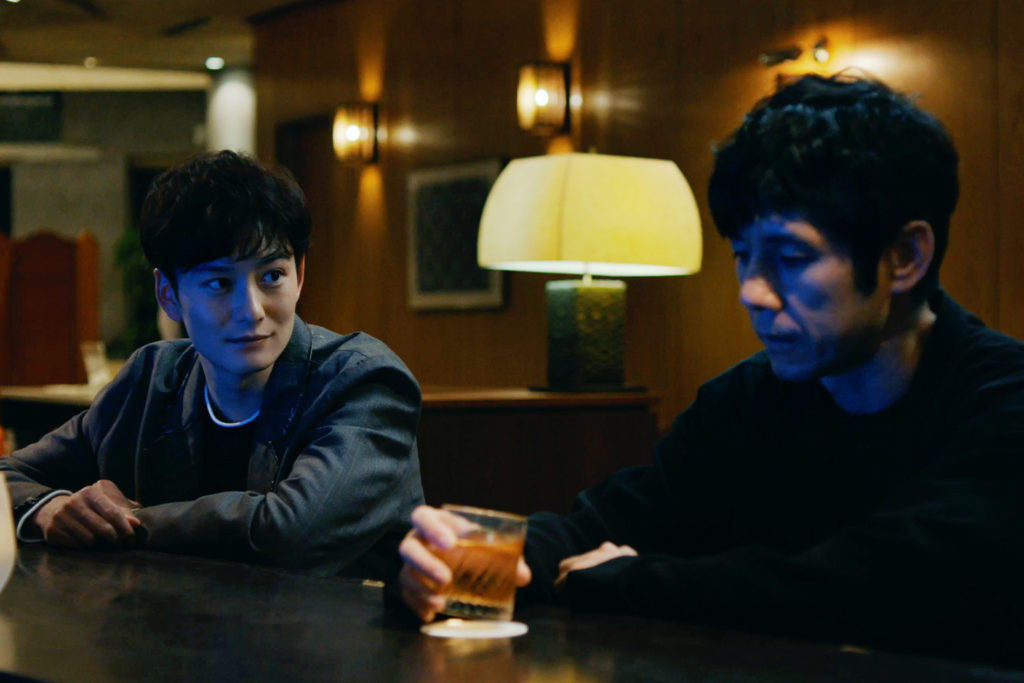
Masaki Okada and Hidetoshi Nishijima in DRIVE MY CAR. Courtesy of The Match Factory.

Yûsuke has cast a young actor, Koji (Masaki Okada), whom we know to be unreliable, but even Koji comes through with an impassioned, and apparently true, story of his own.

There’s an outdoor rehearsal scene between two actors (Sonya Yuan and Yoo-rim Park) that becomes magical.

Sonya Yuan and Yoo-rim Park in DRIVE MY CAR. Courtesy of The Match Factory.

Each component story is powerful, and Drive My Car becomes even more than the sum of its parts and builds in intensity.

Drive My Car is three hours long. While screening a movie, I take notes on an unlined notebook, and I see that I had scrawled, MESMERIZING ENGROSSING WHAT AM I WATCHING? The rest of the art house audience was as spellbound as I.

There is one soon-to-be-iconic shot in Drive My Car. After a cathartic scene, Misaki and Yûsuke drive into a reddish tunnel. Hamaguchi shows us two hands holding lit cigarettes out of the SAAB’s open sun roof. It’s an exhilarating and unforgettable shot, and once enough cinephiles see Drive My Car, it will become the instantly recognizable signature of Drive My Car.

Hidetoshi Nishijima and Tôko Miura in DRIVE MY CAR. Courtesy of The Match Factory.

Hidetoshi Nishijima (Yûsuke) and Tôko Miura (Misaki) are superb. Both characters are poker-faced, so the performances are exceptionally subtle.

I’m dismayed that Drive My Car is so difficult to find. It is currently playing in only three Bay Area theaters, in Berkeley, Oakland and San Francisco, plus a couple For Your Consideration screenings in San Rafael. It is currently the number one movie on many top ten lists, including mine and Barack Obama’s.

PALE FLOWER: bracing neo-noir

Ryô Ikebe in PALE FLOWER

Coming up on Turner Classic Movies on June 18, the Japanese neo-noir Pale Flower is a slow burn that erupts into thrilling set pieces. This is pioneering neo-noir. Pale Flower is writer-director Masahiro Shinoda’s masterpiece; its look and feel is as different from classic noir as are Elevator to the Gallows and Blast of Silence.

Maraki (Ryô Ikebe) is a fortyish Yazuka hit man, just released from loyally serving a prison term. He went away for offing a gangland rival, but now the two gangs have become allies. Out gambling with fellow Yakuza, he encounters the much younger woman Saeko (Mariko Kaga). The stoic and completely self-contained Maraki becomes fascinated by – and then obsessed with – Saeko, who lives her life seeking thrill after thrill.

PALE FLOWER

Maraki and Saeko meet gambling on the Japanese card game of hanafuda (flower cards). She is the only woman at a table surrounded by male gangsters. Shinoda makes the tension of card games resemble that of walking into a hostile bar or waiting an Old West quick draw gunfight. The card games are silent but for the ritual betting and the players clicking their cards. The film’s title refers to both hanafuda and Saeko.

Mariko Kaga in PALE FLOWER

Just who is this mystery woman? Muraki is snagged, but he is too cool to search out her background. His obsession is more complicated than sexual passion alone, although there is a sexual element (watch whether he acts on it when he can). The mystery makes Saeko (the then 20-year-old Mariko Kaga in only her fourth movie) all the more captivating.

In another gripping set piece, Saeko races her sports car through Tokyo’s tunnels and overpasses at 2:30 AM. In the passenger seat, Muraki is transfixed by her recklessness. He’s not thrilled by the careening wild ride, he’s thrilled by Saeko’s compulsion to seek the thrill.

Mariko Kaga and Ryô Ikebe in PALE FLOWER

The ultimate thrill might be to accompany a hit man on the job. The climactic three-minute scene is a mob hit in a church, set to an aria, Henry Purcell’s Dido’s Lament. It is operatic – and remarkably similar to Francis Ford Coppola’s later montage in The Godfather where Michael Corleone’s assassins kills all his enemies while he is standing in church at the christening of his sister’s baby. Muarki’s murder-for-hire is up-close-and-personal.

When Maraki and Saeko are on-screen, Pale Flower is dramatically and stylistic Stylistic – the card games, the car race, the final killing, In contrast, we see the mundane plotting of the Yazuka bosses (but not their crimes) as they kibbitz at the horse races. Their underlings go bowling.

Does it all matter? is a central theme in film noir. Pale Flower’s powerful final prison scene is the the ultimate neo-noir ending.

Pale Flower is included in Roger Ebert’s Great Movies. Pale Flower is challenging to find; it can be streamed with a subscription to Criterion Collection or Kanopy, and it plays occasionally on TCM, including on June 18.

Ryô Ikebe in PALE FLOWER

THE HANDMAIDEN – gorgeous, erotic and a helluva plot

THE HANDMAIDEN
THE HANDMAIDEN

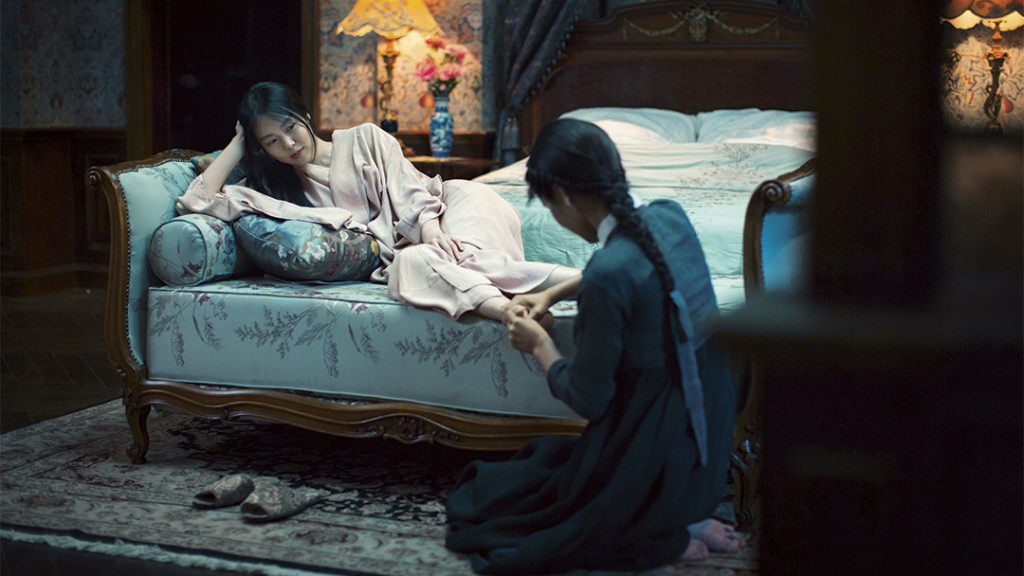
After a few minutes of The Handmaiden, we learn that it’s a con artist movie. After 100 minutes, we think we’ve watched an excellent con artist movie, but then we’re surprised by a huge PLOT TWIST, and we’re in for two more episodes and lots of surprises in a gripping and absorbing final hour. It’s also one of the most visually beautiful and highly erotic films of the year.

Director and co-writer Chan-wook Park sets the story in 1930s Korea during Japanese occupation (Japanese dialogue is subtitled in yellow and Korean dialogue in white). A young heiress has been secluded from childhood by her guardian uncle, who intends to marry her himself for her fortune. A con man embarks on a campaign to seduce and marry the wealthy young woman to harvest her inheritance himself. The con man enlists a pickpocket to become handmaiden to the heiress – and his mole. I’m not going to tell you more about the plot, but the audience is in for a wild ride.

The Handmaiden takes its time revealing its secrets. Who is conning who? Who is attracted to whom? How naive is the heiress? How loyal is the handmaiden? Who is really Japanese and who is really Korean? What’s in those antique books? What’s in the basement? Is the uncle perverted or REALLY perverted? And what legendary sex toy will show up in the final scene?

THE HANDMAIDEN
THE HANDMAIDEN

Chan-wook Park’s 2003 US art house hit Oldboy is highly sexualized, trippy and disturbing. The Handmaiden is much more mainstream and accessible than Oldboy, but its sexuality packs a punch.

Gorgeous and erotic, The Handmaiden is one of the most gloriously entertaining films of the year. You can order the DVD from Netflix or stream it on Amazon Instant Video, iTunes, Vudu, YouTube and Google Play.