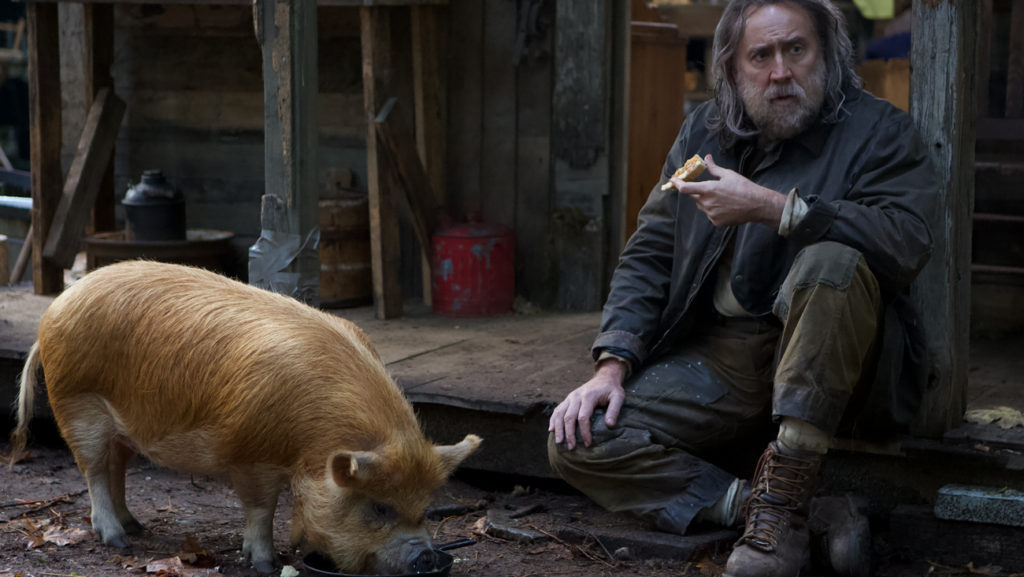
Photo caption: Nicolas Cage (right) in PIG. Courtesy of NEON.
When we first meet Pig’s protagonist Rob (Nicolas Cage), he is living off the grid deep in a Pacific Northwest forest. Rob hunts truffles with his beloved pig. Once a week, Amir (Alex Wolff), a hustler from Portland, arrives to buy the week’s harvest. That is Rob’s only interaction with the human race, and he prefers not to converse with Amir. Rob is filthy, even in comparison to the pig.
When the pig is kidnapped (or pignapped?), Rob forces Amir to drive him into and around Portland on a quest to rescue the pig. As the quest continues, we learn some surprising things about Rob.
Initially, we would assume that Rob, with his crazy homeless guy look, is a broken man, withdrawing from society because a trauma, a failure, a mental breakdown or an addiction has sapped him of his abilities. It turns out that Rob has suffered a loss, but we’re surprised to learn that Rob is revered by an entire community within Portland. In personal grief, and motivated by his assessment of a coming environmental apocalypse, he has chosen to withdraw. He may LOOK like a deranged derelict, but, when he chooses to be, he is very functional.
Pig is the first feature for writer-director Michael Sarnoski, and it’s pretty entertaining.
Sarnoski has created an extreme character in Rob, and who is better at extreme characters than Nicolas Cage? This is Cage’s best performance in years. Rob is a man with a firm beliefs and a rigid code – and he takes them to their logical extremes, however uncomfortable they seem, and Cage credibly shows us a character with resolute self-assurance and impressive skills.
Alex Wolff is suitably annoying as the callow and loquacious Amir, who fashions himself more of a player than he really is. Amir is smart enough to know that he is no match for his father Darius – a very serious guy. Adam Arkin plays Darius’ ruthlessness (and his one vulnerability) convincingly.
Pig is streaming on Amazon, AppleTV, Vudu, YouTube, Hulu and redbox.
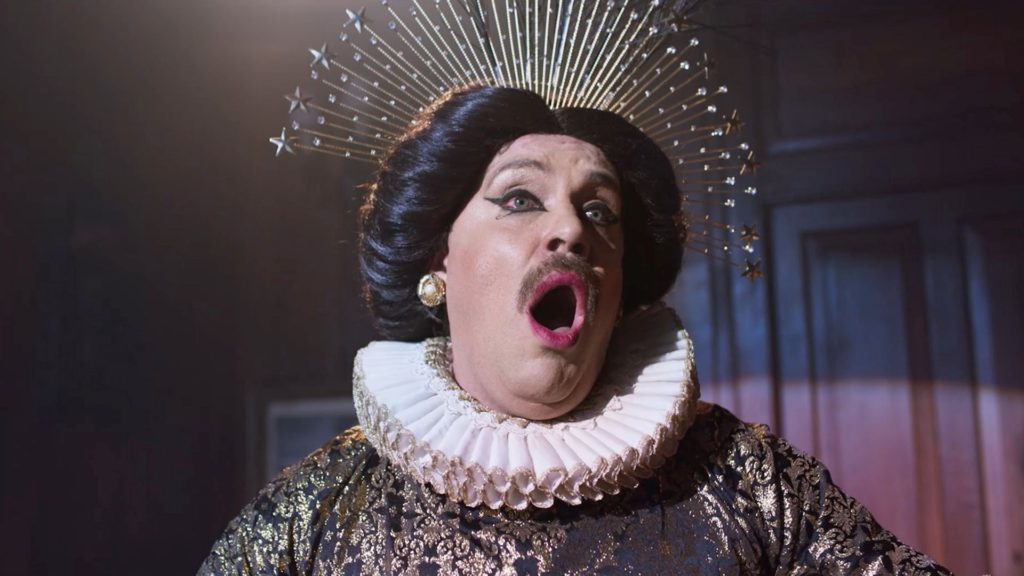
Photo caption: Nicolas Maury in MY BEST PART. Courtesy of Altered Innocence.
In the French coming of age dramedy My Best Part, the young actor Jérémie (Nicolas Maury) is teetering on the verge of a breakdown. Not that Jérémie is generally a stable person – he is so needy and dramatic that he attends Jealous Anonymous. But he loses a gig that he was counting on, his credit card is declined, and worst of all, Jérémie’s smothering jealousy sabotages his relationship with his veterinarian boyfriend (Arnaud Valois), Jérémie’s neurotic fit having disrupted ferret surgery.
With his tail between his legs, Jérémie Paris retreats to hos boyhood home in rural Limousin (the area around Limoges) and the arms of his mother (Nathalie Baye). Jérémie is open to infantilization, but the matter-of-fact Mom is anything but neurotic. With prodding from his mom, will he start behaving like a sane, stable grownup and get his life back on the rails?
Nathalie Baye and Nicolas Maury in MY BEST PART. Courtesy of Altered Innocence.
I’ll watch ten-time César Award nominee Nathalie Baye in anything. Here, in an unchallenging role, she brightens every scene with the sniveling son.
One of the world’s funniest actors, Laure Calamy gets to play a hilarious meltdown in a brief turn as a narcissistic film director.
My Best Part is the feature directing debut for Maury, who also co-wrote the screenplay. My Best Part was nominated for the César for Best First Film.
Parts of My Best Part drag, especially a slooooooow nighttime poolside scene. The final scene, in which Jérémie sings lyrics that explicitly detail his character’s growth, is off-putting and self-indulgent.
My Best Part opens Feb 25 on VOD and at the Glendale Laemmle.
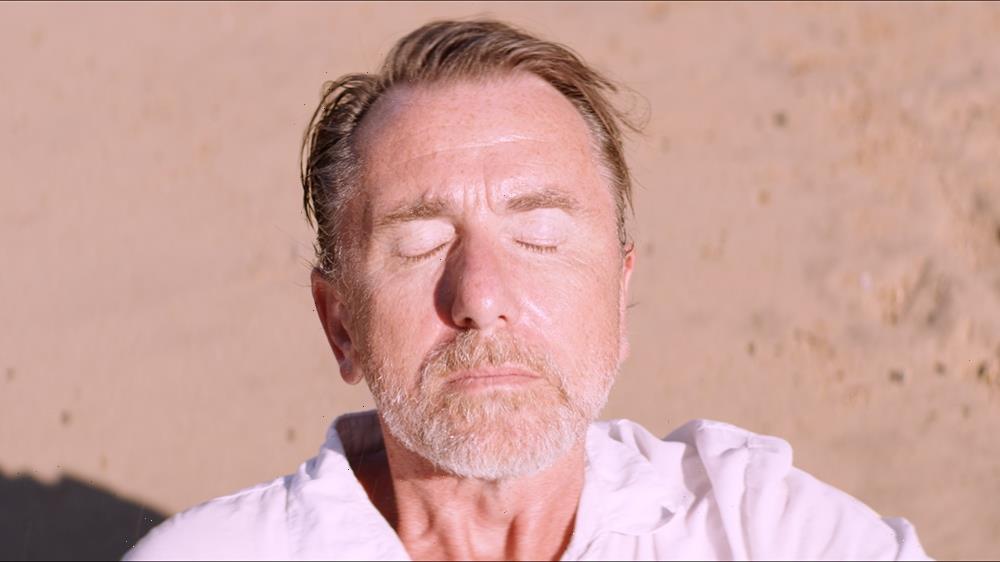
Photo capon: Tim Roth in SUNDOWN. Courtesy of Bleecker Street.
In Sundown, Neil Bennett (Tim Roth) and the hard-charging CEO Alice Bennett (Charlotte Gainsbourg) are vacationing with two college age kids at a luxurious Acapulco resort. Their family matriarch unexpectedly dies and – of course! – they immediately head to the airport to organize the funeral in the UK. But Neil fakes an excuse and avoids getting on the plane, vowing to come along soon. Instead, he does the unthinkable and essentially hides out from the family.
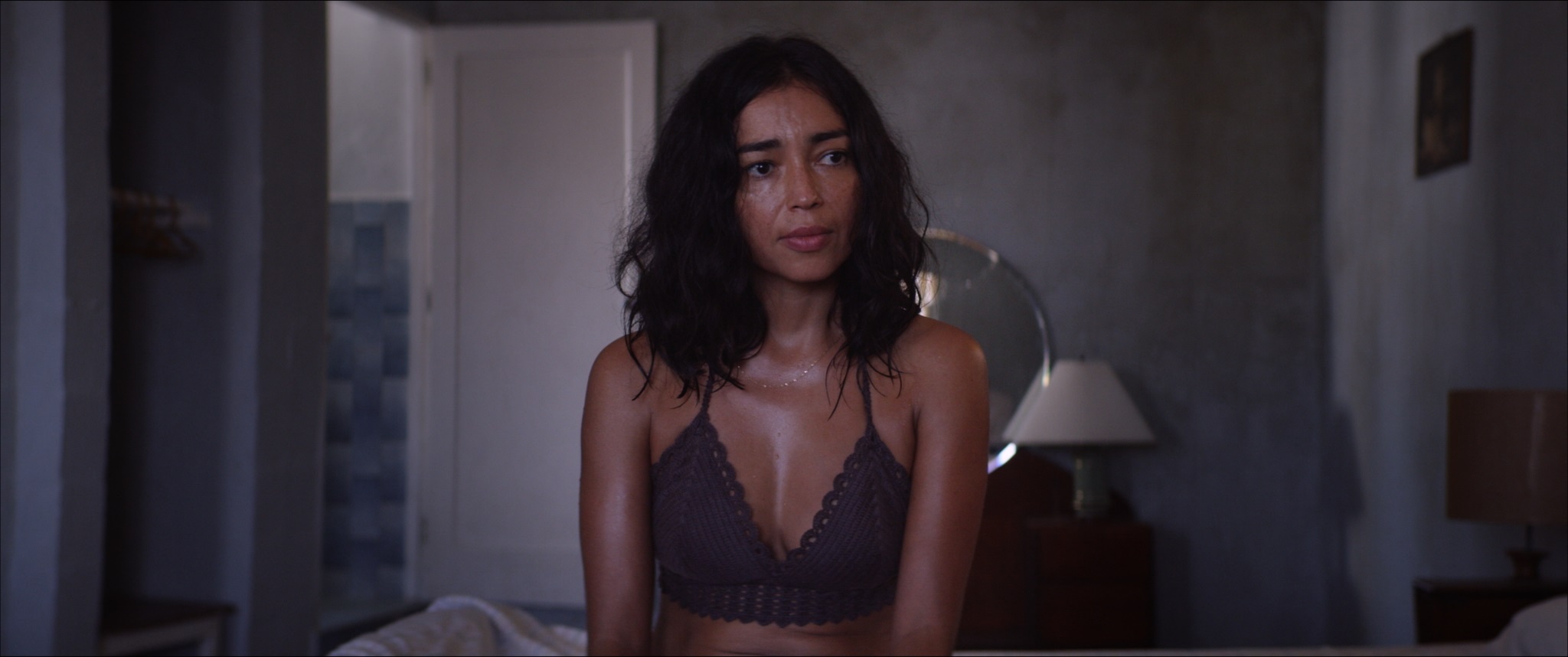
Instead of returning to the resort, Neil moves into a downscale hotel near Acapulco’s public beach. Other than wandering to the beach to commandeer a plastic chair and an ice bucket of cerveza, Neil doesn’t do much for the rest of Sundown. Notably, he does make the acquaintance of a friendly local woman, Berenice (Iazua Larios). Berenice speaks very little English, and Neil speaks essentially no Spanish.
Iazua Larios in SUNDOWN. Courtesy of Bleecker Street.
Writer-director Michel Franco gradually unspins his tale, and we learn how the Bennetts are related and how wealthy they are. But Franco leaves it to us to figure out why Neil is behaving in this way. Is it just awful behavior – irresponsible and selfish? Is he suffering from a psychiatric or neurological disorder?
From the very beginning of Sundown, Neil’s affect is oddly detached and passive. Is he blissed out on vacation? Is he stoned? Bur he soon becomes bizarrely avoidant. And Neil is firmly purposeful in his detachment. A much better director than writer, Michel gives us so little back story, that we really don’t know how divergent Neil’s behavior is. The critic Mick LaSalle observes, “He consistently seems calmer than he should be, so we wonder what he knows.“.
In any case, Sundown is a portrait of a man who is checked out – for an unknown reason and to an explicable extent. We are curious and decidedly not empathetic; his withdrawal from normal obligations causes harm to others – others who at least deserve an explanation.
Sundown’s 82 minutes is hypnotic. Franco is a Mexico City native and brings verisimilitude to the contrasting tiers of Acapulco beach life.
Tim Roth is excellent as a man who is determined to get what he wants, even though what he wants is essentially nothing. Franco and Roth worked together on Chronic.
Iazua Larios is extraordinarily compelling as Berenice, who seems, well, very casual at first, and becomes more complicated. The character of Berenice starts out as an adornment, but she will become the ultimate test of whether there is any limit to Neil’s detachment.
Sundown is a paradox – an unenjoyable observation of an unsympathetic character doing nothing, yet an engaging portrait of an extreme and puzzling personality.
Photo caption: Olivia Colman in THE LOST DAUGHTER. Courtesy of Netflix.
The Lost Daughter is a dark thinkpiece about the impact of maternal obligation to a talented and ambitious woman. We meet Leda (Olivia Colman), a middle-aged comparative literature professor as she arrives for a vacation at a Greek beach. Leda is comfortable traveling alone, and decidedly not sociable.
Leda’s tranquility is harshly disrupted when a large, rambunctious family spills onto the beach from a nearby rental villa, shepherded by their force of nature alpha female Callie (Dagmara Dominczyk). This crowd is a course, vulgar and shady family of Greek-Americans from Queens. Leda is resentful, but she is also intrigued by Nina (Dakota Johnson), a young mother who is unhappily exhausted by parenting her little girl.
When Callie makes neighborly chitchat, Leda pointedly says to Nina, “Kids are a crushing responsibility“. When Leda takes an action that is inexplicable and troubling, we start wondering, “what is going on with her?”. Thereby launches a slow burn exploration of how custodial parents, trapped by their responsibility to always be “on the job” without respite or support, can become drained, depressed, even maddened.
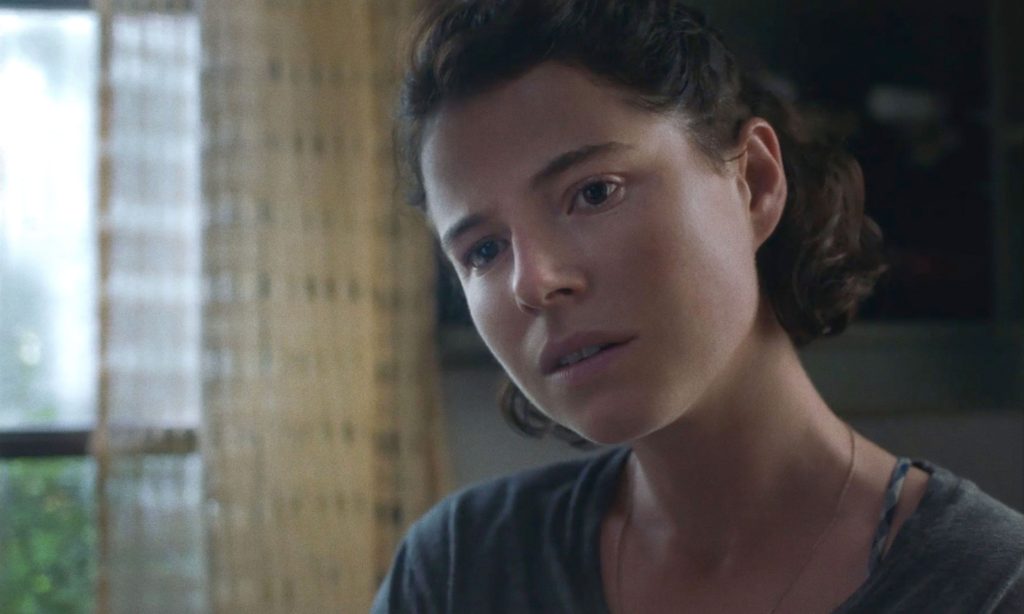
We see flashbacks of a young Leda (Jessie Buckley), a promising scholar on the verge of emerging as a major thought leader, getting whipsawed by her two young daughters, who are adorable yet relentlessly needy.
The young Leda meets a backpacker, who gives her an insight into obligation: “Attention is the rarest and purest form of generosity”. Then, young Leda makes a decision that has major ramifications for her career, her family and which still molds the person who is on the Greek beach today.
The Lost Daughter does not take a Hallmark card, children are such a joy view of motherhood. Parenting is complicated, and it challenges different people differently.
The actress Maggie Gyllenhaal directed (this is her debut) and adapted the screenplay from the novel by Elena Ferrante.
Olivia Colman in THE LOST DAUGHTER. Courtesy of Netflix.
Olivia Colman is brilliant as Leda – so contained and self-confident yet utterly unpredictable. You just gotta keep watching this seemingly staid woman and see how she is going to surprise us next. Colman has earned a best actress Oscar nomination for this performance..
Olivia Colman is now 48, but I didn’t appreciate her until the 2013-17 series Broadchurch. Since 2018, she’s compiled an astonishing body of work – winning the Best Actress Oscar for The Favourite, being Oscar-nominated for The Father, and wining the best actress Emmy for playing Queen Elizabeth II in The Crown.
Jessie Buckley in THE LOST DAUGHTER. Courtesy of Netflix.
Jessie Buckley, one of my favorites since her debut in the psychological thriller Beast, has earned a best supporting actress nomination.
Ed Harris and Peter Sarsgaard (Gyllenhaal’s real-life hubbie) are excellent in minor supporting roles.
The Lost Daughter is a thinker with two superb performances, but it may be too dark and unsettling for many audiences. The Lost Daughter is streaming on Netflix.
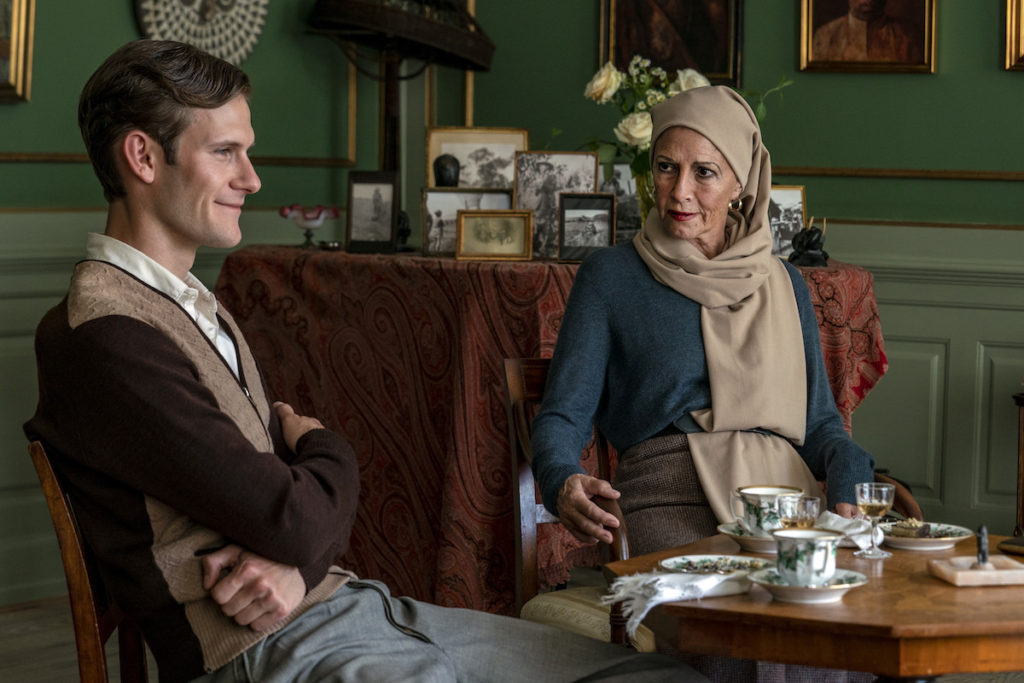
Simon Bennebjerg and Birthe Neumann in THE PACT. Photo by Rolf Konow courtesy of Juno Films.
The Pact is the story of a real life Faustian bargain. In 1948, Karen Blixen (Birthe Neumann) was the rock star of Danish literature, having written Out of Africa under the pen name Isak Dinesen. Blixen was also a baroness, and from her seafront country estate near Copenhagen, she presided over a salon of leading Danish intellectuals and artists.
Thorkild Bjørnvig (Simon Bennebjerg) was an unknown poet whose promise intrigued Blixen. Blixen offered Bjørnvig the titular pact – she would help him achieve his artistic potential, but only if he followed all her guidance. She is transparent – she only cares about elevating his writing, not about his family or his personal happiness. Driven by ambition and entranced by her magnetism, he takes the deal.
She immediately finds him a financial patron and moves him into her estate to write without the distractions of his wife and their adorable but chirpy toddler. His writing starts to blossom, but then her direction becomes more and more intrusive. Soon she dictates his daily schedule, where he lives and even who he sleeps with.
She isolates him from his family, and he doesn’t know what, if any, power he still has.
Does a real life Faustian bargain sound farfetched? This really happened. Director Bille August (the Oscar winning Pelle the Conqueror) adapted the screenplay from Bjørnvig’s memoir.
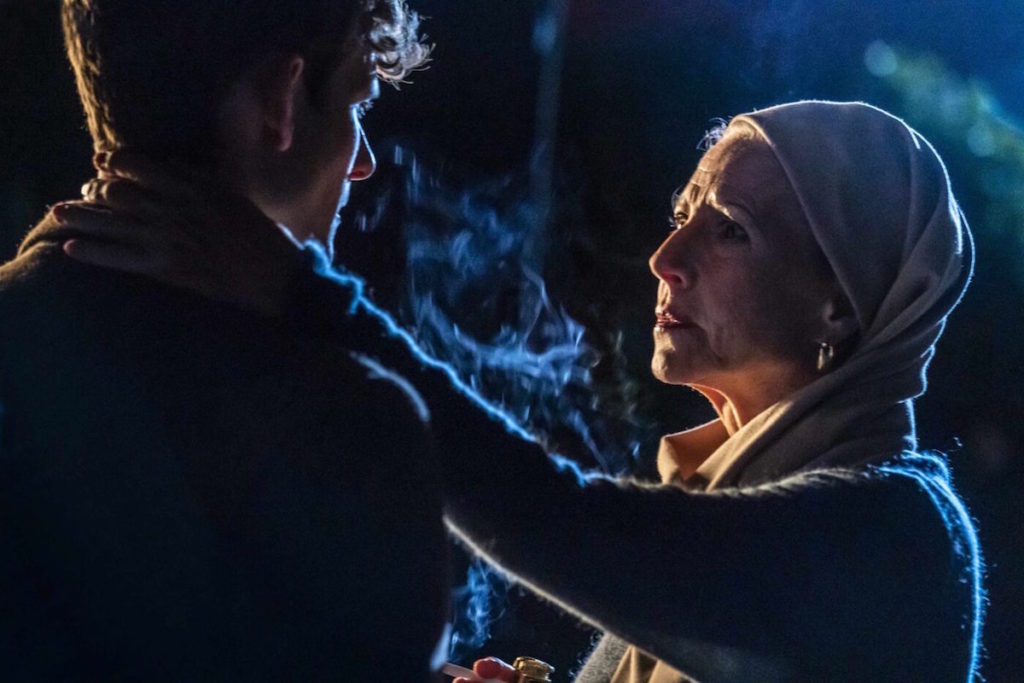
Simon Bennebjerg and Birthe Neumann in THE PACT. Photo by Rolf Konow courtesy of Juno Films.
Although the story is told from Bjørnvig’s point of view, it’s really about what makes the singular Blixen tick. The Pact works because of Birthe Neumann’s exquisite performance as a woman who masks her neediness with a steely willfulness. Neumann had a key role in the 1998 classic Festen.
Tellingly, Blixen says, “It’s you who need to understand that we’re all playing a role in the story.” Not A story, but THE story. Blixen’s story.
Bennebjerg ably portrays Bjørnvig, a character difficult to sympathize with because of his submissiveness and his willingness to expose others to Blixen’s cruelty.
Naturally, Bjørnvig’s wife finds herself whipsawed as he follows Blixen’s whims. Nanna Skaarup Voss is very good in a role that seems doomed to passive victimhood until she delivers a definitive insight near the end of the story.
Asta Kamma August is also excellent as a sweet innocent whose life is upended by Blixen’s manipulation.
Throughout the film, other characters address Bjørnvig as magister, an unfamiliar word for me. Magister is a medieval term for scholar still in use in 1940s Denmark.
The Pact is opening in theaters, including at the Bay Area’s Opera Plaza and the Rafael on February 18.
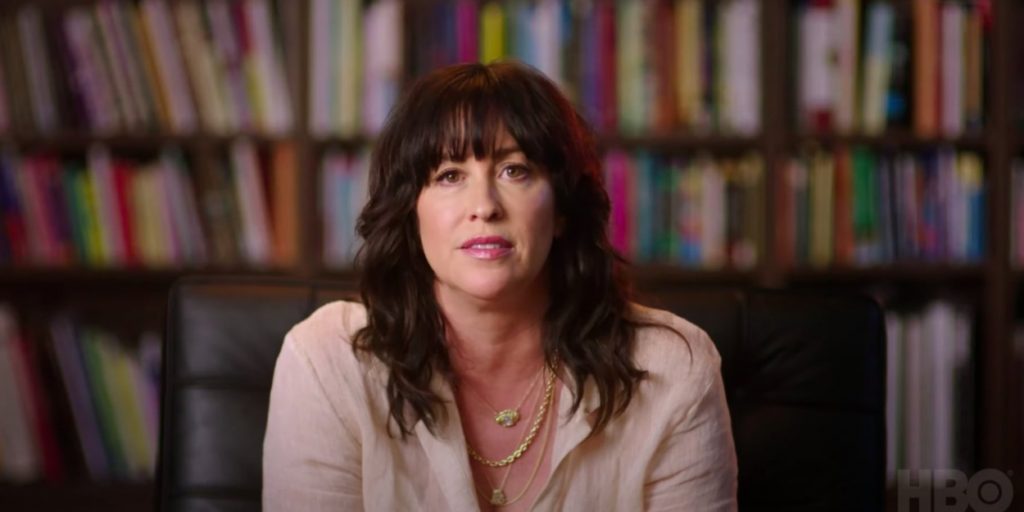
Photo caption: Alanis Morissette in JAGGED. Courtesy of HBO.
Jagged is a surprisingly addictive biodoc of singer-songwriter Alanis Morissette, packed with Morissette’s own reflections. Jagged traces Morissette’s beginnings as a child prodigy and teen pop princess (big hair and all) to the point where she matured into an innovative songwriter and groundbreaking stadium act.
The deepest dive is appropriately on Morissette’s debut album Jagged Little Pill and the 18-month concert tour to support it. With sales of over 33 million, Jagged Little Pill is still the number one selling album by a woman. It’s amazing to reflect that Morissette was only 19-20 when writing the songs and only 20-21 on the tour.
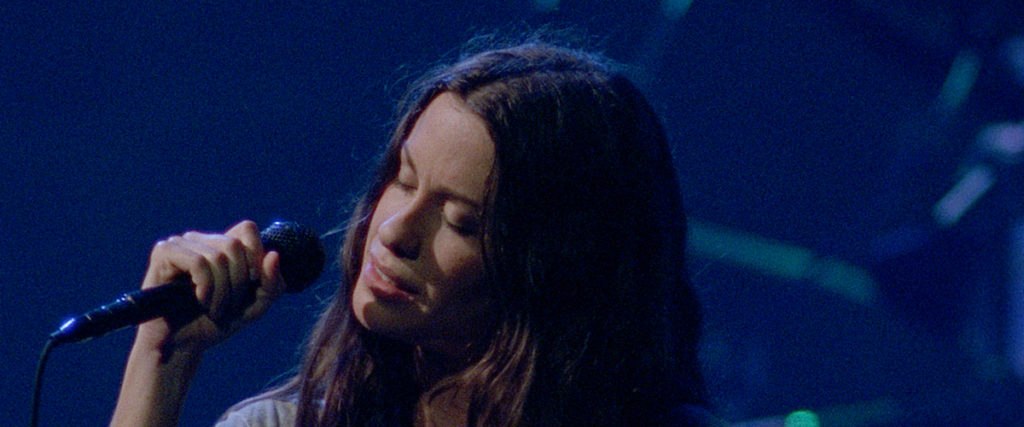
Alanis Morissette in JAGGED. Courtesy of HBO.
Of course, Morissette’s breakthrough came with one of the bitterest of all breakup songs, You Oughta Know, raising the question of just how angry is she? Not at all, says Morissette, who notes that she released her anger in the writing of You Oughta Know and moved on.
Director Alison Klayman (Ai Weiwei: Never Sorry) takes us back to the 1994 media coverage, by male music writers, of Morissette as Angry Young Woman. Jagged takes advantage of lots of candid backstage/tour bus footage from the tour; and that Morissette is an even-tempered and playful person, not even temperamental, let alone raging.
In her years a teen pop singer, Morissette was allowed to tour the world without parental protection, which predictably made her vulnerable to exploitation by older men. It’s really worth watching Jagged to hear Morissette’s framing of how women publicly discuss sexual abuse years afterwards: “They weren’t silent. The culture wasn’t listening.”
Oddly, Morissette herself is unhappy with the documentary, calling it “salacious”. I thought that Klayton handled Morissette’s own words about her sexual abuse in a way that was the opposite of salacious. Klayton has Morissette present herself as insightful and well-grounded, which adds up to a flattering impression.
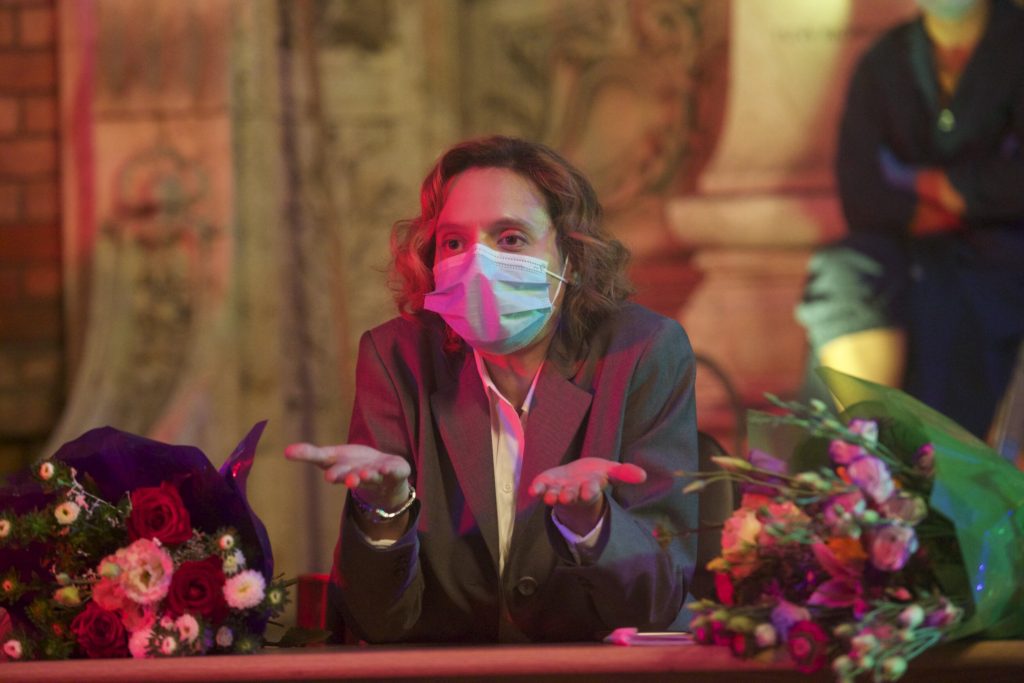
Photo caption: Katia Pascariu in BAD LUCK BANGING OR LOONY PORN. Courtesy of Magnolia Pictures.
The Romanian absurdist comedy Bad Luck Banging or Loony Porn is unlike anything feature film you’ve ever seen. For one thing, it begins with a three-and-a-half minute amateur sex video. The couple is having sex that is playful, enthusiastic and highly verbal. The sex is not simulated.
The couple turns out to be married. The wife is Emi (Katia Pascariu), a teacher of Romanian history at an upscale private school in Bucharest. Unfortunately, her husband takes their laptop to a tech shop for service and the sex video appears on the Internet – and goes viral within her school’s community.
Bad Luck Banging or Loony Porn is divided into three chapters, each approximately 30 minutes. In the first, Emi leaves their crowded apartment and walks, COVID-masked, through Bucharest to her boss’ apartment and then to school, stopping to receive a series of phone calls with ever worsening news about the video.
Beginning with the chaos of daily family life crammed in tight quarters, and spilling out through the city, this is deadpan comedy at its best. Writer-dirctor Radu Jude’s camera wryly points out the mixed martial arts studio Super Kombat Romania next door to a more aspirational Caffe Le Strada.
Jude depicts Bucharest street life as boisterous and earthy, with everyone unleashing torrents of foul invective at the slightest annoyance. I’m an aficionado of vulgarities, and the best in this film comes from the driver of a vehicle whom Emi points out is illegally parked.
Part 2 takes a break from Emi’s story – it’s a series of brief vignettes highlighting the most ridiculous and outrageous excesses of Romanian history, including Nazi collaboration and the Ceaușescu communist dictatorship. Most of the vignettes are funny, and most are wickedly pointed. Some are just refreshingly silly, like a socially-distanced folk dance and the funniest elevator doors I’ve ever seen.
In part 3, the school hosts a meeting of the parents to discuss the sex video – and whether Emi should keep her job. Of course, this is mortifying for Emi.
[MILD SPOILER IN THIS PARAGRAPH] The parents insist on playing the sex video at the meeting, so Emi is subjected to watching them watch her have sex – with a running commentary from the audience. Of course, if the video is offensive, then the parents are offending new viewers or re-offending those who have already seen it. But this is not about reason – it is about slut shaming.
Context completely escapes the parents. Emi’s consensual sex in her home with her husband is entirely her right; she didn’t publish the video, and she is the victim of its publication. Nevertheless, the parents plunge ahead into a witch trial that would have made colonial Salem proud, worsened by a dose of jawdropping antisemitism. That everyone is masked for the pandemic adds another layer of ridiculousness.
Katia Pascariu in BAD LUCK BANGING OR LOONY PORN. Courtesy of Magnolia Pictures.
Through it all, Emi steadfastly tries to salvage her dignity and impose some measure of intellectual consistency on others. She is the last stand of rationality. As Emi, Katia Pascariu is on camera in every scene of the first and third segments of Bad Luck Banging or Loony Porn, and her performance is superb. Pascariu’s Emi is a strong and confident woman thrust into a most humiliating and desperate situation, who keeps her poise…until even she cannot any longer.
What does it all amount to? Writer-director Radu Jude is zeroing in on human foibles, some specific to Romanian society and some universal. Jude has an unsparing, clear-eyed view of human nature, and Bad Luck Banging or Loony Porn nails sexism and misogyny in particular.
Jude’s previous features were the much acclaimed Aferim! (which I didn’t like) and I Do Not Care If We Go Down in HIstory as Barbarians. He was the assistant director of Cristi Pulu’s high brow art house hit The Death of Mr. Lazarescu.
Beyond its title, Bad Luck Banging or Loony Porn is unusual for its hardcore prologue and the mid-movie diversion from the plot. Those aspects may not be enjoyed by everyone; I also recognize that not everybody dials into deadpan absurdism as I do. Nevertheless, Bad Luck Banging or Loony Porn is continuously engaging and very funny.
Bad Luck Banging or Loony Porn is Romania’s submission for the Best Intentional Picture Oscar, and I believe that it will be nominated. It appears on at least 20 critic’s top ten lists, including #1 on J. Hoberman’s and #2 on A.O. Scott’s. I streamed Bad Luck Banging or Loony Porn on Drafthouse On Demand; it is also streaming on AppleTV.
Photo caption: Milena Smith, Penélope Cruz and Aitana Sánchez-Gijón in PARALLEL MOTHERS. Photo courtesy of Sony Pictures Classics.
In Parallel Mothers, Pedro Almodóvar gives a lush melodrama, sandwiched between bookended dives into today’s unhealed wounds from the Spanish Civil War.
Two women meet in a Madrid maternity ward, each about to give birth to her first child. Neither is in a relationship and neither pregnancy was planned, although the circumstances differ strongly. Both are haunted – one by a family tragedy and the other by her parents’ dysfunction.
Janis (Penélope Cruz) is in confident middle age, a fashion photographer. She is worldly and independent, with a support system led by her bestie (Almodóvar veteran Rossy de Palma).
Ana (Milena Smit) is a teenager tossed from her throw-up-his-hands father in Granada to her self-absorbed actress mother in Madrid.
Janis and Ana bond with their babies and with each other. It’s difficult to write about their story because there’s a Big Reveal which I will not spoil.
The story of mothers and babies makes for a compelling 100-minute or so movie on its own. But the film begins and ends with segments in which a war crime from the Spanish Civil War touches characters. When Spain suddenly transitioned from the Franco dictatorship to a democracy, the nation addressed accountability for the Civil War’s atrocities differently than did, say, South Africa or North Ireland, and Parallel Mothers is Almodóvar’s comment on the continuing wounds.
And here’s my quandary: although the characters overlap, I just don’t see the unity that Almodovar intends between the mom/baby story and the Civil War legacy story. Sorry, Pedro – this just looks like two different (good) movies cobbled together to me.
Penélope Cruz in PARALLEL MOTHERS. Photo courtesy of Sony Pictures Classics.
Penélope Cruz is entering her fourth decade of Big Screen luminosity. She remains one of the most compelling presences in cinema.
Milena Smit as excellent as the troubled and immature Ana, who grows and changes more than any character in Parallel Mothers. It’s an impressive breakthrough performance, and Smit bears watching.
Penélope Cruz had already made the American art house faves Jamón Jamón and Belle Epoque before she joined the Almodóvar repertory, but it’s worth reflecting on the Spanish actresses, like Smit, that Almodóvar has introduced us to: Carmen Maura, Victoria Abril, Marisa Paredes, Cecilia Roth, Rosario Flores, Assumpta Serna and Chus Lampreave. (Plus Antonio Banderas and Javier Cámara, as well!)
Aitana Sánchez-Gijón is very good as Ana’s mom, who is initially is reflexibly insufferable, but whose role becomes more complicated as we learn about her.
Israel Elejalde is excellent as the one significant male character. It’s always great to see Rossy de Palma, who is unchallenged by her role as sympathetic sidekick. Julieta Serrano, another Almodóvar favorite also appears.
After beginning his career with two decades of subversively hilarious comedies, Almodóvar has made some of the most profound work in recent cinema. Parallel Mothers is well-crafted and engaging, but doesn’t rank with Almodóvar’s best: Talk to Her, Bad Education, Broken Embraces.
In the rapturously filmed period drama Dance of the 41, Mexican politician Ignacio de la Torre (Alfonso Herrera), a political Icarus if there ever were one, marries President Porfirio Diaz’s daughter Amada (Mabel Cadena). It’s the turn of the 20th Century, and de la Torre starts scheming with breathtaking recklessness.
The risk comes from the fact that de la Torre is in a secret club of gay aristocrats, closeted in plain sight in the most macho and homophobic mainstream culture. He has married Amada so she can be his beard, but his new bride, unaware of her new hubbie’s secret, was expecting her own sexual awakening. Instead, he spurns her for a torrid love affair with Evaristo (Emiliano Zurita).
De la Torre had married the boss’ daughter in a bid for advancement, expecting her to submit to being his pawn. But, hurt at not being desired, she calls on her dad’s capacity as an enforcer. It all culminates in a formal queer bacchanal that turns heartbreaking.
Dance of the 41 is a fictionalized (but very plausible) telling of a historical event, the salacious scandal called the “Dance of the Forty-One” or the “Ball of the Forty-One”.
I found the century-old story of Mexican LGBTQ history and the forbidden love between the men to be less interesting than the story between the husband and the young bride he had wildly underestimated. He is trapped because he’s gay and ambitious, but he is also a dick who is relying on male privilege to dismiss a young woman’s needs and aspirations and to cynically use her.
Director David Pablos and cinematographer Carolina Costa have created a visually extravagant film that makes use of its architecturally stunning locations. Much of Dance of the 41 takes place in gorgeously lit – candlelight.
I screened Dance of the 41 for the 2021 SFFILM. It is now streaming on Netflix.
Linda Manz in OUT OF THE BLUE. Courtesy of Discovery Productions, Inc..
Newly restored for re-release, Dennis Hopper’s 1980 Out of the Blue is an anti-redemptive parable of alienation. It features both an unforgettable performance and an unforgettable ending.
The spirited teenager Cebe (Linda Manz) has the worst parents in her British Columbia town, maybe in the entire province. Her dad (Dennis Hopper), is a drunk, deservedly in prison for an act of irreparable harm. (Cebe bears a facial scar from this incident – and lots of emotional damage as well).
Her chirpy mom (Sharon Farrell) can’t keep a needle out of her arm or guys out of her pants. Ever impulsive, she ruefully observes that there are two kinds of men – the sexy, adventuresome types and the good providers; it’s evident that she hasn’t bet her life on the good providers.
After five years in prison, the dad is released and gets a job operating heavy machinery at a garbage dump overrun by sea gulls. But he’s still sucking on his ever-present pint bottle, and the town won’t forget why he was incarcerated.
Cebe is full of life and has a gum-chewing swagger. She’s comfortable leading her teen peers in some rowdiness, but she also has a rich imagination and she spends a lot of time in her room alone, acting out her interests in Elvis and punk music.
But Cebe doesn’t know in what direction to channel her exuberance; she can’t tell her sympathetic, court-appointed psychologist (Raymond Burr) what she wants.
The one thing that Cebe doesn’t want is what’s best for her – to be separated from her parents. As is common with neglected and abused children, she clings to the bad situation that she is familiar with.
Cebe acts out in mildly rebellious mischief at school, and she runs away for a night of adventure in Vancouver, somehow emerging unscathed from risky situations.
Back home, she hides from her parent’s arguing in her room. Suddenly, the audience is shocked by something the father says (what??!!), and it is revealed that the parents’ dysfunction is MUCH darker, more twisted than previously apparent.
Cebe erupts, and Out of the Blue ends with a stunning, utterly unpredictable climax. Hopper follows Billie Wilder’s screenwriting advice – “don’t hang around”; the ending is not even one second too long.
Dennis Hopper wrote and directed Out of the Blue, pacing the film well and delivering verisimilitude from the Vancouver-area setting. The camera swirls around the actors at times, and Hopper makes good use of the thousands of seagulls populating a garbage dump.
Out of the Blue is really all about Linda Manz’s singular performance as Cebe. Often improvised, her performance is naturalistic and unpredictable. When she is in her room or walking through a Vancouver night, she acts like no one is watching her, and it’s riveting.
By the time she was 19 in 1980, Linda Manz had acted in and narrated a masterpiece (Terence Malick’s Days of Heaven) and appeared in two cult films (Philip Kaufman’s The Wanderers and Dennis Hopper’s Out of the Blue). Then she retired to raise a family. Manz died at 59 in 2020.
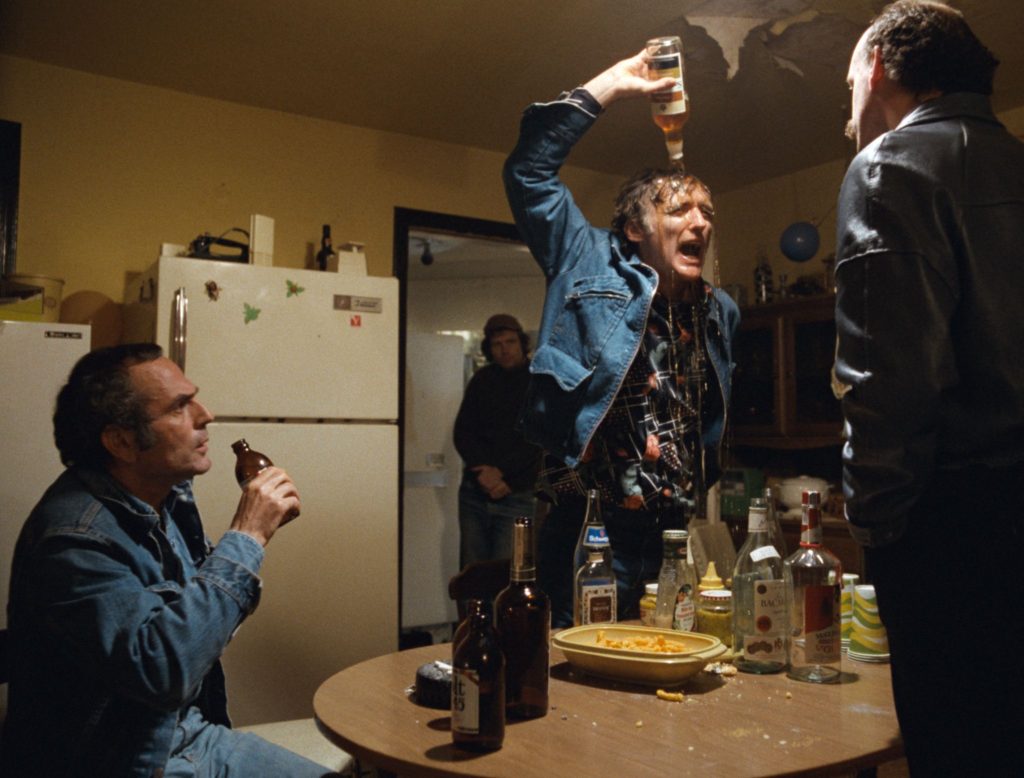
Don Gordon (left) and Dennis Hopper (center) in OUT OF THE BLUE. Courtesy of Discovery Productions, Inc.
As the dad, Hopper is able to demonstrate the charm that attracted the mom and the playfulness that endears him to Cebe. In a scene where the dad dramatically gets himself fired, Hopper shows a man so enjoying his ballsy action, and then, his visage changes as the consequences of his impulsivity sink in, reflecting on his helplessness when he is once again done in by his own impulses.
As the mom, prolific television actress Sharon Farrell excels in a rare movie role.
Don Gordon plays Charlie, the dad’s marginally more functional pal. Gordon had key supporting roles in Bullitt and Papillon and over a hundred appearances in the episodic TV of the 60s and 70s.In Out of the Blue, Gordon displays his gift for playing drunk convincingly. Gordon really understood the essence of drunk thinking and behavior, and has an even more compelling drunk scene in Hopper’s The Last Movie).
Out of the Blue premiered at Cannes and enjoyed praise from Roger Ebert (“Bitter, unforgettable. An unsung treasure.“) and other critics. But the ending is so shocking and emotionally desolate, that it wasn’t released in the US; no distributor wanted to bet on its acceptance by a US audience. John Alan Simon acquired the distribution rights for a 17-week art house tour in 1982 with Hopper. Now Simon and Elizabeth Karr have digitally restored Out of the Blue from the only two 35mm prints in existence.
Out of the Blue has only recently become available to stream; (I own the DVD.) In late 2021, the 4K restoration opened at a New York City screening presented by Chloë Sevigny and Natasha Lyonne. Now you can find Out of the Blue on the Criterion Channel, AppleTV, YouTube and Fandango.