OSCAR MICHEAUX: THE SUPERHERO OF BLACK FILMMAKING. Courtesy of TCM.
If you don’t know who Oscar Micheaux is, you should – so watch the documentary Oscar Micheaux: The Superhero of Black Filmmaking. As writer/director/producer, the African-American Michaeux created so-called “race films” – movies made for black audiences from a black perspective during the most shameful years of American racial segregation. Michaeux himself directed 42 feature films DURING Jim Crow.
There’s a lot in Oscar Micheaux: The Superhero of Black Filmmaking:
Micheaux’s pivotal sojourn in a cabin in, of all places, the Dakotas.
His very personal and hands-on distribution methods.
His discovery of Paul Robeson’s on-screen charisma, a full eight years before Robeson’s first Hollywood film (The Emperor Jones).
Micheaux’s comfort in portraying that most incendiary topic – interracial relationships.
How he slyly bent rules to avoid censorship.
I have seen some Oscar Micheaux films, and their stories, freed of the White Hollywood lens, are eyeopening. They allowed black audiences to see big screen characters that acted like real African-American – not the degrading stereotypes in Hollywood movies.
That being said, Michaeux did not make “Noble Negro” movies. His work is authentic, and criticized, for example, black preacher-hucksters who exploit religious devotion in the African-American community for their own venal and carnal appetites.
Oscar Micheaux: The Superhero of Black Filmmaking features a solid panel of expert talking heads to explain Micheaux’s place in cinema and in African-American history. The most compelling are screenwriter Kevin Wilmott and University of Chicago cinema professor/TCM host Jaqueline Stewart.
Animation is used sparingly and effectively, including one inspired segment to Gil Scott-Heron’s The Revolution Will Not Be Televised.
I watched Oscar Micheaux: The Superhero of Black Filmmaking on Turner Classic Movies, and it is streaming on HBO Max.
Tp honor Cinequest, now underway, here’s the best of the over thirty films that I reviewed at the 2019 Cinequest. The searing dystopian fable Buy Me a Gun takes place in an imaginary near future, in which Mexico’s conquest by narco cartels is so complete that all other institutions have collapsed.
Buy Me a Gun’s Mexico is a bandit society run by rival warlords and their fighters – a new feudal age with automatic weapons. It’s a world of cruelty, where all the mothers and teen daughters have been taken by the cartels as sex slaves. And it’s a surreal Mexico, desolate of people, the population having dwindled due to lack of women.
The cartel fighters spend essentially all of their time in four pursuits: the drug trade, raiding for women and girls, partying and playing baseball.
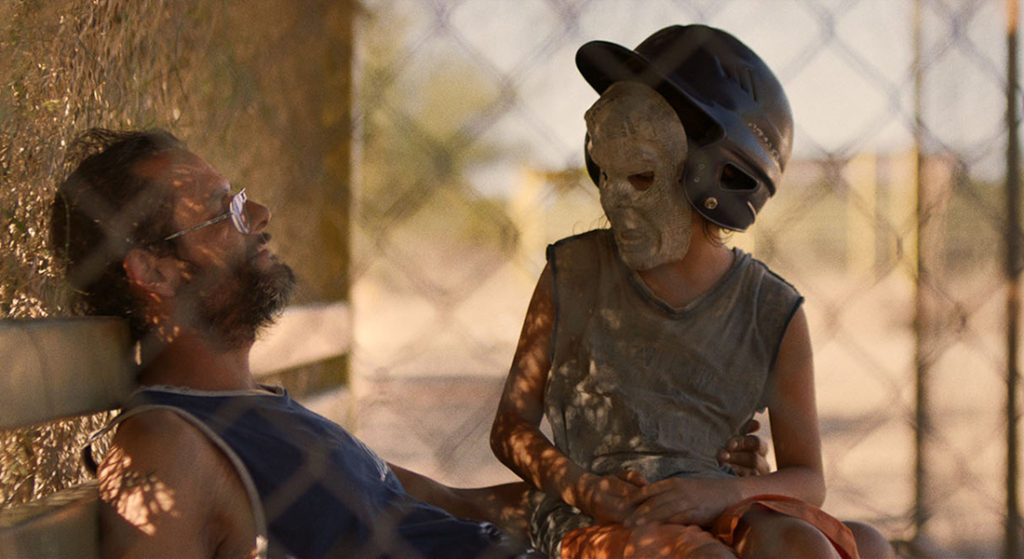
We meet one surviving man who is not in a cartel. Rogelio (Rogelio Sosa) has been imprisoned by a cartel to perform as the groundskeeper of the baseball field at their base. Rogelio is addicted to drugs, and he knows that his life is subject to the whim of any of the fighters at any moment, particularly the terrifying and gender-ambiguous cartel commander (Sostenes Rojas).
While Rogelio walks the tightrope of narco murderers, he is hiding a high stakes secret in plain sight. He has a 10-year-old daughter Huck (Mathilde Hernandez) who he is protecting from the fighters by pretending that she is a boy. If the cartel fighters discover his ruse, he will certainly be killed and his daughter will certainly become a sex slave. Because he can’t escape (and there is no place to escape TO), this is Rogelio’s best option, as harrowing as it is.
Rogelio Sosa and Mathilde Hernandez in BUY ME A GUN. Photo courtesy of Cinequest.
Huck is not the only child at the narco base – she has a pack of feral friends, some horribly disfigured from the environment of violence and the cartel’s cruelty.
While in the throes of his addiction, the groundskeeper is decent, resourceful and brave – devoted to his daughter in a hopeless situation. This is an extraordinary performance by Rogelio Sosa.
One childish mistake puts the dad and daughter in jeopardy. Will she escape the danger? Buy Me a Gun turns into a heart-pounding thriller.
Buy Me a Gun is written and directed by Julio Hernández Cordón, and it’s an impressive achievement, one of the most original films I’ve seen in this decade. One scene in particular, involving a trumpet and purple smoke to illustrate smoking drugs, is genius. Along with Huck, there are child characters that Hernández Cordón has named Tom and Sawyer.
The only crappy thing about Buy Me a Gun is its title, which would better fit a shallow crime movie than such a profound fable.
I screened Buy Me a Gun the 2019 Cinequest before its theatrical release in Mexico. At the 2020 Ariel awards (Mexico’s Oscars) , it garnered eight nominations including for Best Picture, Director and Screenplay and Best Supporting Actor for Sostenes Rojas. Buy Me a Gun is now is now streaming on Amazon, AppleTV, and YouTube
Photo caption: Michael James Kelly and Elizabeth Hirsch-Tauber in 12 MONTHS. Courtesy of Cinequest.
The uncommonly authentic 12 Months traces the year-long span of a romance, using vignettes that are snapshots of the relationship’s evolution. Just like a real life relationship, 12 Months has moments that are playful and moments that are searing. It’s the Must See at this year’s Cinequest.
Ellie (Elizabeth Hirsch-Tauber) and Clark (Michael James Kelly) share a first date, which leads to another, and things get serious. Both Ellie and Clark are decent, smart, sincere and vulnerable; each has quirks, but neither is a bundle of red flags. Each deserves to find a partner, and, so, are they a fit?
Directed by Clinton Cornwell in his feature debut, 12 Months is entirely improvised. Cornwell is credited for the story, Hirsch-Tauber as executive story editor and Kelly as contributing writer. 12 Months is an especially promising calling card for all three.
12 Months soars in recognizing that relationships are rarely symmetrical. The two people involved generally experience different levels of attraction, security, commitment, confidence, comfort and maturity – and at different times.
And 12 Months understands that what a relationship can survive isn’t always predictable, whether it be depression, a sexual proclivity or an out-of-town work assignment.
Clearly, Cornwell, Hirsch-Tauber and Kelly are extremely keen and perceptive observers of relationship behavior (whether from their own or those of others). They don’t hit a single wrong note in12 Months.
Clark’s and Ellie’s best pals are played, respectively, by Christopher Mychael Watson and Lindsey Rose Naves, and they are hilarious.
Movies like 12 Months are why we have film festivals. Cinequest hosts the world premiere of 12 Months, and you can stream it at Cinejoy. View the trailer.
Michael James Kelly and Elizabeth Hirsch-Tauber in 12 MONTHS. Courtesy of Cinequest.
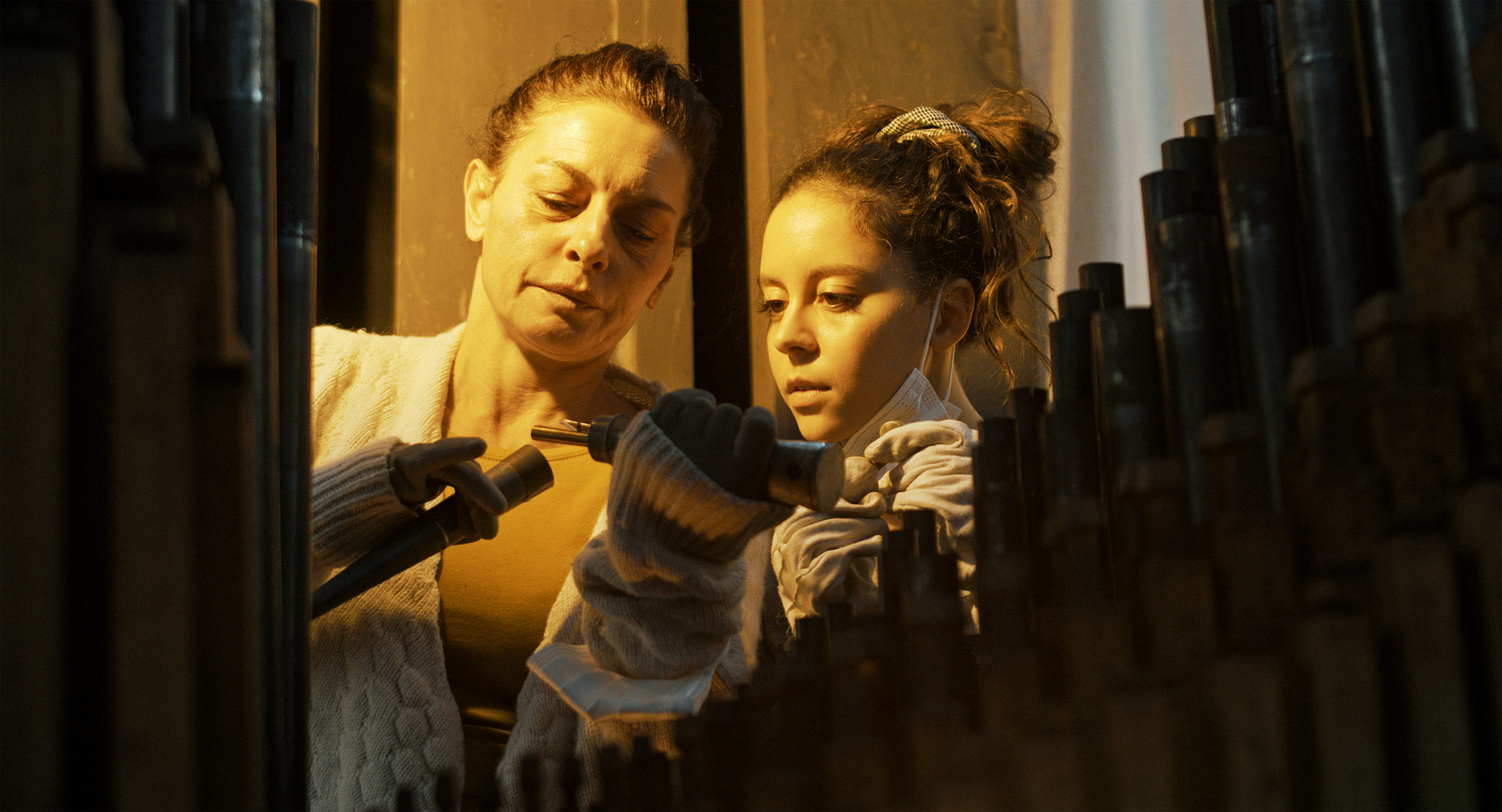
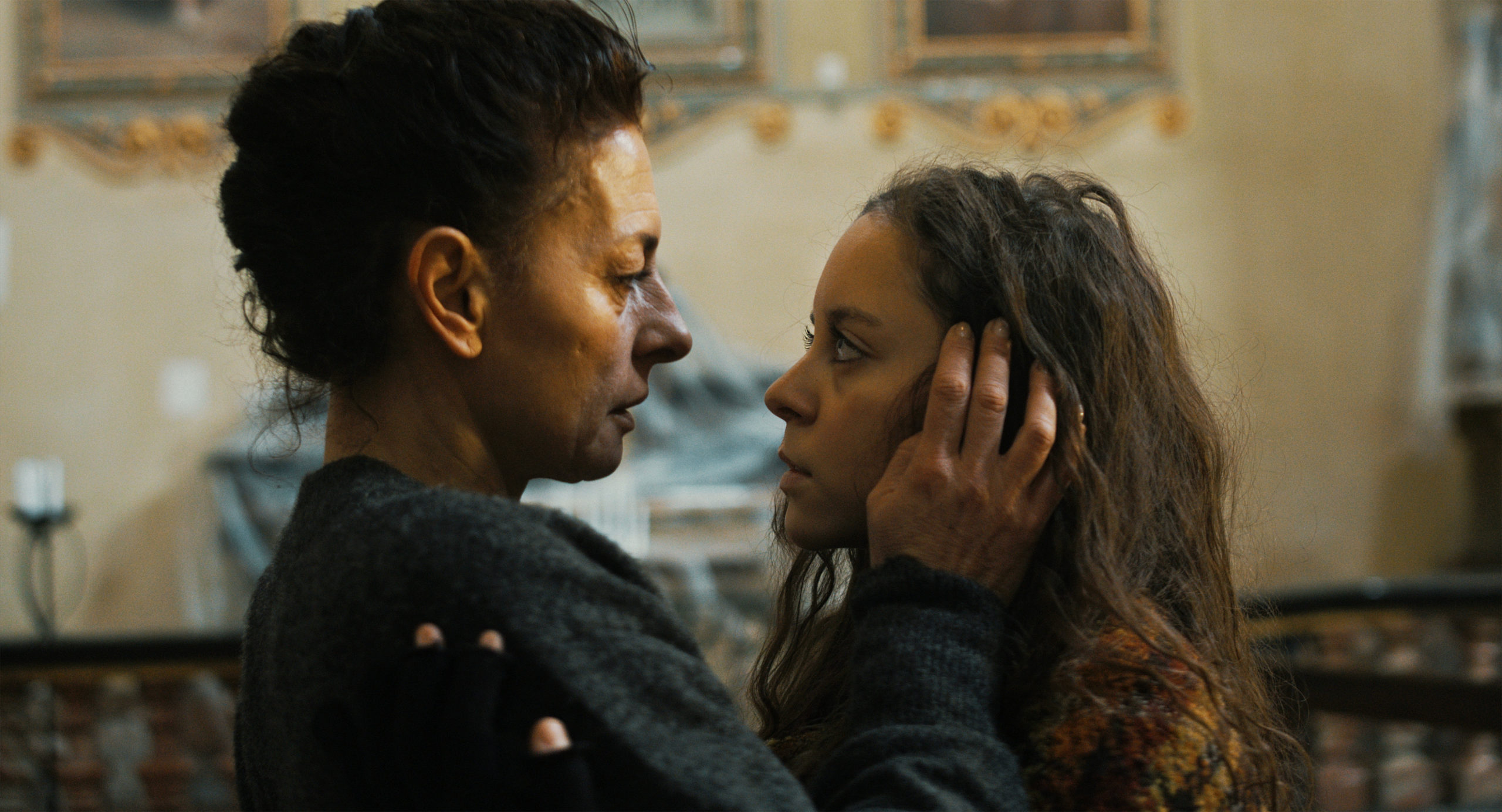
Photo caption: Lidia Vitale and Ludovica Mancini in Gabriele Fabbro’s THE GRAND BOLERO at Cinequest. Courtesy of Cinequest.
The Grand Bolero is set in winter 2020, early in COVID’s devastating assault on Northern Italy. Roxanne (Lidia Vitale), a middle-aged organ restorer, is locked down in a centuries-old church, along with her client Paolo (Marcelli Mariani). Lucia (Ludovica Mancini), a runaway young mute woman with no place else to shelter, arrives at the church. In an act of kindness, Paolo brings her into the church as an assistant to Roxanne. A salty curmudgeon, Roxanne cruelly resists, even when Palolo chides her, “you know what it’s like to be scared and alone.”
Indeed, Roxanne is a solitary person in a solitary profession, moving from church to church to repair the ancient organs.
But Lucia’s unexpected musical gift unlocks appreciation and then passion in the older woman. Passion evolves into obsession, propelling the story to an operatic finale.
Lidia Vitale and Ludovica Mancini in Gabriele Fabbro’s THE GRAND BOLERO at Cinequest. Courtesy of Cinequest.
The Grand Bolero is the most visually beautiful film that I’ve seen in some time. The interior scenes evoke the warmth of candlelight. The characters find relief from the lockdown in stroll through natural beauty characters find comfort in exteriors in the bright crispness of the northern Italian winter. It’s a remarkable first feature for director, co-writer and editor Gabriele Fabbro and his cinematographer Jessica La Malfa.
The all-absorbing power of organ music naturally complements a story of passion. Roxanne becomes transfixed as she watches Lucia’s bare shoulders heaving at the organ. The story climaxes as the dialogue is drowned out by an organ performance of Ravel’s Bolero.
The Grand Bolero is in competition for Best Narrative Feature at Cinequest and may be streamed through April 17 at Cinejoy.
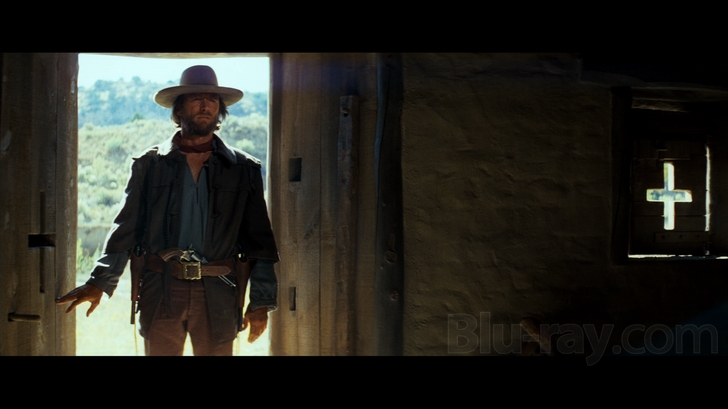
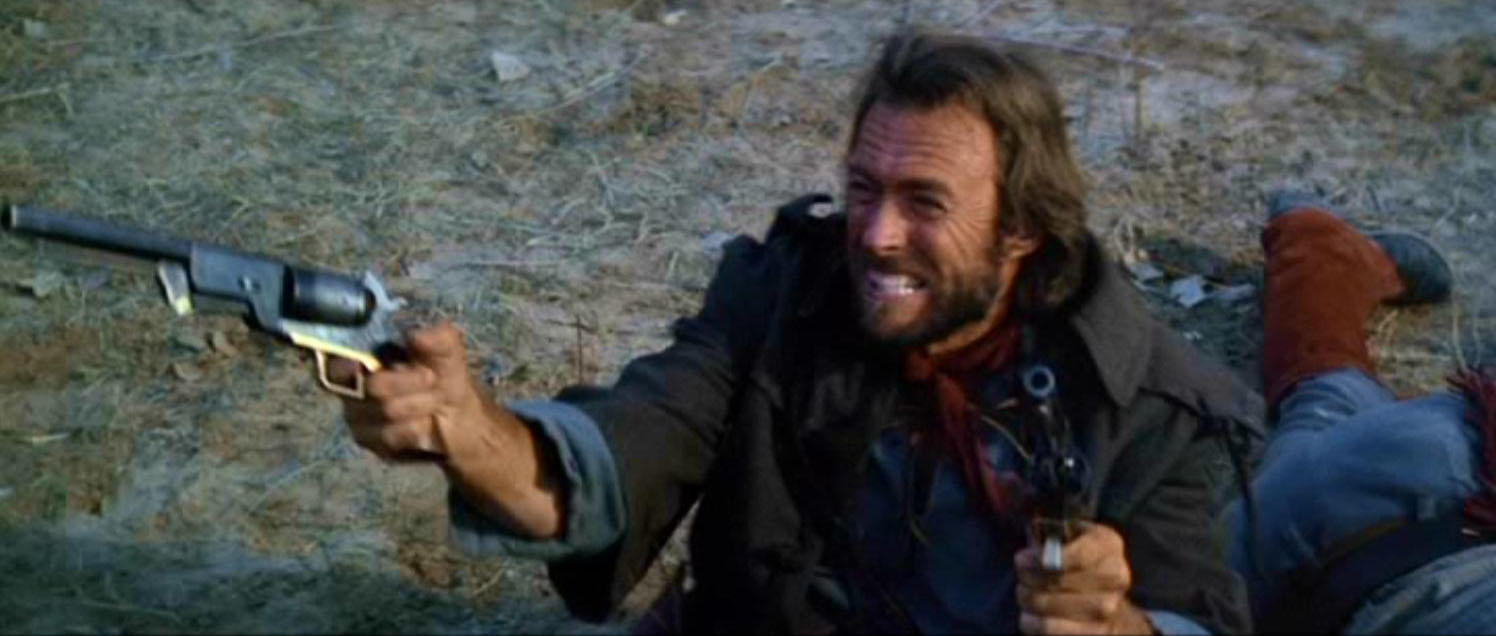
Photo caption: Clint Eastwood in THE OUTLAW JOSEY WALES. Courtesy of Warner Bros.
A top tier Western – and one of my personal favorites. is coming up on Turner Classic Movies on April 2 – Clint Eastwood’s The Outlaw Josey Wales. I venerate Westerns, and I rate John Ford’s The Man Who Shot Liberty Valance and The Searchers and Fred Zinneman’s High Noon at the top of the genre; The Outlaw Josey Wales fits in the tier just below, among the rest of Ford’s portfolio and those of Anthony Mann, Sam Peckinpah, Sergio Leone, Howard Hawks, Budd Boetticher and other masters. Those masters include Clint Eastwood himself, having gone on to win the Best Picture and Best Director Oscars for Unforgiven.
Clint plays Josey Wales, a Missouri farmer whose family is massacred by terrorist partisans at the beginning of the Civil War, leading Josey to join rival irregulars. At the end of the war, Wales refuses to surrender and heads West to restart his life. But his old enemies hound him, and there is a price on his head which draws bounty hunters. As Josey seeks sanctuary westward, he is joined by a motley convoy of Native Americans and White settlers, which Josey defends against outlaw bands and hostile Native Americans. The dramatic tension revolves around whether Josey will survive, and, if so, whether he will find peace.
Josey has blood on his hands from his part in wartime atrocities. He’s no longer looking for trouble, just trying to find a place where he can be left alone. But violence follows him – from the men that are hunting him and the dangers that he will encounter on the journey. Josey says, “Whenever I get to likin’ someone, they ain’t around long.” A companion retorts, “I notice when you get to DISlikin’ someone they ain’t around for long neither.“
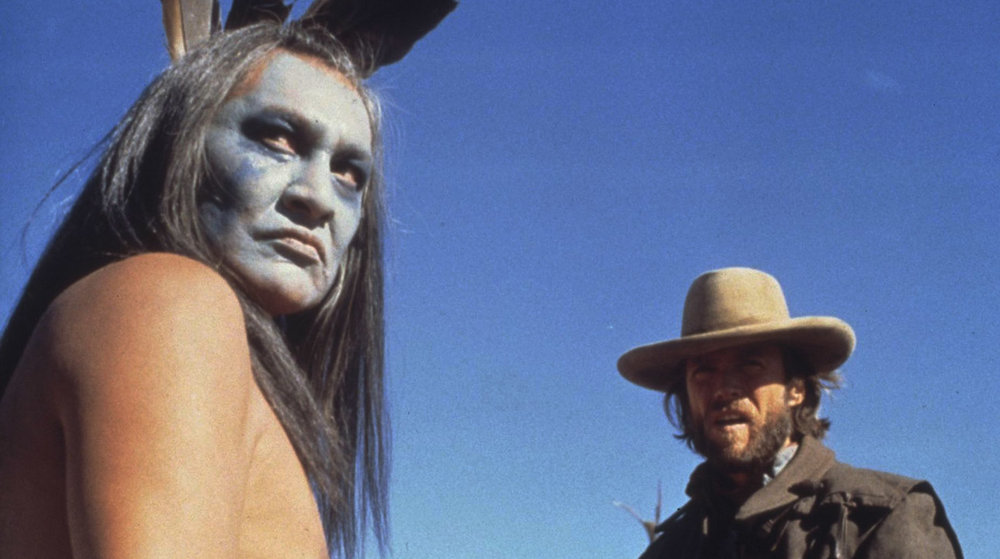
Will Sampson and Clint Eastwood in THE OUTLAW JOSEY WALES. Courtesy of Warner Bros.
The sympathetic portrayal of Native Americans (by Native American actors) is another hallmark of The Outlaw Josey Wales. Josey’s main buddy is Lone Watie, played by Chief Dan George (actually a Native Canadian Squamish) in a sparkling performance. Six-foot-five Creek actor Will Sampson (One Flew Over the Cuckoo’s Nest) and Navajo actor Geraldine Kearnes are also excellent.
Josey must run a gauntlet of the scariest movie bad guys since Kansas City Confidential – Bill McKinney, John Davis Chandler, Len Lesser, John Quade. It’s such a dastardly slew of baddies that it leaves a more complicated role for John Vernon (villain of Point Blank and countless episodes of Mission: Impossible and Dean Wormer in Animal House).
Sam Bottoms play an ill-fated and callow pal of Josey’s. Sondra Locke’s character represents purity and innocence as a counterpoint to Josey’s jaded world view. The cast is peppered with recognizable character actors: Royal Dano, Sheb Wooley, John Mitchum.
Philip Kaufman had co-written the screenplay, and as director, had cast the movie and prepared the shoot, but Eastwood, impatient with what he viewed as too many takes, had Kaufman fired and took over himself. This was Clint’s fifth picture as a director and his second Western (after High Plains Drifter). Eastwood’s work as director is excellent, but it’s important to look at Josey Wales in light of both men’s contributions. In the long run, Kaufman’s career didn’t suffer – he went on to direct The Invasion of the Body Snatchers, The Right Stuff and The Unbearable Lightness of Being.
Clint Eastwood in THE OUTLAW JOSEY WALES. Courtesy of Warner Bros.
What about a former Confederate soldier as hero? The source material for the screenplay was a novel by the racist propagandist Asa Earl Carter, who co-wrote George Wallace’s “Segregation today, segregation tomorrow and segregation forever” speech. However, in Kaufman’s screenplay, Josey isn’t a hater of people because of what they were born as, he hates for what they have done to him and his loved ones. Apolitical, he joins the side that didn’t kill his family. Asa Earl Carter probably wouldn’t have liked that – or the sympathetic portrayal of Native Americans as equals to whites. The Outlaw Josey Wales is now accepted to be a revisionist Western . Eastwood has since said that he considers it an anti-war film, which has much merit.
One more historical note, the Civil War soldiers depicted were not regular Union or Confederate troops, but guerilla raiders that came out of the Bleeding Kansas conflict. These units did exist on both sides in Kansas and Missouri, and were noted for their massacres of unarmed civilians as well as combatants. Josey joins up with one of the most notorious, William T. “Bloody Bill” Anderson. As both a victim and a perpetrator, Josey has seen the most inhumane human behavior.
On set, Clint Eastwood and Sondra Locke began a 14-tear relationship (which did not end well).
Qualified as “culturally, historically, or aesthetically significant” by the Library of Congress, The Outlaw Josey Wales has been selected for preservation in the National Film Registry. Jerry Fielding’s music was nominated for an Academy Award. The Outlaw Josey Wales plays frequently on TV and is streamable from HBO (subscription), Amazon, AppleTV, Vudu and YouTube.
Photo caption: THE AUTOMAT: Actress Audrey Hepburn photographed by Howard Fried in New York City as part of a multi-day photo shoot for Esquire magazine, 1951. Courtesy of A Slice of Pie Productions.
The charming documentary The Automat traces the fascinating seven-decade run of the marble-floored food palaces where one could put nickels in a slot and be rewarded with a meal. The story of the automat is essentially a business history of Holt & Hardart, which pioneered the automat concept in Philadelphia and New York, and dominated the market for years, at one point the nation’s largest restaurant chain. Mel Brooks, Ruth Bader Ginsburg and Colin Powell speak to how the automat touched their lives, and Starbucks founder Howard Schulz credits the automat as his inspiration; (Mel Brooks even wrote and performed a song for the film).
The Automat is the first film for director Lisa Hurvitz, who spent eight years on the project. Along with the celebrities, Hurvitz has sourced her film with longtime Holt & Hardart employees, members of the founding families and even the guy who titled his Ph.D. dissertation, Trapped Behind the Automat: Technological Systems and the American Restaurant, 1902-1991.
The Automat is filled with unexpected nuggets, including:
The New Orleans origin of Holt & Hardart’s signature coffee.
The astounding percentage of the NYC and Philly populations once fed by Holt & Hardart.
The devastating impact of a nickel price increase.
Above all, The Automat features the automat as a democratic institution – a place and an activity enjoyed by a diverse collection of customers from all classes, genders and races.
The Automat gives voice to those nostalgic about the automat, but it is clear-eyed about why it didn’t survive – a business model based on volume when the volume of customers moved to the suburbs, along with social changes in post-war America.
The Automat is opening this weekend at the Vogue in San Francisco, the Rafael in San Rafael, the Landmark Albany Twin in Albany and the Summerfield in Santa Rosa.
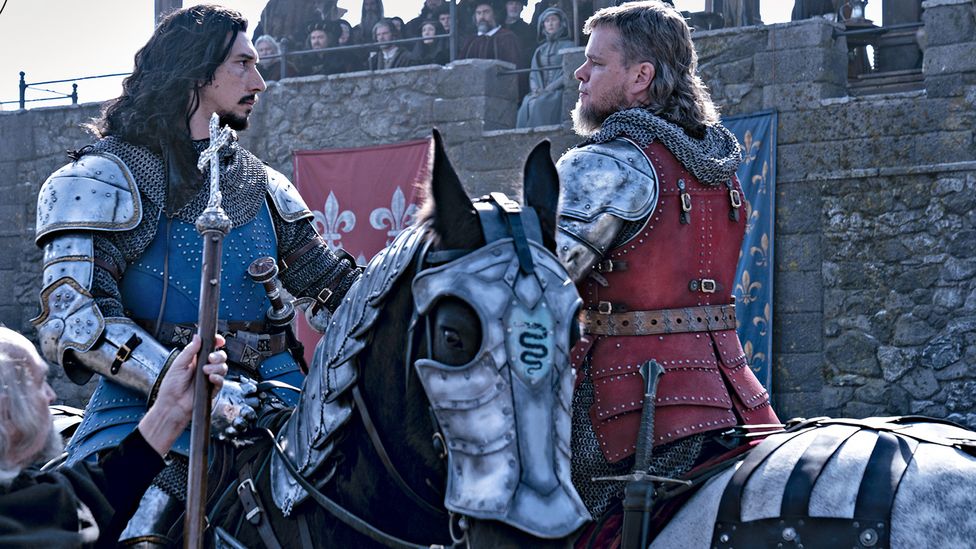
Photo caption: Adam Driver and Matt Damon in THE LAST DUEL. Courtesy 20th Century Studios.
Based on accounts of the last medieval trial by combat, The Last Duel is both a thriller and a thinker. Director Ridley Scott (Alien, Blade Runner, Thelma & Louise, Gladiator, The Martian) brings alive medieval superstition and savagery, and embeds an exploration of the power dynamics within feudal society, especially for women.
The setting is France in the 1380s. Jean (Matt Damon) and Jacques (Adam Driver) have been born into the nobility as squires, which means that they serve as mounted, armored warriors and can own land and castles supported by their very own peasants. Jean is later promoted to the higher title of knight. That puts Jean and Jacques in the elite one percent, but they are totally subservient to the region’s count, Pierre (Ben Affleck), who in turn owes the same absolute fealty to King Charles VI (check him out on Wikipedia).
Jean is an impressive fighter, but not very strategic. He’s a dunderhead, devoid of any social or political skill. Jean has married the beautiful and intelligent aristocrat Marguerite (Jodie Comer), whose father had fallen out of royal favor. Try as she might, Marguerite is only moderately successful in helping Jean from bulling his way through life’s china shop.
Jacques is a canny smoothy, with a rare business sense and charm that melts the ladies. Those financial smarts, along with his appreciation for culture, makes Jacques a protege of Pierre, the count. Pierre favors favors Jacques over Jean, who resents it.
Finding Marguerite alone at home, Jacques rapes her. When Marguerite accuses him, Jacques denies it. Jean presses the case, which culminates in the film’s titular trial by combat.
Ridley Scott tells the story first from Jean’s point of view, then from Jacques’ and, finally, from Margeurite’s. Unlike in Rashomon, the three versions of what occurred don’t diverge much from each other. Instead, we see how Jean and Jacques, who both adhere to the code of their class, see themselves. Jean really thinks that he is a good husband. Jacques, although he has forced himself on Marguerite without her consent, really doesn’t think he has committed rape. (They have their Code of Chivalry, but it sure isn’t very chivalrous.)
Jodie Comer in THE LAST DUEL. Courtesy 20th Century Studios.
We learn that, in 1300s European legality, rape wasn’t even a violent crime against the woman, but was a property crime against her guardian; (she was essentially the property of her father or husband). Ridley Scott slyly emphasizes this when he shows Jean’s reaction to an equine assault on his favorite breeding mare.
Margeurite’s insistence on bringing the rape charge publicly is a major problem for both Jean and for Jacques. It’s also an annoying inconvenience for the count, the king and the Church, who would sweep it under the rug. Jean thinks that he cleverly found away around the cover-up, but he overlooks one disturbing factor – if he dies in the duel, Marguerite will be immediately burned at the stake.
The performances by Comer, Driver, Damon and Affleck are all excellent. Harriet Walker is very good as Jean’s mother, a role which seems at first like a stereotypical stereotypical shrewish mother-in-law, until we learn of her own complicated journey navigating a world where men are unaccountable.
Scott shows us some savage medieval battles to prepare us for the final duel. Warfare at the time was desperate and brutal hand-to-hand butchery, within a sword’s length, like fighting in a phone booth. To stab, slash or impale an opponent, a combatant needed to find an unarmored body part. The jousting in The Last Duel seems especially authentic.
The Wife didn’t want to accompany me when I described it as the “medieval rape movie”; I should have said it’s the “trial by combat movie”.
I was late to The Last Duel, catching up with it several months after its summer 2021 release. Due to the distributor’s blustery publicity campaign, I had underestimated it; it’s one of the Best Movies of 2021, The Last Duel is streaming from Amazon, AppleTV, Vudu, YouTube, HBO and redbox.
Photo caption: A SONG FOR CESAR. Courtesy of Juno Films.
A Song for Cesar is a rich documentary on the role of music and the arts in the critical years of Cesar Chavez’s United Farm Worker movement – so rich that it’s much more than that. There’s a time capsule of the turbulent 1960s, the story of emerging Chicano identity and a meditation on the role of arts in political activism – all embedded in a compelling history lesson.
A Song for Cesar shows us how music and the UFW uplifted each other. Anthems were used in mobilizing, and benefit concerts were a major pillar of UFW fundraising. In the other direction, Cesar Chavez and the movement inspired a generation of Chicano musical artists. We hear directly from a veritable Who’s Who of Chicano musicians from Malo, El Chicano, Tower of Power, War, Santana and Los Lobos through Ozomotli. The memories of UFW allies like Taj Mahal and Joan Baez are also central to A Song for Cesar.
It’s not just only about music, either – the importance of murals and theater are highlighted. We hear from Luis Valdez, founder of Teatro Campesino, about the beginnings of Teatro and its place in the movement.
A Song for Cesar captures the zeitgeist of the time. The UFW’s organizing campaign coincided with (as well as inspiring) new Chicano identity and pride. As Tower of Power’s Emilio Castillo says, “People were ready to protest for social change.They weren’t going for the old okey-doke no more.”
A Song for Cesar reminds us of the mass casualty tragedies that galvanized the Farm Worker movement, along with the low pay, wage theft, horrid working conditions and exploitation. (A personal reflection: when I think of the cruelty, disrespect and social control embodied in the short handled hoe, I still get pissed off.) Exceptionally well-sourced, A Song for Cesar presents first-hand recollections of Chavez family members, UFW leader Dolores Huerta and other participants. The UFW history is deep enough to acknowledge the overlooked role of Filipinos in the UFW, with Larry Itliong as a co-founder of the union.
The Farm Workers had to face goon violence from the growers and infiltration by racist law enforcement. It becomes all the more relatable when Luis Valdez describes facing the violence with non-violence in very personal terms. A Song for Cesar is solid history and an important document of the times.
A Song for Cesar is filled with cool tidbits, like how Cesar Chavez was himself a big jazz fan, who would comb record store bins whenever he had the chance. Who knew?
A Song for Cesar opens this weekend, and will have March 18-24 runs at the Opera Plaza and the Smith San Rafael.
Photo caption: Lexie Mountain in ADVENTURES IN SUCCESS. Photo courtesy of Nashville Film Festival.
The broadly comic Adventures in Success traces the misadventures of a self-help retreat center led by Peggy (Lexie Mountain), a self-described energy transformationist. Peggy claims to have experienced a 12-hour orgasm. Her movement is centered on the female orgasm, the mantra is Jilling Off, and the sessions are essentially orgies where men are not allowed to ejaculate.
Of course, Adventures in Success sends up self-help movements, New Age affectations, and, especially, would-be cult leaders. As Peggy, Lexie Mountain projects a demented self-assurance.
The comic tone is set early – the opening shot is an impressive 28-second performance of urination art.
ADVENTURES IN SUCCESS. Photo courtesy of Nashville Film Festival.
There some inspired LOL moments, but Adventures in Success is not a laugh-a-minute. It runs out of energy when the group takes a final, doomed bus trip to Vegas.
Cinequest hosted the world premiere of Adventures in Success; I screened it for the Nashville Film Festival. Adventures in Success is streaming from Amazon and AppleTV.
Photo caption: Renate Reinsve in THE WORST PERSON IN THE WORLD. Courtesy of NEON.
In writer-director Joachim Trier’s masterpieceThe Worst Person in the World, Julie (Renate Reinsve) is roaring through her life like a locomotive in search of tracks. She’s a medical student until she isn’t, having decided that her passion is psychology instead. Then, she’s convinced her avocation is photography. Each career plunge is accompanied by a new hairstyle and a new boyfriend. She’s charming and talented – and completely restless and unreliable. Surely she can’t keep up this pace of self-invention forever, can she?
Julie falls in love with Aksel (Anders Danielsen Lie) a graphic novelist in his forties, and settles into a dead end retail job in a bookstore and a role as the young companion of a literary figure. Rocking a black cocktail dress for an event celebrating Aksel, she sneaks out and crashes another party. There, she meets the barista Eivind (Herbert Nordrum), and they flirt, after deciding not to cheat on their partners.
Is Julie going to dump Aksel and break up Eivind’s relationship? Real life is more complicated than that, and so is The Worst Person in the World, which maintains a profound authenticity through its moments of silliness, sexiness and poignancy.
I’ve been a huge fan of Trier, since his first feature Reprise, which I named the 4th best movie of 2005. I didn’t care for his well-crafted follow-up Oslo, August 31. But I’ve been strongly recommending his under appreciated Louder Than Bombs. Reprise is available to stream on Amazon, and you can find the other two on many streaming platforms.
Famed director Howard Hawks said that a great movie has “three great scenes and no bad scenes.” There are no bad scenes in The Worst Person in the World, and Trier hits Hawk’s mark with the moments when:
Julie, on her 30th birthday, reflects on what her mother, grandmother and other female ancestors were doing when they were 30.
Julie and Eivind meet and share nonsexual intimacies – which is smolderingly sexy.
Time stands still for the rest of Oslo when Julie has the impulse to find Eivind again.
The title of the film does not refer to Julie; it’s a self-deprecating joke by another character, who is a good person himself.
Renate Reinsve is relentlessly appealing as Julie; Reinsve won the best actress award at Cannes. Lie (who starred in Reprise and Oslo, August 31) and Nordrum are also superb.
Technically, The Worst Person in the World is a romantic comedy, but it’s so smart, so authentic and so original, I can’t bring myself to describe it as such. This is one of the best movies of 2022. The Worst Person in the World is Oscar-nominated both for Trier’s screenplay and for best international feature film.