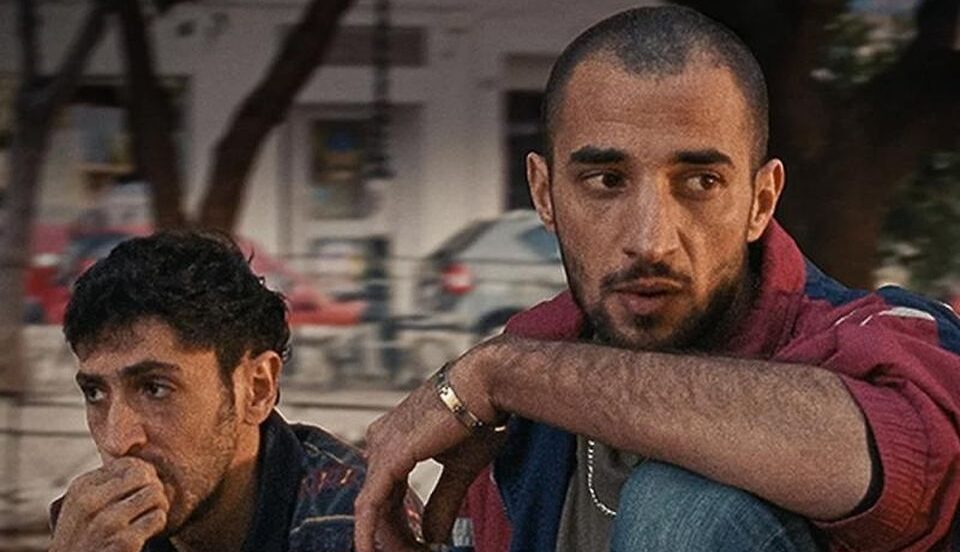
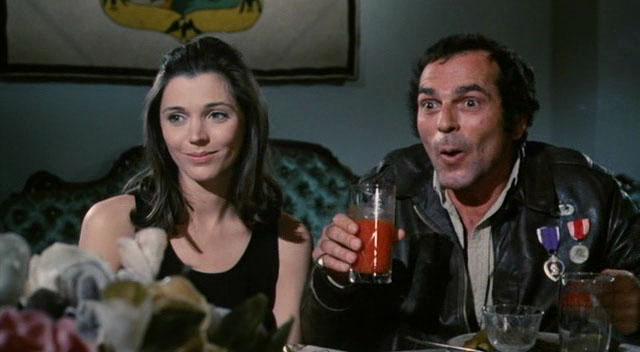
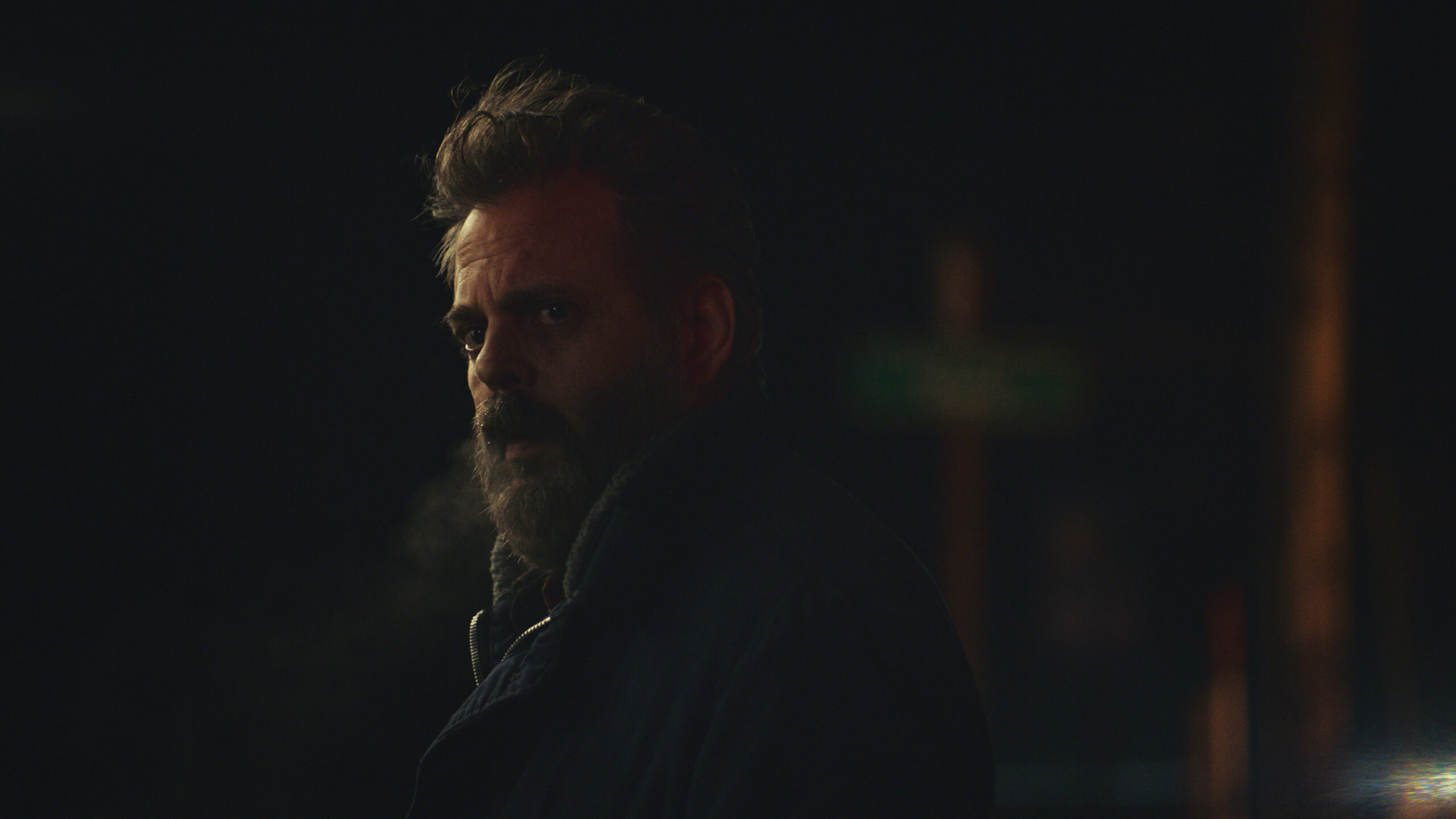
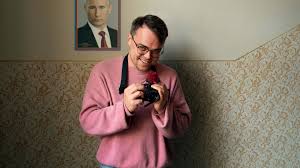
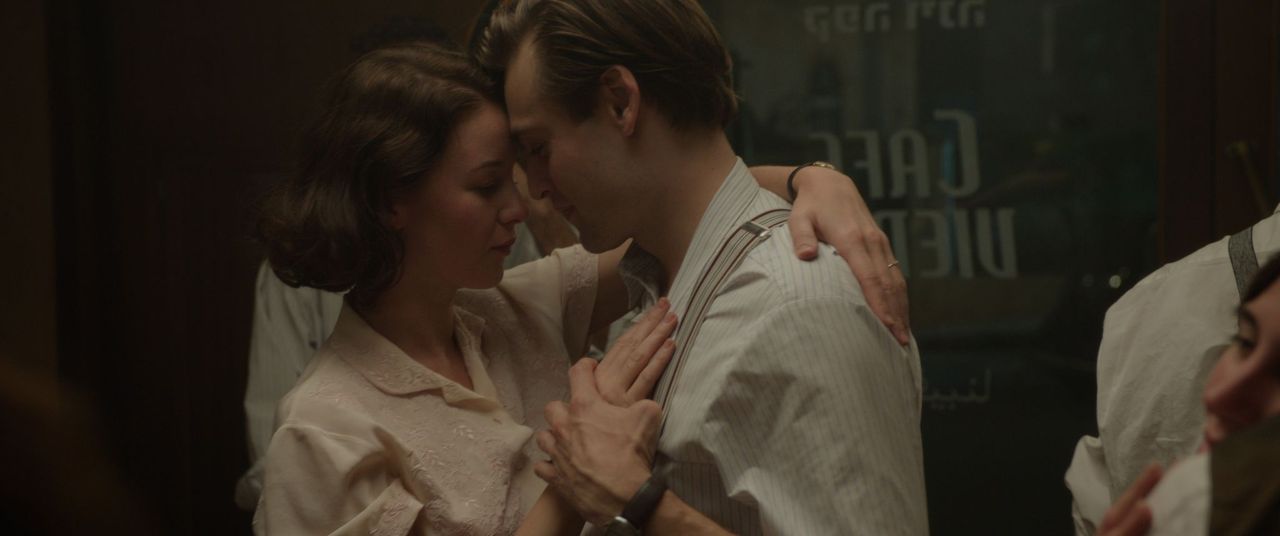
Photo caption: Mohammed Ghassan (right) in TO A LAND UNKNOWN. Courtesy of Watermelon Pictures.
The searing thriller To a Land Unknown takes us to Athens, into the underground world of Palestinian migrants stuck until they acquire false passports that will get them into Germany. Yasser (Mohammed Ghassan) is a decent family man forced into low level criminality to survive and raise money for the forged passport; he is also burdened by responsibility for his cousin, whose drug addiction is a ticking bomb. Repeatedly exploited and defrauded, Yasser conceives of one very risky way out – to scam the very human traffickers preying on him.
Ghassan is excellent, as is Angeliki Papoulis as a fun-loving but clear-eyed Greek woman also living in the margins.
To a Land Unknown is the gripping first feature for Dubai-born Mahdi Fleifel, who works between Britain, Denmark and Greece.
I screened To a Land Unknown for the Nashville Film Festival and recommended it in my Under the radar at Nashville. After a brief arthouse run, To a Land Unknown is streamable from Amazon, AppleTV and YouTube.
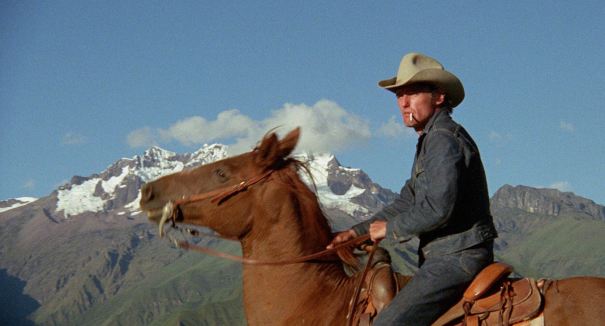
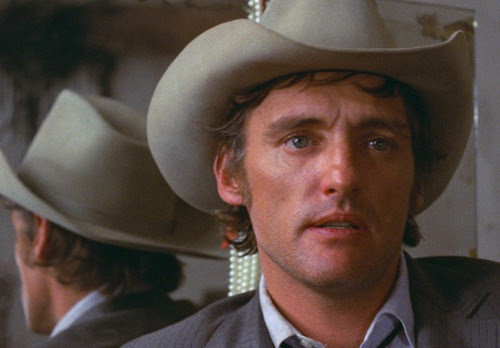
The Last Movie is Dennis Hopper’s notoriously “lost film”, buried by a hostile movie studio in 1971 and still generally unavailable. Given Hopper’s drug addled, out-of-control state during this decade, I was expecting a mess. But what is on the screen is an excellent 1970s art film, beautifully shot by László Kovács. There is a surreal thread that not everyone will buy into, but I think the movie works as a whole.
Hopper plays a Hollywood horse wrangler who is in Peru for a location shoot. He has gone native. setting up local girlfriend Maria (Stella Garcia) in a modern house. He’s already alienated, but a fatal accident on the movie set triggers him into rejecting Western modernity in favor of indigenous Peru. His paradise in the Andes becomes elusive as he meets Ugly American visitors. And then things get really weird, as the local indigenous people begin acting out the movie shoot – only without film. It is a parable of colonialism.
That weirdness, Hopper’s experimentation with the non-chronological construction of the film and some disjointedness/incoherence in the story will be off-putting for many viewers and keeps The Last Movie from being a Great Film. Roger Ebert called it “a wasteland of cinematic wreckage” and condemned it to one star. That said, the setting and Kovács’ cinematography make for a visually stunning film.
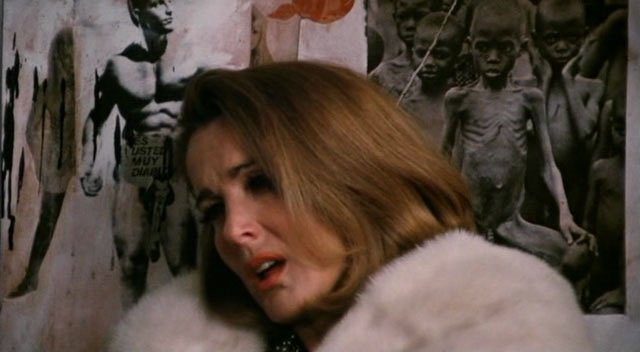
Julie Adams in THE LAST MOVIE
Hopper is always interesting as an actor, but The Last Movie features excellent, perhaps career-topping, performances by Stella Garcia, Julie Adams and Don Gordon.
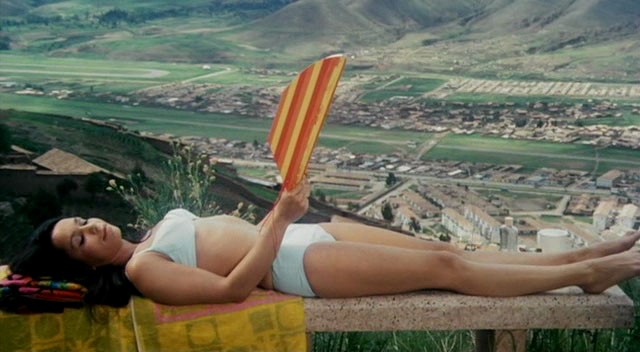
Stella Garcia in THE LAST MOVIE
Garcia projects the inner strength and ambition of a Maria who sees herself as far more than the gringo’s plaything. On the face of it, Maria seems exploited. but she has a strong sense of her value and she insists on getting her due. Anyone who sees her as only arm candy is underestimating her at their own risk. Garcia had already amassed 23 of her 30 screen credits before The Last Movie, then played the top female character in Joe Kidd, and didn’t do much screen acting afterwards.
Julie Adams plays the sexually voracious wife of a visiting American businessman, capable of cruelly inflicting humiliation. With a career that started in the Studio Era (she co-starred with James Stewart and Rock Hudson in 1952’s Bend of the River), I can’t imagine that she got many scripts like this, and her performance is incendiary.
Prolific character actor Don Gordon plays Neville, another American expat. Neville is the guy who thinks up a get-rich-quick idea but doesn’t take into account that someone richer, more powerful and with more business sense can take the whole thing away from him. Gordon’s drunk scene is just perfect, especially in capturing how really drunk people don’t notice things about themselves or others. Gordon had the fourth lead in Bullitt and Papillon, and guest-starred in scores of television shows, but his very best work was in The Last Movie and in Hopper’s searing Out of the Blue (aka No Looking Back).
Don Gordon (right) in THE LAST MOVIE
And here’s some fun for movie fans. Fabled outlaw director Sam Fuller plays the director of the movie-within-the-movie. Various cinema notables show up as part of the film crew and at the cast party: Toni Basil, Rod Cameron, Peter Fonda, Henry Jaglom, Kris Kristofferson, Dean Stockwell, Sylvia Miles, John Philip Law, James Mitchum, Michelle Phillips (Dennis Hopper’s wife for eight DAYS), Dean Stockwell and Russ Tamblyn.
What happened to The Last Movie and why did it become a Lost Film? First, Dennis Hopper’s self-indulgence and drug abuse caused him to discard his script, co-written by Stewart Stern, and wing it on the principal photography by cobbling together improvisations that appealed to him at the time. Then Hopper hung on to the film, constantly re-editing it, blowing past his deadline by six months. Universal Pictures mogul Lew Wasserman had given Hopper $i million and creative control; finally getting a movie that was late and grievously over budget – and a movie he found incoherent – Wasserman was outraged and buried The Last Movie’s distribution and publicity. The fiasco ruined Hopper’s reputation in the industry, and he wasn’t able to direct another movie until Out of the Blue in 1980.
I got to see The Last Movie at a 2017 special event curated by the now defunct Cinema Club Silicon Valley. The screening of The Last Movie was preceded by Along for the Ride, the 2016 Dennis Hopper documentary from the perspective of Satya De La Manitou, Hopper’s personal assistant and wing man for forty years. (Along for the Ride is streamable from The Criterion Channel, Amazon, Vudu and YouTube.) The double feature was accompanied by a panel discussion with Along for the Ride director Nick Ebeling, filmmaker Alejandro Adams, film professor Sara Vizcarrondo and critic Fernando Croce.
Hopper regained the rights to The Last Movie in 2006, but was unable to release it on DVD before his death in 2010. Still close to a Lost Film, The Last Movie is only streamable on kanopy, and it occasional screens at repertory arthouses. I’m choosing not to embed the trailer because it unforgivably gives away the last shot.
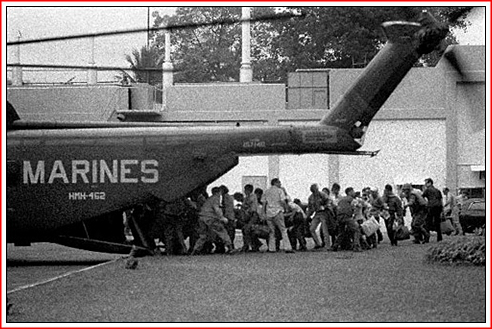
History is a compendium of individual human stories, oft caught up in a world event. That’s what drives the riveting documentary Last Days in Vietnam, which chronicles the desperate attempts of many South Vietnamese to escape before the Communist takeover in 1975. Over 140,000 got out in the initial exodus, including 77,000 through the means depicted in this film – mostly compressed into just two panicked days.
As if there weren’t enough American folly in Vietnam, the first evacuation plan didn’t include any non-Americans, even including the Vietnamese dependents of Americans. Then there were evacuation plans that were never implemented because of the blockheadedness of the US Ambassador. In the final week, young American military and intelligence officers took matters into their own hand, and began a sub rosa evacuation – ignoring the chain of command, breaking immigration laws and risking career-killing charges of insubordination.
Last Days in Vietnam is directed by Rory Kennedy (daughter of RFK), who recently made Ethel, the affecting bio-doc of her mother. Kennedy does a good job of setting the historical stage for those who didn’t live through the era, and then letting the witnesses tell their compelling personal stories.
The talking heads include:
the six-year-old who jumped out of a helicopter and then watched his mother drop his baby sister on to a ship’s deck;
the US Navy vet who plays the taped diary that he sent home to his wife after the fateful day;
the CIA analyst who unsuccessfully tried to convince the deluded US Ambassador that the end was at hand;
the college student who managed to get over a wall inside the embassy, but found that his freedom was not guaranteed;
Ford Administration officials Henry Kissinger and Ron Nessen, who relate the White House view of the events.
One heroic young American officer managed with ingenuity and chutzpah to get out hundreds of Vietnamese. In the film’s most poignant moment, it falls to him to tell the final American lie to the 400 Vietnamese remaining in the US embassy, for whom there were no more helicopters.
I saw the movie in San Jose with an audience that was about half Vietnamese-American, some of the age to have lived through this period. San Jose’s 100,000 Vietnamese population is largest of any city outside Vietnam, and many Vietnamese-Americans still memorialize the subject of this film as Black April. The exit from the theater was somber.
Last Days in Vietnam is a PBS American Experience film, and there are many clips, images and audio on their site; the entire film can be streamed from YouTube.
Photo caption: Linda Fiorentino in THE LAST SEDUCTION
There’s just one reason to watch the 1994 neo-noir The Last Seduction, and that’s the delicious performance by Linda Fiorentino as a sociopath more outrageously devious than any character that Barbara Stanwyck, Audrey Trotter, Jane Greer or Claire Trevor ever got to play.
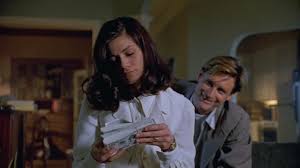
Fiorentino plays Bridget Gregory, who steals her husband Clay’s entire stash of drug deal money and moves away to start a new life under a false identity. Beholden to extremely unpleasant loan sharks, Clay (Bill Pullman) sends a private eye top track her down. Bridget must escape the detective and then enlist a sap to get rid of Clay. She finds her sucker in Mike (Peter Berg), and the tale spins into a web of double-crosses.
Linda Fiorentino and Bill Pullman in THE LAST SEDUCTION
Bridget is fun to watch because she takes the role of femme fatale to unsurpassed heights (or depths?). Her super power is the gift to contrive lies that are both pathological and extraordinarily imaginative. She brazenly employs her sexuality, unmatched audacity and a ruthlessness without any glimmer of empathy. She is just so, so bad.
Both her role and her performance were the best in Fiorentino’s career. However, because The Last Seduction aired on TV before its theatrical release, it didn’t qualify for the Academy Awards. This meant that Fiorentino was denied what would have been a certain Oscar nomination. Some not-so-great movies followed (two with TV heartthrob and movie bust David Caruso), and then her career fizzled out.
The Last Seduction was director John Dahl’s third feature and his third neo-noir after Kill Me Again and Red Rock West (which he had co-written). Since 2009, Dahl has specialized in directing episodes of top tier TV (Breaking Bad, Homeland, The Americans, Californication, Outlander, The Bridge, House of Cards, Justified, Hannibal, Ray Donovan, Yellowstone).
The Last Seduction may not be as good as the apogee of all neo-noirs, Chinatown, but it’s right up there with One False Move as the best neo-noir of the 1990s. The Last Seduction can be streamed from Amazon, AppleTV and Fandango.
Linda Fiorentino and Peter Berg in THE LAST SEDUCTION
Photo caption: Maddison Brown in TO KILL A WOLF. Courtesy of To Kill a Wolf.
In the character-driven indie drama To Kill a Wolf, a reclusive woodsman in the Pacific Northwest (Ivan Martin) finds the seventeen-year-old runaway Dani (Maddison Brown) collapsed in the forest. He brings her back to his isolated cabin, nurses her back to health and tries to learn how he can return her to her home. She’s not forthcoming, so he has a mystery to solve. Meanwhile, the audience is on to other mysteries – why is the Woodsman (that’s the character’s appellation in the credits) living such an isolated life and why is his relationship with local community members so charged? As the Woodsman takes Dani on a road trip to her most recent residence, the answers, one by one, are revealed. It’s an absorbing story.
To Kill a Wolf is the first feature for writer-director Kelsey Taylor, who demonstrates herself to be a very promising filmmaker. A superb story-teller, she doesn’t explain behaviors before you need to understand. We’re continually wondering about the characters and about what will happen next, and are usually surprised about what the Woodsman is doing and why. Music is unusually important to the characters and to the film itself. The way Taylor ends the film is perfect – the final shot is not even a half-second too long.
Ivan Martin in TO KILL A WOLF. Courtesy of To Kill a Wolf.
The lead performances are excellent, as are those of the rest of the veteran professional cast. The roles of Dani’s Aunt Jolene and Uncle Carey are especially well-written, realistic and textured, and the performances of Kaitlin Doubleday and Michael Esper are vividly authentic. As the Rancher, David Knell captures the surprises in the character’s attitudes.
To Kill a Wolf begins streaming today on VOD, including Amazon, AppleTV and Fandango.
Photo caption: Tamara de Lempicka (right) in Julie Rubio’s THE TRUE STORY OF TAMARA DE LEMPICKA & THE ART OF SURVIVAL. Courtesy of Mill Valley Film Festival.
The biodoc The True Story of Tamara de Lempicka & the Art of Survival reveals an astonishing life. The art deco painter Tamara de Lempicka was as groundbreaking in her lifestyle and her self-invention as in her art.
De Lempicka painted her female subjects as confident and comfortable with their sexuality, and her highly-stylized nudes are striking. A de Lempicka has sold for over $20 million, the third-highest price ever paid for a painting by a modern female artist.
De Lempicka lived substantial parts of her life Russian-ruled Poland, France, the US and Mexico. Her adventurous personal life, dotted with rich husbands and affairs with celebrity lesbians, brazenly disregarded all the prevailing societal mores of the first half of the twentieth century. She said, “I live life in the margins of society and the rules of normal society don’t apply to those who live on the fringe.” Although de Lempicka didn’t care what anyone thought of her sexual behavior, she constructed much of her own image, sometimes embracing fiction as fact.
The True Story of Tamara de Lempicka & the Art of Survival is the third feature and first documentary from Bay Area director Julie Rubio, the producer of East Side Sushi. Rubio’s extraordinary research has uncovered that, in building her flamboyant persona, de Lempicka obscured much of her identity, including her heritage and her real name. Bringing birth and baptism certificates, 8mm home movies and the testimony of family members to light for the first time, Rubio completes a new and accurate understanding of de Lempicka.
The True Story of Tamara de Lempicka & the Art of Survival has been playing select theaters and is at the Palm in San Luis Obispo September 20-21, before Laemmle LA hosts 15 shows in five theaters September 27-29. I originally screened it for its world premiere at the Mil Valley Film Festival.
Photo caption: Pavel Talankan in MR. NOBODY AGAINST PUTIN. Courtesy of the SLO Film Fest.
Nothing has changed since Aeschylus observed that the first casualty of war is truth, as revealed in Mr. Nobody Against Putin, the blistering exposé of Putin’s outrageous domestic propaganda about his Ukraine War.
Pavel Talankan is an unassuming, goodhearted guy with a small-time job as the events coordinator at the school in a remote Russian industrial town. That also makes him the school videographer, so no no one notices that, as he films school assemblies, award ceremonies and performances, he is also capturing the blatant Big Lie propaganda. It’s a surreptitious documentary filmed in plain sight.
Pavel is an unlikely muckraker. He is a free-thinking nebbish who loves Russia and loves his hometown of Karabash in the Ural region, putrefied by a noxious copper plant and called “the most toxic place on earth”.
More than anything, Pavel cares about his students, and he is increasingly disgusted as Putin ramps up the propaganda. First, a cadaverous party hack, whose heroes are the most vile Commie hitmen in history, spreads empirically false information about Ukraine being the aggressor in the war. Then, horrifyingly, Wagner mercenaries are brought in as classroom guest speakers. Silently, Pavel continues to film, letting the propagandists defile themselves for history.
Pavel is a hero, albeit a non-violent one, who risked his life to gather this material. David Borenstein exquisitely formed Pavel’s footage into a searing exposé of Putin’s soul-crushing impact on Russia. The secret audio from the funeral of a former student killed in Ukraine is heart-rending. The film begins with video of Pavel’s midnight escape from Russia,
I saw Mr. Nobody Against Putin at the SLO Film Fest; it releases theatrically this weekend.
Photo caption: Irina Starshenbaum and Douglas Booth in SHOSHANA. Courtesy of Greenwich Entertainment.
The thriller Shoshana is a historical drama set in pre-Israel Palestine that revolves around a love story between two people on different sides. The Jewish journalist Shoshana Borochov (Irina Starshenbaum) is a committed Zionist and a supporter of the paramilitary group Haganah. Thomas Wilkin (Douglas Booth) is the Assistant Superintendent of Criminal Investigation for the British authorities.
All of the significant characters in Shoshana were real people, and the story takes place from 1933 to 1944. We don’t see many movies set in this time and place. The Ottoman Empire had ruled Palestine for 400 years, until the Ottomans were expelled by the British in WW I. The British then took over governing Palestine, with its majority Arab population and small Jewish community, under an international agreement – the British Mandate – and with a policy that there should be a Jewish homeland in Palestine. The Arab residents have been living with a few Jews, but are horrified by the specter of mass Jewish immigration, and they revolt. Tit for tat murders begin between Arabs and Jews, which the British try to suppress. Soon there are rival Jewish paramilitary organizations, each with a different take on how to deal with the British, with the Arabs and with each other. When the British sharply limit Jewish immigration and frustrate the efforts to form a Jewish-majority state, the Jews react with anger against the British.
It becomes a lethal gam of three-dimensional chess. Shoshana does a pretty good job in helping the audience track who is who – and who wants to kill who. Shoshana was directed by the veteran Michael Winterbottom (Welcome to Sarajevo, Jude, The Claim, A Mighty Heart and The Trip movies).
Thomas Wilkin and Shoshana Borochov forge an 11-year relationship in an environment that becomes more stressful every year. But Thomas is unwilling to stop being a British policeman, and Shoshana is unwilling to put aside her Zionist beliefs. They love each other, but not enough for either to abandon deeply-held values or their personal identities.
What could doom their relationship is not just arguing politics at the dinner table, but something more ominous – there are plenty of players who want each of them dead. The situation is explosive – often literally. And neither can hide in a Tel Aviv still small enough that everybody knows each other.
The British are trying to cope with what we now know as asymmetrical warfare. A British officer sneeringly asks a Zionist terrorist why he is blowing up women and children, and gets the reply “Because we don’t have the resources that you do“. Ironically, the British in Shoshana are themselves employing mass reprisals, extrajudicial executions and torture that would clearly be considered war crimes today.
Of course, British colonial rule was known for arrogant, racist, and culturally tone-deaf twits, and they are represented by Shoshana‘s villain, police official Geoffrey Morton (the fine actor Harry Melling).
Arabs and their cause may not be depicted in depth in Shoshana, but are shown as victims of both Jewish terrorism and British atrocities.
The historical events constitute the origin stories for both the nation of Israel and the Israeli-Palestinian conflict. The British throw up their hands and fal to provide for Palestinian self-determination within the borders of Palestine. The Jewish organizations in Shoshana later evolved into the two major Israeli political parties of the past 75 years, and the Haganah morphed into the Israeli Defense Forces. Israel has since become a military power and now faces its own asymmetrical warfare.
Given the impact of this history upon the current day, we might have expected more films about this period. After all, there are a zillion films about the Holocaust and a lot set in post-1948 Israel. In 1960, Otto Preminger made the blockbuster film Exodus from the 1958 Leon Uris novel which was the biggest best seller in US since Gone With the Wind. Exodus was set in the period between 1946 and 1948. (My parents saw Exodus at a drive-in with me as a small boy in the back seat.) No less than the pioneering Zionist leader and Israeli prime minister David Ben-Gurion said of the novel, “as a piece of propaganda, it’s the greatest thing ever written about Israel“.
Shoshana is far more clear-eyed and nuanced than Exodus. Shoshana reflects a historical setting that was complicated, and tells the story of lovers’ inner conflicts amid a dynamic and perilous external conflict. Shoshana, which I reviewed earlier this year for the San Francisco Jewish Film Festival, is now streaming on Amazon, AppleTV, YouTube and Fandango.
Photo caption: Liev Schrieber, Austin Butler and Vincent D’Onofrio in CAUGHT STEALING. Courtesy of Columbia Pictures.
Caught Stealing is a genre picture by Darren Aronofsky (Requiem for a Dream, The Wrestler, Black Swan, The Whale), who must have thought he was slumming by directing a genre movie. This is a darkly funny, violent thriller, the kind of movie that I almost always enjoy. But Aronofsky, working off a screenplay by Charlie Huston, has wasted a superb cast and a Hollywood-level budget on a movie so ordinary, that it’s not even worth streaming. It’s not even as good as Ethan Coen’s Honey Don’t or half of the fare on BritBox.
It didn’t have to be that way. As I watched Caught Stealing, I kept thinking of director Steven Soderbergh, who has made Oscar movies like Sex, Lies and Videotape, Erin Brockavich and Traffic, but now churns out genre movies like Kimi and No Sudden Move that may be less artsy but are solid entertainment. Or Richard Linklater, who could make the Before Midnight movies and Boyhood, the very best American cinema of our century, and still entertain us last year with Hit Man. Hell, Rian Johnson and Questin Tarantino ONLY make genre movies – and they’re wonderful. But the director has to love and respect the genre.
In Caught Stealing, Austin Butler plays Hank, a guy who has run away from his past to bartend at a scruffy Lower Manhattan bar in the early 2000s, in a neighborhood that people hoped that Giuliani would clean up. His dodgy punk neighbor (Matt Smith) has to suddenly leave town to visit his stricken father in Britain, and asks Hank to care for his cat. Unsurprisingly, lots of dangerous people show up who think that the neighbor has double-crossed them and that Hank must know where the loot is hidden. They beat him up, and threaten to kill him and his loved ones. This results in lots of chases through NYC as Hank, some scary Russian mobsters, a pair of Hasidic gangsters and a tenacious cop all pursue each other. There’s a bit of sex, lots of violence, and some mild laughs. There’s not a surprising or unpredictable moment here.
Austin Butler is an appealing hunk who was excellent in The Bikeriders and plenty good enough in Once Upon a Time… In Hollywood and Masters of the Air. He even dared to play Elvis Presley and was not the reason that Elvis was bad. Same here.
It’s an impressive cast, with Matt Smith (funny to see The Crown’s Prince Philip sporting a giant mohawk), Liev Schrieber and Vincent D’Onofrio, and Carol Kane and Laura Dern have brief cameos. But the performances by Regina King, Zoe Kravitz and Griffin Dunne are so good, that justice requires them to work in a better movie.
The movie/s title comes from Hank having sabotaged a once promising baseball career, but Darren Aronofsky didn’t even make it to the bag at second base – he was picked off at first.
Photo caption: Dylan O’Brien and James Sweeney in TWINLESS. Courtesy of Roadside Attractions.
In the refreshingly original dramedy Twinless, Roman (Dylan O’Brien) has been rocked by the sudden death of his twin brother Rocky. Roman and Rocky were inseparable in their Moscow Idaho, childhood, but the more adventuresome and cosmopolitan Rocky had been building his own life in Portland. Roman, admittedly not the sharpest knife in the drawer, and burdened with anger management issues, has been stuck in a dead end rut back home with their bitter mother (Lauren Graham). After the funeral, Roman, at loose ends, is sticking around Portland and finds a support group for people who are grieving the loss of their twin siblings.
Roman meets another support group participant, Dennis (James Sweeney), who has very little in common with Rocky, but, like Roman is gay, worldly and quick-witted. What Roman and Dennis share is their grief and loss of connection, and they build a most unlikely friendship. It seems like we’re in for an amiable Odd Couple comedy until something in their back stories is revealed to the audience, but not to both of them. Will the new friends be able to face and overcome this history? The drama is leavened by comedy as Twinless explores grief, loss and identity.
Dennis is played by James Sweeney, Twinless’s writer director. Sweeney has written a character of remarkable ambiguity and vulnerability for himself. Sometimes a person remains sympathetic, even though they have a loathsome character flaw and have done something very wrong. It’s really hard to write (and play) a movie character like that, and that is Sweeney’s triumphant achievement in Twinless.
Dylan O’Brien is well known for the Teen Wolf (as Stiles) and The Maze Runner franchises, with which I am unfamiliar. I’m generally impressed by actors who can convincingly play characters much dumber than they are in real life, and O’Brien is very good as a dopey innocent who we can laugh at but still root for.
Aisling Franciosi plays Marcie, a sunny goodhearted ditz who turns out to be far more formidable than either Dennis or Roman expect. Twelve years ago, in The Fall, I first saw Franciosi’s compelling performance as Katie Benedetto, a troubled Northern Irish teen who is infatuated by a serial killer (Jamie Dornan). Gotta say this – if she can play both Katie Benedetto and Marcie to perfection, she can play any character.
Reflecting both the sweetness and edginess we find in life, Twinless is one of the smartest and most satisfying comedies of recent years.