DAVID CROSBY: REMEMBER MY NAME: all the bridges I have burned

David Crosby in DAVID CROSBY: REMEMBER MY NAME
Photo by Edd Lukas and Ian Coad. Courtesy of Sony Pictures Classics

The notoriously irascible Robert Altman and a drinking buddy once amused themselves by inventing titles of fake country-western songs; Altman came up with I’m Swimming Through the Ashes of All the Bridges I Have Burned. That’s the experience of watching the biodoc David Crosby: Remember My Name.

Most of the doc is a series of interviews with Crosby as he goes on yet another concert tour at age 76; before leaving, he cruises around his old haunts on Sunset Boulevard and Laurel Canyon. Remember My Name’s producer, the director Cameron Crowe, replays an interview with Crosby from 1974, when Crowe was the wunderkind rock writer portrayed in Crowe’s film Almost Famous. Crosby reacts with a telling observation about his friendships.

With the perspective of age, Crosby reflects on his musical achievements, his addiction and recovery and his trail of relationship carnage. He notes that “all” of his intimate collaborators – Roger McGuinn, Graham Nash, Steven Stills and Neil Young – “hate me”, and ruefully observes, “if it were just one, it could be an accident”. The film includes clips of McGuinn, Nash and Young (plus Stills’ emphatic silence) to corroborate.

Crosby’s well-known battle with cocaine and heroin came into play with his estrangements. I would reflect that recovery from addiction will generally IMPROVE behavior, but is no guarantee of ACCEPTABLE behavior. The drugs certainly didn’t help Crosby avoid his “two or three heart attacks” eight cardiac stints, his liver transplant and his diabetes.

Contemplations aside, David Crosby: Remember My Name does an excellent job of tracing Crosby’s musical career and personal life. We get his side of his romance with Joni Mitchell, and the story of getting dumped by Mitchell in front of all their friends – with a song Mitchell composed for the occasion. There’s an wonderful telling of the writing and recording of Neil Young’s great song Ohio.

And here’s an odd note for movie fans: Crosby’s father was Floyd Crosby, a prolific but usually pedestrian cinematographer whose career topper was his Golden Globe-winning work in High Noon. I compared the father-son career paths and found that in 1964-65, when David was starting with the Byrds and hanging out with the Beatles and Miles Davis, Floyd was cranking out Bikini Beach, Pajama Game, Beach Blanket Bingo, How to Stuff a Wild Bikini and Beach Ball. While David was in the vanguard of the 1960s Counterculture, Floyd was winding up the Annette Funicello/Frankie Avalon teen culture that had been hanging on from the 1950s.

DVD/Stream of the Week: TAKE ME TO THE RIVER – fresh, unpredictable and gripping

TAKE ME TO THE RIVER

San Jose native Matt Sobel’s impressive directorial debut Take Me to the River is entirely fresh. Not one thing happens in Take Me to the River that you can predict, and it keeps the audience off-balance and completely engaged.

A California couple and their teenage son drive to an annual family reunion in rural Nebraska. The son is gay and out, but that’s not going to be the drama here. There’s almost immediately an unexpected development that rocks the extended family. Then we settle in for over an hour of simmering unease and tense dread until something REALLY disturbing happens.

The story may be told from the teen’s point of view, but the real story turns out to be in the highly-charged relationship between his mom (Robin Weigert) and her brother Keith (Josh Hamilton). Keith, the boy’s uncle, is not a redneck rube, but very angry and very manipulative. By the end of the movie, we understand why. It’s an excellent performance by Hamilton, and whenever he’s on-screen, we fidget and wait for him to explode.

Weigert (Calamity Jane in Deadwood, Ally in Sons of Anarchy) is also excellent – her character is a Los Angeles physician who hasn’t lost the Nebraskan gift of never referring to the elephant in the room, no matter how huge. She embraces the Nebraskan imperative of avoidance with persistent geniality, covering up any unpleasantness with with niceties. My family is from rural Nebraska, which I have visited many times, so I know of what I speak.

The child actress Ursula Parker (the youngest daughter in Louie) is also especially outstanding here. Take Me to the River contains some sexual behavior by a child which is very uncomfortable for the audience, but central to the story and non-exploitative. Here are some notes from an interview with Sobel.

Take Me to the River played at Sundance in 2015 and was finally released in the Bay Area in Spring 2016. Before its release, I viewed it at the Cinema Cub Silicon Valley.  It made my Best Movies of 2016. You can stream Take Me to the River on Amazon Instant, iTunes, Vudu, YouTube and Google Play or rent the DVD from Netflix.

ROJO: bobbing in a sea of moral relativism

ROJO. Courtesy of SFFILM.

Rojo is Argentine writer-director Benjamín Naishtat’s slow burn drama.  Rojo is set just before the 1970s coup that some characters expect – but no one is anticipating how long and bloody the coup will be.  Several vignettes are woven together into a tapestry of pre-coup moral malaise.

A prominent provincial lawyer Claudio (Darío Grandinetti) is invited to participate in a scam. There’s a scary encounter of lethal restaurant rage. It looks like Claudio, bobbing on a sea of moral relativism, may well remained unscathed, but the arrival of crack detective becomes a grave threat.

As Claudio weaves through his life, his society shows signs of crumbling. There’s a failed teen seduction, an emotional breakdown at a formal reception and a natural metaphor – a solar eclipse.

It’s funny when the audience finally connects the dots and understands who the character nicknamed “the Hippie” is. And Naishtat and Grandinetti get the most out of the scene where Claudio finally dons a toupee.

We know something that the characters don’t know – or at least fully grasp – how bloody the coup will be. Watch for the several references to desaparecido, a foreboding of the coup. Argentina’s coup was known for the desaparecidos – the disappeared – thousands of the regime’s political opponents went missing without a trace, having been executed by death squads. In Rojo, a very inconvenient madman dies and his body is hidden, there’s a disappearing act in a magic show, and a would-be boyfriend vanishes.

This is a moody, atmospheric film that works as a slow-burn thriller. I saw Rojo earlier this year at the San Francisco International Film Festival (SFFILM) and it opens this weekend in Bay Area theaters.

Movies to See Right Now

THEY SHALL NOT GROW OLD

Wow, I gotta say that the offerings in movie theaters this August/September are as unappealing as I can remember, even for this period of traditional cinematic doldrums. There are a couple of good indies that I’ve seen coming to art houses in mid-September, but that’s about it until October.

However, now is a good time to catch up on films from my list of Best Movies of 2019 – So Far. The Last Black Man in San Francisco, They Shall Not Grow Old, Amazing Grace and Booksmart are all available to be streamed.

OUT NOW

  • Once Upon a Time…in Hollywood is a Must See – one of Quentin Tarantino’s very, very best.
  • The family dramedy The Farewell is an audience-pleaser.
  • You can find, if you look hard enough, Jirga, an indie parable about atonement that was Australia’s submission to the Academy Awards.
  • Bay Area filmmaker John Maringouin’s inventive satire Ghostbox Cowboy, skewers white entitlement and sneaks a peek inside the shadiest corners of the Chinese boom economy. Ghostbox Cowboy earned a NY Times Critic’s Pick and can be streamed on Amazon (included with Prime).
  • Here’s my rant on the latest Olivier Assayas film, Non-Fiction.

ON VIDEO

My Stream of the Week is the cautionary documentary Jimmy Carter – about the American people asking for something that they didn’t warm to once they got it. To stream Jimmy Carter from iTunes, search for “Jimmy Carter” under TV Episodes (not under Movies). Jimmy Carter is also available on DVD from American Experience

ON TV

On September 10, Turner Classic Movies will be airing the 1940 version of Gaslight. Here is my essay on the movie versions of Gaslight and gaslighting as domestic violence, including a reference to the Film Noir Foundation’s fine podcast on the topic.

Ingrid Bergman and Charles Boyer in GASLIGHT

GASLIGHT, GASLIGHT and gaslighting in domestic violence

Ingrid Bergman and Charles Boyer in GASLIGHT

On September 10, Turner Classic Movies will air Gaslight (1944), a classic suspense thriller that still has a lot to say about domestic violence and abusive power in relationships.

In Gaslight, an evil husband (Charles Boyer) isolates his wife (Ingrid Bergman) and uses manipulation to convince her that she’s going crazy. He’s seeking to conceal his crimes and gain unfettered control of her house and fortune. He’s also dallying with the maid (a nubile 18-year-old Angela Lansbury). Fortunately, the wife’s longtime admirer (Joseph Cotton) works for Scotland Yard and starts to investigate…

Domestic Violence is abuse of a partner, generally characterized by asserting power and control over the partner. Not all domestic violence is physical, and this phenomenon of abuse by manipulation takes it name – gaslighting – from this movie.

The Film Noir Foundation recently screened Gaslight to an audience of domestic violence survivors and support professionals. I recommend Noir Talk, the Film Noir Foundation’s excellent podcast on iTunes. Search for Gaslight and domestic violence in Episode 10. Here’s one of the tidbits from the podcast: Ingrid Bergman thought she was too vibrant and healthy-looking for the part; but that works to show how the manipulation can work on a woman who doesn’t look like a victim.

This famous Gaslight is actually a remake of the original 1940 version, which is also especially well-acted. Anton Walbrook is suave and evil as the hubbie and Dyana Wyngard is unforgettably haunting as the wife. Only 19 minutes in, we see his duplicity, manipulation and control. Frank Pettingell is very good as the detective, and the cast includes Robert Newton (Long John Silver in the 1950 Treasure Island). Cathleen Cordell plays the oversexed maid Nancy in a less nuanced performance than Angela Lansbury’s. This film version is reportedly the most faithful to the stage play source material. (Oddly, there’s a very good can-can dance in this 1940 movie, too.)

Stream of the Week: JIMMY CARTER – “What people say they want”

In PBS’ American Experience documentary Jimmy Carter, The New Yorker writer and former Carter speechwriter Henrik Hertzberg says:

Jimmy Carter was what the American people always SAY they want – above politics, determined to do the right thing regardless of political consequences, a simple person who doesn’t lie, a modest man, not someone with a lot of imperial pretenses.  That’s what people say they want.  And that’s what they got with Jimmy Carter.

And herein lies the rub. 

In 1976, Americans were reacting to Watergate and wanted a President LEAST like Richard Nixon. We got him, in the form of Jimmy Carter; it turned out that Carter could deliver non-Nixon decency, but not the leadership that the era required.

Today, many – and the polls indicate, most – Americans seek a non-Trump. I share the view that ANYONE would be better then Trump, but Jimmy Carter is instructive that “anyone”, while better than Trump, might not be the best for the country.

In Jimmy Carter, we hear from those who know Carter best – including his wife Rosalynn Carter, his vice-president Walter Mondale, and right-from-the-start Carter insiders Jody Powell, Pat Caddell and Bert Lance. How the times made this man, then propelled him to such improbable electoral success and then finally doomed his Administration, is a great and cautionary story.

To stream Jimmy Carter from iTunes, search for “Jimmy Carter” under TV Episodes (not under Movies). Jimmy Carter is also available on DVD from American Experience

GHOSTBOX COWBOY: a dim bulb tries to re-invent himself

GHOSTBOX COWBOY

In John Maringouin’s inventive satire Ghostbox Cowboy, we first meet Jimmy (David Zellner) in an American store, gazing at that aisle in every Walgreens or CVS that is filled entirely with crappy plastic gizmos made in China. We later learn that he’s thinking, “somebody is getting rich making this stuff and that person should be me.”

Wearing a cowboy hat for effect, Jimmy takes his small nest egg to the capitalist frontier of China and tries to re-invent himself as an entrepreneur. He has the prototype for an absolutely phony product, which he tries to pitch to young Chinese capitalists. Jimmy thinks that he can outsmart the locals because he is an American, but the joke is on him – he’s now the dumbest guy in China.

Jimmy doesn’t bother to learn any Mandarin, so he leans on or two shady, super-marginal ex-pats (Robert Longstreet – just great – and Specialist) to help him navigate the local scene. One of his “buddies” fleeces him, and Jimmy is hired by contemptuous Chinese when they need a Caucasian stand-in. As Jimmy is stranded near Mongolia, Ghostbox Cowboy gets mystical, and the cringe humor gives way to the surreal.

The filmmaking itself is a remarkable story. Ghostbox Cowboy was shot in the massive boomtowns around Dongguan, Guangzho and Shenzhen (each a city with a population between 8 and 15 million). Because the Chinese government frowns on critique cinema, Maringouin had to shoot on the sly, guerilla style. To photograph the illegal factories that manufacture knock-offs, he pretended to be a potential investor. Maringouin and his two SAG actors spent ten days in China, essentially pretending not to shoot a movie.

David Zellner in GHOSTBOX COWBOY

I saw Ghostbox Cowboy at Cinema Club Silicon Valley, with a Q&A with writer-director-camera operator John Maringouin. Bay Area filmmaker Maringouin wanted to focus on White entitlement, with a protagonist who adds no value of his own but imagines that he should still be “a participant” in China.

Ghostbox Cowboy was selected to play the Tribeca film festival and earned a NY Times Critic’s Pick. Ghostbox Cowboy can be streamed on Amazon (included with Prime).

THE SOUVENIR: amplification by stillness

Honor Swinton Byrne and Tom Burke in THE SOUVENIR

The slow-burn romantic tragedy The Souvenir is a study of a bad romantic choice, exacerbated by co-dependence.

In the 1980s Thatcher Era UK, Julie (Honor Swinton Byrne) is a 24-year-old Ken Loach wannabe trying to make her first socially aware film. She’s from a middle class background and has a set of artsy friends. She meets Anthony (Tom Burke), who affects the chalk-stripe pinstripe suits and the bored drawl of the upper classes, and says that he works at the Foreign Office. She is intrigued.

It’s an unusual courtship. He takes her to a stupefyingly posh tearoom. They visit an art gallery and deconstruct the Fragonard painting The Souvenir. But are these dates? Kinda dates? She lets him crash at her place. All of this precedes any physical intimacy or hint of passion. He wants her, but never pushes the pace. They do become lovers, and it turns out that he is not as he seemed. (Kudos to the trailer below for NOT spoiling Anthony’s biggest secret.)

This is a remarkable piece of filmmaking. Writer-director Joanna Hogg frames each shot exquisitely, and lets the characters’ feelings unspool before us. This is a movie with lots of stillness, and the stillness serves to amplify the emotional power.

This is the first feature film performance as an adult for Honor Swinton Byrne, the daughter of Tilda Swinton. Byrne is superb as Julie, whom we care about because she is so genuine and vulnerable. This is also the first time I’ve seen Tom Burke, and he is excellent as a quirky guy who might really appeal to some woman, but who can’t escape his fatal flaw. Tilda Swinton appears in the supporting role as Julie’s protective mom, and nails the character.

Joanna Hogg, just like her Julie, was a young British filmmaker in the 1980s, and this story seems searingly personal. I don’t know to what extent it is autobiographical, but the heartbreak is so powerfully vivid, that I hope Hogg didn’t have to endure it in real life. There’s a sequel already in post-production.

The Souvenir is universally acclaimed by critics and has a Metacritic score of 92. I admired the film and the filmmaking, but was not engrossed; most viewers will find the deliberate pace makes The Souvenir a challenging watch for one hour and 59 minutes. It certainly is the most profoundly sad film of the year. It can be streamed on Amazon, iTunes, Vudu, YouTube and Google Play.

Movies to See Right Now

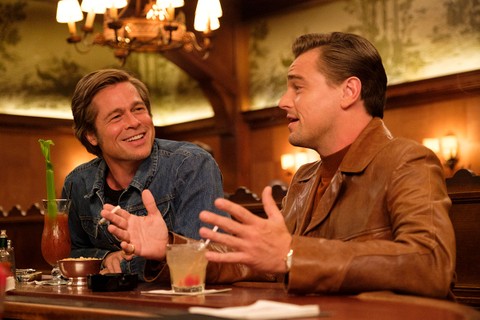
Leonardo DiCaprio and Brad Pitt in ONCE UPON A TIME…IN HOLLYWOOD

Once Upon a Time…in Hollywood is a marvelously entertaining masterpiece. I’m just going to keep beating this drum until I run out of friends who haven’t seen it yet (including The Wife).

OUT NOW

  • Once Upon a Time…in Hollywood is a Must See – one of Quentin Tarantino’s very, very best.
  • The family dramedy The Farewell is an audience-pleaser.
  • You can find, if you look hard enough, Jirga, an indie parable about atonement that was Australia’s submission to the Academy Awards.
  • Here’s my rant on the latest Olivier Assayas film, Non-Fiction.

ON VIDEO

My Stream of the Week is The East, a smart and gripping thriller that explores both our response to corporate criminality and the unfamiliar world of anarchist collectives. The East is available on DVD from both Netflix and Redbox and streaming from Amazon, Vudu, iTunes, GooglePlay and other VOD outlets.

ON TV

Kirk Douglas in SPARTACUS

On August 31, Turner Classic Movies offers Kirk Douglas’ testosterone exploding across the screen in Spartacus, The Vikings and Gunfight at the OK Corral. The latter is the John Sturges 1957 version with Douglas and with Dennis Hopper as Billy Clanton; (I prefer the 1946 John Ford version of the same story – My Darling Clementine, with Henry Fonda, Victor Mature, Ward Bond, Walter Brennan and John Ireland.)

Kirk keeps his shirt on in OK Corral, but Spartacus and The Vikings are filled with shirtless virile charisma. There’s really nothing to The Vikings except action adventure (and a scary contact lens), but it’s been a guilty pleasure of mine since the first time it played on TV.

Kirk Douglas in THE VIKINGS

TOWN WITHOUT PITY – the song, not the movie

Turner Classic Movies is airing Town Without Pity (1961) on Saturday – and I don’t think much of it.  It’s a postwar drama in which Kirk Douglas defends four GIs from rape charges in an Allied-occupied German town.  But the great Dimitri Tiomkin wrote the score, and, like he did with his Oscar-winning High Noon, he came up with a pretty good title song.  The song became a Top 40 hit for Gene Pitney.  Here’s Pitney performing the song on TV.

(For a total change of pace, the song was also featured in John Waters’ 1988 Hairspray.)