DVD/Stream of the Week: THE AURA – smart enough to plan the perfect crime, but is that enough?

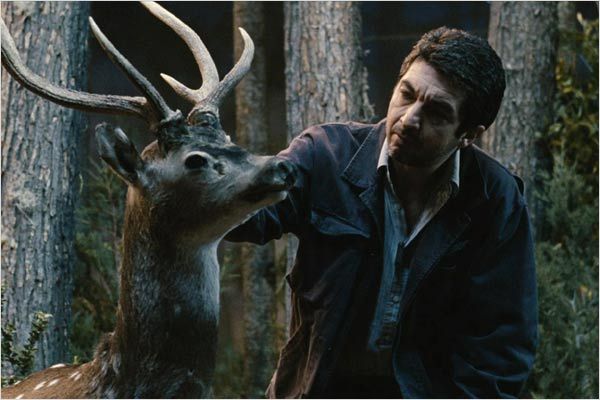
Ricardo Darin in THE AURA

The Aura is a brilliant 2005 neo-noir from Argentina that I wasn’t familiar with until the Czar of Noir, Eddie Muller, programmed it into the 2017 Noir City film festival. The 2019 Noir City opens this weekend.

The Aura is about a taxidermist who leads a boring life, but fantasizes about the Perfect Crime. He is perpetually cranky because he is so dissatisfied, but he resists getting out of his life rut. It’s not easy to be his friend (nor, apparently, his wife). Unexpectedly, he finally finds himself in position to participate in a major heist.

He is epileptic (the movie’s title is from the sensation just before a seizure); he and we never know if and when he will pass out from an episode, a particularly dangerous wild card in a thriller. He also has a photographic memory, and that can help him if he has the nerve to go through with the crime.

The taxidermist is played by one of my favorite actors, Ricardo Darin (Nine Queens, The Secret in their Eyes, Carancho, Wild Tales) . I like to think of Darin as the Argentine Joe Mantegna. Darin can expertly play a slightly twisted Every Man, and he excels at neo-noir.

The rest of the cast is excellent, especially Walter Reyno as The Real Thing criminal, Alejandro Awada as the taxidermist’s long suffering only friend and Dolores Fonzi as the intriguing woman in the woods.
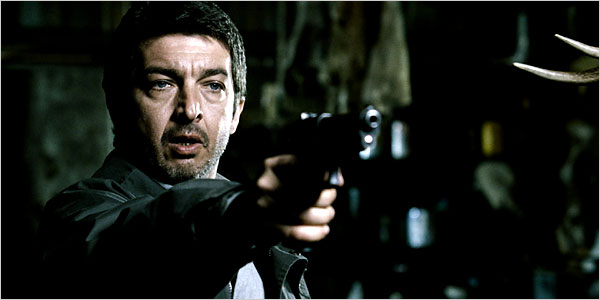
Ricardo Darin THE AURA

Sadly, writer-director Fabián Bielinsky died at 47 after making only two features – the wonderful con artist film Nine Queens (also starring Darin) and The Aura. Those two films indicate that he was a special talent.

Darin’s taxidermist is smart enough to plan a Perfect Crime, but professional criminals have that sociopathic lack of empathy needed to carry out crimes. Does he? Does he get the money? Does he get the girl? Does he even escape with his life? It’s a neo-noir, so you’ll have to watch it to find out.

By the way, the dog in this movie is important. Watch for the dog at the very end.

The Aura is available to rent on DVD from Netflix and to stream from Amazon and Hulu.

Dolores Fonzi in THE AURA

ZAMA: the corruption of colonialism (as if we needed to know)

Daniel Giménez-Cacho in ZAMA

The protagonist of Zama is a colonial magistrate in the late 1700s, a low-level functionary of the Spanish crown in a remote backwater of South America. A pretty decent guy for a colonizer who enslaves other humans, Diego de Zama (Daniel Giménez-Cacho) has been loyally performing his duties, and his sole ambition is to get a transfer and return to his family.

But his bosses just won’t give him that transfer, even when he performs a morally painful task. Worse than that, his life is an unending sequence of indignities. While de Zama can’t get relieved, the underling who has been fired for insubordination gets the assignment of his choice; de Zama lusts for the Spanish colonial woman who teases him, but she only will bed the same insubordinate underling. De Zama can’t even get his indigenous mistress to wash his shirt.

The Wiley Coyote of Spanish colonialism, De Zama is frustrated, humiliated – and finally, far worse. Zama’s descent leads to his final act of refusing to give what he sees as false hope to even his tormentors. As the indignities pile up on Zama, the absurdity becomes wry; I kept thinking of the Job-like misfortunes of the protagonist in the Coen brothers’ A Serious Man, which is funny as hell, unlike Zama.

The finest screen actors are best when they are silently watching, observing and assessing their own situations. The Spanish-born Mexican actor Giménez-Cacho is particularly adept at this, and throughout the film we see “I am so screwed” in his eyes.

This is all meant to show us the fundamental corruption of colonialism, and that colonialism ultimately destroys the colonizer as well as the colonized. (Yes, this really hasn’t been controversial for the past 50 years.)

This is a one-note movie. Zama has a score of 89 from Metacritic and is beloved by many admirable critics, including the great Manohla Dargis. But the repetitive tedium and the Message worn on its sleeve didn’t pay off for me. You can stream it if you insist.

ROMA: exquisite portrait of two enduring women

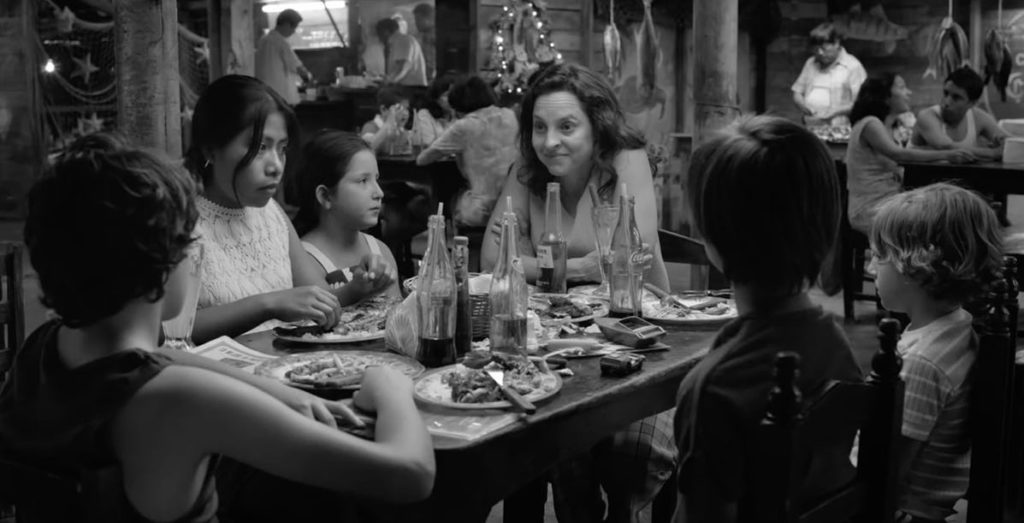
Yalitza Aparicio (second from left) and Marina de Tavira (center) in ROMA

In the powerful and sublimely beautiful Roma, Cleo is the cheerful and ever-on-duty domestic servant in the Mexico City home of Sofia, her doctor husband, their four kids and Sofia’s mother. Sofia’s upper middle class family are light-skinned gueros and Cleo is indigenous. Sofia’s husband leaves her, and she tries to hold her household and her emotions together without letting on to the kids.  Sofia and Cleo’s relationship changes and is forged closer when each faces a personal crisis.

That distillation of the story doesn’t begin to capture the profound depth of Roma.  Despite their differences in race and class, Cleo and Sofia are in the same situation – facing life’s travails and the responsibilities of family without any help. They are isolated and they must find ways to endure.

Cleo (Yaritza Aparicio) encourages and nurtures the imagination of the youngest child, Pepe. She is playful and adored by the children.  This is Aparicio’s first acting gig; she was chosen from among 3000 candidates for the role.  Sofia, who is balancing on a knife-edge throughout the story, is played by veteran actress Marina de Tavira, who found Sofia’s story to be the same as her own mother’s. These are two wonderfully authentic  performances.

Roma is written, directed and edited by master filmmaker Alfonso Cuarón (Gravity, Children of Men and Y Tu Mama Tambien).  This may be his masterpiece.  Cuarón won two Oscars For Gravity, in which he conveyed the terrible and unforgiving enormity of outer space. In Children of Men, he created one of the longest, most intricate and compelling action shots in cinema history.

Shot in glorious black and white, Roma is packed with amazing set pieces, both with long static shots and even longer tracking shots.  There’s a nighttime tracking shot that follows Cleo through several blocks of a bustling Mexico City downtown street.  In another extended single, dolly shot, the camera follows characters from the beach into the surf, beyond the surf break and then back to shore.

Emergencies in the surf of a beach resort and in a hospital are among the most harrowing movie scenes that I’ve seen this year – even more intense than  climactic scenes in thrillers.

As heartbreaking as Roma can get, there’s a great deal of humor here.  Much is centered on the family dog and his massive production of excrement.  There’s also the repeated ordeal of an oversized Ford Galaxy inching its way into an undersized car park.  A rural hacienda contains some very unusual wall decorations.  And there’s an unexpected and remarkably inappropriate naked martial arts performance.

According to those who would know, Roma is an evocative time capsule of Mexico City at the beginning of the 1970s.

The characters of the mom and the domestic, along with the events – the riot, the forest fire, the earthquake, etc. – are recreated from Cuarón’s most vivid and enduring memories of his own childhood. It’s a deeply personal and individual story, but one which is universal –  that of women carrying on without the support of (and even despite) the men in their lives.

I saw Roma at the Mill Valley Film Festival in October at a screening with Aparicio, de Tavira and producers Gabriella Rodriguez and Jonathan King.  Cuarón shot the film in sequence over 108 days and only showed the cast the script one day at a time, directing them to “surrender” to the story.  Rodriguez confirmed that the family sees Marooned at the movie in a nod to Gravity.

Roma takes its title from the family’s neighborhood in Mexico City.

Roma will be released in New York, LA and Mexico City theaters this weekend and will open more widely on November 29. Having been financed by Netflix, it will stream to Netflix subscribers on December 14.  This is one of the year’s very best films, and it will receive multiple Oscar nominations.

MUSEO: portrait of alienation in the form of a heist

MUSEO

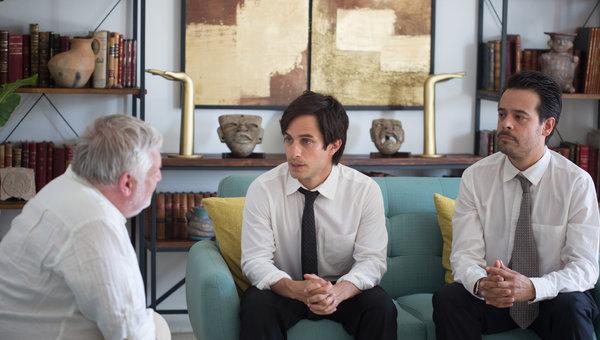
The true life Mexican heist film Museo is really a portrait of alienation – and immature alienation at that. It’s about a young middle class guy in a third world country, and he has first wold problems; his prospects are not unlimited, but he’s way better off than his less educated compatriots. So he and his weak-willed buddy pull off an audacious art theft.

Unusually, and perhaps uniquely, among heist films, hardly any time is invested in assembling the team (here it’s the guy and his buddy) or in the heist itself. The guys steal the most famous ancient Mexican artifacts from the National Museum, essentially the heart of the nation’s heritage. The theft becomes a sensation that dominates the national zeitgeist, triggers an all-out manhunt and a political scandal. How could this have happened?

Of course, there can’t possibly be any buyers for such high visibility objects (just like in this year’s other real life slacker heist film American Animals). Most of the film is figuring out what to do next – and good options are non-existent.

The protagonist is played by the fine actor Gael Garcia Bernal. Unfortunately, this character really isn’t that interesting; I think that is because his alienation is based on petulance and not on rage (see the great Jack Nicholson ragingly alienated roles of the 70s).

Museo does a good job of evoking the Mexico City and Acapulco in the mid 1980s. But without the central thrill of a heist, we are left with an unsympathetic protagonist and his predicament, and that’s really not enough for a two-hour movie. I saw Museo at the Mill Valley Film Festival.

https://vimeo.com/287000720

Cinequest: MARISA IN THE WOODS

Patricia Jordá in MARISA IN THE WOODS

In the Spanish dramedy Marisa in the Woods, Marisa (Patricia Jordá) is at a personal and career crossroads.  She’s burnt out from her job with a touring theater troupe and takes a needed break.  Unfortunately, she doesn’t get any support from her network of friends and colleagues, all of whom are needier than she is.  Her bestie is literally hysterical, over-dramatizing everything in her life until it leads to a tragedy.  Finally, Marisa finds some empathy after reconnecting with a teacher from her past, who has changed gender.

Marisa in the Woods is an acid commentary on first-world problems and the complaints of the self-absorbed.  As Marisa bounces from one dissatisfied friend to another, we are treated to a tour of Madrid locations, all the way to the magical realism at the ending.

This is a very witty film, obviously influenced by early Pedro Almodóvar (not a bad thing), but without Almodóvar’s frenetic energy.  Marisa in the Woods is the first feature for writer-director Antonio Morales.  Its US premiere will be at Cinequest.

Cinequest: AMATEUR

Jazmín Stuart in AMATEUR

The taut Argentine thriller Amateur reminds us of Psycho, but with more grisly killing and sexual perversity.  A new hire at a television station is combing through some old tapes and discovers a sex tape (hence the title).  He becomes obsessed with the woman in the tape and later meets her in real life. As in Psycho, a serial killer suddenly takes over the story, and Amateur plunges into tales of blackmail, kidnapping and a sordid back story of sexual exploitation.  Trying to solve the first murder, the police stumble along as the bodies pile up.

The original sex tape is only the first layer of voyeurism in Amateur. More and more characters video record and view the actions of others.

Jazmín Stuart is very good as a woman that the audience is likely to underestimate at the beginning of the film  There is a moment in Amateur when she has just had a consensual sexual encounter but her eyes start to signal that something is terribly wrong; it’s unforgettable.

Alejandro Awada is perfectly cast as a guy who seems formidable at first; we keep learning that he has more and more assets, including his trophy wife.  His easy-going affect of geniality and confident charm is an effective juxtaposition to the monster he is revealed to be.  Awada delivered another excellent supporting performance in the overlooked neo-noir The Aura.

The veteran producer Sebastian Perillo makes his writing and directing debuts with Amateur.  The US premiere of Amateur is at Cinequest.

Stream of the Week: TRUMAN – how people say goodbye

Javier and Ricardo Darin in TRUMAN
Javier Cámara and Ricardo Darin in TRUMAN

For the second week in a row, I’m suggesting that you take this opportunity to watch what may be the best movie of this year – in your own home. In the deeply emotionally affecting and humane Spanish film Truman, Tomás (Javier Cámara) leaves Montreal to pay a surprise four-day visit to his longtime friend Julián (Ricardo Darin) in Madrid. Julián has been battling cancer and has just received a very grim prognosis. Julián has chosen to forgo further treatment, and his cousin and caregiver Paula (Dolores Fonzi) is hoping that Tomás can talk Julián out of his decision.

Julián is a roguish bon vivant, although now hobbled by illness. Tomás is a responsible family man. As the four day visit unfolds, Tomás tags along as Julián cavalierly settles his affairs. Because of the circumstances, even the most routine activity is heavily charged with emotion. Julián, who has always been a wild card, is now a tinderbox always on the verge of erupting into some socially inappropriate gesture. Julián is particularly focused on arranging for adoption of his beloved and ponderous dog Truman.

Julián is a wiseacre, but his reaction to a moment of kindness from an very unexpected source is heartbreaking. Julián goes to say goodbye to his son, and then the learn a fact afterward that make this encounter exponentially more poignant. Truman has an especially sly ending – the granting of one last favor, however inconvenient.

TRUMAN
TRUMAN

The Argentine actor Darin is one of my favorite screen actors: Nine Queens, The Secret in their Eyes, Carancho, The Aura. As a man living under a death sentence, Julián has adopted a bemused fatalism, but is ready to burst into rage or despair at any moment, and Darin captures that perfectly.

I was blown away by Javier Cámara’s unforgettable performance, at once creepy and heartbreaking, in the Pedro Almodovar drama Talk to Her. Cámara is a master of the reaction, and his Tomás stoically serves as the loyal wing man to a friend with hair trigger unpredictability, often in a state of cringe.

The Argentine actress Dolores Fonzi (The Aura) is excellent as Paula, whose caregiver fatigue finally explodes.

Packed with bittersweet emotions, Truman is never maudlin. The Spanish director Cesc Gay, who co-wrote Truman, has created a gentle and insightful exploration into how people can say goodbye. There’s not a single misstep or hint of inauthenticity. Again, Truman is one of the best films of the year.

Truman had a brief US theatrical run. It’s now streaming on Amazon, iTunes, Vudu, YouTube and Google Play.

(Note: The crappy trailer below fails to capture all the humor and deep emotion in this film.)

Stream of the Week: TRUMAN – the year’s best movie?

Javier and Ricardo Darin in TRUMAN
Javier Cámara and Ricardo Darin in TRUMAN

This may be the best movie I’ve seen this year. In the deeply emotionally affecting and humane Spanish film Truman, Tomás (Javier Cámara) leaves Montreal to pay a surprise four-day visit to his longtime friend Julián (Ricardo Darin) in Madrid. Julián has been battling cancer and has just received a very grim prognosis. Julián has chosen to forgo further treatment, and his cousin and caregiver Paula (Dolores Fonzi) is hoping that Tomás can talk Julián out of his decision.

Julián is a roguish bon vivant, although now hobbled by illness. Tomás is a responsible family man. As the four day visit unfolds, Tomás tags along as Julián cavalierly settles his affairs. Because of the circumstances, even the most routine activity is heavily charged with emotion. Julián, who has always been a wild card, is now a tinderbox always on the verge of erupting into some socially inappropriate gesture. Julián is particularly focused on arranging for adoption of his beloved and ponderous dog Truman.

Julián is a wiseacre, but his reaction to a moment of kindness from an very unexpected source is heartbreaking. Julián goes to say goodbye to his son, and then the learn a fact afterward that make this encounter exponentially more poignant. Truman has an especially sly ending – the granting of one last favor, however inconvenient.

TRUMAN
TRUMAN

The Argentine actor Darin is one of my favorite screen actors: Nine Queens, The Secret in their Eyes, Carancho, The Aura. As a man living under a death sentence, Julián has adopted a bemused fatalism, but is ready to burst into rage or despair at any moment, and Darin captures that perfectly.

I was blown away by Javier Cámara’s unforgettable performance, at once creepy and heartbreaking, in the Pedro Almodovar drama Talk to Her. Cámara is a master of the reaction, and his Tomás stoically serves as the loyal wing man to a friend with hair trigger unpredictability, often in a state of cringe.

The Argentine actress Dolores Fonzi (The Aura) is excellent as Paula, whose caregiver fatigue finally explodes.

Packed with bittersweet emotions, Truman is never maudlin. The Spanish director Cesc Gay, who co-wrote Truman, has created a gentle and insightful exploration into how people can say goodbye. There’s not a single misstep or hint of inauthenticity. Again, Truman is one of the best films of the year.

Truman had a brief US theatrical run. It’s now streaming on Amazon, iTunes, Vudu, YouTube and Google Play.

(Note: The crappy trailer below fails to capture all the humor and deep emotion in this film.)

SUBTE-POLSKA: memory, vitality and loves from the past

SUBTE POLSKA

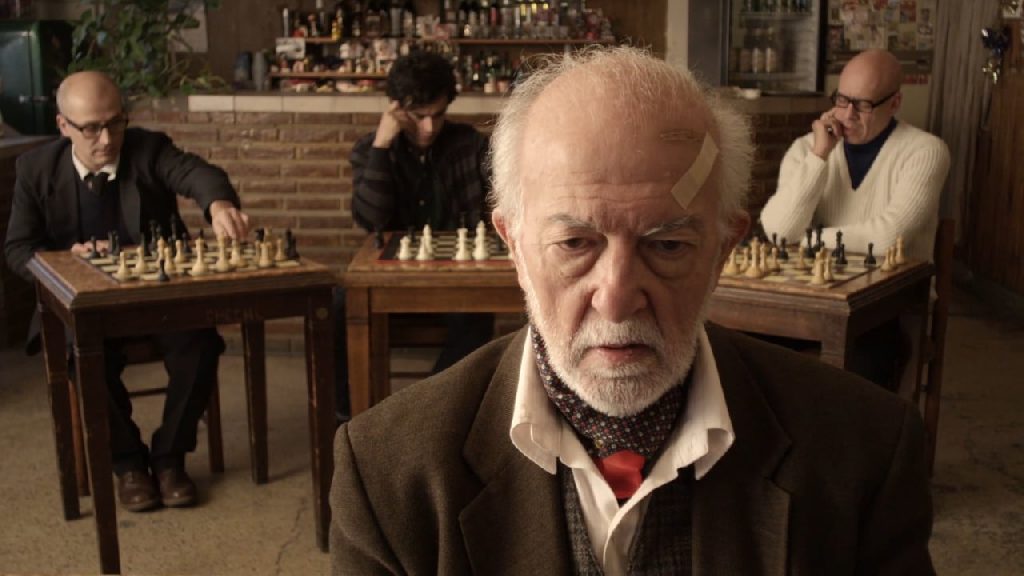
Here’s a wonderful movie (with an off-putting title) that you can ONLY see Sunday in Palo Alto or Wednesday in San Francisco. Subte-Polska is an Argentine gem about a nonagenarian chess master addressing his own memory, vitality and the need to find closure with his past. A promising first feature for writer-director Alejandro Magnone, Subte-Polska is the sleeper Must See at this year’s San Francisco Jewish Film Festival.

Tadeusz (Hector Bidonde) is a working class nonagenarian chess master. He’s still able to win several simultaneous chess matches, but his age is catching up to him and he has periods of confusion and memory loss. His doc has prescribed meds that counteract the memory loss, but he refuses to take them because they…wait for it…diminish his sexual performance.

His adult adopted son (Marcelo Xicarte) is understandably frustrated because he has to keep tracking down an unnecessarily (from his perspective) addled old man. And the son is in a touchy period in his own marriage.

Tadeusz is a Communist Jew who left Poland, his family and his girlfriend to fight fascism in the Spanish Civil War. He found another lover in Spain, but he left her,too, when they were defeated by Franco. Tadeusz’ family didn’t survive Hitler. That’s a lot of loss, and Tadeusz dealt with it by emigrating to Argentina and LITERALLY going underground. To avoid triggering painful memories, he gets a job constructing and then working in the Buenos Aires subway system. He sets up his son as a subway driver, and his best buddies also work in the subway, including the guy who runs the underground newsstand (Manuel Callau).

As Subte-Polska unfolds, Magnone explores our sense of memory, and how we consciously and subconsciously handle both the cherished memories and the devastating ones. As he takes and abstains from taking his meds, Tadeusz’s short-term memory ebbs and flows. This is a guy who has framed his entire life to suppress the memories of his youth, but he begins to remember his youth more and more vividly. As he remembers, he feels a need to find closure.

Tadeusz is a strong-willed person, and Subte-Polska is pretty funny as he causes consternation in his son, doctor and friends – in everybody except his well-serviced girlfriend and his ball-busting old friend from their first days underground. Marcelo Xicarte and Manuel Callau both prove to be excellent comic actors.

Speaking of acting, Hector Bidonde delivers a magnificent lead performance. Bidonde plays someone who has always been determined to do what he wants, stubborn to his core, still confident in his beliefs, mental acuity and sexual prowess, but occasionally shaken by moments of confusion.

You have three chances to catch Subte-Polska at the San Francisco Jewish Film Festival:

  • Cinearts (Palo Alto), Sunday, July 23 4:25 PM
  • Castro (San Francisco), Wednesday, July 26 4:05 PM
  • Albany Twin (Twin), Tuesday, August 1 6:30 PM.

The SFJFF runs from July 20 through August 6 at theaters in San Francisco, Palo Alto, Albany, San Rafael and Oakland. You can peruse the entire program and buy tickets and passes at San Francisco Jewish Film Festival.

Subte-Polska is funny, insightful and moving. I’m still mulling it over. This film deserves a US distributor – and a US distributor who changes the title. After all, it’s a subtitled movie about a 90-year-old; ya gotta help the audience want to see this. It’s the under-the-radar Must See at this year’s SFJFF.

SUBTE-POLSKA: memory, vitality and loves from the past

SUBTE POLSKA

Subte-Polska is an Argentine gem about a nonagenarian chess master addressing his own memory, vitality and the need to find closure with his past.  A promising first feature for writer-director Alejandro Magnone, Subte Polska is the sleeper Must See at this year’s SFJFF.

Great movie. Off-putting title.

Tadeusz (Hector Bidonde) is a working class nonagenarian chess master. He’s still able to win several simultaneous chess matches, but his age is catching up to him and he has periods of confusion and memory loss. His doc has prescribed meds that counteract the memory loss, but he refuses to take them because they…wait for it…diminish his sexual performance.

His adult adopted son (Marcelo Xicarte) is understandably frustrated because he has to keep tracking down an unnecessarily (from his perspective) addled old man. And the son is in a touchy period in his own marriage.

Tadeusz is a Communist Jew who left Poland, his family and his girlfriend to fight fascism in the Spanish Civil War. He found another lover in Spain, but he left her,too, when they were defeated by Franco. Tadeusz’ family didn’t survive Hitler. That’s a lot of loss, and Tadeusz dealt with it by emigrating to Argentina and LITERALLY going underground. To avoid triggering painful memories, he gets a job constructing and then working in the Buenos Aires subway system. He sets up his son as a subway driver, and his best buddies also work in the subway, including the guy who runs the underground newsstand (Manuel Callau).

As Subte-Polska unfolds, Magnone explores our sense of memory, and how we consciously and subconsciously handle both the cherished memories and the devastating ones.  As he takes and abstains from taking his meds, Tadeusz’s short-term memory ebbs and flows.  This is a guy who has framed his entire life to suppress the memories of his youth, but he begins to remember his youth more and more vividly.  As he remembers, he feels a need to find closure.

Tadeusz is a strong-willed person, and Subte-Polska is pretty funny as he causes consternation in his son, doctor and friends – in everybody except his well-serviced girlfriend and his ball-busting old friend from their first days underground.  Marcelo Xicarte and Manuel Callau both prove to be excellent comic actors.

Speaking of acting, Hector Bidonde delivers a magnificent lead performance.  Bidonde plays someone who has always been determined to do what he wants, stubborn to his core, still confident in his beliefs, mental acuity and sexual prowess, but occasionally shaken by moments of confusion.

You have three chances to catch Subte-Polska at the San Francisco Jewish Film Festival:

  • Cinearts (Palo Alto), Sunday, July 23 4:25 PM
  • Castro (San Francisco), Wednesday, July 26 4:05 PM
  • Albany Twin (Twin), Tuesday, August 1 6:30 PM.

The SFJFF runs from July 20 through August 6 at theaters in San Francisco, Palo Alto, Albany, San Rafael and Oakland. You can peruse the entire program and buy tickets and passes at San Francisco Jewish Film Festival.

Subte-Polska is funny, insightful and moving. I’m still mulling it over.  This film deserves a US distributor – and a US distributor who changes the title. After all, it’s a subtitled movie about a 90-year-old; ya gotta help the audience want to see this.  It’s the under-the-radar Must See at this year’s SFJFF.