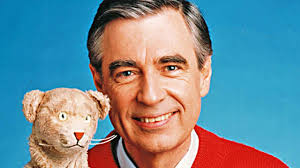
Fred Rogers with his Daniel Tiger in WON’T YOU BE MY NEIGHBOR?
Won’t You Be My Neighbor? is the surprisingly moving biodoc of Fred Rogers, the originator and host of the PBS children’s program The Mr. Roger’s Neighborhood. I had missed this movie at the San Francisco International Film Festival where it submerged audiences in their hankies.
Of course, Won’t You Be My Neighbor? tells the story of the show. But, more than that, it relates Rogers’ fierce passion for the plight of small children, and his need to protect them and help their emotional development.
What is so surprising is that Rogers’ sometimes laughably gentle affect sprang from such internal ferocity. It turns that Rogers was a man who hated, hated, hated the moral emptiness and materialism of commercial children’s television.
His need to help children through difficult times drove him to explain the word “assassination” the day after RFK was killed. And to demystify, clarify and normalize divorce and a host of other potentially child-traumatizing topics. Utterly unafraid of (most) controversy in a timid medium, he was first and foremost the champion for small children, a cardigan-clad champion.
I am immune to Mr. Rogers nostalgia because I am too old to have watched the show as a kid, and it was no longer a first-run show when my own kid came of age. So I was surprised to find myself choked with emotion when Fred Rogers explained to a very skeptical Senator John Pastore the need to “make it clear that feelings are mentionable and manageable”. As Rogers recited the lyrics of his song about having feelings and staying in control, Pastore visibly melted (and so did I).
In Won’t You Be My Neighbor?, Rogers’ family and his TV crew reveal their insider views of Rogers and his show. The origins of the characters, the puppets, the songs and themes are explained. But the core of Won’t You Be My Neighbor? is that Fred Rogers resolutely believed that every small child is deserving of love and has value, a view which has sadly become controversial among some.
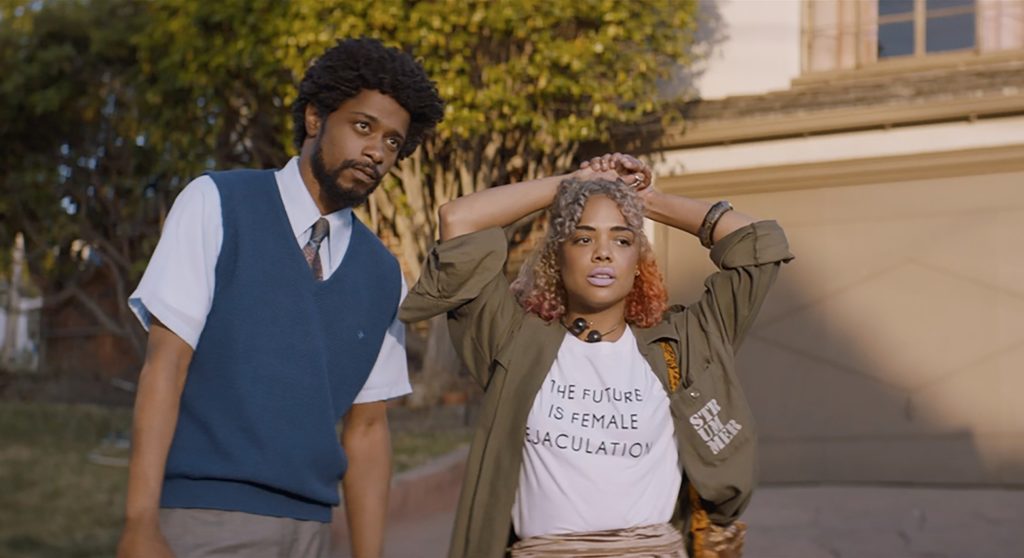
Lakeith Stanfield and Tessa Thompson in SORRY TO BOTHER YOU
The savagely funny social satire Sorry to Bother You rips both the excesses of 21st century capitalism and the popular response to those excesses – apathetic submissiveness. This may be the most original American film of the year.
Sorry to Bother You is set with specificity in Oakland, but the story is about the greater corporate-dominated culture. A sinister corporation named Worry Free flourishes by enlisting consumers to “lifetime contracts” for their employment and household needs; Worry Free clients/employees are provided for life with meals, housing (in barracks crammed with bunk beds) and clothing (hospital scrubs) in return for menial factory labor. The Worry Free system, of course, is slavery. Almost nobody cares about that – this is a vapid culture where the most popular TV game show is I Got the Shit Kicked Out of Me, where each week’s contestant is beaten and humiliated for mass entertainment. Only the insurgent group Left Eye resists, with graffiti and guerilla actions.
Cassius (Lakeith Stanfield), a young man without prospects, is living in his uncle’s Oakland garage with his avant-garde artist girlfriend Detroit (Tessa Thompson). Cassius is overjoyed to finally score a telemarketing job, even though his new boss explains that every applicant is hired. Cassius’ telemarketing career is futile until he acts on a tip from an older colleague (Danny Glover) to “use your white voice”. Suddenly, Cassius vaults to the top of the telemarketing world, and is promoted to make big money pitching Worry Free’s slave labor force to global manufacturers. This raises the question, when does “success” become “selling out”?
Complicating matters for Cassius, his former telemarketing buddies and Detroit take on The Man by organizing a union. Cassius becomes both the butt of a viral YouTube video and estranged from his support system just as Worry Free’s founder (Armie Hammer) offers Cassius an even bigger opportunity. Finding slavery not profitable enough, Worry Free is about to launch what is horrifically called “the future of labor” – a sci-fi solution to create a work force “more durable and compliant” than human slaves. If Cassius decides to expose the atrocities, how will the public react?
Sorry to Bother You is the first feature as writer-director for Bay Area artist and rapper Boots Riley, It’s an impressive film debut for Riley, who has proven himself to be a first-rate social observer and satirist.
Lakeith Stanfield is excellent as the stoic, hunched Cassius, and so is the rest of the cast (Thompson, Glover, Steven Yuen, Omari Harwick, Germaine Fowler). Armie Hammer’s performance as the unapologetically monstrous entrepreneur is delicious. Kate Berlani sparkles as the new telemarketing “team leader”, who, having drank the Kool-Aid, spouts corporate management babble.
Sorry to Bother You is a riot – in the comedic sense and also as sociopolitical disruption. Nary a joke goes awry, from Detroit’s self-crafted earrings to the security code in the corporate elevator. And Riley plays a final joke for us (and on us) in the closing credits.
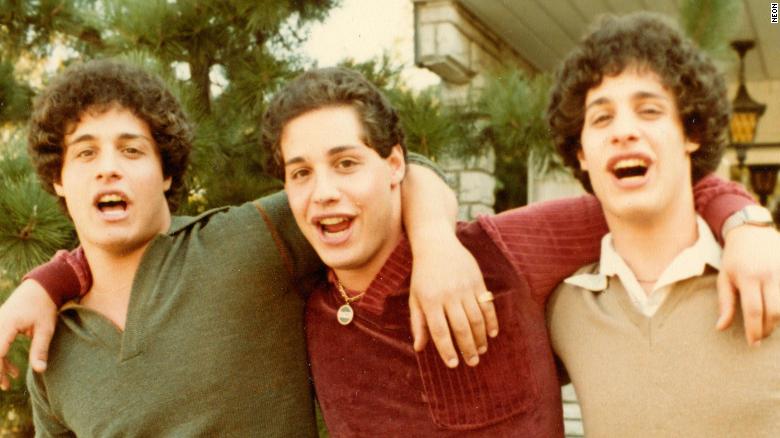
The startling documentary Three Identical Strangers begins with a young man’s first day on a college campus, being greeted by strangers who are convinced that they know him; that night, a fellow student connects him to his double, born on the same day. They turned out to be identical siblings separated at birth and adopted by different families. Even more stunning, the two brothers soon find their identical triplet.
The first third of Three Identical Strangers is a wonderful Feel Good story of family discovery. But then we find that the triplets’ separation had been orchestrated as part of a longitudinal study of nurture vs. nature. Researchers INTENTIONALLY separated identical twins and placed them with families that the researchers kept in the dark. The placements occurred AFTER the twin babies had bonded together in the crib for many months.
This study was not detached observation, it was human experimentation. As details reminiscent of Josef Mengele unfold, the fact that both the researcher and the adoption agency were Jewish becomes even more chilling.
A film that covers much of the same factual territory, Twinning Reaction, premiered two years ago at Cinequest. Twinning Reaction focuses on the study; we meet several sets of twins, and the triplets are the jaw-dropping final act. Three Identical Strangers focuses on the triplets and then takes a more current dive into the study. Twinning Reaction is not yet available to stream, but it will be playing at the San Francisco Jewish Film Festival this July and August.
Three Identical Strangers won the Special Jury Prize for Storytelling at this year’s Sundance Film Festival. It also played at this year’s San Francisco International Film Festival (SFFILM). Well-spun, this is an amazing story.
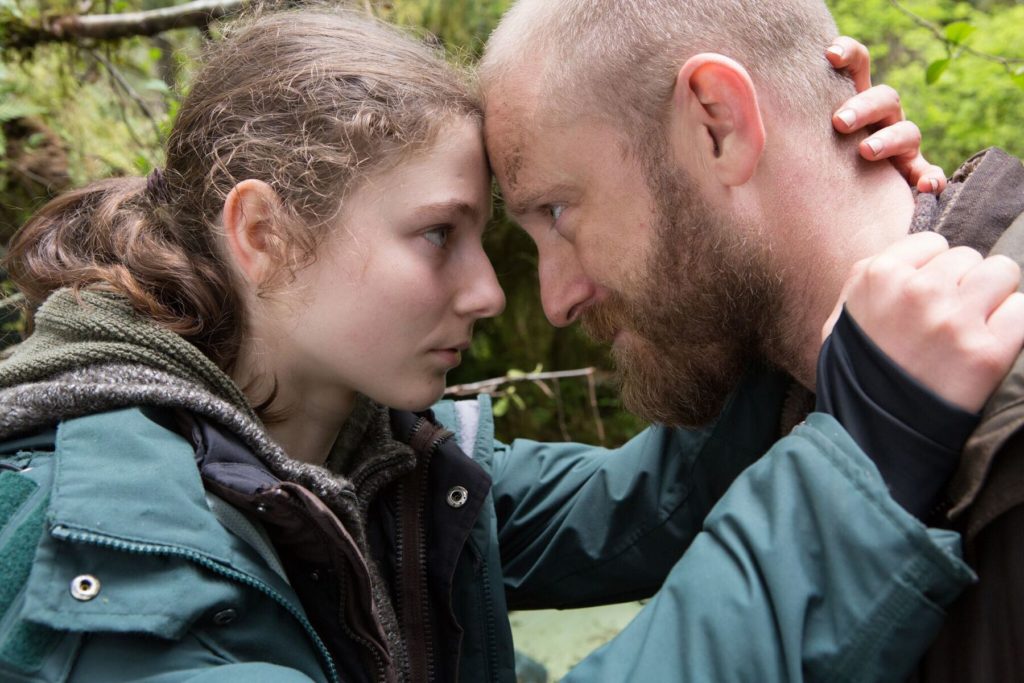
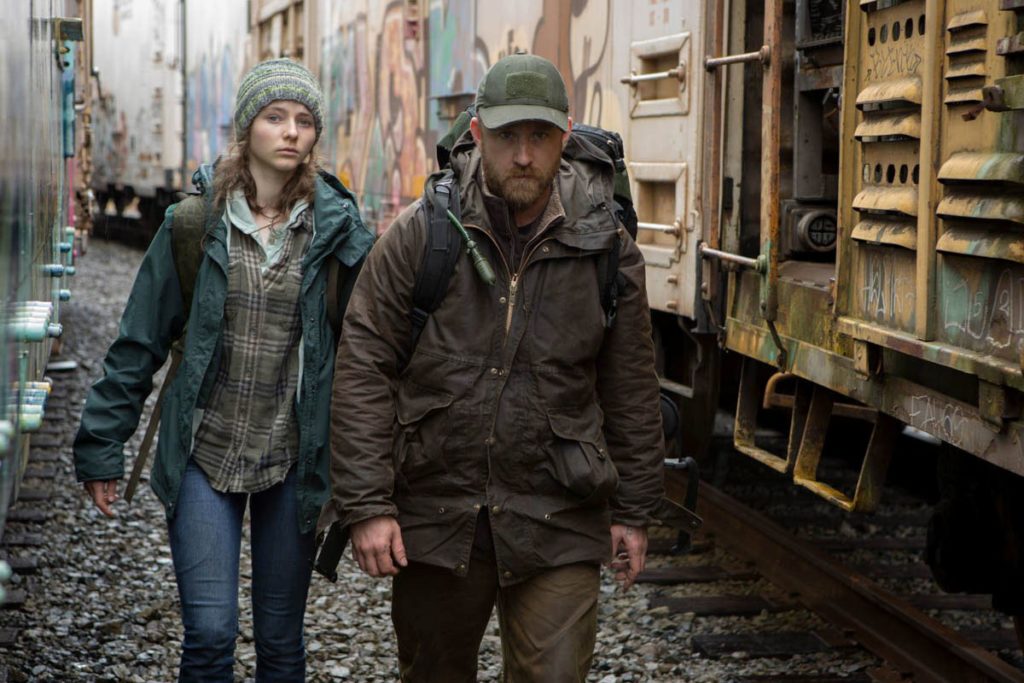
Thomasin Harcourt McKenzie and Ben Foster in a scene from Debra Granik’s LEAVE NO TRACE. Courtesy of SFFILM.
Here is the best movie of 2018 – so far – the unforgettable coming of age film Leave No Trace. Ben Foster and Thomasin McKenzie star as a dad-daughter team who challenge conventional thinking about homelessness and healthy parenting. Leave No Trace is writer-director Debra Granik’s first narrative feature since her Winter’s Bone (which I had rated as the best film of 2010).
When we meet Will (Foster) and his daughter Tom (McKenzie), they are engaging in extremely low impact camping in a fern-rich Oregon forest, to the point of solar cooking foraged mushrooms on a mylar sheet. Dad and daughter are both survivalist experts and work together as a highly trained team. They have the fond, respectful, communicative relationship that most families with teen children aspire to but can only fantasize about.
But Will and Tom are not on vacation. They do not consider themselves homeless, because the forest is their home. However, their lifestyle just isn’t consistent with contemporary thinking about child welfare. Furthermore, living in a public park is illegal,and when they are discovered, social service authorities are understandably and justifiably concerned. Investigators find Tom to be medically and emotionally healthy, Will to be free of drug or alcohol abuse, and there has been no child abuse or neglect – other than having ones child living outdoors and not going to school.
Will is a veteran who has been scarred by his military service, and he is clearly anti-social. But Will is not your stereotypical PTSD-addled movie vet. He is a clear thinker. His behavior, which can range to the bizarre, is not impulsive but deliberate.
Fortunately, the Oregon, social services authorities are remarkably open-minded, and they place Will and Tom in a remote rural setting in their own house at a rural Christmas Tree farm. Will can work on the farm, Tom can go the school, and there’s a liberal non-denominational church filled with kind folks. It’s a massive accommodation to Will and Tom’s lifestyle, only with the additions of living under a roof and public education.
Tom blossoms with social contact, and particularly enjoys the local 4-H and one kid’s pet rabbit named Chainsaw. Tom begins to understand how much she needs human connection – and not just with her dad,
But Will can’t help but feel defeated. When Tom suggests that they try to adapt to their new setting, he scowls, “We’re wearing their clothes, we’re living in their house, we’re eating their food, we’re doing their work. We’ve adapted”. She argues, “Did you try?”, “Why are we doing this?”, and “Dad, this isn’t how it used to be”.
Ben is so damaged that his parenting can nurture Tom for only so long. Leave No Trace is about how he has raised her to this point. Has he imparted his demons to her? Has he helped her become strong and grounded enough to grow without him?
Thomasin Harcourt McKenzie and Ben Foster in a scene from Debra Granik’s LEAVE NO TRACE. Courtesy of SFFILM.
Winter’s Bone launched the career of Jennifer Lawrence, and Leave No Trace might do the same for newcomer Thomasin McKenzie. McKenzie is riveting as she authentically takes Tom from a parented child to an independent young woman. At the San Francisco International Film Festival screening, producer and co-writer Anne Rosellini said “there’s an ‘otherness’ to McKenzie,” who had “tremendous insight into the character”. Rosellini added that McKenzie and Ben Foster bonded before the shoot, as they rehearsed with a survivalist coach.
Foster is no stranger to troubled characters (The Messenger, Rampart, Hell or High Water). Here, he delivers a remarkably intense and contained performance as a man who will not allow himself an outburst no matter what turbulence roils inside him. Rosellini noted that “Will is elusive, a mysterious character to everybody”. It’s a performance that will be in the conversation about Oscar nominations. Actors Jeff Kober, Dale Dickey, Dana Millican and Isaiah Stone (the little brother in Winter’s Bone) are also excellent in smaller roles.
Leave No Trace is thoughtful and emotionally powerful. Superbly well-crafted and impeccably acted, it’s a Must See.
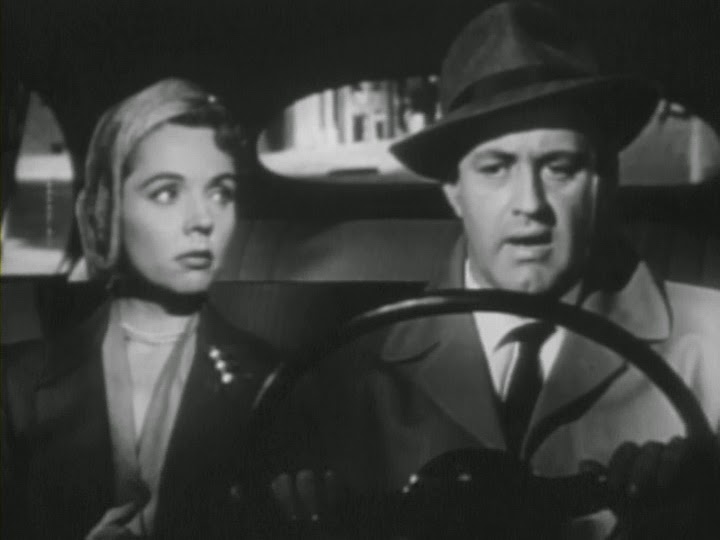
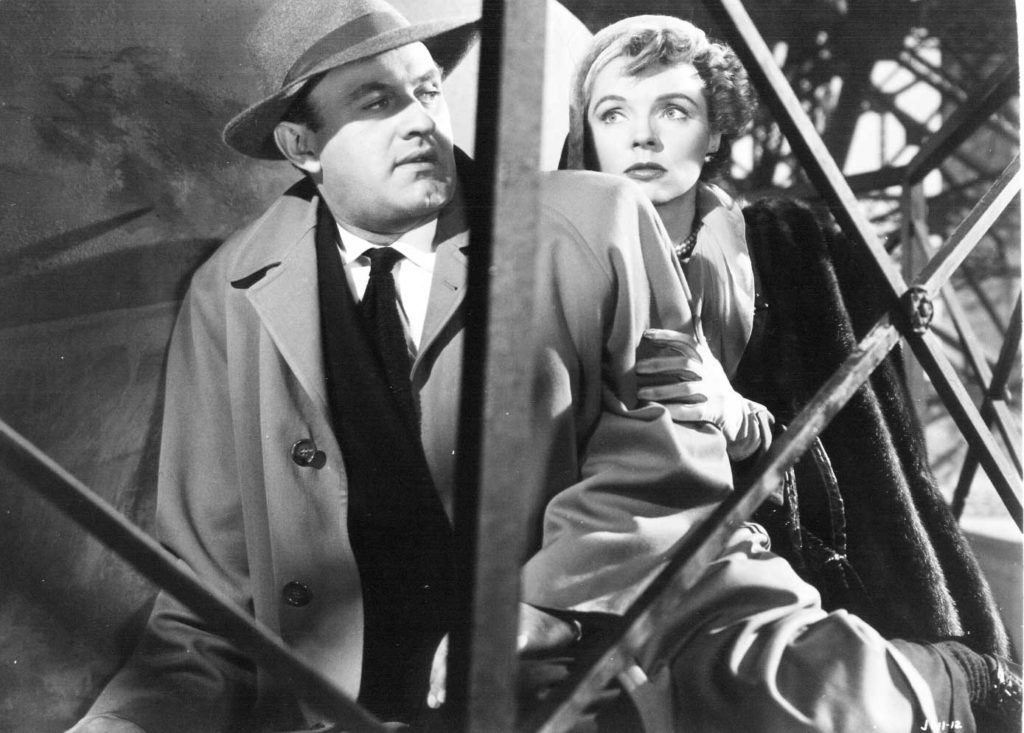
Jane Wyatt amd Lee J. Cobb in THE MAN WHO CHEATED HIMSELF
In The Man Who Cheated Himself, which I saw at the Noir City festival earlier this year, a cop falls for a dame who makes him go bad. But it’s not just any cop and not just any dame.
The cop is Ed, a seasoned and cynical pro who knows better. He is played by Lee J. Cobb, whom Czar of Noir Eddie Muller called “the most blustery actor this side of Rod Steiger”. Cobb is known for playing Juror 3, the primary antagonist to Henry Fonda, in 12 Angry Men and the ruthless mob boss Johnny Friendly in On the Waterfront. Ed seems impervious to human emotion and says things like, “You’re a big girl. Cut the tantrums”.
The dame is the much wealthier – and married – socialite Lois (Jane Wyatt). Lois is a puddle of capriciousness and carnality. She has the same fluttery appeal as Mary Astor’s Brigid O’ Shaunessy in The Maltese Falcon.
Wyatt rarely got a chance to play as mercurial a character as Lois. Of course, she’s best known as the mid-century suburban mom/wife in Father Knows Best, rock steady and super square. Before that Wyatt worked in film noir, but not as the femme fatale. She was in Pitfall as the good wife that Dick Powell gets bored with when Lizabeth Scott comes along. In Boomerang! she was the heroic DA’s wife. She played the wife of a murderer who falls for her brother-in-law in House by the River and the sister in a message picture, Gentleman’s Agreement.
But in The Man Who Cheated Himself, Wyatt got to uncork more hysterical unreliability, sexual predation and neediness than in all of her other roles combined. You know when you see a woman and think, She’s trouble? Well, Lois is trouble.
For all of his world-weariness, Ed is really enjoying his affair with Lois. Despite knowing better, he is in deep. As he says, “She’s good for me. She’s no good, but that’s the way it is.”
Lois impulsively shoots her husband, and, in the moment, Ed makes the fateful decision to cover it up.
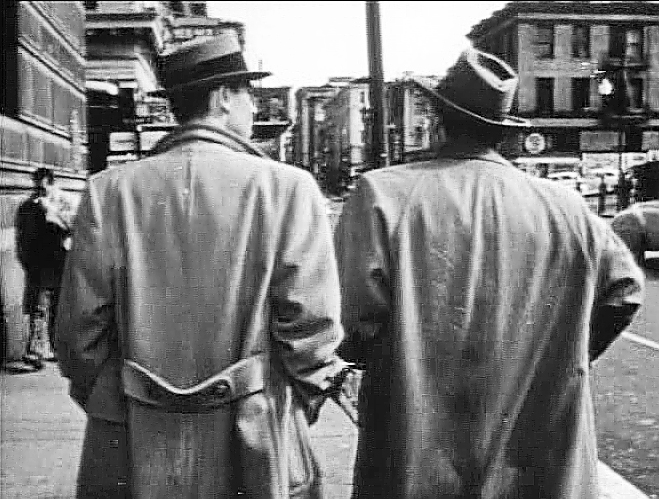
To complicate matters, Ed’s younger brother Andy (John Dall) has followed his brother on to the police force and just been promoted from walking a beat to detective. This murder is his very first case and he’s really eager to show his big brother proud. It turns out that Andy is smart and has the makings of a first class detective.
John Dall and Lee J. Cobb in THE MAN WHO CHEATED HIMSELF
Writers Seton I. Miller and Philip MacDonald cleverly plotted The Man Who Cheated Himself so Ed and Lois get not one, but two, lucky breaks that make it look like they are getting away with it. But then Andy’s young wife and a CHP officer help Andy link the pieces together. Miller and MacDonald have embedded lots of humor in double entendres and absurdly close escapes. One of the funniest bits is an eyewitness, the earnestly unhelpful Mr. Quimby (Charles Arnt).
Are Ed and Lois going to get away with it? Well, this is noir. They find themselves cornered at Fort Point, the windiest spot on the west coast of North America, The notorious wind (actually underplayed in the movie) helps build the suspense.
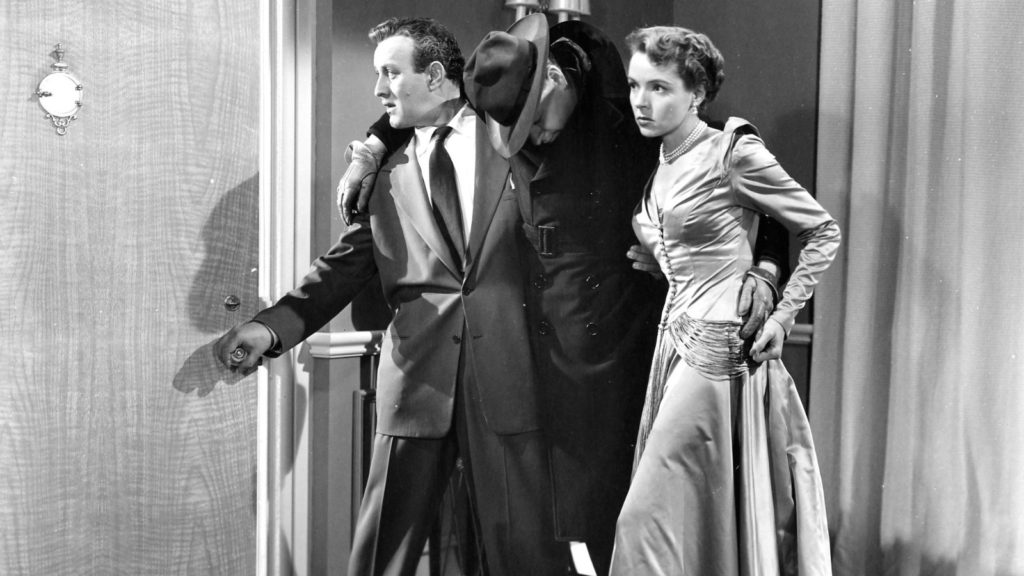
Lee J. Cobb and Jane Wyatt in THE MAN WHO CHEATED HIMSELF
And what an ending! In their final encounter, Lois is going one way – the way that those privileged by wealth and good looks always go. Ed is going in the other direction – the way every noir protagonist goes when he falls for a bad dame. He lights a cigarette and their eyes lock wordlessly; when she leaves, we see in his eyes whether it was all worth it.
The noir in The Man Who Cheated Himself comes from the falling-for-the-wrong-woman theme and the snappy, sarcastic dialogue. There’s no noir camerawork with looming shadows, venetian-blinds-across-the-face and cigarette smoke dancing to the ceiling here.
But there are plenty of glorious mid-century San Francisco locations – hills, mansions of the nobs, grittier streets and the waterfront (back when it was a sketchy working port). It’s the San Francisco that I remember as a child in the 1950s, with women wearing gloves during the day and human-tended toll booths at the Golden Gate Bridge (when the toll was collected northbound, too!).
And, odd for a San Francisco-set noir, it is definitely not fog-shrouded. The day I saw The Man Who Cheated Himself was one of those gorgeous sunny days that San Francisco gets in the winter – and that’s what the movie looks like.
The Man Who Cheated Himself’s director was the otherwise undistinguished journeyman Felix Feist. Feist made a handful of other noirs, including The Threat with Charles McGraw as a vengeful hood, Tomorrow is Another Day with an irresistible Ruth Roman and The Devil Thumbs a Ride with Lawrence Tierney. Then Feist left the movies to direct over seventy episodes of TV shows.
The raison d‘être of the Noir City film festivals is to raise money for the Film Noir Foundation’s restoration of classic film noir. The FNF just restored The Man Who Cheated Himself so it could be seen again in a theater for the first time in decades. It’s not yet available to stream, but Turner Classic Movies will air it on Muller’s Noir Alley series on June 23 and 24.
Lee J. Cobb and Jane Wyatt in THE MAN WHO CHEATED HIMSELF
The psychological thriller Prodigy begins with a psychologist (Richard Neil) being brought to a secret government “black site” to interview a dangerous prisoner. When he receives an orientation, he and we expect to see a superhuman sociopath like Hannibal Lector. But he enters the secure room to face a freckled-face nine-year-old girl (Savannah Liles). Her arms are pinned to her chair with restraints. We learn that there is an understandable reason for this.
She is abnormal in every way – in her super intelligence, in her telekinetic powers and in her capacity for performing monstrous and lethal acts. The two embark on a game of wits with very high stakes. There’s a deadline (literally) so the game is also a race against the clock.
It’s the first feature for writer-directors Alex Haughey and Brian Vidal. Haughey and Vidal have bet their movie, in large part, on the performance of a nine-year-old actor. Savannah Liles is exceptional as she ranges between a very smart little girl and a monstrous psychopath and between a vulnerable child and a person who has made herself invulnerable. It’s a very promising performance.
In the Cinequest program notes, Pia Chamberlain described Prodigy as “reminiscent of a cerebral episode of the Twilight Zone“, which is pretty apt. Just like the best of Rod Serling, Prodigy’s compact story-telling takes us to an environment that we can recognize, but which has different natural laws than the ones under which we operate.
Filmmakers have shocked us before with the juxtaposition of innocent looking children and their heinous deeds Sometimes those children have been created fundamentally evil (The Bad Seed, Rosemary’s Baby, The Omen) and sometimes possessed by evil (The Exorcist). Prodigy takes a different tack – exploring how a trauma can produce monstrous behavior and whether evil behavior is reversible.
Prodigy is a thinking person’s edge-of-the-seat thrill ride. I’m looking forward to the next work from Haughey and Vidal. Note that this trailer is in color, but the version of the movie that I screened at its world premiere at Cinequest was in black and white. You can now stream Prodigy on Amazon, iTunes, Vudu, YouTube and Google Play.
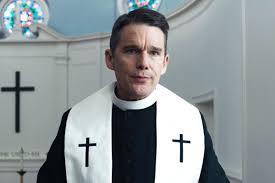
In the emotionally bleak psychological drama First Reformed, Ethan Hawke plays Toller, the clergyman in charge of a historic church with about ten parishioners. The church survives as the museum-and-gift-shop arm of a modern megachurch helmed by Reverend Jeffers (Cedric the Entertainer billed as Cedric Kyles). Toller is a very troubled guy, who is consumed by a journalling project, which he says brings him no peace, but only self-pity. Toller is content to perform a weekly service and guide the odd tourist through the church. That is all about to be disrupted by the church’s upcoming 250-year anniversary celebration, which Toller dreads.
Toller is asked by one of his tiny flock (Amanda Seyfried) to counsel her very depressed husband (Phillip Ettinger). Few understand depression as well as Toller, who, we learn, has joined the church because of a grievous family loss. He is also obsessively thinking and over-thinking a crisis, not so much of faith, but of purpose. And, it is revealed that Toller is in physical pain from a very menacing medical condition.
Toller tells the young husband that balancing hope and despair is life itself. Indeed, most of First Reformed focuses on the despair. As First Reformed gets darker and darker, it become more and more intense, all the way up to a ticking bomb of a thriller ending. The ending is such a squirm-in-your-seat nail-biter that it’s hard to watch, but the payoff is worth it.
Amanda Seyfried in FIRST REFORMED
Writer-director Paul Schrader, has created a serious work of art in First Reformed. It is a very still movie with a very spare soundtrack. The aspect of the frame is squarish and sometimes square. Everything about First Reformed is distilled down to its concentrated core. Schrader wrote Taxi Driver,Raging Bull and The Last Temptation of Christ, and directed Affliction and Auto Focus. So he is no stranger to plumbing the depths of human internal crises.
Ethan Hawke is excellent as Toller. Hawke’s performances are usually fidgety. Not here. Hawke is notable for his stillness as he plays a man who flings himself into reflection and away from social entanglements.
The supporting performances are superb: Amanda Seyfried, Cedric the Entertainer, Bill Hoag as Toller’s lay assistant and Victoria Hill as the woman who wants to rekindle a connection that Toller doesn’t have the emotional capacity for. All are suitably understated; this movie is so stripped-down to concentrate on the profound, there’s just no room for a Big Performance.
Phillip Ettinger is wonderful as the depressed young husband. This is a smart, committed and sensitive character who isn’t at all wrong – he’s just obsessing and going off the rails.
Who can be saved from despairing at the human condition? And what does it take? First Reformed provides an answer in its exceptionally powerful ending.
Burt Reynolds and Ariel Winter in THE LAST MOVIE STAR
In The Last Movie Star, an aged action movie star (Burt Reynolds playing someone very similar to Burt Reynolds) examines his life choices. It’s very funny and sentimental (in a good way).
Burt plays a thinly disguised version of himself – a retired movie star named Vic Edwards, who had played halfback at Tennessee instead of Burt’s Florida State. The movie opens with opens with a clip of the 70s Burt from the Smokey and the Bandit era. But then there’s a stark cut to Burt today, looking every one of his eighty-two years. Vic is in a depressing veterinary waiting room, about to get bad news about his pet. We see that Vic lives a lonely existence, padding about his Beverly Hills home devoid of human recognition or contact.
Vic finds himself invited to be honored at a Nashville film festival. Flattered and excited, he flies off to find that, instead of a ego-boosting tribute, the festival unleashes one indignity after another. Humiliated and enraged, he goes on a rogue road trip to his hometown of Knoxville, where he gets the chance to reflect on his life and make an important amend.
His road trip partner is his film festival driver, a nightmare of Millennial self-absorption, drama and bad attitude played by Ariel Winter (Alex Dunphy in Modern Family). Winters’ character adds an Odd Couple thread to the comedy, and Winter brings down the house with a monologue on her history with psychotropic medication.
Director Adam Rifkin cleverly inserts the 82-year-old Burt into his own movies to interact with the 36-year-old Burt. We see Burt as one of the greatest guests ever on Tonight Show with Johnny Carson. And we see him in Deliverance, brandishing a bow-and-arrow and clad in a sleeveless neoprene vest – there has never been a more studly image in the history of cinema.
The key to Burt Reynolds’ appeal is that unique combination of virility, and charm, his stunning physicality leavened by his not taking himself too seriously. I’m ridiculously handsome, and isn’t that just ridiculous?
If you’re going to be sentimental, then be unashamedly sentimental. Rifkin takes this to heart, which makes The Last Movie Star so emotionally satisfying as well as so damn funny.
I saw The Last Movie Star at Cinequest, where it was warmly received by the festival audience. The Last Movie Star was released theatrically for about a minute-and-a-half (and on only ONE screen in the Bay Area). Fortunately, now you can stream it on Amazon, iTunes, Vudu, YouTube and Google Play.
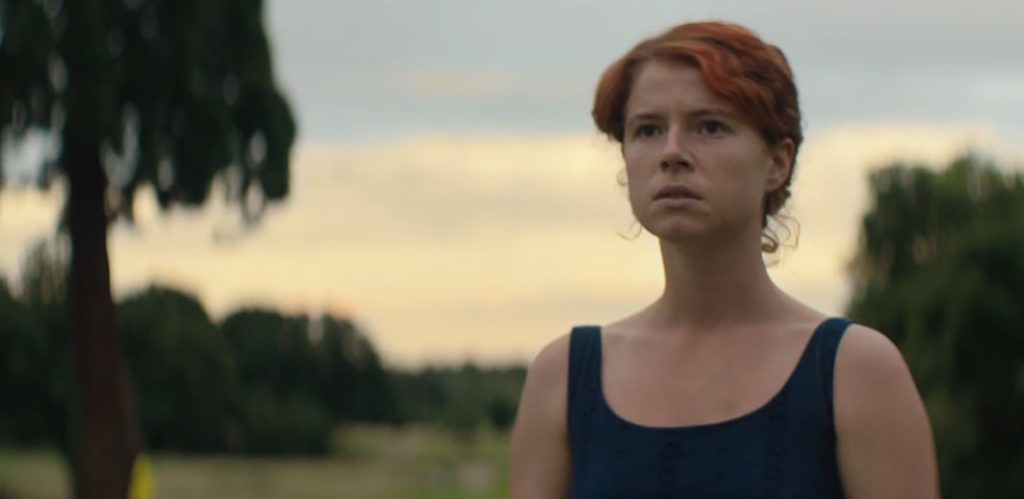
The psychological thriller Beast is set on the British Channel Island of Jersey, where the young woman Moll lives with her affluent family. Moll (Jessie Buckley). Moll is the disregarded and put-upon step-sister in her own family – ignored except when being assigned the task de jour. Only the local cop is sweet on Moll, which brings her only revulsion. Jessie is dramatically rescued from a bad situation by the scruffy, somewhat feral, dreamy-eyed Pascal (Johnny Flynn). Moll and Pascal fall in love.
It turns out that Moll has within herself confidence, strength and passion – all long and cruelly suppressed by her mother. Pascal pulls Moll from her horrid family and unleashes, for better and for worse, Moll’s true persona. So this is a pretty fair romance to this point, but I did mention that Beast is psychological thriller. A serial killer has been prowling Jersey, raping and murdering young women and girls. The police suspect…Pascal.
Now we experience some unsettling ambiguity. Does Moll protect Pascal because she thinks him innocent? Or because she thinks that he’s the murderer? In his impressive first feature, writer-director Michael Pearce finally reveals something in Pascal’s past that gives us pause. And, even later, we learn something about Moll’s past, too. Holy shit. And we’re off on a roller coaster, wondering what Moll is going to do next and why, all the way to the shocking ending.
Jessie Buckley and Johnny Flynn in BEAST
The reason that Beast works so well is the stunning performance of Jessie Buckley. As an audience, we’re always drawn to Buckley’s Moll, at first understanding and relating to her defeatedness, inner rage and lust. But then Buckley keeps us from knowing exactly what’s going on inside, although we learn to accept that it sure is unpredictable. Buckley is Irish, and her singing career was launched on an American Idol-type show in Britain. She’s since acted in some British Isles television series. She is an incredible force of nature in this role.
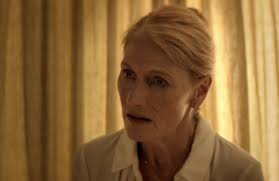
Geraldine James in BEAST
Veteran actress Geraldine James gets the juicy role of the controlling and oppressive mother, her every remark filled with manipulation, shaming and the inducement of guilt. The mom is by FAR the least sympathetic character – and this story also has a serial killer in it. Johnny Flynn is very good as Pascal.
But it’s Jessie Buckley’s performance and Michael Pearce’s story that should bring you to see Beast. It’s a heckuva ride.
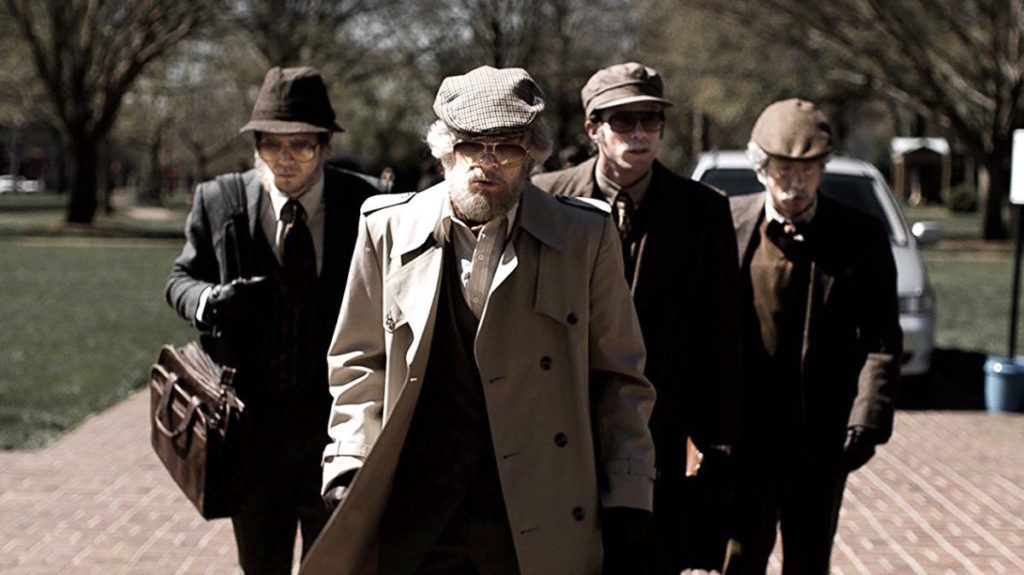
In Bart Layton’s clever documentary/re-enactment mashup American Animals, four college kids plan a major art heist. The film opens with the title words THIS IS NOT BASED ON A TRUE STORY morphing into THIS IS A TRUE STORY. Indeed, in 2003, four college kids really did target $12 million in rare Audubon and Darwin books at the Transylvania University library in Lexington, Kentucky.
The story follows the classic arc of a heist movie -the intricate planning, the assembling of a team and, finally, the Big Day. Because the heist is so preposterous (and because these guys are smoking a lot of weed while planning it), the whole thing is pretty funny.
Layton has his cake and eats it, too. He has actors re-enact the real events. And he has the real participants commenting as talking heads. (With the retrospect of fifteen years, none of the participants now thinks that the heist was a good idea.)
I was especially eager to see American Animals because director Bart Layton also made The Imposter, one of the most jaw-dropping documentaries I have seen. American Animals is not as good as the unforgettable The Imposter, but funnier and more inventive – and damn entertaining.
I saw American Animals at the San Francisco International Film Festival (SFFILM). It opens in the Bay Area this weekend.