In the Finnish family comedy Happier Times, Grump, a grouchy and emotionally-repressed Finnish farmer has been content to alienate everyone in his life, but then gets the chance to step up and support his teen granddaughter emotionally. The curmudgeon’s son, the girl’s father, is a Yuppie living in Belgium and he’s a piece of work himself; he has long resented the old man’s harshness and emotional detachment. The worlds of the simple old farmer and the hyper-connected urban teenager are centuries apart, but the odd couple must connect to handle a crisis in the girl’s life.
To enjoy Happier Times, Grump, the audience must 1) be amused by the politically incorrect and Luddite pronouncements of the old man and 2) relish an overtly sentimental ending.
Jeff Daniels wrote and stars in Guest Artist, a comic two-hander about a Pulitzer Prize-winning playwright drinking his way through an 18-year-old writer’s block. The playwright has sunk to accepting a guest residency from a Lima, Ohio, amateur theater company. He shows up drunk, bitter and entitled, and, of course, he hasn’t written the play that has been commissioned. His appointed Man Friday is a wannabe playwright (newcomer Thomas Macias) who desperately tries to handle the raging ego and the self-destructive behavior of his idol.
[MILD SPOILER HERE] It turns out that the writers’ block stems from a self-suppression of artistic expression. But there really isn’t any humor or insight into the artistic process that we haven’t seen before.
Jeff Daniels is very good as the frustrated genius. Daniels has been a cinema star for a long time, and for good reason. It’s been 34 years since he broke through with his star turn in Woody Allen’s Purple Rose of Cairo, and he’s beloved for roles ranging from those in the Dumb and Dumber movies and television’s The Newsroom. I most admire Daniels’ performance as professor-turned-battlefield-commander Joshua Lawrence Chamberlain in Gettysburg (1993).
Guest Artist is essentially a filmed play, and it looks like it. For some, a dose of Jeff Daniels will be enough.
In the Cuban sci-fi allegory The Extraordinary Journey of Celeste Garcia, the technologically advanced creatures of the Planet Gryok have been living among the Cuban people incognito; impressed by Cuba, they now invite a limited number of Cubans to emigrate to Gryok. Celeste Garcia, a middle-aged docent at a planetarium, decides to make the trip.
Celeste Garcia imagines how this would happen in Cuba and delivers a harsh appraisal of communist Cuba and its omnipresent bureaucracy and line-standing. It’s the tyranny of the minor functionary writ large.
A plot thread of later-life romance and self-discovery makes Celeste Garcia a very sweet film.
What if murder victims didn’t return to haunt the living, but instead, INHABITED the living? That’s the premise of the supernatural thriller Every Time I Die.
Sam (Drew Fronteiro) is an EMT, emotionally damaged by a childhood tragedy. Sam is invited to tag along with two couples on a getaway weekend at a lakeside vacation home. Things get weird as we see that Sam is much more messed up than originally apparent. It also turns out that two of the five have a secret relationship. And…there’s a murder! And then things get even weirder.
Every Time I Die is the first narrative feature for director and co-writer Robi Michael and co-writer Gal Katzir. To their credit, Michael and Katzir refuse to spoon feed the audience, making us connect the dots. Don’t expect to understand everything that’s going on through the first third of the film. This is not a movie for those who need a linear, paint-by-the-numbers plot. To add to the early murkiness, the two female leads are played by twin sisters; once we figure that out, we can try to keep them straight.
At the point where we figure out what happens when a character dies, Every Time I Die has us wondering who will be the next to die and who will be the next to be inhabited by the dead. And, just when we think the movie is over, there’s an unexpected resolution.
Every Time I Die is essentially an ensemble piece, and the cast members – Fronteiro, Marc Menchaca (Ozark), Michelle Macedo, Melissa Macedo and Tyler Dash White – all of whom work often in television, are very good.
Cinequest will host the world premiere of Every Time I Die.
The winning documentary Clownvets pairs two groups of sufferers to bring relief to one and healing to the other. First, we meet US military veterans in rural Michigan and learn about Post Traumatic Stress Disorder from their personal perspectives, and from their families and their health providers. Then, unexpectedly, the famed hospital clown Patch Adams enters. (Adams was portrayed by Robin Williams in a much reviled movie, but this is the real Patch Adams ). Adams has the idea of teaching the vets how to clown and bringing them to entertain the most severely disabled in the Third World.
The result is remarkable. Somehow Adams is able to introduce clowning to these macho guys, and then he brings them to facilities that warehouse the disabled in Guatemala. The kindest description of these places might be “hell hole”. The plight of the patients/victims is heartbreaking. The vets throw themselves wholeheartedly into brightening these deprived lives with clowning and with hands-on human compassion.
Why does clowning – of all things – seem to treat the veterans’ PTSD? Perhaps it is the fully committed silliness and the absurd costumes – the vulnerability from intentionally looking ridiculous and acting ridiculous. Somehow it seems to refract/distract/heal the effects of PTSD.
I am generally not a fan of warmhearted movies, but Clownvets moved even me. In a running time of little less than an hour, it’s able to pack an emotional punch. I expect Clownvets to be the Feel Good hit of this year’s Cinequest.
Cinequest hosts the world premiere of Clownvets, and Patch Adams himself is expected to attend.
In the horror comedy Blood Paradise, the author (Andrea Winter) of lurid best sellers is wallowing in malaise after her latest book bombs. For a change of pace, she gets away to the Swedish version of an agriturismo, a remote and spartan farm. The farm has every earmark of Gothic horror, and Blood Paradise has great fun with every creaky door and ominous scarecrow. The farmer explains his wife’s grave out back, “she loved the garden but now it’s only a garden of death”. The farmer’s creepy middle-aged sister is obsessed with dolls. His menacingly silent, paunchy son is mostly shirtless and fondling a shotgun. And the author’s driver is her biggest fan – and seriously unhinged. Just when the blood starts splattering, the author’s hunky, dim and besotted boyfriend Teddy shows up for a surprise visit in a white suit.
Part of the fun is that the author has adventuresome sexual fantasies and makes a living envisioning gruesome scenarios; her especially rich imagination makes every ominous cue seem even more alarming.
Blood Paradise is written by its star Andrea Winter and directed by Patrick von Barkenberg (who also plays Teddy); it is the first narrative feature for both. Winter is a good sport about her own nudity, and has fun playing the author as a brat. She also has fun with Teddy’s allergies, which erupt at the most importune times. And there’s a very amusing homage to Psycho.
This is a Swedish movie set in Sweden, but almost all the dialogue is in English. Blood Paradise plays at the 2019 Cinequest.
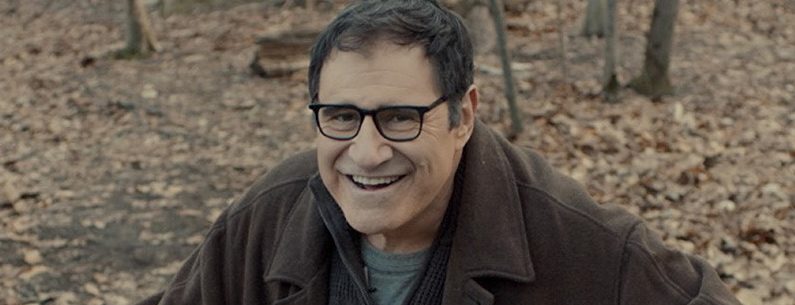
In the superb indie Auggie, Felix (Richard Kind) is pushed into retirement before he wants. He’s given a goodbye gift that he never would have thought to wish for, augmented reality glasses. Suddenly plunged into inactivity just as his wife Anne’s career is thriving, Felix finally gets around to putting on the glasses. The glasses give him a virtual companion, Auggie, equipped with the artificial intelligence to give the wearer his craved-for experiences. Most insidiously, Auggie even delivers individually customized emotional support. Everyone’s digital companion takes the form of what they desire, and Felix’s Auggie is a smoking hot and adorable young woman.
The more Felix wears the glasses, the more Auggie is able to fulfill his every need, even triggering more inner desires that he was aware of. This isn’t quite a Doctor Faust who knowingly opts into his fantasy; Auggie’s artificial intelligence is able to see Felix’s fantasies even before he can imagine them. All things in moderation, of course, but Auggie’s infinite availability becomes additive. This is no longer healthy for Felix or his family.
When a character asks, “Who do you see when you put on the glasses?”, it’s a devastating moment.
Auggie is the first feature for director and co-writer Matt Kane. Kane has avoided writing Felix as a stereotypical clumsy old grouch. As written by Kane and co-writer Marc Underhill and played by Richard Kind, he’s very smart and perceptive. He just isn’t ready for unimaginable temptation.
You’ll recognize Richard Kind, a reliable character actor and voice artist with 221 screen credits. My favorite Kind performance was the moving portrayal of a man seeking closure after the death of his wife in Clint Eastwood’s Hereafter.
Susan Blackwell is perfect at Felix’s wife Anne. Blackwell has had small parts in some very fine films and hosts her own Broadway interview show on YouTube, Side By Side with Susan Blackwell. Cristen Harper is suitably seductive as Auggie.
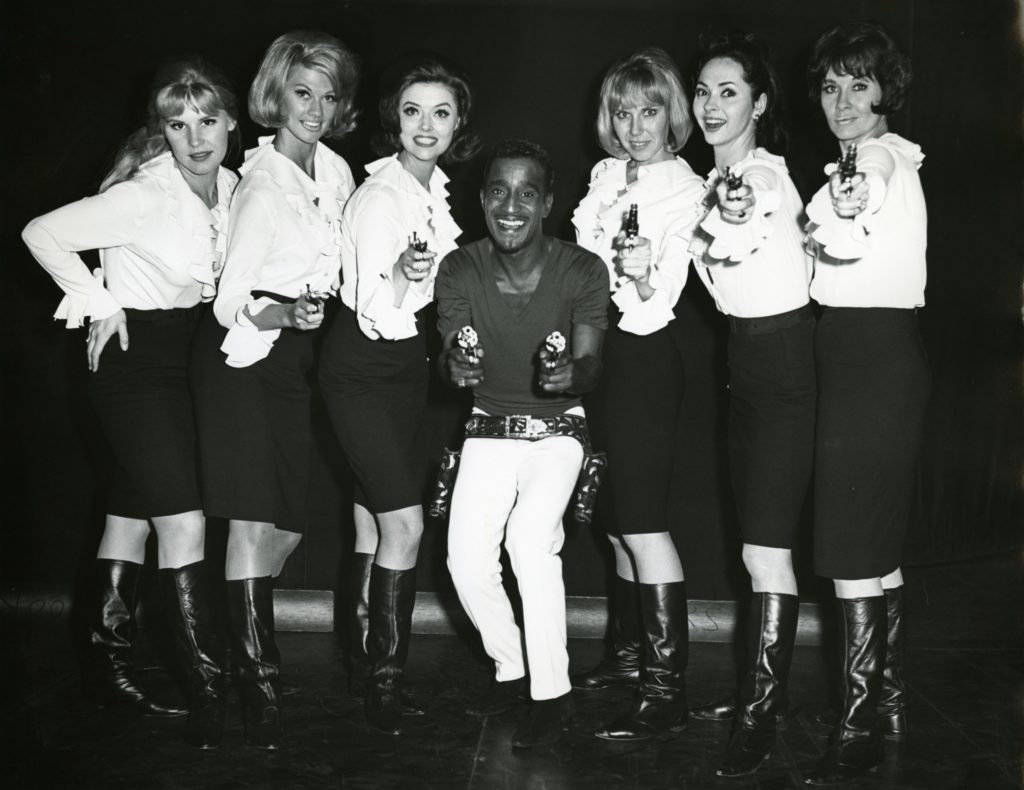
Still from SAMMY DAVIS JR.: I’VE GOTTA BE ME. Photo courtesy JFI.
Tonight, PBS airs Sammy Davis Jr.: I’ve Gotta Be Me on its American Masters series. As a Baby Boomer who had dismissed Sammy Davis Jr. from the moment he publicly hugged Richard Nixon, I found this to be the most surprising doc (and my favorite) at last year’s San Francisco Jewish Film Festival. I learned that Sammy’s 61-year career as a professional entertainer began at age three (with his first movie credit at age 7), a working childhood that left emotional needs It turns out that Sammy was a very, very talented but needy artist,, an uncomplicated man navigating several very complicated times.
Sammy’s life of entertainment began at 3. We get to see a clip of him in the 1933 Rufus Jones for President. All that professional work took away his childhood and engraved upon him a need to please. That and his generation produced the 50s showbiz style that seemed so insincere to us Baby Boomers. And, of course that embrace of Nixon seemed to be the ultimate sell-out moment.
Sammy Davis Jr.: I’ve Gotta Be Me also poses whether he was demeaned by Rat Pack humor? Were Frank and Dino laughing at Sammy, or with him?
But this was an immensely talented man, a masterful dancer with a remarkable crooner’s voice and a gift for mimicry. He was the first American entertainer of color to do impersonations of white celebrities. BTW there is some unbelievable dancing in Sammy Davis Jr.: I’ve Gotta Be Me. We get to see Sammy’s 60th anniversary in showbiz celebrated among a host of celebrities – he still had his dancing chops.
Sammy Davis Jr.: I’ve Gotta Be Me is the story of a man whose success condemned him to a career that spanned generations – none of which fit him comfortably. It’s a fine and insightful film.
[Random note: This film title may contain the most different punctuation marks of any movie: a comma, a period, a colon and an apostrophe.]
In They Shall Not Grow Old, Lord of the Rings filmmaker Peter Jackson has, for the first time, layered humanity over our understanding of World War I. By slowing down the speed of the jerky WWI film footage and adding sound and color, Jackson has allowed us to relate to the real people in the Great War. All of the narration is from the recorded oral histories of actual WW I soldiers.
Jackson started with 100 hours of archived film and 600 hours of oral histories. Removing the jerkiness by changing the film speed makes the biggest difference, but adding the sound of what we’re seeing through the work of Foley artists and even forensic lipreaders (who knew?) is also magically impactful. Jackson was meticulous in newly recording the sounds of actual WWI equipment and artillery.
Stuff that we thought we knew is made real for the first time. For example, we hear story after story of underage boys being accepted by military recruiters. The non-battle relations between the Brit and German grunts seems new. And there are new tidbits, like the “sit on the rail” sanitary technique. The soldiers’ reactions to the Armistice is unexpected – “too exhausted to enjoy it” and “the flattest feeling”. I counted 94 individual oral histories in the end credits.
They Shall Not Grow Old is about 90-minutes long and is accompanied by a fascinating 30-minute “making of” documentary. Jackson points out that soldiers had seen movies, but movie cameras were a novelty, so many soldiers are filmed staring at the camera agape and trying to hold still (as for a still camera). Jackson also takes us to see a sunken road in the film today – and explains that most of the soldiers in the archived footage were in the final 30 minutes of their lives.
As he explains in the “making of ” documentary, Jackson chose to focus on the experience of the ordinary soldier, so he does not depict the naval or air wars, the roles of women and colonial troops or the home front. It’s all-infantry all of the time. That distillation is a sound choice and allows the audience to immerse ourselves into that particular experience.
This is a generational achievement that should not be missed.
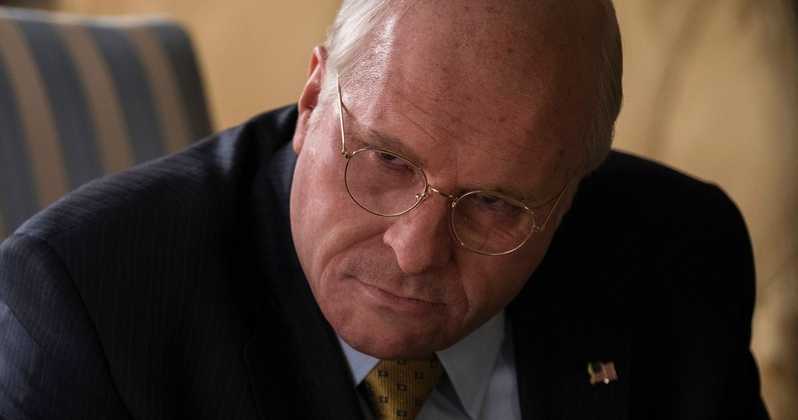
Viceis the comic biopic of Dick Cheney by writer-director Adam McKay (The Big Short). Cheney is played by a physically transformed and unrecognizable Christian Bale.
McKay’s take is that Cheney’s driving motivation and genius is the accumulation and exercise of power – to whatever end and by whatever means. McKay also sees Cheney as a mediocre slacker molded and fueled by Lynne Cheney (Amy Adams), whose own ambitions were limited in the 1960s by her gender. So, this is a tale of ruthless grasping along the lines of Macbeth or House of Cards, only mostly non-fiction.
McKay drops in the horrifying real impacts of Cheney’s exercise of power, but this is mostly a very funny movie. Donald Rumsfeld, Cheney’s mentor in power-grabbing, and George W. Bush, Cheney’s stooge, are played for laughs in very broad performances by Steve Carell and Sam Rockwell. McKay also tosses in a funny faux ending and has Dick and Lynne, in bed for the night, erupt in Shakespearean dialogue. Jesse Plemons plays a fictional Everyman narrator.
Bale’s performance is extraordinary, and goes well beyond the impeccable impersonation, down to every Cheney mannerism – stoneface, sneer and grunt. Adams is excellent as his Lady Macbeth. So is the rest of the fine cast, especially Alsion Pil as lesbian daughter Mary, Tyler Perry as Colin Powell and Shea Whigham as Lynne Cheney’s probably murderous father.
Vice is pretty good history, biography from a sharp point of view and a damn entertaining movie.