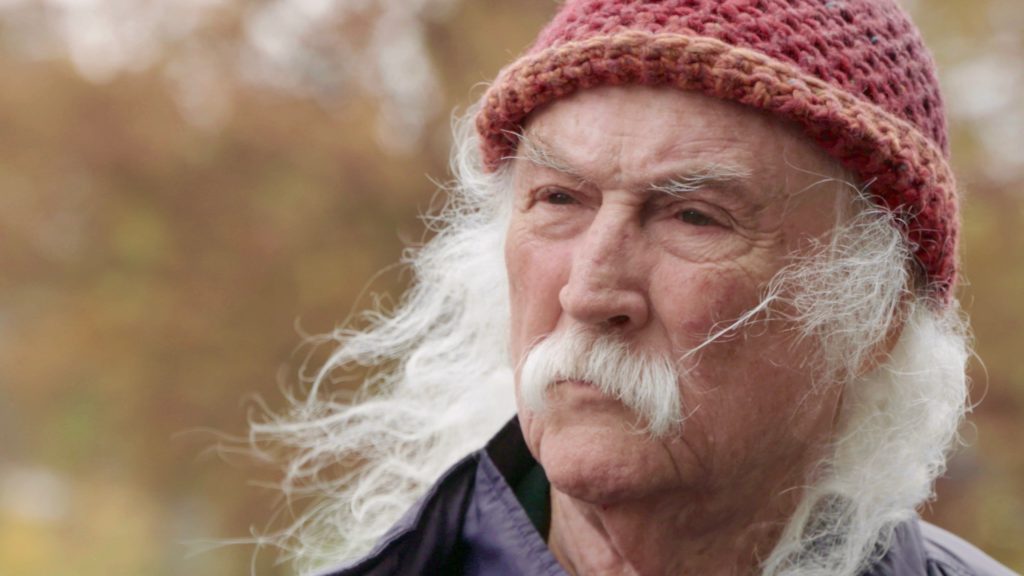
David Crosby in DAVID CROSBY: REMEMBER MY NAME Photo by Edd Lukas and Ian Coad. Courtesy of Sony Pictures Classics
The notoriously irascible Robert Altman and a drinking buddy once amused themselves by inventing titles of fake country-western songs; Altman came up with I’m Swimming Through the Ashes of All the Bridges I Have Burned. That’s the experience of watching the biodoc David Crosby: Remember My Name.
Most of the doc is a series of interviews with Crosby as he goes on yet another concert tour at age 76; before leaving, he cruises around his old haunts on Sunset Boulevard and Laurel Canyon. Remember My Name’s producer, the director Cameron Crowe, replays an interview with Crosby from 1974, when Crowe was the wunderkind rock writer portrayed in Crowe’s film Almost Famous. Crosby reacts with a telling observation about his friendships.
With the perspective of age, Crosby reflects on his musical achievements, his addiction and recovery and his trail of relationship carnage. He notes that “all” of his intimate collaborators – Roger McGuinn, Graham Nash, Steven Stills and Neil Young – “hate me”, and ruefully observes, “if it were just one, it could be an accident”. The film includes clips of McGuinn, Nash and Young (plus Stills’ emphatic silence) to corroborate.
Crosby’s well-known battle with cocaine and heroin came into play with his estrangements. I would reflect that recovery from addiction will generally IMPROVE behavior, but is no guarantee of ACCEPTABLE behavior. The drugs certainly didn’t help Crosby avoid his “two or three heart attacks” eight cardiac stints, his liver transplant and his diabetes.
Contemplations aside, David Crosby: Remember My Name does an excellent job of tracing Crosby’s musical career and personal life. We get his side of his romance with Joni Mitchell, and the story of getting dumped by Mitchell in front of all their friends – with a song Mitchell composed for the occasion. There’s an wonderful telling of the writing and recording of Neil Young’s great song Ohio.
And here’s an odd note for movie fans: Crosby’s father was Floyd Crosby, a prolific but usually pedestrian cinematographer whose career topper was his Golden Globe-winning work in High Noon. I compared the father-son career paths and found that in 1964-65, when David was starting with the Byrds and hanging out with the Beatles and Miles Davis, Floyd was cranking out Bikini Beach, Pajama Game, Beach Blanket Bingo, How to Stuff a Wild Bikini and Beach Ball. While David was in the vanguard of the 1960s Counterculture, Floyd was winding up the Annette Funicello/Frankie Avalon teen culture that had been hanging on from the 1950s.
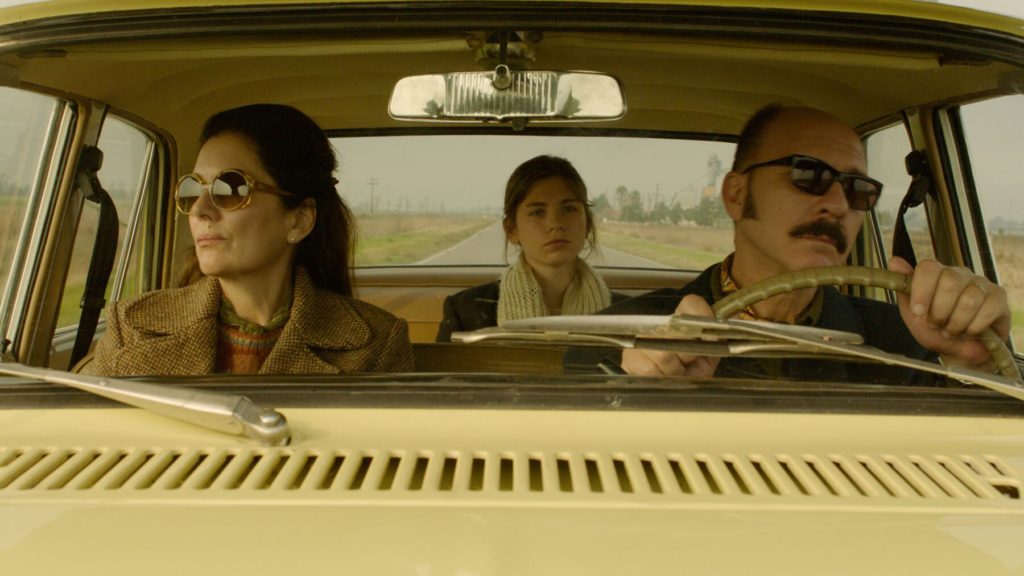
Rojo is Argentine writer-director Benjamín Naishtat’s slow burn drama. Rojo is set just before the 1970s coup that some characters expect – but no one is anticipating how long and bloody the coup will be. Several vignettes are woven together into a tapestry of pre-coup moral malaise.
A prominent provincial lawyer Claudio (Darío Grandinetti) is invited to participate in a scam. There’s a scary encounter of lethal restaurant rage. It looks like Claudio, bobbing on a sea of moral relativism, may well remained unscathed, but the arrival of crack detective becomes a grave threat.
As Claudio weaves through his life, his society shows signs of crumbling. There’s a failed teen seduction, an emotional breakdown at a formal reception and a natural metaphor – a solar eclipse.
It’s funny when the audience finally connects the dots and understands who the character nicknamed “the Hippie” is. And Naishtat and Grandinetti get the most out of the scene where Claudio finally dons a toupee.
We know something that the characters don’t know – or at least fully grasp – how bloody the coup will be. Watch for the several references to desaparecido, a foreboding of the coup. Argentina’s coup was known for the desaparecidos – the disappeared – thousands of the regime’s political opponents went missing without a trace, having been executed by death squads. In Rojo, a very inconvenient madman dies and his body is hidden, there’s a disappearing act in a magic show, and a would-be boyfriend vanishes.
This is a moody, atmospheric film that works as a slow-burn thriller. I saw Rojo earlier this year at the San Francisco International Film Festival (SFFILM) and it opens this weekend in Bay Area theaters.
On September 10, Turner Classic Movies will air Gaslight (1944), a classic suspense thriller that still has a lot to say about domestic violence and abusive power in relationships.
In Gaslight, an evil husband (Charles Boyer) isolates his wife (Ingrid Bergman) and uses manipulation to convince her that she’s going crazy. He’s seeking to conceal his crimes and gain unfettered control of her house and fortune. He’s also dallying with the maid (a nubile 18-year-old Angela Lansbury). Fortunately, the wife’s longtime admirer (Joseph Cotton) works for Scotland Yard and starts to investigate…
Domestic Violence is abuse of a partner, generally characterized by asserting power and control over the partner. Not all domestic violence is physical, and this phenomenon of abuse by manipulation takes it name – gaslighting – from this movie.
The Film Noir Foundation recently screened Gaslight to an audience of domestic violence survivors and support professionals. I recommend Noir Talk, the Film Noir Foundation’s excellent podcast on iTunes. Search for Gaslight and domestic violence in Episode 10. Here’s one of the tidbits from the podcast: Ingrid Bergman thought she was too vibrant and healthy-looking for the part; but that works to show how the manipulation can work on a woman who doesn’t look like a victim.
This famous Gaslight is actually a remake of the original 1940 version, which is also especially well-acted. Anton Walbrook is suave and evil as the hubbie and Dyana Wyngard is unforgettably haunting as the wife. Only 19 minutes in, we see his duplicity, manipulation and control. Frank Pettingell is very good as the detective, and the cast includes Robert Newton (Long John Silver in the 1950 Treasure Island). Cathleen Cordell plays the oversexed maid Nancy in a less nuanced performance than Angela Lansbury’s. This film version is reportedly the most faithful to the stage play source material. (Oddly, there’s a very good can-can dance in this 1940 movie, too.)
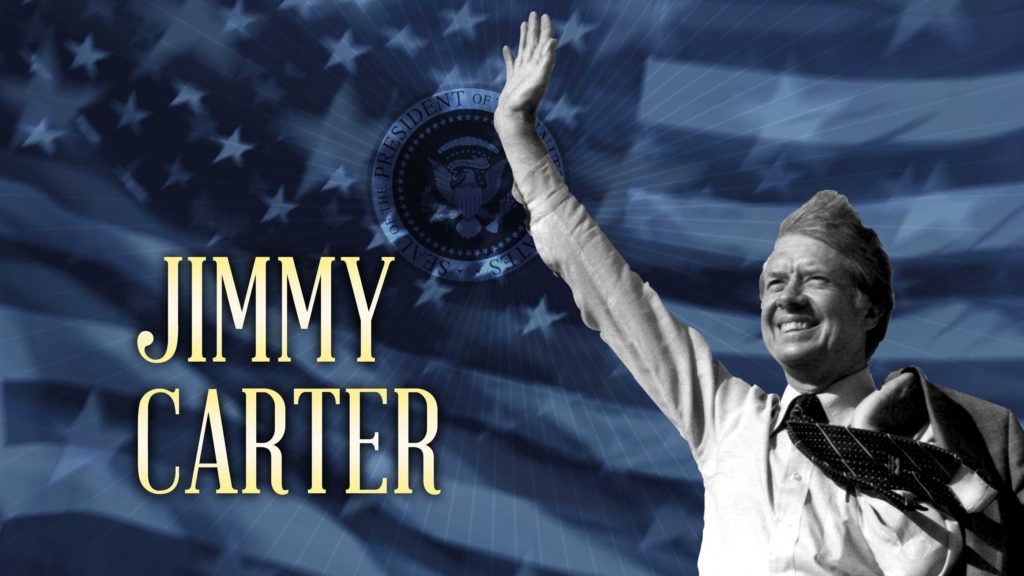
In PBS’ American Experience documentary Jimmy Carter, The New Yorker writer and former Carter speechwriter Henrik Hertzberg says:
Jimmy Carter was what the American people always SAY they want – above politics, determined to do the right thing regardless of political consequences, a simple person who doesn’t lie, a modest man, not someone with a lot of imperial pretenses. That’s what people say they want. And that’s what they got with Jimmy Carter.
And herein lies the rub.
In 1976, Americans were reacting to Watergate and wanted a President LEAST like Richard Nixon. We got him, in the form of Jimmy Carter; it turned out that Carter could deliver non-Nixon decency, but not the leadership that the era required.
Today, many – and the polls indicate, most – Americans seek a non-Trump. I share the view that ANYONE would be better then Trump, but Jimmy Carter is instructive that “anyone”, while better than Trump, might not be the best for the country.
In Jimmy Carter, we hear from those who know Carter best – including his wife Rosalynn Carter, his vice-president Walter Mondale, and right-from-the-start Carter insiders Jody Powell, Pat Caddell and Bert Lance. How the times made this man, then propelled him to such improbable electoral success and then finally doomed his Administration, is a great and cautionary story.
To stream Jimmy Carter from iTunes, search for “Jimmy Carter” under TV Episodes (not under Movies). Jimmy Carter is also available on DVD from American Experience.
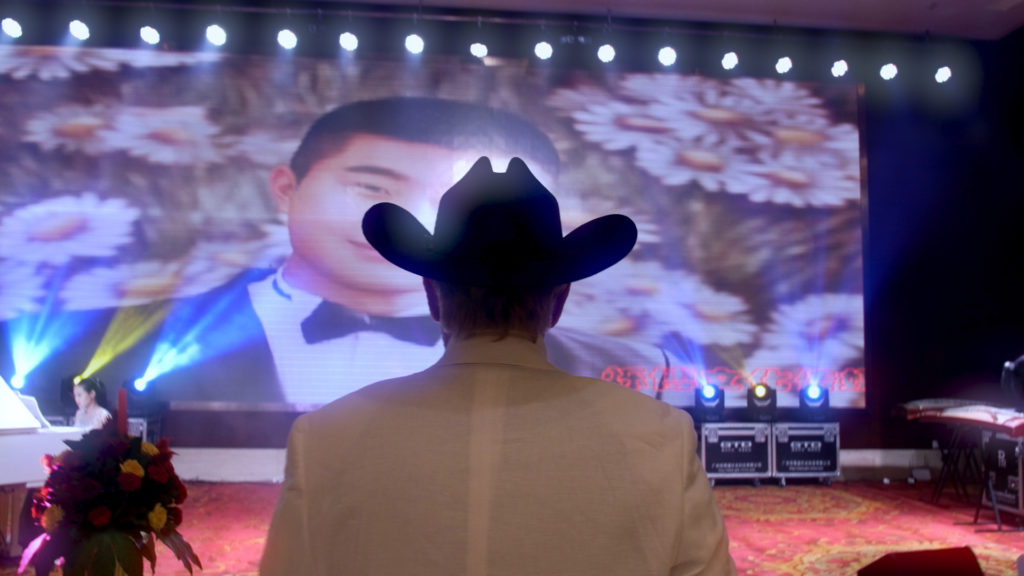
In John Maringouin’s inventive satire Ghostbox Cowboy, we first meet Jimmy (David Zellner) in an American store, gazing at that aisle in every Walgreens or CVS that is filled entirely with crappy plastic gizmos made in China. We later learn that he’s thinking, “somebody is getting rich making this stuff and that person should be me.”
Wearing a cowboy hat for effect, Jimmy takes his small nest egg to the capitalist frontier of China and tries to re-invent himself as an entrepreneur. He has the prototype for an absolutely phony product, which he tries to pitch to young Chinese capitalists. Jimmy thinks that he can outsmart the locals because he is an American, but the joke is on him – he’s now the dumbest guy in China.
Jimmy doesn’t bother to learn any Mandarin, so he leans on or two shady, super-marginal ex-pats (Robert Longstreet – just great – and Specialist) to help him navigate the local scene. One of his “buddies” fleeces him, and Jimmy is hired by contemptuous Chinese when they need a Caucasian stand-in. As Jimmy is stranded near Mongolia, Ghostbox Cowboy gets mystical, and the cringe humor gives way to the surreal.
The filmmaking itself is a remarkable story. Ghostbox Cowboy was shot in the massive boomtowns around Dongguan, Guangzho and Shenzhen (each a city with a population between 8 and 15 million). Because the Chinese government frowns on critique cinema, Maringouin had to shoot on the sly, guerilla style. To photograph the illegal factories that manufacture knock-offs, he pretended to be a potential investor. Maringouin and his two SAG actors spent ten days in China, essentially pretending not to shoot a movie.
David Zellner in GHOSTBOX COWBOY
I saw Ghostbox Cowboy at Cinema Club Silicon Valley, with a Q&A with writer-director-camera operator John Maringouin. Bay Area filmmaker Maringouin wanted to focus on White entitlement, with a protagonist who adds no value of his own but imagines that he should still be “a participant” in China.
Ghostbox Cowboy was selected to play the Tribeca film festival and earned a NY TimesCritic’s Pick. Ghostbox Cowboy can be streamed on Amazon (included with Prime).
The slow-burn romantic tragedy The Souvenir is a study of a bad romantic choice, exacerbated by co-dependence.
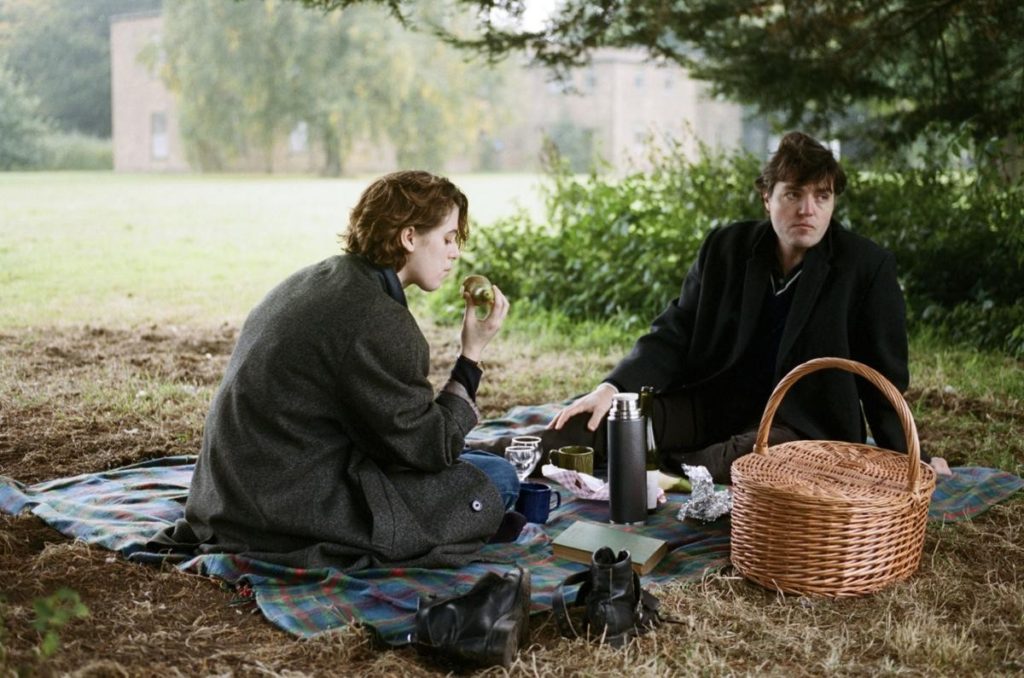
In the 1980s Thatcher Era UK, Julie (Honor Swinton Byrne) is a 24-year-old Ken Loach wannabe trying to make her first socially aware film. She’s from a middle class background and has a set of artsy friends. She meets Anthony (Tom Burke), who affects the chalk-stripe pinstripe suits and the bored drawl of the upper classes, and says that he works at the Foreign Office. She is intrigued.
It’s an unusual courtship. He takes her to a stupefyingly posh tearoom. They visit an art gallery and deconstruct the Fragonard painting The Souvenir. But are these dates? Kinda dates? She lets him crash at her place. All of this precedes any physical intimacy or hint of passion. He wants her, but never pushes the pace. They do become lovers, and it turns out that he is not as he seemed. (Kudos to the trailer below for NOT spoiling Anthony’s biggest secret.)
This is a remarkable piece of filmmaking. Writer-director Joanna Hogg frames each shot exquisitely, and lets the characters’ feelings unspool before us. This is a movie with lots of stillness, and the stillness serves to amplify the emotional power.
This is the first feature film performance as an adult for Honor Swinton Byrne, the daughter of Tilda Swinton. Byrne is superb as Julie, whom we care about because she is so genuine and vulnerable. This is also the first time I’ve seen Tom Burke, and he is excellent as a quirky guy who might really appeal to some woman, but who can’t escape his fatal flaw. Tilda Swinton appears in the supporting role as Julie’s protective mom, and nails the character.
Joanna Hogg, just like her Julie, was a young British filmmaker in the 1980s, and this story seems searingly personal. I don’t know to what extent it is autobiographical, but the heartbreak is so powerfully vivid, that I hope Hogg didn’t have to endure it in real life. There’s a sequel already in post-production.
The Souvenir is universally acclaimed by critics and has a Metacritic score of 92. I admired the film and the filmmaking, but was not engrossed; most viewers will find the deliberate pace makes The Souvenir a challenging watch for one hour and 59 minutes. It certainly is the most profoundly sad film of the year. It can be streamed on Amazon, iTunes, Vudu, YouTube and Google Play.
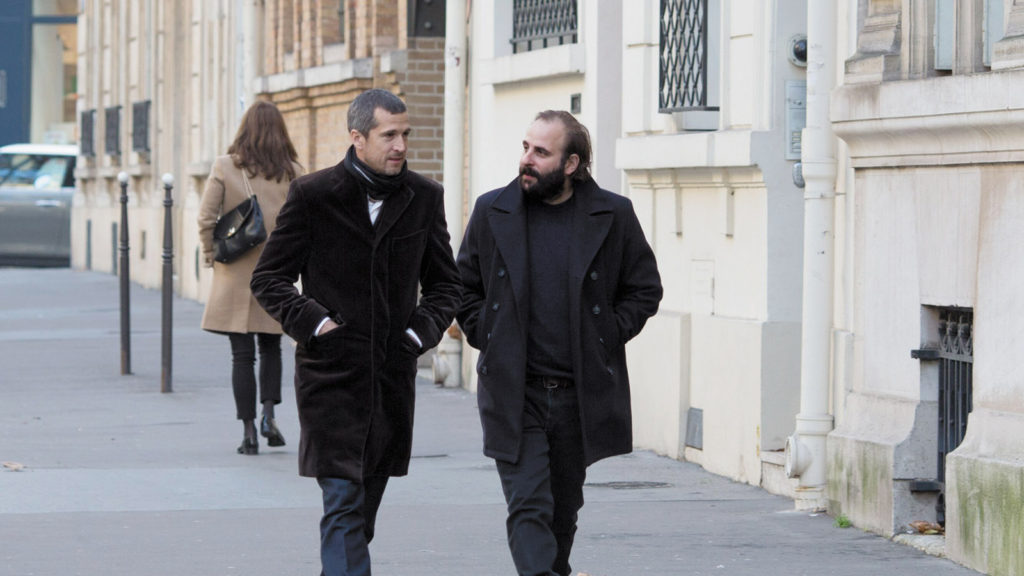
Guillaume Canet (left) and Vincent Macaigne in NON-FICTION
I finally got around to watching writer-director Olivier Assayas’ Non-Fiction. I had been eager to see it because I generally find the French actor Vincent Macaigne hilarious, and I will pretty much watch Juliette Binoche in anything. My conclusion: Olivier Assayas has wasted too many hours of my life, and I am over his films.
Non-Fiction is a comedy of manners that revolves around the once-successful novelist Leonard, whose books are very lightly disguised re-tellings of his own sordid romantic life, and Leonard’s publisher Alain (Guillaume Canet). Alain is married to Selena (Juliette Binoche), an actress in TV cop shows. Everybody sleeps with somebody else’s partner, and everyone wrings their hands over e-books, audio books, blogs and the impending death of the book industry. That’s about it. None of it is engaging.
In 2006, Assayas, a veteran screenwriter, wrote and directed an okay segment (the one with Maggie Gyllenhaal as an actress pining for her drug dealer) in the delightful anthology Paris, je t’aime. He followed it in 2008 with the fine family drama Summer Hours. And then, in 2011, he did the excellent true crime mini-series Carlos. This was a promising start, and he developed a fan base of admiring critics.
But since then, Assayas has wasted brilliant performances by Binoche and Kristen Stewart in the Clouds of Sils Maria and Personal Shopper – two muddled messes that masquerade as cinema. And now, the off-putting Non-Fiction. I am over this guy.
SPOILER: There is one funny moment in Non-Fiction, which I shall now spoil for you, so you won’t need to watch the movie. In the last quarter of the film, the characters decide to publish an audio book read by a celebrity, and they aspire to get Juliette Binoche (who is, of course, in this scene playing her character). I’ll concede that this is a genuinely witty moment, if self-referential.
Non-Fiction is now streaming on Amazon and other platforms.
Werner Herzog’s documentary Little Dieter Needs to Fly is a portrait of Dieter Dengler’s unimaginable life journey, highlighted by one of history’s most amazing feats of human endurance. With a childhood (as Herzog’s) in WWII Germany, Dengler survived US bombing raids that reduced his hometown to rubble; a glimpse of an American pilot spurred Dengler’s obsession with aviation. His drive to fly led him to emigration and a career as a US Navy aviator. Shot down in the Vietnam War, Dieter was captured and tortured. He made a daring escape, and, after the war, pursued civilian aviation; we finally see Dieter in his Marin County home with its odd survivalist features . Unsurprisingly, given the traumas he endured, Dieter has his quirks.
But the core of Little Dieter Needs to Fly is the amazing jungle escape. It was a 23-day ordeal with a manhunt hot on his heels. His 167-pound frame was whittled to 98 pounds. Herzog takes Dieter back to Southeast Asia and pays the locals to re-enact the capture and chase.
Werner Herzog, known for his German New Cinema art house hits of the 70s and 80s (Aguirre:The Wrath of God, Strozek Nosferatu the Vampyre, Fitzcarraldo), switched gears in 1997 with Little Dieter Needs to Fly and followed it with the masterpiece Grizzly Man. Since, Herzog has become a prolific and masterful documentarian.
Note: It’s not in Little Dieter, but, four years after the 1997 release of the film, Dieter was diagnosed with ALS and died from a self-inflicted gunshot.
The brisk 80 minutes of Little Dieter Needs to Fly can be streamed on Criterion, the Amazon Fandor channel, iTunes, Vudu and Google Play.
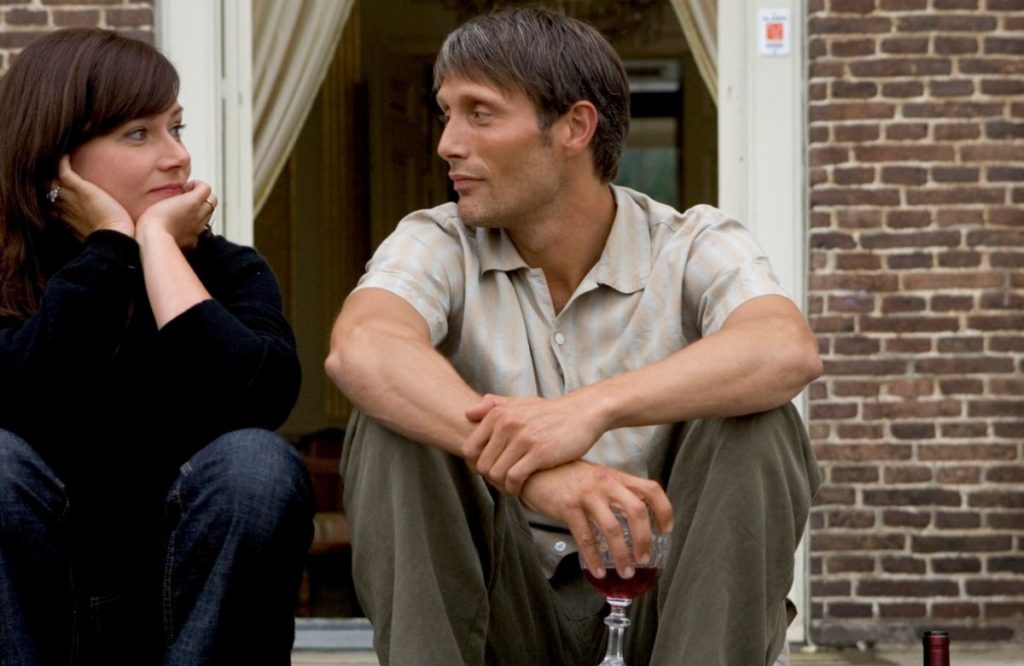
Sidse Babett Knudson and Mads Mikkelsen in Susanne Bier’s AFTER THE WEDDING
The Danish director Susanne Bier’s 2006 After the Wedding (Efter brylluppet) is a successful melodrama in the very best sense. There’s also a remake – a big Hollywood movie to be released this Friday also called After the Wedding, and I can’t say if it’s any good (early reviews are favorable for the stars but not the film overall). But I can tell you that I love, love, love Bier’s 2006 film.
The Danish expat Jacob (Mads Mikkelsen) runs an orphanage in Calcutta, and his non-profit badly needs an infusion of cash. He gets the offer of a huge contribution, but it’s conditioned on his travel to Denmark. There, he meets the prospective philanthropist, the industrialist Jorgen (Rolf Lassgård). Jacob just wants to finalize the money and return to India, but the forceful and wily Jorgen is a difficult guy to close. While apparently stalling, Jorgen sets up Jacob with a driver and a luxury hotel room; this makes the anti-poverty crusader Jacob, a true believer, ever more uncomfortable. Finally, Jorgen invites Jacob to attend the wedding of Jorgen’s daughter. Jacob gets a big surprise when he meets Jorgen’s wife Helene (Sidse Babett Knudsen). A second shocker is unveiled at the wedding by the bride. And then, after the wedding, Jorgen delivers yet another jaw-dropper.
Bier, who co-wrote the film, paces the reveals just perfectly. The plot twists could easily have been preposterous and the ending could have been phony – but Bier skillfully avoids every misstep and delivers a gripping, genuine drama.
Mads Mikkelsen is an especially charismatic actor, and After the Wedding, along with The Hunt, is among his very best work.
After the Wedding was nominated for Best Foreign Language Oscar (and would have won most years, but it had to compete with The Lives of Others). After the Wedding, which I had listed as the second-best movie of 2007, can be streamed from Criterion and Amazon.
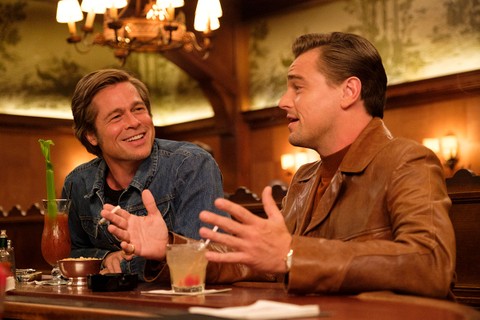
Brad Pitt and Leonardo DiCaprio in ONCE UPON A TIME…IN HOLLYWOOD
In Quentin Tarantino’s spectacularly successful Once Upon a Time…in Hollywood, two fictional characters, Rick Dalton (Leonardo DiCaprio) and Cliff Booth (Brad Pitt) and the actress Sharon Tate (Margot Robbie) navigate a changing Hollywood in 1969. The next evolution of Hollywood is filled only with promise for Sharon, but presents an unseen threat to Rick and Cliff.
Rick is an actor, a former star of TV Westerns who has aged into guest appearances on the shows of a new crop of TV stars. Cliff is Rick’s longtime stuntman, who now works as Rick’s driver, gofer and drinking buddy. Cliff lives in a San Fernando Valley trailer; Rick lives on exclusive Cielo Drive, next door to Sharon and her husband Roman Polanski, but he’s slipped too far down the showbiz ladder to know them.
Once Upon a Time…in Hollywood is about a lot of things, expertly braided together. It’s about a specific time and place. It’s about a woman, filled with innocence and zest, who is justifiably hopeful. It’s about two guys – one tortured and the other decidedly not – facing age and irrelevance. It’s about the guys’ relationship, at once interdependent and asymmetric. And it’s a love letter to vintage Hollywood, the Hollywood that six-year-old Quentin Tarantino lived near to, but was not a part of.
The story follows the three characters through a series of vignettes, right up to the most startling ending in recent cinema. This is a Quentin Tarantino masterpiece, right up there with his best, Jackie Brown and Pulp Fiction.
The movie’s title begins with “Once Upon a Time…“, so you are on notice that this isn’t actual history.
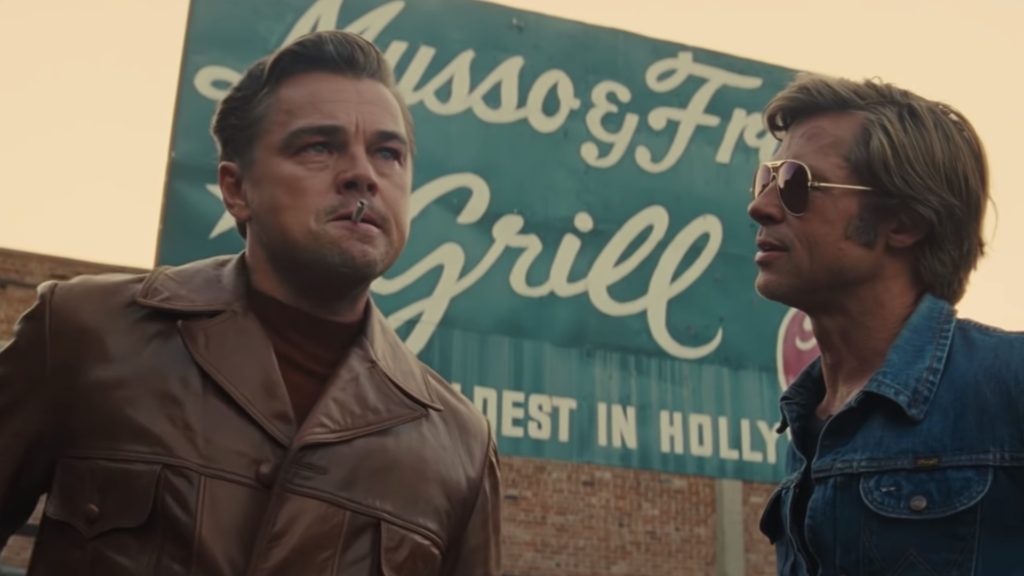
Leonardo DiCaprio and Brad Pitt in ONCE UPON A TIME…IN HOLLYWOOD
Once Upon a Time…in Hollywood is set in the locations most evocative of the 1969 Hollywood: movie studio sets, legendary showbiz hangout Musso & Frank, the Playboy Mansion, the ill-fated Cielo Drive and Spahn Ranch – famous for both its use as a movie set and as the home base of the Manson Family.
There’s a dazzling montage of neon signs being lit up at sunset. Not many contemporary directors still know how to film galloping horse riders, but Tarantino brings us some great shots from Spahn Ranch, where so many Westerns were shot.
Of course, Tarantino’s soundtrack takes us right into 1969 with superbly curated period radio hits like the Deep Purple version of Hush and the Jose Feliciano cover of California Dreamin’. A February scene is perfectly set to Neil Diamond’s Brother Love’s Traveling Salvation Show, with its hot August nights lyrics presaging the Manson murders to come in LA’s stifling August 1969. (Brother Love’s Traveling Salvation Show got me wondering how Tarantino restrained himself from using it in some – or all – of his previous films; it’s every bit as Tarantinoesque as Misirlou or Stuck in the Middle with You.) A snippet of a full-bearded Robert Goulet singing MacArthur Park even turns up on somebody’s TV.
In 1969, American culture and the nation itself were in turbulence. Hollywood showbiz was also being rocked – major movie studios were slipping both financially and creatively, floundering to react to the primacy of television and the public’s changing taste (and growing disinterest in Westerns). The studios were about to reach out in desperation to auteur directors like Polanski. Rick and Cliff are behind the curve – but they haven’t noticed that their world is dying.
As hedonists, Rick and Cliff have embraced the drugs and free sex of the counterculture. But they still drive gas guzzlers – a luxury sedan for Rick and a muscle car for Cliff – and refer to “dirty hippies”.
How does the Manson Family play into all this? There was a time when people actually believed that drug-infused peace and love would cure all that ailed us as a society. By 1969, the Summer of Love had already turned dark in San Francisco; but the Manson killings made the unmistakable point that the counterculture, for all its promise, didn’t have an answer to murderous psychopaths any more than did the mainstream.
We very briefly glimpse Manson himself (in an encounter that is pretty close to historically accurate). Tarantino knows that the best way to depict Manson’s evil is to reflect it in the cult he created.
DiCaprio’s Rick Dalton, drinking way, way too much, is still treated like a star around town, and he’s grown complacent – until the truth about his career staleness finally hits home. DiCaprio shines in the scene where Rick, cast as a one-dimensional villain in a disposable TV Western, shows his acting chops with an explosive performance; Rick, having internalized that his career may be over, lets it all go in the scene. The character of Rick has the movie’s greatest arc, but he’s less interesting overall than Cliff or Sharon.
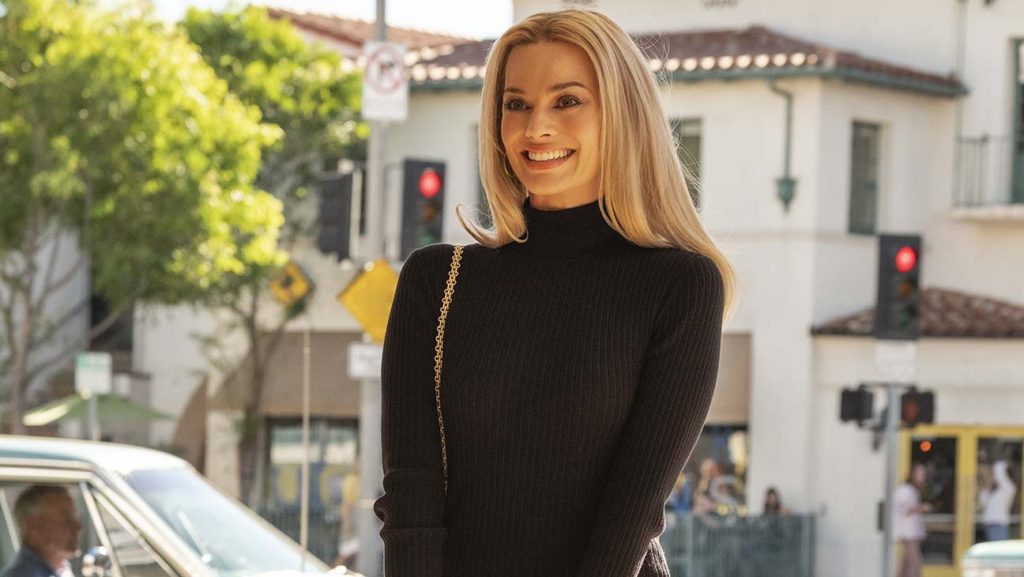
Margot Robbie in ONCE UPON TIME…IN HOLLYWOOD,
Sharon Tate is the soul of Once Upon a Time…in Hollywood. Robbie is absolutely transcendent,. She doesn’t need a lot of lines to make her character unforgettable. Sharon gets a ticket to watch herself in a Dean Martin movie, and it’s impossible to imagine a moment with more goofy innocence.
Cliff Booth is one of Tarantino’s greatest characters. Cliff is secure in his abilities, without any need for recognition or self-promotion. Unambitious, he is absolutely content to be Rick’s second banana. That being said, he’s not going to take any shit from anyone.
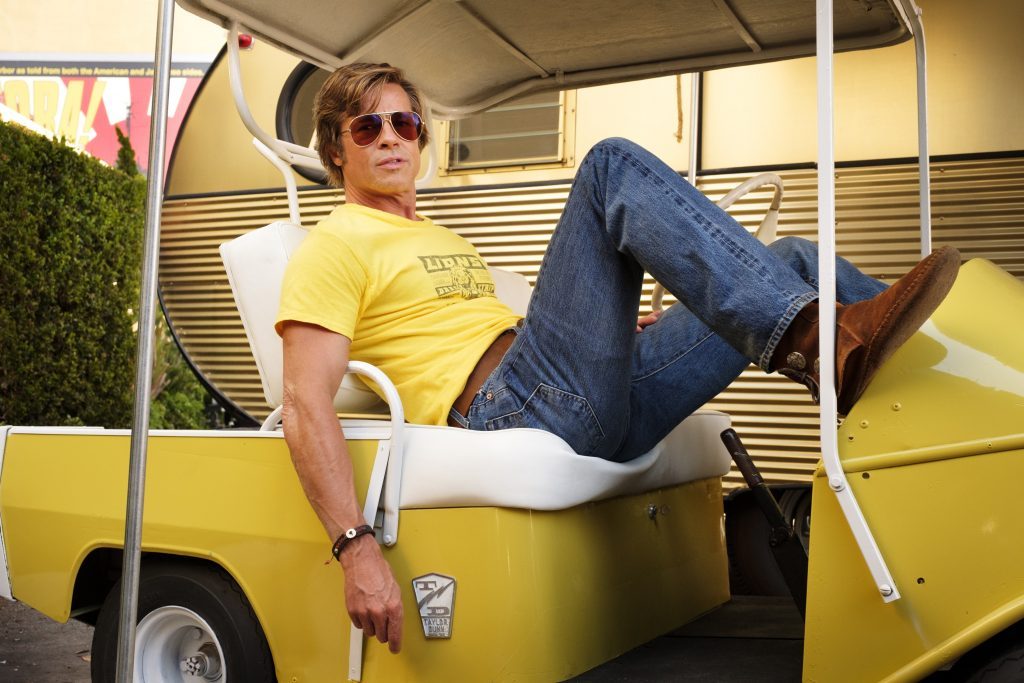
Brad Pitt in ONCE UPON A TIME…IN HOLLYWOOD
In Once Upon a Time…in Hollywood, Brad Pitt shows us what a movie star is and why he is one. I haven’t been a Pitt enthusiast, although I’ve liked him in Fight Club, The Assassination of Jesse James, Moneyball and Inglorious Basterds. Pitts’ Cliff Booth is off the charts, and it’s tough to imagine any other actor in the role. Other male stars can match the physicality, but not the unique combination of confidence and humility.
Right up there with Pitt and Robbie is Margaret Qualley, who plays a fictional Manson girl named Pussycat. She is kooky in the cute way and kooky in the scary way. Qualley fills her with manic energy, brimming with wit and sensuality.
Julia Butters plays a precocious child actor in the pilot Rick is shooting; she’s the best possible counterpoint to Rick’s flabby professional complacency. Michael Moh is very funny in a send-up of Bruce Lee. Damien Lewis has a priceless moment as Steve McQueen.
For his supporting players, Tarantino pulls out an abundant cornucopia of acting talent and Tarantino sentimental favorites: Al Pacino, Dakota Fanning, Kurt Russell, Emile Hirsch, Brenda Vaccaro, Clu Gulager, Bruce Dern, Michael Madsen, Luke Perry, Timothy Olyphant, Zoë Bell, Clifton Collins Jr. (Perry Smith in Capote), Lena Durham and Scoot McNairy.
Tarantino’s exquisite filmmaking skills blend together the verisimilitude of time and place, the vivid performances and a rock ’em, sock ’em story to make Once Upon a Time…in Hollywood an instant classic.
Note: Deep into the closing credits, there’s an Easter egg.