Photo caption: Leos Carax and Denis Lavant in IT’S NOT ME. Courtesy of Janus Films.
I generally only write about feature-length films, but there’s a lot of interest among cinephiles for the mid-length It’s Not Me. A European museum asked the artistic renegade filmmaker Leos Carax for a project that answers the question, Who are you? Although the title of this film is cheeky, It’s Not Me is Carax’s reflection on what has formed him – cinema, the 20th century, his Jewishness – and who he is – an artist, a parent, a moral critic.
It’s Not Me is rapidly-paced montage of bits from classic cinema, Carax’s own films (augmented by some new footage) and historical stills and clips. There’s even cell phone footage of his daughter as a child and now playing the piano as an adult. It is a curated mush mash, decidedly not as random as it sometimes seems. The clips are interspersed with bold color titles a la Jean-Luc Goddard. Movies can be LIKE fever dreams; this one may BE an actual fever dream.
Carax is known for Holy Motors, which I mostly liked, and Annette, which I didn’t. One thing is for sure – each Carax movie will be like nothing you’ve seen before.
Carax isn’t usually very political, but here he explicitly vents his hatred for haters like Hitler and current right wing, nationalist leaders. There’s a very creepy scene where a mother reads her kids a bedtime story that applauds Hitler’s Final Solution. There’s footage of the 1939 pro-Nazi rally at Madison Square Garden, and of the corpses of contemporary would-be immigrant children sloshing on a European beach. Tough stuff.
It’s Not Me runs only 42 minutes, but there’s almost two minutes of opening credits, and then the closing credits start at the 37-minute mark. After the closing credits, there’s a a final 2-minute puppet performance that is brilliant, even if I have no idea why Carax included it.
Denis Lavant reprises his role as Monsieur merde, the outré character in Holy Motors and other Carax films. If you want to know just how outré, read my post on Holy Motors.
Clips of the 27-year-old Juliette Binoche from the 1991 Carax film The Lovers on the Bridge remind us what a breath-taking beauty Binoche has been in every stage of her career.
Photo caption: Rachel Sennott in I USED TO BE FUNNY. Courtesy of Utopia.
In the Canadian indie I Used to Be Funny, Sam is a standup comedian (played by Rachel Sennott, a real life standup comedian). Sam has been suffering the effects of PTSD for a year, and is existing with the kindness of her two comedian roommates. She’s been unable to work, write or leave the house, and it’s a major achievement to take a shower.
Through flashbacks, we learn how she got to her present condition. Sam had taken a day job as a nanny for a 13-year-old girl, Brooke (Olga Petsa). Brooke is a pistol anyway, but her mom is on her deathbed and her father is stricken with both grief and the bewilderment as to how to meet the needs of his teenage daughter, who is already troubled by the mom’s illness and soon to go off the rails completely. At first Brooke responds encouragingly to the hip young Sam. But then, everyone’s life is upended by the traumatic event. (That event is depicted over an hour into the film, but the audience has surely guessed what it is by then. )
Will Sam work through her PTSD and become functional again? Will Brooke be lost to her self-destructiveness?
I Used to Be Funny is the first feature for television writer-director Ally Pankiw. Pankiw accurately portrays the disabling pain of a PTSD sufferer and the helplessness of adults dealing with an out-of-control teenager. Pankiw finally gets us to a redemptive ending, but there’s a lots of emotional pain and drama on the way.
In case you forget that this is a Canadian film, you’ll notice that the comedian roommates, the estranged boyfriend, Brooke’s aunt and the folks at the comedy club are exceedingly nice. Even the troubled teen, a punk drug dealer and sexist cops are very nice for their types.
I watched I Used to Be Funny because I so enjoyed Sennott’s performance in Saturday Night. Now we know that Sennott has the emotional range to play the extremes of the spectrum – a depressive here and a sexy and masterful creative in Saturday Night. Both of those characters are quick-witted, and Sennott is very believable, of course, as a head comedy writer and as a standup comic.
I Used to Be Funny is streaming on Netflix, Amazon, AppleTV, YouTube and Fandango.
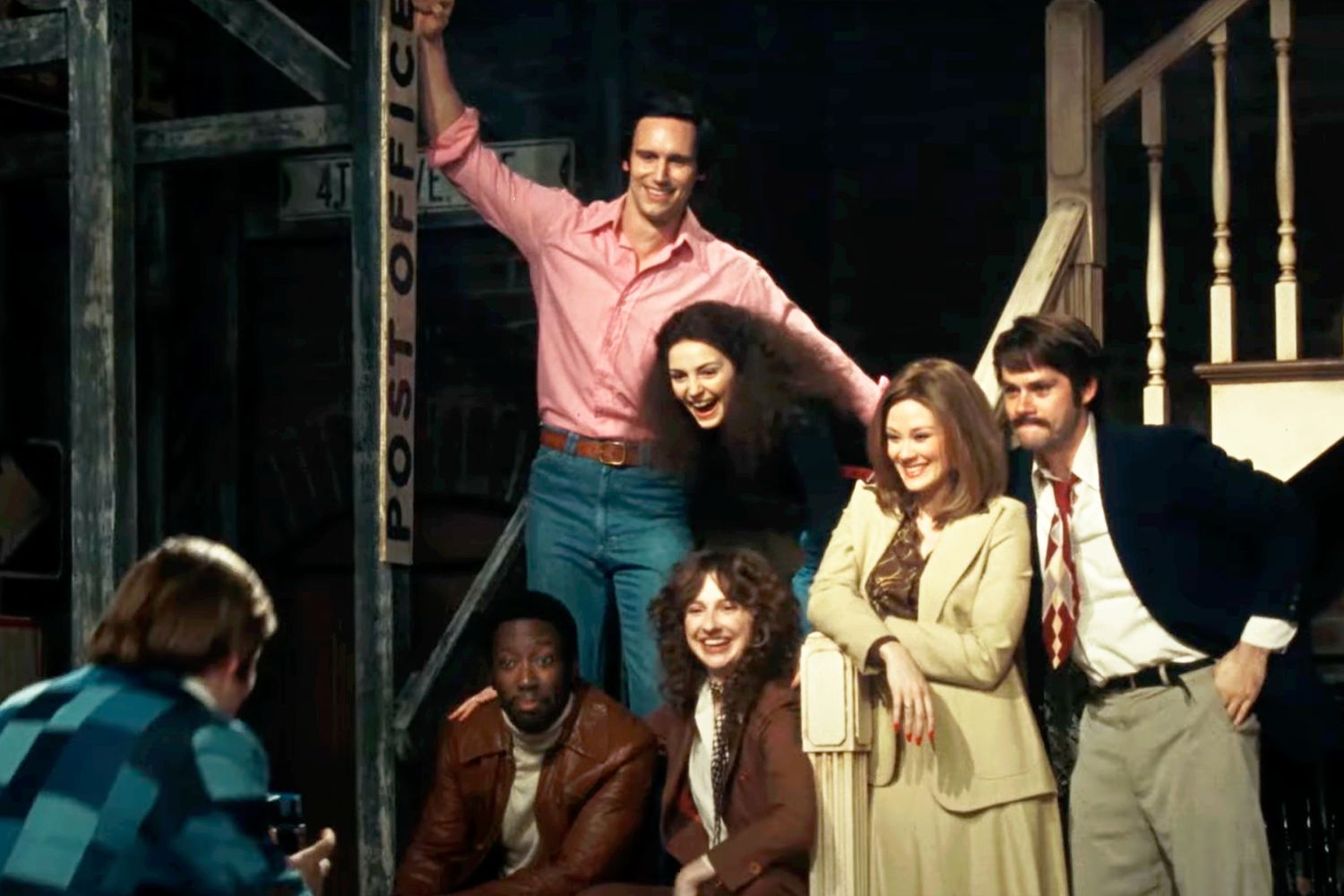
Photo caption: Cooper Hoffman (kneeling), Lamorne Morris, Cory Michael Scott. Ella Hunt, Emily Fairn, Kim Matula and Dylan O’Brien in SATURDAY NIGHY. Courtesy of Columbia Pictures and Sony Pictures Entertainment.
It’s hard to imagine, but fifty years ago there was no Saturday Night Live. There wasn’t much edginess on TV – All in the Family and M.A.S.H. were controversial -and a live performance telecast was unthinkable. Saturday Night depicts the first telecast of Saturday Night Live on October 11, 1975, and it’s quite a story.
Television network executives, always trying not to upset sponsors and affiliate stations, constricted creativity. By 1975, American music, movies, literature and fashion, had all moved on to reflect the turbulence and societal revolution of the 1960s and the Vietnam/Watergate Era of the early 70s. TV was still too square for the culture. There was nothing on TV like Portnoy’s Complaint, Midnight Cowboy, Frank Zappa or The National Lampoon. There was an opening for edgier content that would appeal to then twenty-something Baby Boomers.
As Saturday Night tells it, the timeslot was only available because NBC was in a contract dispute with Johnny Carson and needed a temporary replacement, a show that would be disposable when The Tonight Show with Johnny Carson returned. Into the breach stepped twenty-something showrunner Lorne Michaels (Gabriel Labelle) with an idea for a sketch-comedy show with musical guest performances, to be broadcast live, which the NBC’s Radio City complex was not set up for.
Saturday Night captures the chaos and risks of SNL’s debut. There were staggering technical issues with live television broadcast. The human challenges were more imposing – network suits were ready to pull the plug, the blue collar crew was in revolt and the network censor had never seen a script so transgressive. And Michaels had to wrangle a a group of artists, many whose egos and drug use were out of control.
Saturday Night’s cast members have the challenge of playing figures with whom the audience is extremely familiar – John Belushi, Dan Ackroyd, Chevy Chase, Gilda Radner, Jane Curtin, Garrett Morris and Laraine Newman. They’re all good. Dylan O’Brian kept making me me think I was watching the real 1970s version of Dan Ackroyd. Nicholas Braun captures the off-kilter talent of Andy Kaufman, and also plays a comically earnest Jim Henson.
Two performances stand out. Sennott is a revelation as SNL co-creator and head writer Rosie Shuster. Sennott’s Shuster is bright, sexy and charismatic; her command of situations, leavened with playfulness, is exactly what Lorne Michaels needs, as he is ever more confounded by unexpected crises.
J.K. Simmons is brilliant as Milton Berle, still feeling the entitlement of his TV superstardom, which, in 1975, was over 15 years in the past. Simmons dominates two of the greatest scenes in Saturday Night, the first as Berle cruelly dispenses a deserved comeuppance to Chevy Chase. In my personally favorite scene, Berle is taping an insipid variety show and mailing in his performance; just watch how Simmons’ Berle knows precisely how little effort he needs to put into a dance number.
Director Jason Reitman has delivered some the best movie comedies of the century. Saturday Night doesn’t have the depth of Reitman’s best (Juno, Up in the Air, Young Adult), but it’s entertaining. Saturday Night, a pretty good movie about a pivotal moment in our culture, is streaming on Amazon, AppleTV, YouTube and Fandango.
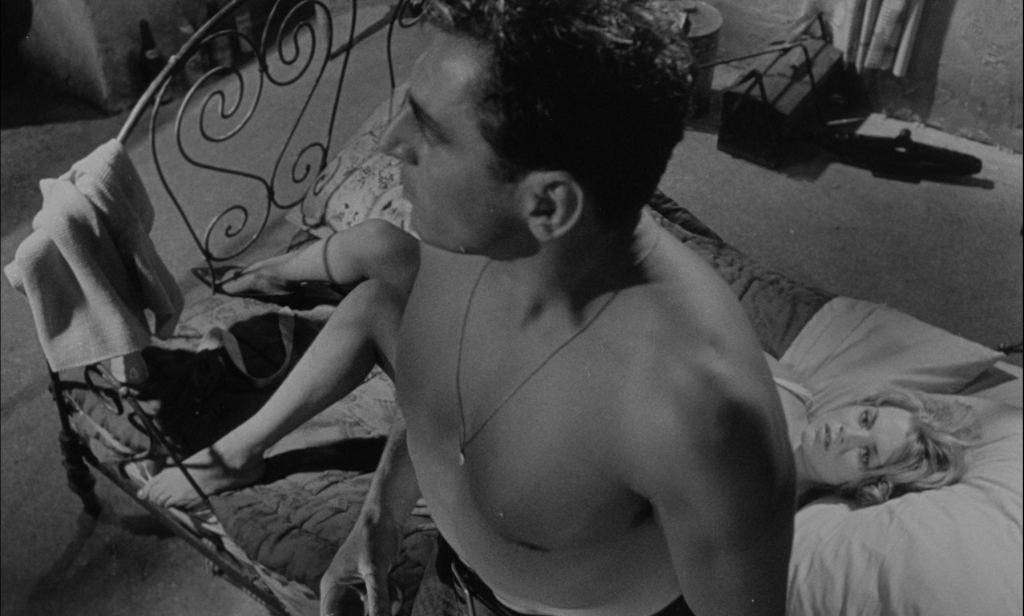
On December 14, Turner Classic Movies airs the super hard-to-find German neo-noir romance Black Gravel. It’s not streaming, so this is your best chance.
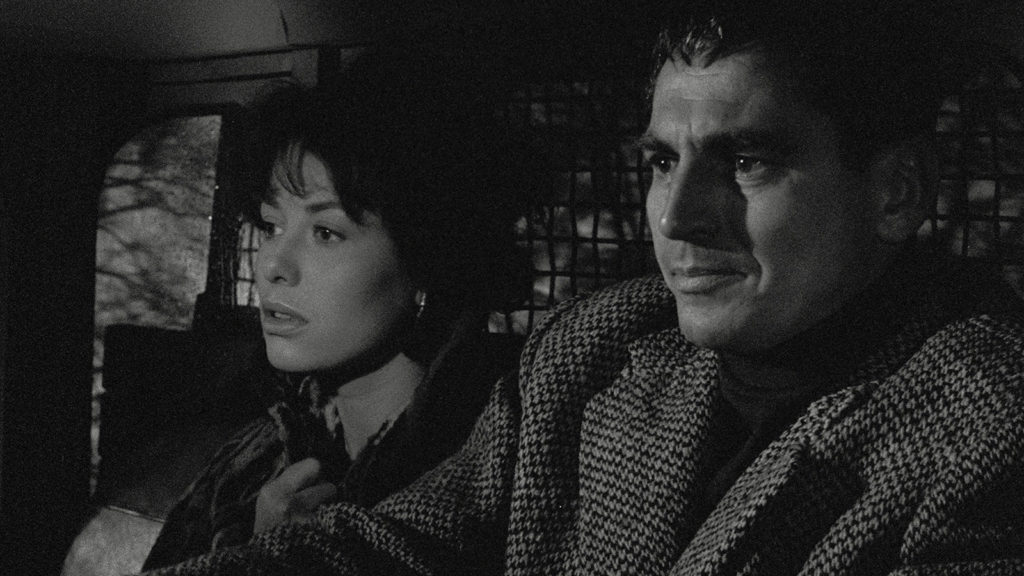
In the German film noirBlack Gravel (Schwarzer Kies), Inge, the beautiful German wife of an American military base commander, runs into the shady hustler Robert, her former lover. He is one cynical dude and an asshole, but he doesn’t pretend to be anything else. Their reunion is bad for her, bad for him and bad for everyone.
The most common situation in film noir is a guy who falls for a dame (or a dame who falls for a guy) to his ruin. The sap is infatuated and thinks he’s in love. Here we have two characters and the question is whether they are really in love. Robert insists that he doesn’t love ANYONE, even as he is trying to rekindle the romance with Inge. Inge insists that it’s over. But is it over – for either of them? That’s what – in the end – Black Gravel is really all about – noir romance
In the last twenty minutes, the circumstances swivel. Rarely has a movie plot swung as rapidly between They’re gonna get caught – No, they’re gonna get away with it – No, They’re gonna get caught – No, they’re gonna get away with it – No, They’re gonna get caught – No, they’re gonna get away with it – No, They’re gonna get caught.
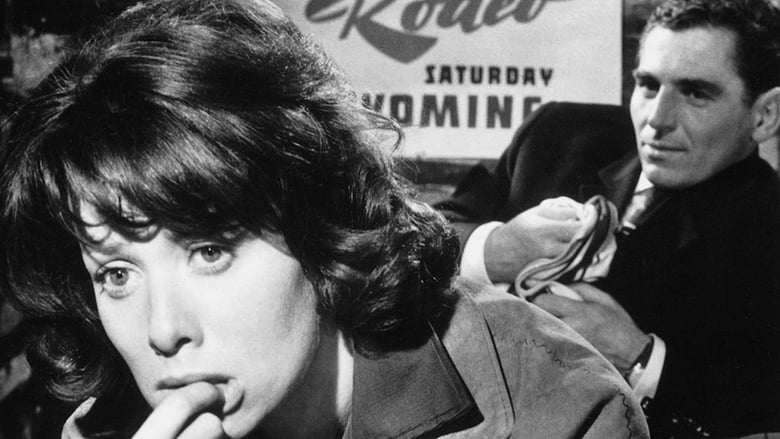
Ingmar Zeisberg and Helmut Wildt in BLACK GRAVEL
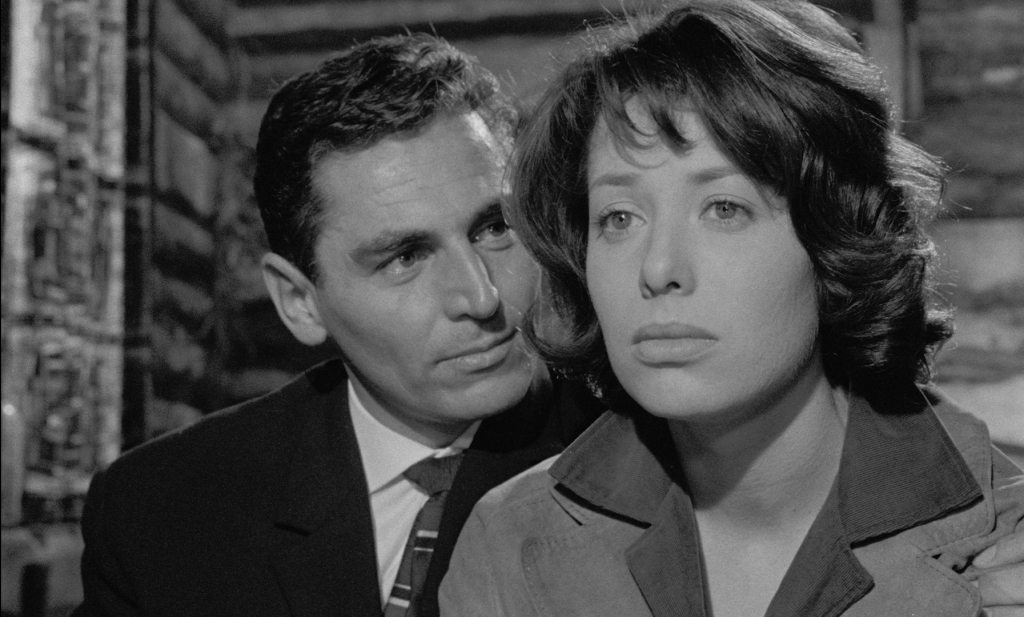
Robert is played by Helmut Wildt, a German actor I hadn’t seen before. He is charismatic and confident, with a breezy swagger that reminds me of Ben Gazzara. The deeply conflicted Inge is played ably by Ingmar Zeisberg.
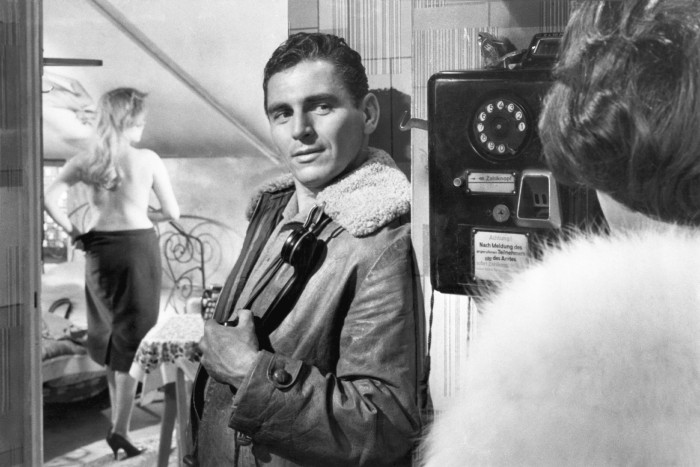
Anita Höfer, Helmut Wildt and Ingmar Zeisberg in BLACK GRAVEL
Black Gravel is set in a tiny German town corrupted by the presence of an US Air Force base, It’s the Phenix City of Germany, a sordid, trashy place. The character of Elli (Anita Höfer) is LITERALLY a slut.
Black Gravel is filled with tart observations of I Like Ike America, with its bland, conventional uniformity. The Germans are an amoral lot, reduced to leeching off the Americans. The Americans are clueless marks.
Helmut Wildt and Anita Höfer in BLACK GRAVEL
Note: A dog dies in the first minute of the film. I recommend that you don’t let this put you off this superb film; but, there it is, you’ve been warned.
The current version restores some bits that were cut from the film in 1961, supposedly as offensive to Jews. Those were probably the anti-semitic slurs uttered by unsympathetic characters; these slurs were not intended to debase Jews, but to illustrate the post-war continuation of antisemitism among Germans. (There’s some German racism in here, too). These are actually ANTI-antisemitic moments in the movie that were misunderstood at the time.
Unfortunately, it’s not streamable, but screenings can be booked from Kino Lorber, and it’s available for purchase in Blu-ray and DVD. I saw it at the 2020 Noir City.
Black Gravel was written and directed by Helmut Käutner. We don’t recognize this until late in the movie, but it turns out there’s no better noir romance than Black Gravel.
Photo caption: Frederika Milano and Gem Deger in ENDLESS SUMMER SYNDROME. Courtesy of NashFilm and Altered Innocence.
In the simmering French drama Endless Summer Syndrome, a professional couple and their two very attractive teenage kids are enjoying August, as upscale Parisians like to do, in a roomy, well-appointed country home. Their idyll is rocked when the mom is tipped off that the dad may be sexually involved with one of the adopted kids. She furtively investigates, trying to find out what is going on with whom. We know that there will be a reckoning once she finds out, but no one in the audience will guess the shattering ending.
First-time director and co-writer Kaveh Daneshmand keeps the tension roiling. All four actors give superb performances: Sophie Colon as the mom, Matheo Capelli as the dad, Frederika Milano as the daughter and Gem Deger as the son. Colon is especially effective, as the audience sees most of the developments (but not all) through her lens. I was surprised to learn that only one of the four actors (Capelli) has substantial film experience.
I screened Endless Summer Syndrome for the Nashville Film Festival. It releases into arthouse theaters this weekend.
Photo caption: Demi Moore in THE SUBSTANCE. Courtesy of MUBI.
Wow, this movie sizzles with originality and it’s a showcase for an emerging female filmmaker, but I’m not sure if you’ll want to watch it. In The Substance, writer-director Coralie Fargeat comments on all the perversity around the unrealistic ideals of female beauty by reimagining the classic Faustian bargain – what would you give up to restore physical youthfulness? Fargeat has made a sharply funny movie that melds the science fiction and horror genres. It’s absolutely brilliant, but some viewers may not be able to get past the body horror.
Elisabeth (Demi Moore) was a big movie star thirty years ago, and is now starring in a network fitness show (think Jane Fonda’s Workout franchise). Elisabeth is happy with her life until the male suits at the TV network tell that she’s passed her Sell By date and prepare to dump her for a younger, hotter starlet. The shock jars Elisabeth into a desperate spiral of body-loathing. Of course, this is absurd because I would describe Demi Moore as the world’s most beautiful 47-year-old woman, except she’s really 62.
Elisabeth finds a mysterious underground pharmaceutical (called The Substance) that will miraculously take 30 years off her appearance. There is a at least one catch. She has to inject a substance, which triggers the formation of a clone in a separate, younger body – but only for a week; then she needs to recover by re-inhabiting the older body. Off and on she goes, alternating weeks and the older and younger versions. Eventually, she learns about an even more significant side effect.
The clone is Sue (Margaret Qualley), who immediately is hired to replace Elisabeth on the show and vaults to stardom herself. With her celebrity, riches and stunning beauty, Sue’s life is pretty damn great – until each week is over. We soon realize that this is not going to end well for either Elisabeth or Sue.
There is a lot of body horror in The Substance, beginning with an icky “clone birth” scene and the weekly transitions between Elisabeth and Sue. The Substance ends with an over-the-top, splattering finale that makes Carrie look like a finger prick. It’s not going to work for most of my readers whom I know personally. I’m not a big horror fan and especially don’t care for body horror, but I’m glad I hung with it.
Margaret Qualley in THE SUBSTANCE. Courtesy of MUBI.
The Substance is the second feature for French writer-director Coralie Fargeat. Her first film Revenge (which I haven’t yet seen) won accolades as a feminist take on the rape revenge genre. To keep her right of final cut, Fargeat spurned Hollywood financing and made The Substance on spec. It is now the highest grossing film for MUBI, which bought the distribution rights. She knows what to do with the actors, the camera and the soundtrack, and is unafraid of coloring outside the lines. Wow, Fargeat is impressive.
The first three scenes are enrapturing. The first is an overhead shot of a broken egg, which is injected with a syringe and then clones a second yolk. The second scene is another overhead shot, this one of Elisabeth’s star on the Hollywood Walk of Fame, which traces the arc of her career. The third is of Elisabeth leaving the set of her show, as she absorbs the accolades of her stardom, the unwelcome birthday wishes and some rude hints to her aging out of being a sex symbol. Really smart storytelling.
Predictably, given my personal bias, I thought that the running time 2 hours, 20 minutes was too long, but it’s not like the movie dragged.
The male characters in The Substance are not very smart nor even minimally evolved; they are so broadly played that it’s even fun for men in the audience.
This is career-topping performance for Demi Moore, who , besides being uniquely physically perfect for the role, brings out all of Elisabeth’s yearnings and vulnerabilities – and her fraught ambivalence for continuing with The Substance. Moore is also a good sport about working under some some very extreme prosthetics.
Margaret Qualley always brings energy and magnetism to her performances, and she’s superb here as s Sue who, like Elisabeth, wants it all and wants it too much.
Dennis Quaid takes boorishness to new lows as a shamelessly sexist network boss. Quaid must have had lots of fun in this role, and he’s hilarious.
The Substance got a standing ovation at its premiere at Cannes, and won the People’s Choice Award at Toronto. The Substance is now streaming on Amazon and AppleTV, and it’s free on MUBI.
Photo caption: Saiorse Ronan and Elliott Heffernan in BLITZ. Courtesy of AppleTV.
In the WW II drama Blitz, Rita (Saiorse Ronan) is a single mom who, like all Londoners, must endure The Blitz, the 8-month German terror bombing of civilian London. Over a million English city-dwellers were evacuated to the countryside, and half of them were children. Rita’s own nine-year-old son George (Elliott Heffernan) is set to be sent to safety while she remains at her job in a munitions factory.
This plan angers George, and he bolts, running amok through London. His adventures, and Rita’s terrified search for him when she finds him missing, make up the core of Blitz. It is a child-in-peril story, but not one where the adult protagonist rescues the child. Rita may be played by a big movie star, but this is George’s story and a portrait of his determination and resourcefulness.
George is multi-racial, which is hard to be in 1940 England, where he looks different that just about everyone else. As he runs a gauntlet of racist attitudes, it’s a huge relief whenever George encounters someone with even minimal kindness.
Elliott Heffernan in BLITZ. Courtesy of AppleTV.
Writer-director Steve McQueen’s biggest achievement in Blitz is to tell this story so compellingly from the child’s point of view. Sometimes George isn’t scared when he should be, and sometimes he is overwhelmed by a situation any adult could handle. McQueen certainly found the right actor to play George in Heffernan, who captures George’s vulnerabilities as well as his underlying reservoir of tenacity.
McQueen also pulls off a well-paced thriller and makes the audience feel the historical context. We’ve all seen depictions of The Blitz with the air raid sirens, blackout wardens and plucky Brits sheltering in the Underground and emerging to see the rubble, carnage and fire. But not like this. McQueen’s Blitz is vivid, uncomfortable and terrifying.
There is a spectacular scene at a ritzy hotel’s nightclub, complete with a Cab Calloway-like band and an extra-long tracking shot through the kitchen, an homage to Martin Scorsese’s famous Copacabana shot in Goodfellas. I understand that McQueen would argue that this scene sets up a brief moment later in the film, but it really isn’t necessary and McQueen is just showing off his skills (and AppleTV’s budget). It’s fun, though.
What McQueen fails to deliver, though, is multi-dimensional characters (with the exception of George). Pretty much every non-George character is just one thing – officious, bigoted, evil or saintly.
The is, however, more than a glimmer of texture in a performance by one of my favorite actors, Stephen Graham, who often plays a troubled cop or a criminal psycho in British crime shows like Line of Duty and Little Boy Blue. Graham has a small role as a depraved gang leader, and he makes the character despicable and unhinged and scary and damaged. Grahamhas worked in US films, too, as an Italian-American mobster in Martin Scorsese’s The Irishman, Scrum in the Pirates of the Caribbean franchise, Al Capone in Boardwalk Empire and Baby Face Nelson in Michael Mann’s Public Enemies.
Blitz is a fine adventure yarn, evocative history and a visually impressive film. Blitz is now streaming on AppleTV.
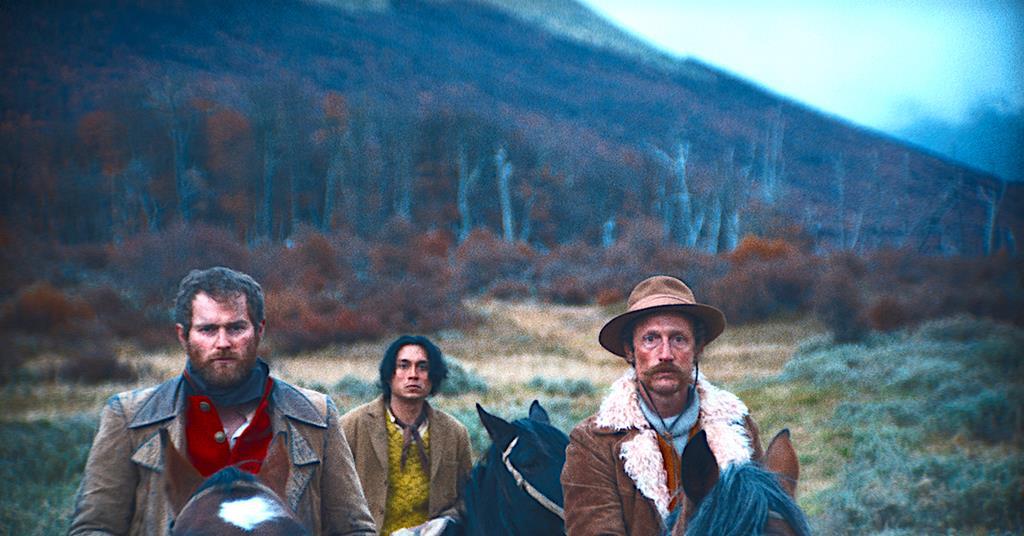
Photo caption: Mark Stanley, Camilo Arancibilia and Benjamin Westfall in THE SETTLERS. Courtesy of MUBI.
The grimly beautiful Chilean drama The Settlers takes us to Tierra del Fuego in 1901 where Spanish tycoon Jose Menendez (Alfredo Castro) is setting up a massive sheep ranch on 250,000 acres that spans across both Chile and Argentina. Menendez assigns his foreman, a ruthless Scot former soldier, Alexander MacLennan (Mark Stanley), to clear out the indigenous residents, who are inconveniently eating some of the sheep. Melendez makes it clear to MacLennan that he wants the indigenous people exterminated. Melendez and MacLennan are real historical figures, and these events are known as the Selk’nam Genocide.
MacLennan is assigned Bill (Benjamin Westfall), an American veteran of Indian conflicts. He also brings along the half-indigenous local man Segundo (Camilo Arancibilia). Neither MacLennan or Bill sees any humanity in the indigenous, and go about their work as if they were eradicating household pests. It’s pretty awful. There is some on-screen gore, but we experience most of the horror through the reaction of Segundo.
The Settlers jumps ahead almost a decade to explore the impact of the events on some of the key characters and their loved ones. There has to be a reckoning, after all, even if it can’t be fully satisfying.
Sobering as it is, The Settlers is remarkably fine cinema, and is an impressive debut feature for director Felipe Galvez Haberle. The matter-of-fact brutality is almost dwarfed by the stark, vast expanses of Patagonia. Some of the landscape shots by cinematographer Simone D’Arcangelo (The Tale of King Crab) are absolutely breathtaking. The unsettling story is enhanced by a soundtrack reminiscent, but not derivative of, Ennio Morricone’s spaghetti western scores.
First time actress Mishell Guana is very powerful as an indigenous woman. Sam Spruell colorfully brings alive a rogue British colonel (think Kurz in Apocalypse Now!).
The Settlers played in the Un Certain Regard program at Cannes, winning the FIPRESCI prize, and has won awards at a slew of other international film festivals. The Settlers is streaming on MUBI.
Photo caption: Sav Rodgers in CHASING CHASING AMY. Courtesy of Level 33 Entertainment and Kino.
In the irresistible documentary Chasing Chasing Amy, filmmaker Sav Rodgers tells his own highly personal story of finding sanctuary in a romantic comedy, a movie that ultimately spurs a both a filmmaking career and his transition to trans man. Rodgers weaves in parallel tracks, the origin story of the 1997 movie Chasing Amy, and thoughtful discussion of how that film, after 25 years of cultural evolution, has aged. Chasing Chasing Amy seamlessly braids together the fictional love story in Chasing Amy with the stories of real life relationships, including his own.
Chasing Chasing Amy‘s writer-director Savannah Rodgers grew up a bullied lesbian in small town Kansas, and found lesbian representation in an old DVD of Chasing Amy, which became a lifesaver. When Kevin Smith himself heard Rodgers’ TED Talk, he connected with Rodgers and supported her (and then his) filmmaking career. All this is contained in Chasing Chasing Amy along with some revelations.
The novelty of Chasing Amy is a straight man and a lesbian as inseparable soulmates, and we learn that Kevin Smith modeled this after his real life friends, his producer Scott Mosier and the screenwriter Guinevere Turner. Turner had written the lesbian coming of age film Go Fish, which was on the festival circuit along with Smith and Mosier’s Clerks; Turner later wrote the screenplays for American Psycho and The Notorious Bettie Page.
But the core of Chasing Amy’s narrative is a love affair sabotaged by the guy’s insecurities, mirroring Smith’s own less-than-two-year relationship with Joey Lauren Adams, who plays Alyssa, the main female character.
Rodgers meets Smith himself, who becomes a mentor, and we get current on-camera interviews with Smith, Adams and other principals. There’s a shoulder-to-shoulder joint interview with Smith and Adams, followed by a sobering solo interview with Adams. Along the way, Rodgers matures from a gushing fan girl to a grownup who recognizes the personal flaws that complicate other people’s relationships. Smith comes off well here, and if Rodgers seems too adoring of Smith in most of the film, just wait until her final interview with Joey Lauren Adams.
Chasing Amy was director Kevin Smith’s 1997 masterpiece, with a groundbreaking lesbian/bi-sexual leading lady; but, after 25 years of cultural evolution, some elements now seem stale and even embarrassing. The leading male character is Holden, played by Ben Affleck. His buddy and wingman is Banky, played by Jason Lee, and Banky (to Lee’s off camera discomfort) is unspeakably vulgar and homophobic, a whirlpool of toxic masculinity. But of course, Banky is there to highlight Holden’s comparative evolved tolerance and openness. As an exasperated Kevin Smith says, ‘Banky is the idiot“. However, were Smith to make the same movie today, he would certainly still make Banky offensive, but not so over-the-top offensive.
Some viewers saw in Chasing Amy a toxic male fantasy of a “the right” straight male being able to “convert” a lesbian to heterosexuality. But Alyssa is a bisexual character, as is explicitly depicted in the movie when her lesbian friends react to her fling with Holden. She’s just a bisexual who is more than he is emotionally able to handle.
The story of Sav Rodgers winds from Kansas and the TedTalk, through her long relationship and now marriage, and final, the transitioning into a he/him trans man. Rodgers grows from a naïf into a grown ass man, albeit one that is still earnest, sweet and wears his emotions on his sleeve.
That Rodgers tells such a highly personal story along with the origin story of Chasing Amy and subsequent film and cultural criticism is impressive and ever watchable. I screened Chasing Chasing Amy for the San Luis Obispo Film Festival. It releases into theaters tomorrow.
Photo caption: Kieran Culkin and Jesse Eisenberg in A REAL PAIN. Courtesy of Searchlight Pictures.
Jesse Eisenberg’s A Real Pain begins as an odd couple comedy and evolves into something much deeper. Cousins David (Eisenberg) and Benji (Kieran Culkin) adored their late grandmother and are honoring her by taking a pilgrimage to Poland to see her homeplace and the Nazi death camp that she survived.
The two forty-year-olds were inseparable growing up, but have drifted apart as adults. David, although he takes medication for his OCD, is highly functional; he has a solid job and lives in NYC with his beautiful wife and adorable son. Benji still hasn’t landed anywhere outside of his family’s upstate basement.
David is a little neurotic and little uptight, but his behavior is well within the normal band; he would be an amiable traveling companion. On the other hand, Benji is erratic, unfiltered and immune to embarrassment and social convention. They have signed up for a guided group tour, and Benji’s unrelenting, inappropriate antics mortify David. To the audience, it looks like Benji is the Real Pain of the title.
But, as the story is unspooled, we learn that Benji is just not quirky – he’s a very damaged human being. His emotional distress is the source of the film’s title. David is frustrated that he cannot fix Benji’s pain, and the ambiguity in the ending is very truthful.
Kieran Culkin’s performance as Benji is extraordinary. He captures all Benji’s charm, impulsiveness, empathy, and profound, underlying sadness.
The rest of the cast is very good, especially Jennifer Grey (yes, THAT Jennifer Grey) as a tour group member and Will Sharpe (White Lotus) as their guide.
Eisenberg wrote and directed A Real Pain as well as starring in it. Eisenberg has said that he was exploring the contrast between “epic pain” (e.g., the Holocaust and its continuing impact) to “more modern pain” (i.e., the real anguish of we who may be hurting personally, but don’t have to worry about survival). The grandmother’s house that David and Benji eventually find is the real former home of Eisenberg’s own relatives.
As a screenwriter, Eisenberg demonstrates real talent for subtlety, in creating a unique character and in exploring sobering topics, leavened with just enough humor. And, as a director, Eisenberg gets some credit for Culkin’s performance.
The soundtrack is almost entirely Chopin, which is both Polish and (vital for indie filmmakers) in the public domain. The Wife found it distracting, and it had a somnolent effect on me.
Watching A Real Pain does not tantalize the viewer into planning a trip to Poland.
Eisenberg’s character David is always wearing a University of Indiana baseball cap. That’s interesting because Indiana is the perennial doormat of Big Ten football and has actually lost more games than any other team in the 140-year history of college football. What Eisenberg could not have possibly known when shooting the film is that Indiana football would be having its best year ever, and, as I write this, is a shocking 10-0.
You might get the impression from the trailer below, as I did, that A Real Pain is lighter than it is. A Real Pain is now in theaters.