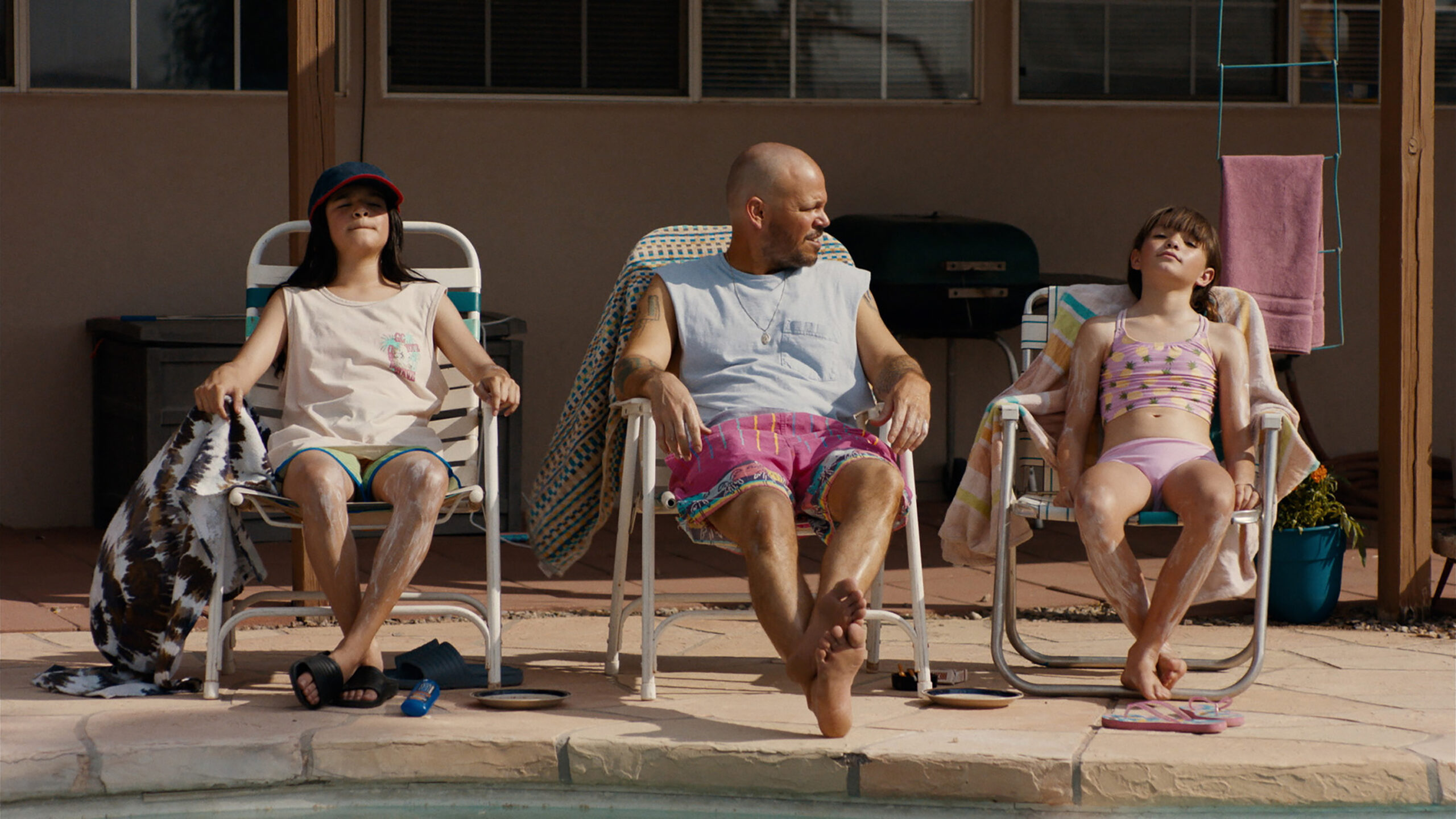
Photocaption: Rene Perez Joglar (center) in IN THE SUMMERS. Courtesy of NashFilm and Music Box Films.
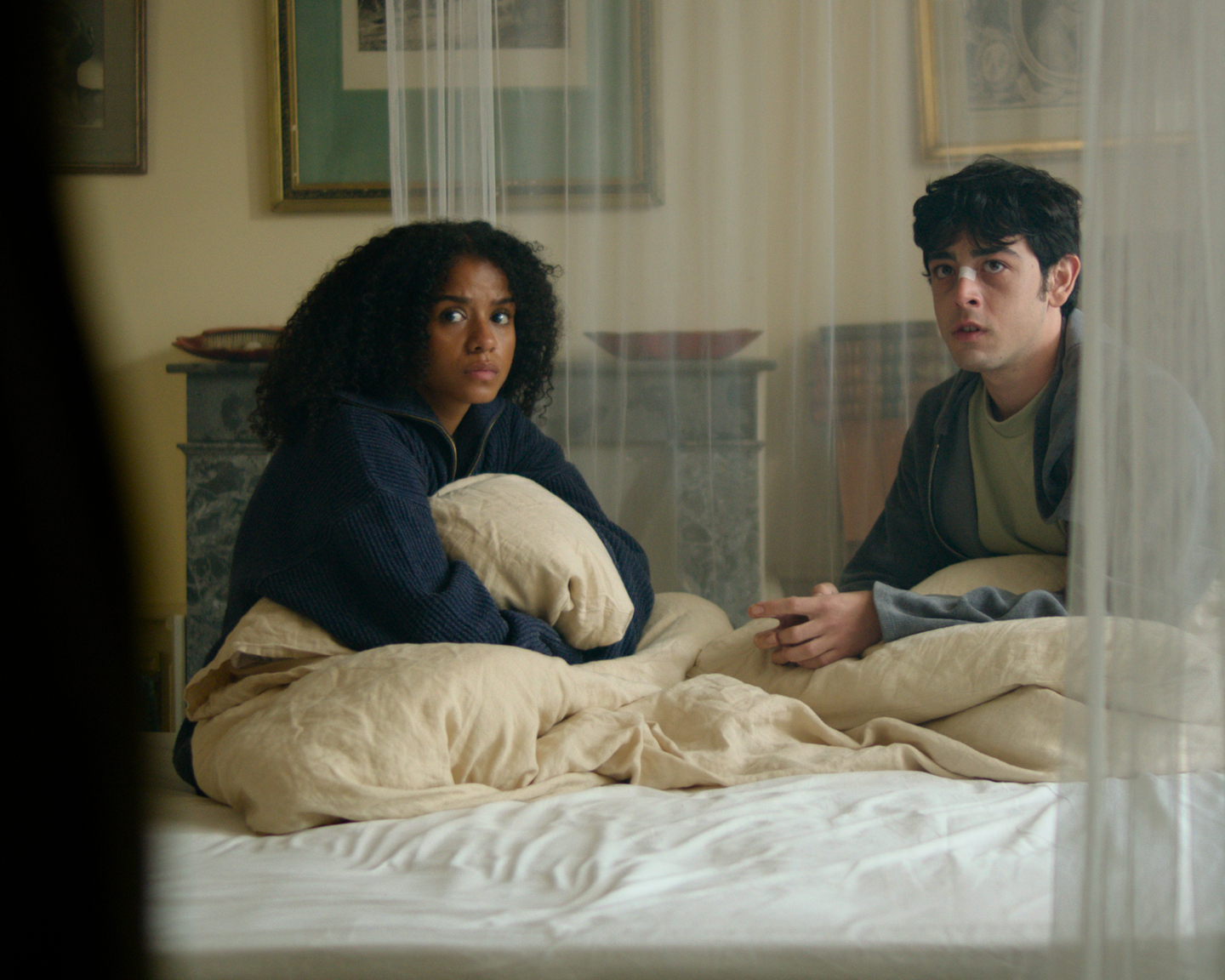
In the remarkably authentic and evocative In the Summers, two sisters fly to Las Cruces, New Mexico, for annual summer visits with their divorced dad. The father, Vincente, played by Rene Perez Joglar (AKA the rapper Residente) is a spirited and talented underachiever who tries to show them a Disney Dad experience; the girls soak up the fun, but also absorb lessons about Vincente’s less reliable characteristics. Each summer, the girls return to Las Cruces with additional savvy and sponge up real world lessons from Vincente’s changing behavior.
The girls arrive expecting last year’s Vincente, but they get a new model, shaped by his changing circumstances and emotional needs, and reflecting how he sees himself. From year to year, Vincente bounces between unearned swagger to self-loathing distraction to an uneasy humility. It’s a compelling coming of age for the daughters.
Carmen (Emma Ramos), the bartender at the local pool hall, is the one consistent sounding board who can validate what the girls are experiencing with their dad.
Joglar’s performance, only his second acting role in a narrative feature and first lead, is remarkable. He is able to portray a character who is the same man at the core, but whose behavior each year is formed by the cumulative slings and arrows of his life.
The three sets of actors playing Violeta and Eva as they mature (Dreya Castillo and Luciana Eva Quinonez, Kimaya Thais and Allison Salinas, Sasha Calle and Lio Meliel) are excellent. So is Emma Ramos (New Amsterdam) as Carmen.
Writer-director Alessandra Lacorazza Samudio is able to convey so much narrative without spoon-feeding the audience. She positions the audience in the point of view of the watchful daughters, as they they to assess what is going on with their own father. She also gets fine performances out of actors with little or no movie experience. In the Summers is a triumphant debut feature for Lacorazza and marks the emergence of very promising filmmaker,
In the Summers was my favorite film at last month’s Nashville Film Festival, and it’s now in arthouse theaters.
Photo caption: Adam Driver and Nathalie Emmanuel in MEGALOPOLIS. Courtesy of Lionsgate.
The epic Megalopolis is Francis Ford Coppola’s labor of love, a project he had been imagining since the 1970s. I’m glad he finally got to make the movie he wanted to make. Sadly, it’s not good.
Megalopolis is set later in this century in a New York City fictionalized as New Rome. Cesar Catilina (Adam Driver), a visionary urban designer, seeks to replace midtown Manhattan with his creation, a utopian built environment. From his aerie atop the Chrysler Building, Cesar is as unaccountable Robert Moses in The Power Broker. Cesar must overcome the resistance of the vision-impervious mayor Cicero (Giancarlo Esposito), the psychotically venal aristocrat Clodio (Shia LaBeouf) and Cesar’s own ruthlessly avaricious mistress Wow Platinum (Aubrey Plaza). Mayor Cicero’s Wild Child daughter Julia (Nathalie Emmanuel) sets out to punish Cesar for Cesar’s disrespect to her father, but she becomes fascinated by him.
Obviously, no one can imagine razing and rebuilding 100 contiguous square blocks of Manhattan without some hubris, and Cesar has plenty. Of course, he has invented a miracle building material, won a Nobel Prize and has the super power of stopping time. But his hubris makes him underestimate his enemies at his peril. Soon, Cesar and New Rome are plunged into a convulsion of betrayal and treachery. Will Cesar and his vision survive?
The visuals are astounding. New Rome is so dystopian that we yearn for the Times Square of Joe Buck, Ratso Rizzo and Travis Bickle. Ben Hur-like gladiator battles emerge, and a circus looks like Baz Luhrman’s Moulin Rouge. There’s no shortage of eye candy.
Unfortunately, there are also no shortage of movie-killing flaws. The first is the revolting pretentiousness. Each chapter is introduced with a self-important title, carved into stone, no less. Great Thinkers, from Marcus Aurelius to Ralph Waldo Emerson, are quoted, and, just in case that isn’t elevated enough, Latin is occasionally uttered. Every time poor Lawrence Fishburne speaks in voice-over, he’s proclaiming something ridiculously heavy-handed without any irony. All of these Great Thoughts are about as deep as the inside of a Hallmark greeting card.
The second major flaw is that Megalopolis is a message movie with a message that is naive and simplistic. Coppola seems to have missed the core lesson in The Power Broker, which is that the tradeoff for letting an unaccountable visionary build great things in a city, is that the result may be unjust, and that regular people are stripped of any ability to control their own lives. Everybody likes freedom, which requires the messiness and inefficiency of democracy. Coppola wants us to root for Cesar because he is vaguely high-minded, but letting Cesar have his way on everything is pretty disrespectful of Cesar’s fellow citizens.
Third, with one exception, the characters are cartoonish, like they’ve been pulled from a Batman movie. As a result, we don’t care about them. For example, there’s never been an actress better equipped to play a dangerous, sexy conniver than Aubrey Plaza; but here, Plaza only gets to act like a comic strip version of a dangerous, sexy conniver. Clodio is a silly cross between a Bond villain and Dr. Frank-N-Furter from The Rocky Horror Picture Show (and Shia LaBeouf ‘s eye makeup sometimes makes him resemble TV character actor Anthony Zerbe). Cesar himself toggles between smug and tortured with little texture.
Finally, the story is often incomprehensible.
This all makes for a wretched movie-viewing experience.
There are a few bright spots. Nathalie Emmanuel seems to be acting in a different movie than the rest of the cast, and imbues her Julia with life force, charisma and genuine feelings. Ratso Rizzo and Joe Buck themselves are back in very small parts. Dustin Hoffman sparkles as a big city fixer. Jon Voight plays a doddering financier with the dulled eyes and speaking mannerism of Donald Trump – very funny. And what about the name of Aubrey Plaza’s character – Wow Platinum? What would her stripper name be?
It pains me to pan a Coppola movie. Casablanca remains my favorite all-time movie, but The Godfather Part II is probably my #2. Godfather II, along with The Godfather, The Conversation and Apocalypse Now! are films that have impacted me deeply. That being said, as fond of Coppola as I am, and even reverential, I haven’t been enraptured by his post-1979 body of work.
In the first 20 minutes of Megalopolis, I resolved that I didn’t care about any aspect of the film and was going to walk out, but somehow stayed for the entire two hours, eighteen minutes, You don’t need to.
This week on The Movie Gourmet – a new review of the charming dramedy Tokyo Cowboy, opening in the Bay Area at the Lark. The fall movies are beginning to cascade into theaters and VOD, and I hope to screening FOUR new movies in the next few days.
CURRENT MOVIES
Thelma: too proud to be taken. Amazon, AppleTV, YouTube, Fandango.
Perfect Days: intentional contentment. Amazon, AppleTV, YouTube, Fandango, Hulu (included).
Hit Man: who knew self-invention could be so fun? Netflix.
I Saw the TV Glow: brimming with originality. Back in some theaters and Amazon, AppleTV; Fandango.
The Bikeriders: they ride, drink and fight, and yet we care. Amazon, AppleTV, YouTube, Fandango, Peacock (included).
Ghostlight: a family saves itself, in iambic pentameter. Amazon, AppleTV, YouTube, Fandango (included).movie of Truman Capote’sresearch and wrting of In Cold Blood,
Challengers: three people and their desire. Amazon, AppleTV, YouTube, Fandango.
La Chimera: six genres for the price of one. Amazon, AppleTV, YouTube, Fandango.
ON TV
On September 30, Turner Classic Movies presents Capote, the 2005 story of Truman Capote’s research and writing of In Cold Blood. Philip Seymour Hoffman won his Oscar for playing Capote. Capote was the first time I noticed, Clifton Collins, Jr., who is great as the killer Perry Smith.
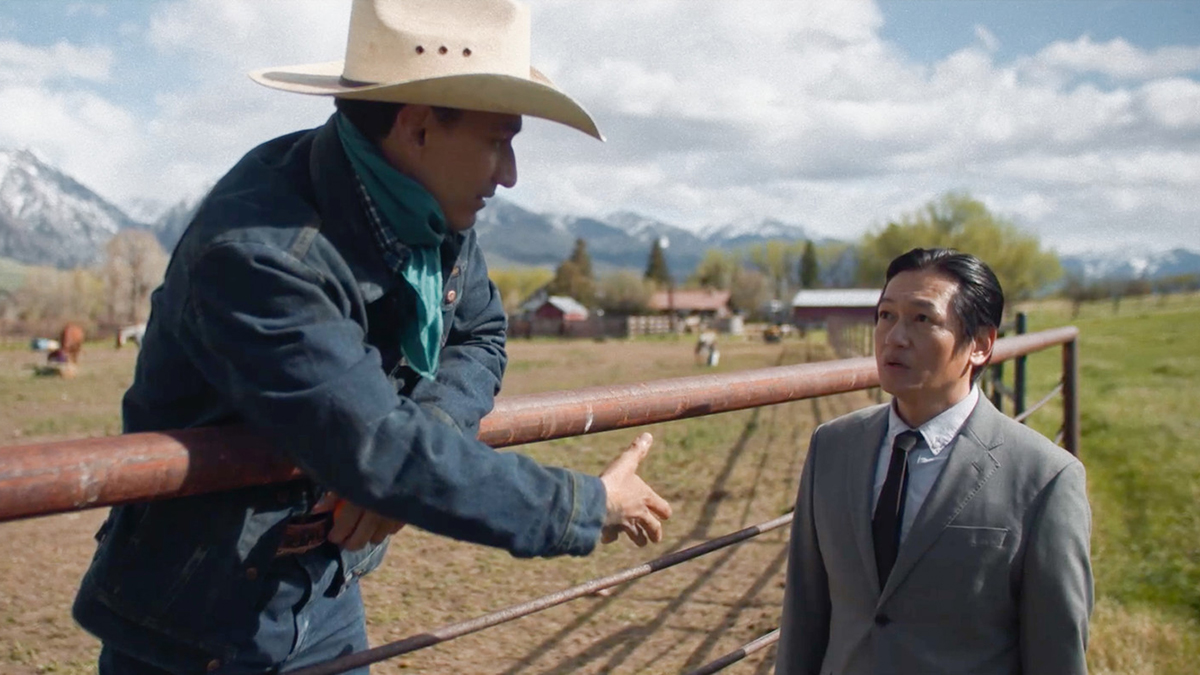
Photo caption: Goya Robles and Arata Iura in TOKYO COWBOY. Courtesy of Salaryman.
The charming dramedy Tokyo Cowboy centers on a Japanese corporate turnaround artist, Hideki (Arata Iura). Confident that he has the secret sauce to recharge any stagnant brand, he’s got a slick pitch deck (with a snapshot from his own childhood), and he’s engaged to the corporate vice-president he reports to. His company is about to liquidate a money-hemorrhaging cattle ranch in Montana, when he parachutes in for a quick fix. His Japanese beef consultant goes hilariously native, and Hideki, a smart guy, immediately sees that his idea for a quick fix was mistaken. Now unsettled and off the grid in an alien culture, Hideki recalibrates his values and his life goals.
Arata Iura’s performance is exceptional, especially since the character of Hideki is a restrained man from a very reserved culture, a cypher who is dramatically changing internally. Ayako Fujitani is very good a Hideki’s fiancé/boss Keiko. Robin Weigert (Calamity Jane in Deadwood) is excellent as the ranch manager. Jun Kunimura (222 IMDb credits) is hilarious as Hideki’s cattle expert.
Arata Iura and Ayako Fujitani in TOKYO COWBOY. Courtesy of Salaryman.
It’s the first narrative feature for director Marc Marriott, who, with cinematographer Oscar Ignacio Jiménez, creates a Big Sky setting that could reset any of us in need of self-discovery. Some directors would have ruined this story by making the fish-out-water comedy too broad or the self-discovery too self-important, but Marriott strikes the perfect tone. The screenplay was co-written by Ayako Fujitani (who plays Keiko)) and Dave Boyle.
I screened Tokyo Cowboy for the SLO Film Fest, where it won the jury award for Best Narrative Feature. Tokyo Cowboy opens on September 28 at the Lark in Larkspur and on October 25 at the Palm in San Luis Obispo.
Photo caption: Keith Kupferer and Katherine Mallen Kupferer in GHOSTLIGHT. Courtesy of IFC Films.
This week on The Movie Gourmet, as we are on the verge of what looks like a rich fall movie season, I’m recommending another look at an overlooked little movie from earlier this year, the endearing family drama Ghostlight, available to watch at home on Amazon, AppleTV, YouTube, Fandango (included). The acting in Ghostlight, which won the audience award at SCSW, is superbly authentic. The actors playing the family members are an actual dad, mom and daughter. One of the best movies of the year.
CURRENT MOVIES
Thelma: too proud to be taken. Amazon, AppleTV, YouTube, Fandango.
Perfect Days: intentional contentment. Amazon, AppleTV, YouTube, Fandango, Hulu (included).
Hit Man: who knew self-invention could be so fun? Netflix.
I Saw the TV Glow: brimming with originality. Back in some theaters and Amazon, AppleTV; Fandango.
The Bikeriders: they ride, drink and fight, and yet we care. Amazon, AppleTV, YouTube, Fandango, Peacock (included).
Ghostlight: a family saves itself, in iambic pentameter. Amazon, AppleTV, YouTube, Fandango (included).
Challengers: three people and their desire. Amazon, AppleTV, YouTube, Fandango.
La Chimera: six genres for the price of one. Amazon, AppleTV, YouTube, Fandango.
ON TV
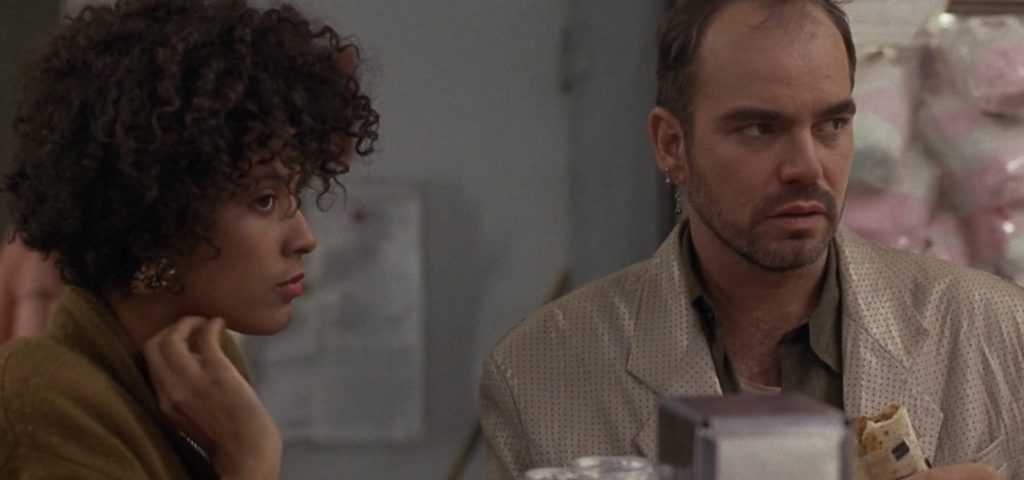
Cynda Williams and Billy Bob Thornton in ONE FALSE MOVE
On September 21, Turner Classic Movies presents the gripping contemporary neo-noir One False Move. This is a fundamentally noir story – there are guys overreaching for greed and ambition, a femme fatale, and a very dark secret. America’s original sin – race – is at the core of One False Move.
The tale begins with a home invasion in Los Angeles. Two vicious professional robbers, with one’s beautiful girlfriend, steal money and cocaine, leaving a trail of corpses. The crime is solved right away – the cops know who did it and that the murderers are headed to a small town in Arkansas. The LA cops fly to Arkansas and lay in wait with the local constabulary. One False Move is a ticking time bomb as we wait for the criminals to drive across the Southwest to the inevitable confrontation.
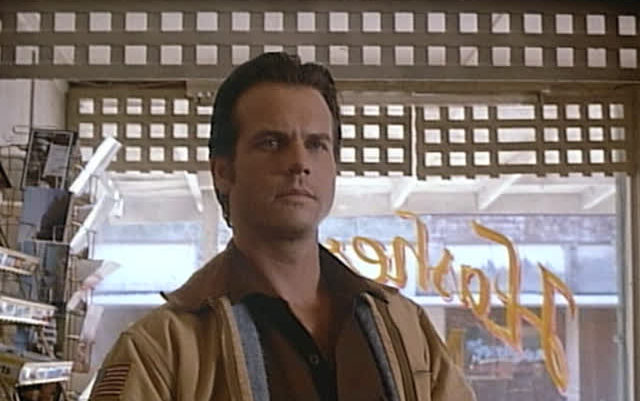
One False Move features a great performance by the late Bill Paxton. It’s one of my Overlooked Neo-noir, and can also be streamed from Amazon, AppleTV, Vudu and YouTube.
Rene Perez Joglar (center) in IN THE SUMMERS. Courtesy of NashFilm and Music Box Films.
While the Nashville Film Festival has its share of high-profile movies, don’t miss the discoveries that are screening under the radar. Here are three films by new directors and an indie doc with 100% African-American voices. These movies are why we go to film festivals.
In the Summers: in this remarkably authentic and evocative narrative, two sisters fly to Las Cruces, New Mexico, for annual summer visits with their divorced dad. The father, Vincente, played by Rene Perez Joglar (AKA the rapper Residente) is a spirited and talented underachiever who tries to show them a Disney Dad experience; the girls soak up the fun, but also absorb lessons about Vincente’s less reliable characteristics. Each summer the girls return with additional savvy and sponge up real world lessons from Vincente’s changing circumstances and behavior. It’s a compelling coming of age for the daughters, but the changes each year in the dad, bouncing from unearned swagger to self-loathing distraction to an uneasy humility, are just as forceful. The three sets of actors playing the daughters as they mature are excellent, as is Joglar. In the Summers is a triumphant debut feature for writer-director Alessandra Lacorazza Samudio, who coveys so much without spoon-feeding the audience.
To a Land Unknown: This searing thriller takes us to Athens, into the underground world of Palestinian migrants stuck until they acquire false passports that will get them into Germany. Yasser (Mohammed Ghassan) is a decent family man forced into low level criminality to survive and raise money for the forged passport; he is also burdened by responsibility for his cousin, whose drug addiction is a ticking bomb. Repeatedly exploited and defrauded, Yasser conceives of one very risky way out – to scam the very human traffickers preying on him. Ghassan is excellent, as is Angeliki Papoulis as a fun-loving but clear-eyed Greek woman also living in the margins. To a Land Unknown is the gripping first feature for Dubai-born Mahdi Fleifel, who works between Britain, Denmark and Greece.
A King Like Me: This fun and thoughtful doc tells the story of the all-African-American Mardi Gras parading organization, Zulu Social Aid and Pleasure Club. A King Like Me traces the journey of this 100+-year-old New Orleans cultural institution as it survives Jim Crow, Hurricane Katrina and COVID-19, and faces a sensitive question – should African-American men continue to publicly parade in black face? This movie is brimming with humanity.
Endless Summer Syndrome: A professional couple and their two very attractive teenage kids are enjoying August, as upscale Parisians like to do, in a roomy, well-appointed country home. Their idyll is rocked when the mom is tipped off that the dad may be sexually involved with one of the adopted kids. She furtively investigates, trying to find out what is going on with whom. We know that there will be a reckoning once she finds out, but no one in the audience will guess the shattering ending. First-time director and co-writer Kaveh Daneshmand keeps the tension simmering. The performances are superb, and I was surprised to learn that only one of the four actors has substantial film experience.
Will Ferrell and Harper Steele in WILL & HARPER. Courtesy of Netflix.
The always exquisitely curated Nashville Film Festival opens on Thursday, September 19 and runs through September 25 with a diverse menu of cinema. The Nashville Film Festival is the oldest running film festival in the South (this is the 55th!) and is an Academy Award qualifying festival. The program includes a mix of indies, docs and international cinema, including world and North American premieres.
Programming Director Lauren Thelen says, “I’m impressed, honored and excited to screen this year 150 films from 25 countries. I continue to be impressed by the diverse range of cinema out there, and I’m eager to see how our audience will react.”
I’ve sampled the program and, later this week, will recommend three films by new directors and an indie doc with 100% African-American voices.
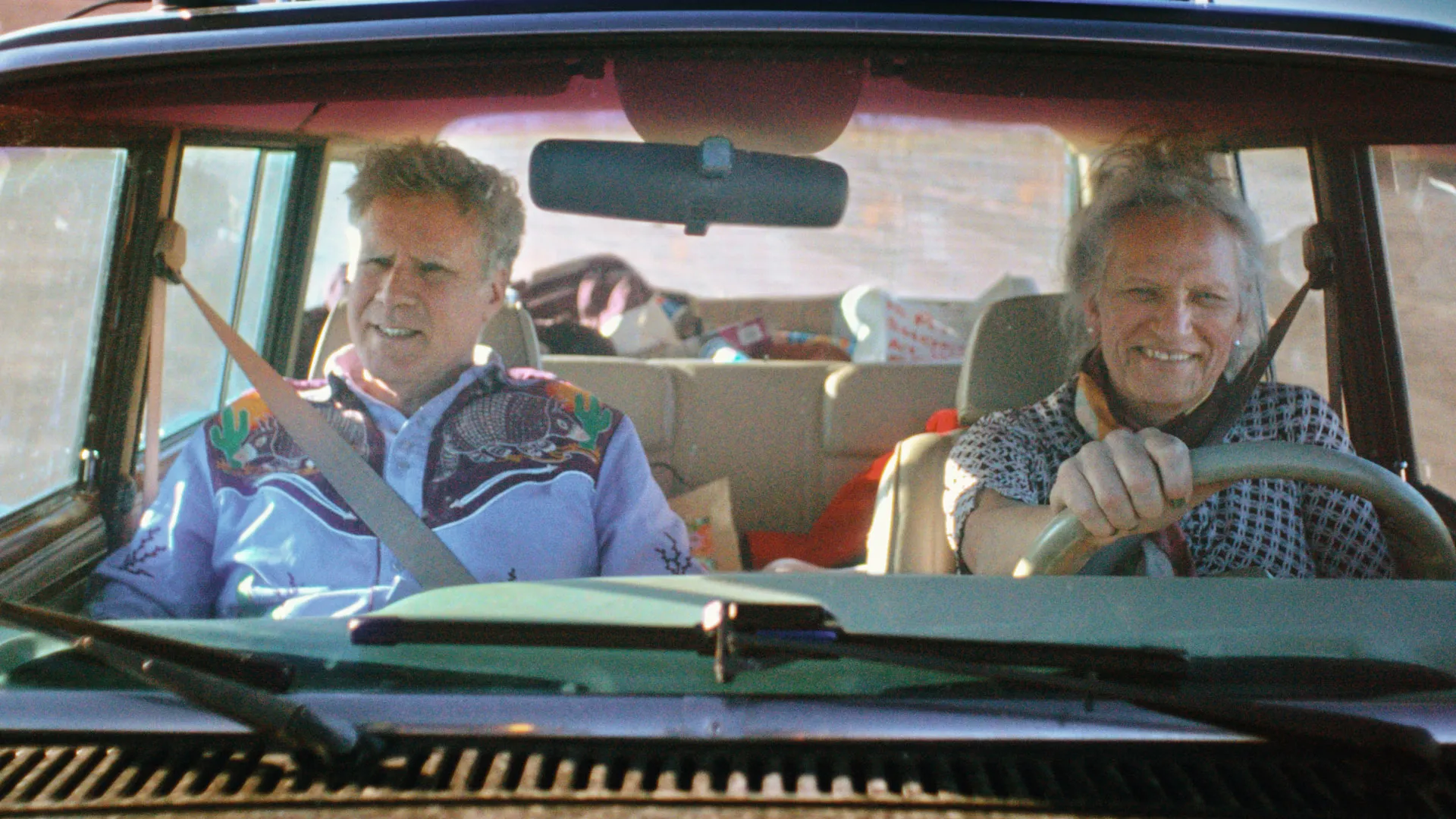
One sure fire crowd-pleaser will be the Netflix doc Will & Harper, featuring a road trip by Will Farrell and his longtime friend, former SNL writer Harper Steele, who has transitioned.
See it here first: several films in the program have already secured distribution and will be available to theater and/or watch-at-home audiences. Before just anybody can watch them, you can get your personal preview at the Nashville Film Festival: Will& Harper, Bob Trevino Likes It, In the Summers, Exhibiting Forgiveness and Endless Summer Syndrome.
Check out the program and buy tickets at the festival’s Film Guide. Watch this space in a couple days for my NashFilm recommendations. Here’s the festival trailer.
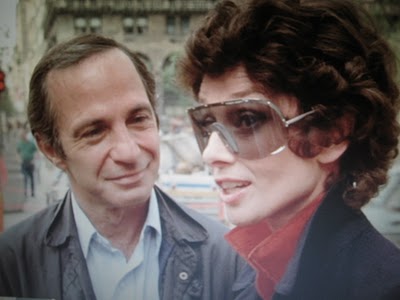
Photo caption: Ben Gazzara and Audrey Hepburn in THEY ALL LAUGHED
This week on The Movie Gourmet, Turner Classic Movies presents one of my favorite overlooked movies, the extremely hard-to-find THEY ALL LAUGHED. Peter Bogdanovich’s 1971 film elevates the entire rom com genre. The middleaged romance between Ben Gazzara and Audrey Hepburn is exquisitely wistful and authentic. John Ritter leads an endearingly funny supporting cast with Patti Hansen, Blaine Novak, Dorothy Stratton and Colleen Camp. Ritter’s comedic performance is itself a masterpiece – right up there with the best of Chaplin, Keaton and Cary Grant. They All Laughed remains an essentially lost film, although you can find the DVD. Set your DVR to record the TCM screening on September 15.
REMEMBRANCE
James Earl Jones’ expressive face, imposing bearing and authoritative voice won him an Oscar for THE GREAT WHITE HOPE. The voice was enough by itself to dominate the STAR WARS franchise as Darth Vader.
CURRENT MOVIES
Thelma: too proud to be taken. Amazon, AppleTV, YouTube, Fandango.
Perfect Days: intentional contentment. Amazon, AppleTV, YouTube, Fandango, Hulu (included).
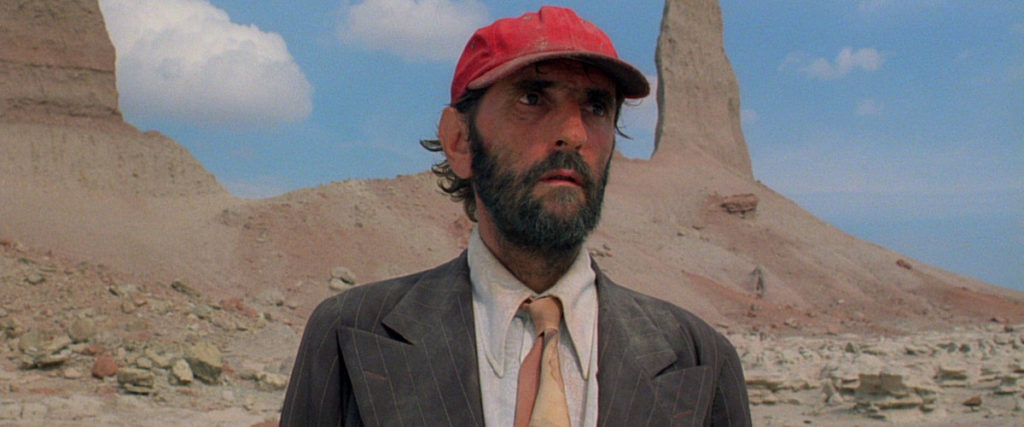
This week on The Movie Gourmet – Harry Dean Stanton’s masterpiece in Wim Wenders’ Paris, Texas has been restored and re-released in theaters. In Paris Texas, Harry Dean plays Travis, a man so traumatized that he has disappeared and is found wandering across the desert and mistaken for a mute. As he is cared for by his brother (Dean Stockwell), he evolves from feral to erratic to troubled, but with a sense of tenderness and a determination to put things right. We see Travis as a madman who gains extraordinary lucidity about what wrong in his life and his own responsibility for it.
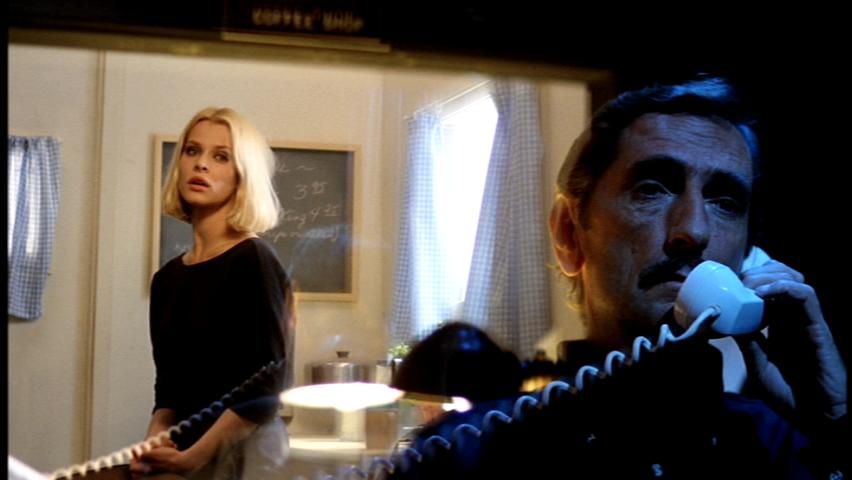
At the film’s climax, Travis speaks to Jane (Natassja Kinski) through a one-way mirror (she can’t see him). Spinning what at first seems like parable, Travis explains what happened to him – and to her – and why it happened. It’s a 20-minute monologue so captivating and touching that it rises to be recognized as one of the very greatest screen performances.
Paris, Texas is on my list of the fifty or soGreatest Movies of All Time. It’s been playing the Laemmle theaters in LA this week, opens at San Francisco’s Roxie today and opens at the Palm in San Luis Obispo next week.
Natassja Kinski and Harry Dean Stanton in PARIS, TEXAS
CURRENT MOVIES
Thelma: too proud to be taken. Amazon, AppleTV, YouTube, Fandango.
Perfect Days: intentional contentment. Amazon, AppleTV, YouTube, Fandango, Hulu (included).
Civil War: a most cautionary tale. Amazon, AppleTV, YouTube, Fandango.
ON TV
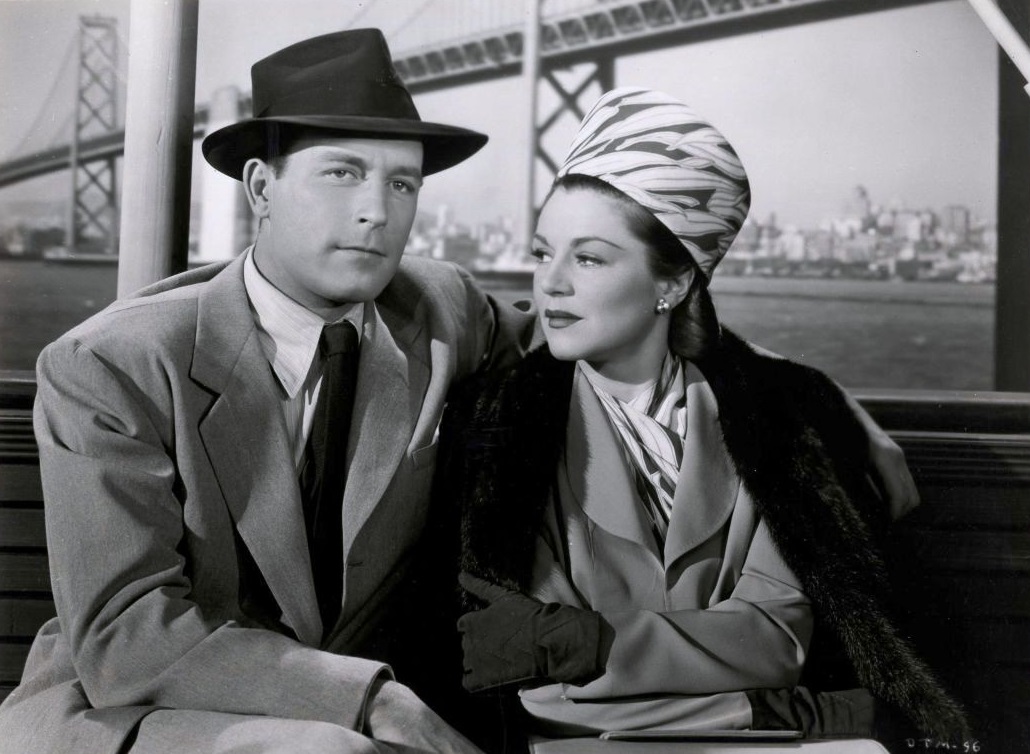
Lawrence Tierney and Claire Trevor in BORN TO KILL.
On September 10, Turner Classic Movies offers Born to Kill (1947). Lawrence Tierney (no cupcake in real life, either), plays the nastiest, most predatory and savage male character in film noir history. Set in the world of Reno quickie divorces, the characters seem to compete to demonstrate the most venal behavior; (spoiler: the psychopath played by Tierney wins.) Claire Trevor, the Queen of Noir, was often wore flamboyant hats, but she just keeps topping herself in this film. Walter Slezak and Elisha Cook, Jr., play dregs of the underworld.
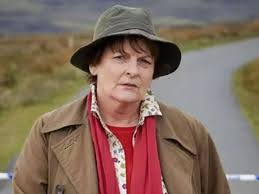
This week on The Movie Gourmet – my irreplaceable father-in-law died this week, so I’m honoring him with a photo from his favorite BritBox crime show, Vera.
CURRENT MOVIES
Thelma: too proud to be taken. Amazon, AppleTV, YouTube, Fandango.
Perfect Days: intentional contentment. Amazon, AppleTV, YouTube, Fandango, Hulu (included).