I very much admired Disclosure, the insightful – and even revelatory – documentary about the depiction of trans people in film and television and the impacts of that depiction.
The best thing about Disclosure is the unfiltered trans voice – near as I can tell, 100% of the subjects and talking heads are trans or non-binary people, and it’s an uncommonly articulate bunch. I found the most compelling to be Emmy-winning actress Laverne Cox (Orange Is the New Black), actress/writer Jen Richards (Tales of the City), producer Zackary Drucker (Transparent) and actress Candis Cayne (Dirty Sexy Money).
The first 25 minutes – tracing depiction of trans people in film since D.W. Griffin’s silents – is not riveting. But stay with it – Disclosure pays off big time with these moving personal stories. Near the end, Jen Richards comments on an accepting parent that she saw in another documentary – get out the Kleenex for this moment.
I had always thought of Jaye Davidson’s Oscar nomination for her performance as Dil in The Crying Game as a step forward for trans people. It’s complicated. I had always viewed Stephen Rea’s reaction in the Big Reveal scene from my straight male perspective (cis, if you insist); Disclosure made me consider the trans woman’s lens, too.
The revelatory biodoc Ella Fitzgerald: Just One of Those Things traces the life of the jazz icon.
It opens with the Harlem teenage dancer who was an eyewitness to Ella’s 17-year-old public debut at the Apollo Theater’s Amateur Night in 1934. We learn of Ella’s rocky childhood, with the traumas that led her to being incarcerated as a juvenile delinquent and becoming homeless in Harlem. We see the arc of her career, with the initial mentorship of bandleader Chick Webb and the later guidance of producer Norman Grantz.
Her son, Ray Brown, Jr., is on hand to reveal Ella’s family side (with photos of mom pitching to son, both in Dodgers gear).
One of the Ella Fitzgerald: Just One of Those Things‘ highlights is a never-broadcast interview in which Ella makes clear her views on race, American racism and civil rights. Markedly clear-eyed, it’s all the more powerful because of Ella’s gentle demeanor.
A Must See for jazz fans, Ella Fitzgerald: Just One of Those Things is reverential and by-the-numbers, but it is well-sourced and insightful. It opens June 26 in the Roxie Virtual Cinema.
Spike Lee’s latest film, Da 5 Bloods has some compelling elements, but the movie isn’t compelling as a whole. It’s too long and drags in places. The Wife and I stopped watching after the first hour. I finished it a couple days later.
Da 5 Bloods works best as a reflection on the Vietnam War and on the Black experience in America; how Spike handles those themes is far more evocative than is the story itself.
The story: four African-American vets return to Vietnam fifty years after their service. They are seeking to recover the remains of their beloved commanding officer. What they keep to themselves, is that he is buried with a fortune in gold bars. This quest is remarkably similar to Treasure of the Sierra Madre (and Spike even throws in the most famous quote from Sierra Madre).
Delroy Lindo in DA 5 BLOODS. Photo courtesy of NETFLIX.
The best reason to watch Da 5 Bloods are the performances of Delroy Lindo and Clarke Peters. Lindo has the best role of his craeer – as a man who is tormented by PTSD from wartime guilt and a family tragedy back home.
The old actors play themselves in the fifty-years-before flashback scenes. I suspended disbelief, but it decidedly did not work for The Wife.
Besides Delroy Lindo’s searing monologues, the highlights of the movie are an unexpected family reunion for the Clarke Peters character and a gripping sequence in a minefield.
The supporting cast is excellent, especially Melanie Thierry, Paul Walter Hauser, Jean Reno, Le Y Tan and first time actress Sandy Huong Pham, Jonathan Majors, so great in The Last Black Man in San Francisco, is fine but wasted in an underwritten role.
Da 5 Bloods does showcase an impressive selection of soul shakes. Spike also drops in has signature double dolly shot in the epilogue, to effetively cap the Clarke Peters story line.
One of the best things about Da 5 Bloods is the soundtrack; I can’t get enough of Marvin Gaye’s What’s Going On, and neither can Spike. Time Has Come Today by the Chambers Brothers is underused in the movie, but dominates the great trailer embedded below (and the trailer is better than the movie).
The absurdism of Luis Buñuel meets the social awkwardness of Seinfeld in Hong Sang-soo’s Koran comedy Yourself and Yours.
In Yourself and Yours, Minjung (Lee You-young) dumps her boyfriend (Kim Joo-hyuck) after he objects to her heavy drinking (“I’ve stopped drinking – now I stop after only five rounds“). Then another man thinks that he meets Minjung, but she claims that she is Minjung’s identical twin. We’re not so sure about that. And then she meets ANOTHER man, and her identity remains in question. Her original boyfriend is comically bereft, and he’s on the lookout for her, too.
One character says “You men are all pathetic“, and Minjung proves that point at every opportunity. In a deliberate homage to Buñuel’s That Obscure Object of Desire, Lee You-young plays the role of Minjung and her multiple doppelgängers (unless they are all really Minjung herself). There are plenty of LOL moments as Yourself and Yours winds its way full circle to a satisfyingly sly finale.
I saw Yourself and Yours (Dangsinjasingwa dangsinui geot) at the San Francisco International Film Festival (SFFILM). In an Only-At-SFFILM moment, I (a Hong Sang-soo newbie) was surrounded in the audience by devoted Hong Sang-soo fans. During its Bay Area virtual run at the Roxie, you can stream Yourself and Yours at Roxie Virtual Cinema.
This week: The most original teen coming of age movie you’ll ever see, and a historical documentary with insights on two forgotten years of MLK’s life. Plus the most eclectic watch-at-home recommendations you’ll find anywhere.
ON VIDEO
Electrick Children: A female filmmaker, in her first faeture, has created an entirely unique teen coming of age story – a magical tale of Mormon runaways in Vegas. Julia Garner, currently the best thing about the Netflix series show Ozark, stars. Electrick Children can be streamed from Amazon (included in Amazon Prime) and can be purchased from several other VOD platforms.
King in the Wilderness: This superb documentary follows Martin Luther King, Jr., through his turbulent final two years, when he was facing a big fat case of What Have You Done For Me Lately? It originally aired on HBO and won an Emmy for best historical documentary. King in the Wilderness is now widely available on streaming platforms.
Radio Dreams: stranger in a strange and funny land.
ON TV
David Hemmings in BLOW-UP
On June 22, Turner Classic Movies will air one of my personal favorites from the 1960s, Blow-up. Set in the Mod London of the mid-60s, a fashion photographer (David Hemmings) is living a fun, but shallow, life filled with sports cars, discos and scoring with supermodels (think Jane Birkin, Sarah Miles and Verushka). Then he discovers that his random photograph of a landscape may contain a clue in a murder and meets a mystery woman (Vanessa Redgrave). After taking us into a vivid depiction of the Mod world, director Michelangelo Antonioni brilliantly turns the story into a suspenseful story of spiraling obsession. His L’Avventura, La Notte and L’Eclisse made Antonioni an icon of cinema, but Blow-up is his most accessible and enjoyable masterwork. There’s also a cameo performance by the Jeff Beck/Jimmy Page version of the Yardbirds and a quick sighting of Monty Python’s Michael Palin in a nightclub.
The superb documentary King in the Wilderness follows Martin Luther King, Jr., through his turbulent final two years. Although King had already become an icon, he was facing the challenges of a new political and societal landscape that King himself had helped create. And he was foundering.
King’s approach, which overcame the overt cultural racism and statutory segregation in the South, was not working against the de facto segregation and urban riots in the North. Nor was King gaining traction to expand the movement against bigotry into a movement against poverty.
His leadership in the Black community was being usurped by younger, more militant, leaders. Stokely Carmichael and his peers were quick to discard longtime White Civil Rights workers and to alienate White America with a message of Black Power, which resonated in the Black community. King refused to use the weaponized term, while trying to hang on to his base.
King was under pressure to make public his opposition to the Vietnam War. King’s strong anti-militarism came naturally from his study of Gandhi and his commitment to non-violence. But campaigning against the War would be seen as a betrayal by King’s most effective ally and benefactor, President Lyndon B. Johnson. King was genuinely grateful to LBJ, and LBJ was famously vindictive.
King was just off the Civil Rights Act of 1964 and the Voting Rights Act of 1965, the two greatest legislative Civil Rights victories since the 13th Amendment prohibiting slavery one hundred years before. In King in the Wilderness, it’s only a year later, and Martin Luther King, Jr. is facing a big fat case of What Have You Done For Me Lately?
It’s easy for us to forget just how young King was:
He was only 26 when he led the Birmingham Bus Boycott.
King wrote the Letter from Birmingham Jail and led the the March on Washington at 34.
He won the Nobel Peace Prize at 35.
He led the march from Selma to Montgomery at 36.
After a great historic victory, it can be difficult to find a new objective. It’s hard to gain political power, and it can be just as hard to keep it. It’s difficult for a public figure to remain relevant in changing times. These are the challenges of leadership.
By focusing on this period of King’s life and career, director Peter Kunhardt and writer Chris Chuang have made an inspired choice. They have also sourced it brilliantly, with the remembrances of King intimates, most notably Andrew Young and Henry Belafonte, along with Stokely Carmichael’s fellow SNCC leader Cleveland Sellers. King family confidante Xernona Clayton bookends the movie with the two most poignant anecdotes.
King in the Wilderness was originally aired on HBO and won an Emmy for best historical documentary. It’s now widely available on streaming platforms.
Coming up on Turner Classic Movies on June 18, the Japanese neo-noir Pale Flower is a slow burn that erupts into thrilling set pieces. This is pioneering neo-noir. Pale Flower is writer-director Masahiro Shinoda’s masterpiece; its look and feel is as different from classic noir as are Elevator to the Gallows and Blast of Silence.
Maraki (Ryô Ikebe) is a fortyish Yazuka hit man, just released from loyally serving a prison term. He went away for offing a gangland rival, but now the two gangs have become allies. Out gambling with fellow Yakuza, he encounters the much younger woman Saeko (Mariko Kaga). The stoic and completely self-contained Maraki becomes fascinated by – and then obsessed with – Saeko, who lives her life seeking thrill after thrill.
PALE FLOWER
Maraki and Saeko meet gambling on the Japanese card game of hanafuda (flower cards). She is the only woman at a table surrounded by male gangsters. Shinoda makes the tension of card games resemble that of walking into a hostile bar or waiting an Old West quick draw gunfight. The card games are silent but for the ritual betting and the players clicking their cards. The film’s title refers to both hanafuda and Saeko.
Mariko Kaga in PALE FLOWER
Just who is this mystery woman? Muraki is snagged, but he is too cool to search out her background. His obsession is more complicated than sexual passion alone, although there is a sexual element (watch whether he acts on it when he can). The mystery makes Saeko (the then 20-year-old Mariko Kaga in only her fourth movie) all the more captivating.
In another gripping set piece, Saeko races her sports car through Tokyo’s tunnels and overpasses at 2:30 AM. In the passenger seat, Muraki is transfixed by her recklessness. He’s not thrilled by the careening wild ride, he’s thrilled by Saeko’s compulsion to seek the thrill.
Mariko Kaga and Ryô Ikebe in PALE FLOWER
The ultimate thrill might be to accompany a hit man on the job. The climactic three-minute scene is a mob hit in a church, set to an aria, Henry Purcell’s Dido’s Lament. It is operatic – and remarkably similar to Francis Ford Coppola’s later montage in The Godfather where Michael Corleone’s assassins kills all his enemies while he is standing in church at the christening of his sister’s baby. Muarki’s murder-for-hire is up-close-and-personal.
When Maraki and Saeko are on-screen, Pale Flower is dramatically and stylistic Stylistic – the card games, the car race, the final killing, In contrast, we see the mundane plotting of the Yazuka bosses (but not their crimes) as they kibbitz at the horse races. Their underlings go bowling.
Does it all matter? is a central theme in film noir. Pale Flower’s powerful final prison scene is the the ultimate neo-noir ending.
Pale Flower is included in Roger Ebert’s Great Movies. Pale Flower is challenging to find; it can be streamed with a subscription to Criterion Collection or Kanopy, and it plays occasionally on TCM, including on June 18.
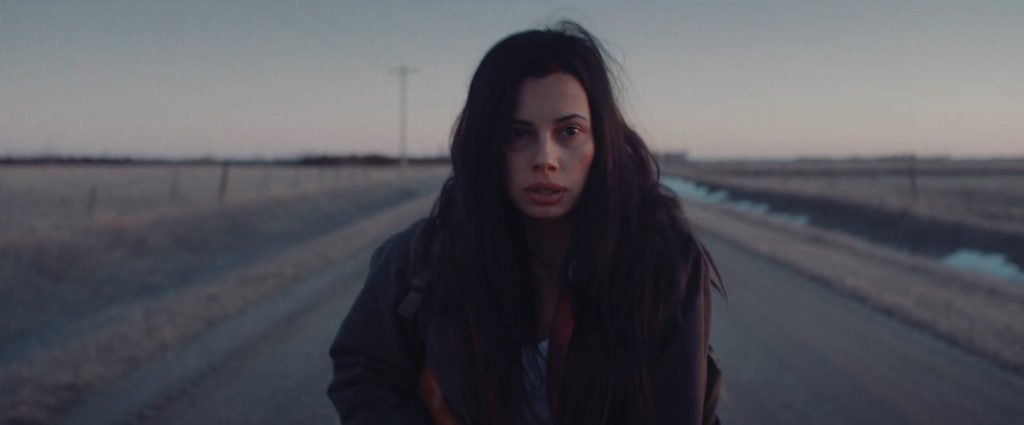
With Electrick Children, a first-time feature filmmaker has created an entirely unique teen coming of age story. Electrick Children employs an element of magical realism that requires the audience to accept a premise which cannot be real. The result is a highly original success.
A 15-year-old Utah girl has been raised in a remote fundamentalist Mormon enclave where everyone dresses as 19th century pioneers. She has been immersed in Bible stories, but hasn’t been exposed to any modern culture or to the facts of life. She happens upon a hidden cassette tape and finds her first rock and roll song revelatory – so revelatory that she thinks that the song has moved her to pregnancy. Here comes the magical realism – she really is a virgin, and she really is pregnant.
Because of her faith, she doesn’t find immaculate conception to be the least bit implausible. Not so with her parents, who wrongly blame her 17-year-old brother. Their answer is to kick the boy out of the home and to marry off the girl to a neighboring fundamentalist. Facing the unwanted shotgun wedding, the girl commandeers the family pickup and flees; her brother, seeking a way to prove his innocence, stows away.
The kids surface in Las Vegas, where they fall in with a band of runaway teens. Of course the Mormon kids are completely unprepared to navigate any modern city, let alone Vegas. Their guides, the more streetwise kids, are more comfortable with the glitz and sleaze of Vegas, but are just as untethered. The Mormon kids and the suburban runaways have life-altering adventures on the streets.
The girl embarks on a quest to find the singer who she thinks has fathered her child through song, not understanding that there is more than one rock band in the world (or that Blondie’s Hanging on the Telephone has not made her pregnant.) Central to the film’s success is that the girl is naive but never silly. The young actress Julia Garner shines in a performance that is never ironic and always completely sincere. The girl is determined and devout, seeking teen independence in ways that are logical for someone with her isolated upbringing. Garner is currently the best thing about the Netflix series show Ozark.
As good as Garner is, the real talent here is writer-director Rebecca Thomas, who went from growing up in Mormon in Nevada to earning an MFA from Columbia. This is her first feature film, and I can’t wait for her next one.
Electrick Childrencan be streamed from Amazon (included in Amazon Prime) and can be purchased from several other VOD platforms.
This week: a Hollywood buddy documentary, an all-on-screens horror film, a current Netflix rom com and a sweet, heartfelt indie. Plus the most eclectic watch-at-home recommendations you’ll find anywhere.
ON VIDEO
Burt Reynolds and Hal Needham in THE BANDIT. Photo courtesy of the San Francisco Film Society.
The Bandit: The buddies in this buddy documentary are mega-star Burt Reynoldsand his stuntman/friend/roommate Hal Needham, who directed the enormously successful Smokey and the Bandit franchise. The Bandit is a hoot, and features some amazing movie stunts., Stream it from Amazon, Vudu, YouTube and Google Play.
Unfriended: Teenagers convene via webcams on social media. But their computers are hijacked by an Unknown Force who starts wreaking revenge. It’s a perfect little horror film for a time when we are living our lives on Zoom. Unfriended is available to rent on DVD from Netflix and Redbox and to stream from Amazon, iTunes, Vudu, YouTube, Google Play and Flixster.
The Lovebirds: Issa Rae (Insecure) and Kumail Nanjiani (Silicon Valley, The Big Sick) star in this rom com. The plot is playful, but the relationship is truthful. It’s streaming on Netflix.
Driveways: I can’t think of a more authentic movie about intergenerational relationships than this charming, character-driven indie. The more I think about Driveways, the more I admire it. It also features the final performance – so genuine and subtle – by Brian Dennehy. Driveways is available to stream on all the major platforms.
The most eclectic watch-at-home recommendations you’ll find ANYWHERE:
Wind River:“This isn’t the land of backup, Jane. This is the land of you’re on your own.”
Touching the Void: the gripping true life story of a mountaineer who had to cut his climbing partner’s rope.
Searching: A ticking clock thriller that captures the Silicon Valley vibe.
Outside In: A story of self-discovery with an astonishing performance by Edie Falco.
The T.A.M.I. Show: The first concert film, featuring eight future Rock and Roll Hall of Famers.
On June 18, Turner Classic Movies will air the hard-to-find Pale Flower, one of my Overlooked Noir This Japanese neo-noir is a slow burn that erupts into thrilling set pieces. Writer-director Masahiro Shinoda’s masterpiece is pioneering neo-noir. Don’t miss it.
In the very satisfying horror film Unfriended, it’s the one-year anniversary of a teenage girl’s suicide, and her bullying peers convene via webcams on social media. But their computers are hijacked by an Unknown Force who starts wreaking revenge. The kids become annoyed, then worried and, finally, panicked for their lives.
Here’s something I had never seen before this 2015 film: the entire movie is compiled of the characters’ screenshots. The critic Christy Lemire says that “Unfriended is a gimmick with a ridiculous premise, but damned if it doesn’t work”, and she’s right. Writer Nelson Greaves and Director Levan Gabriadze came up with this device, and their originality pays off with a fun and effective movie.
And, just like all-on-screens Searching, it’s perfect for a time when we are living our lives on Zoom.
It’s on both my 2015 lists of I Hadn’t Seen This Before and Low Budget, High Quality Horror. Unfriended is available to rent on DVD from Netflix and Redbox and streaming from Amazon, iTunes, Vudu, YouTube, Google Play and Flixster.