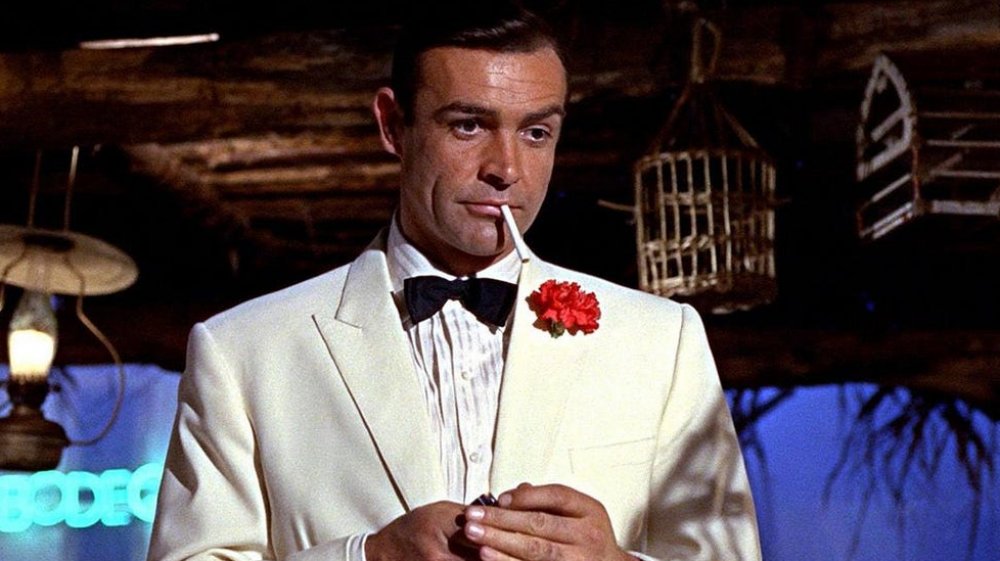
If we’re going to talk about male cinema stars with overpowering magnetism and studly charisma, we’re going to start with Sean Connery, who has died at age 90.
No screen actor has more personally defined a role than did Connery with James Bond. The character of James Bond in Ian Fleming’s source novels is nothing special; Bond was made iconic by Connery’s gifts.
The Bond movies are cartoonish, but Connery’s James Bond never is. Connery’s Bond is hunky, but he’s not just a hunk. He is supremely confident. He is cunning. He always assesses a risk before he takes it.
Several actors, some very talented, have also played the James Bond role that Connery originated. Only Daniel Craig has approached the mix of rugged charm and resourceful physicality that that Connery delivered.
I learned a lot about the crushing childhood poverty that formed Connery in this insightful NYT obit. There’s also a great Sydney Lumet admonition against underestimating an actor’s charm.
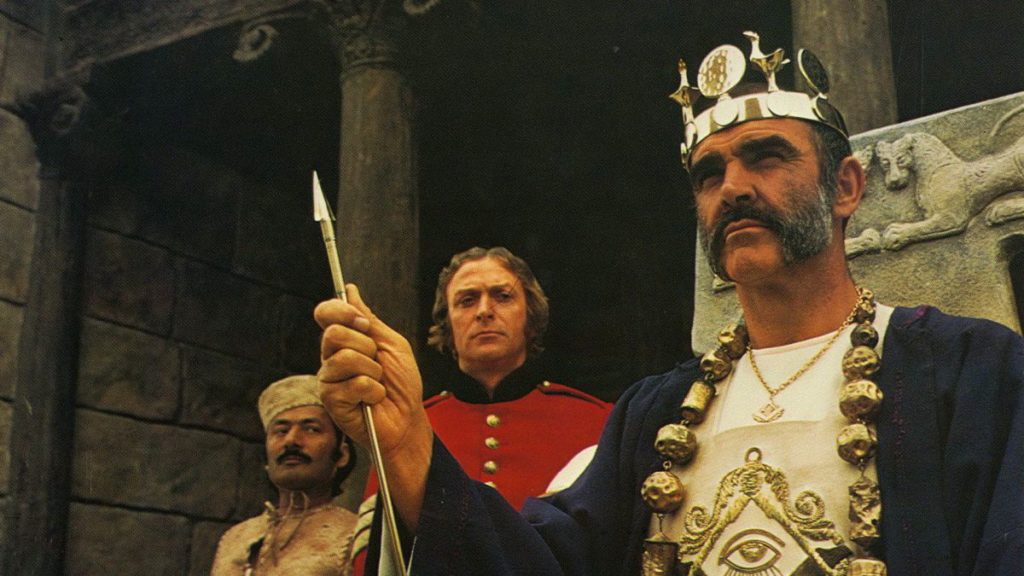
My favorite Connery performance (and the best movie he was in) is The Man Who Would Be King (1975). It’s a great Rudyard Kipling adventure yarn, gloriously brought to the screen by director John Huston.
Connery stars with Michael Caine as a pair of reprobates mustered out of the Queen’s army in colonial India. Rather than return to menial prospects in England, these cheeky and lovable scoundrels seek to make their fortune as mercenaries in the outskirts of the Raj. Fortune smiles, and they reach unforeseeable success – and then Connery’s character overreaches…
The Man Who Would Be King, which is widely available to stream, is unforgettable, and so is Sean Connery.
Sean Connery (right) with Saeed Jaffrey and Michael Caine in THE MAN WHO WOULD BE KING
This week: celebrate Halloween with two unconventionally scary movies, Borgman and Freaks. Plus more 2020 films to stream at home.
ON VIDEO
Borgman: This Dutch thriller is a horror film for adults, without the gore and with lots of wit. You can stream it from all the major services.
The Trial of the Chicago 7 (link will go live this week, I promise): Aaron Sorkin’s fresh look at an indelible moment in American history. Sacha Baron Cohen, John Carroll Lynch and Frank Langella are great. Streaming on Netflix.
My Octopus Teacher: A diver encounters an octopus and films her every day for a year. He’s not that interesting but the resourceful octopus and the underwater cinematography are worthwhile. Streaming on Netflix.
The most eclectic watch-at-home recommendations you’ll find ANYWHERE:
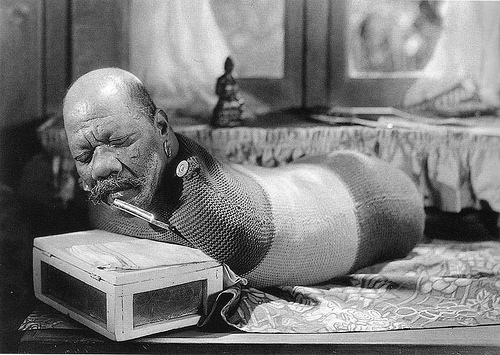
Here’s a genuinely scary movie for Halloween – and it’s 88 years old. Tomorrow morning October 31, Turner Classics airs Tod Browning’s Freaks. Bad things happen at the circus. And bad things happen in Freaks. This is one of the most unsettling horror films (and the least politically correct), because it was filmed in 1932 with real circus freaks. If you have teenagers jaded by today’s empty horror flicks, this will knock them for a loop. Only 64 minutes.
As nature documentaries go, My Octopus Teacher, is pretty singular. Filmmaker Craig Foster, stewing in mid-life disillusionment, is diving in a South African kelp forest when he encounters an octopus and decides to shadow her over a year and document her life every day. The octopus takes to Foster and adopts him as kind of a pet. But My Octopus Teacher is mostly worthwhile for the amazing resourcefulness of the octopus and the harrowing shark attacks.
I knew that octopuses are wizards at camouflage and at squeezing through tight spaces. I didn’t appreciate how intelligent they are and that they commonly live for only one year.
There are some sequences in My Octopus Teacher that are just astonishing. The underwater photography, especially the scenes just below the surf in the first fifteen minutes are among the best I’ve ever seen. The cinematographer is underwater specialist Roger Horrocks.
Foster himself narrates the film. The Movie Gourmet doesn’t cotton to the simpering of grown men, so I wish I had turned off the sound for the first fifteen minutes of his personal angst and the final ten minutes when he forges a blissful father-and-son shared interest in the ocean.
I do admire Foster for two things. First, he generally didn’t interfere with the course of nature (i.e., rescue the octopus from shark attacks). And he didn’t give her a human name. Good for him.
Off South Africa, the octopus’ major predator is the pajama shark, so named because of the stripes that resemble old-fashioned vertically-striped pajamas. Pajama sharks are especially well-equipped to attack in the narrow and deep crevices where octopuses hide out.
I can’t really blame the sharks because octopus is one of my favorite foods, too. It takes some mastery (which I haven’t as yet attained) to cook them so they’re not rubbery. So, I order octopus every time I see it on the menu (usually at Greek, Spanish, Mexican or Portuguese restaurants).
Technically, the Dutch thriller Borgman is a horror film, but it’s horror for adults, without the gore and with lots of wit. The shock doesn’t come from monsters unexpectedly lurching out of nowhere. The entertainment comes from the OMG moments of the “don’t ask the weird guy into your house!” and “don’t let the sinister guys watch your kids!” variety.
The setting is the architecturally striking and well-tended home of an affluent Dutch family and their Danish nanny. The husband is an aggro corporate schemer and a real scumbag – selfish, racist and chauvinistic, with the capacity for a violent rage. His wife Marina is repressed and neurotic. But they are highly functional until a homeless guy, Camiel Borgman, happens by, and circumstances compel them to put him up. Borgman feels entitled to more and more outrageous impositions – and soon it’s apparent that he’s even more sinister than he is obnoxious.
What if Charles Manson wasn’t a drug addled hoodlum, and his deranged charisma worked on the affluent mainstream? Borgman leads a crew of normal looking but murderous henchmen, who operate with the ruthless efficiency of Navy Seals. (Watch for the scar near the younger woman’s shoulder-blade.) Vaguely gifted with mind control, he can apparently create dreams by squatting naked and gargoyle-like above Marina while she slumbers with her husband. There is violence aplenty, but it tends to come through a bonk on the head or some poison in a glass.
Dark comedy stems from the matter-of-factness of the murders and body disposal (as in tossing corpses into a lake and then diving in for a relaxing swim). Every once in a while, there’s a hilariously sinister moment, like the supremely random appearance of some whippets that seem more like hellhounds.
BORGMAN
The acting is uniformly excellent, including the kids, but Jan Bijvoet as Borgman and Hadewych Minis as Marina are stellar.
Some questions are never answered (who are those three guys at the beginning and why are they hunting the homeless guys?). Is this a cult or aliens or what? The audience needs to accept some ambiguity. But the overall story arc is clear – no good is going to come of these people once they meet Camiel Borgman and his friends.
There is a subtext here: is this family so bourgeois that it deserves its fate? Fortunately, this subtext isn’t as in-your-face as in some recent self-loathing Eurocrap like Happy Days or Finsterworld, so it’s not at all off-putting. But Borgman can be enjoyed without going there at all.
Borgman is superbly written and directed by Alex van Warmerdam, a 62-year-old Dutch actor with only a handful of writing and directing credits.
I don’t often recommend a horror movie, but I’m all in on Borgman. Take it from me – you haven’t seen this movie before, and it’s endlessly entertaining. Borgman is available to stream from Amazon, iTunes, Vudu, YouTube, Google Play and Hulu.
John Carroll Lynch and Sasha Baron Cohen in THE TRIAL OF THE CHICAGO 7
This week: The latest from Aaron Sorkin and Spike Lee. But, first, a remembrance.
REMEMBRANCE
Dick Powell and Rhonda Fleming in CRY DANGER
Actress Rhonda Fleming has died at age 97. She was known as the “Queen of Technicolor” when movie studios exploited her blazing red hair, blue eyes, ivory complexion and uncommon beauty in a series of Western, sword-and-sandal and adventure films; in this period, she was a candidate for the world’s most beautiful woman, along with her age peers Gene Tierney, Lana Turner and Marilyn Monroe. But Fleming’s very best acting work was in black-and-white, in Spellbound, Out of the Past, Cry Danger and While the City Sleeps. My favorite Fleming performance is in Cry Danger, where she plays the girlfriend of the guy who had framed the hero (Dick Powell) – an irresistible woman of uncertain loyalty.
ON VIDEO
The Trial of the Chicago Seven (link to full review will go live this weekend) is Aaron Sorkin’s dramatization of the notorious 1969 political trial of Vietnam War protestors. Sasha Baron Cohen, Mark Rylance and Frank Langella are all really good. Streaming on Netflix.
David Byrne’s American Utopia, directed by Spike Lee, is the concert film for Byrne’s Broadway Show, with the Broadway glitz pared down to explore humanity itself. It’s playing on HBO.
The most eclectic watch-at-home recommendations you’ll find ANYWHERE:
Driveways: I can’t think of a more authentic movie about intergenerational relationships than this charming, character-driven indie. Best Movies of 2020 – So Far.
The Lovebirds: A rom com with a playful plot and a truthful relationship.
ON TV
Vera Clouzot in DIABOLIQUE
Turner Classic Movies plays a lot of horror in October. But the best is coming on October 25, Diabolique from director Henri-Georges Clouzot (often tagged as the French Hitchcock). The headmaster of a provincial boarding school is so cruel, even sadistic, that everyone wants him dead, especially his wife and his mistress. When he goes missing, the police drain the murky pool where the killers dumped the body…and the killers get a big surprise. Now the suspense really starts…
I recently saw director Rene Clement pegged as the French Hitchcock, although Claude Chabrol and Clouzot are the favorites for that title. It occurred to me that Jen-Pierre Melville loved American film noir and was such an Americanphile that he wore a Stetson and drove a Cadillac. Would he be the French Robert Siodmak, Frtiz Lang, Richard Fleischer, Jules Dassin or Jacques Toruneur? Wait a minute – isn’t Jacques Tourneur already French?
On October 27, TCM broadcasts a searing real life time capsule The Connection, a 1962 cinema vérité of NYC heroine addicts waiting for, and getting, their fixes. It’s haunting.
David Byrne’s American Utopia is the concert film for David Byrne’s (currently paused) Broadway show, directed by Spike Lee. The songs are organized to explores themes of humanity and human behaviors and attitudes, and some are overly political. It’s a thoughtful and entertaining show.
To isolate the humanity on stage, Byrne has very intentionally pared away all the glitz. What remains is just Byrne and his band, which serves as a chorus – two dancers, two guitarists, a keyboard player and six percussionists. All are barefoot and clad in identical grey suits that are well-fitting descendants of Byrne’s Big Suit from Stop Making Sense.
Most, but not all, of the of the songs are Byrne’s or by the Talking Heads. The biggest show-stoppers are the Talking Heads’ vintage anthems Burning Down the House and Road to Nowhere and Janelle Monae’s Hell You Talmbout. This is no run-of-the-mill jukebox musical.
Stop Making Sense, of course, is one of the greatest of concert films, directed by Jonathan Demme. It shouldn’t surprise anyone that great directors make great concert films (e.g., Martin Scorsese and The Last Waltz; DA Pennebaker and Monterey Pop). Given the constraints of the contained set and material, Spike Lee does a great job of projecting the vibe of American Utopia.
This week: a doumentary, a Feel Good narrative and a docufantasy, all from a female point of view.
The Mill Valley Film Festival is still running, and you can still watch most of the films at home through this weekend. Here is my MVFF preview.
ON VIDEO
Today only – stream She Is the Ocean. In this visually stunning documentary, fearless and high-achieving women celebrate the oceans in science and sport.
The Artist’s Wife: Lena Olin’s performance as a woman facing the decline of her older husband with remarkable generosity. A Feel Good.
Dick Johnson Is Dead: A daughter and her dad face the end of his life in this funny, heartfelt and frequently bizarre docufantasy. One of a kind.
The Life and Death of Colonel Blimp: I wrote about 1943 Powell-Pressburger masterpiece last week. If you missed it last night on TCM, you can stream it from Amazon, AppleTV and the Criterion Channel.
SIBYL
The most eclectic watch-at-home recommendations you’ll find ANYWHERE:
Sibyl: trashy, but in that sly and expert French way.
Driveways: I can’t think of a more authentic movie about intergenerational relationships than this charming, character-driven indie. Best Movies of 2020 – So Far.
The Lovebirds: A rom com with a playful plot and a truthful relationship.
ON TV
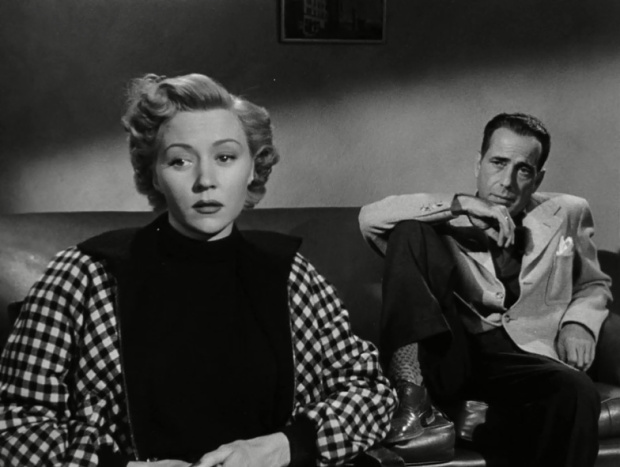
Tonight, Turner Classic Movies airs In a Lonely Place(1950). The most unsettlingly sexy film noiress Gloria Grahame falls for the troubled screenwriter Humphrey Bogart, a guy with a MAJOR anger management issue; once she’s hooked, she realizes that he might be a murderer after all…Nicholas Ray directs. In a Lonely Place justifiably made the BBC’s list of the 100 Greatest American Films. The Czar of Noir Eddie Muller has named it as his #1 film noir.
Gloria Grahame and Humphrey Bogart in IN A LONELY PLACE
Documentarian Kirsten Johnson and her dad face the end of his life in this funny, heartfelt and frequently bizarre film. Dick Johnson Is Dead is so highly original that I would place it in its own genre – docufantasy.
Kirsten’s father Dick Johnson is an 85-year-old psychiatrist whose increasing forgetfulness and frailty is forcing hm to leave his Seattle house and move onto Kirsten’s NYC apartment. As generally sunny as he is, his loss of vigor and independence is hard on him. His impending loss of memory (and of life itself is hard on them both.
Kirsten chronicles the familiar – the doctor’s appointments, the closing of her dad’s practice, the selling of his car and the downsizing of his possessions. And then she grapples with his mortality by staging a series of fictional demises – as he “dies” in a series of quirky accidents, like getting a large appliance dropped on him from a highrise. Other scenes imagine Dick in heaven, dancing with her mom, and dining with Frederick Douglass and Buster Keaton.
DICK JOHNSON IS DEAD
Dick Johnson is indulgent with his daughter and one helluva good sport. There’s even a Seattle “funeral” while Dick is still alive and able to watch from the wings.
Offbeat as it is, the core of Dick Johnson Is Dead is wistful and deeply personal. Dick Johnson Is Dead is streaming on Netflix.
Roger Livesey in THE LIFE AND DEATH OF COLONEL BLIMP
The 1943 masterpiece The Life and Death of Colonel Blimp is a remarkably textured portrait of a man over four decades and his struggles to evolve into new eras. Written and directed by the great British filmmakers Michael Powell and Emeric Pressburger, this is a movie with a sharp message to 1940s audiences about modernity, as well as a subtle exploration of privilege that will resonate today.
The character of Clive Candy, when we first seem him as an old man, is the butt of a humorous scene, being made fun of as out of touch and ridiculously old-fashioned. Candy, a veteran of sabre duels between 19th Century gentleman officers, still naively thinks that wars should be fought according to rules. Made in the urgency of wartime 1943, The Life and Death of Colonel Blimp pointedly delivers the message that the old fuddy duddies should get out of the way. Only modern men can fight the quintessentially modern threat – the Nazis with their propaganda and industrialized genocide.
But Powell and Pressburger can make this argument without emasculating or demonizing Blimp; he is a good man, just a good man whose time has passed – and it is what it is.
We see flashbacks of the younger Clive Candy and see his bravery, steadfastness, loyalty, sentimentality, romance, and his occasional wit. He is a man devoted to a code of behavior. always profoundly anchored to doing the right thing and willing to sacrifice (in both love and war).
Candy is also a creature of privilege, and he’s clueless about that privilege. He is an upper crust Englishman in a class-driven, all male and all-white power structure. His day job is serving an empire whose premise is the suppression and exploitation of darker skinned peoples peoples. He never has to compete, on the merits, with women or with the working class or people of color. He just assumes that he should be a military leader and that England should have an empire; but he also unquestionably shoulders the duties and obligations that goes with the leadership and the empire.
Roger Livesey plays Candy as he ages over the forty years. Livesey often played decent and genial romantic leads, and I usually find those roles pretty bland. But here Livesey convincingly depicts a man who believes that he must never change, even as he faces heartbreak or changing times.
Anton Walbrook excels as Candy’s German peer, an officer of Candy’s generation who realizes in the 1940s that their time has passed. I’ve lately warmed to Walbrook, who was typecast as romantic, European dandies early in his career; his later work, in Powell and Pressburger’s The Red Shoes and The 49th Parallel, Max Ophul’s Le Plaisir and La Ronde and the 1940, less well known version of, Gaslight, is excellent.
The always coolly reliable Deborah Kerr appears in multiple roles, playing three different women who show up in Candy’s life.
Powell and Pressburger insert plenty of humor and smart filmmaking to tell this story. The montage of mounted animal heads that spans the period between the world wars is especially witty.
Clive Candy is a creature of his time – which TLADOCB unsentimentally depicts as having passed. But there is value in this man. Just like with Wille Loman – attention must be paid.
The Life and Death of Colonel Blimp airs October 15 on Turner Clssic Movies and is available to stream from Amazon, AppleTV and the Criterion Channel.
Roger Livesey in THE LIFE AND DEATH OF COLONEL BLIMP
In The Artist’s Wife, sixty-something Claire (Lena Olin) is married to a famous, much older, painter Richard (Bruce Dern). You get the idea that Richard has always been a handful, but he is undergoing some disturbing changes. He is increasingly confused and mean, even abusive. Claire is the last to recognize and accept that Richard is sinking into Alzheimer’s.
We see glimpses of Richard as a good catch – affectionate and witty – and he is a superstar of the art world. Now, however, Richard is creatively blocked and drinking more. And the dementia is showing itself in more and more inappropriate behavior, from cruelty to his students to the impulse purchase of a $94,000 clock.
Claire was a painter herself, having sidelined her own career to support Richard’s. Now, seeking relief from Richard’s decline, she rents a studio and starts working herself. More than anything, Clare is generous, and she finds ways to give other great gifts.
The Artist’s Wife is Lena Olin’s movie, and her performance is the best thing about the movie, as her Clare ranges from clueless to desperate to persistent to tipsy to seductive to hurt and, finally, triumphant.
Let’s remember that, in 1988’s The Unbearable Lightness of Being, Olin played the girlfriend even more beautiful than Juliette Binoche. She can still rock bikini underwear.
Speaking of beauties from the 70s, Stephanie Powers (Hart to Hart) appears (and briefly in full frontal nudity).
Ultimately a Feel Good movie, The Artist’s Wife is streaming on Amazon, Vudu, YouTube and Google Play.