
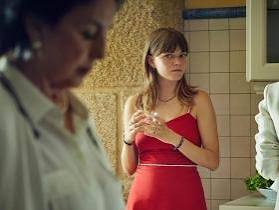
In the captivating drama Romeria, Marina (Llucia Garcia) has turned eighteen and travels from her home across Spain to Vigo on Galicia’s Atlantic coast. Marina’s biological parents died when she was very young, and she has been raised by an adoptive family in Catalonia. She doesn’t even remember her biological father, but she needs his death certificate to qualify for a college scholarship. So she heads to his hometown, both to pick up that document and to meet her father’s family for the first time.
She is welcomed by her father’s brothers and sisters, heartily by some and warily by others. Marina is carrying her mother’s diary, so she believes she understands the outline of her parents’ life together in Vigo, and she.’s eager to fill in the blanks. But the details that are related by – and slip out from – her uncles, aunts and cousins are surprising and sometimes unsettling. Not all of the dots are connecting.
In her third feature, director and co-writer Carla Simon has spun a helluva story. Marina and the audience work out the mystery of her heritage one step (or misstep) at a time, all the way to the satisfying, but poignant. resolution.
As Marina pieces together her parent’s reality, Romeria uses magical realism to veer into a flashback vignette. I’m generally not a fan of magical realism in movies, but I couldn’t think of a better way for Simon to portray the contrast between her mother’s actual experience and what her mother “recorded” in her diary.
Llucia Garcia, in her screen debut, perfectly captures Marina trying to keep her balance while being rocked by revelations of family secrets. Marina is reserved and ever correct, and maintains outward stoicism, but Garcia’s eyes let the audience inside as she processes surprise after surprise. The moment she quickly sizes up her grandfather is a tour de force.
Romeria is Spanish for pilgrimage, a fitting title for Marina’s journey in search of truth and love, especially since it ends near Santiago de Campostela, the terminus of the Camino de Santiago.
Spanish speakers will note that Marina speaks Catalan on the phone to her adoptive family and the readings from the mother’s diary are in Catalan. Marina speaks Spanish, of course, with everyone in Vigo.
The more I think about Romeria, the more I like it, and I’m looking forward to seeing more from both Simon and Garcia.