
In a fine movie debut, Stephen Chbosky directs the screen version of his novel. A shy high school freshman in 1991 is adopted by two unapologetically misfit seniors, played by Harry Potter’s Emma Watson and Ezra Miller (very different here than in We Need to Talk About Kevin). The Perks of Being a Wallflower is a coming of age story, and a very good one. We’ve all experienced adolescence, so my test for a film in this genre is whether the moments of adolescent awkwardness, peer obsession, self-doubt and discovery feel real. I felt that authenticity with Perks. In addition, the story is textured and unpredictable, and the performances – especially those by Watson and Miller – are excellent. It’s available on DVD from Netflix and Redbox and streaming from Amazon, iTunes and other VOD providers.
Movies
Movies to See Right Now
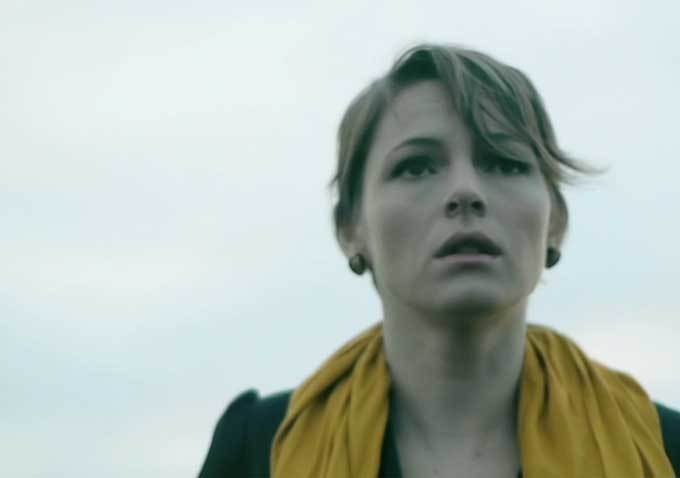
Best bets in theaters this week:
- If you see the thought-provoking drama The Place Beyond the Pines with Ryan Gosling and Bradley Cooper, you’ll still be mulling it over days later;
- I guarantee that you will enjoy the absolutely winning The Sapphires, a charmer about Australian Aboriginal teens forming a girl group to entertain troops in the Vietnam War.
- Read my ambivalent comments before going to see the enigmatic Upstream Color.
PBS is broadcasting the compelling doumentary The Central Park Five from Ken Burns, et al.
On Video on Demand:
- Letters from the Big Man: a beautifully looking and sounding fable about a prickly woman with a guy and a Bigfoot competing for her affections.
- Electrick Children: an entirely unique teen coming of age story with fundamentalist Mormon teens in Las Vegas.
- Music fans will enjoy the bio-documentary Beware of Mr. Baker.
On the Road is the faithful but ultimately unsuccessful adaptation of the seminal Jack Kerouac novel, with surprisingly little energy. The HBO movie Phil Spector is really just a freak show.
I haven’t yet seen the Norwegian scientific true adventure Kon-Tiki. Also opening today is Terence Malick’s To The Wonder. You can read descriptions and view trailers of upcoming films at Movies I’m Looking Forward To.
My DVD of the week is the indie drama Smashed, with its breakthrough performance by Mary Elizabeth Winstead. It’s available on DVD from Netflix and Redbox and streaming from Amazon, iTunes and other VOD providers.
Upstream Color: “enigmatic” is an understatement
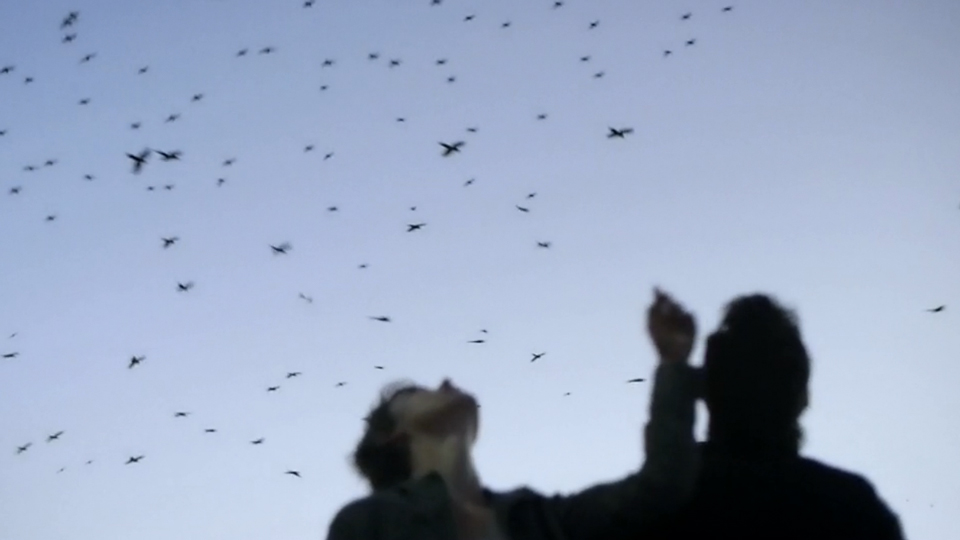
I have never been as ambivalent about a movie as I am about Upstream Color. (More about that later.)
A character named Thief concocts a drug from corpulent worms, doses a woman and scams her out of her savings. Another character, named Sampler, deworms her in a surgical tent at a pig farm. This experience washes away her memory, and she happens into a relationship with a man, another loner trying to move on from a traumatic episode. Along the way, we see vividly colorful shots of the human bloodstream and riparian ecology. Sampler periodically reappears to solemnly observe the goings on and experiment with sound recordings, and he spends lots of time with the herd of pigs.
Yes, this is one trippy movie. The worming and deworming scenes could fit in a sci-fi or horror movie. The second half has the air of a romantic thriller. The overall tone is of an art film or experimental film. Upstream Color is written, directed, produced and co-edited by Shane Carruth, who also plays the male lead and composed the score. Indeed, the cinematography and Carruth’s editing and music are strikingly unique and effective.
Even viewers who admire Upstream Color find it baffling. What’s going on and what’s it all mean? Halfway through, I put it all together: Sampler represented the writer himself who was imagining – and trying on – different characters, plot elements and settings. So I thought this was a brilliant film about the creative process. But then Carruth himself set me straight. At the screening Q & A, Carruth said that I was wrong about Sampler, that the film is about how people might relate if their identities are stripped away, and that Upstream Color is intended to be a coherent narrative.
So here’s my problem – it’s not a coherent narrative – not even close. If Sampler is merely an observer, how can he play a critical part in the plot by deworming the woman? Why are the characters doing the same thing simultaneously at the pig farm and in the highrise? And what gives with the bearded guy and his wife (seemingly unrelated to the other plot threads)? So I don’t think that Upstream Color is a success on the filmmaker’s own stated terms. But my interpretation did work for me, and the music, visuals, editing, and lead actress Amy Seimetz combined to make the overall experiece worthwhile.
Amy Seimetz is excellent as this haunted and confused character. (Seimetz is a director in her own right and is getting enough acting parts now to demonstrate that she has the chops of a potentially significant actress. (BTW 25 years ago, Lindsay Crouse would have played this role.)
If you like your movies understandable, stay away from Upstream Color – you will hate it. If you want a unique art film experience, go with it.
The Central Park Five: a sense of outrage
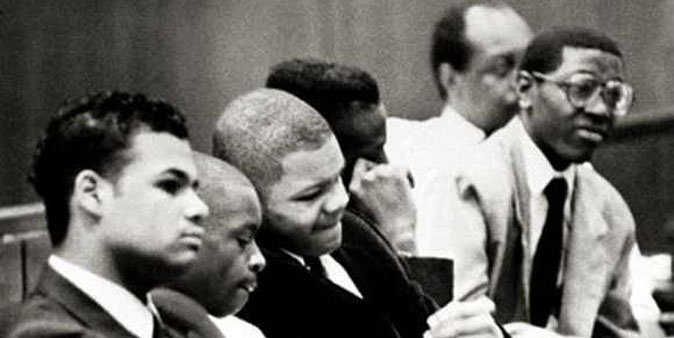
PBS is now broadcasting the excellent documentary The Central Park Five, about the media-driven rush to wrongly convict five young men of the rape attack upon the Central Park Jogger. The film is co-directed and co-written by famed documentarian Ken Burns (The Civil War, Baseball) , his daughter Sarah Burns and her husband David McMahon from Sarah’s book of the same name. The Central Park Five is just as credibly researched as Ken Burns’ previous work but has more of a bite, more of a sense of outrage.
The Central Park Five begins with the actual perpetrator of the crime, so we immediately are reminded that the Central Park Five teens are innocent, which helps us absorb their experience through their eyes. That’s critical for us to understand how they could have been browbeaten into confessing to crimes that they did not commit.
We see their video confessions and hear from the Five and their families today. We also hear from lawyers, politicians and journalists, but not from the police or prosecutors.
The story of The Central Park Five is remarkably compelling. It’s also an important film. Viewers will never assess confessions induced by police interrogations in the same way again.
DVD of the Week: Smashed
In this indie drama, a couple navigates life while drunk. Can they stay together and flourish when she sobers up? Smashed is a remarkably realistic portrayal of the drinking life and the challenges of recovery and relapse, informed by the personal experience of co-writer Susan Burke.
The best thing about Smashed is the performance of Mary Elizabeth Winstead as the wife. Winstead realistically takes her character through the carelessness, denial, humiliation and self-degradation of drinking and the fears and determination that co-exist in her recovery. It’s a stellar performance, and I’ll be looking for Winstead in bigger roles.
Also very good are Nick Offerman as the wife’s colleague, Megan Mullally, unrecognizable as the wife’s boss, and the always delightful Octavia Spencer.
As The Wife pointed out, the amount of time that director and co-writer James Ponsoldt spent on the drinking part of the story means that lots of plot points whiz by in the final ten minutes. Still, Smashed is very watchable and benefits from the breakthrough performance by Winstead. It’s available on DVD from Netflix and Redbox and streaming from Amazon, iTunes and other VOD providers.
The Place Beyond the Pines: the sins of the fathers visited upon the sons
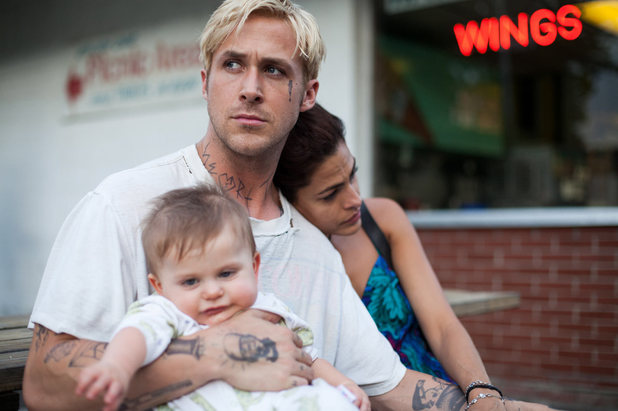
According to the Old Testament, “the iniquity of the fathers shall be visited upon the sons”. Indeed, the successes and flaws of fathers, and the choices they make, impact their sons. And sons are often driven to be like or unlike their fathers, to match them or to surpass them. That is the territory explored in writer-director Derek Cianfrance’s intelligent drama The Place Beyond the Pines. (The story is set in Schenectady, New York, and the title refers to the Mohawk origin of the town’s name.)
At first, the story follows a familiar path for a crime drama – a motorcycle trick rider (Ryan Gosling) turns to bank robbery and has an encounter with a cop on patrol (Bradley Cooper). But the screenplay embeds nuggets about how both men feel about their fathers and how those feelings drive their actions. Both men have infant sons, and the father-son theme becomes more apparent as the story resumes fifteen years later with a focus on their own sons as teenagers.
I can’t remember a recent performance by Ryan Gosling that hasn’t been compelling, and he’s outstanding here, too. But the unexpected gem is Bradley Cooper, who shows us acting depth and range that we haven’t seen in his earlier work. Especially in scenes with a police psychiatrist and when forced to ask his father for advice, Cooper exposes the naked vulnerability of his character.
The Place Beyond the Pines is replete with excellent performances. Eva Mendes plays the mother of Gosling’s baby, and her performance stands up to Gosling’s – no small feat. Harris Yulin is superb as Cooper’s canny father. The wonderful Australian actor Ben Mendelsohn (Animal Kingdom, Killing Them Softly) plays Gosling’s crime partner. Ray Liotta, who often plays shady characters, has never been so menacing.
I found the character of Cooper’s son to be very unsympathetic; he is supposed to be a kid messed up by his parents’ divorce and father’s inattention, and I think that the story would have worked better if it were easier to look past his obnoxiousness to appreciate his damaged nature. Still, it’s a film that I’m still pondering a day later. Cianfrance made Blue Valentine, the hard-to-watch but starkly authentic story of an unraveled relationship, an acting showcase for Gosling and Michele Williams. The Place Beyond the Pines is just as thoughtful and more accessible than Blue Valentine. Pines is an ambitious and mostly successful film.
Movies to See Right Now
- The Sapphires
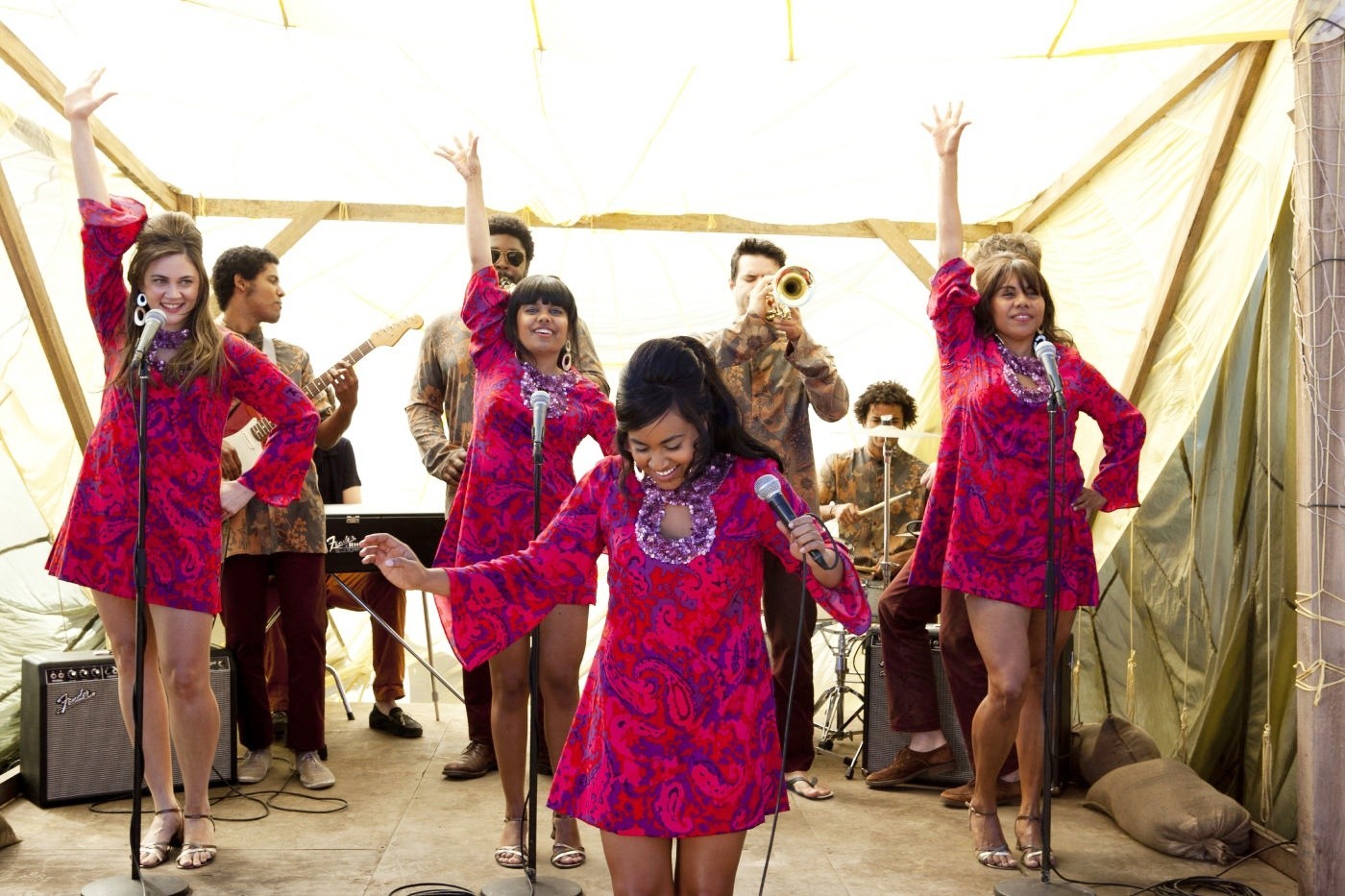
I’m still recommending the absolutely winning The Sapphires, a charmer about Australian Aboriginal teens forming a girl group to entertain troops in the Vietnam War. The other side of the coin is the bleak, but masterful Romanian drama Beyond the Hills.
And I still love two indies on Video on Demand:
- Letters from the Big Man: a beautifully looking and sounding fable about a prickly woman with a guy and a Bigfoot competing for her affections.
- Electrick Children: an entirely unique teen coming of age story with fundamentalist Mormon teens in Las Vegas.
The other best choices in theaters:
- No: Gael Garcia Bernal stars as the regular guy who brainstormed the guerrilla advertising campaign that dethroned Chilean dictator Pinochet.
- The Incredible Burt Wonderstone: a pleasant comedy and a showcase for Jim Carrey.
- Side Effects: Steven Soderbergh’s psychological thriller starring Rooney Mara, Jude Law and Catherine Zeta-Jones.
- Quartet: a pleasant lark of a geezer comedy with four fine performances.
Music fans will enjoy the bio-documentary Beware of Mr. Baker, available on VOD.
On the Road is the faithful but ultimately unsuccessful adaptation of the seminal Jack Kerouac novel, with surprisingly little energy. The HBO movie Phil Spector is really just a freak show.
You may still be able to catch the fine PBS documentary Philip Roth: Unmasked. Roth himself gets lots of screen time to explain his career and his creative process.
I haven’t yet seen the much anticipated The Place Beyond the Pines with Ryan Gosling and Bradley Cooper, which opens today. You can read descriptions and view trailers of upcoming films at Movies I’m Looking Forward To.
My DVD of the week is the campy 1994 sci fi western Oblivion, which I’m betting is more entertaining than this week’s Hollywood remake.
On April 15, Turner Classic Movies is showing all four of the Clint Eastwood Man with No Name movies: the Sergio Leone trilogy (For a Fistful of Dollars, For a Few Dollars More and The Good, the Bad and the Ugly) plus Hang Em High.
Beyond the Hills: a bleak tragedy by a masterful filmmaker
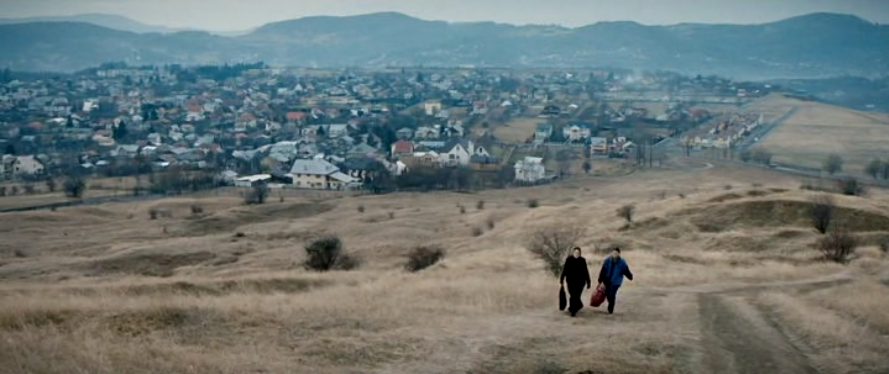 The two lead characters in Beyond the Hills grew up together in a Romanian orphanage where they were subjected to privation and worse – and where they became lifelong soulmates. They aged out of the orphanage, and, now 24, Alina has been working menial jobs in Germany while Voichita has joined a local monastery. The monastery is a small rural compound with a rigidly dogmatic provincial priest, a compassionate but simple mother superior and a dozen nuns who run the gamut from devout to superstitious.
Alina craves Voichita’s companionship and viisits the monastery to convince Voichita to leave and join her in Germany. Voichita resists, and tries to get Alina to join the religious order. They’re both emotionally damaged from childhood experiences. There’s a strong bond between the two, and each is unable to let the other go. But each is strong willed and stubborn.
Then Alina suffers a psychotic breakdown. Now, since the worst place to treat such a condition would be a community of religious fanatics that is intentionally devoid of modernity, bad things happen. The priest and nuns are not monsters, but ill-equipped to avoid making a series of monstrous choices. We can only watch as the story moves unrelentingly to its awful conclusion. Sadly, the story is based on actual events at a Moldavian monastery a decade ago.
Beyond the Hills is compelling, in an oft excruciating and uncomfortable way. But those who commit to its 2 1/2 hours will see some remarkable film artistry from its real star – director Christian Mungiu. Munghiu’s thriller 4 Months, Three Weeks, 2 Days won the top prize at the Cannes Film Festival (and made #3 on my Best Movies of 2007). Beyond the Hills won Canne’s screenwriting award.
Munghiu fills Beyond the Hills will one dramatic shot after another. Early in the film, we see Voichita and Alina hike up a hillside in the Romanian countryside (see photo at top); when they reach the top, the camera swings behind them, and we see the monastery on the next rise. At the climax, the camera stays fixed on a crowd of characters (see photo below); the action and dialogue is between the two men in the foreground, but our attention is on the reactions of Voichita in the background. The length and patience of the shot allow our attention to settle on Voichita, and her eyes tell us what she has concluded. It’s an absolutely gripping moment.
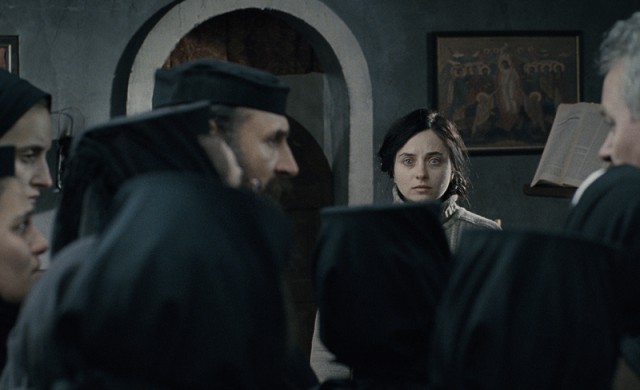 Beyond the Hills is a tough movie by a major film artist.
DVD of the Week: the campy 1994 Oblivion
There’s a big budget Hollywood movie named Oblivion opening this week. I really enjoyed the original version, the sci fi spoof 1994 Oblivion, now available on DVD. It is set in the year 3030 on the planet Oblivion, which strongly resembles a frontier town from a spaghetti Western, peppered with the occasional cyborg, ray gun and ATM machine.
Oblivion is intentionally campy, has a silly plot and lots of tongue-in-cheek dialogue. The scene where the funeral is interrupted by the weekly bingo game upstairs is especially funny. The cast seems to be having lots of fun with the material. Musetta Vander as the rawhide whip-wielding dominatrix Lash and Carel Struycken as the death-forboding undertaker Gaunt are especially over-the-top good. In addition, Julie Newmar plays a cougarish saloon proprietor, and Star Trek’s George Takei is the Jim Beam-swilling town doc. Amazingly, Oblivion rated a 1996 sequel, Oblivion 2: Backlash, in which most of the cast returned.
Ebert’s favorite lines
Roger Ebert was never snarky unless a movie deserved it – and then he was masterful. In 2011, he published Roger Ebert’s Favorite Lines From Movie Reviews, which quickly made my own list of Other People’s Great Movie Lists.
Here are some examples from Ebert’s reviews:
“Pearl Harbor is a two-hour movie squeezed into three hours, about how on Dec. 7, 1941, the Japanese staged a surprise attack on an American love triangle.”
“Heaven’s Gate is the most scandalous cinematic waste I have ever seen, and remember, I’ve seen Paint Your Wagon.”
“I know full well I’m expected to Suspend My Disbelief. Unfortunately, my disbelief is very heavy, and during Ocean’s Thirteen, the suspension cable snapped.”
“Keanu Reeves is often low-key in his roles, but in this movie, his piano has no keys at all. He is so solemn, detached and uninvolved he makes Mr. Spock look like Hunter S. Thompson at closing time.” — The Day the Earth Stood Still
“She and Daredevil are powerfully attracted to each other, and even share some PG-13 sex, which is a relief, because when superheroes have sex at the R level, I am always afraid someone will get hurt.” — Daredevil
“I am informed that 5,000 cockroaches were used in the filming of Joe’s Apartment. That depresses me, but not as much as the news that none of them were harmed during the production.”