Roger Ebert has died. It’s a particularly somber moment for me because the Siskel & Ebert television show was one of the two essential triggers for my love of movies (along with my college History of Film class).
I first set up my massive 1982 VCR to record his and Siskel’s Sneak Previews. In the early 2000s, Ebert’s was the first blog that I checked every day. The reason that I signed up for Twitter was to follow Roger Ebert.
Roger Ebert was first a great film critic, period. He was also the most effective popularizer of movie criticism. Most importantly, especially for me starting in the late 1970s, he was the leading evangelist for independent and foreign cinema in the US. Without Siskel & Ebert, I wouldn’t have known to seek out a French film like La cage aux folles or the debut features of indie directors John Sayles (Return of the Secaucus Seven) and Spike Lee (She’s Gotta Have It).
In taking a “leave of presence” yesterday, Roger Ebert wrote, “On this day of reflection I say again, thank you for going on this journey with me. I’ll see you at the movies.”
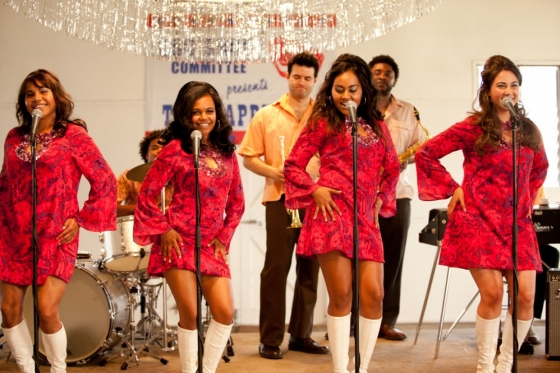
The Sapphires is a triumph of a Feel Good Movie. Set in the 1960s, a singing group from an Australian Aboriginal family faces racial obstacles at home, but blossoms when the girls learn Motown hits to entertain US troops in Vietnam. Remarkably, Tony Briggs based the screenplay on his mother’s real experience – make sure you stay for the Where Are They Now end credits.
The ever amiable Chris O’Dowd (one of the best things about Bridesmaids) is funny and charming as the girls’ dissolute manager. Jessica Mauboy, who plays the lead singer, has a great voice for soul music. A surprisingly beautiful song by the girls’ mom, played by veteran actress Kylie Belling, is an especially touching moment.
The Sapphires is not a deep movie, but it is a satisfying one. It’s predictable and manipulative, but I can’t think of anyone who wouldn’t enjoy it. I saw it at this year’s Cinequest, and predict that it will become a word-of-mouth hit. The Sapphires is a guaranteed good time at the movies.
A Late Quartet is a compelling character-driven drama about the individuals that make up an elite and successful classical string quartet. After twenty-five years, the cellist and leader develops Parkinson’s and must consider retirement. This development takes the lid off an array of long-simmering issues and triggers personal and interpersonal crises.
What makes A Late Quartet so gripping is the level of performance – not surprising considering the top shelf cast. Christopher Walken plays a man of uncommon dignity and stateliness, without the creepiness or even the eccentricity that his characters are usually imbued. Philip Seymour Hoffman is superb as a man who unleashes deeply buried resentments and vulnerabilities. Catherine Keener is also striking as a woman who cannot answer the question, “Do you love me?”. Mark Ivanir (who I didn’t remember from Schindler’s List and who often plays Russian gangsters) is excellent as a callous perfectionist brought literally to his knees by something he never expected. Imogen Poots (Solitary Man) also shines as the prodigy daughter whose drops her youthful playfulness when it’s time to settle a score with her mother.
One more note: I relished the delightful homage to Dinner with Andre when we suddenly see Wallace Shawn holding forth in a New York restaurant.
We aren’t surprised by any of the plot points, but we are continually surprised by the reactions of the characters, so masterfully delivered by the actors.
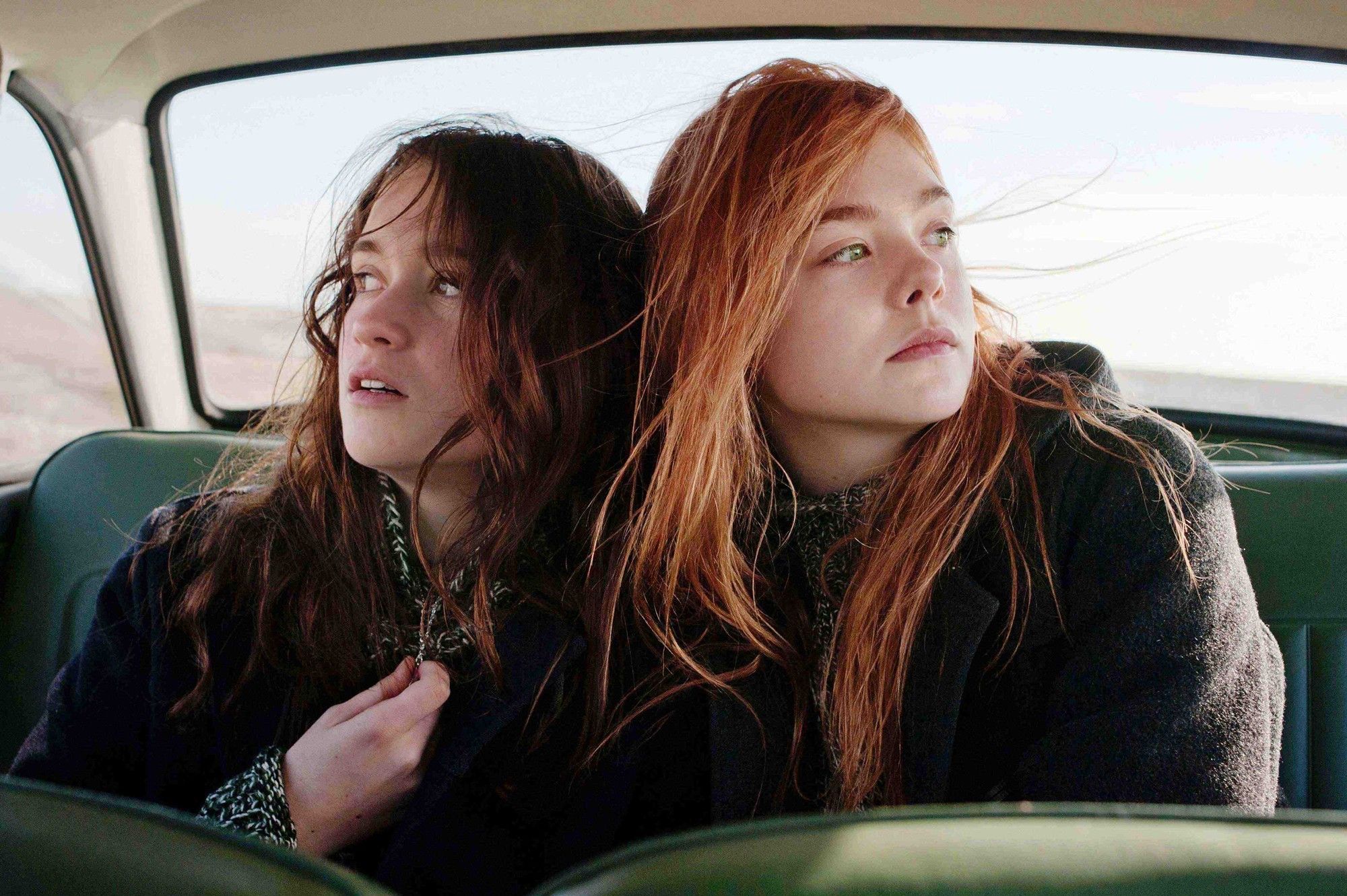
The title characters in Ginger & Rosa are 17-year-old best friends in 1962 London. Through each stage of childhood, they have been inseparable companions and are now, as teens, fierce allies against their mothers. But at 17, Ginger’s intellectualism and Rosa’s romanticism are becoming more pronounced. Ginger is obsessed with the British nuclear disarmament movement and Rosa is boy crazy. Ginger & Rosa is a solid dramatic snapshot of the moment when this friendship plunges into crisis.
Another important character is Ginger’s unreliable dad (Alessandro Nivola), a political pamphleteer once jailed for his pacifism who justifies his anarchic lifestyle as resistance to authority. This is political statement, conveniently, serves as a rationale for doing whatever he wants to do, whatever the impact upon others.
The truth tellers in the story are the most constant adults in Ginger’s life, gay couple and their arch friend played by Timothy Spall, Oliver Platt and Annette Bening. These three actors are always welcome in a movie, and are outstanding in Ginger & Rosa.
The American actress Elle Fanning is excellent as the always-observant Ginger. Her performance here marks her as someone who could have an extraordinary career. Remarkably, Fanning played this 17-year-old character when she was only 14. The less demanding role of Rosa is well-played by director Sally Potter’s daughter Alice Englert.
Potter gets the period exactly right – from the girls’ ironing their hair to their discovery of turtleneck sweaters. But, along with Fanning’s stellar performance, is that enough for a satisfying movie? At the end of the day, it’s a well-crafted, character-driven little movie – but not a Must See.
Side Effects: Steven Soderbergh’s psychological thriller starring Rooney Mara, Jude Law and Catherine Zeta-Jones.
Quartet: a pleasant lark of a geezer comedy with four fine performances.
Music fans will enjoy the bio-documentary Beware of Mr. Baker, available on VOD.
Emperor, with Tommy Lee Jones as Gen. Douglas MacArthur leading the American occupation of Japan, is historical but plodding. On the Road is the faithful but ultimately unsuccessful adaptation of the seminal Jack Kerouac novel, with surprisingly little energy. The HBO movie Phil Spector is really just a freak show.
I haven’t yet seen the upcoming PBS documentary Philip Roth: Unmasked. You can read descriptions and view trailers of upcoming films atMovies I’m Looking Forward To.
On Easter Sunday, Turner Classic Movies offers a Jesusathon of Sword and Sandal movies: Ben-Hur, The Robe and Barabbas.Ben-Hur has the thrilling chariot race around that phenomenal set – one of the greatest sets in movie history. In Barabbas, Anthony Quinn sees Charlton Hestons’s galley slavery and raises it by a tour in the sulpher mines, a stint as a gladiator and the witnessing of the burning of Rome, all culminating in a Christian martyrdom.
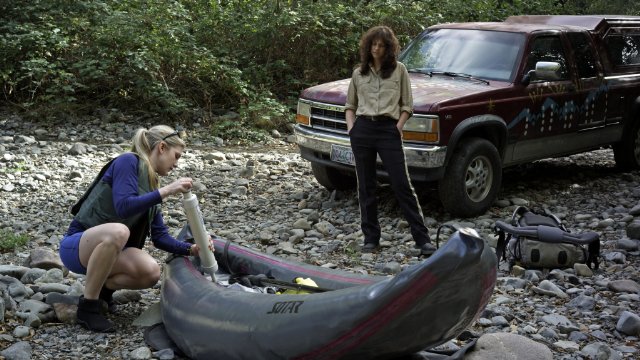
Employing magical realism like Electrick Children, Letters from the Big Man is a completely original movie. A young woman of fierce independence has left a career with the US Forest Service to do art. Upended by a bad breakup, she takes an assignment from her former employer that conveniently requires her to do what she really needs to do – make a solo backpacking trip deep into the southern Oregon forests.
The opening quarter of the movie establishes two things. First, the ancient Oregon forest is awesomely beautiful and inspires reflection. Second, this woman’s wilderness skills are beyond impressive – she hikes, kayaks, chops wood, makes camp and kindles fire with great ease. It’s clear that she is extremely experienced in the wild, and she exudes confidence. She recognizes every plant species, snorkels to count the horns on a sturgeon and wades into streams to measure the siltation. And she can handle a handgun, too. Wow. (Later in the movie, we see her matter-of-factually rig her bike to recharge her laptop battery with pedal power.) She comes to realize that someone/something is following her, a thought that may terrify the audience (especially at night), but which only annoys and intrigues her.
As the young woman, Lily Rabe carries the film with her physicality and strength of will. (Rabe is the daughter of the late Jill Clayburgh.) Her character is also prickly, which keeps us from warming to her right away. But she attracts the attention of two males. The first is another backpacker, who turns out to be an environmental activist at odds with the Forest Service and ready for female company. The second is a Bigfoot, who rages against logging in his forest, but who melts at the sight of our heroine and leaves her piles of twigs as tokens of his affection (this is the magical realism). The movie turns on her response to her two suitors.
Writer-director Christopher Munch has created a movie of uncommon beauty, and he has the balls to include a lovelorn Bigfoot. The magical realism works because he presents it absolutely straight, as if having a Sasquatch in the story is as normal as a squirrel. Most of the rest of the story is extremely realistic, especially the interactions between officials of the Forest Service, environmentalist activists and loggers. The one exception is an unnecessarily farfetched conspiracy theory about military intelligence.
Letters from the Big Man is one of the best looking and best sounding movies of the year. Visually, it’s like trekking through wilderness (but without the insects). And the sound track is exquisite, centered on the natural sounds of rushing water and animal calls, occasionally augmented with an ensemble’s reverential music.
Will Sasquatch get the girl? It’s worth finding out. Letters from the Big Man is available on VOD, including on Amazon Instant.
With Electrick Children, a new filmmaker has created an entirely unique teen coming of age story. Electrick Children employs an element of magical realism that requires the audience to accept a premise which cannot be real. The result is a highly original success.
A 15-year-old Utah girl has been raised in a remote fundamentalist Mormon enclave where everyone dresses as 19th century pioneers. She has been immersed in Bible stories, but hasn’t been exposed to any modern culture or to the facts of life. She happens upon a hidden cassette tape and finds her first rock and roll song revelatory – so revelatory that she thinks that the song has moved her to pregnancy. Here comes the magical realism – she really is a virgin, and she really is pregnant.
Because of her faith, she doesn’t find immaculate conception to be the least bit implausible. Not so with her parents, who wrongly blame her 17-year-old brother. Their answer is to kick the boy out of the home and to marry off the girl to a neighboring fundamentalist. Facing the unwanted shotgun wedding, the girl commandeers the family pickup and flees; her brother, seeking a way to prove his innocence, stows away.
The kids surface in Las Vegas, where they fall in with a band of runaway teens. Of course the Mormon kids are completely unprepared to navigate any modern city, let alone Vegas. Their guides, the more streetwise kids, are more comfortable with the glitz and sleaze of Vegas, but are just as untethered. The Mormon kids and the suburban runaways have life-altering adventures on the streets.
The girl embarks on a quest to find the singer who she thinks has fathered her child, not understanding that there is more than one rock band in the world (or that Blondie’s Hanging on the Telephone has not made her pregnant.) Central to the film’s success is that the girl is naive but never silly. The young actress Julia Garner shines in a performance that is never ironic and always completely sincere. The girl is determined and devout, seeking teen independence in ways that are logical for someone with her isolated upbringing.
As good as Garner is, the real talent here is writer-director Rebecca Thomas, a Mormon from Nevada with an MFA from Columbia. This is her first feature film, and I can’t wait for her next one.
Who better to play the explosively wacked-out music genius in Phil Spector than Al Pacino? Here, Spector is living in self-delusional isolation and still taking way too many drugs, and he’s on trial for his life. His defense lawyer (Helen Mirren) faces a dilemma – the only way the court will hear her best evidence is if she first calls her very unsympathetic client to the stand.
Phil Spector is written and directed by David Mamet (Glengarry Glen Ross, House of Games), but it’s very minor Mamet. The only reason to watch Phil Spector is for the inevitable Pacino meltdown. That meltdown is a doozy, but it exposes Phil Spector as more of a freak show than a complete film.
I really enjoyed Celeste and Jesse Forever, starring Rashida Jones and Andy Samberg as best friends who have been married, are now working on an amiable divorce and are still best friends. The screenplay is co-written by Rashida Jones (Paul Rudd’s fiance in I Love You, Man) and, once you accept the comic premise that this couple is made for each other but not as a married couple, everyone’s behavior is authentic. Sure, he wants to get back with her when she isn’t in a place to do that – and, then, vice versa – but the characters resolve the conflict as they would in real life. Here’s a mini-spoiler – this movie is just too smart to end in rushing to the airport or disrupting the wedding or any of the other typical rom com contrivances.
The supporting characters are funny without being absurdly zany (except for one pot dealer). Chris Messina pops up in Celeste, as he did in the other smart actress-written comedy Ruby Sparks, and does a good job here, too. I’m certainly looking forward to Rashida Jones’ next screenplay.
On the Road is the faithful but ultimately unsuccessful movie adaptation of the seminal Jack Kerouac novel. The novel is itself primarily remembered as memoir of the Beat Generation’s defining literary voices, for its stream of consciousness narrative and for the unforgettable portrait of Keroauc’s muse Neal Cassady as the character Dean Moriarity. Director Walter Salles succeeds in creating a wonderful time capsule of the Beats – but that’s not enough.
The story is centered on the famous series of road trips where Keroauc latches on to the the charismatic and erratic Cassady, hoping that their adventures will unclog Kerouac’s writer’s block. Although he has some independent escapades, Kerouac is essentially the observer, unleashing Cassady on North America. Cassady had insatiable appetites for sex, Benzedrine, marijuana, nonstop talking and driving long distances at high rates of speed, and he was a pillar of unreliability. If Cassady is known for anything, it’s for his twitchy freneticism and speedy monologues. If you’ve read On the Road and especially if you’ve seen film footage of the real Neal Cassady, you’ll find the actor Garret Hedlund’s portrayal too measured. Except for one jazz party scene, it seems as if Hedlund has never witnessed the effects of amphetamines. Unfortunately, the Cassady character – the throttle for the novel – is the brakes to the movie.
The narrative is pretty linear. We are SHOWN stream of consciousness at the end of the movie when Kerouac bangs out On the Road on his single 120-foot roll of typewriter paper. But the movie has none of the novel’s helter-skelter flavor.
But if anyone knows how to direct a road movie, it’s Walter Salles (The Motorcycle Diaries). Salles captures the long hauls across the vast continent and vividly depicts settings from gritty NYC to the never ending Nebraska plains. In one particularly nice touch, the characters enter San Francisco on a completely fog-shrouded Golden Gate Bridge, which Bay Area residents know to be a more typical experience than postcard weather on the Bridge.
The Keroauc character is ably played by Sam Riley, who has the less showy role of Kerouac’s cultural sponge.
Kristen Stewart plays Cassady’s 16-year-old bride; since she’s a big movie star, she gets more screen time than she gets pages in the book. That’s a good thing, because, despite all the grief she gets for the Twilight movies, Stewart can really act.
The surrounding cast is excellent. Tom Sturridge stands out as the young Allen Ginsburg. Alice Braga sparkles as the Mexican-American single mom that Keroauc picks cotton with. We glimpse Viggo Mortensen and Amy Adams as Beat figures William S. Burroughs and June Vollmer. Steve Buscemi is always welcome in a movie, and here he gets a creepy pencil-thin mustache. Kirsten Dunst and Elisabeth Moss do what they can with the roles of women scolding their unreliable men.
On the Road, with its fine secondary cast, is a leisurely tour through the Beat period, but without the energy of its pioneers.

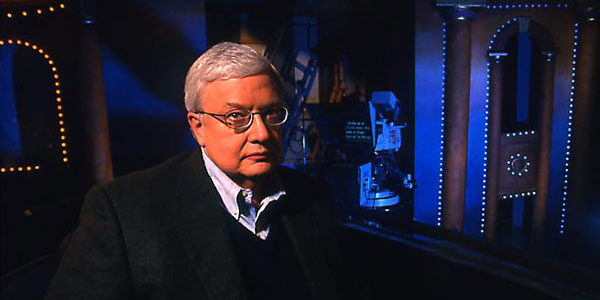 Roger Ebert has died. It’s a particularly somber moment for me because the Siskel & Ebert television show was one of the two essential triggers for my love of movies (along with my college History of Film class).