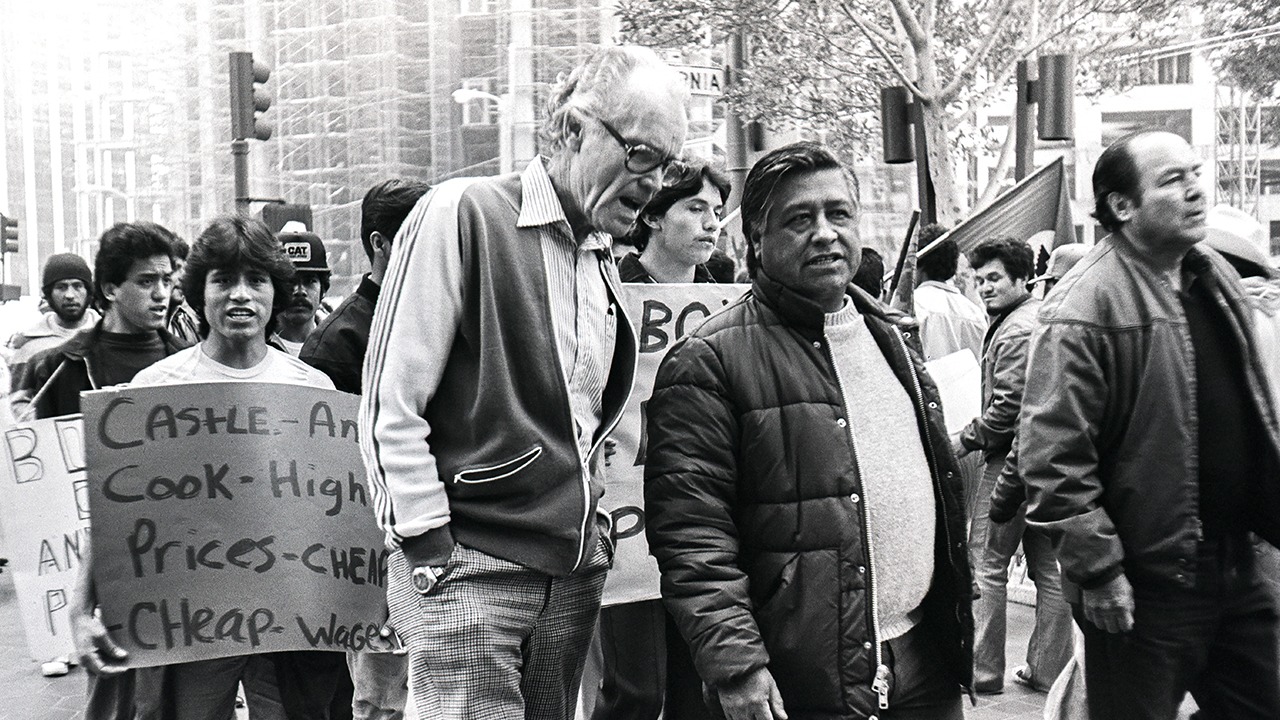
Fred Ross (foreground left) and Cesar Chavez (foreground right) in AMERICAN AGITATORS. Courtesy of Cinequest.
American Agitators is the important story of legendary organizer Fred Ross, the mentor of Cesar Chavez, and essentially a saint of the social justice movement. American Agitators shows Ross being formed by the Great Depression and the left-wing politics, the union movement and the New Deal. As a fully formed organizer, Ross met Chavez; Ross’ organizing resonated with Chavez applied his own imagination to Ross’ tactics and launched his own historically essential movements for farmworker unionization and Chicano Rights.
Director Raymond Telles has sourced the film impeccably. The third act rolls out Ross’ legacy today, not just Chavez the icon and the Farmworkers movement, but the influence of Fred Ross, Jr. and then a more loosely configured compendium of recent and current labor campaigns..
Fred Ross and Dolores Huerta in AMERICAN AGITATORS. Courtesy of Cinequest.
LOCAL SAN JOSE INTEREST: Fred Ross met Chavez at Cesar’s home at 53 Sharff Avenue in San Jose, hired Cesar as his deputy and organized out of McDonnell Hall at Our Lady of Guadalupe on East Antonio Street. Cesar’s son Paul (of San Jose) appears in the film as does Luis Valdes of Teatro Campesino, who has also had a significant presence in San Jose.
I screened American Agitators for its world premiere at Cinequest.
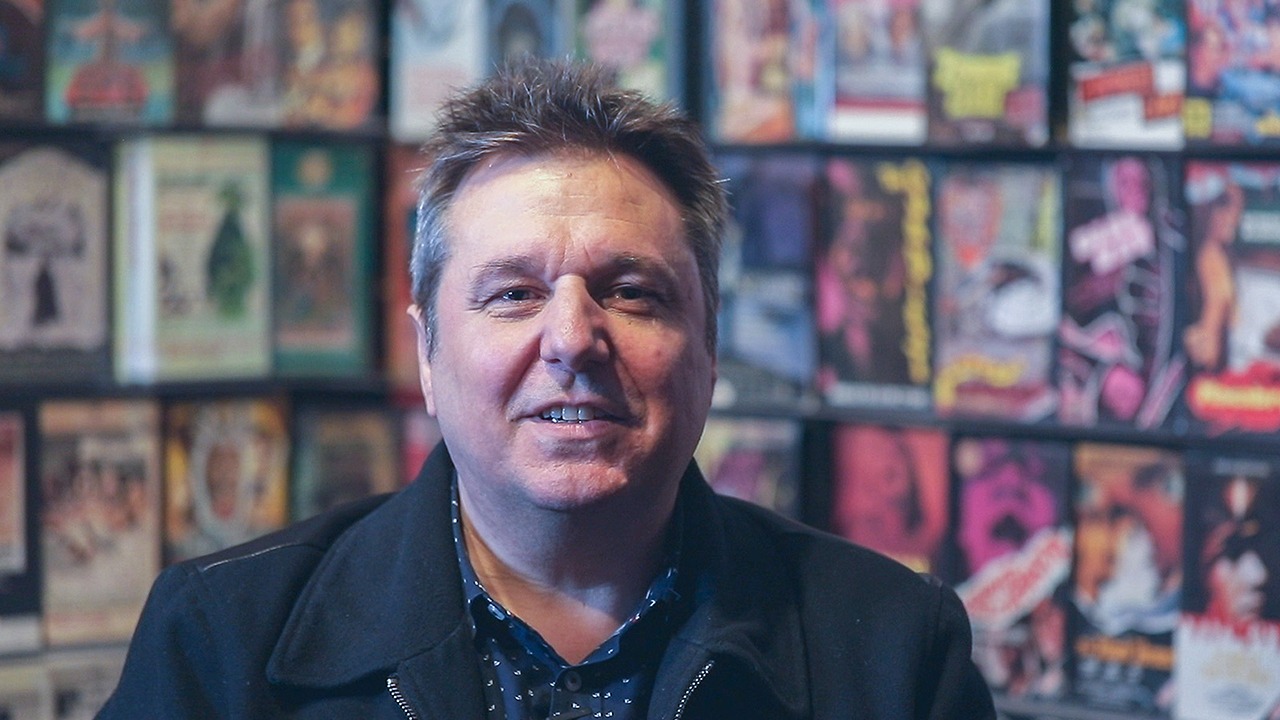
Severin Films founder David Gregory in BOUTIQUE: TO PRESERVE AND COLLECT. Courtesy of Cinequest.
Ry Levey’s infectious documentary Boutique: To Preserve and Collect is about passion – passion that fuels the preservation and rejuvenation of cult cinema. We’re mostly talking about exploitation movies that would otherwise be lost. Much the credit for saving them goes to Severin Films and Vinegar Syndrome, which are essentially the Criterion Collection for grindhouse cinema. Both companies evolved from aficionados making bootleg tapes of their favorite obscure films into legitimate catalogues of preserved films.
You may not think that a certain movie is IMPORTANT, but there is probably someone who finds it absolutely ESSENTIAL. Many movies have been made to be disposable, but have inspired loyal fans. One person’s drive-in may be another’s arthouse. What makes Boutique: To Preserve and Collect fun to watch is the contagious enthusiasm of the devotees.
Boutique: To Preserve and Collect takes us from the Dark Ages, back when, once you had seen it in a theater, a film was forever lost to you. No matter how much you wanted to watch it again or share it with others, your only recourse would be to scour TV Guide for when it might show up on late night television. Then, the introduction of the VCR made it possible to collect movies you love and to evangelize for them. The video store and the DVD opened up the possibilities even more.
Boutique: To Preserve and Collect covers a lot of ground, much of it arcane, so it’s fortunate that the editing keeps the film popping. Canadian filmmaker Ry Levey has been to Cinequest before, most recently with his fine LGBTQ pro wrestling doc, Out in the Ring.
[Severin is now selling House of Psychotic Women: Rarities Collection Volume 2 and a Blu-ray set of Fear in the Philippines: The Complete Blood Island Films. Vinegar Syndrome’s current offerings include DVDs of The Possession of Joel Delaney (4K Ultra HD) and The White Cannibal Queen.]
I screened Boutique To Preserve and Collect for its US premiere at Cinequest.
A. P. Giannini in A LITTLE FELLOW: THE LEGACY OF A.P. GIANNINI. Courtesy of Cinequest.
A Little Fellow: The Legacy of A.P. Giannini: Here’s an underdog story – a boy loses his immigrant father, starts out impoverished and builds the nation’s largest bank, helping to rebuild San Francisco after the 1906 earthquake. This very comprehensive documentary also tells the less well-known story of Giannini as movie financier – backing films like City Lights, Gone with the Wind and Sleeping Beauty.
A Little Fellow is a very by-the-numbers doc and is pretty uncritical of Giannini, but it is impeccably sourced and has a damn interesting subject.
I screened A Little Fellow: The Legacy of A.P. Gianninifor its US premiere at Cinequest. The Cinequest audience will note the local interest. Giannini’s childhood began in San Jose, his father was murdered in Alviso, and his first bank branch building still stands, only 1500 feet from the Cinequest screening at the Hammer Theatre.
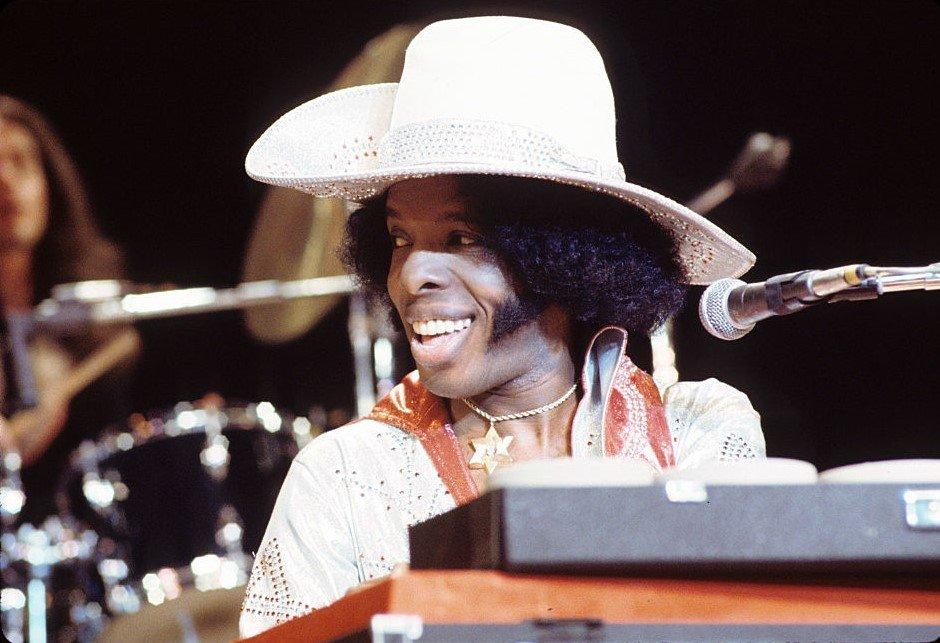
Photo caption: Sly Stone in SLY LIVES! (AKA THE BURDEN OF BLACK GENIUS). Courtesy of Hulu.
Questlove’s insightful documentary Sly Lives! (aka The Burden of Black Genius) traces the rise, fall and legacy of the groundbreaking musician Sly Stone (birth name Sylvester Stewart) of Sly and the Family Stone. It’s the remarkable story of a prodigy
Sly led and wrote the songs for Sly and the Family Stone, startlingly innovative as both a multi-racial and a multi-gender band. It’s too easy to use the label psychedelic soul (although it does fit Sly and the Family Stone’s music); but, Sly was an original and a genre-buster, whose music blurred (or erased) the lines between rock, R&B, funk, soul and pop.
The term prodigy also gets thrown around, but I didn’t know (until I watched Sly Lives!), that Sly was working as a songwriter, producer and D-jay as a TEENAGER, already moving the needle on Bay Area music culture during its most fertile period.
Sly Lives! also gives us file footage showing Sly to be articulate and charming, with the gift of being quick-witted even while stoned. But then came the heavier drugs, sabotaging his career with a pattern of concert no shows and walkouts that have persisted thru at least 2007. His productivity essentially ended in 1974. All members of Sly and the Family Stone were inducted into the Rock and Roll Hall of Fame in 1993. Sly is alive today at age 81.
This is an exceptionally well-sourced fil. Besides lots of previously obscure archival material from before Sly’s stardom, we get plenty of footage of Sly in interviews and performances back in the day. Perspective comes from the band member themselves, Sly’s ex-wife and his former partner, and a slew of experts in the music industry,
Questlove asks his interviewees about black genius (and seems to confound them). There’s no question Sly was a musical genius. I think that Questlove is emphasizing the word burden in his subtitle – suggesting that having to achieve while battling institutional racism finally sapped Sly of his resilience.
Questlove also reminds us that Sly’s creativity peaked during one of our most turbulent periods – the MLK and RFK assassinations, urban riots and the political evolution from Civil Rights to Black Power. The Black Panther Party suggested that Sly bankroll them personally.
Questlove, who was three years old at the time of Sly’s last hit in 1974, is widely known as the band leader of The Roots on The Tonight Show Starring Jimmy Fallon, and the producer for many recording artists, including Common, Jay-Z, John Legend Al Green and Elvis Costello. He is a musicologist and a historian of Black music and Black culture. In his directorial debut as a filmmaker, he won the Best Doc Oscar for Summer of Soul (…Or, When the Revolution Could Not Be Televised). (The Movie Gourmet predicted that Oscar BTW.)
I loved this nugget from the film – band members celebrated their first big paycheck by acquiring signature dogs. Not cars, jewelry or exotic vacations – dogs.
Sly Lives! (aka The Burden of Black Genius) is streaming on Hulu.
Photo caption: MEMORIES OF LOVE RETURNED. Courtesy of Slamdance.
The fine documentary Memories of Love Returned is the result of an accidental meeting. On a 2002 trip to his native Uganda, actor Ntare Guma Mbaho Mwine (Treme, The Chi, The Lincoln Lawyer) happened upon a rural studio portrait photographer named Kibaate. Over a span of decades, Kibaate had documented everyday people over decades in thousands of portrait, many of them stunningly evocative. Mwine helped Kibaate preserve his body of work, and, after Kibaate’s death 20 years later, organized a public showcase of Kibaate’s collection.
The revelation of the unknown Kibaate as an artistic genius, is a compelling enough story, but the exhibition prompts a complicated and sometimes awkward exploration of Kibaate’s siring a prodigious number of children with a bevy of surviving mothers. The filmmaker’s own health and family story takes Memories of Love Returned seamlessly into another direction, topped off by Kibaate’s documentation of Ugandan LGBTQ culture.
Memories of Love Returned is the second documentary feature directed by Mwine. Executive-produced by Steven Soderberrgh, the film has been piling up awards from film festivals. I screened Memories of Love Returned for Slamdance.
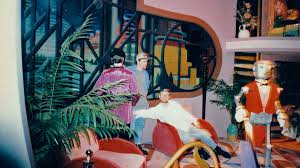
A scene from STOLEN KINGDOM. Courtesy of Slamdance.
The documentary Stolen Kingdom uncovers a series of offbeat pastimes and their bizarre convergence. Of course, we’re already aware of Disney fans and collectors. Stolen Kingdom also reveals the world of urban explorers, who trespass into closed and abandoned buildings. They’re enjoying the thrill of being where they’re not supposed to be and gawking at what the public isn’t supposed to see.
In Stolen Kingdom, we meet people who sneak into closed theme park attractions and even some daredevils who jump off the rides while operating and mosey around backstage(see photo above). Those folks can be tempted by the black market in Disneyana. As the behavior escalates from pranks to larceny, we know that somebody’s going to get in big trouble, Centering on the theft of an obsolete animatron, Stolen Kingdom takes on the guise of a true crime story, but with the very nerdiest criminals.
A scene from STOLEN KINGDOM. Courtesy of Slamdance.
Stolen Kingdom is one of those documentaries about our fellow humans that make us shake our heads.
Stolen Kingdom is the first feature for director Joshua Bailey. I screened Stolen Kingdom for Slamdance, a week after its world premiere at the Big Sky Documentary Film Festival.
Yana Osman (right) in her TWIN FENCES. Courtesy of Slamdance.
In her quirky, and finally profound, documentary Twin Fences, writer-director Yana Osman starts us off with what seems like a a droll, absurdist film about a ridiculously obscure subject, a prefab concrete fence design replicated thru the USSR. Osman stands, hands down at her side, facing the camera, spouting random facts. It may be off-putting at first, but the approach grows to be intoxicating. When she finds talking heads who are actually experts on the fences, we wonder if we’re watching a parody of a talking head expert documentary. We even hear about a Soviet who returned from Chicago in the 1920s, inspired to improve public health with a proprietary sausage.
Osman’s story takes us through Russia, Afghanistan and Ukraine, until there’s a pivotal tragedy in her family. The ending, with her grandfather, is sweet and heartbreaking. Only then do we realize that we’ve just watched a clear-eyed comment on contemporary Russia.
TWIN FENCES. Courtesy of Slamdance.
I’ve never seen a film that wanders across such disparate topics over 99 minutes, seemingly randomly, but which turns out to get somewhere unexpected and worth arriving at. This is Osman’s first feature; Twin Fences is very well-edited, and unsettling tones on the soundtrack help tell the story. Osman is an idiosyncratic, and, I think, pretty brilliant filmmaker.
Audiences who hang withTwin Fences will be rewarded. I screened Twin Fences for its North American premiere at Slamdance.
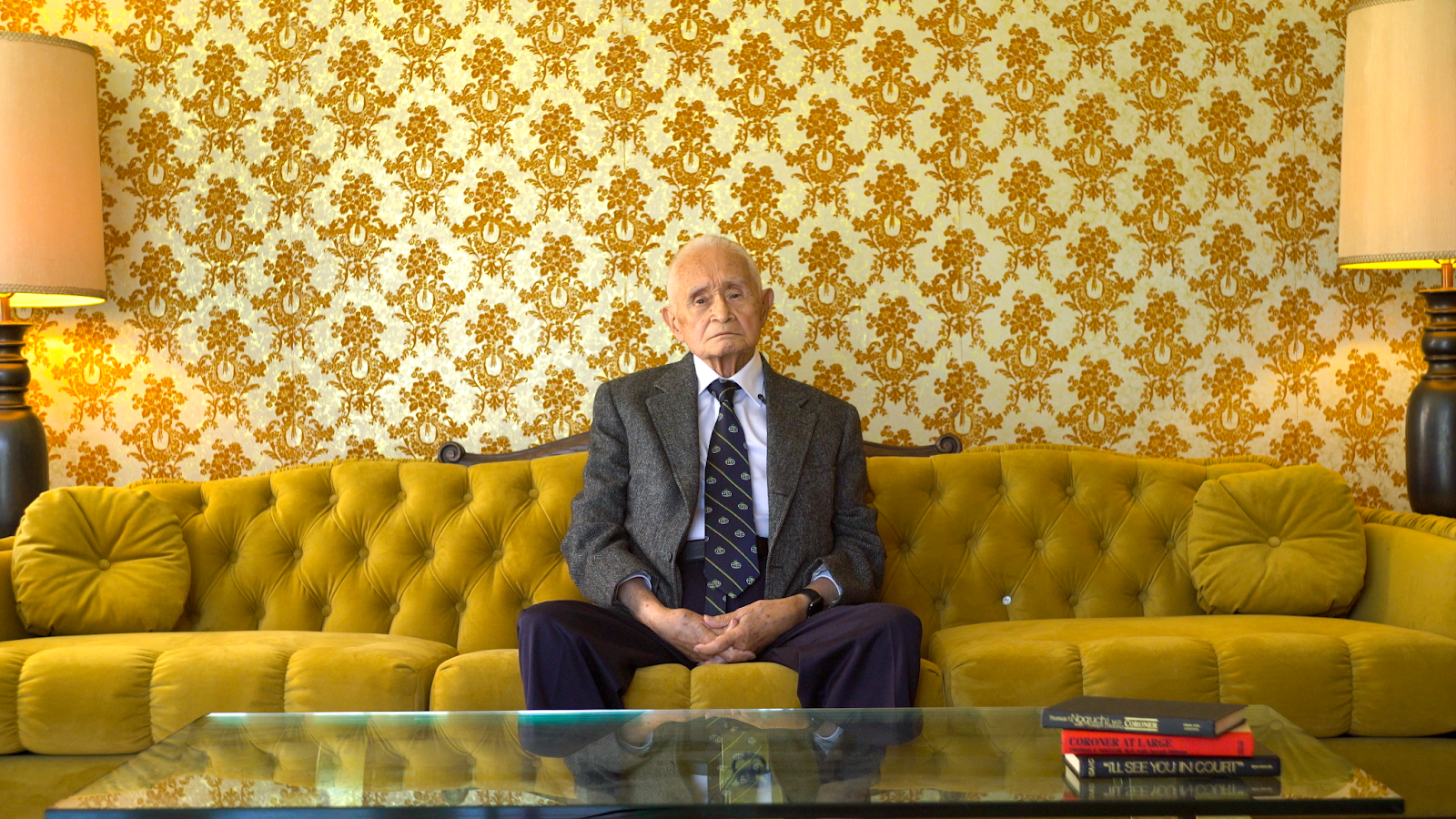
Photo caption: Dr. Thomas Noguchi in CORONER TO THE STARS. Courtesy of Slamdance.
The absorbing biodoc Coroner to the Stars tells the story of Dr. Thomas Noguchi, the former Los Angeles County Chief Medical Examiner and his bouts with fame (or infamy). His LA County jurisdiction meant that he was responsible for conducting the autopsies of a striking collection of celebrities, including Marilyn Monroe, William Holden, Natalie Wood, John Belushi and the Manson Family’s murder victims. Noguchi was also responsible for making his reports public – and therein lies the rub.
The public is fascinated by the details of celebrity deaths, and the news media eagerly panders to that need, however prurient or ghoulish. Official records in California, including coroner’s reports, are public. Noguchi did not shy away from the media spotlight, which triggered controversy. He was clearly fulfilling his legal duty, but did he enjoy it too much? Was he a publicity hound? Can an official be transparent without being unseemly? Indeed, Coroner to the Star’s tag line is Fame kills.
Writer-director Ben Hethcoat and Keita Ideno, in the first feature for both, present an extraordinarily well-sourced, credible and insightful documentary. Noguchi is still alive at age 98 and appears in the film to speak for himself.
Noguchi’s work (and style) stepped on some influential toes – the families and friends of the deceased, the major Hollywood studios and bureaucratic/political foes. Whenever he came under attack, the subtext was his race and the public perception and acceptance of Asian-Americans. Noguchi was a post-war immigrant who didn’t experience the Japanese-American internment during WW II, but Japanese-Americans traumatized by the camps would organize to defend LA’s highest ranking Japanese-American official.
Noguchi was also an internationally recognized pioneer in forensic science. Coroner to the Stars reveals his determination, in the RFK autopsy, to avoid the mistakes that resulted in the continuing, unresolved contention about the JFK assassination. Coroner to the Stars, without sensationalizing it, also touches on a key finding of the RFK forensic evidence.
Rock-solid in its exploration of race, science and history, Coroner to the Stars thoughtfully considers the challenge of acting professionally with what is sensational. I screened Coroner to the Stars for its world premiere at Slamdance.
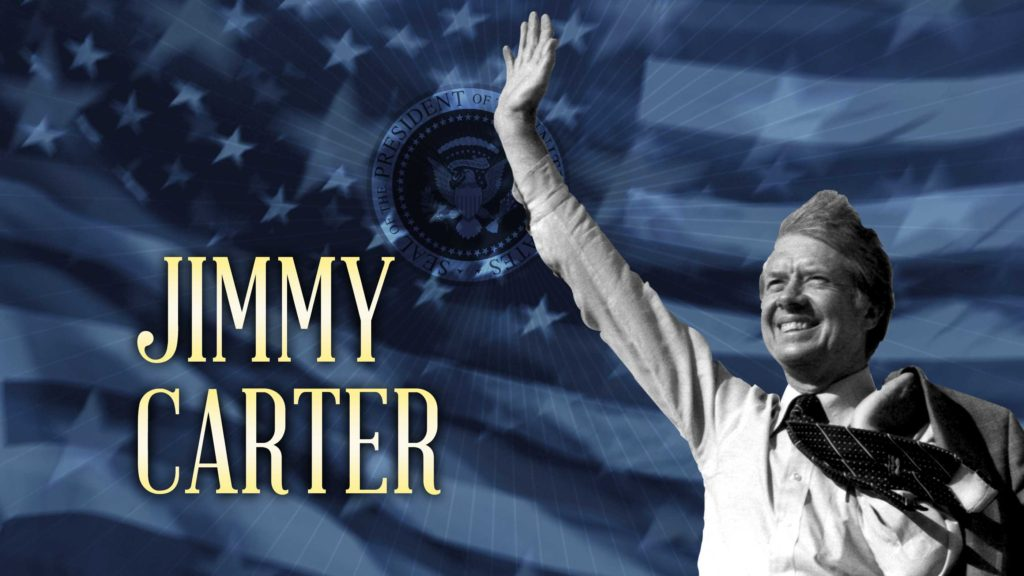
In PBS’ American Experience documentary Jimmy Carter, The New Yorker writer and former Carter speechwriter Henrik Hertzberg says:
Jimmy Carter was what the American people always SAY they want – above politics, determined to do the right thing regardless of political consequences, a simple person who doesn’t lie, a modest man, not someone with a lot of imperial pretenses. That’s what people say they want. And that’s what they got with Jimmy Carter.
And herein lies the rub.
In 1976, Americans were reacting to Watergate and wanted a President the LEAST like Richard Nixon. We got him, in the form of Jimmy Carter; it turned out that Carter could deliver non-Nixonian decency, but not the leadership that the era required.
In Jimmy Carter, we hear from those who know Carter best – including his wife Rosalynn Carter, his vice-president Walter Mondale, and right-from-the-start Carter insiders Jody Powell, Pat Caddell and Bert Lance. How the times made this man, then propelled him to such improbable electoral success and then finally doomed his Administration, is a great and cautionary story.
Jimmy Carter is in two parts, which combine for two hours and 39 minutes. It’s available to stream from Amazon and AppleTV (I can find it on my app, but not on the website).
Photo caption: Sav Rodgers in CHASING CHASING AMY. Courtesy of Level 33 Entertainment and Kino.
In the irresistible documentary Chasing Chasing Amy, filmmaker Sav Rodgers tells his own highly personal story of finding sanctuary in a romantic comedy, a movie that ultimately spurs a both a filmmaking career and his transition to trans man. Rodgers weaves in parallel tracks, the origin story of the 1997 movie Chasing Amy, and thoughtful discussion of how that film, after 25 years of cultural evolution, has aged. Chasing Chasing Amy seamlessly braids together the fictional love story in Chasing Amy with the stories of real life relationships, including his own.
Chasing Chasing Amy‘s writer-director Savannah Rodgers grew up a bullied lesbian in small town Kansas, and found lesbian representation in an old DVD of Chasing Amy, which became a lifesaver. When Kevin Smith himself heard Rodgers’ TED Talk, he connected with Rodgers and supported her (and then his) filmmaking career. All this is contained in Chasing Chasing Amy along with some revelations.
The novelty of Chasing Amy is a straight man and a lesbian as inseparable soulmates, and we learn that Kevin Smith modeled this after his real life friends, his producer Scott Mosier and the screenwriter Guinevere Turner. Turner had written the lesbian coming of age film Go Fish, which was on the festival circuit along with Smith and Mosier’s Clerks; Turner later wrote the screenplays for American Psycho and The Notorious Bettie Page.
But the core of Chasing Amy’s narrative is a love affair sabotaged by the guy’s insecurities, mirroring Smith’s own less-than-two-year relationship with Joey Lauren Adams, who plays Alyssa, the main female character.
Rodgers meets Smith himself, who becomes a mentor, and we get current on-camera interviews with Smith, Adams and other principals. There’s a shoulder-to-shoulder joint interview with Smith and Adams, followed by a sobering solo interview with Adams. Along the way, Rodgers matures from a gushing fan girl to a grownup who recognizes the personal flaws that complicate other people’s relationships. Smith comes off well here, and if Rodgers seems too adoring of Smith in most of the film, just wait until her final interview with Joey Lauren Adams.
Chasing Amy was director Kevin Smith’s 1997 masterpiece, with a groundbreaking lesbian/bi-sexual leading lady; but, after 25 years of cultural evolution, some elements now seem stale and even embarrassing. The leading male character is Holden, played by Ben Affleck. His buddy and wingman is Banky, played by Jason Lee, and Banky (to Lee’s off camera discomfort) is unspeakably vulgar and homophobic, a whirlpool of toxic masculinity. But of course, Banky is there to highlight Holden’s comparative evolved tolerance and openness. As an exasperated Kevin Smith says, ‘Banky is the idiot“. However, were Smith to make the same movie today, he would certainly still make Banky offensive, but not so over-the-top offensive.
Some viewers saw in Chasing Amy a toxic male fantasy of a “the right” straight male being able to “convert” a lesbian to heterosexuality. But Alyssa is a bisexual character, as is explicitly depicted in the movie when her lesbian friends react to her fling with Holden. She’s just a bisexual who is more than he is emotionally able to handle.
The story of Sav Rodgers winds from Kansas and the TedTalk, through her long relationship and now marriage, and final, the transitioning into a he/him trans man. Rodgers grows from a naïf into a grown ass man, albeit one that is still earnest, sweet and wears his emotions on his sleeve.
That Rodgers tells such a highly personal story along with the origin story of Chasing Amy and subsequent film and cultural criticism is impressive and ever watchable. I screened Chasing Chasing Amy for the San Luis Obispo Film Festival. It releases into theaters tomorrow.