Photo caption: ROADS OF FIRE. Courtesy of New Mountain Films
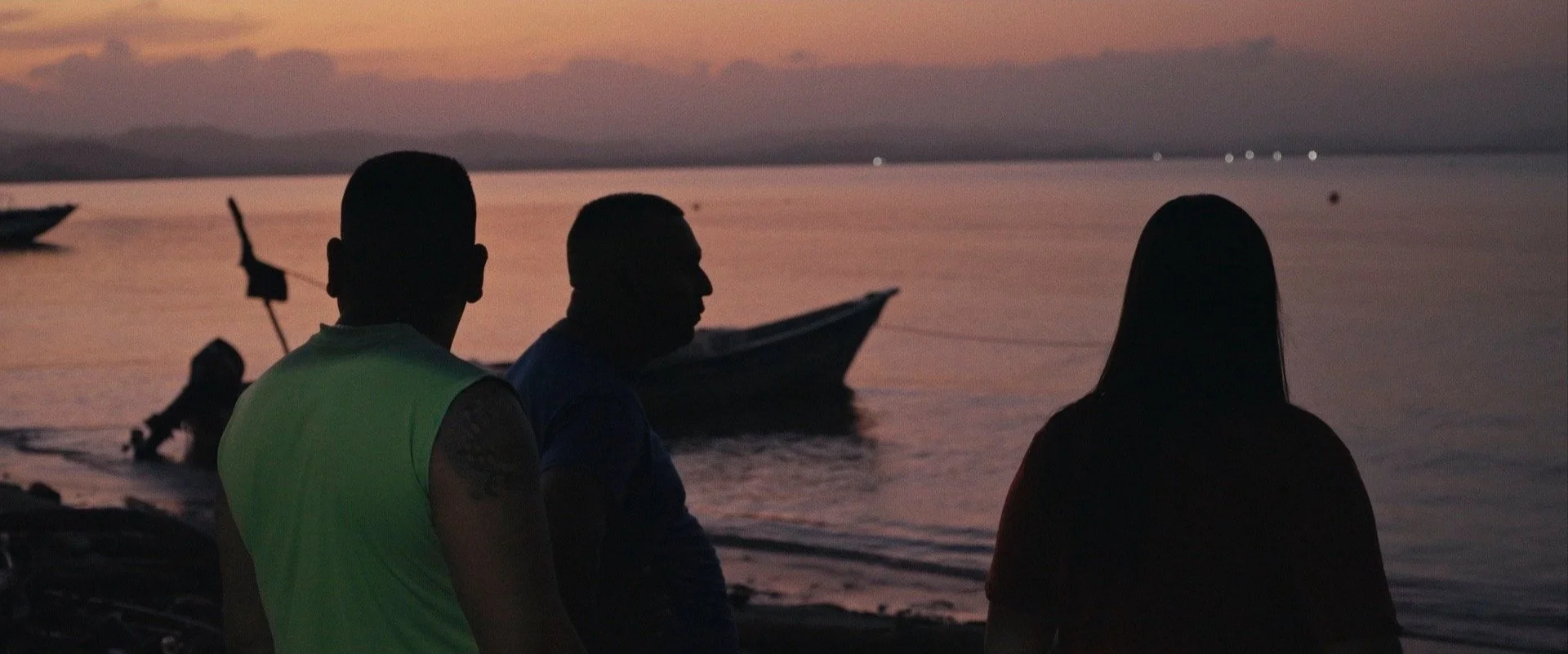
The edge-of-your-seat doc Roads of Fire explores undocumented immigration into the US by cross-cutting together three stories –
an Ecuadorian asylum-seeker prepares for her deportation hearing,
a small NGO faces the tsunami of migrants being dumped by the Texas Governor into NYC, and and
a group of Venezuelans try to get from Columbia to Panama on the first leg of their journey.
The inside story of the Venezuelans is an incredible insider’s view – down to their orientation by their smugglers. We hear the Ecuadorian woman’s description of the same harrowing route as we follow the Venezuelans. Wow.
Many of the shots involve zipping through the jungle on motorbikes, hiding from authorities and interfacing with human traffickers. With its oft-breathtaking derring-do, Roads of Fire is a significant achievement for filmmaker Nathaniel Lezra. Every year, I screen a bunch of immigration-centered documentaries, and hardly ever do I see one with this much punch.
Super-topical, well-crafted and very compelling, Roads of Fire opens Friday at the Laemmle’s Monica Film Center and next week at the Glendale and the Claremont 5.
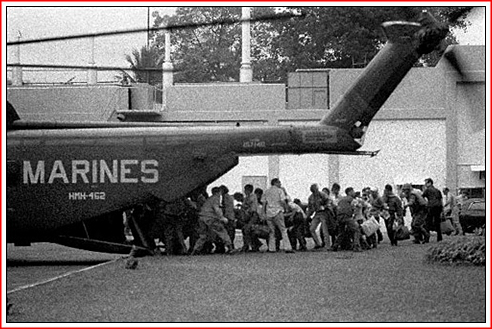
History is a compendium of individual human stories, oft caught up in a world event. That’s what drives the riveting documentary Last Days in Vietnam, which chronicles the desperate attempts of many South Vietnamese to escape before the Communist takeover in 1975. Over 140,000 got out in the initial exodus, including 77,000 through the means depicted in this film – mostly compressed into just two panicked days.
As if there weren’t enough American folly in Vietnam, the first evacuation plan didn’t include any non-Americans, even including the Vietnamese dependents of Americans. Then there were evacuation plans that were never implemented because of the blockheadedness of the US Ambassador. In the final week, young American military and intelligence officers took matters into their own hand, and began a sub rosa evacuation – ignoring the chain of command, breaking immigration laws and risking career-killing charges of insubordination.
Last Days in Vietnam is directed by Rory Kennedy (daughter of RFK), who recently made Ethel, the affecting bio-doc of her mother. Kennedy does a good job of setting the historical stage for those who didn’t live through the era, and then letting the witnesses tell their compelling personal stories.
The talking heads include:
the six-year-old who jumped out of a helicopter and then watched his mother drop his baby sister on to a ship’s deck;
the US Navy vet who plays the taped diary that he sent home to his wife after the fateful day;
the CIA analyst who unsuccessfully tried to convince the deluded US Ambassador that the end was at hand;
the college student who managed to get over a wall inside the embassy, but found that his freedom was not guaranteed;
Ford Administration officials Henry Kissinger and Ron Nessen, who relate the White House view of the events.
One heroic young American officer managed with ingenuity and chutzpah to get out hundreds of Vietnamese. In the film’s most poignant moment, it falls to him to tell the final American lie to the 400 Vietnamese remaining in the US embassy, for whom there were no more helicopters.
I saw the movie in San Jose with an audience that was about half Vietnamese-American, some of the age to have lived through this period. San Jose’s 100,000 Vietnamese population is largest of any city outside Vietnam, and many Vietnamese-Americans still memorialize the subject of this film as Black April. The exit from the theater was somber.
Last Days in Vietnam is a PBS American Experience film, and there are many clips, images and audio on their site; the entire film can be streamed from YouTube.
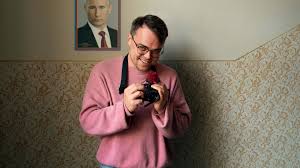
Photo caption: Pavel Talankan in MR. NOBODY AGAINST PUTIN. Courtesy of the SLO Film Fest.
Nothing has changed since Aeschylus observed that the first casualty of war is truth, as revealed in Mr. Nobody Against Putin, the blistering exposé of Putin’s outrageous domestic propaganda about his Ukraine War.
Pavel Talankan is an unassuming, goodhearted guy with a small-time job as the events coordinator at the school in a remote Russian industrial town. That also makes him the school videographer, so no no one notices that, as he films school assemblies, award ceremonies and performances, he is also capturing the blatant Big Lie propaganda. It’s a surreptitious documentary filmed in plain sight.
Pavel is an unlikely muckraker. He is a free-thinking nebbish who loves Russia and loves his hometown of Karabash in the Ural region, putrefied by a noxious copper plant and called “the most toxic place on earth”.
More than anything, Pavel cares about his students, and he is increasingly disgusted as Putin ramps up the propaganda. First, a cadaverous party hack, whose heroes are the most vile Commie hitmen in history, spreads empirically false information about Ukraine being the aggressor in the war. Then, horrifyingly, Wagner mercenaries are brought in as classroom guest speakers. Silently, Pavel continues to film, letting the propagandists defile themselves for history.
Pavel is a hero, albeit a non-violent one, who risked his life to gather this material. David Borenstein exquisitely formed Pavel’s footage into a searing exposé of Putin’s soul-crushing impact on Russia. The secret audio from the funeral of a former student killed in Ukraine is heart-rending. The film begins with video of Pavel’s midnight escape from Russia,
I saw Mr. Nobody Against Putin at the SLO Film Fest; it releases theatrically this weekend.
The singular documentary Architecton is cinema as high art and surprisingly entertaining. Almost narration-free and elevated by Evgueni Galperine’s original music, Architecton is director Viktor Kossakovsky’s immersion into rocks – rocks arranged and moved by Nature and by humans. The visual experience is hypnotic.
Kossakovsky takes us to the site of Baalbek, with its famed, massive stones, somehow hewn in antiquity and still among the world’s largest quarried stones and to its Roman quarry. We see scores of fallen segments of ancient fluted columns – and, then, the majesty of five columns still standing intact. Kossakovsky presents an enormous, tiered modern quarry, rock-crushing machinery in close-up and light cascading on wet, glisteneing rocks. In a very long shot, we see a seemingly endless freight train pulling a hundred gondola cars filled with rocks.
Architecton begins with ugly Soviet apartment blocks in Ukraine, destroyed by Russian bombardment. Later, we see similar damage in earthquake-ruined cities in Turkey. As the rubble is hauled away, it makes new mountains. It’s like the circle of life for inanimate rock.
There’s an elderly Italian architect named Marcele De Lucchi, who is directing construction of a circle of stones at his home; the only dialogue in Architecton is chatter between De Lucchi and his crew of stone masons.
ARCHITECTON. Courtesy of A24.
Kossakovsky had previously made the highly acclaimed Aquarela, taking audiences into the worlds of water. The movements of the camera and Kossakovsky’s choices of perspectives make looking at rocks for 98 minutes actually enthralling. The cinematographer is Ben Bernhard (Aquarela), who should win awards for his drone photography alone.
Early in Architecton there are close-ups of a rock slide, with four shots taking about four minutes, followed by an overhead shot. The scene could only have been safely captured by a drone zooming in, presumably, on a quarry explosion. It’s absolutely mesmerizing.
I take notes in darkened cinemas, and I wrote, “nowhere I’d rather be than in this theater watching this movie.” That was before the epilogue where Kossakovsky himself prompts De Lucchi to expound on the role of architecture, the malignant impacts of concrete and the planet’s future. The epilogue takes us out of the immersive experience and is a buzz kill, the one weak part of Architecton.
Architecton is now in theaters, and it’s one of those films which must be seen on the biggest screen that you can access.
In the scintillating documentry Made in Ethiopia, businesswoman Motto is the face of a huge, new Chinese industrial park in Ethiopia. How huge? A factory with 3,000 workers is just one of its 130 businesses – and Motto is working on an 18,000-acre expansion.
Motto is smart, zealous, charismatic and utterly non-ironic. Along with the other Chinese, she has drunk the Koo-Aid and sees the park as entirely benevolent – bringing large scale employment and investment to a poor and neglected society. A visiting Chinese official exclaims, “it’s just like China used to be!“.
All of the workers are Ethiopian, who earn $50 per month in what is essentially a clean and gleaming sweatshop. All of the supervisors are Chinese who have left their families behind in China. The local farmers feel ripped off by their government, and an armed rebellion may be brewing. Apart from a global pandemic, what could possibly go wrong? In their first feature, directors Xinyan Yu and Max Duncan have created a brilliant exploration of clashing cultures and economic imperialism.
I screened Made in Ethiopia for the SLO Film Fest, where it made my Best of the SLO Film Fest. Now it’s on PBS’ POV. You can stream Made in Ethiopia on the PBS app or directly at the POV website.
Bix Biederbecke in BIX BIEDERBECKE: AIN’T NONE OF THEM PLAY LIKE HIM YET
The thorough documentary Bix Biederbecke: Ain’t None of Them Play Like Him Yet rediscovers a lost jazz legend. Bix Biederbecke was a cornet prodigy and an age peer of Louis Armstrong. His love for and obsession with music was undermined by alcoholism, and he drank himself to death at age 28 in 1931.
Biederbecke was an innovator and soulful performer. One of his bandmates compares the thrill of listening to Bix to hearing a woman say, Yes.
This superbly-sourced documentary was released in 1981 release, and includes interviews filmed in 1978-1980 with fellow musicians and band-mates, including his friend, Hoagy Carmichael. Bix’s sister also appears. There are also recordings of Bix’s performances.
Bix Biederbecke: Ain’t None of Them Play Like Him Yet has made my list of Longest Movie Titles.
This is a bit of a Lost Film, having been very, very hard to find on streaming platforms over the last few years. Bix Biederbecke: Ain’t None of Them Play Like Him Yet can now be streamed on Amazon.
Pavel Talankan in MR. NOBODY AGAINST PUTIN. Courtesy of the SLO Film Fest.
Nothing has changed since Aeschylus observed that the first casualty of war is truth, as revealed in Mr. Nobody Against Putin, the blistering exposé of Putin’s outrageous domestic propaganda about his Ukraine War.
Pavel Talankan is an unassuming, goodhearted guy with a small-time job as the events coordinator at the school in a remote Russian industrial town. That also makes him the school videographer, so no no one notices that, as he films school assemblies, award ceremonies and performances, he is also capturing the blatant Big Lie propaganda. It’s a surreptitious documentary filmed in plain sight.
Pavel is an unlikely muckraker. He is a free-thinking nebbish who loves Russia and loves his hometown of Karabash in the Ural region, putrefied by a noxious copper plant and called “the most toxic place on earth”.
More than anything, Pavel cares about his students, and he is increasingly disgusted as Putin ramps up the propaganda. First, a cadaverous party hack, whose heroes are the most vile Commie hitmen in history, spreads empirically false information about Ukraine being the aggressor in the war. Then, horrifyingly, Wagner mercenaries are brought in as classroom guest speakers. Silently, Pavel continues to film, letting the propagandists defile themselves for history.
Pavel is a hero, albeit a non-violent one, who risked his life to gather this material. David Borenstein exquisitely formed Pavel’s footage into a searing exposé of Putin’s soul-crushing impact on Russia. The secret audio from the funeral of a former student killed in Ukraine is heart-rending. The film begins with video of Pavel’s midnight escape from Russia,
I saw Mr. Nobody Against Putin at the SLO Film Fest; I’ll let you know when it gets a theatrical or VOD release.
Photo caption: Janis Ian in JANIS IAN: BREAKING SILENCE. Courtesy of Greenwich Entertainment.
In Janis Ian, Breaking Silence, the biodoc of the earnest pop-folk singer-songwriter, a teen prodigy steps onto the roller coaster of the music industry at a tender age and experiences the highest highs and the lowest lows. And, it turns out that there’s more to Janis Ian than Society’s Child and At Seventeen.
The word prodigy is overused, but accurately describes Ian, who was doing professional-level song-writing at age 14. Her dad answers a booking request on the home phone with with, “You know she’s only 15, right?“
We’re not surprised that Ian experiences the shock of instant national stardom, the vicissitudes of record companies, the proverbial crooked business managers, (but not as MANY drugs as in most music biodocs). But it’s insightful to hear from Ian herself about how all this seemed and felt as it happened. Ian recounts her relationships while touring, with both men and women, and the impact of being outed involuntarily.
When Ian is unexpectedly confronted by someone who broke her heart years before, she blurts out the perfect last laugh.
Janis Ian: Breaking Silence was made with Janis Ian’s cooperation, and takes a very sympathetic point of view; that’s okay because Ian herself is clear-eyed, self-deprecating and maintains a solid, often wry, perspective on her experience. Janis Ian herself testifies, along with others close to her (including old pals Arlo Guthrie and Joan Baez).
This is the third feature for director Varda Bar-Kar, who is aided by excellent editing from Ryan Larkin in his first feature.
I originally reviewed Janis Ian: Breaking Silence for its brief thetricl release earlier this year. It’s now playing on PBS American Masters; you can find American Masters on your PBS channel or watch the film on the American Masters website.
Photo caption: Paul Reubens in PEE-WEE AS HIMSELF. Courtesy of HBP Max.
The delightfully wacky character Pee-Wee Herman sprang on the scene, seemingly from nowhere, sweetly celebrating his own weirdness. Pee-Wee was the creation of actor Paul Reubens. Reubens, of course, had a life before Pee-Wee, and he had a very private personal life distinct from his invented persona. Sadly, Reubens lost his privacy in, not one, but two career-killing tabloid scandals.
HBO Max is airing the bio-doc Pee-Wee as Himself, from the acclaimed Silicon Valley native, New York-based documentarian Matt Wolf. Wolf has an uncanny gift for finding compelling stories that everyone else has overlooked: Teenage, Recorder: The Marion Stokes Project, Spaceship Earth and Rustin. Here, Wolf reveals three stories, each in itself worthy of a documentary.
The first is Paul Reubens’ origin story – his childhood, his self-confidence as an avant garde art student and his comfort in an out gay lifestyle. Reubens was failing as an actor, and his overweening drive to be successful as an actor led him to leave his partner and go back in the closet.
The second is Pee-Wee’s creation story – how Reubens joined the famed The Groundlings improv group, working with the likes of Laraine Newman, Phil Hartman and Elvira, and originated several characters, one of which was Pee-Wee. Amazingly, Reubens, as Pee-Wee, was a winning contestant on The Gong Show and even The Dating Game. When Reubens failed to be selected for Saturday Night Live, he determined to produce his own TV show – and the sui generis Pee-Wee’s Playhouse was born. Another helluva story.
Finally, we come to the tabloid scandal, an unexpected comeback and then a second scandal. As Reubens himself ruefully notes, by the time he realized the privacy tradeoffs that come with fame, “the ink had dried on my pact with the devil”.
Wolf had elicited permission from Reubens to make a film about Reubens’ life, and secured 40 hours of on-camera interview footage. But the mercurial Reubens, highly ambivalent to sharing his personal story, kept pulling the plug on the project. In the interviews, Reubens often brings up that ambivalence and repeatedly jerks Wolf’s chain. When Reubens fell ill, Wolf was in a race against mortality to get Reubens back on board. Fortunately, Wolf succeeded.
We also hear from Reubens’ sister and his longtime personal assistant, along with old pals like Laraine Newman, Elvira and Natasha Lyonne. We see an archival interview of Phil Hartman, reflecting on what he saw as a betrayal by Reubens.
I’m not sure that I’ve seen another biodoc where the subject himself, so wounded and humbled, stiffens his dignity to reflect on his own brilliance and his suffering from both injustices and his own mistakes. Pee-Wee as Himself runs three hours and twenty-five minutes and is airing on two parts on HBO Max.
Photo caption: Paul Reubens in PEE-WEE AS HIMSELF. Courtesy of HBP Max.
Tomorrow, HBO Max begins airing the bio-doc Pee-Wee as Himself, from the acclaimed Silicon Valley native, New York-based documentarian Matt Wolf. Wolf has an uncanny gift for finding compelling stories that everyone else has overlooked: Teenage, Recorder: The Marion Stokes Project, Spaceship Earth and Rustin.
The delightfully wacky character Pee-Wee Herman sprang on the scene, seemingly from nowhere, sweetly celebrating his own weirdness. Pee-Wee was the creation of actor Paul Reubens. Reubens, of course, had a life before Pee-Wee, and he had a very private personal life distinct from his invented persona. Sadly, Reubens lost his privacy in a career-killing tabloid scandal.
Wolf had elicited permission from Reubens to make a film about Reubens’ life, and secured hours of on-camera interview footage. But the mercurial Reubens, highly ambivalent to sharing his personal story, kept pulling the plug on the project. When Reubens fell ill, Wolf was in a race against mortality to get Reubens back on board. Fortunately, Wolf succeeded.
Pee-Wee as Himself runs three hours and twenty-five minutes and will be aired in two parts on HBO Max, beginning tomorrow.