tonight on TV: SAMMY DAVIS, JR.: I’VE GOTTA BE ME: a needy talent through complicated times

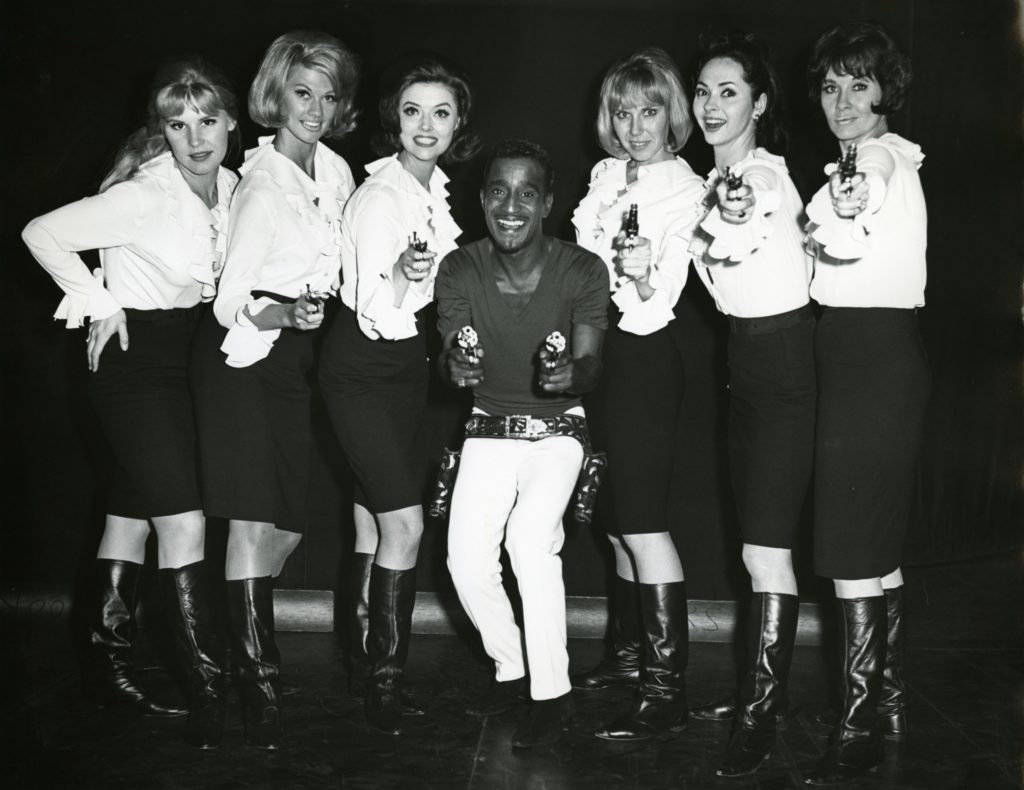
Still from SAMMY DAVIS JR.: I’VE GOTTA BE ME. Photo courtesy JFI.

Tonight, PBS airs Sammy Davis Jr.: I’ve Gotta Be Me on its American Masters series.  As a Baby Boomer who had dismissed Sammy Davis Jr. from the moment he publicly hugged Richard Nixon, I found this to be the most surprising doc (and my favorite) at last year’s San Francisco Jewish Film Festival. I learned that Sammy’s 61-year career as a professional entertainer began at age three (with his first movie credit at age 7), a working childhood that  left emotional needs  It turns out that Sammy was a very, very talented but needy artist,, an uncomplicated man navigating several very complicated times.

Sammy’s life of entertainment began at 3.  We get to see a clip of him in the 1933 Rufus Jones for President.  All that professional work took away his childhood and engraved upon him a need to please.  That and his generation produced the 50s showbiz style that seemed so insincere to us Baby Boomers.  And, of course that embrace of Nixon seemed to be the ultimate sell-out moment.

Sammy Davis Jr.: I’ve Gotta Be Me also poses whether he was demeaned by Rat Pack humor? Were Frank and Dino laughing at Sammy, or with him?

But this was  an immensely talented man, a masterful dancer with a remarkable crooner’s voice and a gift for mimicry.  He was the first American entertainer of color to do impersonations of white celebrities.   BTW there is some unbelievable dancing in Sammy Davis Jr.: I’ve Gotta Be Me.  We get to see Sammy’s 60th anniversary in showbiz celebrated among a host of celebrities – he still had his dancing chops.

Sammy Davis Jr.: I’ve Gotta Be Me is the story of a man whose success condemned him to a career that spanned generations – none of which fit him comfortably.  It’s a fine and insightful film.

[Random note: This film title may contain the most different punctuation marks of any movie: a comma, a period, a colon and an apostrophe.]

coming up on TV – WON’T YOU BE MY NEIGHBOR?: gentleness from ferocity

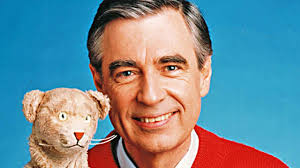
Fred Rogers with his Daniel Tiger in WON’T YOU BE MY NEIGHBOR?

On Saturday night, PBS will broadcast Won’t You Be My Neighbor?, the surprisingly moving biodoc of Fred Rogers, the originator and host of the PBS children’s program Mr. Roger’s Neighborhood. In theaters, this movie submerged audiences in their hankies.

Of course, Won’t You Be My Neighbor? tells the story of the show. But, more than that, it relates Rogers’ fierce passion for the plight of small children, and his need to protect them and help their emotional development.

What is so surprising is that Rogers’ sometimes laughably gentle affect sprang from such internal ferocity. It turns that Rogers was a man who hated, hated, hated the moral emptiness and materialism of commercial children’s television.

His need to help children through difficult times drove him to explain the word “assassination” the day after RFK was killed. And to demystify, clarify and normalize divorce and a host of other potentially child-traumatizing topics. Utterly unafraid of (most) controversy in a timid medium, he was first and foremost the champion for small children, a cardigan-clad champion.

I am immune to Mr. Rogers nostalgia because I am too old to have watched the show as a kid, and it was no longer a first-run show when my own kid came of age. So I was surprised to find myself choked with emotion when Fred Rogers explained to a very skeptical Senator John Pastore the need to “make it clear that feelings are mentionable and manageable”. As Rogers recited the lyrics of his song about having feelings and staying in control, Pastore visibly melted (and so did I).

In Won’t You Be My Neighbor?, Rogers’ family and his TV crew reveal their insider views of Rogers and his show. The origins of the characters, the puppets, the songs and themes are explained. But the core of Won’t You Be My Neighbor? is that Fred Rogers resolutely believed that every small child is deserving of love and has value, a view which has sadly become controversial among some.

THEY SHALL NOT GROW OLD: technology transforms film and resurrects a generation

THEY SHALL NOT GROW OLD

In They Shall Not Grow Old, Lord of the Rings filmmaker Peter Jackson has, for the first time, layered humanity over our understanding of World War I. By slowing down the speed of the jerky WWI film footage and adding sound and color, Jackson has allowed us to relate to the real people in the Great War.   All of the narration is from the recorded oral histories of actual WW I soldiers.

Jackson started with 100 hours of archived film and 600 hours of oral histories.  Removing the jerkiness by changing the film speed makes the biggest difference, but adding the sound of what we’re seeing through the work of Foley artists and even forensic lipreaders (who knew?) is also magically impactful.  Jackson was meticulous in newly recording the sounds of actual WWI equipment and artillery.

Stuff that we thought we knew is made real for the first time.  For example, we hear story after story of underage boys being accepted by military recruiters.  The non-battle relations between the Brit and German grunts seems new. And there are new tidbits, like the “sit on the rail” sanitary technique.   The soldiers’ reactions to the Armistice is unexpected – “too exhausted to enjoy it” and “the flattest feeling”.  I counted 94 individual oral histories in the end credits.

They Shall Not Grow Old is about 90-minutes long and is accompanied by a fascinating 30-minute “making of” documentary.  Jackson points out that soldiers had seen movies, but movie cameras were a novelty, so many soldiers are filmed staring at the camera agape and trying to hold still (as for a still camera).  Jackson also takes us to see a sunken road in the film today – and explains that most of the soldiers in the archived footage were in the final 30 minutes of their lives.

As he explains in the “making of ” documentary, Jackson chose to focus on the experience of the ordinary soldier, so he does not depict the naval or air wars, the roles of women and colonial troops or the home front.  It’s all-infantry all of the time.  That distillation is a sound choice and  allows the audience to immerse ourselves into that particular experience.

This is a generational achievement that should not be missed.

DIVIDE AND CONQUER: THE STORY OF ROGER AILES: the American political apocalypse

DIVIDE AND CONQUER: THE STORY ROGER AILES

The biodoc Divide and Conquer: The Story of Roger Ailes provides insight into the life of the man who, by founding Fox News, created what was once entirely unthinkable, the defiling of the American body politic and our venerable nation’s descent into Trump’s America. Fox News has stripped from American civil society our shared acceptance of fact. You just can’t debate the goals and means of governing with people who devoutly believe things that just are not empirically accurate – that Obama founded Isis, that Hilary murdered Vince Foster and the like. That is the legacy and stain of Ailes and his Fox News.

Divide and Conquer: The Story of Roger Ailes tells that story, and precedes it with some nuggets about Ailes’ childhood (including a significant medical condition), his ambitious clambering up the career ladder and his worship of Richard Nixon. The most surprising talking head (in terms of the content of his remarks) is Glenn Beck.

Of course, Ailes met his downfall when his decades-long sexual harassment was exposed. The disgustingly naked quid pro quo character of his serial sexual predation is startling – even among the worst we’ve seen in this #MeToo period.

Divide and Conquer: The Story of Roger Ailes opens this week in Bay Area theaters.

THE GREAT BUSTER: A CELEBRATION: comic genius unleashed and then squandered

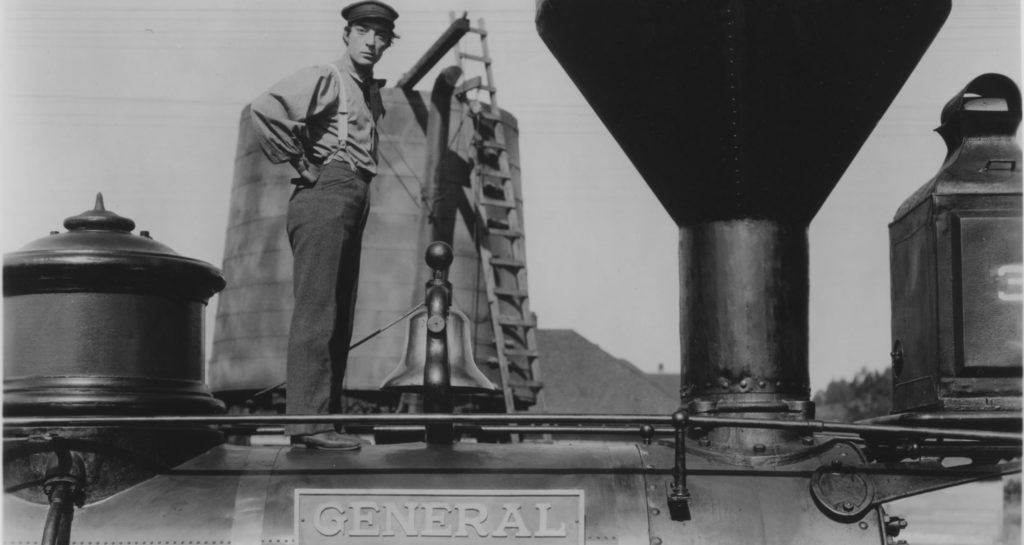
Buster Keaton’s THE GENERAL in THE GREAT BUSTER: A CELEBRATION. Courtesy of Cohen Media Group.

The documentary The Great Buster: A Celebration traces the life and career of the filmmaking genius Buster Keaton.  Every chance I get, I recommend Keaton’s silent masterpieces Seven Chances and The General. But The Great Buster puts Keaton’s work in helpful context.

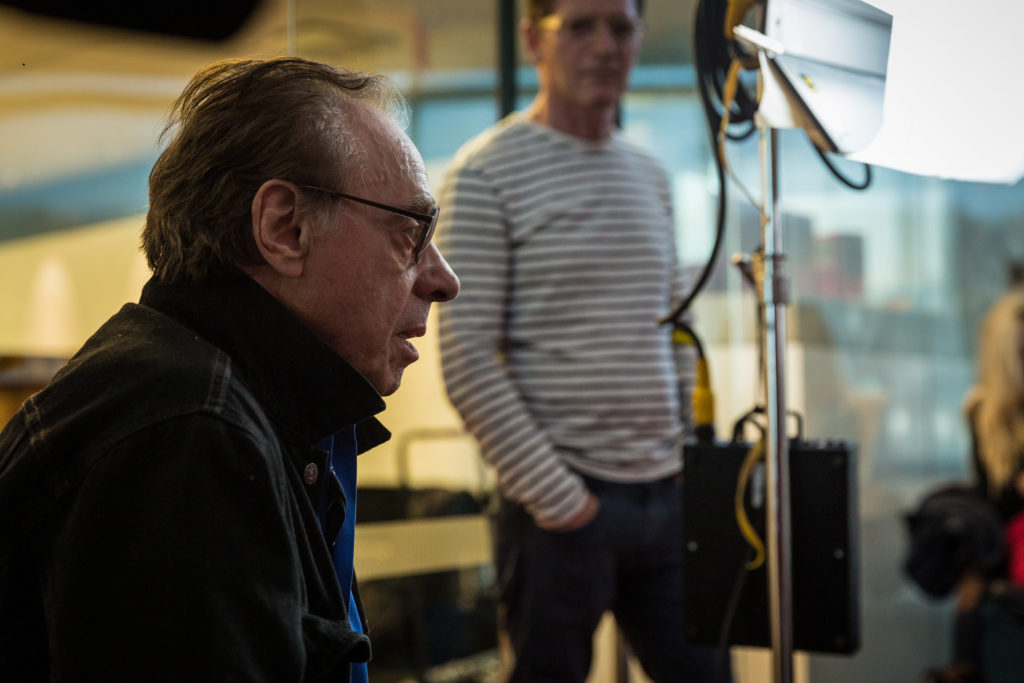
First, director/film historian Peter Bogdanovich introduces us to Keaton’s upbringing as the child star in his parent’s vaudeville act. This is a CRAZY story, about Keaton working one-night performances from the age of FOUR in an act where he was essentially a guided missile in a fake leprechaun beard.

Next we learn about the young adult Keaton being introduced to the movie business by San Jose’s own, Fatty Arbuckle, and then moving on to creating his own two-reelers. Then The Great Buster focuses on the ten great features on which Buster had complete creative control. And then Bogdanovich takes us through MGM’s mishandling of Keaton’s career and the resultant decline. I thought that I had a good handle on Keaton’s body of work, but The Great Buster is essential to understanding it.

The Great Buster gives us many cool tidbits from his work in TV commercials through his final happy marriage. And 100-year-old actor Norman Lloyd relates an anecdote about performing a scene in Limelight with Keaton and Charlie Chaplin.

Peter Bogdanovich in THE GREAT BUSTER: A CELEBRATION. Courtesy of Cohen Media Group.

The Great Buster: A Celebration opens this weekend in the Bay Area.

MONROVIA, INDIANA: not much happens, except life itself

MONROVIA, INDIANA

Master documentarian Frederic Wiseman peels back our prejudices and reveals the humanity and beauty – even in Fly-over America  – in Monrovia, Indiana.  His static camera and patient editing give us unadulterated doses of life in Monrovia, a 1,000-person hamlet amid the cornfields and pig farms of central Indiana.  In a 2 hour, 23 minute tour, we visit the barber shop, the high school, pig farm, the grocery store, the coffee shop, the town council, the hair salon, a livestock auction, the liquor store, the grain silo and the town’s annual festival.

Not much happens, except life.

We do see a Masonic Lodge ritual (a first for me) and the entire sermon at a funeral.

This is deeply Red State territory and a land of bad haircuts.  But people care about what they do and about each other. Wiseman introduces us to Monrovia as a reflection upon humanity and upon life itself. There has never been a more fascinating documentary about a more boring subject. Surprisingly, this is a mesmerizing film.

RODENTS OF UNUSUAL SIZE: 5 million orange-toothed critters and a Cajun octogenarian

Thomas Gonzalez in RODENTS OF UNUSUAL SIZE

The offbeat documentary Rodents of Unusual Size, with its bizarre subject, is charmingly addictive. That subject is the nutria, a 20- to 30-pound Argentine rodent that threatens Louisiana’s wetlands and coastline.  Yes, 30-pound swamp rats with orange teeth.

Although Rodents of Unusual Size is decidedly non-preachy, the nutria is serious business. Imported for the commercial potential of its fur by a Tabasco sauce heir, nutria escaped into the Louisiana wilds and propagated wildly. When the US fur market crashed in the 1990s, the locals stopped trapping them, and Louisiana’s nutria population exploded to 20 million.

The problem is that nutria eat the roots of the vegetation in the Louisiana wetlands, causing erosion that has converted at least 42 square miles of land into open water. Worse, those wetlands are the storm buffer for the rest of the state.

Louisiana offers hunters a $5 bounty for the tail of each dead nutria, which has reduced the nutria population to a more manageable 5 million.  We even meet a guy whose official job title is Nutria Tail Assessor.

One of the reasons I love Louisiana is that folks just don’t take themselves too seriously there. Even when they are focused on the grave environmental impacts of the nutria invasion, they still appreciate the absurdity of a 30-pound, orange-toothed swamp rat.  (And, fittingly,  Rodents of Unusual Size is narrated by Louisiana native Wendell Pierce.)

Along the way, we are also introduced to nutria fur and the fur company Righteous Fur, nutria meat, nutria sports mascots and even nutria as pets.
But most compellingly, we meet Thomas Gonzalez, an 80-year-old bayou native, nutria hunter and bon vivant. Gonzalez is a force of nature, complete with strong-willed opinions and some impressive dance moves. Gonzalez serves as the voice of Louisiana and finishes the movie with a profound perspective on the nutria.

I saw Rodents of Unusual Size at Silicon Valley’s Cinema Club with filmmaker Chris Metzler available for Q&A. Metzler and his colleagues Jeff Springer and Quinn Costello filmed Rodents of Unusual Size over four years during Louisiana’s nutria season (November to April). The affable Metzler is a font of nutria knowledge, full of tidbits like albino nutria being prized by taxidermists. Because nutria are very difficult to spot and film in the wild, the filmmakers used Nooty the stunt nutria throughout the film. Nooty joined the filmmakers in creeping along the red carpet at various film festivals and has her own Facebook page.

Thomas Gonzalez alone is worth meeting on film, and, as told by Rodents of Unusual Size, the story of the nutria is quirkily fascinating. This weekend, Rodents of Unusual Size will be opening a new run at theaters in Marin and the East Bay.

Stream of the week: BRIMSTONE & GLORY – people who blow stuff up

BRIMSTONE & GLORY
BRIMSTONE & GLORY
BRIMSTONE & GLORY

Life in Tultepec, a city of about 90,000, just north of Mexico City is dominated by the main local industry – fireworks manufacturing.  That’s the subject of the documentary Brimstone & Glory, which is alternatively jaw-dropping and visually amazing.

The overwhelming majority of Mexico’s fireworks are handmade in Tultepec.  Brimstone & Glory traces the townspeople’s march toward their annual National Pyrotechnic Festival. At the festival, giant toros are set afire as they roll blazing down the commercial streets.  People actually dance within a cacophony of fireworks.

This may not sound entirely safe to you.  Indeed, Brimstone & Glory takes us into the pre-festival training sessions, where paramedics review their triage protocols.  During the festival, we’re in the medical tent as the actual injuries flood in.

One of the festival highlights is a competition with 75-foot high towers embedded with fireworks.  As a lightning storm approaches, one guy climbs the metal tower to repair some wind damage.  It’s clear that Mexican safety regulations, if they exist, are quite relaxed.   Brimstone & Glory is probably a fantasy movie for American personal injury lawyers.

Remember that the manufacturing is by hand.  Without comment, Brimstone & Glory observes an old fireworks craftsman working with three digits left on one hand and none on other.

Brimstone & Glory follows one local kid, the boy Esau (“Santi”).  Everyone expects him to follow in the family fireworks tradition, but his own feelings about fireworks are very ambivalent.

Cinematographer Tobias von dem Borne and director Viktor Jakovleski deliver a feast for the eyes, as you can tell from the photos above.  Slo mo is used very effectively, and the night photography is very special.

Brimstone & Glory can be streamed from Amazon (included with Prime), iTunes and Vudu.

JANE FONDA IN FIVE ACTS: self-assessment and self-revelation

Jane Fonda appears in JANE FONDA IN FIVE ACTS by Susan Lacy, an official selection of the Documentary Premieres program at the 2018 Sundance Film Festival. Courtesy of Sundance Institute | photo courtesy of Everett Collection.

HBO is airing a remarkable biodoc of Jane Fonda, Jane Fonda in Five Acts.  It turns the talking head documentary on its, well, talking head, because the main narrator/commentator on Jane Fonda’s life is Jane Fonda herself.  She reveals the most personal, even intimate, experiences and feelings; you could tag this as “extremely personally revealing” or even as “oversharing”.  either way, I found it irresistible.

The theme is that Fonda’s life was shaped, in phases, by (or to reflect), the four most important men in her life: her father Henry Fonda and her husbands Roger Vadim, Tom Hayden and Ted Turner.  Hayden, Turner,  her son Troy Garity and her BFF Paula Weinstein get the most screen time among various confidantes.  But mostly, this film is Jane herself, neat with a chaser.

From being the daughter of a movie super star dad and a suicidal mom, through a starlet period, to the shrill activist with the Klute hairdo, to the video exercise queen and then billionaire’s bride, it a helluva story.  If you dislike Jane Fonda, you’ll find this biodoc annoying.  If you’re like me, you’ll find it fascinating.

WYETH: what is a muse?

Andrew Wyeth’s Christina’s World, featured in WYETH

Wyeth, the latest documentary in the PBS American Masters series, takes on the odd case of the great painter Andrew Wyeth and explores the question, what is a muse?    And how can great art come from the most unlikely and obscure subjects?

Every artist has a source of inspiration, and it’s amazing that Wyeth was able to find his while living an unusually parochial life.   Choosing not to “see the world”, Wyeth spent his entire life in two rural settings – his childhood home in  Chadds Ford, Pennsylvania. and his summer coastal home in Cushing, Maine.  Fortunately, some of his neighbors allowed him to hang around and watch them in their daily lives.  Wyeth would then pad along home to his studio and churn out hundreds of finely detailed paintings from what he remembered.

In doing so, he rendered iconic some very unlikely subjects by painting them again and again – a disabled neighbor woman, a stolid farmer, an alcoholic eccentric.

We learn that Wyeth could spend all of his time on his two obsessions – studying the locals and painting them – because of his wife Betsy.  From age 17, Betsy managed Wyeth’s business, household and family, freeing him to devote every thought to the artistic process.

That’s why it was so shocking when Wyeth revealed fifteen years’ work – over 200 paintings, many erotic – with a subject Betsy had known nothing about.

Wyeth draws upon rich source material, including never-before-seen family photos and artifacts, and we meet Wyeth’s family members, neighbors and subjects, and visit the actual homes where Wyeth studied his subjects.

Wyeth will be airing on the PBS American Masters series beginning on September 7.