Mads Brügger’s eccentric and irresistible documentary Cold Case Hammarskjöld purports to solve a historical mystery. In 1961, Secretary-General of the United Nations Dag Hammarskjöld was flying to cease-fire negotiations near the Congo-Rhodesia border when his plane crashed, killing all aboard. There has never been a satisfactory explanation of why or how the plane crashed.
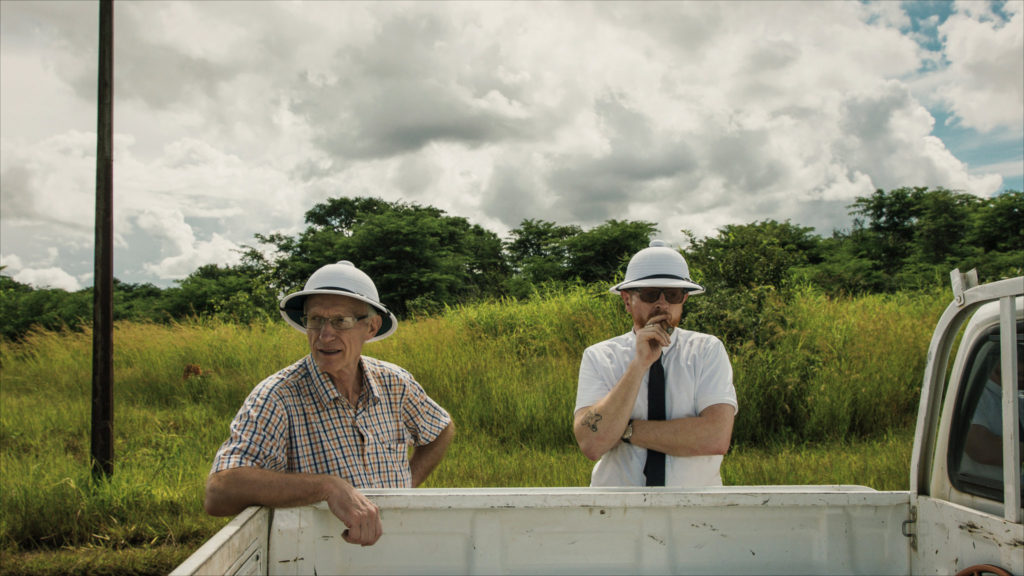
Danish filmmaker Brügger enlists the Swedish private investigator Göran Björkdahl, who has been researching the Hammarskjöld crash, and heads off to Africa in search of witnesses and clues. Björkdahl is dead serious. Brügger is, well, entertaining. With an ironic wink at the audience, Brügger begins by equipping the two with pith helmets for their African exploration.
The two come across a very plausible conspiracy that the Hammarskjöld plane was targeted. And, as they move among the shady world of South African reactionaries, they encounter an even more shocking conspiracy theory. But Brügger is a story-teller, not a historian; fortunately, he doesn’t have to deliver a smoking gun.
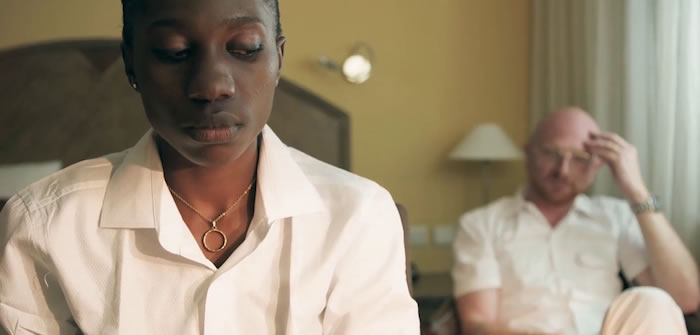
Idiosyncratically, Brügger chooses to narrate his film by dictating the “script” to two African secretaries. Midway, he admits that what really drives him is the excuse to hop around Africa talking to aged fixers and mercenaries. And it’s a rich collection of scoundrels that he finds, some revealing old secrets, some covering them up and some apparently spinning wild tales.
That’s the fun of Cold Case Hammarskjöld, now available from all the usual streaming services.
CAPITAL IN THE TWENTY-FIRST CENTURY. Courtesy of Kino Lorber.
Documentarian Justin Pemberton brings alive Thomas Piketty’s bestselling Capital in the Twenty-First Century, a critique of the concentration of wealth. There’s no more fundamentally important political topic than inequality, and this theme has resonated through the best of recent cinema, including Parasite and Knives Out.
Pinketty traces the economics of wealth from feudal times to the present, and Pemberton keeps all the economic history lively with plenty of eye candy. Capital in the Twenty-First Century covers a lot of ground – globalization and movable capital, deregulation and privatization, defanging of organized labor, China state capital, and the impact on today’s youngest generations.
Piketty’s proffered solutions are simple and intellectually sound (stopping off-shore tax dodges, taxing inheritance, incentivizing wealth to be invested in productive risk instead of moving around a closed-loop of financial instruments). But, given the political power of great wealth, this is a very heavy political lift.
CAPITAL IN THE TWENTY-FIRST CENTURY. Courtesy of Kino Lorber.
Capital in the Twenty-First Century pops along fairly briskly, but, as an entertaining popularizer, it’s no The Big Short or An Inconvenient Truth. Still, about an hour in, there’s a jaw-dropping psych experiment in which people benefiting from pure luck believe and act as though they are entitled.
During its Bay Area virtual run at the Roxie, you can stream Capital in the Twenty-First Century at Roxie Virtual Cinema, or at distributoe Kino Lorber’s new virtual platform Kino Marquee.
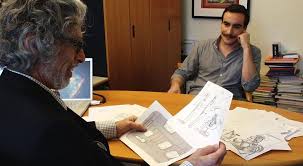
If you’re like me and you worship the cartoons in The New Yorker, then the documentary Very Semi-Serious is a Must See. Very Semi-Serious takes us inside The New Yorker for a glimpse inside the process of creating and selecting the cartoons, chiefly from the perspective of cartoonist and twenty-year New Yorker Cartoon Editor Bob Mankoff. You will know Mankoff from his cartoon with the caption, “How about never? Is never good for you?”. (Mankoff has since left The New Yorker for Esquire and the website Cartoon Collections.)
We also meet rock star cartoonists that include Roz Chast and George Booth, along with The New Yorker Editor David Remnick and some aspiring cartoonist newcomers. We are boggled by the tens of cartoons each cartoonist pitches each week and the hundreds that the Cartoon Editor must review. Rejection is a major part of the cartoon life.
We also learn how Mankoff scientifically studies the eye movements of readers to see how/when/if we “get” the jokes. And we get to laugh again at HUNDREDS of cartoons.
I saw Very Semi-Serious at the 2015 San Francisco International Film Festival (SFFILM), and now you can stream it from Amazon (free with Prime), iTunes, YouTube and Google Play.
. Marion Stokes in RECORDER: THE MARION STOKES PROJECT, directed by Matt Wolf. Photo credit: Eileen Emond and courtesy of Zeitgeist Films.
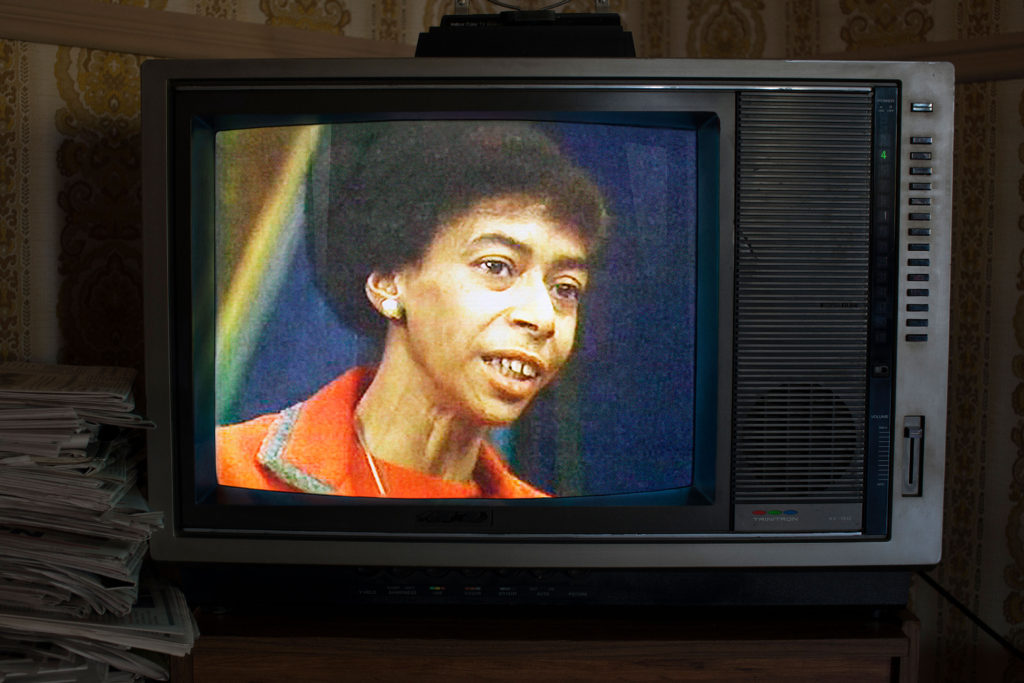
The excellent documentary Recorder: The Marion Stokes Project, is about an eccentric woman who did something that seemed crazy, but turned out to be be important. For over 30 years, 24 hours per day, on multiple channels, Marion Stokes everything that was on TV – local news, commercials, network shows – the whole enchilada. She left a collection of 70,000 videotapes, Recorder explains the How and the Why.
It turns out that, before digital technology, TV stations did not preserve what they broadcast. So, what Stokes compiled is essential and irreplaceable – a unique archive of broadcasting and of American culture as it has been reflected by television.
Now, this was – and had to be – the project of an obsessive. Stokes’ son sagely observes that the difference between collecting and hoarding is the perceived value of the objects.
Stokes was one of those people whose cause was so important to them that it is prioritized above, for example, family relationships. I found the testimony from Stokes’ household staff – essentially her chosen family – most insightful and touching.
It’s a fascinating story. Stokes was that rare radical activist who both understood the power of media and had the financial means of recording and storing all of these broadcasts. She was an early adopter (her first tapings were on Betamax!), and became an Apple enthusiast.
Director Matt Wolf unspools this story perfectly. He is the son of Cinequest documentary screener Sandy Wolf; in this recent profile of Sandy, I also highlight Matt Wolf’s career (scroll down).
Recorder: The Marion Stokes Project is streamable on Amazon, iTunes, Vudu, YouTube and Google Play.
Buck is a documentary about real-life horse whisperer Buck Brannaman, an exceedingly grounded and gentle man who knows everything about horse behavior. But the movie is more about human behavior, about the disturbing crucible that formed Buck, and about what we can learn about people from their handling of horses.
Fortunately, Director Cindy Meehl realized that she had a great story and got out of the way. The understated guitar-based score never becomes melodramatic. And Meehl never lets the admiring talking heads elevate Buck to more than what he is, which is remarkable enough. This movie could have easily been painfully corny or pretentious and is neither. I’d happily view it again today.
Buck’s own background is so nasty that it would totally unremarkable for him to have emerged mean or emotionally crippled – and he is the farthest from either. With some help from loving people, Buck has chosen to become something different from his apparent fate. In this way, Buck could be a companion piece to Mike Leigh’s Another Year.
Buck was shortlisted for the Best Documentary Oscar. You can rent Buck from Amazon, YouTube and Google Play or buy it from iTunes.
Sandy also publishes the weekly e-newsletter This Week on TCM, in which he reviews the most significant choices on Turner Classic Movies. He doesn’t write about every movie on TCM, but he touches on several each day. And this is not a quick scan of the weekly classic film menu – each email runs to up to 6,000 words.
Every Sunday morning, while The Wife pours over the New York Times, I’m scanning Sandy’s email to see if TCM is featuring a film I had overlooked or need to revisit. For example, I DVRed the 1937 They Won’t Forget, which I had never seen, only because of Sandy’s description of Lana Turner’s entrance. Worth it.
Earlier this year, I finally got around to the 1936 classic Dodsworth, only because Sandy recommended it. Dodsworth rewarded me with remarkable performances from Walter Huston, Mary Astor and Ruth Chatterton. (Familiarity with Dodsworth is also central to understanding the documentary Scandal: The Trial of Mary Astor, because Astor channeled her Dodsworth character during her testimony at the notorious child custody trial.)
Sandy’s regular readers always wait for the weekly use of the word “oeuvre ” and the mention of the “ubiquitous Michael Curtiz”. Sandy is the kind of film writer who can use the word “mendacity” about a movie (All About Eve) OTHER than Cat on a Hot Tin Roof.
It’s difficult to decide which is the biggest value add in This Week on TCM – Sandy’s usually perfect movie taste or his capsulized commentary, enlivened with Grouchoesque quips. Here’s a taste:
Story of Seabiscuit: This does not remotely resemble the true story of Seabiscuit; in fact, it should be entitled Nothing Like the True Story of Seabiscuit.
Manchurian Candidate: A ludicrous premise: the Russians want to put a puppet in the White House, whom they can maneuver and control – hey, wait a minute.
Gaslight: Joseph Cotton is an old friend who senses something rotten in the state of Denmark (which means he has a strong sense of smell, since this takes place in Victorian era England).
The Searchers: John Ford’s magnum opus and the apogee (or apotheosis if you prefer an even more pretentious “ap” word) of his Western genre films.
Doctor Zhivago : My least favorite of Lean’s well known films, which I find ponderous and unwieldy (or if you prefer, slow and boring). I came to CA to get away from snow, so why spend over 3 hours looking at it. Then again, you can spend all that time looking at Julie Christie, which almost makes it worth it. This film was a huge hit and mine is a minority opinion, but is there anyone in America who isn’t sick of Lara’s Theme?
Detour: Talk about femme fatales – Ann Savage (no name better fit an actress) is the fataliest of all femmes. Ms. Savage more than makes up for the flimsy sets and if she doesn’t give you nightmares, nobody will (whenever I wake up screaming in the night soaked in sweat, and Harriet asks what’s wrong I just say “Ann Savage”).
Ingmar Bergman’s Passion of Anna: Moving and powerful, under no circumstances should you watch this film unless you are prepared to hit the emotional depths of human existence (I’m not sure what that means, but don’t have a bottle of pills nearby when you are watching).
Buffalo Bill and the Indians or Sitting Bull’s History Lesson: (Paul) Newman and director Robert Altman were at the height of their respective powers when they teamed up to make this can’t miss film. But miss it did and by miles.
The Window: Young Bobby Driscoll goes out on the fire escape to sleep on a sweltering NYC summer night and through a neighbor’s window witnesses a murder. Bobby is proverbial boy who cried Sandy Wolf (I use that line every time this movie airs and can’t help myself).
Scarlet Pimpernel: Whenever I see this title, I think of pumpernickel bread, which you can’t get in Northern CA (at least I have never seen it).
The Longest Day: BTW, an astute and erudite reader correctly informed me that the “D” in D-Day stands for “Day”. How stupid is that – what does Day Day mean? I would call it T-Day for The Day or even I-Day for Invasion Day.
Henry V: All I know about Henry V is that he came after Henry IV (not sure where O Henry came from – and I’m talking about the candy bar and not the author).
Red Badge of Courage: This was deemed an utter failure upon its release and caused director John Huston grief (or as much grief he could sustain between cavorting and carousing) .
Lolita: Shelley Winters, as Lolita’s Mom, is as annoying as ever (which is as annoying as any human being can possibly be) but she is in fact somewhat empathetic and plays her role well (Shelley could do annoying in her sleep and I’m sure she was annoying even when she was asleep).
Sandy’s taste in exceptional, but not perfect. We differ on the fourth and fifth greatest Hitchcock films, and I’m about to set him straight on his under appreciation of Peckinpah’s The Getaway.
Sandy is also the father of filmmaker Matt Wolf, the accomplished documentarian behind:
Wild Combination, the critically praised biodoc of the influential musician Arthur Russell. (Included with Amazon Prime.)
Teenage, an especially insightful look at the emergence of teenage culture, surprisingly recent in American culture. Teenage aired on PBS. (Included with Amazon Prime.)
Bayard and Me, the undertold story of Bayard Russell’s key role in the Civil Rights movement as a gay man in the 50s and 60s.
Recorder: The Marion Stokes Project, about a woman who recorded 30 years of TV, 24 hours per day, and left a 70,000 videotape tape-archive of American culture reflected by television. (Streamable on Amazon and iTunes.)
Spaceship Earth, the soon to be released 2020 Sundance hit about Biosphere 2, the 1991 scientic and social experiment where a team moved into a model replica of our planet’s ecosystem.
Matt Wolf was already an NYU film school grad when Sandy started his role at Cinequest, but Sandy takes some credit for some of Matt’s love of movies. Back in the VCR era, Sandy recorded classic films one at a time, and then played the collection at family movie nights.
On the red carpet of the Tribeca Film Festival for one of Matt’s premieres, Sandy Wolf heard a publicist summoning “Mr. Wolf, over here, please.” Sandy’s proudest moment came when he realized they were calling Matt.
How does Cinequest fill its slate of documentary features each year? For the past two decades, Sandy Wolf, a now-retired attorney, has been volunteering to find the documentaries that premiere at Cinequest.
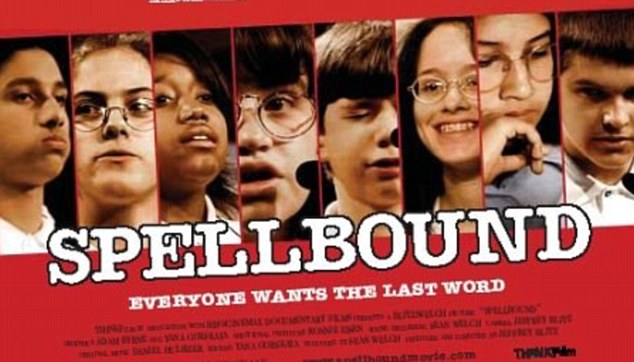
Back in 2002, Wolf’s recommendation gotSpellbound into the festival. The story of eight teenagers competing for the national spelling bee championship, Spellbound went on to become a national art house hit, and Wolf earned some major cred.
Each year, Wolf screens the 250 documentary features that have been submitted to Cinequest by filmmakers. Wolf then submits a top ten and a second twenty recommendations, along with his comments, to Cinequest Director of Programming and Associate Director Mike Rabehl. (Rabehl himself screens every Cinequest submission, including documentaries,) Rabehl has the final say, but he agrees with most of Wolf’s recommendations.
“You rarely see a bad documentary,” says Wolf. “Although there are a lot of mediocre ones.”
How does one actually watch 250 movies? From each July though November, Wolf watches movies in the morning, until he takes a break for lunch. After a visit to the neighborhood coffee joint, he resumes until dinnertime. But he reserves the evening for his own movie choices, not festival screeners.
“Mike Rabehl tells me not to make it a job”, but Wolf thinks its goes best with this regimen.
The slate of documentaries at Cinequest is usually quite rich. Here are some of my favorites from recent Cinequests, all of which are are now available to stream:
The Brainwashing of My Dad: When TV changes not just opinions, but mood and personality, too. Amazon, Vudu, YouTube, Google Play.
Meet the Hitlers: Wouldn’t you change YOUR name? Amazon, iTunes, Vudu.
There Will Be No Stay: In a society with capital punishment, someone must perform the executions. iTunes, Vudu, YouTube, Google Play.
Wolf saved me from a big mistake at the 2019 Cinequest. I had decided to pass on screening Clownvets because it looked too sappy for my notoriously jaded taste. But I watched it on Wolf’s recommendation, and I’m very glad that I did. Clownvets turned out to be well-constructed and surprisingly powerful.
This year Wolf tipped me off to The Quicksilver Chronicles, which is also my own favorite of the 2020 Cinequest documentaries.
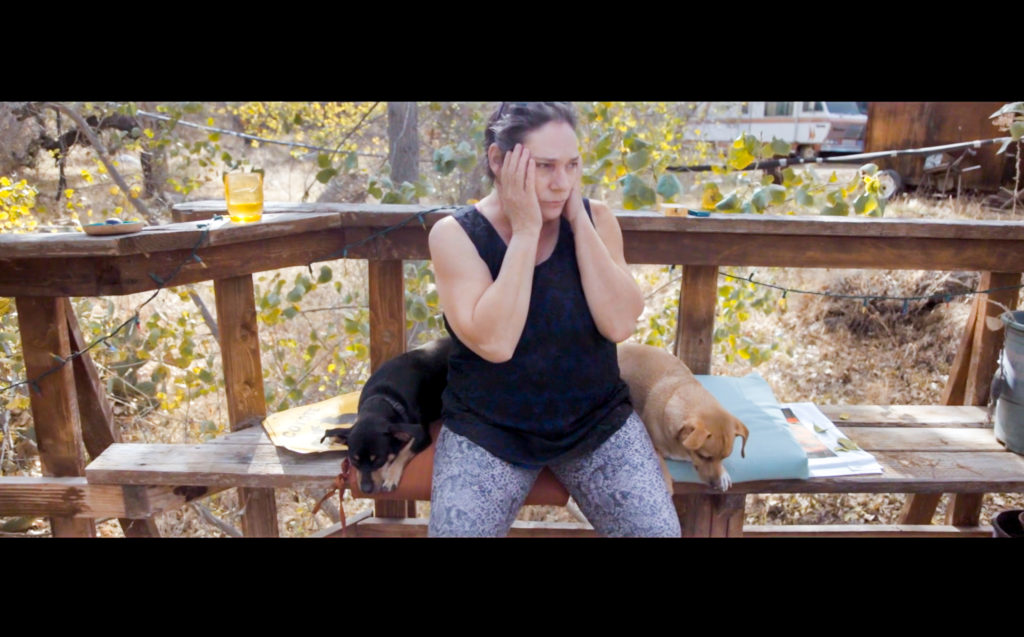
Kate Woods in THE QUICKSILVER CHRONICLES. Photo courtesy of Cinequest.
The documentary The Quicksilver Chronicles introduces us to the 60ish brother and sister Kemp and Kate Woods, who live a bohemian existence in a ghost town that they have to themselves. In other times, Kemp and Kate might have been labeled eccentrics or Free Thinkers.
Kate is raucously voluble. She is never without a cigarette, espouses her love of Mexican ballads and has an opinion on everything. Her friend, photographer Tom Chargin, has been taking pictures of Kate for decades.
Most of Kemp and Kate’s lives seem to involve dogs and cigarettes. The Quicksilver Chronicles is only 75 minutes long, which gives the filmmakers the freedom to pace the film slowly – that allows us to settle in and let these characters and their lifestyle wash over us. Just when you think we’re just watching these two putter around in the boonies, a major life event DOES happen.
They are living in Idria, California, population 2. This is the site of the long-defunct New Idria Mine, once America’s second biggest mercury mine (after San Jose’s New Almaden Quicksilver mine), In the California Gold Rush, mercury was used to extract gold from ore. There’s a mountainful of naturally occurring mercury at Idria, and the disturbances from the mining have made this a Superfund site.
As the crow flies, Idria is remarkably close to Silicon Valley. But, to get there, you first have to drive the 45 minutes to Hollister and then ANOTHER 2 hours past the tiny crossroads of Paicines, Panoche and Mercey Hot Spings.
Documentarians Ben Guez and Aleksandra Kulak shot The Quicksilver Chronicles over four years of visits to New Idria.
Cinequest hosts the US premiere of The Quicksilver Chronicles, my favorite documentary at this year’s festival.
The documentaryTheremin Magicexplores that most weirdly unworldly of musical instruments, the Theremin. Documentarian Cressandra Thibodeaux took advantage of a global Theremin festival (who knew?) to film the world’s top five Theremin players.
The five are a diverse lot, and their mastery of the instrument is astonishing. Because the instrument is played by waving one’s fingers in the air next to it, the performances are visually somewhere between conducting an orchestra and dancing ballet. At the very end there’s a scene with an entire classroom full of Theremin players.
If you are interested in music and haven’t dived deeply into the Theremin, this is all interesting. Cinequest hosts the world premiere of Theremin Magic.
JOHN PINETTE: YOU GO NOW. Photo cpurtesy of Cinequest
John Pinette: You Go Now, the biodoc of the comedian, plumbs beneath Pinette’s cherubic skin for insights into what sparked his humor – and his obesity. Let’s just say that his childhood was not the most nurturing.
The clips of Pinette’s performances are very funny, and the ones from his youth illustrate his remarkable gift at mimicry. Pinette himself thought that he had inherited genes that predisposed him to addiction, but he was clearly also born with immense talent.
Cinequest hosts the world premiere of John Pinette: You Go Now. It’s only the second time in Cinequest’s 30-year history that an open submission has been selected as the festival’s opening night film.