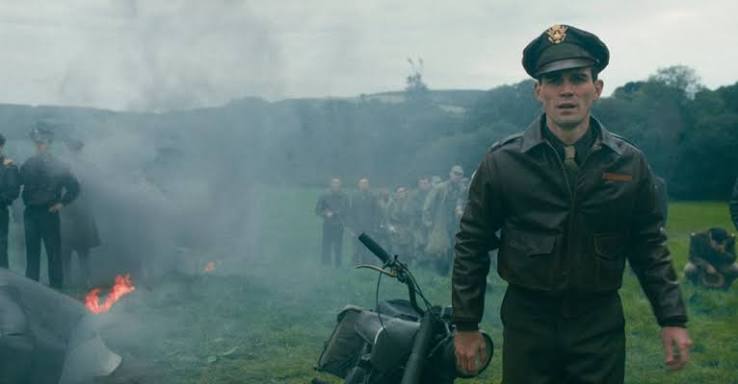
Jimmy tells the story of the actor James Stewart’s courageous WW II experience and projects the impact it must have had on him personally and professionally. Stewart’s is a great and oft overlooked story, and deserves a better film than Jimmy.
As depicted in Jimmy, Stewart, with a recent Oscar win, was riding high in Hollywood when the war broke out, enjoying a huge salary and dating other movie stars. According to Jimmy, Stewart had some initial ambivalence about joining the US military, which I don’t believe was historical. Having been refused enlistment before the war because he was too skinny, Stewart volunteered again within days of Pearl Harbor, and, already a pilot, quickly received a commission in the Army Air Corps, the predecessor of the Air Force. Many Hollywood types served in WW II, but it was very unusual for star actors to be exposed to combat on the front lines. At age 33, Stewart could have served in a desk job, a US posting or avoided the military altogether.
Jimmy accurately describes Stewart’s wartime service, and it’s difficult to overstate his bravery. Stewart piloted B-24 Liberators, the heavy bombers that the Allies used in the strategic bombing designed to degrade the Nazi war effort. Because of the RAF’s losses in the Battle of Britain, British bombers flew the safer night missions, and the Americans, including Stewart, flew the much more dangerous daytime missions. Each mission, flying through hundreds of miles of flak and fighter attacks, was terrifying. The fatality rate for heavy bomber crews in the war was 23%, so the flyers knew that, after just a few missions, they were essentially playing Russian Roulette. Jimmy Stewart flew twenty combat missions.
Every bomber wing commander, including Stewart, had to order men to their deaths and watch many of their friends dying in shocking and grisly ways. Informed by our modern understanding of PTSD, the Jimmy screenplay has a tortured Jimmy anguishing just out of sight of his men, and seeking support from a fictional aristocratic war widow (Kara Killmer).
I doubt that it happened that way. I grew up in a world where essentially all the dads were WW II vets, so I’m very familiar with the men of that generation. When they felt strong emotions, they repressed them and self-medicated. They sure didn’t get all angsty, even though that would have been appropriate. Even in the 1960s, they didn’t talk about what happened to them in WW II.
My problem with Jimmy is that the screenplay often resorts to corny cliches, exacerbated by a manipulative score that wells the music in the big moments.
None of this is the fault of Australian actor KJ Apa, who must have been cast because of his lanky frame and his uncanny ability to capture Stewart’s voice and idiosyncratic speech patterns. Apa captures Jimmy Stewart navigating those hellish experiences. In fact, there isn’t a bad performance in the film, even though Max Casella (Frank Capra), Neal McDonough (Jimmy’s dad) and Jason Alexander (Louis B. Mayer) are the only cast members I had seen before.
Before the war, Jimmy Stewart was already an A-list star, with one of the greatest screwball comedies, The Philadelphia Story, the seminal rom com, The Shop Around the Corner, the weeper Made for Each Other and the uplifting (if naive and corny) Mr. Smith Goes to Washington.
Jimmy makes the case that combat trauma informed a much darker Stewart performance in It’s a Wonderful Life. And, after all, in even that most Feel Good of all Feel Good movies, Stewart plays a guy who is suicidal. I think there may something to that. In his more accomplished post-war career, Stewart showed he could play characters that were bitter, disillusioned, and obsessive in Winchester 73, Rear Window and Anatomy of a Murder, and, of course, completely twisted in Vertigo.
Jimmy was financed and is distributed by Fathom Events, a joint venture of the AMC, Regal and Cinemark theater chains, which produces content for the theaters. It is now playing in those theaters.