
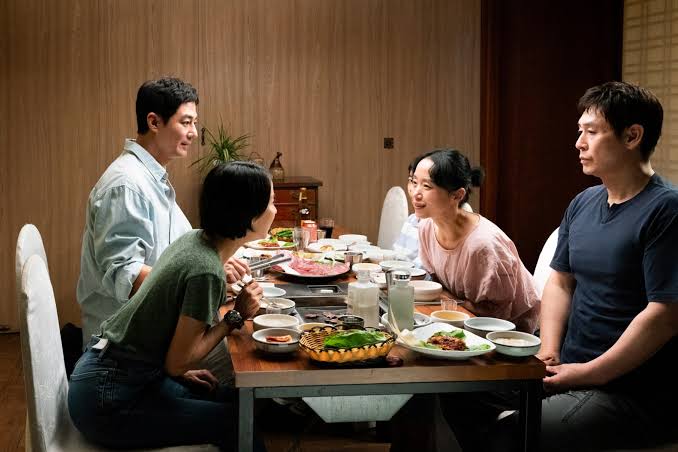
In director and co-writer Chang-dong Lee’s quietly powerful Possible Love, two couples navigate a new friendship under the shadow of social inequality and one character’s long-simmering trauma. The four individuals, each molded by their backgrounds, navigate changes in their lives, right up to the inevitable eruption.
Right away, we meet the ever-bubbly Mi-ok (Jeon Do-yeon), an over-sharing chatterbox who works in a workshop that makes surgical masks. Opposites attract, and she’s married to the impassive Ho-Seok (Sul Kyung-gu), unemployed after losing his heavy industry job in a corporate restructuring. Something is up with Ho-Seok, who drives the family to the funeral of a former co-worker, who has taken his life after he layoffs; initially, Ho-Seok refuses to leave the car, only to finally enter and embarrass Mi-ok by drinking too much and making a scene.
Ho-Seok had worked for Korea’s largest manufacturing company, where jobs were thought to bring lifetime security. The workers fought the layoffs with a strike that was broken by brutal government violence. The breach of the social contract, the sudden plunge into economic insecurity, the defeat of a righteous cause and the violence have traumatized the entire work force, and every interaction between the former colleagues is charged. Many attend a therapy group to work out their feelings, but Ho-seok refuses to join them.
The documentary filmmaker Ye-ji (Cho Yeo-Jeong of Parasite) is shooting a film about the impact of the layoffs. She spots the kerfuffle at the funeral and engages with Mi-ok, who becomes a willing participant in the documentary. Ye-ji is earnest about telling the workers’ story, even though she herself is affluent, what Americans would call a limousine liberal. Despite the class difference, Ye-ji and Mi-ok hit it off, and a friendship quickly evolves.
Ye-ji is married to the charming and handsome Sang-woo (Zo In-sung), who has the easy confidence of those born into great wealth. Sang-woo is friendly and generous, and goes along with his wife’s new friendship, taking the two coupkes out to dinner and then even hosting them for a weekend at his family’s seaside retreat, an impressive estate with a private beach and a caretaker.
Mi-ok and Ho-Seok bring their ten-year-old son Cheol (Jung Seol), who slips around in the background, absorbing lessons about adult behavior.
Is Ye-ji exploiting Mi-ok’s family for her film? Can Ye-ji and Mi-ok maintain their friendship over the abyss of unequal means? Will Ho-seok reveal the most painful source of his depression? Will Ho-seok explode in volcanic violence? Does Sang-woo have a more fundamental role in the story than first apparent?

Chang-dong Lee masterfully tells this story, revealing the inner perspectives of his characters through flashbacks and brilliant details like Mi-ok surreptitious pricing of Ye-ji’s handbag and an old whistle from Sang-woo’s childhood. Possible Love is a two hour, forty-four minute slow burn that never drags. I tagged Lee’s earlier film Burning as “hypnotically compelling”, which would apply to Possible Love, too. I embrace Howard Hawks’ definition of a great movie – three great scenes and no bad ones“, and Possible Love easily meets that test.
Possible Love was Lee’s contribution to a series of riffs on Krzysztof Kieslowski’s iconic Dekalog (referring to the Ten Commandments) by international directors. Indeed, Mi-ok’s reaction to Ye-ji’s affluence and suave husband falls within the commandment Thou shalt not covet, but Possible Love explores much more territory than envy.
Possible Love was nominated for the best film at the Toronto International Film Festival and won the best film award at the Venice Film Festival. Its current Metacritic rating is a sky high 95. Possible Love is Korea’s submission for the Best International Feature Oscar.
This is one of the Best Movies of 2026 – So Far (and topping my list right now). Possible Love is streaming on Netflix, where you can watch it subtitled and/or dubbed in English.