DVD/Stream of the Week: HACKSAW RIDGE – unimaginable bravery disconnected from acts of violence

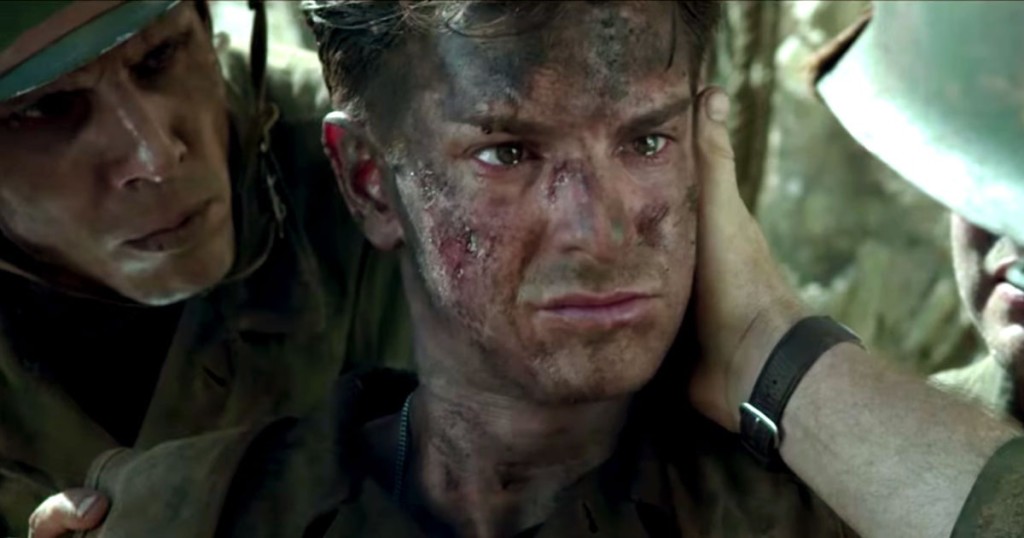
Andrew Garfield in HACKSAW RIDGE

My video pick for Memorial Day Week is Mel Gibson’s powerful Hacksaw Ridge.  Just before the 2017 Oscars, The Wife and I finally got around to watching Hacksaw Ridge, which had been nominated for a Best Picture Oscar. Before you see this movie, you need to know that it’s a true story – otherwise you wouldn’t believe it. It’s the story of American Army Medic Desmond T. Doss who single-handedly rescued 75 fellow soldiers at the Battle of Okinawa and became the first Conscientious Objector in American history to be awarded the Congressional Medal of Honor.

Hacksaw Ridge shows Doss (Andrew Garfield) growing up in rural Virginia as a devout Seventh Day Adventist.  After Pearl Harbor, Doss feels compelled to serve his country but, as a religious pacifist, he can’t sign up for combat.  So he enlists as a conscientious objector to become a combat medic.  He’s thrown into a combat unit for training and endures bullying from both his officers and his fellow troops.

Doss and his unit are ordered into the Battle of Okinawa. They must climb a 350-foot cliff on cargo netting,   The Americans can carry up radios, bazookas, machine guns and flamethrowers but not anything heavier than that.   The Japanese are not contesting the climb up because they have set up a killing field on the ridge-top, which they have fortified with concrete pill-boxes.  The Japanese have also constructed a network of tunnels, in which they can wait out the US naval artillery bombardments.

It’s a blood bath.  Historically, this was an extraordinarily brutal battle – even by War in the Pacific standards.  And so director Mel Gibson, who never shies away from violence, graphically depicts that violence.  Of course, being Mel, he can’t resist a few completely gratuitous moments, including a hara-kiri and the very cool-looking slo-mo ejection of casings from an automatic weapon.  But, generally, the movie violence is proportionate to the real-life violence.

Nevertheless, the real focus is on the bravery of the US troops, of which Doss’ is extraordinary.  Their and his courage to climb the cliff a SECOND time – after learning what it is like on top –  is unimaginable.

Andrew Garfield is superb as Doss, playing him with a goofy and infectious grin, whose niceness and sweetness masks formidable strong will.  I’ve never see him as Spider-Man, but Garfield’s work in Red Riding, The Social Network, 99 Homes and now Hacksaw Ridge has been very impressive.

There isn’t a bad, or even mediocre performance in Hacksaw Ridge.  You can’t tell that Aussies Teresa Palmer, Hugo Weaving and Rachel Griffiths (Brenda in Six Feet Under) aren’t from Blue Ridge Virginia.  Sam Worthington and Vince Vaughn are especially good as Doss’ commanders.

I’ve been a fan of Hugo Weaving since he so compellingly played a blind man in the 1991 Proof (also our first look at a very young Russell Crowe). Since then, Weaving has earned iconic roles in the Matrix movies and V for Vendetta and is usually the most interesting performer in big budget movies.  Here Weaving plays Doss’ father, not just as the mean drunk who terrorizes his family, but as a vet still reeling from the PTSD of his own WWI combat experience.

Hacksaw Ridge deservedly won Oscars for both film editing and sound mixing. Gibson’s directing is excellent, as is the work of cinematographer Simon Duggan (who shot Baz Luhrman’s otherwise dreadful but great-looking The Great Gatsby).

Make sure that you watch through the epilogue and closing credits to see and hear the real life folks portrayed in the film.

You can rent Hacksaw Ridge on DVD from Netflix and Redbox or stream it from Amazon, iTunes, Vudu, YouTube and Google Play and DirecTV.

[SPOILER ALERT: I have also read on the Internet about something that is NOT in the movie. Reportedly, when Doss was being evacuated by stretcher after being wounded by the grenade, he ROLLED OFF the stretcher when he passed another wounded soldier and demanded that the stretcher bearers take the other guy. Doss then CRAWLED the final 300 yards to the cargo netting to rescue himself. Again reportedly, Mel Gibson kept this out of the movie because he thought the audience just couldn’t be expected to believe that it really happened.]
RADIO DREAMS: stranger in a strange and funny land

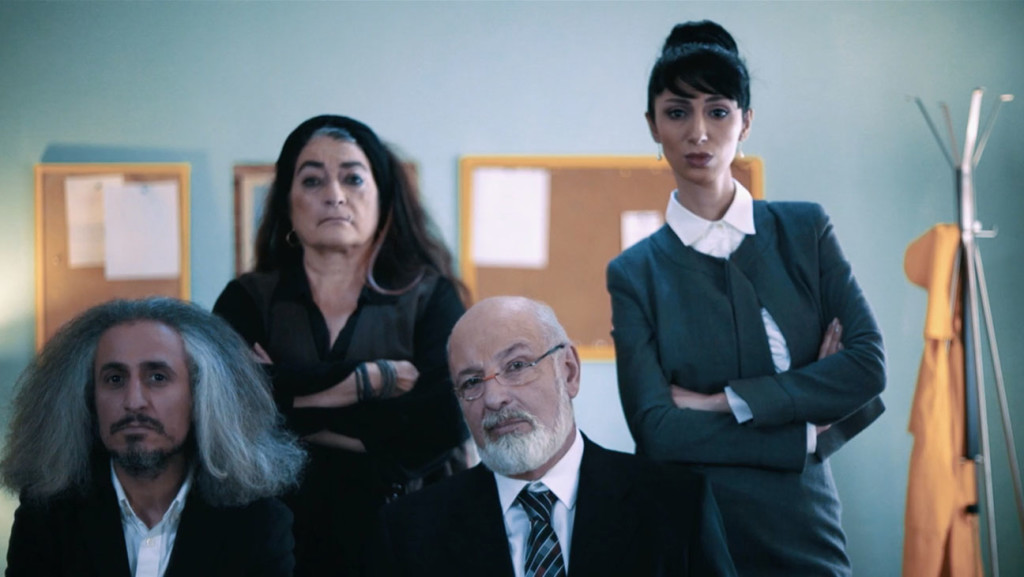
RADIO DREAMS
RADIO DREAMS

The droll dark comedy Radio Dreams explores the ambivalence of the immigrant experience through the portrait of a flamboyant misfit, a man who rides the roller coaster of megalomania and despair. That misfit is Hamid Royani (Mohsen Namjoo), the director of programming at an Iranian radio station in the San Francisco Bay Area. Radio Dreams opens tomorrow for a one-week-only run at the Roxie Theater in San Francisco.

Hamid, an author in Iran, is a man of great certainty, with an unwavering sense of intellectual superiority He assumes that everyone should – and will – buy in to his idiosyncratic taste. This results in extremely random radio programming, and Hamid tries to sabotage everything that he finds vulgar (which is everything that might bring more listeners and revenue to the station.)

With his wild mane and indulgent programming, we first think that Hamid is simply batty. But immigrants to the US generally forge new identities, and we come to understand that Hamid has not, perhaps will not, forge that new identity. His despair is real but it’s hard to empathize with – he might be a legitimate literary figure in Iran, but he’s probably a pompous ass over there, too.

The highlight of Radio Dreams is Hamid’s reaction when he is surprised that Miss Iran USA, whom he has dismissed as a bimbo, might have literary chops that rivaling his.

Hamid has concocted a plan to have Afghanistan’s first rock band visit with the members of Metallica on air, and that’s the movie’s MacGuffin. As we wait to see if Metallica will really show up, the foibles of the radio station crew dot Radio Dreams with moments of absurdity. There are the cheesy commercials about unwanted body hair, Hamid’s obsession with hand sanitizer, a radio jungle played live on keyboards EVERY time, a new employee orientation that focuses on international time zones, along with a station intern compelled to take wrestling lessons.

Writer-director Babak Jalali is an adept storyteller. As the movie opens, we are wondering, why do these guys have musical instruments? Why are they talking about Metallica? What’s with the ON AIR sign? Much of the movie unfolds before Hamid Royani emerges as the centerpiece character.

Hamid is played by the well-known Iranian singer-songwriter Mohsen Namjoo, “Iran’s Bob Dylan”. This is only Namjoo’s second feature film as an actor. He’s a compelling figure, and this is a very fine performance.

Except for Namjoo, the cast is made up of Bay Area actors. Masters of the implacable and the stone face, all of the actors do deadpan really, really well.

As befits the mix of reality and absurdism, here’s a podcast by the characters in Radio Dreams. I saw Radio Dreams at the Camera Cinema Club, and Babak Jalali took Q&A after the screening by phone from Belgium.

Radio Dreams is the second feature for Jalali, an Iranian-born filmmaker living and working in Europe. He shot Radio Dreams with a small crew over only 24 days in San Francisco. About 60% of the dialogue was scripted and 40% improvised. The band in the movie, Kabul Dreams, really is Afghanistan’s first rock band, they did get to meet Metallica in real life and the PARS-FM were filmed at a real Iranian radio station in the Bay Area.

Babak Jalali is a promising filmmaker and Radio Dreams is a movie that we haven’t seen before.

THE DINNER: emotional potboiler

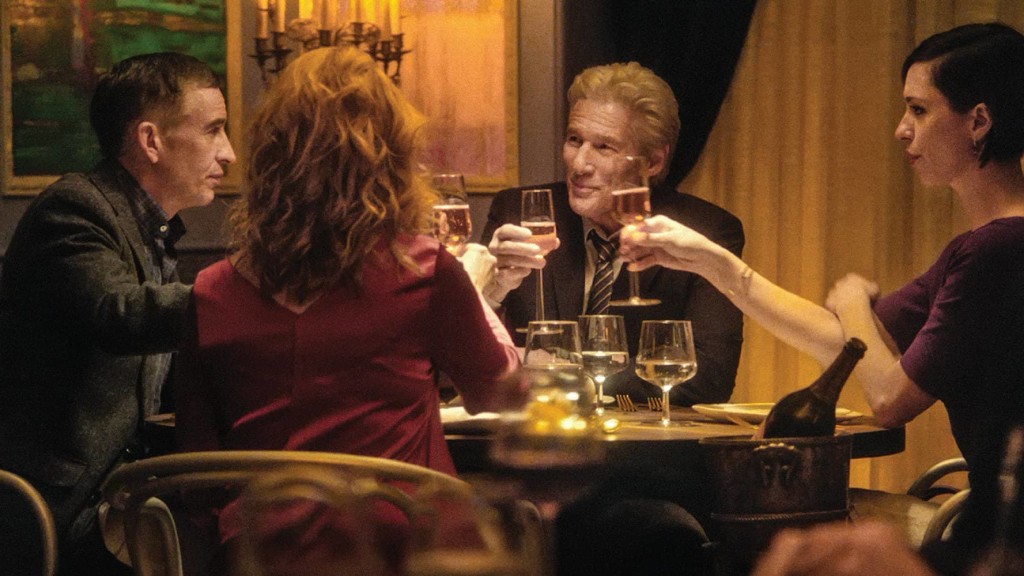
THE DINNER
THE DINNER

In the emotional potboiler The Dinner, Richard Gere plays Stan, a Congressman under a whole lot of pressure. His career-topping legislation is up for a vote tomorrow and he a few votes short. He’s navigating the perils of the 24-hour news cycle as he runs for Governor. And a scandal from his own family is threatening to erupt. It doesn’t look like he’s going to get much help from Kate (Rebecca Hall), his self-described trophy wife, who is very tightly wound.

Stan’s brother Paul (Steve Coogan) knows about pressure because his wife’s Claire cancer episode crushed him into a mental breakdown. He’s out of the asylum, but he’s still a basket case, clinging to a modest level of functionality. Claire (Laura Linney) is now able to run the family, and she’s a rock.

Now the four of them meet at an exclusive and trendy restaurant to discuss how to handle a family crisis. Paul can’t get over his resentment and jealousy of Stan. To describe the plot of the The Dinner as a family meal is like calling The Revenant the story of a hike in the woods. Accustomed to making deals in politics, Stan has to work things out with two hyper-protective mother bears and a volatile and hostile loony. Is Kate really shallow and brittle? She may surprise us as one tough tough-as-nails negotiator. And what is Claire really capable of to protect her child? The pressure builds and builds, all the way up to a shattering and ambiguous ending.

Coogan sheds his usual smugness and delivers a stunning portrait of mental illness. His Paul has the all-time movie meltdown in a high school classroom, and another amazing monologue given to an empty classroom. He has pathetically grasping conversations with a son who now only patronizes him. Coogan’s searing performance is reason enough to see The Dinner.

The Dinner is also a showcase for Linney, Gere and Hall. Adepero Oduye (12 Years a Slave, The Big Short) is excellent (and realistic) as Gere’s never-off-duty chief of staff. Chloe Sevigny nails a character who has the knack of saying exactly the wrong thing to defuse an awkward situation.  The always interesting Michael Chernus provides chuckles as the restaurant’s ringmaster, who presents one pretentious course after another. The restaurant’s locally sourced and extravagantly presented food does look and sound delicious, even if each dish is so overly precious.

The Dinner explores a very thorny philosophical question: what is the parental responsibility to help a child who has done something unforgivable?  Is it better to let him face harsh consequences, even if it will ruin much of his life? Or is it better to help him avoid those consequences so he can get a second chance at a normal life?

I went to see The Dinner because it was directed by (and its screenplay adapted by) Oren Moverman, and I very much admired Moverman’s The Messenger and Rampart. He has a gift for getting great performances from his cast and for portraying the moments in life that are the most emotionally explosive.

A QUIET PASSION: she was unhappy and so are we

A QUIET PASSION
A QUIET PASSION

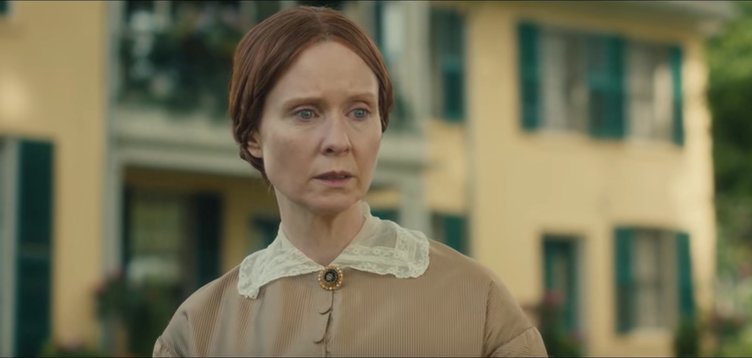
Cynthia Nixon plays the 19th Century American poet Emily Dickinson in the biopic A Quiet Passion.  Even though the Dickinson family was free-thinking for its era, Protestant New England society was severe as the women’s hairstyle.   As I watched these characters navigate their world, the words “forbidding” and “stern” kept coming to mind.  It was an age where the groom kisses his new bride on the cheek, and a euphoric outburst is “Reverend Wadsworth’s sermon took my breath away.”

That’s a bad time and place to be innovative or iconoclastic.  And a horrible time for a woman to seek recognition for her art.  The Quiet Passion’s Emily Dickinson is in a constant state of social rebellion and always unappreciated as a poet.

She clearly appreciates the sexism of the era and is enraged by the injustice.  She sees through the unnecessary constrictions of the religiosity of the day and is disgusted. Unfortunately, she also holds everyone to impossible standards.  She suffers emotionally, and then begins to suffer physically.  All of this makes her very unpleasant and difficult to live with.

Cynthia Nixon is a fine actress and vividly conveys Dickinson’s unhappiness.  Nixon, of course, is known for playing Miranda, by far the most interesting character in Sex in the City. Nixon gets to showcase her wit when Dickinson and her sister (Jennifer Ehle) repress laughter during a hilariously awkward tea with Reverend Wadsworth and his abstemious and anti-social wife.

All of the cast in A Quiet Passion is good, with the exception of the hammy Duncan Duff, who plays Dickinson’s brother, who apparently was known for tightening his brow and popping his eyes.  Catherine Bailey gets to sparkle as she pops off the wicked bon mots of Dickinson’s super ironic friend Vryling Buffam.

The British director Terence Davies is a critical favorite, and generously employs arty touches like static shots of long duration and the subjective view.  But I have never warmed to his films.

Davies often follows scenes from Dickinson’s life with a voice over of a Dickinson poem on the same subject.  So Dickinson’s poetry comments on Dickinson’s life.  The problem is that The Quiet Passion is a daisy chain of unlinked anecdotes.  For a linear story, the whole thing is distractingly disjointed.

The Quiet Passion is a dreary and ponderous film.  I was actually rooting for Emily to die so the movie would be over.

TRUMAN: how people say goodbye

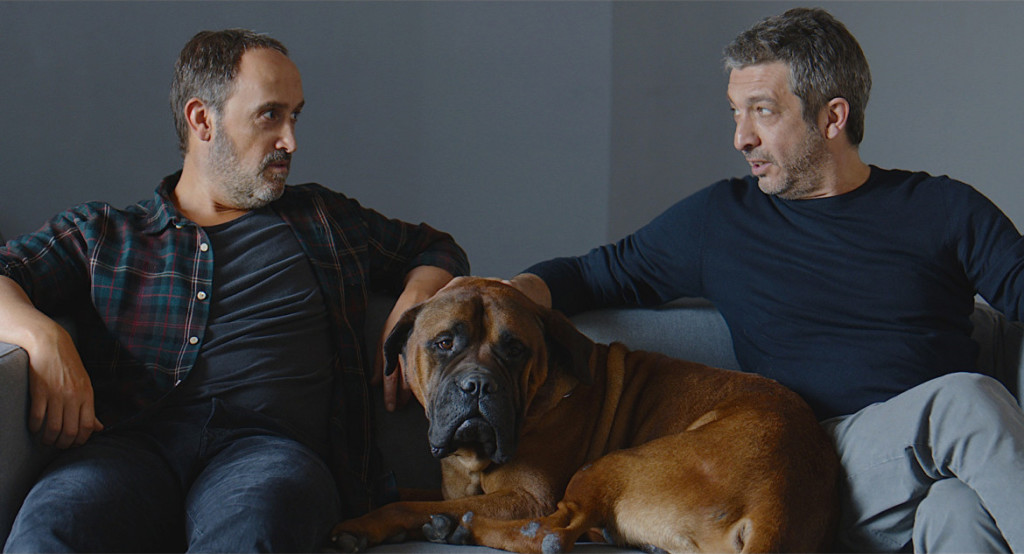
Javier and Ricardo Darin in TRUMAN
Javier Cámara and Ricardo Darin in TRUMAN

This may be the best movie I’ve seen this year.  In the deeply emotionally affecting and humane Spanish film Truman, Tomás (Javier Cámara) leaves Montreal to pay a surprise four-day visit to his longtime friend Julián (Ricardo Darin) in Madrid. Julián has been battling cancer and has just received a very grim prognosis. Julián has chosen to forgo further treatment, and his cousin and caregiver Paula (Dolores Fonzi) is hoping that Tomás can talk Julián out of his decision.

Julián is a roguish bon vivant, although now hobbled by illness. Tomás is a responsible family man.  As the four day visit unfolds, Tomás tags along as Julián cavalierly settles his affairs.  Because of the circumstances, even the most routine activity is heavily charged with emotion.  Julián, who has always been a wild card, is now a tinderbox always on the verge of erupting into some socially inappropriate gesture.  Julián is particularly focused on arranging for adoption of his beloved and ponderous dog Truman.

Julián is a wiseacre, but his reaction to a moment of kindness from an very unexpected source is heartbreaking.  Julián goes to say goodbye to his son, and then the  learn a fact afterward that make this encounter exponentially more poignant.  Truman has an especially sly ending  – the granting of one last favor, however inconvenient.

TRUMAN
TRUMAN

The Argentine actor Darin is one of my favorite screen actors: Nine Queens, The Secret in their Eyes, Carancho, The Aura.  As a man living under a death sentence, Julián has adopted a bemused fatalism, but is ready to burst into rage or despair at any moment, and Darin captures that perfectly.

I was blown away by Javier Cámara’s unforgettable performance, at once creepy and heartbreaking, in the Pedro Almodovar drama Talk to Her. Cámara is a master of the reaction, and his Tomás stoically serves as the loyal wing man to a friend with hair trigger unpredictability, often in a state of cringe.

The Argentine actress Dolores Fonzi (The Aura) is excellent as Paula, whose caregiver fatigue finally explodes.

Packed with bittersweet emotions, Truman is never maudlin.  The Spanish director Cesc Gay, who co-wrote Truman, has created a gentle and insightful exploration into how people can say goodbye.  There’s not a single misstep or hint of inauthenticity.  Again, Truman is one of the best films of the year.

(Note: The crappy trailer below fails to capture all the humor and deep emotion in this film.)

RADIO DREAMS: stranger in a strange and funny land

RADIO DREAMS
RADIO DREAMS

The droll dark comedy Radio Dreams explores the ambivalence of the immigrant experience through the portrait of a flamboyant misfit, a man who rides the roller coaster of megalomania and despair.  That misfit is Hamid Royani (Mohsen Namjoo), the director of programming at an Iranian radio station in the San Francisco Bay Area.

Hamid, an author in Iran, is a man of great certainty, with an unwavering sense of intellectual superiority  He assumes that everyone should – and will – buy in to his idiosyncratic taste.  This results in extremely random radio programming, and Hamid tries to sabotage everything that he finds vulgar (which is everything that might bring more listeners and revenue to the station.)

With his wild mane and indulgent programming, we first think that Hamid is simply batty.  But immigrants to the US generally forge new identities, and we come to understand that Hamid has not, perhaps will not, forge that new identity.   His despair is real but it’s hard to empathize with – he might be a legitimate literary figure in Iran, but he’s probably a pompous ass over there, too.

The highlight of Radio Dreams is Hamid’s reaction when he is surprised that Miss Iran USA, whom he has dismissed as a bimbo, might have literary chops that rivaling his.

Hamid has concocted a plan to have Afghanistan’s first rock band visit with the members of Metallica on air, and that’s the movie’s MacGuffin.  As we wait to see if Metallica will really show up, the foibles of the radio station crew dot Radio Dreams with moments of absurdity.  There are the cheesy commercials about unwanted body hair, Hamid’s obsession with hand sanitizer, a radio jungle played live on keyboards EVERY time, a new employee orientation that focuses on international time zones, along with a station intern compelled to take wrestling lessons.

Writer-director Babak Jalali is an adept storyteller.  As the movie opens, we are wondering, why do these guys have musical instruments? Why are they talking about Metallica? What’s with the ON AIR sign? Much of the movie unfolds before Hamid Royani emerges as the centerpiece character.

Hamid is played by the well-known Iranian singer-songwriter Mohsen Namjoo, “Iran’s Bob Dylan”.  This is only Namjoo’s second feature film as an actor.  He’s a compelling figure, and this is a very fine performance.

Except for Namjoo, the cast is made up of Bay Area actors.  Masters of the implacable and the stone face, all of the actors do deadpan really, really well.

As befits the mix of reality and absurdism, here’s a podcast by the characters in Radio Dreams.  I saw Radio Dreams at the Camera Cinema Club, and Babak Jalali took Q&A after the screening by phone from Belgium.

Radio Dreams is the second feature for Jalali, an Iranian-born filmmaker living and working in Europe.  He shot Radio Dreams with a small crew over only 24 days in San Francisco.   About 60% of the dialogue was scripted and 40% improvised.  The band in the movie, Kabul Dreams, really is Afghanistan’s first rock band, they did get to meet Metallica in real life and the PARS-FM were filmed at a real Iranian radio station in the Bay Area.

Babak Jalali is a promising filmmaker and Radio Dreams is a movie that we haven’t seen before.

NORMAN: THE MODERATE RISE AND TRAGIC FALL OF A NEW YORK FIXER: big deals are not for little men

NORMAN: THE MODERATE RISE AND TRAGIC FALL OF A NEW YORK FIXER
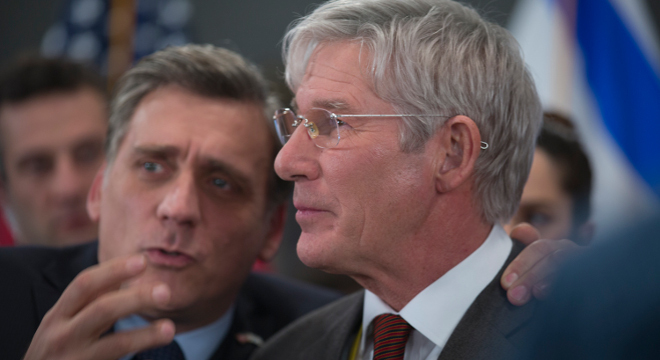
Lior Ashkenazi and Richard Gere in NORMAN: THE MODERATE RISE AND TRAGIC FALL OF A NEW YORK FIXER

In Norman: The Moderate Rise and Tragic Fall of a New York Fixer,  writer-director Joseph Cedar and his star Richard Gere combine to create the unforgettable character of Norman Oppenheimer, a Jewish Willy Loman who finally gets his chance to sits with the Movers and Shakers.  Norman’s gig is to find two real businessmen that he does not know, pretending to each to be the confidante of the other, and introduce them, hoping that they make a deal (a deal that he neither engineers or invests in), hoping that he can get a percentage as a finder’s fee.

Norman has not so much a ready smile as a compulsive one. Unencumbered by any sense of boundaries or propriety, he literally stalks the rich and influential like paparazzi stalk celebrities.  He feigns familiarity and drops names (“a high official, I can’t say his name”).  All he time, he tries, usually successfully, to stifle the odor of desperation.

I’ve spent over thirty years in politics, and in my business, it is said that there are Who Ya Know consultants and there are What Ya Know consultants. The most effective consultants combine both. If you’re only at the table to peddle the influence of Who Ya Know, you might be a little shady.  That’s Norman.

I know the world of powerful and important people, a world that hustlers try to crash, and I’ve known people like Norman.  And I know the Whack-A-Mole pressure of shepherding home a complex, multi-faceted deal. Norman’s character, while extreme, rings true.

Norman is everybody’s acquaintance but has no actual reputation of his own.  No one knows where he lives or what deals he has structured before.  He is so mysterious that we find ourselves even asking, is he homeless?

This may be Richard Gere’s best movie performance.  Gere perfectly distills Norman’s obnoxious ambition to play with the high rollers and then his stress and bewilderment once he’s gotten to the high stakes table.  The critic Christy Lemire writes, “You may not be able to root for him, but you can’t help but feel for him.”

Norman ingratiates himself to an Israeli politician (Lior Ashkenazi) and hits pay dirt when the politician unexpectedly becomes prime minister.  Norman says, “for once, I have bet on the right horse”, and indeed Norman did spot a uniquely optimistic quality that other observers failed to recognize and appreciate.  For the first time, Norman is relevant and at the exhilarating  center of power.

Lior Ashkenazi is brilliant as the politician, a man who is able to recognize his own specific gifts.  He is ebullient, and it’s easy to see how people can be attracted to his charisma and infectious confidence.  His vulnerability is an appetite for fine things and a neediness for the flattery and attention that a poser like Norman can offer.  Ashkenazi played a totally contrasting, much more nerdy, character in Cedar’s 2011 inventive and mostly successful character-driven dramedy Footnote.

Norman is juggling multiple balls in air, and he must make all of his deals pay off because they are all interlinked.  It’s kind of like making an exotic bet at the racetrack like an exacta, a superfecta or a pick 6.  If one part unravels, the whole thing will come crashing down.  Norman has always been able to get by on bullshit, but now he’s has gotten his wish – to play at the highest level, where, at some point you’ve got to deliver.  Here’s where “the tragic fall” comes in.

The stellar performances of Gere and Ashkenazi are but two highlights of Norman’s superb casting:  Michael Sheen, Charlotte Gainsbourg, Harris Yulin, Steve Buscemi.   Josh Charles plays a magnate who can sniff out a bullshit artist and can dismiss one with blistering efficiency.  The always excellent Isaach De Bankolé (Night on Earth) is memorable in a tiny part.  Hank Azaria  sparkles as a character who confounds Norman with a taste of his own medicine.   And we get to hear the glorious singing voice of Cantor Azi Schwartz.

As they say, if you can’t run with the big dogs, stay on the porch.  Big deals are not for little men.

Note: Norman: The Moderate Rise and Tragic Fall of a New York Fixer weighs in at #16 on my list of Longest Movie Titles.

THEIR FINEST: the appealing side of propaganda

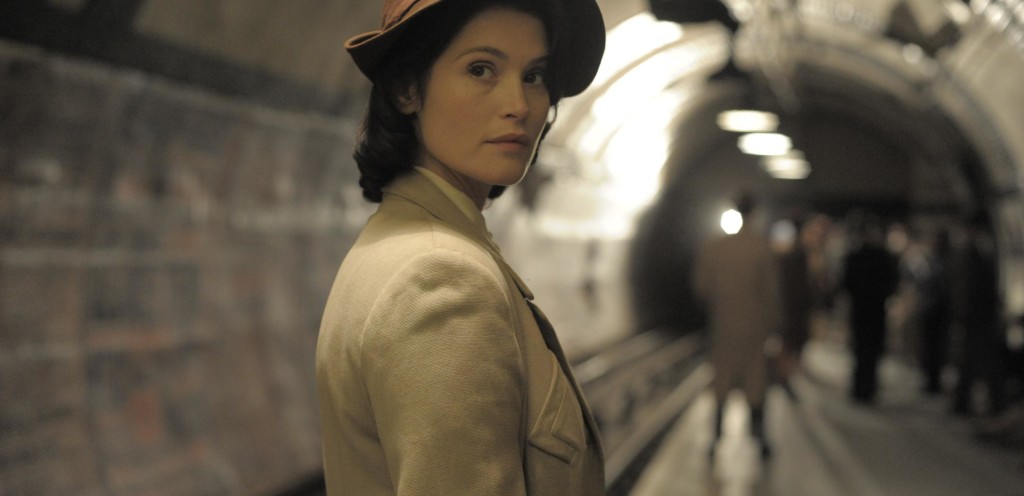
Gemma Arterton in THEIR FINEST

Rosie the Riveter meets Nora Ephron in Their Finest, where Gemma Arterton plays a wannabe secretary summoned to write the female dialogue in a British propaganda movie aimed at easing America into WW II.  Of course, she discovers that she has a gift for screenwriting and a passion for it.  As in Mad Men, there are plenty of snickers at the assumed sexism the of the era. The driven lead writer (Sam Clafton) is a contrast to her nogoodnik common law husband (Jack Huston).

Originally, the plot of the movie-within-the movie is set to be a more or less true (okay – less true) account of the Dunkirk seaborne rescue, but a hook for American audiences is required.  So the filmmakers slap on a superfluous character to be played by a bonafide war hero (Jake Lacy):  he’s a real hero, he’s American, he’s stunningly handsome with a gleaming smile, but he’s absolutely talentless.

One of the sound reasons to watch any movie, and this especially applies to Their Finest, is Bill Nighy.  Here, he plays a vain actor sliding down the down slope of his career.  Nighy, as always, is able to summon both hilarity and poignancy, from his character’s foibles and vulnerability.

I’ve always liked Gemma Arterton, and she’s good here, too.  Arterton is an underappreciated actress, with winning roles in Gemma Bovary, Tamara Drewe and as the Bond Girl in Quantum of Solace.

Their Finest contains elements of the romance, comedy, historical and Girl Power genres.  The romantic element might have worked had not Sam Clafton delivered such a one-note performance.  Jack of some aspects and master of none, Their Finest is a harmless and appealing diversion.

FREE FIRE: a witty and fun shoot ’em up

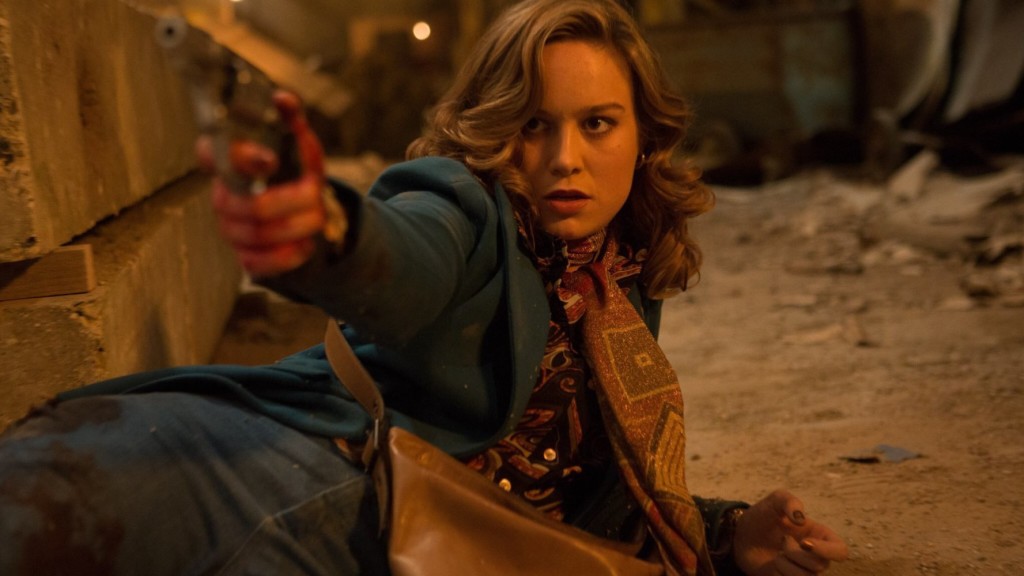
Brie larson in FREE FIRE
Brie Larson in FREE FIRE

The clever and fun action thriller Free Fire begins when Oscar-winning actress Brie Larson introduces both sides of an illegal gun transaction.    It’s 1978, and the hoods, played by Armie Hammer, Cillian Murphy and a bunch of less recognizable faces, meetup in a long-abandoned factory.  The deal, of course, goes bad, and they start shooting at each other.  They are all pinned down, and all the action occurs in a confined space.  Pretty quickly, everyone is wounded, and has to crawl, hobble, limp and hop around trying to take out the others.

The factory is a dark and gritty setting, and it’s not going to turn out well, but it’s too light-hearted to call this a neo-noir.  These are boys (and a girl) playing with guns, and everybody is having a lot of fun.  Indeed, Free Fall has the all-in-good-fun tone of The Dirty Dozen and reminds us of a Quentin Tarantino film with much crisper dialogue and less gore.  Two of characters come to especially gruesome ends, but this is not a splatter-a-thon.  And here’s a cinematic First – a tickle attack in the midst of a gunfight.

In another Taratinoesque touch, classic rock, especially Creedence Clearwater Revival, is put to great use on the soundtrack.  But the insertion of a John Denver album into a cassette tape player is a hilarious high point.

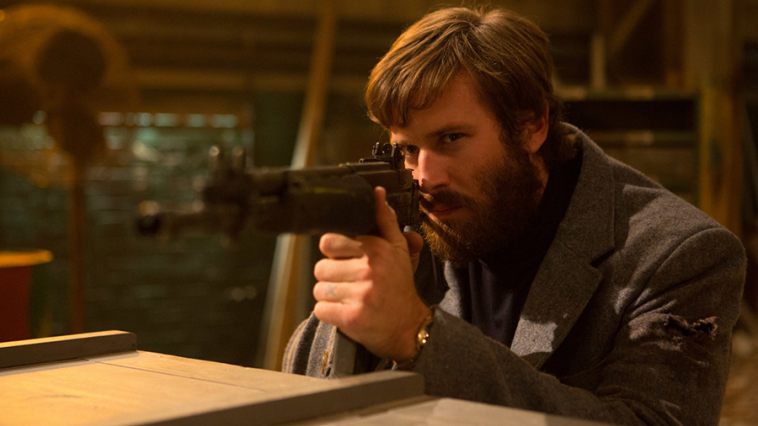
Larson leads a set of appealing performances.  Armie Hammer is especially memorable as a particularly suave and smug gun merchant (and wears the same stylish beard sported by The Movie Gourmet in 1978).

Written by director Ben Wheatley and his writing partner Amy Jump, Free Fire is pure Wheatley.  Jump adapted his successful 2016 sci-fi High-Rise from  the J.G. Ballard novel

Leaving the theater, The Wife asked me “Why did I enjoy that movie so much?”, and I replied “Because it didn’t try to be more than it was.”  It tries to be a very witty shoot ’em up, and, as such, it’s very entertaining.

Armie Hammer in FREE FIRE

THE LOST CITY OF Z: the historical adventure epic revived

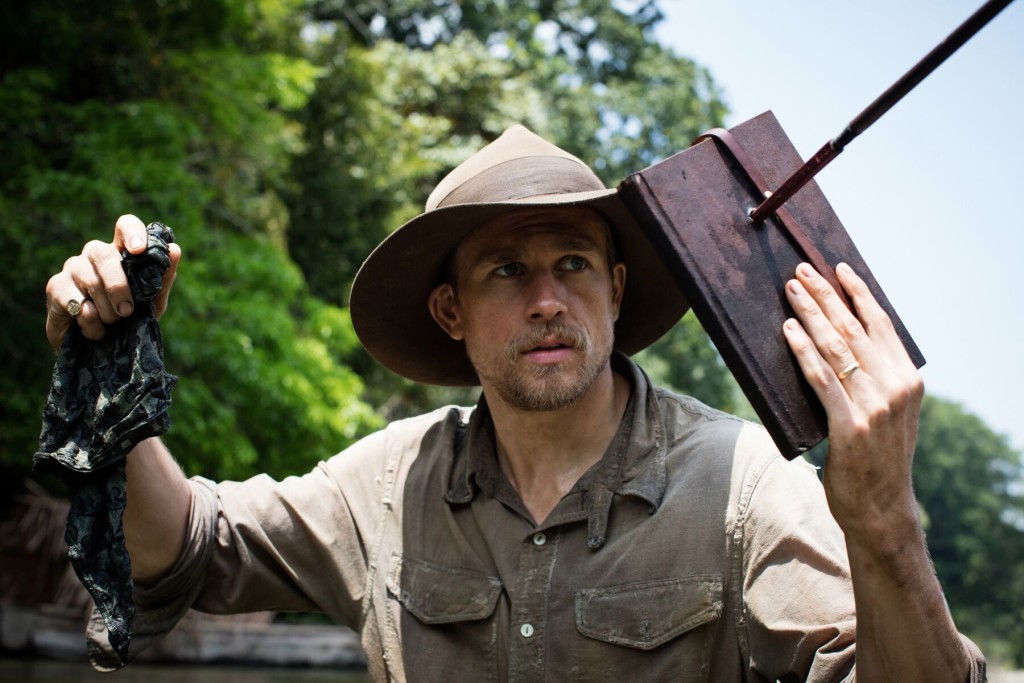
Charlie Hunnam in THE LOST CITY OF Z photo courtesy of SFFILM
Charlie Hunnam in THE LOST CITY OF Z
photo courtesy of SFFILM

In auteur James Gray’s sweeping turn of the 20th Century epic The Lost City of Z, a stiff-upper-lip type British military officer becomes the first European to probe into the deepest heart of unmapped Amazonia. Finding his way through the lush jungles, braving encounters with sometimes cannibalistic indigenous warriors, he becomes obsessed with finding the lost city of an ancient civilization. I know this sounds like Indiana Jones, but it’s based on the real life of Percy Fawcett as chronicled in the recent book Lost City of Z by David Grann.

The Lost City of Z opens tomorrow in Bay Area theaters. I saw The Lost City of Z at the San Francisco International Film Festival (SFFILMFestival) at a screening with director James Gray. I’ll be sharing some snippets from Gray’s Q & A on Sunday.

The Lost City of Z begins with an Edwardian stag hunt through the verdant Irish countryside, complete with horses spilling riders. This scene is gorgeous, but its point is to introduce the young British military officer Percy Fawcett (Charlie Hunnam) as a man of unusual resourcefulness, talent and, above all, drive. Despite his abilities, he has been chaffing at the unattractive assignments that have precluded his career advancement. In the snobby Edwardian military, he has been in disfavor because his dissolute father had stained the family name. One of Fawcett’s commanders says, “He’s been rather unfortunate in his choice of ancestors”.

That yearning to earn the recognition that he believes he merits – and to attain the accomplishments of a Great Man – is the core of this character-driven movie. Fawcett resists yet another assignment away from the career-making action, a mapping expedition designed to have a minor diplomatic payoff. But it takes him on a spectacular Amazon exploration that brings him celebrity – and backing for more high-profile expeditions. Fawcett was surfing the zeitgeist in the age of his contemporaries Roald Amundsen (South Pole), Robert Peary (North Pole) and Howard Carter (King Tut).

In that first expedition, Fawcett becomes convinced that he can find the magnificent city of a lost civilization deep in the Amazon, a city he calls Z (which is pronounced as the British “Zed”). The Lost City of Z takes us through two more Amazonian expeditions, sandwiched around Fawcett’s WW I service in the hellish Battle of the Somme.
That final expedition ends mysteriously – and not well.

No one knows for sure what happened to Fawcett. In The Lost City of Z, Gray leads us toward the most likely conclusion, the one embraced by Grann’s book. If you’re interested in the decades of speculation about Fawcett’s fate, there’s a good outline on Percy Fawcett’s Wikipedia page.

Fawcett comes with his own Victorian upper class prejudices, but he has the capacity to set those aside for a post-Darwin open-mindedness. Gray made it a point that the indigenous peoples in the movie are independent of Fawcett; Gray shows them living their lives in a world that Fawcett has found, not just advancing the plot points in Fawcett’s quest. Four real tribes – and their cultures – are shown in the film.

As Percy Fawcett, with his oft-manic obsession and fame-seeking that color his scientific curiosity and his old-fashioned Dudley Do-Right values, Charlie Hunnam gives a tremendous, perhaps carer breakthrough, performance. He’s been a promising actor in Sons of Anarchy and the overlooked thriller Deadfall) (and such a good actor that I never dreamed that he’s really British).  Hunnam will next star as the title character in the King Arthur movie franchise.

Robert Pattinson is unexpectedly perfect as Fawcett’s travel buddy Henry Costin. With his Twilight dreaminess hidden behind a Smith Brothers beard, Pattinson projects a lean manliness. It’s probably his best performance.

Sienna Miller shines as Fawcett’s proto-feminist wife Nina. I first noticed Miller (and Daniel Craig) in the underrated neo-noir thriller 2004 Layer Cake. Now Miller is still only 35 years old and has delivered other fine recent performances in Foxcatcher, American Sniper and (in an especially delicious role) High-Rise.

Director James Gray (The Yard, Two Lovers, The Immigrant) is a favorite of cinephiles and of other filmmakers, but regular audiences don’t turn out for his movies. That may change with The Lost City of Z, a remarkably beautiful film that Gray shot, bucking the trend to digital, in 35 mm. The jungle scenes were filmed in a national park in Columbia. The cinemeatographer is the Oscar-nominated Darius Khondji. Khondji shot The Immigrant for Gray and has been the DP of choice for David Fincher (Se7en) Alan Parker (Evita), Michael Haneke (Amour), and Woody Allen (Midnight in Paris). Along with the stag hunt and the voyages up and down the jungle rivers, there is also a breathtakingly beautiful ballroom scene and a gaspingly surreal nighttime discovery of a rubber plantation’s opera house deep in the jungle.

There have been other Lost Expedition movies, most famously Werner Herzog’s Aquirre, the Wrath of God and Fitzcarraldo. The Lost City of Z shares an obsession, a quest and a mysterious tragic end with those films, but it stands apart with its exploration of the motivation of a real life character and the authenticity of Gray’s depiction of the indigenous people.

Movie studios used to make an entire genre of very fun movies from Gunga Din and The Four Feathers through Lawrence of Arabia and Zulu that featured white Europeans getting their thrills in exotic third world playgrounds. We often cringe at the racist premises and the treatment of “the natives” those movies today. Since the 1960s, the best examples of the genre, like Raiders of the Lost Ark, have had an ironic tinge. With The Lost City of Z, James Gray loses both the racism and the irony, and brings us brings a straight-ahead exploration tale.

The Lost City of Z revives the genre of the historical adventure epic, with all the spectacle of a swashbuckler, while braiding in modern sensitivities and a psychological portrait. This is a beautiful and thoughtful film.

[And here are some completely random tidbits. There’s a cameo by Spaghetti Western star Franco Nero. The closing credits recognize the “animal weath coordinator” and the “data wrangler”.]