SONG LANG: operatic romance in a Vietnamese opera

Isaac and Lien Binh Phat in SONG LANG, playing at Frameline.

Song Lang is writer-director Leon Le’s groundbreaking romantic tragedy. Set in 1990s Vietnam, Dung (Lien Binh Phat) is an effectively brutal collector for a loan shark, Sent to collect from an on-the-skids traditional opera company, Dung is about to trash the company’s wardrobe, when he encounters the opera’s charismatic lead singer Phung (Isaac). Dung has a female bed buddy, but Phung triggers some strong feelings in Dung. The evolving relationship between the two soars – until the consequences of Dung’s business catch up.

Song Lang is a great-looking movie. The color palette reflects the tropical vibrancy of Vietnam, and the sets and the costumes of the cải lương opera are breathtaking.
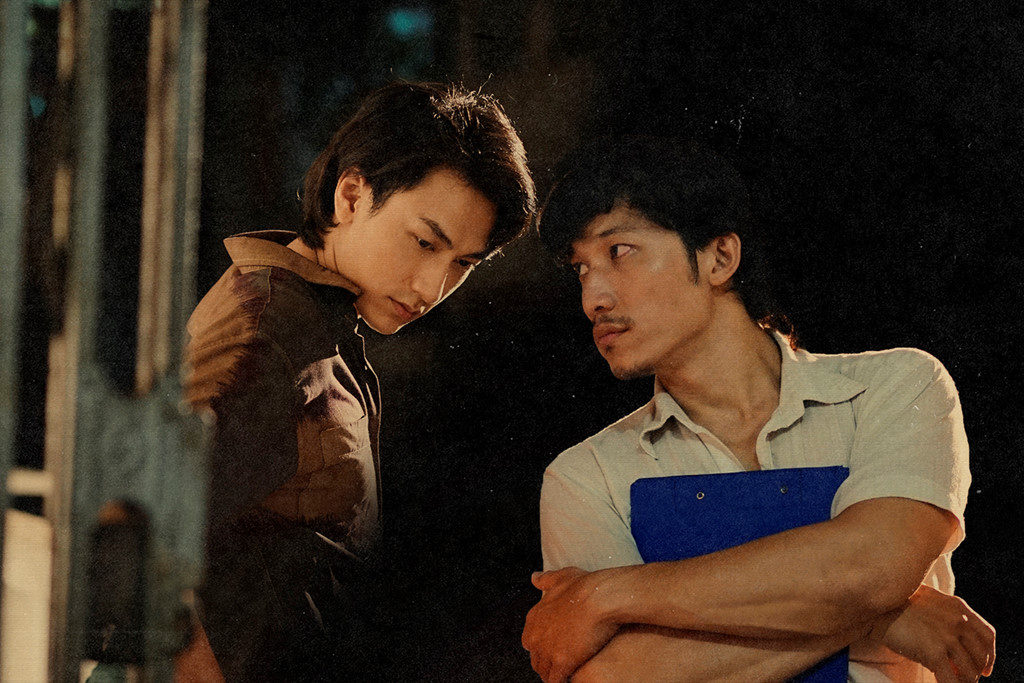
Isaac and Lien Binh Phat in SONG LANG, playing at Frameline.

Song Lang is also a love letter to cải lương itself; the art form is depicted beautifully and affectionately. And the story reveals that Dung himself has his own connection to cải lương.

Both leads are very good. This is the first screen credit for Lien Binh Phat, who won an acting award at the Tokyo International Film Festival.

American audiences will expect more physical expressions of passion than are portrayed in this film romance. This is a Vietnamese film.

On the other hand, there is one distracting moment for Vietnamese-American – when there’s a quick hug of grandma – no one hugs their grandma in Vietnam.

But, as is common in Vietnamese cinema, this is a tearjerker. It’s too easy to call this just “the Vietnamese Brokeback Mountain“. It’s an especially beautiful film with two original characters.

I also recommend this LA Times article on Leon Le and how he came to make Song Lang.

Frameline hosts the North American premiere of Song Lang. This is the directorial debut for Leon Le and is one of several first features in the Frameline program.
FRAMELINE: the documentaries

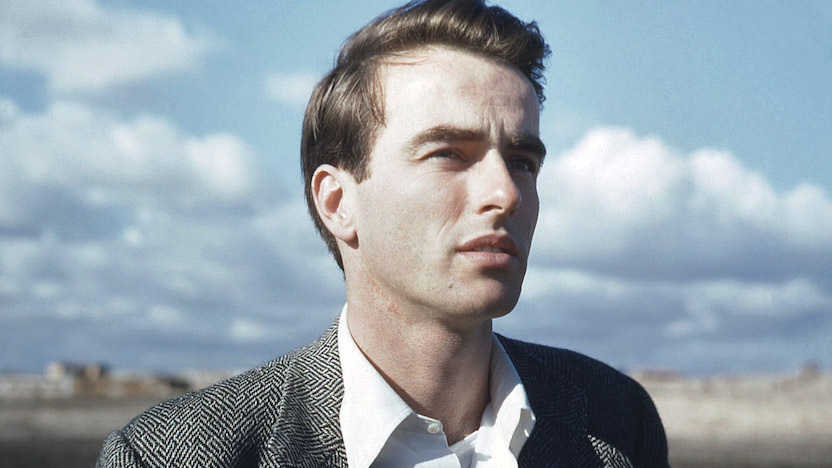
MAKING MONTGOMERY CLIFT, directed by Robert Anderson Clift and Hilary Demmon

Frameline, the San Francisco International LGBTQ+ Film Festival, is underway and offers a rich selection of documentaries.

  • Frameline’s closing night film, the emotionally powerful documentary, Gay Chorus Deep South. It tracks the San Francisco Gay Men’s Chorus concert tour through the Deep South in the aftermath of the Trump election. This will be an audience-pleaser; bring hankies.
  • The best doc in the fest may be Making Montgomery Clift, from directors Robert Anderson Clift and Hilary Demmon. It’s an unexpectedly insightful and nuanced probe into the life of Clift’s uncle, the movie star Montgomery Clift.
  • Anybody who attends Frameline (or SFFILM or Noir City, for that matter) knows the Twin Peaks bar at the corner of Castro and Market. Through the Windows tells the story of the first San Francisco gay bar set up to let patrons and passers-by observe each other directly.
  • The documentary short that plays before Through the Windows, Dressing Up Like Mrs. Doubtfire, explores the history of cross-dressing in the movies and the impact of the Robin Williams performance in Mrs. Doubtfire. There are several intriguing threads in this short, which could be expanded into a future doc feature.

ROLLING THUNDER REVUE: A BOB DYLAN STORY BY MARTIN SCORSESE: doc and playfully not

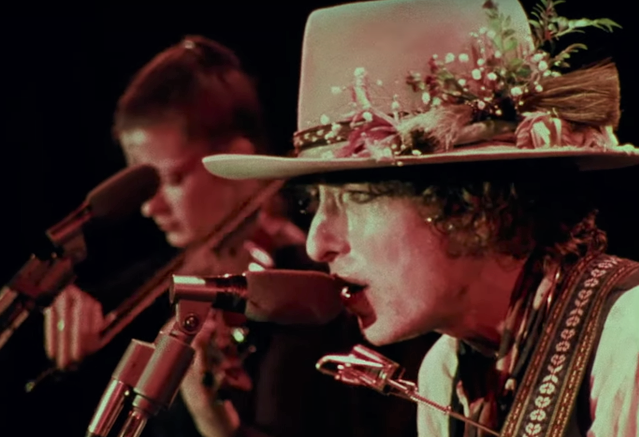
Scarlett Rivera and Bob Dylan in ROLLING THUNDER REVUE: A BOB DYLAN STORY BY MARTIN SCORSESE

So you think you know what you’re going to get from a movie titled Rolling Thunder Revue: A Bob Dylan Story by Martin Scorsese. Indeed, Scorsese documents Dylan’s 1975 Rolling Thunder tour. But he also, in what critic Jason Gorber calls an “anti-documentary” adds some fictional flourish, as befits Dylan’s longtime trickster persona.

Now for the documentary, which gives us a look at a mid-career Dylan (on the downside of his superstardom). The talking heads are great: lots of Bob Dylan himself, his sidemen, performers Joan Baez, Ramblin’ Jack Elliott, Ronnie Hawkins and Ronee Blakley, and even the subject of a Dylan song, Rubin “Hurricane” Carter. There’s a hilarious encounter between ex-lovers Baez and Dylan, as they mull over who left who.

There are explosive concert performances of Hurricane, Isis and A Hard Rain’s Gonna Fall (but also a disappointing version of the tour’s signature song, Knockin’ on Heaven’s Door).

Baez aside, the real co-star of the Rolling Thunder Revue was violinist Scarlett Rivera, whose violin licks elevated almost every song, especially Hurricane. My favorite Dylan performance – One More Cup of Coffee (Valley Below) from the live album – is really more Rivera’s song than Dylan’s. In Rolling Thunder Revue, we get to hear from Rivera – and about her and her spirited personal life.

And now for the playful part – Scorsese has dotted this “documentary” with stuff that is not true. The performance artist Martin von Haselberg claims to have shot the concert footage for a pretentious art film that was never made, which Dylan credits to Stefan van Dorp. Hasleberg didn’t shoot it and van Dorp doesn’t even exist. The guy identified as the tour promoter is actually a movie exec. And Sharon Stone was too young to have been on this tour, although she spins a ROFLMAO faux anecdote about Just Like a Woman.

Michael Murphy, who starred in Robert Altman’s political mockumentary Tanner, is shown as a real Congressman Tanner. And did Scarlett Rivera really have a sword collection? Was Allen Ginsberg really a good dancer?

The critical praise for Rolling Thunder Revue: A Bob Dylan Story by Martin Scorsese has been rapturous, with one respected critic pegging it as the best doc of year. This reeks to me of Scorsese worship. I’m not sure I would recommend Rolling Thunder Revue to a general (non-Baby Boomer) audience. It does do a great job of taking us backstage for the inside morsels – and it is creatively sly.

Rolling Thunder Revue: A Bob Dylan Story by Martin Scorsese is now streaming on Netflix.

BTW I highly recommend Peter Sobczynski’s comprehensive essay on the Cinema of Bob Dylan in rogerebert.com. It’s kind of spectacular.

HELMET HEADS: engaging characters can take a light comedy a long way.

HELMET HEADS

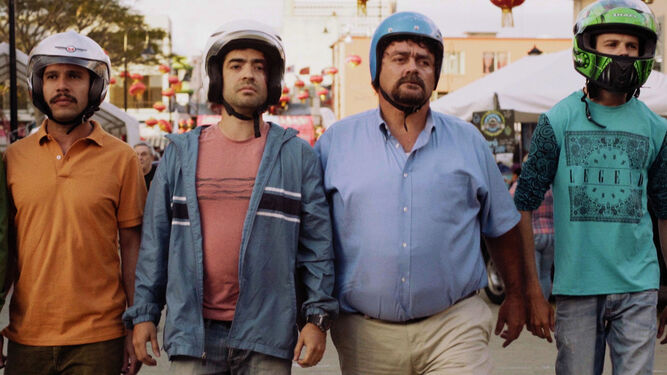
Engaging characters can take a light comedy a long way.  (And light comedy can take social commentary a long way, too.)  That’s the case with Neto Villalobos’ amiable comedy Helmet Heads (Cascos Nomados).

Mancha (Arturo Parda) buzzes around San Jose, Costa Rica, as a motorcycle delivery driver and canoodles with his girlfriend Clara (Daniela Mora). Mancha hangs out with his buddies from work. Clara tends a pack of 700 wild dogs on a mountainside outside the city. There’s a job crisis at Mancha’s employer, and Clara is moving to another town – so Mancha faces some choices.

The core of Helmet Heads is the bro-buddy camaraderie of the drivers. They all know each other by nicknames (and not their real names). “Mancha” means “Stain” and refers to the protagonist’s prominent facial birthmark. I especially loved the ever-blissed out Chito, the bombastic Gordo and the conveniently/inconveniently diabetic Gato. I was surprised to learn that most of the cast are non-actors and some are motorcycle delivery drivers.

Freedom’s just another word for nothin’ left to lose. These guys, especially Mancha, value their independence, but Helmet Heads reminds us – usually slyly – that their place in Costa Rica’s society is insecure, even fragile. Even with the social comment, Helmet Heads is pretty funny throughout.

There is also a sex scene unlike any I’ve seen. The sex is conventional, but the setting is not.

[Oddly, I flashed on another motorcycle messenger movie, the 1981 French thriller Diva, even though that is an entirely dissimilar movie – sleeker production values, a Hitchcock homage, an iconic chase through the Paris Metro, etc.]

I saw Helmet Heads at Cinema Club Silicon Valley, with a post screening Q&A with director Neto Villalobos.. I’ll let you know when and if Helmet Heads can be streamed.

FRAMING JOHN DELOREAN: a pulpy story, partly rehashed

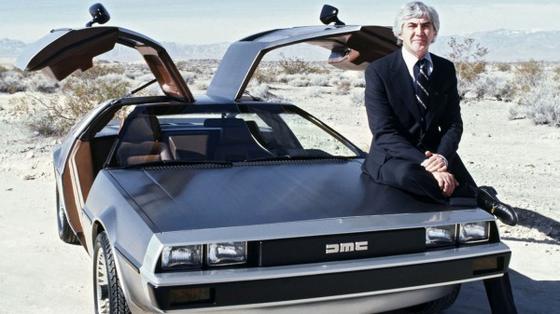
John DeLorean in FRAMING JOHN DELOREAN

Ever since the myth of Icarus, we have understood that audacity can take you only so far – but it often makes for a great story. The biodoc Framing John DeLorean tells PART of the story of a man whose audacious risk-taking invented the muscle car, propelled a meteoric corporate career, led him to found an automaker and to become a global celebrity and to marry a supermodel. And then to stumble into criminal prosecution, bankruptcy and divorce.

Framing John DeLorean leads through the familiar DeLorean story of his rise and flame-out and General Motors, the founding of the DeLorean Motors Company and the FBI videotaping him in a hotel room with $6.5 million of cocaine. We hear from Bill Collins – DeLorean’s engineering whiz for the Pontiac GTO and the DeLorean – and from DeLorean’s son and daughter. (But not from Cristina Ferrare, DeLorean’s celebrity trophy spouse). There a few unfamiliar nuggets, like DeLorean’s getting cosmetic surgery to enhance his jaw – and make him look like the swashbuckler that he was.

However, there’s a massive hole in Framing John DeLorean. A sketchy deal with a company called GPD is mentioned, but even with a forensic accountant as a talking head, the film doesn’t answer, or even pose, some questions that come immediately to mind. This article in Car and Driver provides more insight into the real story than does Framing John DeLorean.

The actor Alec Baldwin claims that DeLorean himself once suggested that Baldwin play him on screen. Framing John DeLorean has Baldwin play DeLorean in re-enactment scenes (along with Josh Charles as Bill Collins). The scenes with Baldwin add nothing to the film. I suspect that these Baldwin scenes were added only to use Baldwin’s drawing power to create a more marketable, not a better, film.

Framing John Delorean repeatedly asks why a narrative feature film has not been made about DeLorean and his pulpy story. But there isn’t a clear answer, and asking that question should be left to the audience of any documentary.

If you don’t know anything about John DeLorean, Framing John DeLorean is a decent primer. If you already know the story, I’d recommend the Car and Driver article instead. Framing John DeLorean is available to stream from Amazon, iTunes, Vudu, YouTube and Google Play.

ROCKETMAN: just a jukebox musical, but that’s okay

Taron Egerton (center) as Elton John composing Your Song in ROCKETMAN

The tagline to Rocketman pretty wells captures the movie: “A musical fantasy about … Elton John’s breakthrough years”. Emphasis on the musical fantasy. It’s not the standard showbiz biodrama like Ray or Walk the Line – it uses the form of a musical (characters bursting into song) to illustrate Elton John’s creative rise, his descent into substance abuse and his recovery.

Taron Egerton (and juvenile actors Matthew Illesley and Kit Connor) play Reggie Dwight, who must battle a pair of unsupportive parents and his pasty, pudgy, hirsute and bespectacled appearance – all while coping with being gay in an unwelcoming culture. What Reggie has going for him is that he is a musical genius. Paired with a song-writing partner, his brother-from-another-mother Bernie Taupin (Jamie Bell), he explodes into popular culture as Elton John. Suddenly making kazillions, he buys a lot of booze and drugs, and that – as we know – doesn’t usually go well…

Of course, the best reason to see Rocketman is the Elton John songbook. The best numbers are the recreated composition of Your Song and Elton’s debut at the Troubadour Club with Crocodile Rock. The latter – a magical moment – is depicted as literally magical. Tiny Dancer is fine, but my favorite screen version is still the one on the tour bus in in Almost Famous.

Taron Egerton actually sang the songs himself and did well; most importantly, he captured Elton’s on-stage flamboyance. As I wrote about Elisabeth Moss in Her Smell and Elle Fanning in Teen Spirit, given that Rami Malek just won an Oscar for lip-syncing, we should bestow a Nobel upon Egerton. 

[And when did it become okay for Bryce Dallas Howard to portray somebody’s middle-aged mom?  I’ve barely gotten used to Ron Howard having an adult child.]

Elton John’s story is a good one, Taron Egerton’s performance is convincing and appealing and two hours filled with Elton John songs make Rocketman a fun diversion.

DEADWOOD: THE MOVIE

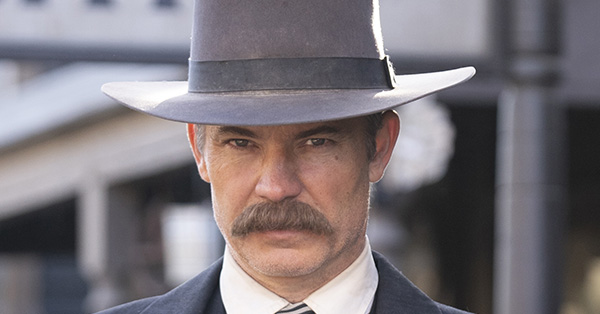
Timothy Olyphant in DEADWOOD: THE MOVIE

The series Deadwood ranks among the best of episodic television because of its vivid characters, along with its ruthless violence and its florid – and unexpectedly foul – language. It is the apogee of the Loquacious Western.

For fans of Deadwood, there is now Deadwood: The Movie, an affectionate update of our frontier friends – both vile and righteous. Deadwood: The Movie is just as character-rich as the series. If you already know the characters, that is. And one of the denizens utters the line, “Does brevity exist in your repertoire?

More than a decade has passed since the events of the Deadwood series. The occasion of South Dakota’s statehood has brought back merciless George Hearst with another monopolist scheme, this one based on the new technology of telephone wires. Motivated by old grudges and new greed, he threatens a spate of Deadwood stalwarts: Charlie Utter, Trixie, Sol Star, Marshal Seth Bullock, Samuel Fields and Mr. Wu.

At last, Al Swearengen’s life of dissolution has taken its toll on his health. But his personality still comes through his slurred speech, and he observes all from from his balcony – the Oracle of Deadwood.

It’s all an entertaining swan song for our favorite characters; Calamity Jane, Joanie Stubbs, Mrs. Ellsworth, Doc Cochran, Tom Nuttall and E.B. Farnum all show up, too.

Deadwood: The Movie is broadcast on and can be streamed from HBO.

THE FALL OF THE AMERICAN EMPIRE: pointed satire in the form of a heist movie

Alexandre Landry and Maripier Morin in THE FALL OF THE AMERICAN EMPIRE

In the pointed satire The Fall of the American Empire, Pierre-Paul (Alexandre Landry) chafes at his dead-end blue-collar job as an express freight delivery driver; he feels that, with his PhD in Philosophy, he has been unjustly screwed out of a much better life by the System. He may be right, but he’s also a self-absorbed putz, who is justifiably dumped by his girlfriend. But then he happens across a windfall fortune of ill-gotten cash – and keeps it. The critical questions, of course, are how he can escape from the ruthless gang and the corrupt police who want to recover the money, and how will he be able to spend the money without getting caught? Pierre-Paul is a heads-in-the-clouds intellectual, and he is totally over-matched.

Fortunately, Pierre-Paul makes the acquaintance of a criminal mastermind, Sylvain ‘The Brain’ Bigras (Rémy Girard), who has just been released from prison. Pierre-Paul also can’t resist blowing some of his newfound treasure on Montreal’s most expensive escort, the astonishingly beautiful Aspasie (Maripier Morin). She used to be the mistress of the powerful banker Taschereau (Pierre Curzi), and soon Pierre-Paul has a team of confederates with real know-how.

Veteran French-Canadian writer-director Denys Arcand portrays a society corrupted head-to-toe by the capitalist imperative to acquire more and more money. And all of the characters make a point of insisting getting theirs in American dollars. The two older guys – one a lifelong outlaw and convict and the other a socially and politically prominent banker – hit if off immediately; after all, they’re both crooks.

Arcand comes at his films from the the Left, but he skewers the doctrinaire Left with equal glee. He pokes fun at the personal foibles of individuals on the Left, but saves his savagery for the inequalities of Capitalism. While he is sending up the entire Capitalist system. he makes his points without descending into a screed. All the fun in The Fall of the American Empire is dotted with realistic – and some real – plight of the homeless – depicted neither with finger-wagging or as maudlin.

The satire fits into the formula of a heist film – the assembling of a team to pull off a job. Of course, here they already HAVE the money, and they don’t need to steal it. To get the benefit of the money, they need to launder it and hide it from tax authorities.

Rémy Girard in THE FALL OF THE AMERICAN EMPIRE

Arcand stalwarts Rémy Girard and Pierre Curzi both give superb performances. Vincent Leclerc, as a homeless man who volunteers at a soup kitchen, has an especially moving scene.

Arcand is known for his trilogy The Decline of the American Empire (1986), The Barbarian Invasions (2003 and Oscar-winner for Best Foreign Language Film) and Days of Darkness (2006 – which I haven’t seen).

While the love story between Pierre-Paul and Aspasie and the Robin Hood aspect of our heroes’ plans are fantasies, The Fall of the American Empire has an authenticity at its core – the impact of disparity of wealth in a system rigged in favor of the Haves. And it’s damn funny – progressively funnier as the money-laundering scheme takes shape. The Fall of the American Empire opens June 7 in the Bay Area, and will spread to more local theaters in June.

BOOKSMART: fresh, smart and funny

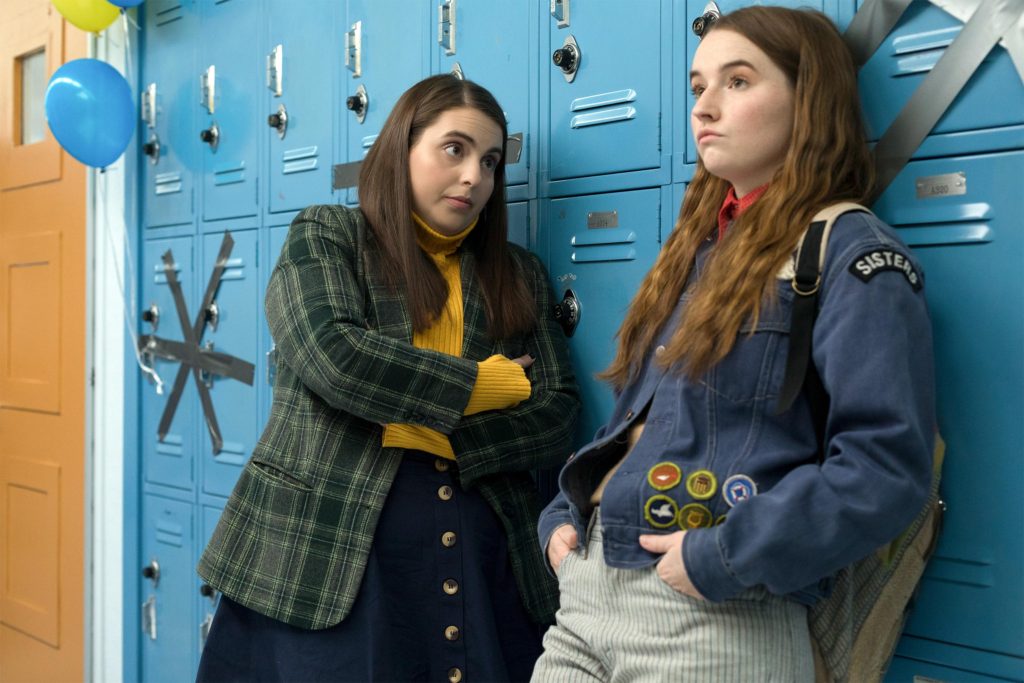
Beanie Feldstein and Kaitlyn Dever in BOOKSMART Credit: Francois Duhamel / Annapurna Pictures

In Olivia Wilde,’s wildly successful comedy Booksmart, Molly (Beanie Feldstein) and Amy (Kaitlyn Dever) play super-achieving kids who have followed every rule and refused to be distracted by high school frivolity; appalled to learn that their more conventionally fun-loving classmates have also gotten admitted to elite colleges, Molly and Amy decide to consume four years of teen fun in one night of graduation parties. This is an entirely fresh take on the coming of age film, and a high school graduation party romp like you’ve never seen.

Booksmart is the directorial debut of actress Olivia Wilde, and was written by Emily Halpern, Sarah Haskins, Susanna Fogel and Katie Silberman. The impact of the all-female creative team, to my eyes, is not in any particular scene or character, but woven throughout. These women have gotten the rare chance to make a movie, brought their talent and fresh eyes to it and knocked it out of the park.

Beanie Feldstein and Kaitlyn Dever in BOOKSMART

Kaitlyn Dever and Beanie Feldstein are special talents. Dever played one of the most compelling characters in TV’s Justified as Loretta McCready and was excellent in the Lynne Shelton drama Outside In. Feldstein sparkled as the protagonist’s high school best friend in Lady Bird. Here’s a particularly fun NYT interview with Dever and Feldstein.

Others in the relatively underseen cast – especially Diana Silvers, Molly Gordon, Billie Lourd, Austin Crute, Noah Galvin and the skateboarder Victoria Ruesga – bring interesting presences to the film. One wonders if Booksmart will become an American Graffiti/Animal House/Fast Times at Ridgemont High/The Breakfast Club phenomenon, and launch a cohort of movie careers.

Booksmart is smart, funny and a very fulfilling start to 2019’s slate of summer movies.

BURNING: hypnotically compelling

Ah-in Lee , Jong-seo Jun and Steven Yeun in BURNING

Burning is a hypnotically compelling 2 hour, 28 minute slow burn that begins as a character study, evolves into a romance and then a mystery, and finally packs a powerhouse punch with a thriller climax. It’s a superb achievement for director and co-writer Chang-dong Lee.

Jong-su  (Ah-in Lee) is a young man living an isolated, unfulfilling life when, on a shopping excursion, he encounters a childhood schoolmate, Hae-mi (Jong-seo Jun). She is as blithe and fun-loving as he is introverted and socially awkward. Sex turns Jong-su’s fascination with Hae-mi into a worshipful adoration.

She heads off to a long-planned African vacation, and returns with a new acquaintance, Ben (Steven Yeun); to Jong-su’s profound chagrin, Hae-mi and Ben, a rich playboy, have clearly become intimate.

Ben invites Jong-su to join along with Hae-mi and his other friends in a cavalcade of partying. Jong-su senses – as does the audience – that Ben is not a good guy. Jong-su, an aspiring writer, calls Ben a “Great Gatsby”. But Gatsby, while rich and impossibly cool, was also vulnerable –  hiding his past and aching for Daisy. Ben doesn’t seem to care about anything enough to be vulnerable, and there’s just something “off” about him.

Jong-su also smolders with the feeling that Ben is not good enough for Hae-mi (up there on Jong-su’s imagined pedestal). Jong-su lapses into the jealousy and obsession that a young man feels for a woman, who more beautiful that he ever could hope to woo, has granted him the grace of sexual intimacy.

Jong-su now finds Ben fascinating, too, and, when Ben casually discloses a disturbing hobby, Jong-su embarks on an investigation that leads to more mysteries and even more disturbing revelations.

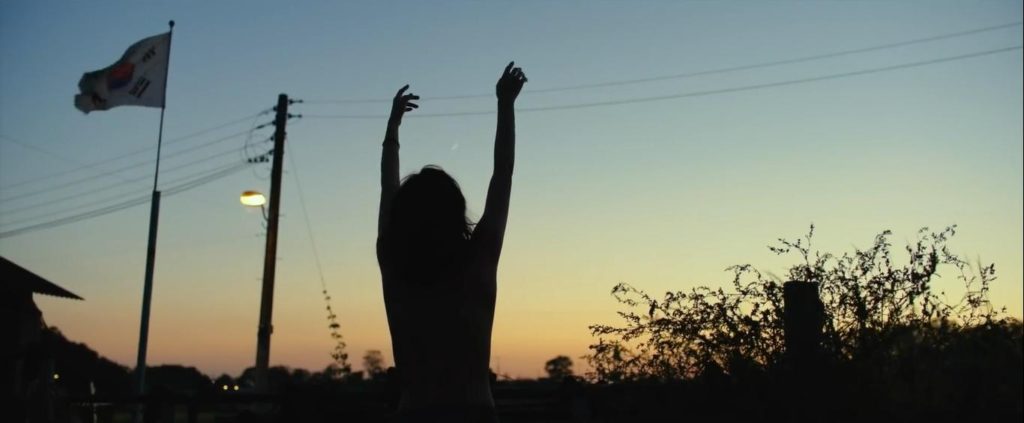
One particular scene in Burning is perfect. After the three characters smoke some pot, Hae-mi takes off her shirt and dances, alone and topless, before the men, silhouetted against a purple, blue and orange twilight sky. As Hae-mi sways in her mesmerizing dance, we glimpse a character’s brief – and disturbingly revealing – yawn! As Burning goes on, Chang-dong Lee perfectly builds the story; we become more and more uneasy until we gasp at the ending.

Jong-seo Jun in BURNING

Jong-su is trying to write his first novel. If he were going to “write what you know”, then it would be a very boring book. But by the end of Burning, he has the material for a seething, blockbuster page-turner.

This should be a star-making turn for Jong-seo Jun. Amazingly, this is her ONLY screen credit. Her tangerine-peeling pantomime is amazing. Her dance, though, is one of the most unforgettable moments in 2018 cinema. Steven Yuen and Ah-in Lee are excellent, too.

Jong-seo Jun in BURNING

What is “burning” in Burning? There is literal burning (as in arson), but the deepest burning is that of obsession. Jong-su isn’t fully alive until he is ignited by that obsession.

This film was critically praised after it won a prize at the 2018 Cannes Film Festival. I had missed Burning, which I had thought of as “the Korean ménage à trois movie“, in theaters last year, but I’ve now added it to my Best Movies of 2018. You can stream Burning now from Netflix, Amazon, iTunes and Vudu.