Ash Is Purest White is writer-director Zhangke Jia’s portrait of an unforgettable woman surviving betrayal, the crime world and the tidal waves of change in modern China, all embedded in a gangster neo-noir.
Qiao (Tao Zhao), is the tough and spirited girlfriend of the provincial jianghu gang leader Bin (Fan Liao). They are the big fish in their little pond, and they are relishing life. Then circumstances change – great and unperceived economic forces are enervating their hometown and a younger rival gang emerges. Qiao takes a heroic action with severe consequnces. When she re-emerges, she finds herself personally betrayed and unsupported. The seventeen-year span of Ash Is Purest White follows Qiao as she roams across China to rebuild her life. She is at times devastated but refuses to accept permanent defeat.
Tao Zhao in ASH IS PUREST WHITE
Tao Zhao is Jia’s wife and muse. Ash Is Purest White is a sweeping epic, and it is her movie. Her performance is a tour de force. Watch her portray Qiao’s confidence in the opening scenes, her resourcefulness and ingenious cons when she is dumped out on her own and the resolve that powers her quest. Fan Liao is also excellent as Bin.
As Qiao’s journey spans almost two decades and thousands of miles, we get insights into contemporary China. Jia’s China is a place where, when the coal industry plays out in one city, the government builds a new city for hundreds of thousands of people to movie into the oil industry. Economic forces sweep across China like flash floods that inundate and sudenly recede. Qiao rides these changes like a fishing bobber on the surface of a tsunami.
Tao Zhao in ASH IS PUREST WHITE
We are familiar with movies about the Mafia and yakuza, but Ash Is Purest White is a glimpse into jianghu – their Chinese equivalent.
Ash is Purest White is on my list of Best Movies of 2019, and it’s streaming on Amazon, iTunes, Vudu, YouTube and Google Play.
I know that I’m late to the party with these comments, especially since I saw The Irishmanat its first Silicon Valley screening. Since then, I’ve been ruminating on why it’s so good.
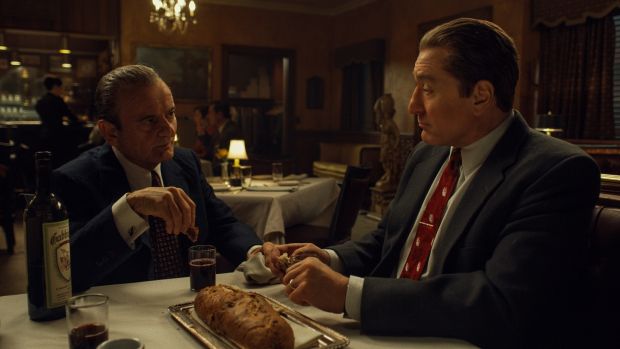
The titular Irishman is Frank Sheeran (Robert De Niro), a WW II vet, who starts out as a truck driver who diverts his meat deliveries to his own “buyers”. He meets Mafia leader Russell Bufalino (Joe Pesci), who mentors him, and Sheeran becomes a professional hit man. Through Bufalino, Sheeran also becomes close to Teamster leader Jimmy Hoffa (Al Pacino). Like Hoffa, Sheeran and Bufalino were real people. Scorsese takes Sheeran’s life through the decades in this gangland saga.
The Irishman is based on real events. Even the Frank Sheeran appreciation banquet with Jimmy Hoffa and Jerry Vale really happened. Of course, Scorsese ‘s solution to the What Happened to Jimmy Hoffa mystery is imagined, but it does conform to one of the more credible hypotheses.
Besides Bufalino and Sheeran, the characters of real life gangsters Tony Pro Provenzano, Fat Tony Salerno, Angelo Bruno and Crazy Joe Gallo figure in The Irishman’s plot, and we also glimpse Allen Dorfman, Tony Jack Giacalone, Joe Colombo, Sam Giancana and Albert Anastasia.
There is plenty of familiar mob lore – I particularly love the reference to a nickname, “the OTHER Whispers“. But this is a less glamorized Mafia than is usual for a gangster flick – the violence is decidedly unheroic. The toxic impact upon family members is unvarnished.
The Irishman is also a comment on the decline of the Mob. By the end, for all the omerta, we’ve reached a world where these guys (except for Frank Sheeran) routinely rat each other out. When we see the aged Sheeran in the retirement facility, we understand that his storied criminal career hadn’t gotten him any more creature comfort than if he had retired with the Teamster’s pension of an honest trucker. – and he might have instead had the support of an affectionate family.
DeNiro is excellent in The Irishman, as are all the cast members. I really enjoyed Steven “Little Steven” Van Zandt in his cameo as crooner Jerry Vale. British actor Stephen Graham has gotten a lot of plaudits for his as Tony Pro. Four other performances stand out for me.
Joe Pesci has made his acting career playing hair-trigger, tinderbox gangsters. In contrast, his Russell Bufalino is completely contained and ever in control. At one point, Hoffa refuses his request, and Bufalino does not explode or threaten; Pesci’s eyes barely register that Bufalino has made n irreparable decision.
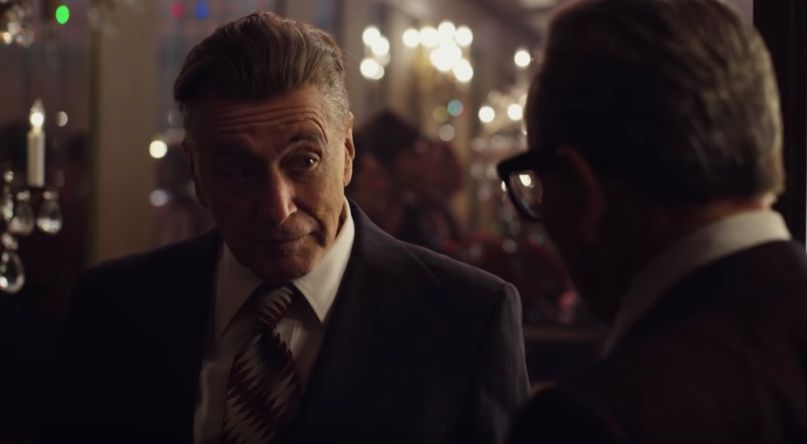
Al Pacino, of course can play chilly (Michael Corleone in The Godfather or volatile (in Dog Day Afternoon and thirty other roles). Here, he perfectly captures Hoffa’s strong will, audacity and smarts (the key to his success) and his hotheadedness (his Achilles heel). This is one of Pacino’s many Oscar nomination-worthy performances.
Anna Paquin and Marin Ireland play the grown-up versions of Sheeran’s daughters. Sheeran’s murderous life has impacted them in ways that he will never understand. As adults, the daughters are no longer afraid of their father and become estranged from him. Paquin shows us her character’s feelings with very few lines. In one brief but riveting monologue, Ireland tries to connects the dot explicitly.
Al Pacino in THE IRISHMAN
Hoffa is an especially interesting character who really hasn’t been captured onscreen as well as he is here. Hoffa was a strategic genius who recognized that putting every Teamster workplace under a single, unified national contract would give the union unmatched bargaining power – from the capacity to essentially shut down all of the shipping and transportation in North America. To accomplish that, he needed the Teamster locals on the coasts to temporarily stagnate their higher pay until the lower-paid locals in the middle of the country could catch up. Because the East Coast locals were mobbed up, he needed – and sought – the cooperation of the Mafia. So, his dalliance with the mob was strategic, aimed at getting him power for his members, not to personally enrich himself as would the garden-variety crook.
Netflix’s investment allowed Scorsese to use a computer special effect to alter the appearances of DeNiro (age 76), Pacino (79) and Pesci (76) so they could play flashback scenes of their characters thirty years before. I knew this technique was used before I saw The Irishman, but I didn’t notice it.
The Irishman is a three-and-a-half hour movie. As The Wife noted, that is indulgent. But it doesn’t drag, and I enjoyed every minute of Scorsese’s masterwork. I saw it in a theater, but The Irishman is streaming on Netflix.
Here’s a bonus treat: Jason Gorber dissects the soundtrack in The Slash.
63 Up is the latest chapter in the greatest documentary series in cinema history (and on my list of Greatest Movies of All Time). Starting with Seven Up! in 1964, director Michael Apted has followed the same fourteen British children, filming snapshots of their lives at ages 7, 14, 21, 28, 35, 42, 49. and 56 – and now at age 63. Choosing kids from different backgrounds, the series started as a critique of the British class system, but has since evolved into a broader exploration of what factors can lead to success and happiness at different stages of human life. (Apted was the hands-on researcher, not the director on Seven Up! and then directed the next nine films in the series.)
We have seen these characters live roller coaster lives. The surprise in 56 Up was how contented they seemed to be, having independently reached a stage in their lives where they live with acceptance and satisfaction; the subjects had already weathered their broken marriages and other dramas and seemed to have settled into themselves. The same is true of 63 Up, but there is more reflection in light of mortality. There’s a death and a life-threatening illness, but all the characters understand that they’re longer at the beginning of their lives.
Because Apted includes clips from earlier films to set the stage for each character, you don’t need to watch all nine movies. Because there is so little conflict in 63 Up, it would be ideal to first screen an edgier film like 35 Up or 42: Forty Two Up. The earlier films are difficult, perhaps impossible, to find streaming, but the entire series (Seven Up!, Seven Plus Seven, 21 Up, 28 Up, 35 Up, 42 Up, 49 Up, 56 Up) is available on Netflix DVDs. 56 Up is streamable on Amazon, iTunes, Vudu, YouTube, Google Play and Kanopy.
The theme of the series at the outset was “Give me a boy of seven and I will give you the man“. This time, Apted asks this question directly of the subjects, with varying results.
As usual, the voluble Tony and the utterly unpredictable Neil are the stars, but I got more out of the stories of Symon and Paul than I had ever before. The biggest surprise for me was the earnest do-gooder teacher Bruce, who I hadn’t ever envisaged as a jovial family patriarch.
63 UP
Michael Apted is a big time director (Coal Miner’s Daughter, Gorillas in the Mist). It is remarkable that he has returned so faithfully to his subjects in the Up series.
I saw 63 Up at the Mill Valley Film Festival, with Apted in attendance. Apted is now 78, and hopes to direct 70 Up if he still has mental acuity. Apted acknowledges that his biggest mistake was not including enough girls at the outset (four girls out of fourteen kids); he’s tried to address it by expanding the roles of several of the male subjects’ female partners.
The Up series is significant and unique cinema – see 63 Up if you can.
On December 23, Turner Classic Movies brings us that Holiday classic, A Christmas Carol, and I’m talking about the 1951 version with Alastair Sim. Since the 1908 Tom Ricketts silent version, this Charles Dickens story has been made over 60 times for the screen. Scrooge has been played by George C Scott, Bill Murray, Rich Little, Cecily Tyson, Patrick Stewart, Jim Carrey and Kelsey Grammer. (But NOT, to my knowledge, by Nicolas Cage, Christopher Walken, Toshiro Mifune or Zac Efron.)
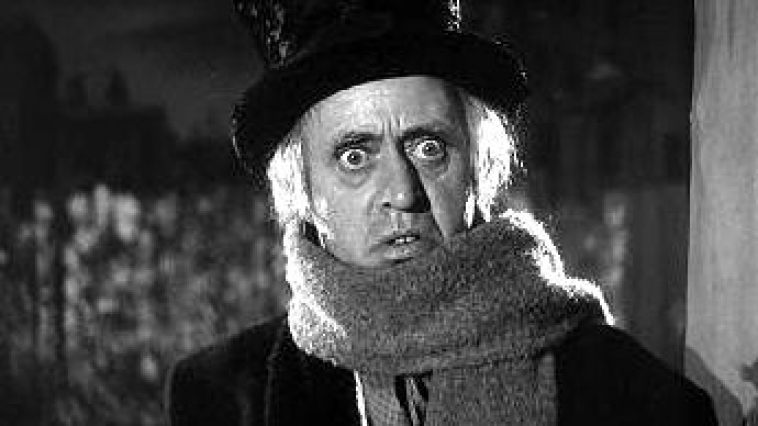
Alastair Sim’s performance as Scrooge elevates this 1951 version; Sim perfectly modulates Scrooge’s transformation from impervious meanness to vulnerability. A Christmas Carol was, by far, the highlight of Sim’s screen credits; he was primarily a stage actor, who appeared in 46 West End productions. It’s a simple but compelling story, and everyone can relate to the curmudgeon Ebenezer Scrooge, his touching backstory and his joyous redemption.
Writer-director Rian Johnson explodes the genre of the drawing room murder mystery in the gloriously entertaining Knives Out.
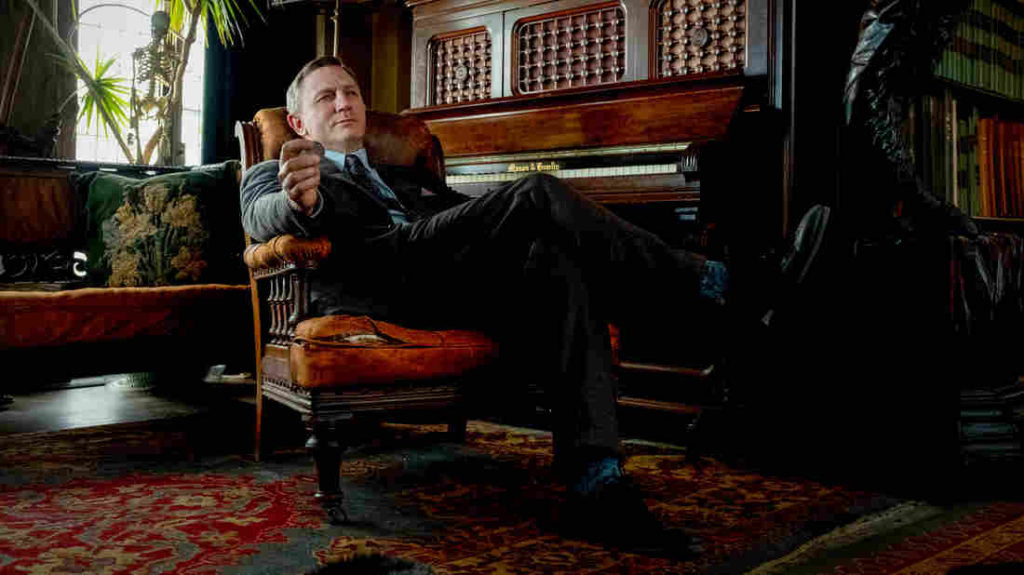
Knives Out opens at the country estate of a multi-millionaire author (Chistopher Plummer), where he is found dead. If he was murdered, it had to be at the hands of his sweet caregiver Marta (Ana de Armas) or a member of his icky family of ingrates (Jamie Lee Curtis, Don Johnson, Michael Shannon, Toni Collette, Chris Evans). A Hercule Poirot-type consulting detective (Daniel Craig with a Southern accent) arrives to investigate, and the game is afoot.
I’ve met plenty of folks like the author’s family, who were born on third base and thought they hit a triple. That’s what Knives Out is really about – a wickedly funny send-up of totally unjustified entitlement. One of the running jokes is that they claim that Marta is “one of the family”, but none can remember which Latin American country she’s from.
Despite Daniel Craig’s turn as the famed detective, this is really Ana de Armas’ movie, and she is superb. All of the cast are excellent, but everyone except de Armas and Plummer play very broad characters. BTW De Armas plays Paloma, the Bond Girl, to Craig’s James Bond in No Time to Die (coming in April 2020).
Ana de Armas in KNIVES OUT
I recently wrote about Rian Johnson’s 2005 breakthrough Brick, which inhabited the form of another familiar movie genre – film noir. In Nate Jones’ interview in Vulture, Johnson says “One thing I don’t believe in is the notion that this is a dusty old genre and you have to find a way to flip the old tropes on their heads. The basic machinery of it, the tropes of it, are why it works.”
Johnson slyly (and without comment) inserts a shot of Marta’s mom watching a rerun of Angela Lansbury in a Murder, She Wrote, dubbed in Spanish. And the great M. Emmet Walsh has a cameo as the aged security guy who proudly explains the VHS-based security camera system.
Knives Out works as a darkly funny murder mystery and as a pointed social satire. It’s one of the year’s smartest and funniest films.
Noah Baumbach’s family dramedy Marriage Story,
one of the very best films of 2019, traces two good people who care for each
other at the end of their marriage. It’s
a heartfelt film about a personal tragedy that has some of the funniest moments
on screen this year.
Charlie (Adam Driver) is a theater director and Nicole
(Scarlett Johannson) is an actress.
They are married with an eight-year-old son Henry. Nicole’s career is taking her to California,
while Charlie’s is anchored to his beloved New York. Adults might be able to manage a bicoastal
relationship, but the kid needs to have his school and his friends in one place
or the other.
The two try to complete an amicable divorce, but their disagreement over the kid’s primary home unintentionally plunges them into a litigation nightmare, with a cascade of stress added by the lawyers and the courts. It’s been written elsewhere, but I need to add that Nicole and Charlie are horrified by a system that is working as designed. There’s a wonderful shot of Charlie and Nicole sitting apart on an near-empty subway car, exhausted, bereft and unable to support each other.
In a masterstroke, Baumbach introduces his lead
characters with each spouse’s assessment of what is so lovable about the
other. Then we sober up when we learn
what prompted the essays.
We relate to both Charlie and Nicole, and Driver and Johansson perfectly inhabit these good folks, slipping into a deeper nightmare with each step in the process. Near the end, the two have the raw argument that they had each been too nice to have before.
I think that the reason Marriage Story works is
that Johansson and Driver can go through their characters’ pain with complete
authenticity while amidst all the funny supporting characters.
Laura Dern and Ray Liotta play top echelon Divorce
Lawyers to the Stars. Alan Alda plays a sage older attorney who has lost
something off his fastball. Dern’s
riotously funny performance is a lock for an Oscar nomination for Best
Supporting Actress. Dern, Liotta, Alda,
Julie Haggerty, Merritt Wever and Wallace Shawn are each hilarious. Azhy Robertson (Juliet, Naked) is very
good as the kid.
At one point, the court appoints a child evaluator to visit Charlie and judge his relationship with his child. Having any stranger parachute into your home, with your parenting rights at stake, would be stressful. Martha Kelly is superb as an especially humorless evaluator, an oddball impervious to Charlie’s charms and oblivious to any of his positive attributes. As things start going wrong, Charlie gets more and more desperate and the scene gets funnier.
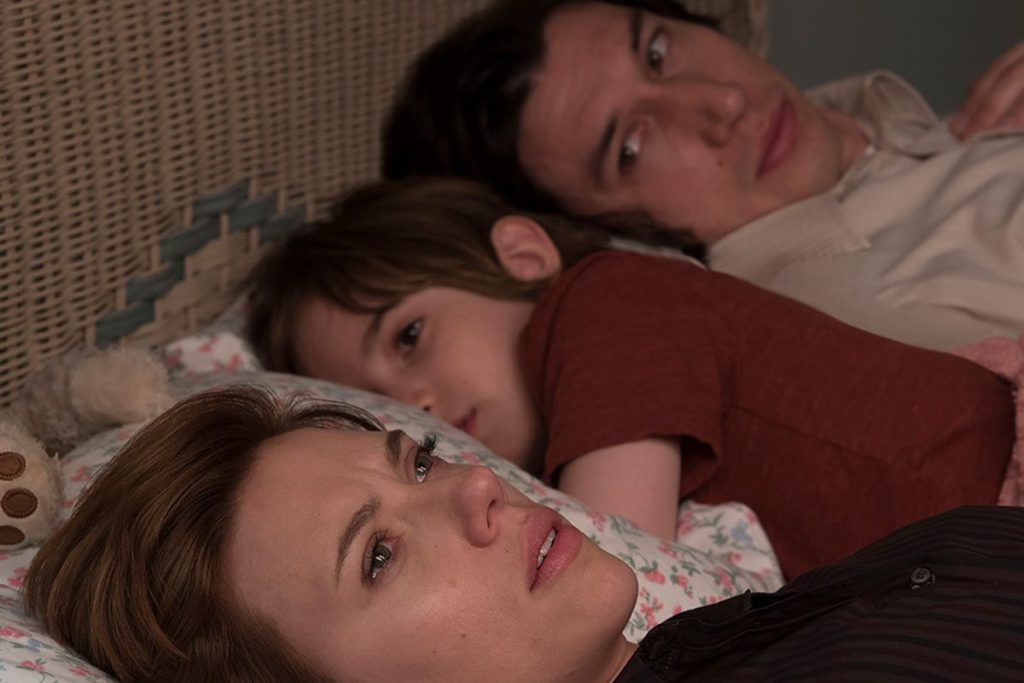
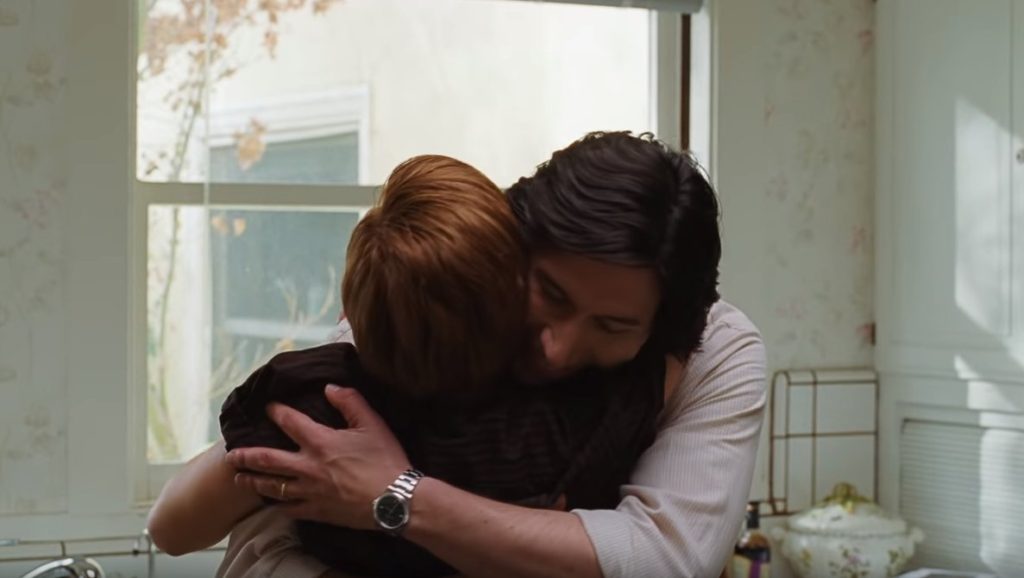
Scarlett Johannson and Adam Driver in MARRIAGE STORY
Director Noah Baumbach’s screenplay is informed by the end of his own marriage to actress Jennifer Jason Leigh. He acknowledges “a connection to the material”, but that it’s not only about his divorce. He is generous enough to write the character of Charlie with self-absorbed cluelessness about his impact to Nicole’s career aspirations.
I liked Baumbach’s first movie The Squid and the Whale, about his own parents’ divorce. But my reaction to all his subsequent work until now has ranged from to indifference to antipathy; “detest” is the adjective that springs to mind. Despite my bias, I gotta admit that Marriage Story is so, so good that it solidifies Baumbach’s place as an American auteur. Baumbach should head into awards season as the favorite for the screenplay Oscar.
A superb screenplay, superbly acted, Marriage Story balances tragedy and comedy with uncommon success. It’s a masterpiece, and among the very best cinema of 2019. It’s a Must See. I saw Marriage Story in early October at the Mill Valley Film Festival. You can find it theaters now, and it will stream on Netflix beginning on Friday, December 6.
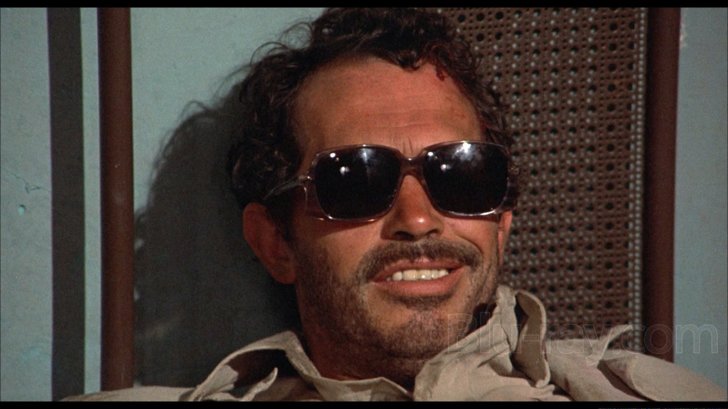
Warren Oates in BRING ME THE HEAD OF ALFREDO GARCIA
One of my favorite actors is Warren Oates, whose crowning achievement, Bring Me the Head of Alfredo Garcia, plays on TCM on December 6. This is a Sam Peckinpah film, one of those 1970s neo-noirs that was perfect for Oates. Oates plays a hard scrabble grasper, and you just know things are not going to go well for him.
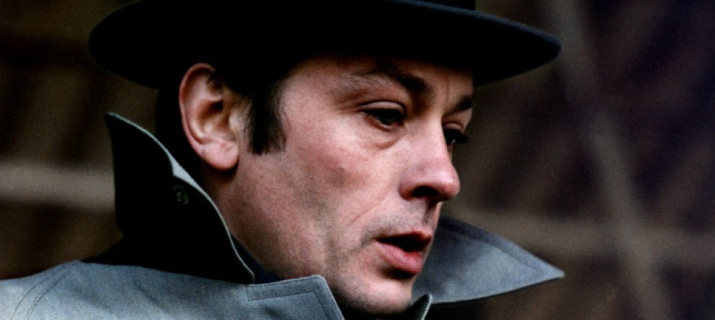
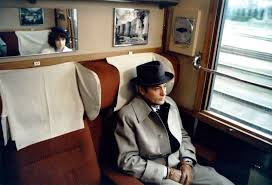
Here’s a chance to see a brilliant movie almost nobody has seen in 43 years. The Roxie and BAMPFA are screening Joseph Losey’s slowburn thriller Mr. Klein, a searing critique of French collaboration with the Nazis. Mr. Klein stars Alain Delon as a predator trapped by his own obsession.
To make sure we understand the stakes, Mr. Klein opens with a sobering pseudo-medical exam, absurdly intended to determine if a woman is Jewish; the waiting room overflows with others awaiting the humiliating and terrifying “examination”.
Only then do we meet Robert Klein (Delon) in his splendid silk dressing gown, living in an opulent Paris apartment with his randy mistress. Klein is a bottom feeder who profits from the desperation of Jewish art collectors; when they flee France to escape the Nazis, Klein unapologetically buys their art at rock bottom prices.
Then Klein gets a Jewish newspaper delivered to his door. He is Alsatian and his name is Klein, but some Jews are named Klein. There is another Robert Klein – a Jewish Klein. What is the extent of the mistaken identity? Is it inadvertent, or is someone trying to paint Klein as Jewish? Who is this other Robert Klein, and is he masterminding a frame job? Klein hits the streets in his trench coat and fedora, trying to solve the mystery himself.
Klein’s journey becomes surreal and then Kafkaesque, as what he thinks is a whodunit is interspersed with clips of the ever more riuhkess French police hunting down Jews. Klein, at first only vaguely understanding that he, too, is at risk, is racing against the clock.
The improbably handsome Alain Delon has eyes that can switch off any glimmer of empathy – perfect for playing sociopaths. The best analysis of Delon’s gift is Sheila O’Malley‘s.
Mr. Klein showcases Delon at 41, after his iconic run of Jean-Pierre Melville crime classics: Le Samourai, Le Cercle Rouge and Un Flic. Seven years earlier, he had been able to play the young guy matched with Jean Gabin and Lino Ventura in The Sicilian Clan. Now, even with his still dazzling looks, Delon has the weight of a life lived into his forties.
Mr. Klein also features a slate of French actresses: the great Jeanne Moreau, Francine Bergé, Juliet Berto and Francine Racette. Michael Lonsdale, so good in The Day of the Jackal three years before, is also excellent here (and has his own luxurious dressing gown).
Joseph Losey and his regular cinematographer Gerry Fisher keep both Robert Klein and the audience off-balance, bouncing between Klein’s richly-colored apartment, his surreal dreamlike visit to a country estate, the noirishly mysterious haunts of the other Klein and a starkly realistic depiction of France’s most unpleasant history. Losey ironically inserts an Alsatian dog. It all culminates in Klein’s one final miscalculation.
Losey’s 1947 directorial debut was the political parable The Boy with the Green Hair. In 1951, he remade M with an inventive basement-to-roof exploration of Los Angeles’ storied Bradbury Building. Later that year, he turned the usually sympathetic good guy Van Heflin into the twisted bad guy in The Prowler. After being named at HUAC, he was blacklisted and, in 1953, successfully set up shop in Europe. His The Go-Between won the Palm d’Or at Cannes, and he made four of Dirk Bogarde’s most notable movies in the late 1950s and 1960s. He was 67 when he directed Mr. Klein.
Mr. Klein depicts the historical Vel’ d’Hiv roundup, when French police swept up over 11,000 Jews on the same day, July 16, 1942, and detained them in a stadium, the Velodrome d’Hiver; they were then transported to Auschwitz to be murdered.
French audiences in 1976 did not want to be reminded that collaboration was a mainstream phenomenon. Mr. Klein depicts French police enthusiastically hunting down Jews, theater patrons laughing heartily at a grotesquely anti-Semitic farce, and regular Parisians nonchalantly lining up for bread at the boulangerie indifferent to Jews being bused off to concentration camps.
Mr. Klein was nominated for seven Césars (the French equivalents of Oscars) and won best film and best director. Until this reissue by Rialto Pictures, Mr. Klein has essentially been a lost film. It is not currently available on the major streaming platforms, nor can it be found on DVD, except for some bootlegs from Asia.
Mr. Klein will play at BAMPFA in Berkeley on December 4, 14 & 18 and at San Francisco’s Roxie December 6-12.
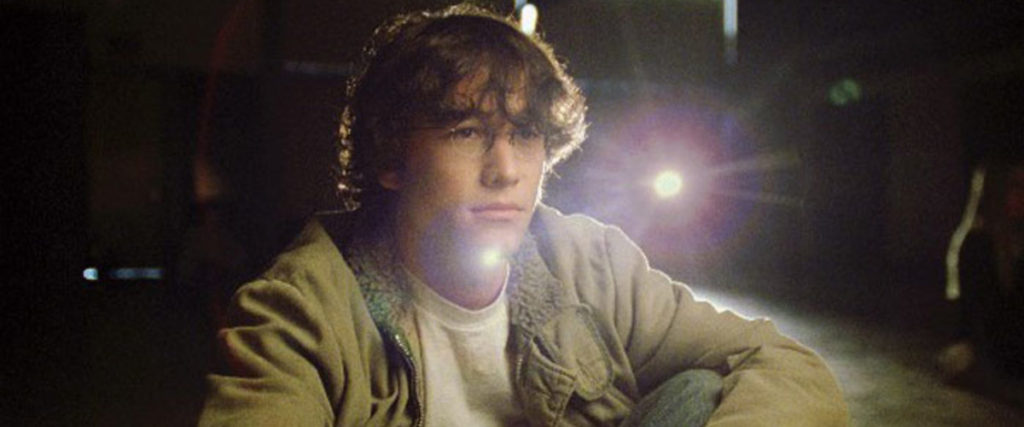
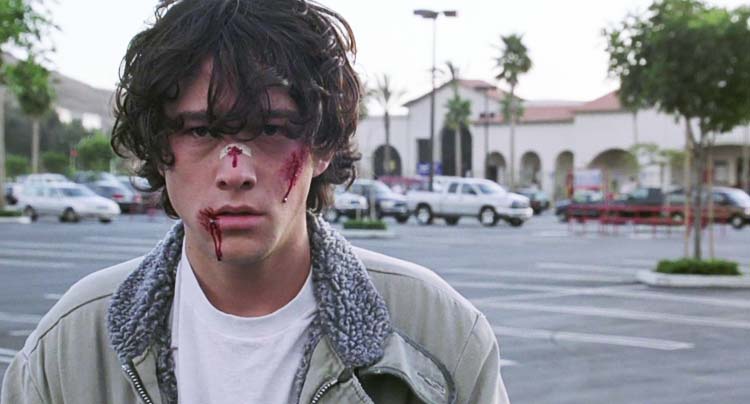
Writer-director Rian Johnson’s gloriously inventive 2005 debut, Brick, was inspired by Johnson’s love of Dashiell Hammett’s novels and his own dark memories of high school.
Brick is a hard-boiled detective story, complete with a femme fatale and a plot right out of a Dick Powell classic noir like Murder, My Sweet or Cry Danger.
The genius of Brick is that it takes place in the teenage culture of 2005 San Clemente. The characters roam the isolated school corridors where the nerd eats lunch by himself, the drama room, the vice-principal’s office, the empty football field where kids can meet after school the party at the popular girl’s house. The kingpin crime lord operates out of his mother’s basement; he and his gang emerge upstairs in the kitchen where his mom supplies breakfast cereal and dispenses milk from a pitcher shaped like a chicken.
The dialogue is Hammettesque:
I gave you Jerr to see him eaten, not to see you fed.
The ape blows or I clam.
Bulls would gum it. They’d flash their dusty standards at the wide-eyes and probably find some yegg to pin, probably even the right one. No cops, not for a bit
Brad was a sap. You weren’t. You were with him, and so you were playing him. So you’re a player. With you behind me I’d have to tie one eye up watching both your hands, and I can’t spare it.
The noir patter works because Johnson and the cast play it dead seriously, with no hint of irony.
In Nate Jones’ interview in Vulture, Johnson says “One thing I don’t believe in is the notion that this is a dusty old genre and you have to find a way to flip the old tropes on their heads. The basic machinery of it, the tropes of it, are why it works.”
Brick was at that point in Joseph Gordon-Levitt’s career, between Mysterious Skin (2004) and Lookout (2007), when it was becoming clear what a major talent he is.
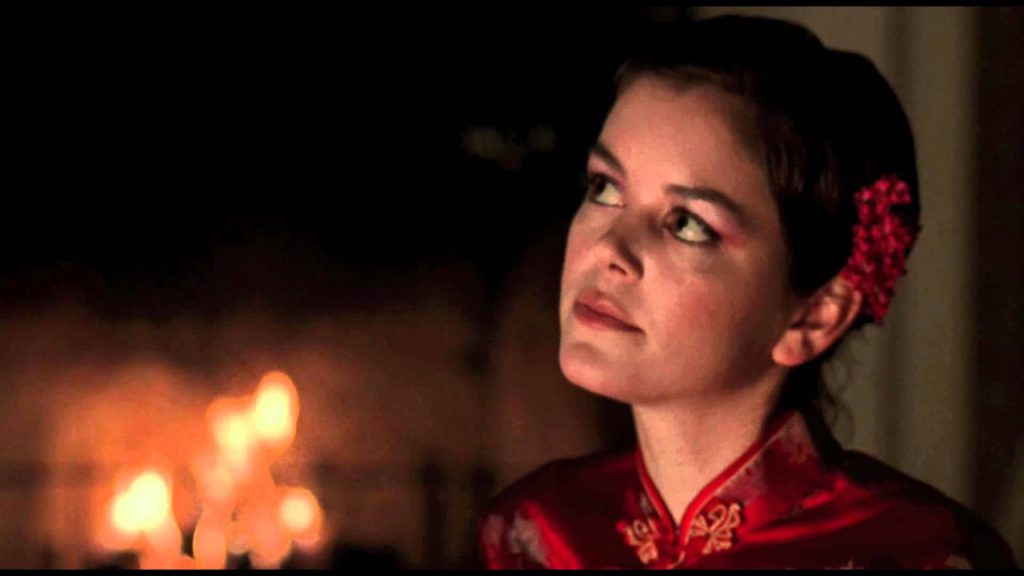
Norah Zehetner in BRICK
The femme fatale is played by Norah Zehetner in an unforgettable performance. Zehetner works a lot, and did ten episodes of Grey’s Anatomy, but Brick may be her career-topper.
Rian Johnson went on to make another original feature with Gordon-Levitt, Looper, along with the 2017 Star Wars movie. Knives Out, Johnson’s new take on the drawing room mystery, hits theaters this weekend.
Brick is available to stream on Netflix, AYouTube and Google Play.
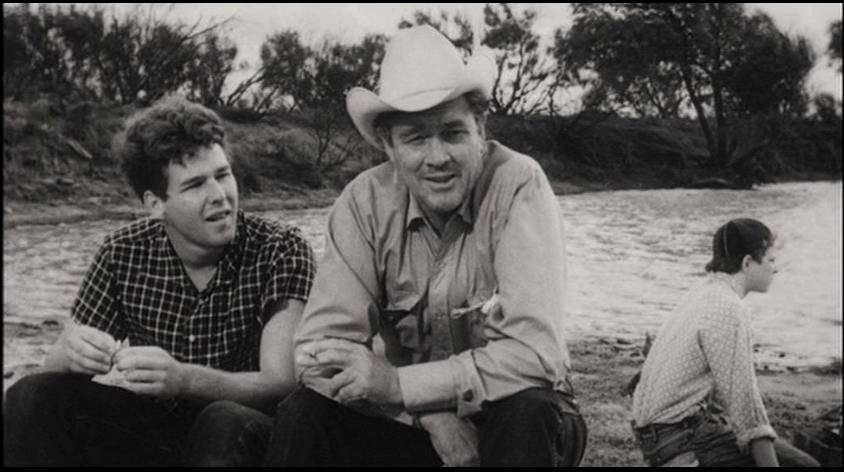
Timothy Bottoms, Ben Johnson and Sam Bottoms in THE LAST PICTURE SHOW
On November 20, Turner Classic Movies is airing Peter Bogdanovich’s 1971 masterpiece The Last Picture Show. It’s a movie about kids that is best appreciated by grown-ups, especially grown-ups with some mileage on them.
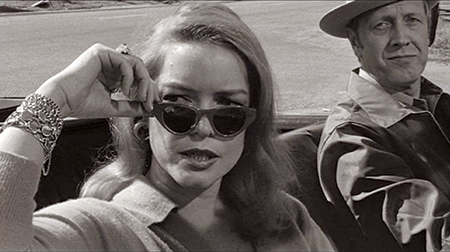
The Last Picture Show is the story of 18-year-olds in a tiny, windblown Texas town in the early 1950s, from Larry McMurtry’s novel about his own upbringing in Archer City, Texas. It’s a coming of age film about teens finishing high school: the sensitive Sonny (Timothy Bottoms), his macho best friend Duane (Jeff Bridges) and pretty, snotty Jacy (Cybill Shepherd), entitled by her looks and her family’s wealth. There’s also a sweet, intellectually disabled boy Billy (Sam Bottoms). The boys’ male role model is Sam the Lion (Ben Johnson in an Oscar-winning performance), an older bachelor cowpoke who owns the town’s cafe, movie theater and pool hall.
The film was actually shot in Archer City, which took the movie name of a Texas ghost town, Anarene. (Decades later, Archer City also showed up in a bank robbery in 2016’s Hell and High Water.)
Cybill Shepherd in THE LAST PICTURE SHOW
18-year-olds wonder how they will navigate the world of adults that they are about to enter. It turns out that, for the kids in the movie, if only they paid attention, there’s plenty to lean about life from the adults in Anarene. The other thing that 18-year-olds obsess about is their sexuality, super-fueled by hormones but piloted by immature brains.
It’s a remarkable thing to watch a coming of age story about 18-year-olds when you are 18 and then again forty years later when you know stuff.
When I saw The Last Picture Show at San Jose’s domed Century Theaters in 1971, I was the same age as the main characters, and I was especially interested in their sexual escapades. I was, however, discerning enough to appreciate that this was a great movie, and I fully experienced the heartbreak of the Cloris Leachman character and grasped that Sam the Lion’s authority came from his decency and dignity.
Peter Bogdanovich with Jesse Hawthorne Ficks at the Roxie
In September, I was privileged to attend one of the year’s most stirring experiences of Bay Area cinema culture. The Roxie Theater screened the The Last Picture Show – with the legendary Bogdanovich himself in attendance for two Q&A sessions, plus a screening of his hard-to-find Saint Jack (1979).
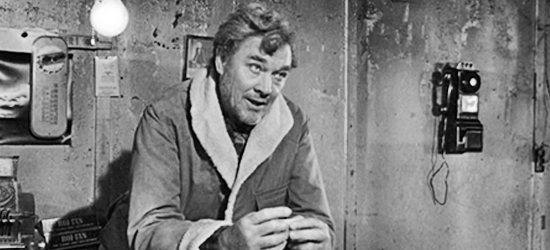
Ben Johnson in THE LAST PICTURE SHOW
Rewatching The Last Picture Show, I was especially struck by the subtle yet emotionally powerful performances by Ben Johnson, Clu Gulager and Ellen Burstyn
The plot is about the kids, but Ben Johnson’s character is the center of the film. Johnson underplays the part, and Bogdanovich says that Johnson didn’t even like to say lines at all. But Johnson nailed two unforgettable speeches. In the first, his eyes flash as he spits out his disgust at bullying. In the other, he recalls a love affair; as a clueless kid the first time around, I failed to connect the dots as who the woman was. Ben Johnson’s Oscar acceptance speech (you can find it on YouTube) is still my all-time favorite.
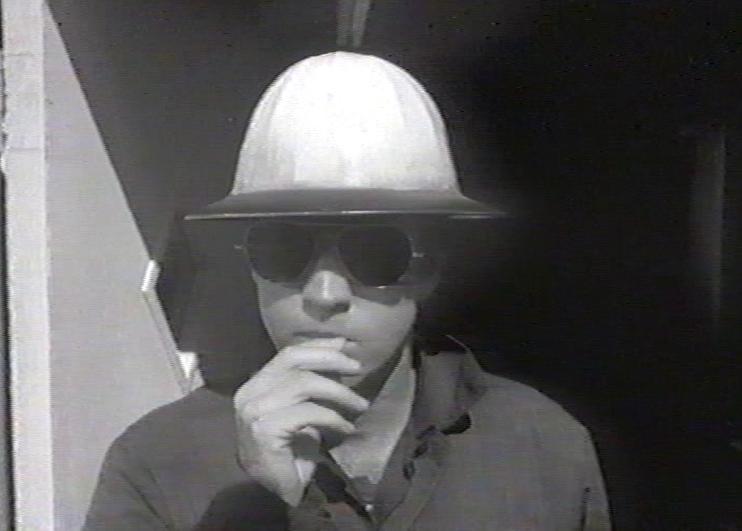
Clu Gulager in THE LAST PICTURE SHOW
Clu Gulager plays an oil rig foreman who is the illicit squeeze of his boss’ wife (Burstyn) . Gulager did scores of TV Westerns in the 1960s, including 105 appearances as the sheriff on The Virginian. The Last Picture Show is probably his best-ever screen performance. The Director’s Cut also adds some sizzle to his sex scene with Jacy in the pool hall. This guy is trapped in a job he will never improve upon and an affair he will never control; Gulager perfectly conveys his bitter dissatisfaction.
Unlike Gulager, Burstyn was already a prestige actress. Here, she brings both searing and withering looks at the men and wise and comforting, if cynical, advice to her daughter.
This is a great film, and it’s just as timeless today as it was in 1971.