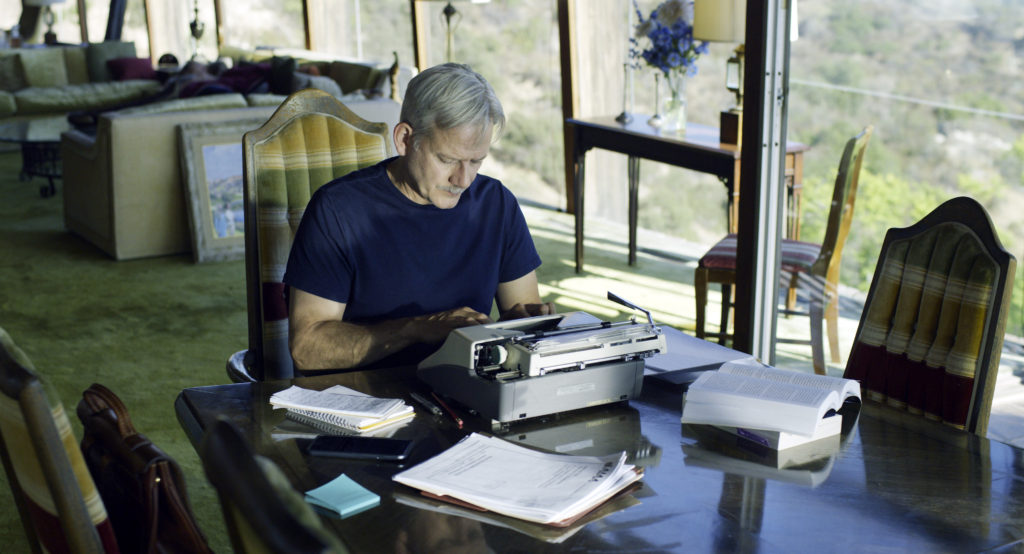
THE 11TH GREEN: a thinking person’s conspiracy

Campbell Scott in THE 11TH GREEN

Writer-director Christopher Munch notes that it’s difficult to have a serious discussion of extra-terrestrial visitors to Earth; he notes that talk of UFOs brings giggles and that “gatekeepers in the media” avoid the subject, fearing that they won’t seem smart anymore. That’s the territory he plumbs in The 11th Green. There are no lovable ETs or terrifying space monsters or flying saucers in The 11th Green, just a life-and-death conspiracy of secrets.

Suppose there is intelligent life elsewhere in the universe. Now it’s not much of a leap that such intelligent life would have visited Earth. If THAT has happened, then maybe humans have noticed the visitors – or maybe even humans have been contacted by the visitors.

The 11th Green starts with the premise that extraterrestrials visited and made contact in the 1950s, but the leadership of that American generation, having experienced Orson Welles’ War of the Worlds, has suppressed the news until the public can be prepared not to panic. The conspiracy of secrecy has survived to this day.

Our protagonist, Jeremy Rudd (Campbell Scott), is a DC-based science journalist. He has been estranged from his father, an Air Force General retired from the national security elite. When his father dies, Jeremy travels to his father’s home in Palm Desert, California, to handle the estate. There, he goes through his father’s stuff and meets his father’s peers, including a fascist general, an oleaginous spook and his dad’s nubile assistant.

As Jeremy unpeels the onion of his father’s career, he uncovers the story of the Millennium. And here’s where Munch launches his trademark Magical Realism. Weird shit starts happening – but all with its own internally consistent logic.

Ike and Mamie Eisenhower show up as characters in The 11th Green, along with a retired President Barack Obama and post-war Defense Secretary James Forrestal. (Jeremy’s father had been living in the former winter retirement home of President Eisenhower on the 11th green). You need to suspend disbelief here – do it.

I loved Christopher Munch’s previous film, Letters from the Big Man, a work of uncommon beauty. Munch’s magical realism worked there because he presented it absolutely straight, as if having a lovelorn Sasquatch in the forest setting was as normal as a squirrel. Sadly, Letters from the Big Man is currently difficult to find.

The cerebral and reserved Campbell Scott is perfectly cast as the offbeat, but always contained, brainiac Jeremy. Religiously scientific, Jeremy always follows the data, even when the data takes him to what others would find unbelievable. More than a little OCD, he makes the emergency trip from DC to Palm Desert – on a train!

I am resistant to science fiction generally, But I went with the story, and found The 11th Green to be absorbing and satisfying – and another completely original work from Christopher Munch. You can buy a virtual ticket for The 11th Green – and support the Roxie Theater – at Theatrical-At-Home.
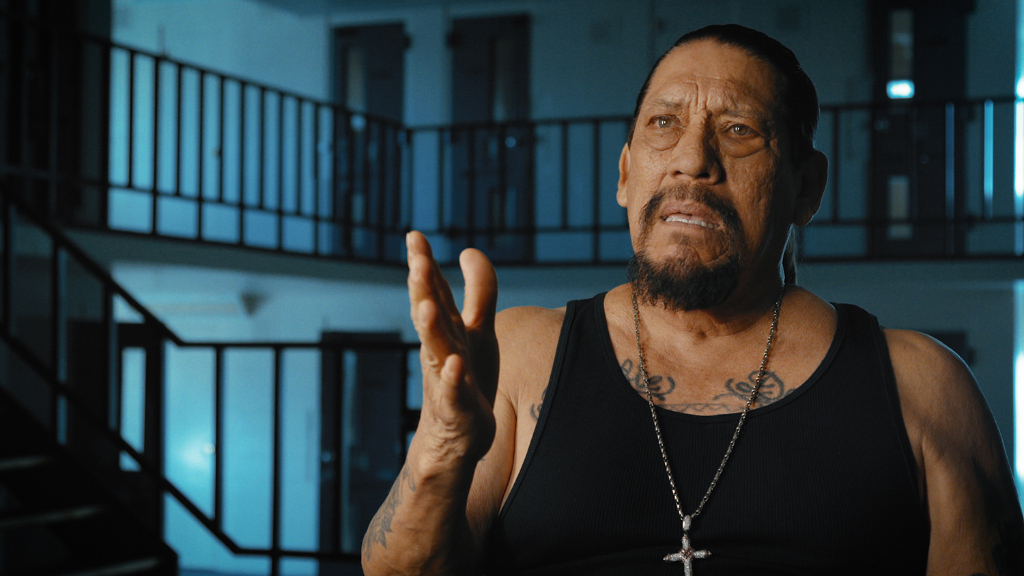
INMATE #1: THE RISE OF DANNY TREJO – redemption never gets old

Danny Trejo in INMATE #1: THE RISE OF DANNY TREJO

Inmate #1: The Rise of Danny Trejo is a satisfying documentary on an extraordinarily redemptive life. A vicious criminal addicted to heroin like his gangster uncle, Danny Trejo got one lucky break in San Quentin and used the opportunity to go into recovery. Working as a drug counselor, he happened on to a movie set, and, what do you know, Danny’s got over 300 screen credits and 50 years of recovery,

There’s plenty of Danny and his friends and family in Inmate #1: The Rise of Danny Trejo, and there’s remarkable detail about his journey from the tough streets of Pacoima to, well, to Pacoima. Emphasizing an essential point of 12-step programs, Danny points out that every good thing that has happened to him has come when he has been in service to others.

Yeah, this is a feel-good story, but I didn’t find it corny. We really can’t have too much redemption these days.

Inmate #1: The Rise of Danny Trejo can be streamed from Amazon, Vudu, TouTube and Google Play.

JOHN LEWIS: GOOD TROUBLE – an icon continues

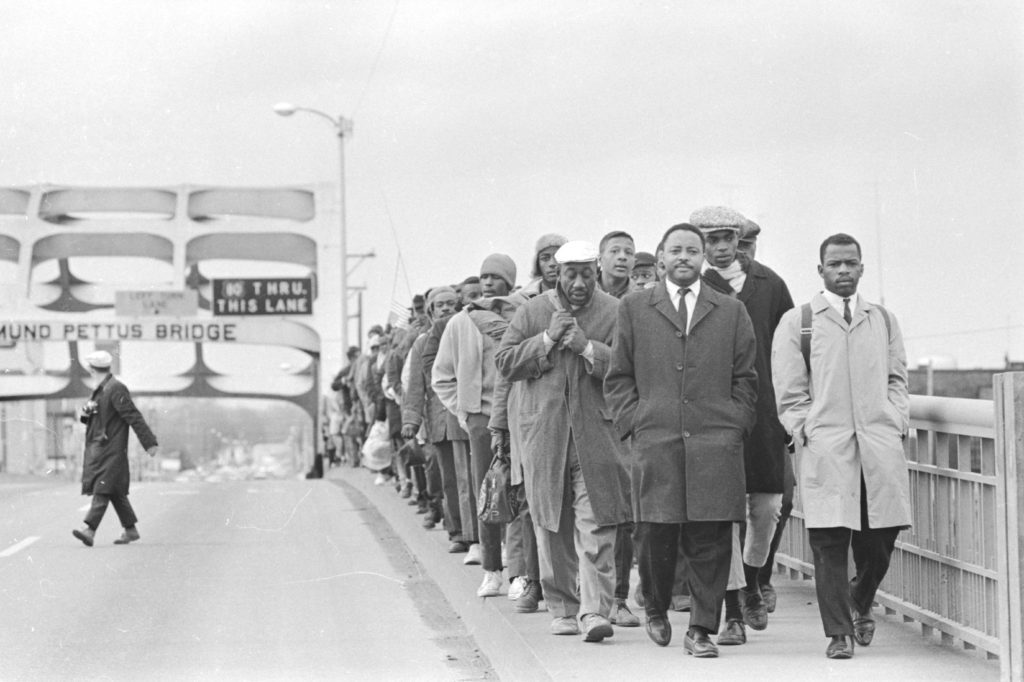
John Lewis (on far right) in JOHN LEWIS: GOOD TROUBLE. Courtesy of Magnolia Pictures.

The documentary John Lewis: Good Trouble traces the life of civil rights icon, US Representative John Lewis.  I usually don’t buy reverential biodocs, but when the subject is a freaking saint, I guess you have to go with it.  The rest of the title comes from Lewis’ mantra – if you see injustice, make good trouble, necessary trouble

John Lewis, of course, is a real American hero.  As a very young man in 1965, he had been leading efforts to register Blacks to vote in Selma, Alabama, including a peaceful march to the State Capitol in Montgomery.  On March 7, 1965, the march got as far as the Edmund Pettus Bridge on the outskirts of Selma when they were attached by local law enforcement and Ku Klux Klan members under the command of Sheriff Jim Clark.  Lewis was in the very first rank and was beaten, shedding his own blood on “Bloody Sunday”.  Two subsequent marches on the bridge and the LBJ speech that followed led directly to the Voting Rights Act of 1964, the most important civil rights legislation since 1867. 

In John Lewis: Good Trouble, we see footage from the Edmund Pettus Bridge.  We see a young John Lewis being beaten in 1965, and we see an elderly Lewis in an anniversary march with President Barack Obama and former Presidents Bill Clinton and George W. Bush.

John Lewis: Good Trouble is well-sourced by director Dawn Porter, even though only a few of Lewis’ contemporaries survive.  When the first Black president was elected, Lewis says he wept for JFK, RFK, Dr. King and the others who hadn’t lived to see it.  Fortunately, Lewis has sisters sill alive who participate in the documentary.

We get an inside glimpse at Lewis’ childhood.  We get to see Lewis watching footage of himself at a pivotal Nashville sit-in that he had “never seen”.  And, this intimate portrait shows us some dry Lewis humor and some impressive octogenarian dance moves.

How did Lewis get to Congress?  John Lewis: Good Trouble shows us the race against his longtime friend and fellow Civil Rights icon Julian Bond. My day job is in politics, and I understand that, to win, you have to do what you have to do to win; others may find this episode bracing and unsettling. 

 John Lewis: Good Trouble is an insightful view of a man and of a critical point in American history.  You can stream it on Amazon, iTunes, Vudu, YouTube and Google Play.

THE TRUTH: reconciling your truth with another’s

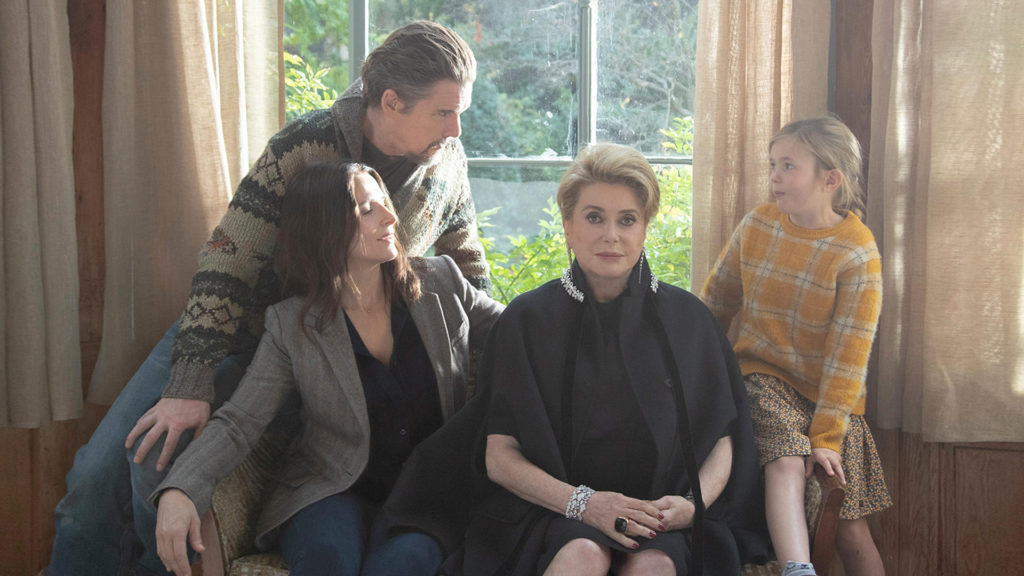
Catherine Denueve in THE TRUTH. Photo courtesy of IFC Films.

In The Truth, writer-director Hirozaki Koreeda’s latest wry and authentic exploration of human behavior, Catherine Deneuve plays Fabienne, one of France’s most iconic living actresses. Her daughter Lumir (Juliette Binoche), a screenwriter living in New York, brings her family to Paris for a visit to celebrate the publication of Fabienne’s memoir.

As the film opens, an imperious Fabienne is being interviewed by a journalist so mediocre that he’s not ashamed of plagiarizing his questions – and Fabienne doesn’t suffer fools.

Fabienne is a diva who demands to be doted upon, and she is a Real Piece of Work. Fabienne has been so career-focused that she sacrificed an emotional attachment to Lumir, who received maternal nurturing from Sarah, a now-deceased peer of Fabienne’s who Fabienne had screwed out of a career-making role.

Her self-worshipful memoir is ridiculously also entitled The Truth. The book falsely paints Fabienne as an attentive, model mother, doesn’t even mention her longtime assistant and inaccurately claims that Lumir’s father is dead.

Lumir’s resentments quickly bubble to the surface, the two probe and spar throughout he movie. Each sees her own experience as a “truth”. The Truth is about their journeys to accept the other’s point of view and on what terms. It’s very funny, and, thanks to Hirokeeda’s touch, remarkably genuine.

Juliette Binoche, Ethan Hawke, Catherine Deneuve and Clémentine Grenier in THE TRUTH. Photo courtesy of IFC Films.

Fabienne is now shooting a movie where she plays the mother of a much younger French film star (Manon Clavel), and the ever-competitive Fabienne has manufactured a one-sided rivalry with her, as she had with Sarah. (The film-within-a-film is a sci fi exploration of mother-daughter angst which I think I would hate if it were a real movie).

I’ve seen four of Koreeda’s movies and they’re all brilliant: Still Walking, Our Little Sister, The Third Murder and The Shoplifters. I rated The Shoplifters among the four best movies of 2018. The Truth is Koreeda’s first film made outside Japan and in languages (French and English) other than Japanese.

Deneuve and Binoche are superb. All of the cast is excellent, including Ethan Hawke, who is a good enough sport to play Lumir’s tag-along husband, a good-hearted but modestly talented American TV actor. The firecracker child actress Clémentine Grenier, in her first film, soars as Lumir and Hank’s daughter Charlotte; Charlotte wants to become an actress like her grandma, and Clémentine just might attain that herself.

The Truth also benefits from the beautiful work of cinematographer Eric Gautier (Ash Is Purest White, The Motorcycle Diaries, Summer Hours).

The Truth may not be Koreeda’s very best, but it’s plenty good. Hirokeeda, such an insightful observer of behavior, can cut to the core his characters’ profound humanity. The Truth is streaming on Amazon, Vudu, YouTube and Google Play.

a tribute to Carl Reiner: THE RUSSIANS ARE COMING! THE RUSSIANS ARE COMING!

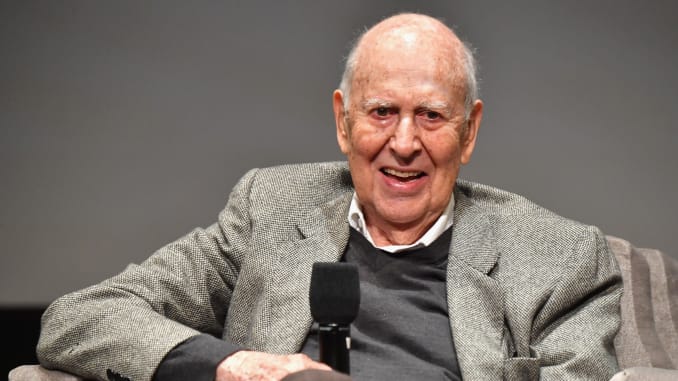
comedy legend Carl Reiner

No one has been more important in the evolution of American comedy than Carl Reiner, who has died at age 98. Reiner was a writer and performer on Sid Caesar’s seminal Your Show of Shows. He created one of the greatest and most influential TV sitcoms, The Dick Van Dyke Show. Reiner was the comedy partner who helped Mel Brooks form his work. And he directed four Steve Martin comedies. Reiner was the third person awarded the Mark Twain Prize for American Humor.

Active to the end, Reiner was playing Saul Bloom in the Ocean’s 11 franchise into his late eighties and voiced Carl Reineroceros in last year’s Toy Story 4. In recent years, he also Tweeted some pointed and wickedly funny anti-Trump video commentaries.

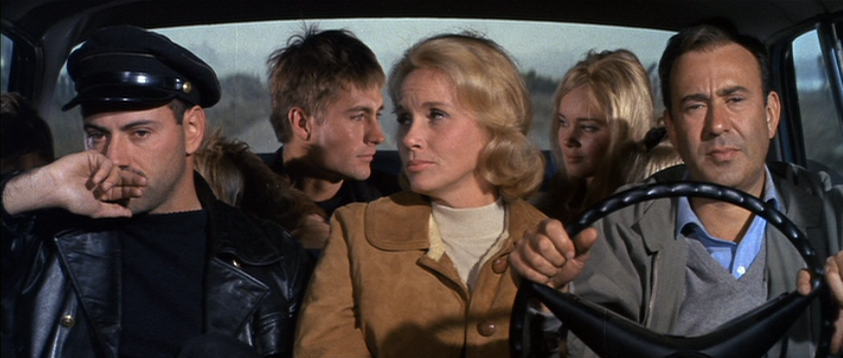
Alan Arkin, Eva Marie Saint and Carl Reiner in THE RUSSIANS ARE COMING! THE RUSSIANS ARE COMING!

Reiner starred in one of my favorite movie comedies – the still timely satire on the Duck and Cover Era, the 1966 The Russians Are Coming! The Russians Are Coming!.  At the height of the Cold War, a Soviet nuclear submarine runs aground and is trapped just off a tiny New England coastal village, and the crew sends a party ashore to heist a boat. The landing party encounters a vacationing American family and the two groups must work together to find a solution to help the sub escape without igniting World War III.

The superb cast includes Carl Reiner, Eva Marie Saint, Jonathan Winters and Alan Arkin in his breakthrough performance. Although it primarily satirizes the paranoia of the Cold War, there are plenty of laughs sparked by small town New England, family dynamics, teen love and the recurring joke of the town drunk with his reluctant horse.

The message that demonizing “Others” leads to no good, especially resonates in this moment of American and human history.

I rewatch The Russians Are Coming! every other year or so, and it still holds up.  Besides showing regularly on Turner Classic Movies, The Russians Are Coming! The Russians Are Coming! is also available streaming from Amazon and Vudu (and on DVD from Netflix).

a Sicilian Mafia double bill: THE TRAITOR and SHOOTING THE MAFIA

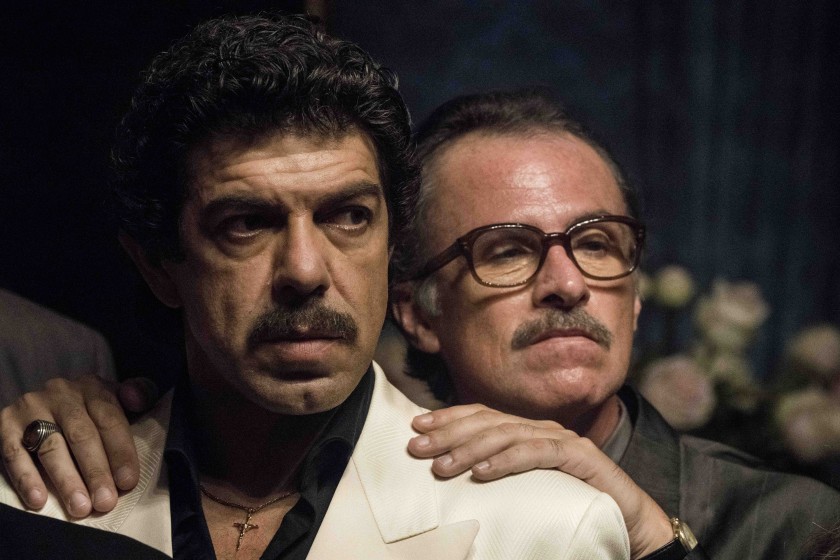
Pierfrancesco Favino and Totò Riina in THE TRAITOR, Photo courtesy of Sony Pictures Classics

Mafia movies have long been a cinematic staple and two current films explore the original Sicilian Mafia, the Cosa Nostra. The true life epic The Traitor and the documentary Shooting the Mafia cover the same territory – the Cosa Nostra‘s utter domination of Sicily until prosecuting judges Giovanni Falcone and Paolo Borsellini convicted almost 400 mafiosi in the bizarre Maxi Trial in 1986-87, the Mafia War on the State and assassination of the judges, leading to public outrage and arrests which have somewhat tamed the Cosa Nostra. Both films even feature the real village of Corleone, the home village of the fictional Godfather.

Pierfrancesco Favino in THE TRAITOR, Photo courtesy of Sony Pictures Classics.

The Traitor chronicles the career of Tommaso Buscetta, a mafia figure who traded in billions of dollars worth of heroin. Then, an internal gangland power grab led to the murders of his sons and to his arrest by very harsh Brazilian authorities. Buscetta retaliated by turning state’s evidence and testifying against his former Mafiosi, becoming the first and most important Sicilian Cosa Nostra informer.

The Traitor opens at a Mafia party where Buscetta (Pierfrancesco Favino) is sniffing out betrayal by his colleagues. It’s poker wisdom that, if you can’t spot the player who is :”the fish”, then it’s you. Or, as Victor Mature said in Gambling House, “You know what I think, Willie? I think I’m the fall guy.

Written and directed by Marco Bellocchio, The Traitor is a two-and-a-half hour epic that spans decades and three continents. The highlight is the Maxi Trial, held in a super-secure fortified arnea, ringed by over 400 defendants caged around the top.

Pierfrancesco Favino is very, very good as Buscetta, a guy who is firmly devoted to his personal code. Luigi Lo Cascio from The Best of Youth also appears as a Buscetta friend.

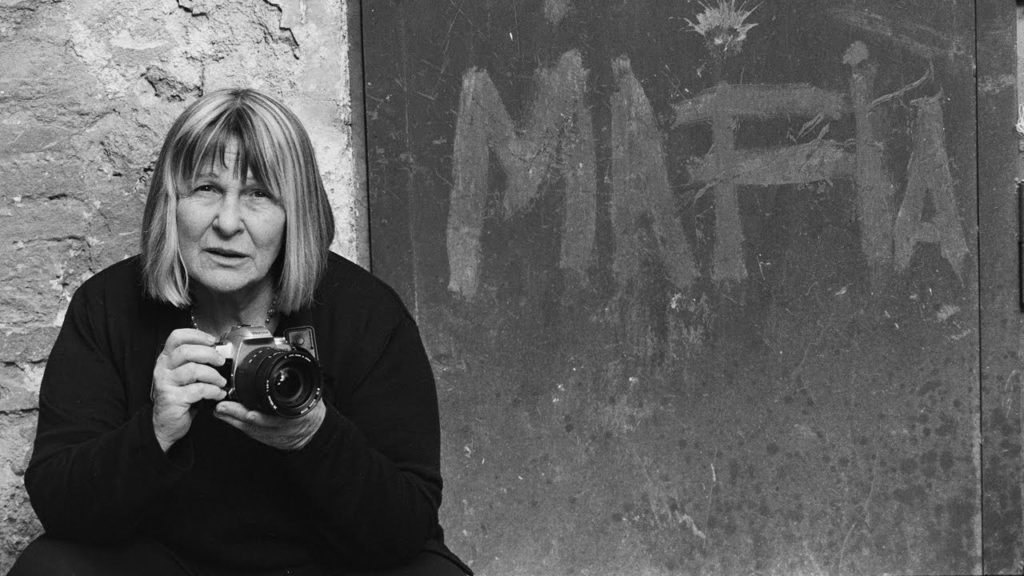
Letizia Battaglia in SHOOTING THE MAFIA

The documentary Shooting the Mafia introduces us to Letizia Battaglia, a talented Palermo photographer, whose photojournalistic specialty became photographing murder victims – scores, perhaps hundreds of corpses, bullet-riddled and bomb-mangled, in pools of blood. Her work also documented the grief. trauma and outrage of the Sicilian population.

Battaglia is open and unapologetic about her lusty personal appetites – and she over-shares. She would be an interesting subject for a biodoc even if she photographed ears of corn.

A Letizia Battaglia photograph in SHOOTING THE MAFIA

Shooting the Mafia, an Irish and US production, is directed by Kim Longinotto.

The Traitor can be rented from all the major streaming services. Shooting the Mafia can be streamed on iTunes, YouTube and Google Play.

DISCLOSURE: giving voice to the trans perspective

Laverne Cox in DISCLOSURE. Courtesy of NETFLIX.

I very much admired Disclosure, the insightful – and even revelatory – documentary about the depiction of trans people in film and television and the impacts of that depiction.

The best thing about Disclosure is the unfiltered trans voice – near as I can tell, 100% of the subjects and talking heads are trans or non-binary people, and it’s an uncommonly articulate bunch. I found the most compelling to be Emmy-winning actress Laverne Cox (Orange Is the New Black), actress/writer Jen Richards (Tales of the City), producer Zackary Drucker (Transparent) and actress Candis Cayne (Dirty Sexy Money).

The first 25 minutes – tracing depiction of trans people in film since D.W. Griffin’s silents – is not riveting. But stay with it – Disclosure pays off big time with these moving personal stories. Near the end, Jen Richards comments on an accepting parent that she saw in another documentary – get out the Kleenex for this moment.

I had always thought of Jaye Davidson’s Oscar nomination for her performance as Dil in The Crying Game as a step forward for trans people. It’s complicated. I had always viewed Stephen Rea’s reaction in the Big Reveal scene from my straight male perspective (cis, if you insist); Disclosure made me consider the trans woman’s lens, too.

Disclosure is streaming on Netflix.

ELLA FITZGERALD: JUST ONE OF THOSE THINGS: gentle genius of jazz

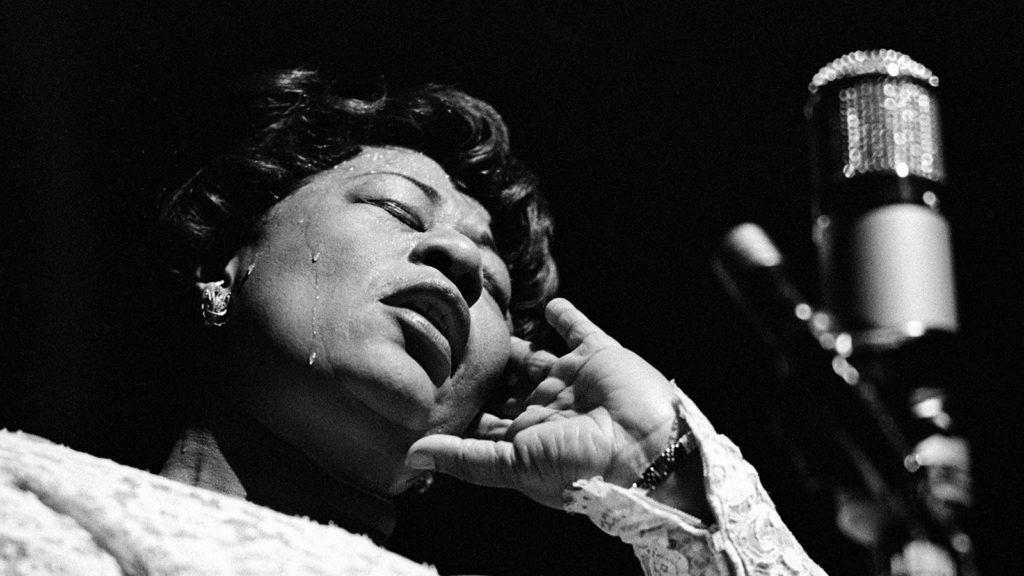
The revelatory biodoc Ella Fitzgerald: Just One of Those Things traces the life of the jazz icon.

It opens with the Harlem teenage dancer who was an eyewitness to Ella’s 17-year-old public debut at the Apollo Theater’s Amateur Night in 1934. We learn of Ella’s rocky childhood, with the traumas that led her to being incarcerated as a juvenile delinquent and becoming homeless in Harlem. We see the arc of her career, with the initial mentorship of bandleader Chick Webb and the later guidance of producer Norman Grantz.

Her son, Ray Brown, Jr., is on hand to reveal Ella’s family side (with photos of mom pitching to son, both in Dodgers gear).

One of the Ella Fitzgerald: Just One of Those Things‘ highlights is a never-broadcast interview in which Ella makes clear her views on race, American racism and civil rights. Markedly clear-eyed, it’s all the more powerful because of Ella’s gentle demeanor.

A Must See for jazz fans, Ella Fitzgerald: Just One of Those Things is reverential and by-the-numbers, but it is well-sourced and insightful. It opens June 26 in the Roxie Virtual Cinema.

DA 5 BLOODS: a few compelling elements

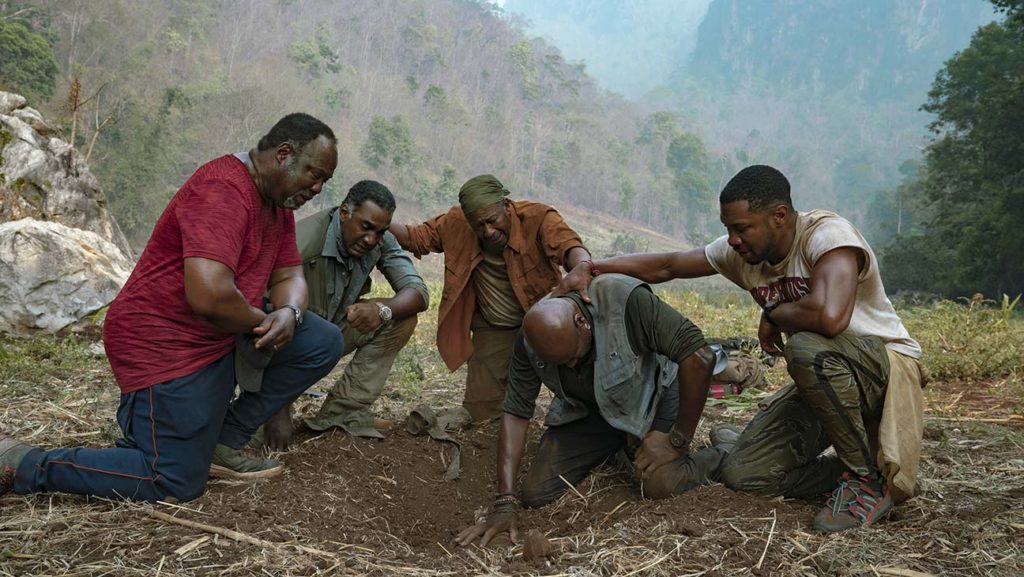
Isiah Whitlock Jr., Norm Lewis, Clarke Peters, Delroy Lindo and Jonathan Majors in in DA 5 BLOODS. Cr. DAVID LEE/NETFLIX © 2020

Spike Lee’s latest film, Da 5 Bloods has some compelling elements, but the movie isn’t compelling as a whole. It’s too long and drags in places. The Wife and I stopped watching after the first hour. I finished it a couple days later.

Da 5 Bloods works best as a reflection on the Vietnam War and on the Black experience in America; how Spike handles those themes is far more evocative than is the story itself.

The story: four African-American vets return to Vietnam fifty years after their service. They are seeking to recover the remains of their beloved commanding officer. What they keep to themselves, is that he is buried with a fortune in gold bars. This quest is remarkably similar to Treasure of the Sierra Madre (and Spike even throws in the most famous quote from Sierra Madre).

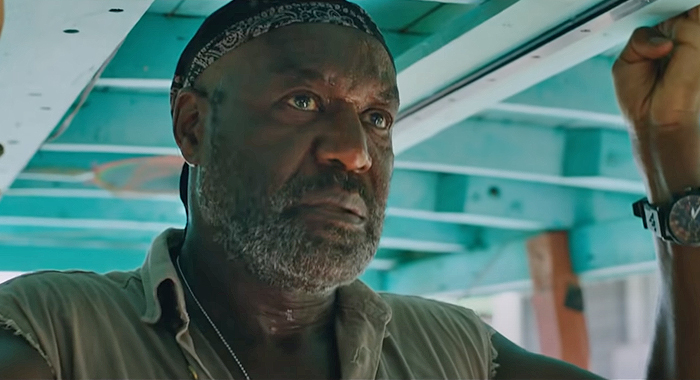
Delroy Lindo in DA 5 BLOODS. Photo courtesy of NETFLIX.

The best reason to watch Da 5 Bloods are the performances of Delroy Lindo and Clarke Peters. Lindo has the best role of his craeer – as a man who is tormented by PTSD from wartime guilt and a family tragedy back home.

The old actors play themselves in the fifty-years-before flashback scenes. I suspended disbelief, but it decidedly did not work for The Wife.

Besides Delroy Lindo’s searing monologues, the highlights of the movie are an unexpected family reunion for the Clarke Peters character and a gripping sequence in a minefield.

The supporting cast is excellent, especially Melanie Thierry, Paul Walter Hauser, Jean Reno, Le Y Tan and first time actress Sandy Huong Pham, Jonathan Majors, so great in The Last Black Man in San Francisco, is fine but wasted in an underwritten role.

Da 5 Bloods does showcase an impressive selection of soul shakes. Spike also drops in has signature double dolly shot in the epilogue, to effetively cap the Clarke Peters story line.

One of the best things about Da 5 Bloods is the soundtrack; I can’t get enough of Marvin Gaye’s What’s Going On, and neither can Spike. Time Has Come Today by the Chambers Brothers is underused in the movie, but dominates the great trailer embedded below (and the trailer is better than the movie).

Da 5 Bloods is streaming on Netflix.

YOURSELF AND YOURS: Buñuel meets Seinfeld

YOURSELF AND YOURS
YOURSELF AND YOURS
photo courtesy of SFFILM

The absurdism of Luis Buñuel meets the social awkwardness of Seinfeld in Hong Sang-soo’s Koran comedy Yourself and Yours.

In Yourself and Yours, Minjung (Lee You-young) dumps her boyfriend (Kim Joo-hyuck) after he objects to her heavy drinking (“I’ve stopped drinking – now I stop after only five rounds“). Then another man thinks that he meets Minjung, but she claims that she is Minjung’s identical twin. We’re not so sure about that. And then she meets ANOTHER man, and her identity remains in question. Her original boyfriend is comically bereft, and he’s on the lookout for her, too.

One character says “You men are all pathetic“, and Minjung proves that point at every opportunity. In a deliberate homage to Buñuel’s That Obscure Object of Desire, Lee You-young plays the role of Minjung and her multiple doppelgängers (unless they are all really Minjung herself).  There are plenty of LOL moments as Yourself and Yours winds its way full circle to a satisfyingly sly finale.

I saw Yourself and Yours (Dangsinjasingwa dangsinui geot) at the San Francisco International Film Festival (SFFILM).  In an Only-At-SFFILM moment, I (a Hong Sang-soo newbie) was surrounded in the audience by devoted Hong Sang-soo fans. During its Bay Area virtual run at the Roxie, you can stream Yourself and Yours at Roxie Virtual Cinema.