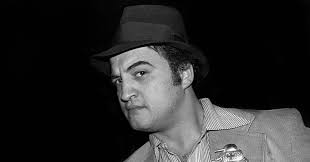
We all know the story of John Belushi – a career soaring like Icarus, propelled by comic genius and then death by drug overdose at age 33. The new biodoc Belushi brings us more texture because of unprecedented access to Belushi’s friends and widow and to Belushi’s own letters, notes and journals.
There are many insights into Belushi’s family and his upbringing, the fodder for some of his unhappiness. We learn about a year of white-knuckle sobriety when he was protected by a bodyguard named Smokey. Friend and fellow addict Carrie Fisher weigh in regarding that unsupported year of sobriety.
And their are some new stories of Belushi’s zaniness, like when he wandered off a movie set to be found in a house across the street by Dan Aykroyd – Belushi had convinced the resident, a total stranger, to feed him a sandwich and milk and to let him stretch out for a nap.
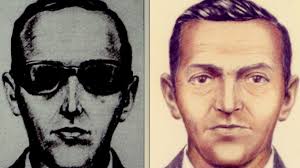
We are justifiably still intrigued by the only unsolved American air hijacking. The documentary The Mystery of D.B. Cooper takes us back and adds some detail to the story. Most importantly, it makes four suspects become almost tangible to us.
We get to meet the flight attendant forced to sit next to the hijacker, and the guy who sat across the aisle and the pilot. But, the highlights come from the folks that are today convinced that they knew D.B. Cooper. These stories range from odd to bizarre.
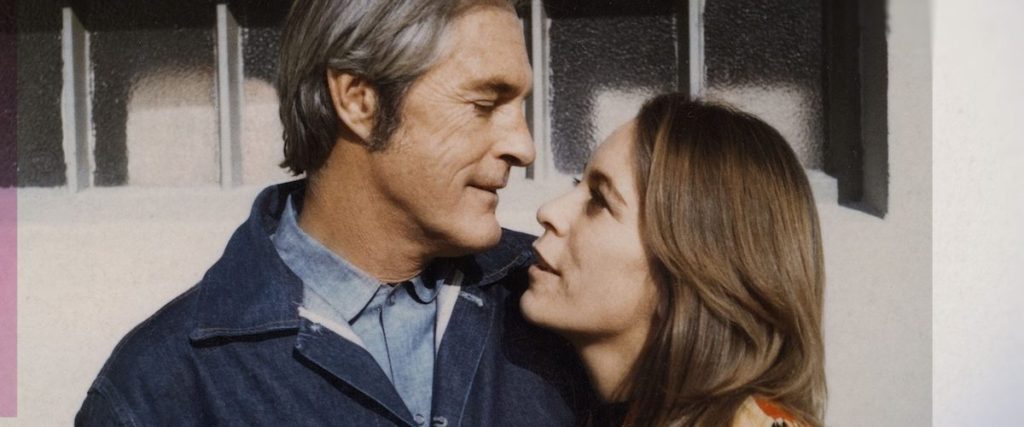
Timothy Leary and Joanna Harcourt-Smith in MY PSYCHEDELIC LOVE STORY
The documentarian Errol Morris has a remarkable gift for finding interview subjects with bizarre stories to tell. In My Psychedelic Love Story, Morris introduces us to Joanna Harcourt-Smith, who was swept off her feet in 1972 by bad boy celebrity Timothy Leary and spent a few years as his romantic partner. This was a period when Leary, hounded by US authorities for advocating psychedelic drug use, was on the lam in Europe and the Middle East, and finally imprisoned.
Joanna Harcourt-Smith in MY PSYCHEDELIC LOVE STORY
Morris extracts the tale from Harcourt-Smith herself. We learned that Harcourt-Smith came from a wealthy but difficult and unconventional upbringing. She plunged into a hippie version of what we would now call a Eurotrash lifestyle.
While much of her story is undeniably factual, we suspect that Harcourt-Smith is less than a reliable narrator. She drops bits like “I was happy we were stopping in Lebanon because the President was in love with my mother”. It’s either an astonishing fact or a an astonishingly brazen lie. Either way, she’s entertaining.
I’ve loved Morris since his first feature in 1978, Gates of Heaven, the story of a Bay Area pet cemetery and its quirky owners and customers (plus digging up all the dead pets and moving them from Cupertino to Napa). For bizarre personal stories, it’s tough to top Morris’ Tabloid, about a woman who kidnapped and sexually abused a Mormon missionary in England and retired in North Carolina to a pastime of tending dogs cloned in Korea,
My Psychedelic Love Story, which is minor Morris, is streaming on Showtime.
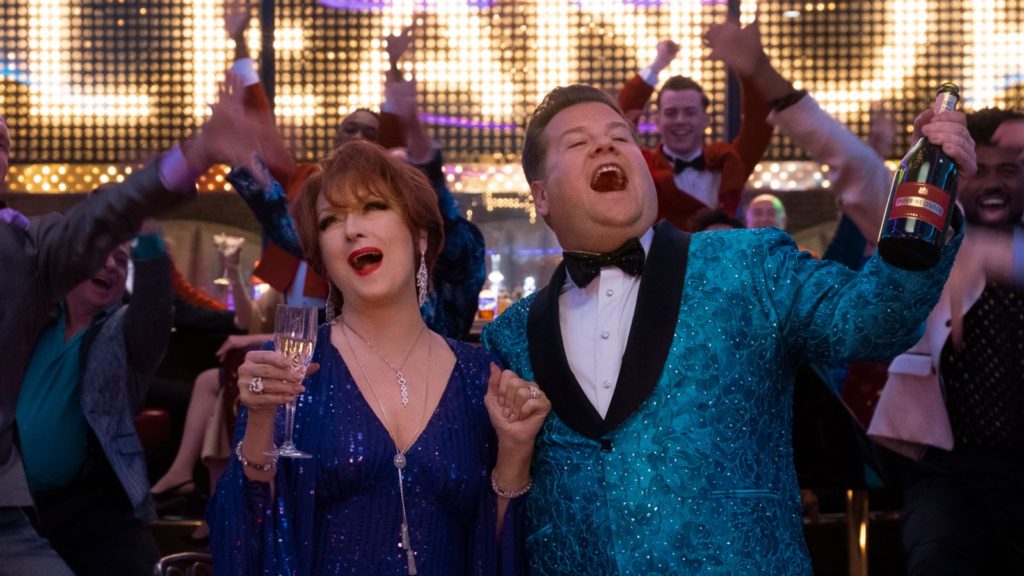
The Prom brings the musical to the screen, with Meryl Streep and James Corden as the self-absorbed Broadway stars who seek to rebound from a disastrous theatrical closing. They lead a cultural rescue party to Indiana, where a high school lesbian has been denied her prom. They bring along their less successful buddies (Nicole Kidman and Andrew Rannells) in a comic misadventure in Flyover America.
The first part of the film, with the focus on the narcissism of the is performers, is pretty funny. As the story settles into standard fish-out-of-water territory, it’s less compelling.
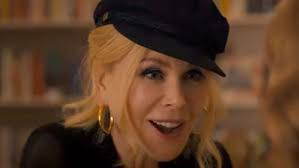
Nicole Kidman in THE PROM
The cast is just fine at singing and dancing. Nicole Kidman (who better to play a leggy chorus girl?) is exceptional. I also admired Keegan-Michael Key as the local principal and Broadway fanboy. (And I have evidently aged to the point where I now watch movies where Kerry Washington plays somebody’s mom.)
The Prom is an airy confection, the movie equivalent of cotton candy. It’s streaming on Netflix.
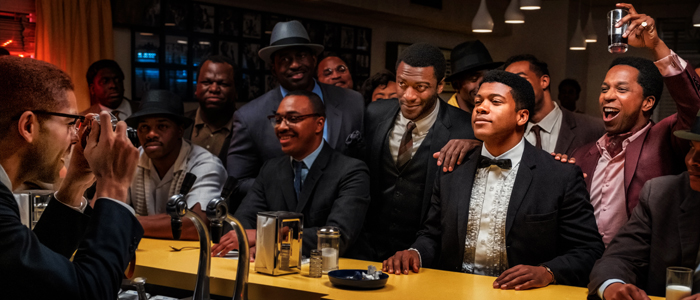
The marvelous actress Regina King directed One Night in Miami, a study of four American Black icons – Cassius Clay, Jim Brown, Malcolm X and Sam Cooke – as they spend an evening together. The encounter is imagined, but the four guys did know each other.
Cooke was a star, Brown was a superstar, Malcolm was emerging as a national figure and Clay was about to become whatever is superior to “icon”.
The titular One Night is a unique one. Cassius Clay had just stunned the world by winning the world’s heavyweight boxing championship in an unthinkable upset over ferocious Sonny Liston. And he was about to shock America again by announcing his embrace of the Nation of Islam and his name change to Muhammad Ali.
The most interesting aspect is the emphasis on each man at a pivotal point in his career. Brown is at the top, recognized as an all-time great with nothing else to prove in pro football; the question is whether he can transition his fame into a movie career and other pursuits. Malcolm is about to move away from the leadership of the Nation of Islam and into a new level of public thought-leading. Cooke has been at the top, but his career arc may be descending. And, of course, Clay is seven days from becoming Muhammad Ali; enough said there. And none of them know that Malcolm and Cooke will be murdered within three years.
Of course, all four were faced with struggling against American racism – systemic and personal, flagrant and subtle. King’s unflinching eye introduces the particular ingrown racism of the 1960’s South with a gut punch of a scene, when Jim Brown visits a white acquaintance from his youth, played by Beau Bridges.
One Night in Miami is well-acted. Clay is played by Eli Goree, Malcolm by Kingsley Ben-Adir, Brown by Aldis Hodge and Cooke by Leslie Odom, Jr.
One Night in Miami is more intellectually interesting than enthralling. This is very talkie, however, and feels too much like a play to be excellent cinema.
I screened One Night in Miami at the 2020 Mill Valley Film Festival. You will be able to stream it on Amazon on Christmas Day.
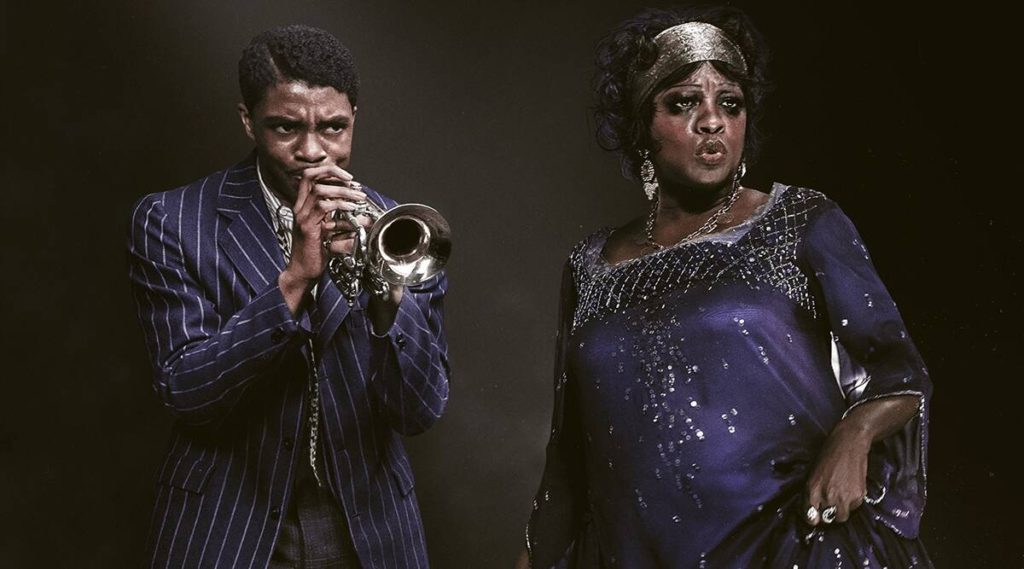
Chadwick Boseman and Viola Davis in MA RAINEY’S BLACK BOTTOM
Ma Rainey’s Black Bottom is a searing revelation of the impacts of racism, with charged performances by Chadwick Boseman and Viola Davis.
The plot is about a turbulent recording session in 1927 Chicago, featuring the ferocious diva Ma Rainey, the Mother of the Blues. But the movie is really about how each character has been traumatized by racism. We see overt racism in the American North – in a cop, a working class deli, a recording studio and a crushing final shot of cultural appropriation. But the key is the reflection of racism in how it has shaped each of the characters.
There is a violent eruption that literally stuns the audience, and then, as Billy Wilder advised, the movie doesn’t stick around too long after. This is a dark film.
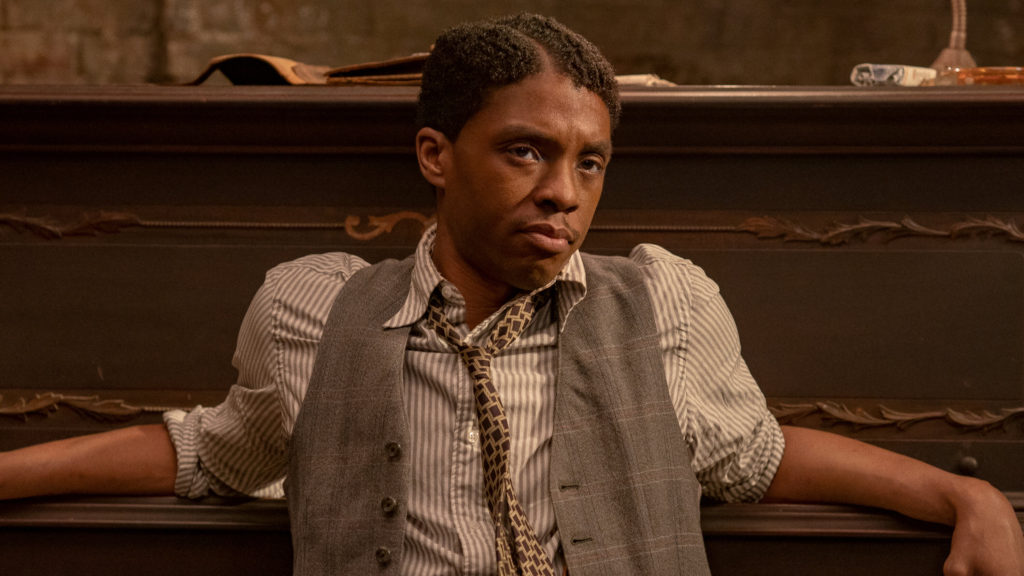
Chadwick Boseman in MA RAINEY’S BLACK BOTTOM
The core of the film is Chadwick Boseman’s portrayal of Levee, the trumpet player in Ma’s backup band. He sees himself as a star in the making, which doesn’t sit well with Ma. Boseman’s Levee is a peacock, but Boseman reveals that Levee understands superficiality and transcends it. At his core is a rage and a unhealed wound, profound emotional damage that he is able to hide…until he doesn’t.
Whether blowing his horn, hanging in the band room or canoodling with Ma’s oversexed sweet young thang (Taylour Paige), Levee is charismatic. The highlight of the film is his gripping monologue, and he’s absolutely electric at the climax.
Boseman died earlier this year at 43 after playing Jackie Ronbison, James Brown and Thurgood Marshal, and soaring to superstardom as Black Panther. There’s been a lot of buzz about a posthumous Oscar for this performance, which is both sentimental and richly deserving. I certainly haven’t seen a better performance in 2020.
Viola Davis, as one would expect, has the presence and ferocity to make an excellent Ma Rainey. The real Ma Rainey wore exaggerated makeup and was constantly sweaty, and Davis uses here characteristics in her performance.
Davis and Boseman are big stars, but Ma Rainey’s Black Bottom is an ensemble work. Colman Domingo, Glynn Turman, Michael Potts, Jeremy Shanos and Paige are all excellent.
Ma Rainey’s Black Bottom Blues is the second August Wilson play, following Fences, that Denzel Washington has brought to the screen in a deal that originated at HBO and moved to Netflix. This is obviously a play, but it doesn’t feel too stagey, especially with the scenes of the Chicago streets and an earlier Ma Rainey live performance in the rural South.
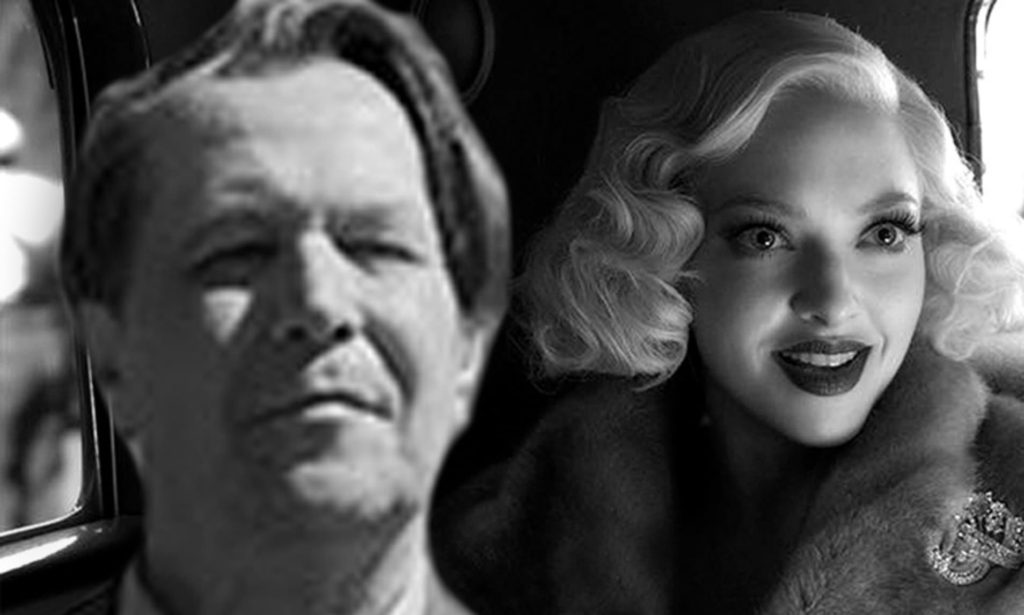
David Fincher’s Mankis a black-and-white beauty of a film, a portrait of troubled talent in Classic Hollywood.
Mank is a character study of Herman J. Mankiewicz (Gary Oldman) as he pens his Oscar-winning screenplay for Citizen Kane. Mankiewicz was an Algonquin Round Table wit whose misfortune was that he despised the one thing that he excelled at. He was a master writer and fixer of Hollywood movie scripts, but he would rather have been in Manhattan trading bon mots with his peers in the intelligentsia. He particularly the industrial, ultra-commercial and course movie studio bosses and despised their politics.
It didn’t help that Mankiewicz was a raging alcoholic and compulsive gambler (although not a womanizer). He was so hard to handle that Orson Welles essentially imprisoned him at a remote California desert ranch to write Citizen Kane.
Mankiewicz had one unsurpassed idea for a script – the story of media mogul (and frustrated politician) William Randolph Hearst. Mankiewicz had been a frequent guest of Hearst and his companion Marion Davies at Hearst Castle. The problem is that telling this story would piss off the owner of the world’s biggest publicity machine and horrify the movie studio heads who employed screenwriters. And, most poignantly, it would betray Mankiewicz’s kind friend Marion Davies.
Mankiewicz had served as the court jester at Hearst Castle, and the term comes up repeatedly in Mank, most importantly in a cutting remark by Herman’s little brother Joseph Mankiewicz.
The Wife stayed with Mank and finished it, but she advised me that Mank is much more appealing to cinephiles who already know the “inside baseball” of the old movie studio system and the making of Citizen Kane. Indeed, when the likes of Louis B. Mayer, Ben Hecht, Joseph Mankiewicz, Irving Thalberg and John Houseman popped up, it instantly resonated with me.
The entire cast is excellent, but Amanda Seyfried is beyond great as Marion Davies. Charles Dance (coming off his Lord Mountbatten in The Crown) is perfect as William Randolph Hearst. Muckraker-turned-socialist-gubernatorial-candidate Upton Sinclair is played by…(wait for it)…Bill Nye the Science Guy.
David Fincher is one of our greatest directors (Se7en, Fight Club, Zodiac, The Social Network, Gone Girl). Fincher’s father Jack Fincher wrote the screnplay for Mank (and clearly shared Herman Mankiewicz’ acid view of the Hollywood hierarchy), so this is clearly a labor of love for David Fincher.
As a tribute to both Citizen Kane and the Golden Age of Hollywood, Mank is just gorgeous, as beautiful a black-and-white film as any directed by John Ford or shot by Sidney Toler, Nicholas Musuraca or John Alton. Mank’s cinematographer is Erik Messerschmidt (TV’s Mindhunter).
Mank is going on my list of Best Movies of 2020 – So Far. I see Oscar nominations coming for Fincher, Messerschmidt and Seyfried. Mank is streaming on Netflix.
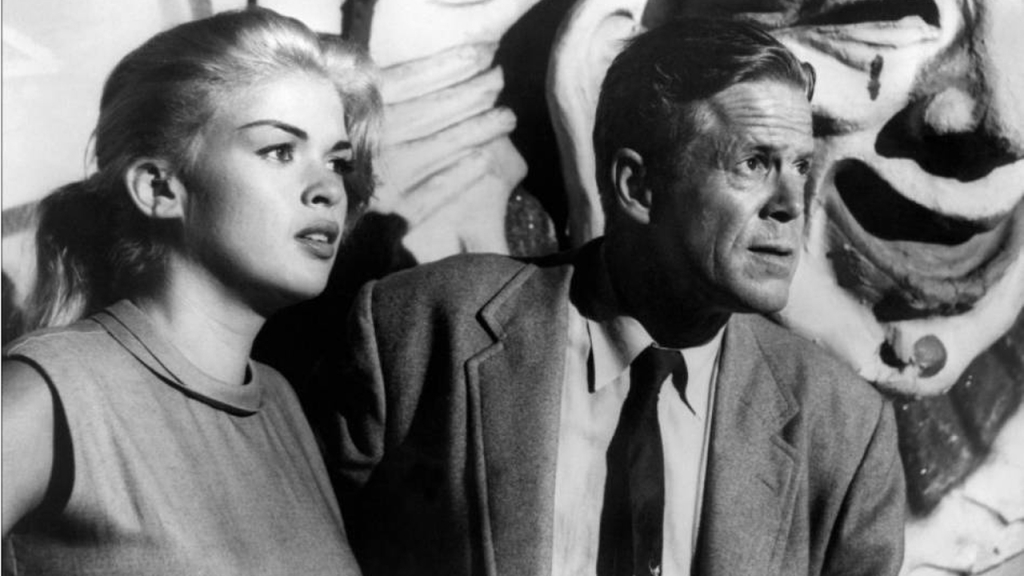
Turner Classic Movies is presenting one of my Overlooked Noir on December 12, and you shouldn’t miss it. The Burglar (1957) is known popularly as the movie debut of Jayne Mansfield, but it’s a fine film noir. It starts out with a tense burglary, but once the necklace is successfully burgled, the story focuses on the heist team going stir crazy as they wait for the environment to cool down so they can safely fence the booty. They are strung so tight that even the whistle of a tea kettle is enough to startle the gang. While dodging the cops, they find that they are also being hunted by a corrupt rogue cop and his partner.
The core of The Burglar is the stellar lead performance of Dan Duryea as the chief burglar. He’s a tortured and worn-out guy – with one deep loyalty.
There are plenty of noir moments – lots of shadows, uplit faces in the darkness and amoral, grasping characters. We have not one, but two noir vixens – Jayne Mansfield and Martha Vickers. Asked at a bar by Duryea what she wants, Vickers answers “Basically, I’m out to find myself a man.” The characters in this fine film noir find themselves in Atlantic City, where the bad cop chases the protagonists through the House of Horrors and the Steel Pier, culminating in a final confrontation under the boardwalk.
The acting is excellent, other than Peter Capell, who gives over-acting a bad name while playing the most nerve-wracked member of the gang. Even Mansfield is good; (The Burglar was held in the can for two years and then released when Mansfield became a sensation with The Girl Can’t Help It).
The movie was shot on location in Philadelphia and Atlantic City. We see Independence Hall, and it’s hard not to think of Rocky when Duryea climbs the steps to the Philadelphia Museum of Art.
The Burglarplays from time to time on Turner Classic Movies and is available streaming on Amazon, AppleTV, Vudu, and other platforms.
[Note: The Burglar features John Facenda as his real-life role as a Philadelphia newscaster (when local TV stations aired 15-minute newscasts). Facenda later found much broader fame as “The Voice of God” for his narration for NFL Films football documentaries.]
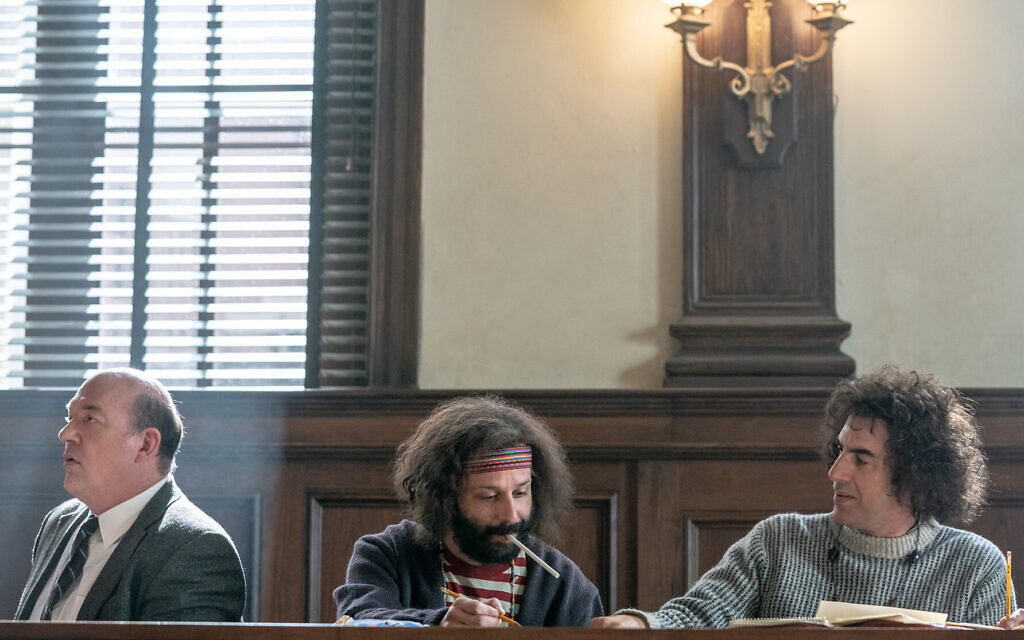
John Carrol Lynch, Jeremy Strong and Sacha Baron Cohen in THE TRIAL OF THE CHICAGO 7
In The Trial of the Chicago Seven, writer Aaron Sorkin (The West Wing, Oscar winner for The Social Network) brings history alive. The trial of anti-Vietnam war activists in 1969 was a bizarre moment in our political history (but not any more bizarre than the past four years).
Now in 2020, it’s time for this movie. Back in 1969, there were authoritative statements about criminality on both sides. But it’s more clear today – and indisputable – that the violence outside the 1968 Democratic Party convention in Chicago was a series of police riots, pure and simple, and that the trial was Nixon’s nakedly illegitimate legal assault against all activism.
The overriding absurdity of this political trial was that it alleged a conspiracy – and some of the alleged conspirators barely knew each other and some despised the others. These were rivals within the anti-war movement and only together in Nixon’s mind.
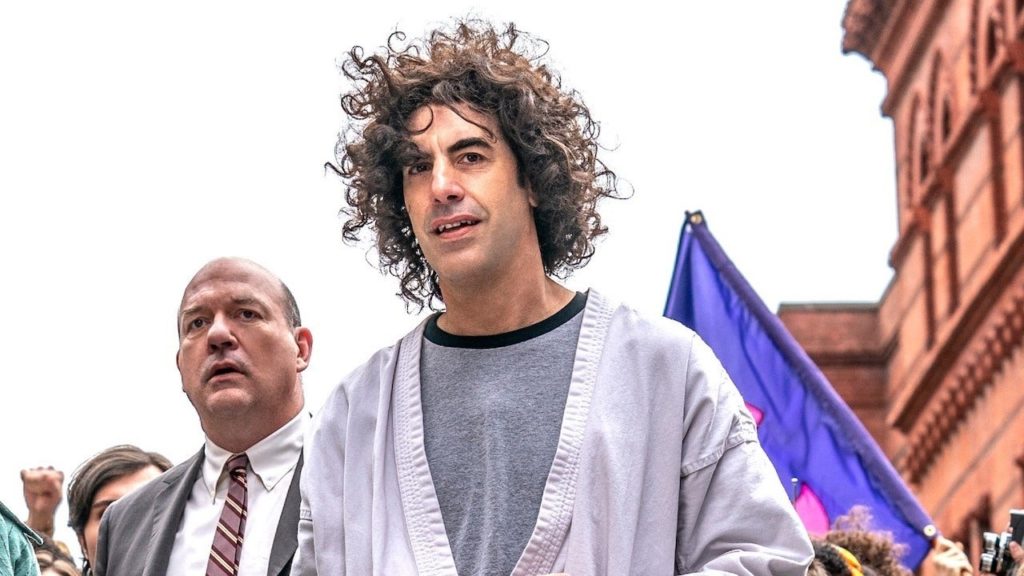
The movie makes this most clear in the conflict between Tom Hayden (Eddie Redmayne) and Abby Hoffman (Sacha Baron Cohen). Hayden of Students for a Democratic Society wanted to end the Vietnam politically. Hoffman of the Youth International Party (Yippies) was against the war, but sought a wider cultural revolution; the Yippies’ clownish political theater alienated the American Middle and made Hayden’s job harder. Hoffman was hilariously witty and Hayden was as funny as a heart attack. The two men couldn’t have conspired together to order lunch.
Hayden does not benefit from the Sorkin treatment. One is reminded that another activist said, “Tom Hayden gives opportunism a bad name.” THat almost tops Abby Hoffman’s own cutting appraisal of Hayden: “He’s our Nixon”.
The disparity between the defendants was emphasized by the prosecution of David Dellinger (John Carroll Lynch), the non-hippie, a pacifist leader from another generation. Dellinger was a suburban dad and boy scout leader, No one could see him as some punk kid, so when his outrage finally boils over, it’s one of the most powerful moments in the film.
John Carrol Lynch and Sacha Baron Cohen in THE TRIAL OF THE CHICAGO 7
Cohen and Lynch are superb in The Trial of the Chicago 7, along with Kelvin Harrison, Jr., who plays Black Panther leader and martyr Fred Hampton, and Mark Rylance as defense lawyer William Kunstler. It’s a star-studded cast with Michael Keaton, Joseph Gordon-Levitt and Jeremy Strong (so good as Lee Harvey Oswald in Parkland).
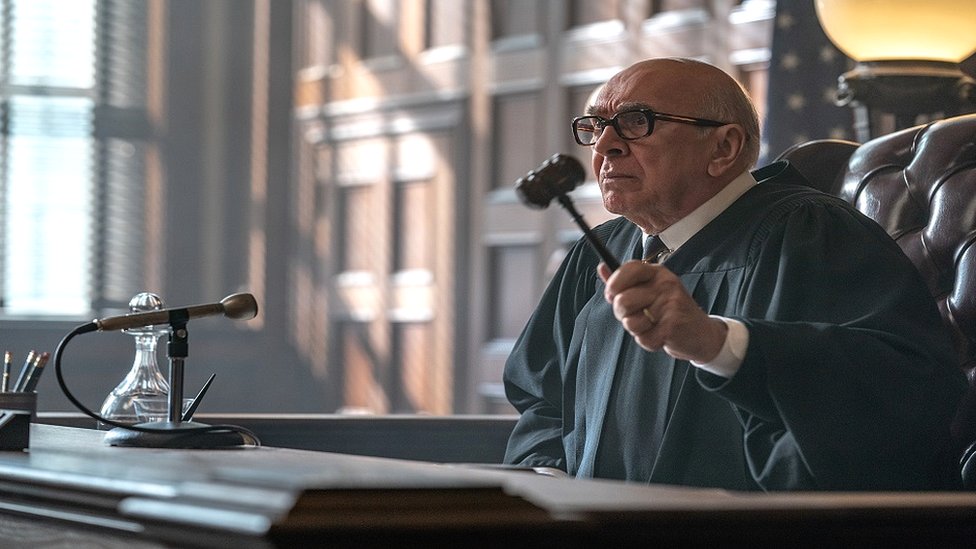
Frank Langella is also brilliant as the villain, Judge Julius Hoffman. Langella’s Hoffman is imperious and intemperate, and utterly blind to his own racism and generational bias.
Frank Langella in THE TRIAL OF THE CHICAGO 7
The facts are compressed and – for the most part – kept in context. The role of former Attorney General Ramsey Clark (Keaton) happened a little differently but is portrayed with basic truth. Fred Hampton didn’t actually attend the trial and sit behind Bobby Seale; but the facts and impact of his assassination are fundamentally correct.
The one thing that annoys me about The Trial of the Chicago 7 is the spunky character of the defendants’ office manager Bernardine – because it’s clearly inspired by radical Bernardine Dohrn. Dohrn, who was not part of the trial, was NOT some chick answering the phone, but had already graduated from law school and was about to co-found the Weather Underground terrorist cell. I’m guessing that Sorkin wrote her in the story in a well-intentioned attempt to make the story NOT all-male. But the truth is that even the counter culture was sexist, and even male hippies saw women as adornments in 1969. The 1963 publication of The Feminine Mystique did not immediately wash away millennia of patriarchy.
This, however, is a sound retelling of a salient moment in our political and cultural history. Cohen, Lynch, Rylance, Langella, Harrison Jr, are all exceptional, and The Trial of the Chicago 7 is pretty entertaining.
As nature documentaries go, My Octopus Teacher, is pretty singular. Filmmaker Craig Foster, stewing in mid-life disillusionment, is diving in a South African kelp forest when he encounters an octopus and decides to shadow her over a year and document her life every day. The octopus takes to Foster and adopts him as kind of a pet. But My Octopus Teacher is mostly worthwhile for the amazing resourcefulness of the octopus and the harrowing shark attacks.
I knew that octopuses are wizards at camouflage and at squeezing through tight spaces. I didn’t appreciate how intelligent they are and that they commonly live for only one year.
There are some sequences in My Octopus Teacher that are just astonishing. The underwater photography, especially the scenes just below the surf in the first fifteen minutes are among the best I’ve ever seen. The cinematographer is underwater specialist Roger Horrocks.
Foster himself narrates the film. The Movie Gourmet doesn’t cotton to the simpering of grown men, so I wish I had turned off the sound for the first fifteen minutes of his personal angst and the final ten minutes when he forges a blissful father-and-son shared interest in the ocean.
I do admire Foster for two things. First, he generally didn’t interfere with the course of nature (i.e., rescue the octopus from shark attacks). And he didn’t give her a human name. Good for him.
Off South Africa, the octopus’ major predator is the pajama shark, so named because of the stripes that resemble old-fashioned vertically-striped pajamas. Pajama sharks are especially well-equipped to attack in the narrow and deep crevices where octopuses hide out.
I can’t really blame the sharks because octopus is one of my favorite foods, too. It takes some mastery (which I haven’t as yet attained) to cook them so they’re not rubbery. So, I order octopus every time I see it on the menu (usually at Greek, Spanish, Mexican or Portuguese restaurants).