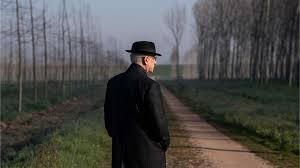
Photo caption: Toni Servillo in LA GRAZIA. Courtesy of MUBI.
When we talk of “coming of age” movies, we usually mean those about kids or young adults experiencing life lessons for the first time. But, the more mature among us also face new realities as we age into new phases of our lives. That’s the case with Paolo Sorrentino’s lyrical La Grazia.
La Grazia is an insightful and empathetic portrait of a fictional president of Italy (Toni Servillo) in the final months of his term. He is a man of quiet and resolute competence, a jurist admired for guiding the country through six political crises. He is also staid and taciturn, a man of boring countenance (except for an his fondness of the most current pop music, including rap).
He is a lame duck and in a malaise from the loss of wife of fifty years. He’s just running out the clock. Fortunately, his daughter Dorotea (Anna Ferzeti), an impressive jurist in her own right, is nudging him through his daily duties. To her frustration, he is refusing to make his final three official decisions, about whether to sign euthanasia legislation and whether to grant two pardons.
He believes that his beloved wife had an affair forty years before, and now, instead of working, he’s stewing over who was her lover.
His lethargy contrasts with the vibrant, over-the-top baroque art covering every surface of the Quirinale Palazzo, the former papal palace now the headquarters of Italy’s President. The only sparks of life come from Anna’s prodding and from dinners with the art critic Coco, his friend from grade school and his wife’s bestie (played in a charismatic performance by Milvia Marigliano).
As doggedly as the president drags his feet, we know that he will need to find a catharsis and reset his life. As he figures things out, there is a remarkable scene involving, of all things, an astronaut shedding a zero gravity tear.
Toni Servillo is excellent here as a much more decent and much less flamboyant politician than the ones he played in Sorrentino’s Il Divo and Loro. La Grazia matches up well with his Youth, another contemplation of the end of a career. As usual, Sorrentino takes full advantage of the palace interiors and Roman exteriors; visually and otherwise, Sorrentino’s masterpiece remains The Great Beauty.
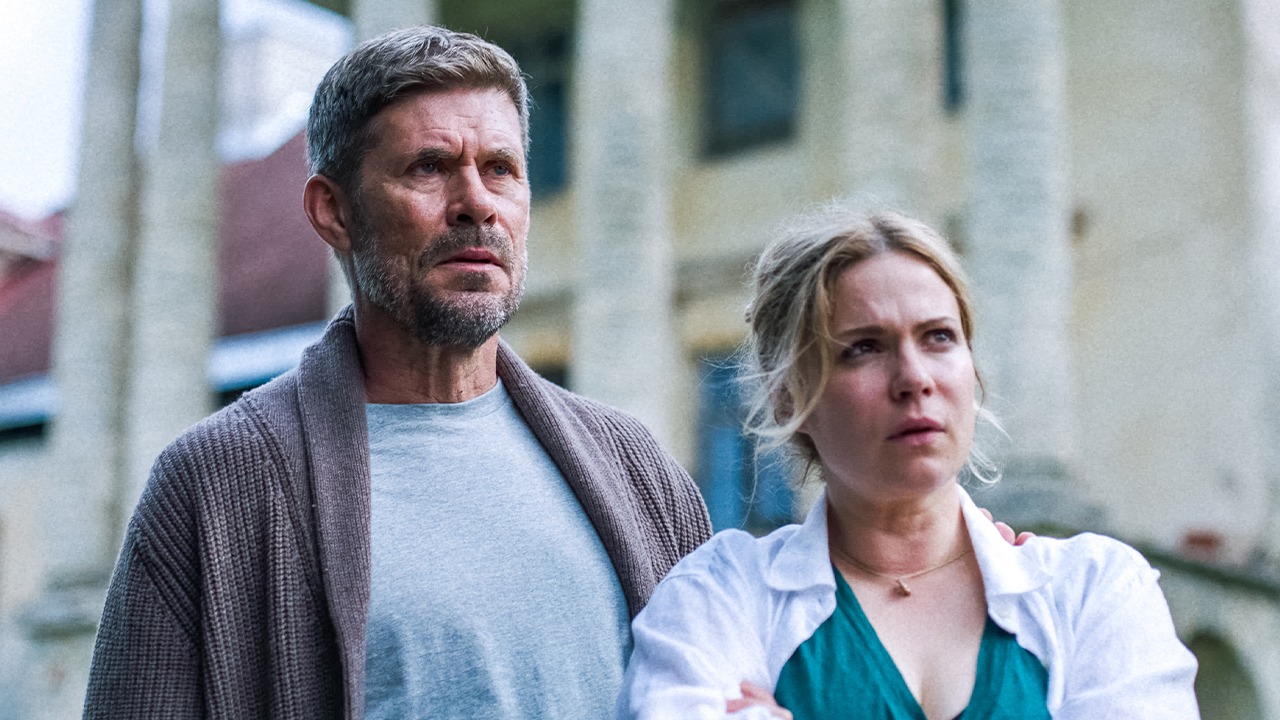
Photo caption: Tommi Korpela and Pihla Viitala in THERAPY. Courtesy of Cinequest.
Beginning today, and thru midnight March 31, select films from this year’s Cinequest are now available to watch at home through Cinequest’s online festival Cinejoy. The price is less than ten bucks per movie for all but two, and you can watch all of them with a $50 pass.
There’s a Spotlight section where, for $14..99, you can join others watching the film at the same time and participate in Q&A with the filmmakers. The Spotlight film I recommend is Adult Children.
Amber Gray in HEARTWORM. Courtesy of Cinequest.
The other films that I recommend are in the Cinejoy Showcase section, so you can watch them whenever convenient, for only $9.99. They include my choices for the very best of the festival:
Heartworm: Set in a near future where humans can connect to an AI-generated world indistinguishable from reality, a couple grapples with the heartbreaking death of their daughter. The mom is bravely working through her grief, trying to harness her resilience; the dad, equally shattered, has emotionally shut down. When we see the daughter, is it a flashback or a reappearance? The mom must figure out whether she has experienced a trauma-induced hallucination or a psychotic break – or whether the dad has stepped into an insidious AI pseudo-reality where their trauma didn’t happen? The distinguished Broadway actress Amber Gray, most recently Tony-nominated for Hadestown, soars as the mom, fighting fiercely for her sanity at the moment of her greatest vulnerability. This brilliantly constructed film is a striking debut feature for writer-directors Miriam Louise Arens and Mitchell Arens. World premiere.
Therapy: A husband and wife team of therapists have over-invested in a spacious seaside manor, where they are about to host a five-day couples retreat. Trouble is, the splendid but decaying estate has tapped out their finances, and their own marriage is on the rocks. What could possibly go wrong? This very funny Finnish dramedy sends up psychobabble while exploring the topics of grief, loyalty, betrayal, jealousy, disappointment and relationship fatigue. Therapy’s screenplay brims with insight, wit and humanity. Second narrative feature for writer-director Paavo Westerberg. US premiere.
Photo caption: Andrea Riseborough, Kit Rakusen, Stephan Graham and Anson Boon in HEEL. Courtesy of Magnolia Pictures.
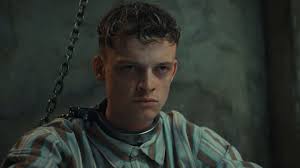
As the psychological thriller Heel opens, we see the feral teenage Tommy (Anson Boon) partying insatiably and behaving despicably. He is a bully, a vandal, and a hedonist who thinks of no one but himself. If he had any aspiration or cultural curiosity, he might see himself as the Malcom McDowell character in A Clockwork Orange. Addled by drugs and booze, he staggers off to pass out.
Tommy regains consciousness, and finds himself wearing a steel collar on his neck, chained to the wall of a dungeon-like basement. He doesn’t know where he is, but it’s in an isolated house in the remote English countryside. The home belongs to Chris (Stephen Graham) and Kathryn (Andrea Riseborough), who have KIDNAPPED Tommy with the intention of turning him into a good boy, a kid who is civil, respectful, considerate and responsible. Chris and Kathryn have a 10-year-old son Jonathan (Kit Rakusen), who is almost sickeningly obedient.
Yes, this is all bizarre. It is not okay to hold someone against their will, literally chained to the wall, even if Chris and Kathryn act like it’s the most normal and benevolent behavior. Even Tommy has enough awareness to label his situation a “Guantanamo”.
Chris and Kathryn hire a young, undocumented Macedonian woman, Rina (Monika Frajczyk), as a housekeeper. The family is so twisted, and Tommy is so vile, that Rina’s point of view validates the audience’ perspective.
Anson Boon in HEEL. Courtesy of Magnolia Pictures.
What Chris and Kathryn are doing is inhumane, illegal and very, very creepy. Corporal punishment does work to modify behavior in the short term, that’s not the reason that civilized society doesn’t use it anymore. Of course, this very extreme situation is used to explore just what children need from their parents. Kids do need stability, consistency, discipline, attention and unconditional love, and Chris and Kathryn get that much right.
As unhinged as Chris and Kathryn are, they DO really care about Tommy, which drives a surprise ending.
I love Stephen Graham as an actor. His characters can be very menacing and brutish. Here, his Chris acts like he’s naturally a milquetoast, but one very determined to stay on mission; he doesn’t LIKE using an electric prod, but if he has to…
Andrea Riseborough, another actor who is always superb, is wonderful in Heel as a woman who seems at first to live in a stupor of grief, but whose agency is eventually revealed.
The folks responsible for this story, in all its bracing originality, are Polish director Jan Komasa and co-writers Barto Bartosik (his first screenplay) and Naqqash Khalid (his second). Let’s order up some more movies from these guys!
Heel was originally titled Good Boy (which would have been a much better title IMO), but it was changed to avoid confusion with another film (the horror picture with the dog’s POV).
Heel is wild, unsettling and very entertaining. Heel is streaming on Amazon, AppleTV, YouTube and Fandango.
Liana Wright-Mark in AMERICAN MUSCLE. Courtesy of Cinequest.
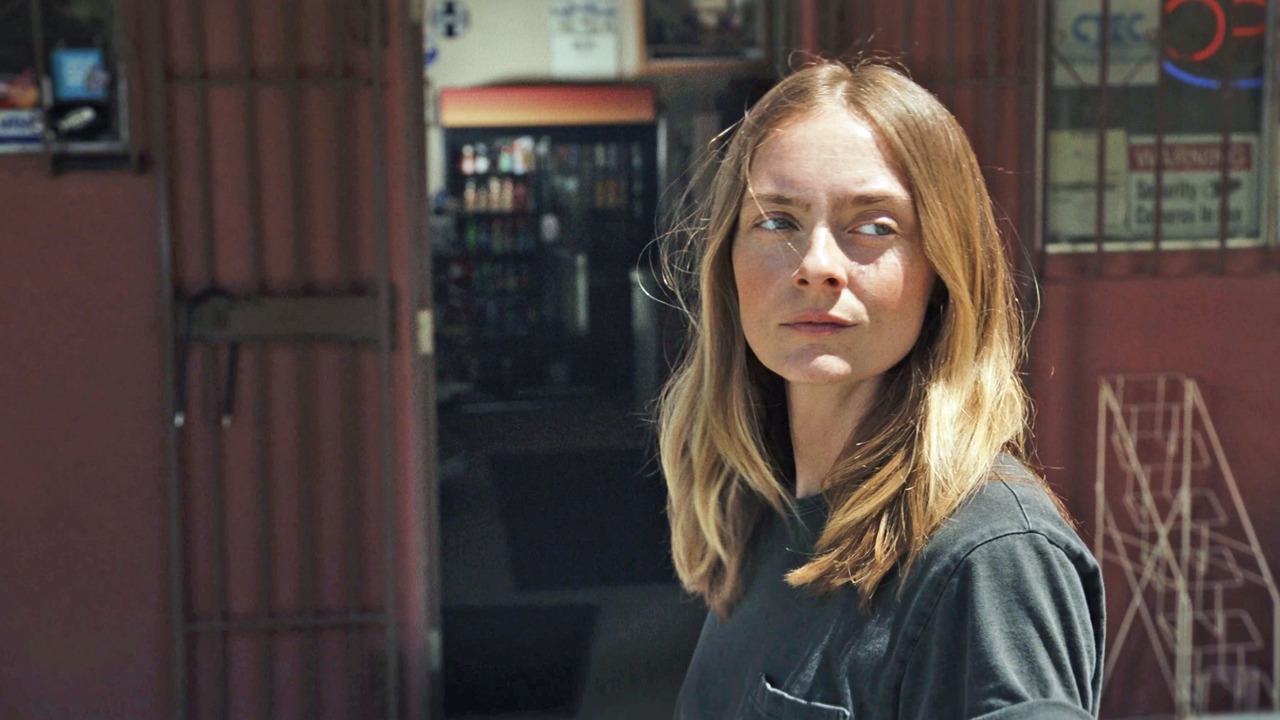
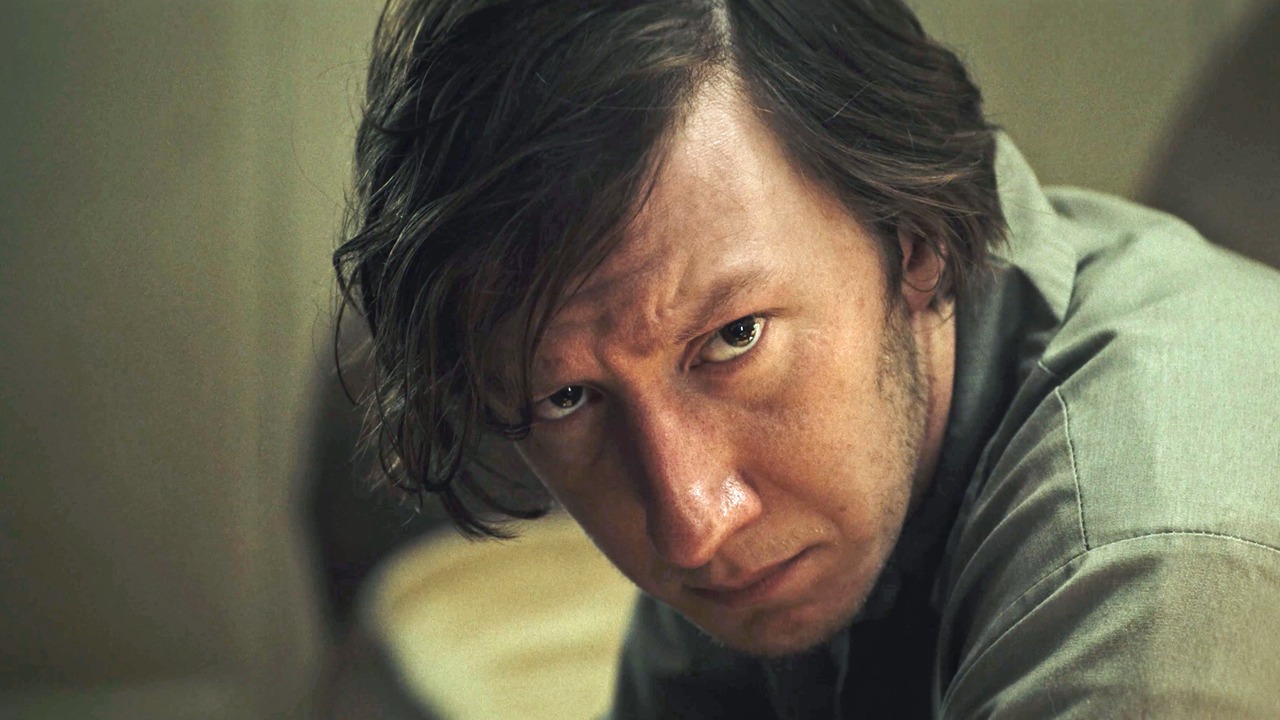
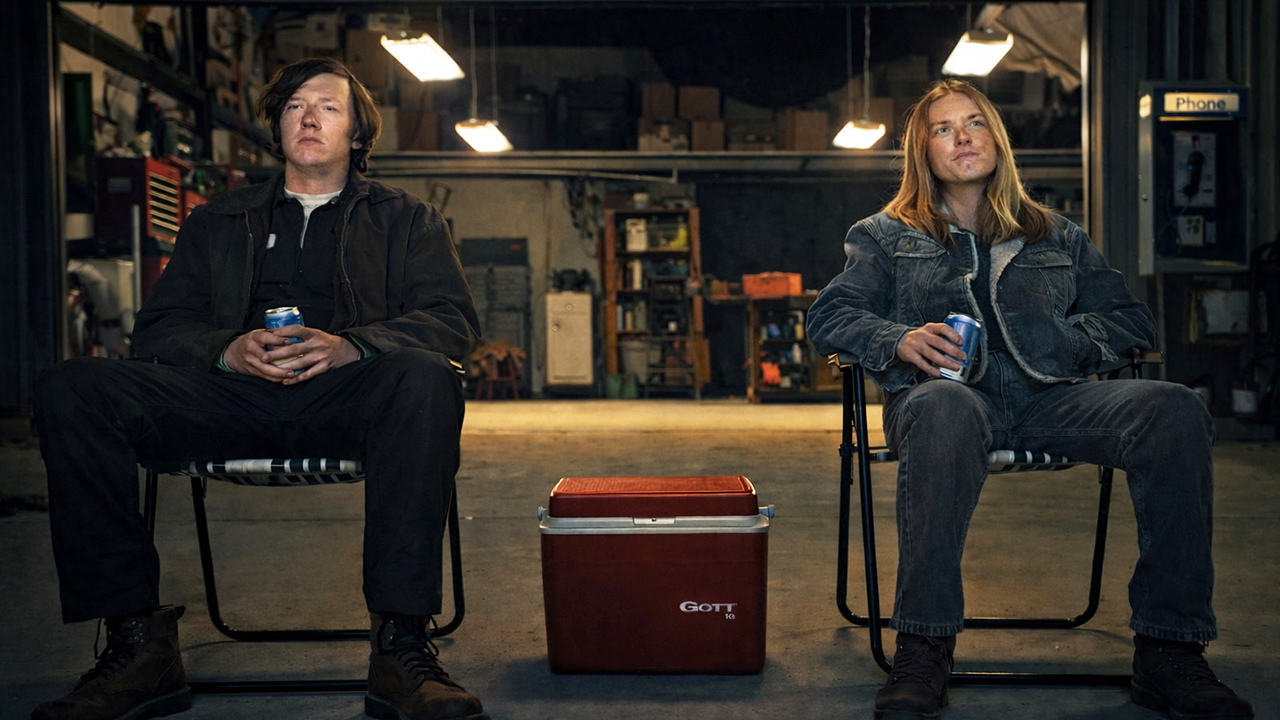
In the taut, 80-minute neo-noir American Muscle, Ray (David Thompson) is the mechanic at an isolated auto shop in rural Kern County. Ray is in serious debt to a very serious man, but he has a scheme for raising the payoff. Trouble is, his lender’s two very scary enforcers arrive to collect the money now, and Ray doesn’t have it. Just then, Ray’s long-estranged sister Maggie (Liana Wright-Mark) shows up unexpectedly. Ray’s financial deadline is accelerated, and he is plunged into a desperate and apparently hopeless race against the clock.
The out-of-town enforcers (Gbenga Akinnabe and Brendan Sexton III), with their chattiness and intellectual curiosity, are a welcome homage to the hit men Vincent and Jules in Pulp Fiction. (And I love that they wear bolo ties with their suits!)
Thompson and Wright-Mark are excellent as siblings who have survived a grim upbringing that will either make one strong and resilient or break one into weakness. American Muscle reveals that childhood’s impact on both Ray and Maggie.
David Thompson in AMERICAN MUSCLE. Courtesy of Cinequest.
In his first feature, writer-director Joel Veach creates a vivid milieu and delivers a perfect ending. Veach understands a great truth that is also a tenet of film noir: if you’re a loser, you can always find a way to make yourself a bigger loser.
The dry emptiness of American Muscle’s Kern County (it was actually shot in Santa Clarita) makes the Bakersfield of Honey Don’t look like Mumbai.
I screened American Muscle for its world premiere at the 2026 Cinequest. A perfectly-seasoned mixture of humor, menace and cynicism, it’s ever entertaining and a first class neo-noir.
David Thompson and Liana Wright-Mark in AMERICAN MUSCLE. Courtesy of Cinequest.
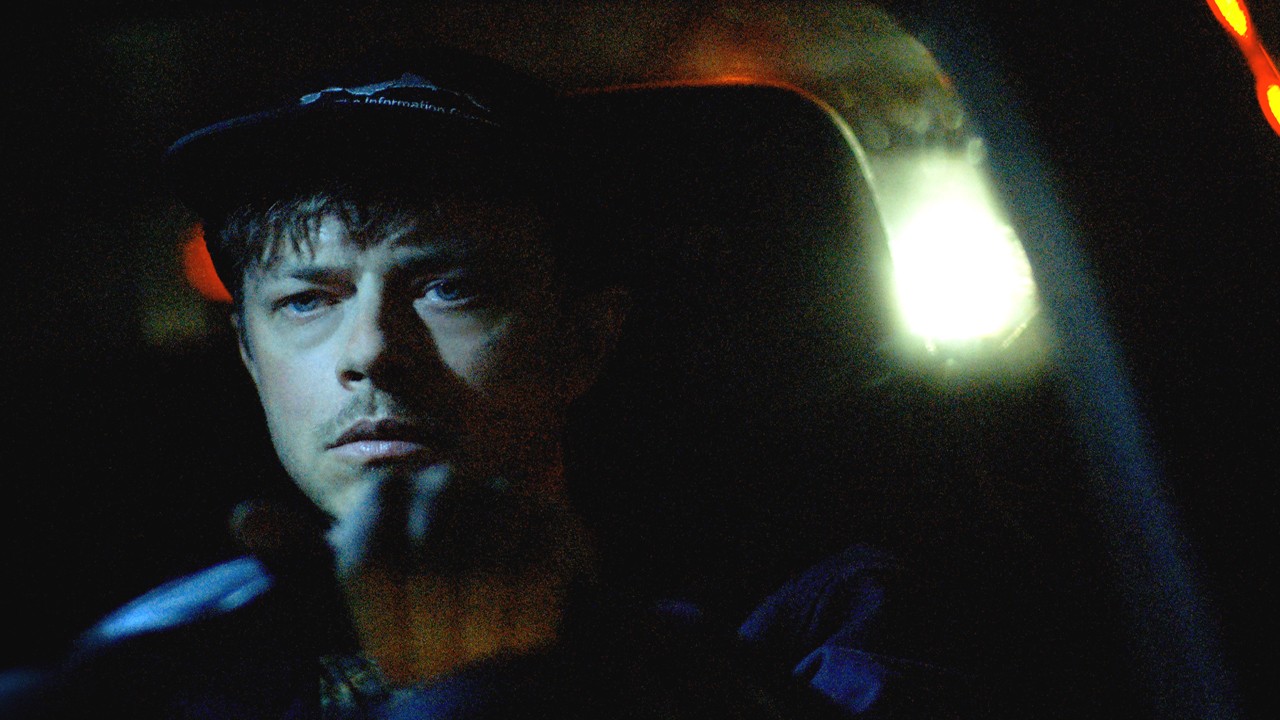
Photo caption: Dane DeHaan in WARDRIVER. Courtesy of Cinequest.
In the pulsating and highly original thriller Wardriver, Cole (Dane DeHaan) is a hacker, who drives around Salt Lake City logging on to other people’s wireless networks, locating their business payrolls and draining them into his own secret accounts. He conveniently claims to only steal from banks, not people. Cole may be a professional criminal, but he is a geeky as your company’s IT guy. If you’re not already paranoid about the security of your home router, you will be.
Alarmingly, Cole finds himself entangled with a sequence of extremely dangerous bad guys, each scarier than the last. When he meets a beautiful woman who may or may not be who she says she is, his compulsion to save her puts him at even more risk. You will recognize all the elements of neo-noir here, but with a refreshingly techie flavor.
Dane DeHaan’s performance carries this well-acted film. DeHaan is always good (Kill Your Darlings, LIFE, Oppenheimer), and here his Cole struggles, relying on his wits alone, to keep things in his control. Fittingly for a noir protagonist, Cole recognizes that he is an underdog, but doesn’t grasp just how over-matched he is.
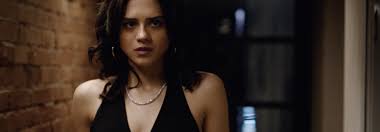
Sasha Calle in WARDRIVER. Courtesy of The Avenue.
Sasha Calle delivers just the right mix of vulnerability, sexiness and well-masked toughness as the object of Cole’s infatuation. Calle was excellent in In the Summers, an overlooked indie that made my list of Best Movies of 2024.
Mamadou Athie and William Belleau (Killers of the Flower Moon) stand out in supporting roles.
In a complete departure from her brilliant debut film Electrick Children, this time, director Rebecca Thomas works in a conventional genre and keeps the pace sizzling. The highly original techno noir screenplay was written by Daniel Casey.
I screened Wardriver for its world premiere at Cinequest, where it made my Best of Cinequest.
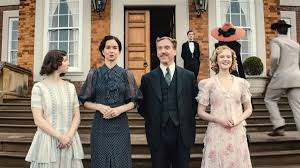
Photo caption: Thomasin McKenzie, Katherin Waterston, Damian Lewis and Emma Laird in FACKHAM HALL. Courtesy of Bleecker Street.
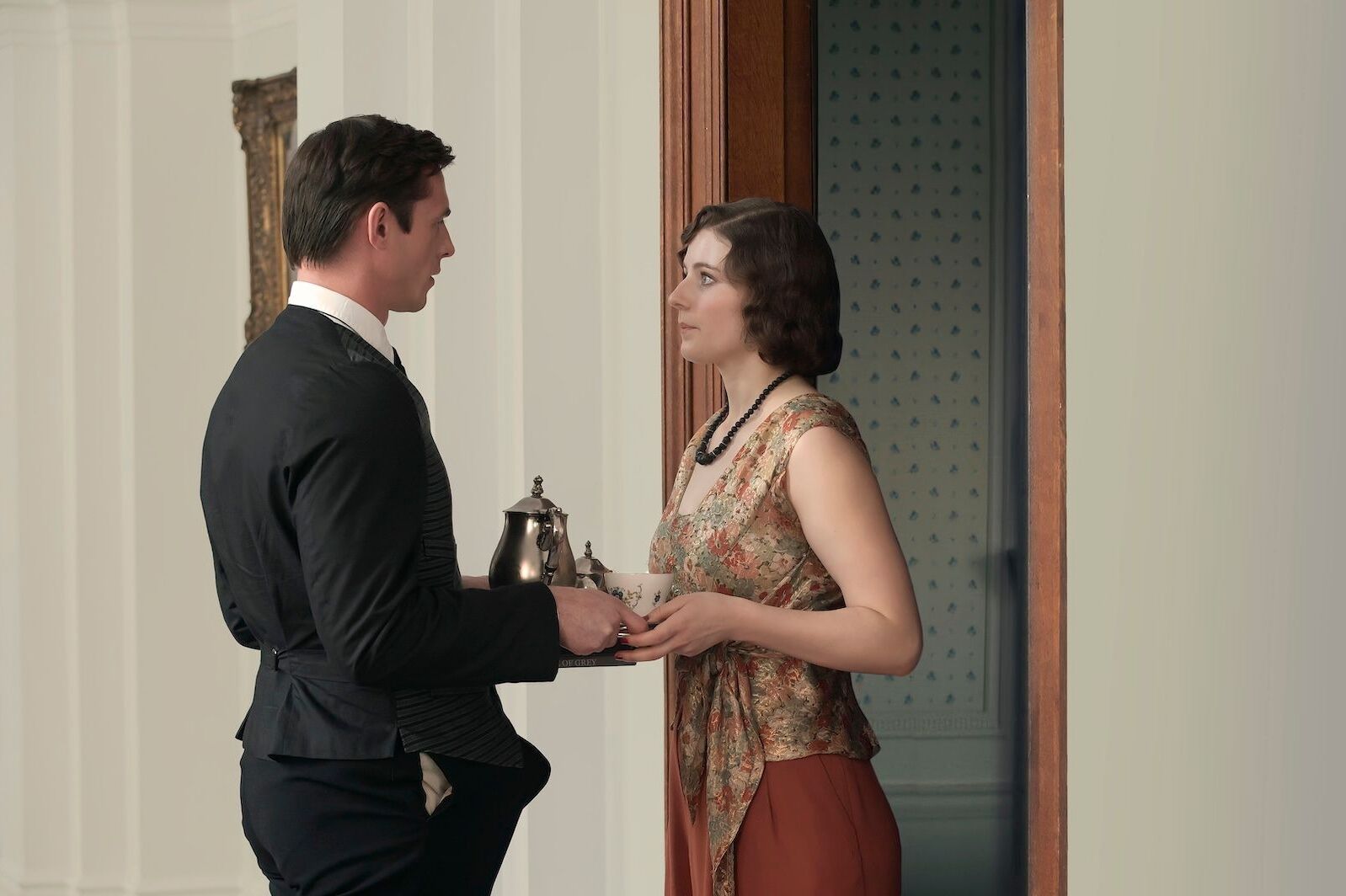
Fackham Hall is a parody of the beloved Downton Abbey franchise, which has many aspects which can be mocked. The humor is generally low-brow, as you can see from the photo below. At its silliest, it’s still mostly funny, and the jokes are rapid-fire. Look away from the screen for even a a second, and you risk missing a sight gag in the background. Think Airplane!.
Ben Radcliffe (with erection) and Thomasin McKenzie in FACKHAM HALL. Courtesy of Bleecker Street.
Fackham Hall does a good job of mocking Downton Abbey’s fundamental premises, that the owners are preoccupied with keeping the estate in the family, even with the tangles of 800-year-old inheritance law, and with an obsolete business model – and, of course, the ridiculous privilege bestowed upon rich twits by meritless birthright.
Damian Lewis, Katharine Waterston and Thomasin McKenzie are very good as the aristocratic owners and Ben Radcliffe is very good as the new Downstairs hall boy.
I usually don’t write about a movie’s publicity campaign, but it included a blurb from Fackham Hall’s own screenwriter Jimmy Carr, “The funniest film I have written”, and the declaration, “From the producers who watched the first two seasons of Downton Abbey“.
After seeing the trailer, I decided that I could wait to stream Fackham Hall at home. But, now that I have, I think it’s actually a BETTER movie than Downton Abbey: The Grand Finale. Fackham Hall is free on HBO Max and rentable from other VOD platforms.
Photo caption: Jessie Buckley in THE BRIDE!. Courtesy of Warner Bros.
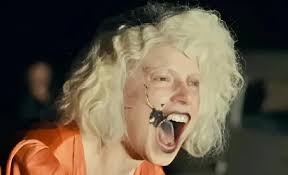
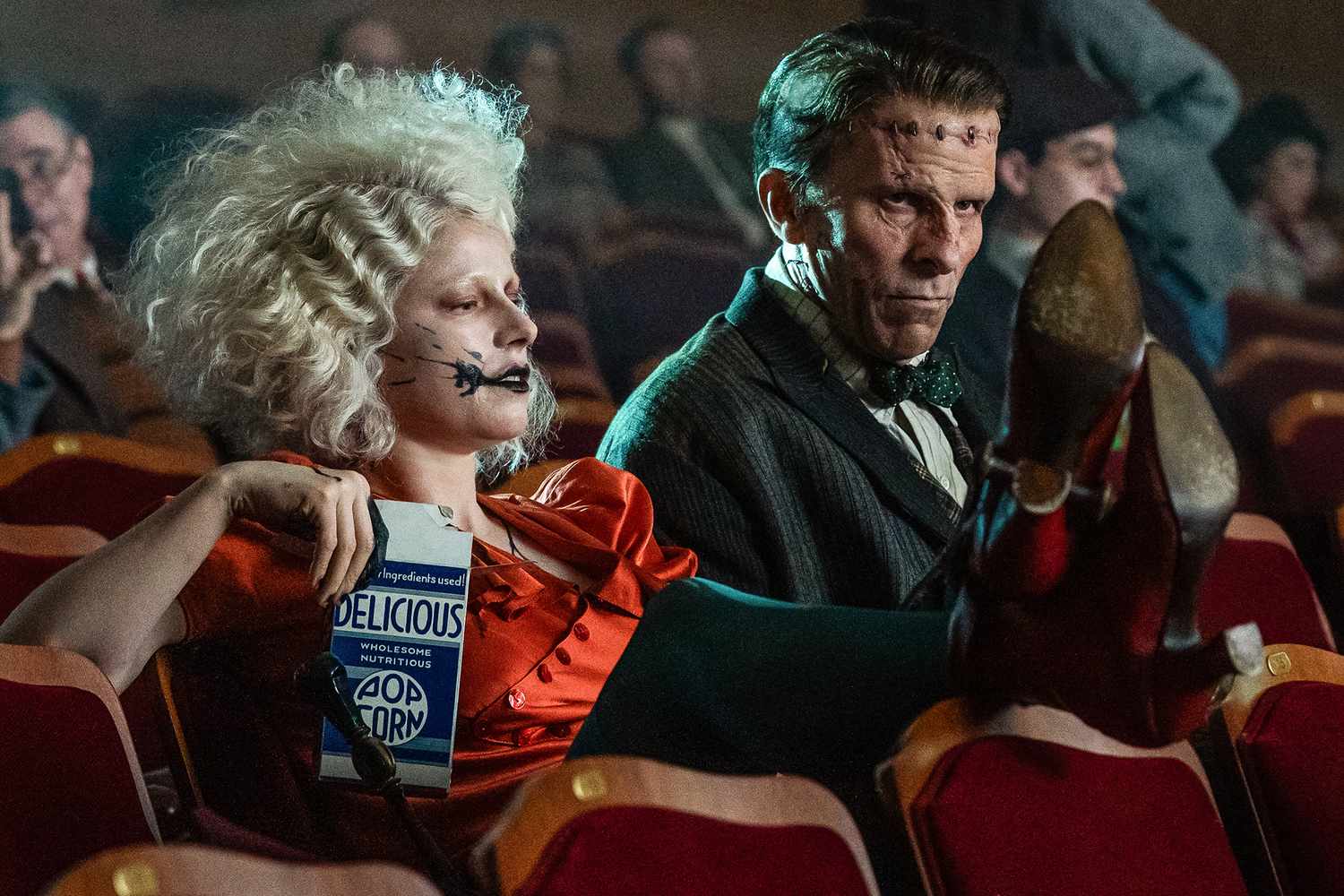
Director Maggie Gyllenhaal’s The Bride! is both a pedal-to-the-metal spectacle and an intellectual exercise, but not a great movie for the ages. But it is most certainly a showcase for the unique and awesome talents of Jessie Buckley.
The Bride! is set in the America of the early 1930s, that time of speakeasies, flappers, gangsters, hobos hopping trains and popular fascination with Talking Pictures. Having been re-animated 100 years before in Europe, the very sensitive Frankenstein’s monster (Christian Bale) longs for female companionship, and gets it when a Chicago mad scientist (Annette Bening) reanimates the corpse of a gangland escort (Jessie Buckley).
She doesn’t remember who she is or any specific experiences in her previous life. But, unlike the traditional Frankenstein’s monster, she immediately behaves like a fully formed woman, who is already acquainted with 1930s America, and speaks English with an impressive vocabulary. And she already knows how some men mistreat women, and, boy, is she pissed off.
The original male monster in The Bride! is named Frankenstein, unlike in Guillermo Del Toro’s and other Frankenstein movies, where the mad scientist is Viktor Frankenstein and the monster is “the Creature”.
The two take to each other, but Frankenstein has been comfortable living on the down low, and his bride has the ability and compulsion to ignite every social situation into an uproar and to escalate every commotion into a volcanic riot. They must flee Chicago and embark on a road trip to Manhattan, Niagara Falls and back to Chicago, leaving carnage in their wake.
Let’s talk about what The Bride! is NOT. It’s not anything like Guillermo Del Toro’s operatic Frankenstein epic. It’s not anything like the campy 1935 Bride of Frankenstein starring Elsa Lanchester. And, although there’s violence, it is not a gore fest like many contemporary horror movies.
The movie that The Bride! most resembles – and it’s intentional – is Bonnie and Clyde (and there’s at least one identical shot, where Buckley mirrors Faye Dunaway). There’s plenty of subversive humor in Bonnie and Clyde, but The Bride! is much more generally funny.
Jessie Buckley and Christian Bale in THE BRIDE!. Courtesy of Warner Bros.
Whether happy or angry, the Bride herself is absolutely explosive, and Jessie Buckley, with untethered physicality, makes her into a human detonator. Whether she enters a speakeasy or a cinema or a fancy hotel ballroom, there’s gonna be a riot very soon.
Christian Bale’s monster character is the most textured in The Bride! – in turns yearning, lovelorn, socially fearful, pathetic, disciplined, and joyous. Bale is really, really good in the role.
The Bride!’s cast is very rich; besides Bening, there’s Penelope Cruz, Peter Sarsgard and John Magaro. They’re all good, although all of the complexity is in Buckley’s and Bale’s roles. Jeannie Berlin, Oscar-nominated for 1973’s The Heartbreak Kid, is very good as the mad scientist’s grotesque assistant. I always sit up and take notice of Louis Cancelmi (Billions) when he shows up in a supporting role, and he’s just as good here as in The Eyes of Tammy Faye and Killers of the Flower Moon. The director’s brother, Jake Gyllenhaal, is very good as a song-and-dance movie star revered by Frankenstein.
The Bride’s volatility stems from her rage against misogyny, and that is the most persistent theme within The Bride!. I found myself more often thinking about the message and the cinematic references in The Bride! than being emotionally involved in it. Since Jessie Buckley is the most soulful actor in today’s cinema, I was expecting more soulfulness in the movie, and I think that’s a miss. Nevertheless, The Bride! is smart, funny and entertaining.
Pedro De Tavira (center) in HUMAN RESOURCES. Courtesy of Cinequest.
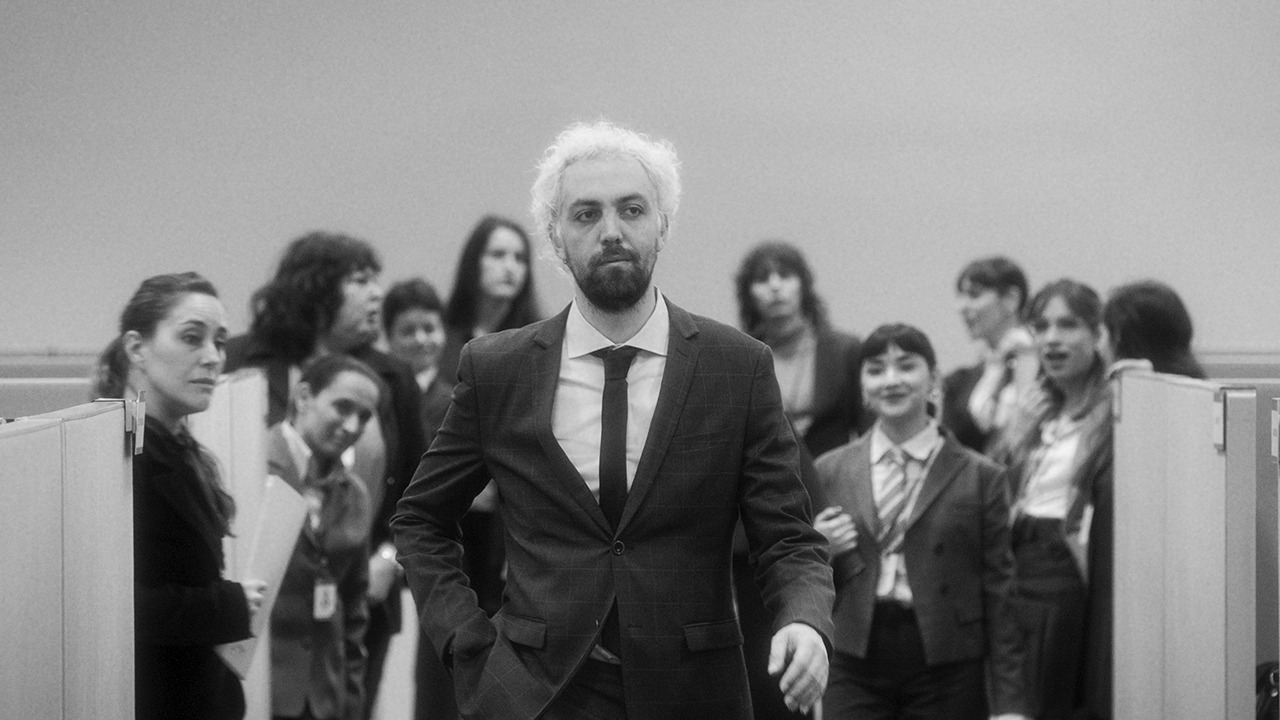
In the dark, dark Argentinian comedy Human Resources, Gabriel Lynch (Pedro De Tavira) is an alienated office worker, in an absurdly alienating workplace. Gabriel is a low-level supervisor on an anonymous lower floor of a corporate hive with too many layers of management and an oppressive, top-down culture. It’s also oversexed, with a carousel of Inappropriate office liaisons. And, we’ll soon see, is shockingly tolerant of what we would see as the most horrifying workplace violence.
Gabriel, an Iago with a sick sense of humor, begins a ruthless, unhinged campaign against those who offend him. Alienation leaks out in how her treats everyone. Mischievous, mean-spirited and completely unashamed, he’s very fun to watch. And, as venal as Gabriel is, he is matched, step-for-step, by Veronica from Finance (Juana Viale).
Around the 41-minute mark, Gabriel makes his grievance explicit (followed by a great drone shot)
“I’ve lived like the secret son of a king for a long time, waiting for a courtier to rescue me. Of course, nobody rescued me. Nobody rescues anybody.”
Human Resources is the creation of writer-director Jesús Magaña Vázquez. I’ve rarely seen a more cynical comedy.
Last year’s Cinequest hosted the US premiere of Human Resources, which I highlighted in my Best of Cinequest.Human Resources is now streaming on Hulu. There are many recent movies with a similar title; make sure you’re watching the 2023 Recursos Humanos directed by Magana and starring Pedro De Tavira.
I love the Spanish language trailer, even without English subtitles:
Photo caption: Linda Manz in OUT OF THE BLUE. Courtesy of Discovery Productions, Inc..
Newly restored for re-release, Dennis Hopper’s 1980 Out of the Blue is an anti-redemptive parable of alienation. It features both an unforgettable performance and an unforgettable ending.
The spirited teenager Cebe (Linda Manz) has the worst parents in her British Columbia town, maybe in the entire province. Her dad (Dennis Hopper), is a drunk, deservedly in prison for an act of irreparable harm. (Cebe bears a facial scar from this incident – and lots of emotional damage as well).
Her chirpy mom (Sharon Farrell) can’t keep a needle out of her arm or guys out of her pants. Ever impulsive, she ruefully observes that there are two kinds of men – the sexy, adventuresome types and the good providers; it’s evident that she hasn’t bet her life on the good providers.
After five years in prison, the dad is released and gets a job operating heavy machinery at a garbage dump overrun by sea gulls. But he’s still sucking on his ever-present pint bottle, and the town won’t forget why he was incarcerated.
Cebe is full of life and has a gum-chewing swagger. She’s comfortable leading her teen peers in some rowdiness, but she also has a rich imagination and she spends a lot of time in her room alone, acting out her interests in Elvis and punk music.
But Cebe doesn’t know in what direction to channel her exuberance; she can’t tell her sympathetic, court-appointed psychologist (Raymond Burr) what she wants.
The one thing that Cebe doesn’t want is what’s best for her – to be separated from her parents. As is common with neglected and abused children, she clings to the bad situation that she is familiar with.
Cebe acts out in mildly rebellious mischief at school, and she runs away for a night of adventure in Vancouver, somehow emerging unscathed from risky situations.
Back home, she hides from her parent’s arguing in her room. Suddenly, the audience is shocked by something the father says (what??!!), and it is revealed that the parents’ dysfunction is MUCH darker, more twisted than previously apparent.
Cebe erupts, and Out of the Blue ends with a stunning, utterly unpredictable climax. Hopper follows Billie Wilder’s screenwriting advice – “don’t hang around”; the ending is not even one second too long.
Dennis Hopper wrote and directed Out of the Blue, pacing the film well and delivering verisimilitude from the Vancouver-area setting. The camera swirls around the actors at times, and Hopper makes good use of the thousands of seagulls populating a garbage dump.
Out of the Blue is really all about Linda Manz’s singular performance as Cebe. Often improvised, her performance is naturalistic and unpredictable. When she is in her room or walking through a Vancouver night, she acts like no one is watching her, and it’s riveting.
By the time she was 19 in 1980, Linda Manz had acted in and narrated a masterpiece (Terence Malick’s Days of Heaven) and appeared in two cult films (Philip Kaufman’s The Wanderers and Dennis Hopper’s Out of the Blue). Then she retired to raise a family. Manz died at 59 in 2020.
Don Gordon (left) and Dennis Hopper (center) in OUT OF THE BLUE. Courtesy of Discovery Productions, Inc.
As the dad, Hopper is able to demonstrate the charm that attracted the mom and the playfulness that endears him to Cebe. In a scene where the dad dramatically gets himself fired, Hopper shows a man so enjoying his ballsy action, and then, his visage changes as the consequences of his impulsivity sink in, reflecting on his helplessness when he is once again done in by his own impulses.
As the mom, prolific television actress Sharon Farrell excels in a rare movie role.
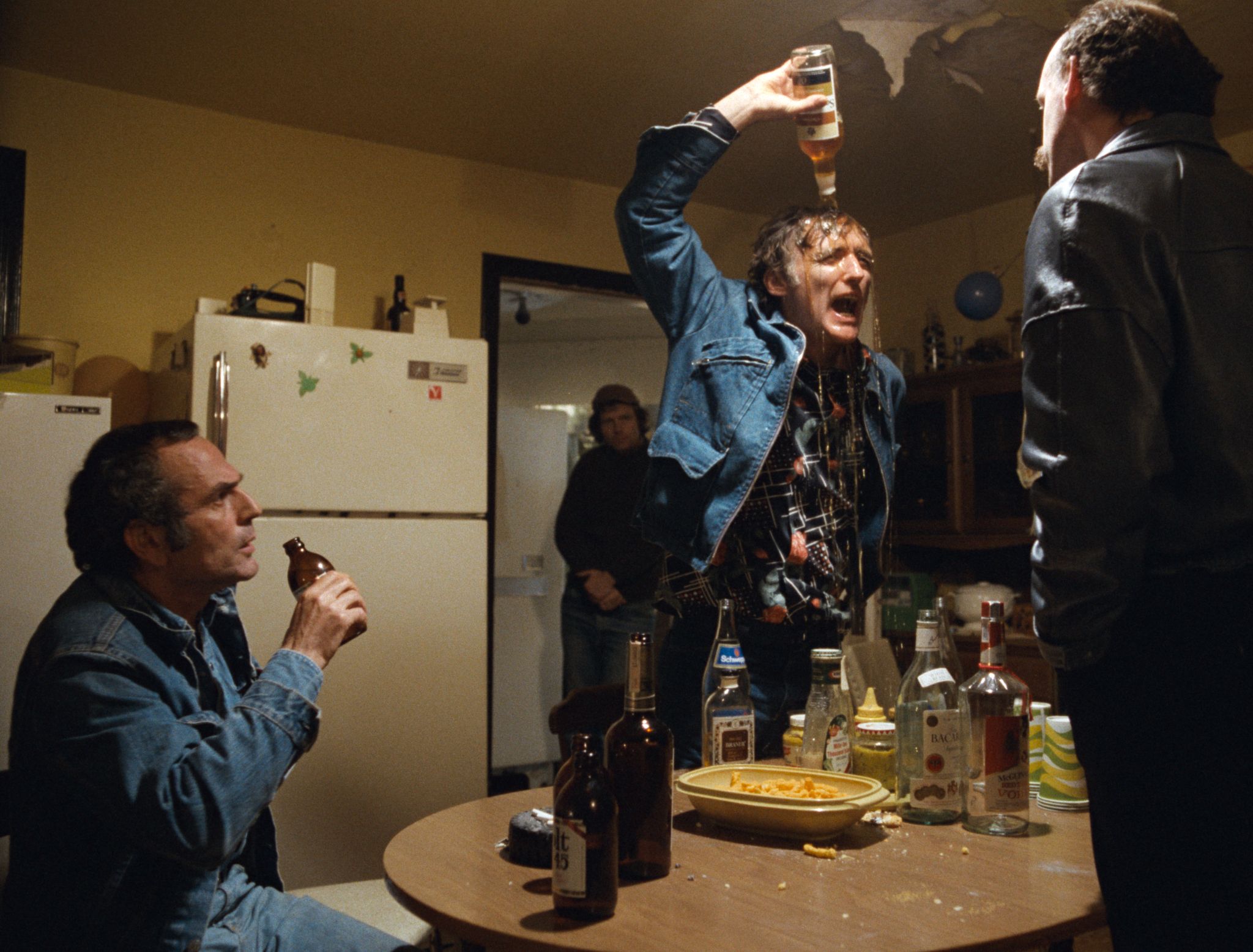
Don Gordon plays Charlie, the dad’s marginally more functional pal. Gordon had key supporting roles in Bullitt and Papillon and over a hundred appearances in the episodic TV of the 60s and 70s.In Out of the Blue, Gordon displays his gift for playing drunk convincingly. Gordon really understood the essence of drunk thinking and behavior, and has an even more compelling drunk scene in Hopper’s The Last Movie).
Out of the Blue premiered at Cannes and enjoyed praise from Roger Ebert (“Bitter, unforgettable. An unsung treasure.“) and other critics. But the ending is so shocking and emotionally desolate, that it wasn’t released in the US; no distributor wanted to bet on its acceptance by a US audience. John Alan Simon acquired the distribution rights for a 17-week art house tour in 1982 with Hopper.
Simon and Elizabeth Karr have digitally restored Out of the Blue, and here’s how Simon describes the project:
“OUT OF THE BLUE was restored from the original 35mm negative and soundtrack. So the visual quality is superb. The two existing 35mm prints were struck back in 2010 after restoration work on the negative – and were becoming worn and damaged even with very limited and selective, archive, museum, art-house, festival screenings.With Technicolor out of the “film” business there was no practical way to strike new 35mm prints. Hence the new 4k digital restoration.”
Out of the Blue has only recently become available to stream; (I own the DVD.) In late 2021, the 4K restoration opened at a New York City screening presented by Chloë Sevigny and Natasha Lyonne. Now you can find Out of the Blue on the Criterion Channel, AppleTV, YouTube and Fandango.
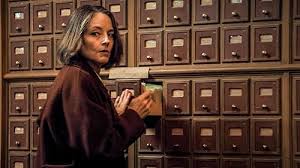
Photo caption: Jodie Foster in A PRIVATE LIFE. Courtesy of Sony Pictures Classics.
In the dark comedy A Private Life, Jodie Foster plays Lilian Steiner, a prickly, disagreeable Paris psychiatrist, so self-absorbed that she often fails to listen to her own patients. One of her patients dies, and Lilian is stung to be blamed by the family for their loved one’s suicide. More out of personal pique than any sense of justice, Lilian sets out to prove that the woman was murdered.
It’s very funny as Lilian blusters off, imagining potential suspects and projecting motive and opportunity. When Lilian reports a real crime, a burglary of her apartment, she’s so high strunf that the cops suspect that she’s a crank.
What’s even funnier is that Lilian presents the same compulsive behavior, lack of boundaries, and attachment issues that she is paid to treat in her patients. After all, what woman declines an opportunity to hold her first baby grandchild? Indeed, the whodunit is merely the vehicle for Lilian’s journey to personal connection.
Jodie Foster is very good as the ever-aggrieved Lilian, a role that must have been fun for her to play. Liliane is an American who has lived for decades in Paris, mirroring Foster’s own lifelong embrace of French language and culture. The movie’s biggest laugh comes when Lilian is stymied by what Americans see as the French over-vacationing.
Daniel Auteil, who has been nominated 14 times for a Best Actor César, is wonderful as Lilian’s adorable ex-husband. The rest of the cast is filled with French A-listers in minor roles (Mathieu Amalric, Virginie Efira, Irene Jacob). Vincent Lacoste is quite good as the son who expects his mom tp behave badly, but still can be surprised by a new outrage. The great 95-year-old documentarian Fredrick Wiseman sparkles in a cameo playing Lilian’s stern mentor, who calls her on her shit.
A Private Life was written and directed by Rebecca Zlotowski (Grand Central). It’s a well-made diversion that you can wait to stream at home.